viewpoint
interview
MAGDALENA FONSECA ’98, ’11
CREATING COMMUNITY FOR UNDOCUMENTED STUDENTS BY H AN NE LOR E S UDE RM AN N
A
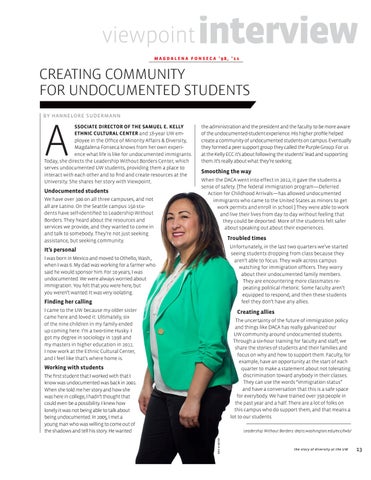
SSOCIATE DIRECTOR OF THE SAMUEL E. KELLY ETHNIC CULTURAL CENTER and 18-year UW employee in the Office of Minority Affairs & Diversity, Magdalena Fonseca knows from her own experience what life is like for undocumented immigrants. Today, she directs the Leadership Without Borders Center, which serves undocumented UW students, providing them a place to interact with each other and to find and create resources at the University. She shares her story with Viewpoint.
Undocumented students We have over 300 on all three campuses, and not all are Latino. On the Seattle campus 150 students have self-identified to Leadership Without Borders. They heard about the resources and services we provide, and they wanted to come in and talk to somebody. They’re not just seeking assistance, but seeking community.
the administration and the president and the faculty to be more aware of the undocumented-student experience. His higher profile helped create a community of undocumented students on campus. Eventually they formed a peer support group they called the Purple Group. For us at the Kelly ECC it’s about following the students’ lead and supporting them. It’s really about what they’re seeking.
Smoothing the way When the DACA went into effect in 2012, it gave the students a sense of safety. [The federal immigration program—Deferred Action for Childhood Arrivals—has allowed undocumented immigrants who came to the United States as minors to get work permits and enroll in school.] They were able to work and live their lives from day to day without feeling that they could be deported. More of the students felt safer about speaking out about their experiences.
Troubled times Unfortunately, in the last two quarters we’ve started seeing students dropping from class because they aren’t able to focus. They walk across campus watching for immigration officers. They worry about their undocumented family members. They are encountering more classmates repeating political rhetoric. Some faculty aren’t equipped to respond, and then these students feel they don’t have any allies.
It’s personal I was born in Mexico and moved to Othello, Wash., when I was 6. My dad was working for a farmer who said he would sponsor him. For 10 years, I was undocumented. We were always worried about immigration. You felt that you were here, but you weren’t wanted. It was very isolating.
Finding her calling I came to the UW because my older sister came here and loved it. Ultimately, six of the nine children in my family ended up coming here. I’m a two-time Husky. I got my degree in sociology in 1998 and my masters in higher education in 2011. I now work at the Ethnic Cultural Center, and I feel like that’s where home is.
Creating allies The uncertainty of the future of immigration policy and things like DACA has really galvanized our UW community around undocumented students. Through a six-hour training for faculty and staff, we share the stories of students and their families and focus on why and how to support them. Faculty, for example, have an opportunity at the start of each quarter to make a statement about not tolerating discrimination toward anybody in their classes. They can use the words “immigration status” and have a conversation that this is a safe space for everybody. We have trained over 350 people in the past year and a half. There are a lot of folks on this campus who do support them, and that means a lot to our students.
Working with students The first student that I worked with that I know was undocumented was back in 2001. When she told me her story and how she was here in college, I hadn’t thought that could even be a possibility. I knew how lonely it was not being able to talk about being undocumented. In 2005, I met a young man who was willing to come out of the shadows and tell his story. He wanted R ON WUR ZER
Leadership Without Borders: depts.washington.edu/ecc/lwb/
the story of diversity at the UW
13