n ews
THURSDAY, APRIL 25, 2013
3
Professor solves rare medical mystery Ayla Yersel Staff Writer A UVM biology professor played a key role in solving a 60-year-old medical mystery relating to the blood type “Velnegative.” ported some patients rejecting blood transfusions because of a molecule in the patients’ red blood cells. Today, about North America have the blood type that doesn’t make the Small Integral Membrane Proor three individuals in France and two to four in America need this rare blood, professor Bryan Ballif said. This unknown molecule remained a mystery until Ballif and his colleague Dr. Lionel which causes people with the Vel-blood type to reject certain types of blood. “I am fascinated by how proteins function to govern all aspects biological systems,” he said.“[The] project was immediately interesting to me, as it was one where I saw the potential for an important, immeditransfusion.” The project has been in the works for about four years, collaborating with Arnaud to identify the unknown molecule using an instrument called a mass spectrometer that allows scientists to weigh and break down a molecule to determine
CRIME LOG Lauren Drasler Staff Writer
April 17 12:51 p.m. ticed that there were students outside on the roof of the that the students get off the roof, and they complied.
April 18 9:44 a..m. A report came in about a person walking in the Marsh Austin Tupper dorm complex and was described as having “no apparent purpose” for being in the building. Police services investigated, and determined that the person being described was a high school student who was visiting family and was waiting to be picked up by his/her mom.
10:38 p.m. acting strangely near the PFG Parking Lot. Apparently the student walked from the garage to Marsh Hall, onto East Avenue and the bike path and then back to Gutterson. When student, it was apparent that nothing was amiss and there were no further issues with this person.
its identity, Ballif said. “It’s a ‘Humpty Dumpty’ approach,” he said. “Humpty Dumpty breaks in a diagnostic manner, and then you put the pieces back together and you “It’s like a word puzzle, where a protein has maybe 600 letters, and then someone gives you six of those and says ‘What is the identity?’” he said. The scientists were then able to search in a protein lar amino acid sequence that matched their molecule, Ballif said. The results told Ballif that “At the time, it was actually a theoretical protein-- it wasn’t even known to be a protein,” he said. In the past, the blood type bodies rejected blood transfusions. Now, scientists can look tify the blood type, making it easier to match blood donors with recipients, Ballif said. “If you can’t give them the blood, people can die- and they have died,” Ballif said. “It becomes a very stressful situation every time a patient needs this rare blood.” “Now we can identify this rare blood in a very short period of time with very little trouble, even in the blood that’s available to these people in all of the hospitals and clinics,” he said. “Now they don’t have to call up France or Germany to get this rare blood.” Although this research is useful to only a handful of peo-
9:57 p.m. Hall staff in Marsh Hall reported an odor of marijuana coming from one of the dorm rooms in the building. An ofdetermine where the odor was coming from. Upon investigagrams of the drug from the students.
10:57 p.m. Police services received information from people stating that there were going to be marijuana brownies sold at UVM’s of marijuana, along with a pipe and grinder from a dorm room in Wing Hall.
April 19 12:02 a.m. Police services received a call from a student that there was an intoxicated person in Urived on the scene, and found vomit on the ground but no intoxicated person. Upon speaking with the student caller, the intoxicated person in question had taken off after the student tried to talk to him/her. Go online to see the
cynic Crime Map
www.vermontcynic.com
LORENA LINERO The Vermont Cynic
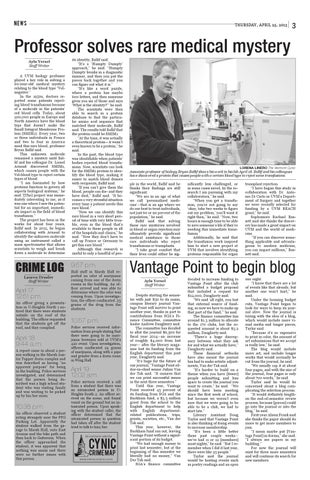
Associate professor of biology Bryan Ballif shows his work in his lab April 18. Ballif and his colleagues have discovered a protein that causes people with a certain blood type to reject some transfusions. ple in the world, Ballif said he “We are in an age of what we call ‘personalized medido our best to treat individuals, population,” he said. Ballif said that solving these rare mysteries involved in blood or organ rejection may medical assistance to those rare individuals who reject transfusions or transplants. “I take great comfort that their lives could either be sig-
in some cases saved, by the research I am pursuing with my collaborators,” he said. “When you get a transfusion, you’re not going to say out my problem,’ you’ll want it right then,” he said. “Now, two hours is enough time to be able to save someone’s life if they’re needing this immediate transfusion.” Additionally, he said that the transfusion work inspired him to start a new project at UVM that involves identifying proteins responsible for organ
transplant rejection. “I have begun this study in collaboration with Dr. Antonio Di Carlo in UVM’s Department of Surgery and together we were recently selected for funding by a UVM REACH grant,” he said. Sophomore Rachael Bassett said she thinks the discovery has made a great impact on UVM and the world of medicine. “If you can discover something applicable and advantageous to modern medicine, you can impact millions,” Bassett said.
Vantage Point to begin blog Ayla Yersel Staff Writer Despite starting the semester with just $50 to its name, campus literary journal Vantage Point will survive to print another year, thanks in part to contributions from SGA’s Finance Committee, committee leader Andrew Daughtery said. The committee has decided to allot the journal $6,500 for zine lost its funding from the English department this past year, Daugherty said. “It’s huge for the future of our journal,” Vantage Point editor-in-chief senior Julian Van der Tak said. “It ensures that we can print successful issues in the next three semesters.” Until this year, Vantage its funding from SGA and the Buckham fund, a $3.5 million grant from the school to the English department to help with English departmentrelated publications, trips, grants, societies, etc., Van der Tak said. This year, however, the Buckham fund ran out, leaving Vantage Point without a significant portion of its budget. “We had enough money to print last semester, but at the beginning of this semester we literally had no money,” Van Der Tak said.
decided to increase funding to Vantage Point after the club submitted a budget proposal that included a request for “We said ‘all right, you lost that external source of funding, so now we have to make up that part of the fund,’” he said. million, Daugherty said. “There’s a huge discrepancy between what they ask for and what we actually have,” Daugherty said. have also meant the journal has had to make artistic adjustments, Van der Tak said. “It’s harder to build on a theme when you have [fewer] people submitting and less space to create the journal you want to create,” he said. “We should have been meeting but because we weren’t even sure that we were going to be able to be a club, we had to start late.” Literary Assistant Doug Taylor said that Vantage Point is also thinking of doing events to increase membership. “It’s been a little better most nights,” he said. “But I remember when I did it last year, Taylor said the journal would be hosting events such as poetry readings and an open
mic night. “I know that there are a lot of events like that already, but another one won’t hurt,” he said. Under the looming budget cuts, Vantage Point began to look for ways to keep its journal alive. Now the journal is toying with the idea of a blog, which would include more visual media and longer pieces, Taylor said. “Because it’s so expensive to print in color, the amount of art submissions that we accept is really low,” he said. The blog would include more art, and include longer works that would normally be cut from the journal, he said. “We usually cap it at about four pages, and with the size of the journal, four pages is only Taylor said he would be concerned about a blog complicating the selection process. en the end-of-semester review process, because [pieces] could go into the journal or into the blog,” he said. First-year Alison Frank said she thinks the paper should do more to get more members to join. “I mean maybe put [Vantage Point] in dorms,” she said. “I always see papers in my building.” For now the journal will exist for three more semesters and will continue its search for new members.