THEPROSPECTOR
| A18 | NEWS
December 2, 2014
Online threats case heard at the Supreme Court By Kara Mason SHFWire WASHINGTON – It might have been the first time “just kidding, laughing out loud” was used by a justice in Supreme Court oral arguments, but for some, Elonis v. U.S., the First Amendment case heard Monday, isn’t a laughing matter at all. Justices heard arguments about whether intent is required to prove that a person’s online words are a true threat. After Anthony Elonis and his wife, Tara Elonis, split in May 2010, he began posting status updates on his Facebook page that were seen as a threat to his ex-wife’s life. He also threatened a former coworker, who tipped off the FBI to the posts. But Anthony Elonis said the graphic fantasies of Tara Elonis’ death was a coping mechanism. While oral arguments touched on several different aspects of the First Amendment, it was the topic of what constitutes a “true threat” that dominated the argument. “I’m not sure that the court did either the law or the English language much of a good service when it said ‘true threat.’ It could mean so many things,” JusticeAnthony Kennedy said to John Elwood, who represented Anthony Elonis. “It could mean that you really intend to carry it out … you really intend to intimidate the person, or that no one could possibly believe it.” The court has not clearly defined a true threat in past First Amendment cases. As in the Elonis case, it is debated whether intent is required for a true threat. In this case, lower courts decided the standard for a true threat would be if a reasonable person would consider the language threatening. “But how would the government prove whether this threat in the mind
of the threatener was genuine?” Justice Ruth Bader Ginsburg asked. Anthony Elonis claimed his posts were merely therapeutic and for entertainment. In October 2010, he changed the name on his Facebook profile from Anthony Elonis to “Tone Dougie,” a rap pseudonym. He said that the lyrics “did not reflect the views, values or beliefs of Anthony Elonis, the person.” Thus, he lacked intent to actually kill his ex-wife. Tara Elonis still saw the posts as threatening. She said she never knew her former husband to listen to rap music while they were married. When her sister posted about Halloween costume shopping with her and her children, Anthony Elonis responded with a comment saying their son “should dress up as matricide.” “I don’t know what his costume would entail though. Maybe (Tara’s) head on a stick?” he said in the comment. Anthony Elonis mentioned the death of his ex-wife in three more Facebook posts and then on Nov. 16, 2010, posted that he would make a name for himself by initiating the most heinous school shooting ever. “And hell hath no fury like a crazy man in a kindergarten class,” he wrote. If the court sides with Tara Elonis and deems the posts threatening, it could mean a lot of what is said online would be taken much more seriously, and the possibility of prosecution would increase significantly. Elwood argued that the audience of the language is very important to the threat. Taken out of context, a reasonable person might believe Anthony Elonis really wished to harm his exwife, but his friends, or his audience, wouldn’t take the language seriously. “I think many of the speakers who are online and many of the people who are being prosecuted now are teenagers who are essentially shoot-
50
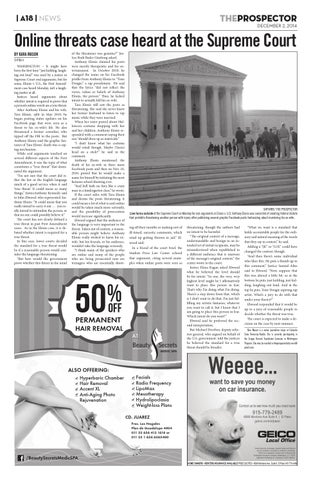
SHfWire/ The Prospector Line forms outside of the Supreme Court on Monday for oral arguments in Elonis v. U.S. Anthony Elonis was convicted of violating federal statute that prohibits threatening another person with injury after publishing several graphic Facebook posts fantasizing about murdering his ex-wife.. ing off their mouths or making sort of ill-timed, sarcastic comments, which wind up getting thrown in jail,” Elwood said. In a friend of the court brief, the Student Press Law Center echoed that argument, citing several examples when online posts were seen as
% off
PERMANENT
HAIR REMOVAL AT:
Beauty
Secrets MEDIC SPA
ALSO OFFERING: Hyperbaric Chamber Hair Removal Accent XL Anti-Aging Photo Rejuvenation
Facials Radio Frequency LipoMax Mesotherapy Hydrolipoclasia Weight-loss Plans CD. JUAREZ Frac. Los Nogales Plan de Guadalupe 4904 011 52 656 415 1618 or 011 52 1 656 6265400
/BeautySecretsMedicSPA
threatening, though the authors had no intent to be harmful. “The original context of a message, understandable and benign to an intended set of initial recipients, may be misunderstood when republished to a different audience that is unaware of the message’s original context,” the center wrote to the court. Justice Elana Kagan asked Elwood what he believed the level should be for intent: “So one, the very, very highest level might be I affirmatively want to place this person in fear. That’s why I’m doing what I’m doing. There’s a step down from that, which is I don’t want to do that, I’m just fulfilling my artistic fantasies, whatever you want to call it, but I know that I am going to place this person in fear. Which intent do you want?” Elwood said he preferred the second interpretation. But Michael Dreeben, deputy solicitor general, who argued on behalf of the U.S. government, told the justices he believed the standard for a true threat should be broader.
“What we want is a standard that holds accountable people for the ordinary and natural meaning of the words that they say in context,” he said. Adding a “JK” or “LOL” could have changed the context, though. “And then there’s some individual who likes this. He puts a thumb up to this comment,” Justice Samuel Alito said to Elwood. “Now, suppose that this was altered a little bit, so at the bottom he puts, just kidding, just kidding, laughing out loud. And at the top he puts, Tone Dougie aspiring rap artist. What’s a jury to do with that under your theory?” Elwood responded that it would be up to a jury of reasonable people to decide whether the threat was true. The court is expected to make a decision on the case by next summer. Kara Mason is a senior journalism major at Colorado State University-Pueblo. She is currently participating in the Scripps Howard Foundation Semester in Washington Program. She may be reached at theprospectordaily.news@ gmail.com.