T
he Moores' adobe home squats majestically on a secluded, tree-ringed lot off North Loop and Zaragosa Roads, ruling all it surveys. One part of the structure has been dated to 1806 and most of the rest of it is 150 years old. Its three-footthick walls, its towering ceilings supported by ancient vigas, its main doors "locked" by the old expediency of a wooden bar dropped across their seam, the cool whitewashed rooms - here, one imagines, a Spanish envoy might have lived in splendid isolation with only the whisper of water rhythmically running along the nearby acequia to break the viceregal silence. There is something disquieting about the fact that Tom Moore's home, freighted with all that history, is in such close proximity to the Whataburger stand in the Plaza de Flores shopping center. On the other hand, Moore's Winnebago camper is parked in the dirt driveway outside his house and there are other; stranger; passages-across-time inside. On one wall of the grand step-down living room is a 1750 painting of San Ramon Nonato, New Mexico's patron saint of midwives; on other walls are retablos - oil paintings on tin - of Santa Liberata, Mary and the Christ Child, and Our Lady of Guadalupe. A few steps away and one step up, in a hallway, in a place of honor; there hangs an enormous, vertical, original pen-andink "Prince Valiant" comic strip by Hal Foster. Seeing this, you have entered Tom Moore's true domain. Tom Moore drew some hilarious one-panel cartoon gags for the Prospector and El Burro in his College of Mines and Texas Western days in the mid-40s, serving on the paper and humor magazine with such excellent journalism and writer people as Nancy Miller (Hamilton), Lucky Leverett, Scott Thurber; Mike Martinez and Hawley Richeson. Hamilton, who also knew Moore (as well as Ruth Kurz, who became Mrs. Tom Moore) as a classmate at Austin High, recalls him at the College as "a quiet guy, very modest but a terrific cartoonist even then:路 In the Navy during the Korean War; Moore continued cartooning, now for Navy publications, and eventually created a
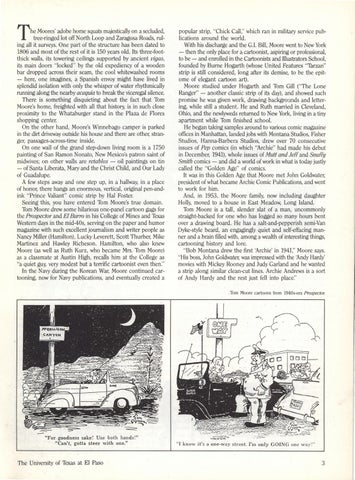
popular strip, "Chick Call;' which ran in military service publications around the world. With his discharge and the G.I. Bill, Moore went to New York - then the only place for a cartoonist, aspiring or professional, to be - and enrolled in the Cartoonists and Illustrators School, founded by Burne Hogarth (whose United Features "Thrzan" strip is still considered, long after its demise, to be the epitome of elegant cartoon art). Moore studied under Hogarth and Tom Gill ("The Lone Ranger" - another classic strip of its day), and showed such promise he was given work, drawing backgro~nds and lettering, while still a student. He and Ruth married in Cleveland, Ohio, and the newlyweds returned to New York, living in a tiny apartment while Tom finished school. He began taking samples around to various comic magazine offices in Manhattan, landed jobs with Montana Studios, Fisher Studios, Hanna-Barbera Studios, drew over 70 consecutive issues of Pep comics (in which "Archie" had made his debut in December, 1941), whole issues of Mutt and Jeff and Snuffy Smith comics - and did a world of work in what is today justly called the "Golden Age" of comics. It was in this Golden Age that Moore met John Goldwater, president of what became Archie Comic Publications, and went to work for him. And, in 1953, the Moore family, now including daughter Holly, moved to a house in East Meadow, Long Island. Tom Moore is a tall, slender slat of a man, uncommonly straight-backed for one who has logged so many hours bent over a drawing board. He has a salt-and-pepperish semi-Van Dyke-style beard, an engagingly quiet and self-effacing manner and a brain filled with, among a wealth of interesting things, cartooning history and lore. "Bob Montana drew the first 'Archie' in 1941;' Moore says. "His boss, John Goldwater; was impressed with the 'Andy Hardy' movies with Mickey Rooney and Judy Garland and he wanted a strip along similar clean-cut lines. Archie Andrews is a sort of Andy Hardy and the rest just fell into place:路 Tom Moore cartoons from 1940s-era Prospector.
"For goodness sake! Use both hands!" "Can't, gotta steer with one."
The University of Texas at El Paso
"I know it's a one-way street. I'm only GOING one way '"
3