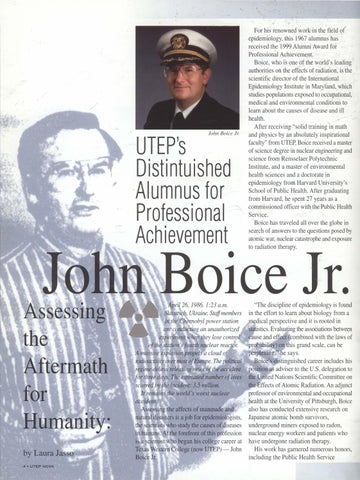
John Boice Jr.
UTEP's Distintuished -Alumnus for Professional Achievement
•
For his renowned work in the field of epidemiology, this 1967 alumnus has received the 1999 Alumni Award for Professional Achievement. Bo!ce, who is one of the world's leading authorities on the effecfs of radiation, is the scientific director of the International Epidemiology Institute in Maryland, which studies populations exposed to occupational, medical and environmental conditions to learn about the causes of disease and il1 health. After receiving "solid training in math and physics by an absolutely inspirational faculty" from UTEP, Boice received a master of science degree in nuclear engineering and science from Rensselaer Polytechnic Institute, and a master of environmental health sciences and a doctorate in epidemiology from Harvard University's School of Public Health. After graduating from Harvard, he spent 27 years as a commissioned officer with the Public Health Service. ·Boice has traveled all over the globe in search of answers to the questions posed by atomic war, nuclear catastrophe and exposure to radiation therapy.
OlCe Assessing the Aftermath
by Laura Jasso 4• UTEPNOVA
April 26, 1986. 1:23 a.m. Slavutych, Ukraine. Staffmembers in the Chernobyl power station are conducting an unauthorized experiment when they lose control of the station's fourth nuclear reactor. A massive explosion propels a cloud of radioactivity over most ofEurope. The political regime delays releasing news of the accident for three days. The estimated number of lives scarred by the incident: 3.5 million. lt remains the world's worst nuclear accident. Assessing the affects of manmade and natural disasters is a job for epidemiologists, the scientists who study the causes of diseases in humans. At the forefront of this profession is a scientist who began his college career at Texas Western College (now UTEP) - John Boice Jr.
"The discipline of epidemiology is found in the effort to learn about biology from a medical perspective and it is rooted in statistics. Evaluating the associations between cause and effect (combined with the laws of probability) on this grand scale, can be perplexing," he says. Boice's distinguished career includes his position as adviser to the U.S. delegation to the United Nations Scientific Committee on the Effects of Atomic Radiation. An adjunct professor of environmental and occupational health at the University of Pittsburgh, Boice also has conducted extensive research on Japanese atomic bomb survivors, underground miners exposed to radon, nuclear energy workers and patients who have undergone radiation therapy. His work has garnered numerous honors, including the Public Health Service