Utility & Transportation
contracTOR
Weeks Marine Celebrates 100 Years In Business
april 2020
I
de i s n
:
p rou G rs tive r e a 5 Ye a C 3 kes es Sto ebrat l Ce
president’s message
From the desk of: dave smith
A
s I write this edition of my President’s Message, I can think of a magnitude of things that we are working on and trying to improve for the benefit of our industry. However, I must limit this to the two that are at the forefront. COVID – 19 As the President of UTCA, I never would have thought I would be writing about an epidemic level event. Our state and our country are in crisis and our industry has a considerable role to play that can be difficult to see. I have been asked by so many, “How can our work be considered life sustaining?” My response is pretty simple, I ask the following questions; • If we stop monitoring and performing maintenance on the already distressed bridge infrastructure for 2 weeks would you want to drive across them? • If we stop working on, repairing and upgrading the water system, what do you think would happen when you turn on the faucet? • If we stop working on, repairing and upgrading the sewer system, what do you think would happen when you flush the toilet? • If we stop working on, repairing and upgrading the electric grid and communications network, what do you think would happen when you turn on a light switch or log onto the internet or charge your electric batteries? • If we stop working on, repairing and upgrading the pipelines, where do you think you will get fuel for your cars, ambulances and fire trucks, to fly your planes or heat your homes? As it turns out we are a life sustaining industry, and we must do everything we can to protect our workers and keep our industry moving. The state and the nation are depending on us to not only keep our infrastructure intact, but to keep the economic engine running.
The Governor and his office, NJDOT, and the Turnpike Authority have been champions of this need and we owe them a great debt of gratitude for their efforts. We must be strong and united and not allow politics and opinion to stand in the way of our national recovery. Stimulus efforts of many types are being discussed and some have already been put in place in the form of SBA loans, project acceleration, and infrastructure spending plans. The very nature of these plans and
2 Utility & Transportation Contractor | april | 2020
the fact that most include funding for our industry is a testament to the importance of what we do, not only for our infrastructure, but for our employees and the economy as a whole. Turnpike Tolls Although the timing could not be more unfortunate, there has been progress on the effort to raise NJ Turnpike Authority tolls. For years, UTCA has been working with the Administration in an effort to increase tolls on the Garden State Parkway and New Jersey Turnpike. This much-needed funding will be the first increase in eight years, and will fund substantial improvements in the North and South ends of the roadways. It will fund much needed improvements on the Atlantic City Expressway and provide Transit with funding assistance. It will also index tolls to inflation, which will help take such critical funding out of the political football arena. Thank you to all of our firms that have sent in comments in support of the increases, your input has been very much appreciated. Our time to act is now, although it is a difficult time to focus on anything other than COVID-19, we must work diligently as an industry to support these efforts. Please take every opportunity to respond to UTCA’s requests for action. Spread our outreach through your team, family and friends. Ask that they do the same and let’s overwhelm our state and its leaders with the much-needed support. Together, we can move this initiative across the finish line. I must say that the UTCA staff under the leadership of Bob Briant is working incredibly hard and diligently near 24 hours a day and 7 days a week. They are communicating at the highest level in the administration and at the agency levels. They are working with our other local groups and national representatives to help keep our industry safe, moving, and funded. Myself, the Board of Directors and Staff are committed to leading our industry during and through this time we all hope is soon behind us.
Stay Healthy Best regards,
Dave Smith
CONTENTS
Cover story 36 weeks marine
completes 100 years in business
36
DEPARTMENTS
FEATURES
2 7 13 19 27 55
46 stokes creative group, inc. celebrates 35 years 70 utca's executive seminar 2020
President’sMessage Financial Overview Legal Dig Accounting Corner Legislative News
NEWS 61 insurance office of america merges with rda benefit services
The pipeline
Published Bimonthly During 2020
1670 Route 34 North Farmingdale, NJ 07727 PO Box 728 Allenwood, NJ 08720 PH: (732) 292-4300 FAX: (732) 292-4310 www.utcanj.org
Publisher: Robert A. Briant, Jr. Editor: Helene Nasdeo Editorial Contributors: Dan Kennedy, Zoe Baldwin, Dan Neville Advertising Manager: Helene Nasdeo Production/Graphics: Lauren Hagan, Helene Nasdeo Circulation: Helene Nasdeo Printed By: American Plus Printers Affiliations: ARTBA, Clean Water Construction Coalition, Water Infrastructure Network UTILITY AND TRANSPORTATION CONTRACTOR (ISSN 0192-4843) is published six times a year by the Utility and Transportation Contractors Association of New Jersey, 1670 Highway 34 North, Farmingdale, NJ 07727. Periodical postage paid at Farmingdale, NJ and additional mailing offices. POSTMASTER: Send address changes to UTILITY AND TRANSPORTATION CONTRACTOR, PO Box 728, Allenwood, NJ 08720.
Utility & Transportation Contractor | april| 2020 3
By: bill ruckert, provident bank
F
raudsters are everywhere. They spend more time trying to plunder a company’s money than the average business owner does trying to protect it. Companies are routinely exposed to cyber-crime through name recognition, vendor payments, employee payroll, email addresses, and other venues. There are many ways for a perpetrator to gain access to company information. Your bank should be working closely with you and offer a variety of cyber-prevention services. Fraud comes in many varieties and concludes with the successful theft of money from a business or an individual. Illicit wire transfers are probably the most common method for criminals to steal funds. Everyone has heard about the cash-strapped college student who asks for emergency funding from Grandma or Grandpa. Unfortunate results routinely occur, and those same criminals are calling and/or emailing your Finance Department regularly with the identical intent of theft. Of further concern is their unusually high degree of success!
ACH transactions are also a frequent avenue for fraud. A common occurrence is when cyber- criminals provide fake vendor information to companies. When payments are made, funds go to fraudulent accounts. The funds are then almost immediately transferred from the bogus account, leaving no trace of their whereabouts. Very little information is needed by felons to target companies to perpetrate this type of fraud.
uments, providing a solid foundation of information for a thief. Email addresses can also lead to a fraudulent activity more commonly referred to as Business Email Compromise, or BEC. As an example, bad guys can closely replicate an email address and give fraudulent instructions to the receiver. Unless the address is closely scrutinized by the receiver, it will mistakenly be accepted and followed. Once duped, the receiver of the sham email quickly falls prey and subsequent actions can cause economic, customer and/or reputation damage. Business partners can also represent fraud risk as their systems can become compromised, leading to an undetected incursion into an unsuspecting company. This activity is more difficult to identify and its impact may not be felt until some future date. Once a company’s system has been hacked, there are many areas cyber-criminals can attack to meet their ends.
Financial overview
fraud: if you don't think it can happen to your company....you're mistaken!
Unfortunately, fraud is most often discovered after it occurs leading to re-active remedial action. If it involved the transferring of funds, the likelihood of recovery is quite small. An event that impacts a company’s customers and reputation requires much more extensive remedies that can only be cured with time and money. To avoid these risks, companies must take a pro-active approach to managing their cyber risk, and there are many tools available. Education is the primary example of how to avoid cyber-crime. Enlightening employees about the inherent risks associated with critical company information will go a long way to stop perpetrators. The old bank adage ‘trust but verify’ rings true here. When unsure about a wire transfer or ACH request, a simple solution is to call the company in question and validate the request from a reputable source. These remedies may be considered common sense, but as a practical matter, they are imperative to preventing criminals from entering your door.
Employees unwittingly expose their employers to fraud through routine payroll checks. Information found on these checks, whether cashed, uncashed, or simply an advice of deposit, is invaluable to criminals. A company’s bank name, account identification and routing number are readily available on these doc-
Bank products are specifically designed to prevent fraudulent activity and are integral to a company’s cyber protection program. Standard services including Positive Pay, ACH Positive Pay and Universal Payment Identification Code (UPIC) offer inexpensive, efficient and timely responses of protection. Establishing routine schedules for payments, whether A/P or payroll, also provides security as transactions outside the norm will garner internal scrutiny. Restricting employee access to company information as well as utilizing dual control, with dollar thresholds for the transferring of funds, also provide added security. Lastly,
Utility & Transportation Contractor | april| 2020 7
Financial overview
companies should limit what devices can gain access to its records outside the workplace. If hacked, a company should act swiftly and decisively to protect itself. Closing hacked accounts is paramount to avoiding future fraudulent activity, as is understanding the root cause. Companies need to assign individual roles and responsibilities for cyber protection. Policies should be adopted and practiced to ensure fraud protection measures are in place not only internally, but with business partners and customers. In addition, any fraudulent activity discovered should be reported to the authorities quickly, including the Internet Crime Complaint Center (IC3). If your bank is not discussing with you how to protect your business from cyber-crime, you’re being exposed, but that can be minimized. Take a proactive stance against fraudsters and demand services be offered to your company by your bank, or, consider using an alternative financial institution that is committed to protecting its customers. Also, to better familiarize yourself with cyber dangers, I encourage you to visit the National Automated Clearing House Association (NACHA) website – www. nacha.org – for a list of fraud threats. I would like to take this opportunity to congratulate our friends at Weeks Marine for celebrating its 100 year anniversary and acknowledge the successful 35 years and going celebration for Stokes Creative Group.
8 Utility & Transportation Contractor | april | 2020
By: adrienne l. isacoff, Florio Perrucci Steinhardt Cappelli Tipton & Taylor LLC
T
he extent of the COVID-19 outbreak and its effect on the United States and international economy continues to expand exponentially. The construction industry is already experiencing very difficult ramifications and should be as proactive as possible to meet the challenges ahead. Force Majeure Clauses Almost all construction contracts include a force majeure clause which relieves a party impacted by some extreme condition from having to perform their contractual obligations. Typical force majeure clauses include “acts of God” such as hurricanes, tornadoes, earthquakes, and wildfires, as well as man-made events like riots, wars, and terrorism. To be classified as a force majeure event, the event must be beyond the control of the contracting party, it cannot be anticipated or foreseeable, and the event must be unavoidable. If there is no force majeure clause in the contract, in some jurisdictions the owner and contractor would share the risk. In most jurisdictions, the risk falls on the contractor for absorbing the increased costs associated with material shortages and project completion delays. You should review whether your existing contracts and subcontracts include a force majeure clause. If they do, make sure to comply with any notice provisions now. There will be time enough for the parties to argue about whether epidemics, although not identified specifically in the force majeure clause, should legally or equitably be considered a force majeure event.
No Damage for Delay Even if the force majeure clause entitles a contractor to an extension of time, thereby alleviating the assessment of liquidated damages, if the contract contains a no damage for delay clause, the contractor may not be entitled to additional compensation to cover increases in costs of materials or labor or additional overhead. Commercial contracts generally include such a clause.
Legal Dig
CONTRACTUAL CONSIDERATIONS OF THE CORONAVIRUS
In New Jersey, State contracts have limitations on no damage for delay provisions. N.J.S.A. 2A:58B-3 provides that a contract with any State agency for construction, repair, maintenance, and related services performed on a building, structure, highway, roadway, or railroad “purporting to limit a contractor's remedy for delayed performance caused by the public entity's negligence, bad faith, active interference, or other tortious conduct to an extension of time for performance under the contract, is against public policy and is void and unenforceable.” The outbreak of an epidemic is not itself indicative of any negligence, bad faith, or tortious interference by the State. Therefore, the State may be able to successfully take the position that its only obligation in response to the epidemic is to grant an extension of time. Court interpretation of this clause have not been favorable to contractors. In PT, & L Construction Co., Inc. v. State of New Jersey Dep’t of Transportation, 108 N.J. 539 (1987), the New Jersey Supreme Court held that a public agency’s failure to coordinate the work of utilities subcontractors on a highway project did not constitute “active interference.” In so deciding, the court reaffirmed the rule that when there is a disclaimer of liability, such as a no-damage for-delay clause, “in the absence of bad faith, the State will not be liable for delays in carrying out its duty to coordinate, even if the delay is unreasonable.” A contractor may try to counter that the State would be acting in bad faith not to provide additional compensation in view of the epidemic, but we are all in unchartered waters here and do not know how the courts will interpret these provisions. Note, also, that the State limitation on no-damage for delay is not applicable to municipalities. Most importantly, you should still comply with notice provisions of any claims to preserve your right to additional compensation in the event that you can prove that an exception to the no damage for delay clause covers your circumstances and in the event
Utility & Transportation Contractor | april| 2020 13
that legislation is enacted to assist contractors facing this national emergency.
Legal Dig
Termination for Convenience While a contractor may be able to invoke a force majeure clause to alleviate itself from fulfilling its contractual obligations, the owner may be able to use the termination for convenience clause to stop the project altogether. If that occurs, review the terms of the clause to determine what payment you are still owed. Certainly, the owner will remain responsible for payment for satisfactory work performed to date of termination. The contract may also address other potential payments for materials stored offsite, material orders placed prior to the date of termination that cannot be cancelled, mobilization and demobilization, and sometimes a set additional fee. Subcontractor/Supplier Issues To the extent that a contractor adds a price acceleration provision to its standard form of subcontract, the subcontractor should try to have the same clause added to the prime contract to seek additional funds from the owner for any labor or price acceleration
14 Utility & Transportation Contractor | april | 2020
that occurs. Subcontractors may also want to request a deposit to purchase materials in order to protect against future unknown risks as the impact on the economy continues. Insurance Coverage Insurance policies may mitigate the effects of shutdowns and delays. Business interruption coverage is an endorsement that may or may not provide relief. Speak with your broker about whether you have such an endorsement and whether it applies to these circumstances. Workers compensation will help with any outbreak of the disease affecting your employees. Travel insurance will protect firms whose employees travel frequently for business. Takeaway The construction industry has always been resilient when dealing with past impacts, from September 11th to natural disasters. The industry will get through this, but working with your legal and insurance professionals will help you plan for the challenges ahead.
Getting stabilized during a black swan By: jack callahan, cohnreznick growth, and now I can honestly say I have never seen anything with an impact like COVID-19. This is uncharted ground for us all. Is this a several-week or a few-month pause in work? Will it spark a new burst of positive trendlines? Or will it cause issues and slowdowns?
Sadly, that swan has taken the form of COVID-19. The effects of this are certainly undetermined now, but it already is disrupting some construction sites with shutdowns, and other states are either enacting or considering issuing other stoppages for largescale sites. We all hope that the downturn is temporary and that the events of early March will help to advance a federal infrastructure bill.
For our construction contractor clients, we want to provide the following thoughts and potential action items for immediate consideration due to the crisis:
Once COVID-19 became a business disruption reality, we mobilized as a construction practice and generated ideas and initial thoughts on what contractors need to be thinking about. We also have pushed out numerous communications about the latest from the government as well as developed resources to help you strategize through the COVID-19 emergency. These are all found on our firm’s resource center. It is critical to monitor relief bills and tax updates from the government. In recent days, the Small Business Administration committed to issuing Economic Injury Disaster Loans for up to $2 million in assistance (www.sba.gov/disaster). We all are hearing of other governmental assistance programs. Before this all began, I was going to write that I am certain that in my 40 years in this industry, I have not seen an expansion that hasn’t contracted within 10 years. Well, we went 11 years with
1) Cash is and always will be king. You will need to assess your current cash position and keep a very close eye on accounts receivable collections, timing of accounts payable payments, and effective utilization of your line of credit. You need to model out your cash flows weekly, monthly, and quarterly to identify and understand your liquidity situation. There will be opportunities here if you effectively manage your cash. 2) You will need to develop and/or review your wind-down strategy to determine how quickly and in what areas you can cut overhead in the event of work stoppages. Labor shortages have been a critical concern in this strong economy. You need to assess how best to reduce overhead and communicate these reductions in such a way that you won’t lose your key players who will be needed upon resumption of full operations. What other obligations can be extended or adjusted?
Accounting Corner
W
hen I set out to write this, all was well with the economy and New Jersey utility contracting. For those of you who have heard me talk about strong backlogs and great stimulus at recent events, I did hedge about the potential for a black swan.
3) Labor management will be critical. You need to know from your labor counsel how to manage furloughs effectively. A recently passed coronavirus relief act includes paid sick leave and family leave that could substantially impact all of you. See the attached AGC discussion. Timely and honest communication will be necessary to minimize the impact. 4) Review critical external commitments. Talk to your banker, talk to your surety agent, talk with your insurance agent, and talk with your legal representation. Nearly every state, New Jersey included, has pending legislation that would force business interruption insurance to cover COVID-19 disruption. Know all your requirements and deadlines and be sure to miss no commitments without effective communication.
Utility & Transportation Contractor | april| 2020 19
5) Site security. The City of Boston recently shut down construction sites, giving contractors limited notice. You need to have contingencies in place to shut down a construction site quickly and effectively. Secure equipment, safely store cranes and heavy machinery, and collect materials and small tools. Government shutdowns will not stop the criminal element from targeting your unmanned sites.
Accounting Corner
6) Refamiliarize yourself with your contract clauses, specifically those with owners, subcontractors, and suppliers. Understand required notices that must be given and procedures that must be followed to best protect your company’s position in the event of a claim. While there is so much more to consider and so many actions to be taken, we hope that this short list will start conversations among your internal team and your trusted advisors. Amid and beyond this initial COVID-19 climate, here are ongoing considerations to help you put your company in a position to succeed. The time to plan for tough times is now. While backlog is strong and cash flow is positive, you need to be taking a hard look at your business. As you plan your year-end financial wrap-up meetings with your accountants, look past the current reported results and obtain a gauge on your preparedness. Have you… • Invested in your people? • Invested in technology? • Shown strong cash management skills? • Surrounded yourself with a strong team of independent and knowledgeable advisors? • Established strong and trusted banking and surety relationships? • Shown restraint in growth of overhead? • Shown the ability to forecast and plan? • Established clear succession plans? • Invested in client relationships where you are viewed as a contractor of choice? • Built up significant book to tax deferrals? These are just some of the critical factors that you will need to assess as you look at your long-term viability to succeed and thrive in a down market. When markets turn, contractors close shop, retract, or implode at the same time that work will need to be built and work outs will be occurring. The well-positioned contractor with the correct team around them can be well-situated to grow. If you are not able to assess your preparedness favorably, begin this process before it is too late to take effective remedial actions. First and foremost are your people. Keep in mind that the industry universally is citing an aging workforce and labor shortages as major concerns. The best-in-class contractors have invested
20 Utility & Transportation Contractor | april | 2020
in their workforce and have a balance in demographics. At this critical juncture, keeping your people and your workforce balanced is essential. Along with investment in people is investment in technology. The new-age workforce demands access to technological tools that allow them to spend less time on remedial labor-intensive tasks. Between a tech-savvy environment and one mired in ledger sheets, the choice will be clear. Further, as you have grown and prospered, have you invested in strong cash-management skills? Have you been meticulous in cash collections and timely subcontractor and supplier payments? Have you established sound cash forecasting that is built into your estimating and bidding process? This is now essential given current events. Best-in-class subcontractors and suppliers will look to work with and provide best pricing to contractors who treated them well. I have always contended that successful contractors have surrounded themselves with a strong team of core trusted advisors such as accountants, attorneys, insurance agents, sureties, and bankers. Evaluate the strengths of those individuals. While all the trusted advisors are critical to success, the banking and surety relationships can often have the biggest immediate impact. We have experienced down markets where banks have redlined the construction industry. Sound-performing contractors have been told to close their accounts and move all banking relationships without notice. These types of actions can certainly be repeated. Less reactionary but just as critical is having surety relationships with a track record of trust and reliability. There will be a bad job or a bad year. If the relationships are strong and you are trusted, more times than not the surety will support you. Overhead is always a major concern for a contractor. You need to properly identify what your overhead is and know what your breakeven numbers are. When times are good, margins are strong, and volume is growing, overhead management may not be critical. I can assure you that it is, and the evidence lies in the bottom line. If the growth of the overhead has been inconsistent with volume growth, you need to determine if you have the ability and willingness to correct that change quickly enough. Forecasting and budgeting are vital to a contractor’s success. Do you have a solid forecasting system that is reliable and responsive? In addition to cash flow, closely monitor labor, production, material delivery, and backlog runoff. Reacting to what happens each day or planning week by week is just not acceptable in this challenging environment. Careful and thoughtful succession planning has been the key to all mature contractors. Have you taken a hard look at where you want to go with the business? Is family succession or key employee succession an option? If the desire is to sell the company, any type of succession transaction and plan will take time, so see that you have things positioned to minimize the disruption of operations should a buyout event occur or be required. Evaluate your reputation on the street honestly and independently. If you have a reputation of doing good work at a fair price
and paying employees, subcontractors, and suppliers fairly and promptly, you will likely have developed a loyal customer base. If your background is to be a low bidder, to push hard on subcontractors and suppliers, and to have an extended track record of claims, change orders, and extras, you may not be looked upon as a preferred vendor. In times of tightening markets, those pure low bid contractors have proven to be the ones who lose work.
Even when the market is strong, the action points I have laid out are important to your success. Now that things have turned, they will be critical to your survival. In the past, we have seen the construction market impacted a year or more after a market correction, but clearly the effects of this virus are immediate. It is never too soon to have these discussions and, now that a black swan has landed, take this newly found time available and use it wisely.
Accounting Corner
Understand what your book-to-tax deferrals are and be certain to plan when these will turn and how those deferred taxes will be paid. As the market tightens and volumes shrink, it is likely that these deferrals will begin to turn around. Think about the cash flow impact of shrinking volume, shrinking margins, and significant cash flow needs to pay taxes; we have seen it take its toll. In the past, contractors were able to carry back losses and obtain refunds of previously paid taxes. The Tax Cuts and Jobs Act of 2017, while providing more favorable tax rates, took away a contractor’s ability to carry back losses. In prior recessions, these tax refunds were often used as a lifeline to get through a crunch, but that option is no longer available. Be sure to ask about the deferrals and obtain a plan for handling them.
Utility & Transportation Contractor | april| 2020 21
in the lobby By: zoe baldwin
I
First off, the Feds. In Mid-March President Trump signed into law a more than $100 billion coronavirus aid package that includes new leave requirements for employers. The new law requires governments and private businesses with fewer than 500 employees to provide up to two weeks of paid sick leave for those who miss work due to coronavirus or for those who have to take care of affected family members. An eligible employee is one who has worked at least 30 calendar days for the employer. USDOL will exempt companies with fewer than 50 workers if they risk going out of business. The provisions will only apply to coronavirus-related illnesses and would last only through the end of 2020. This paid sick leave is in addition to existing paid sick leave or PTO time that is offered by or required of employers. Employers will receive 100% tax credit for paid sick time up to the ACT’s paid limitations (up to $511 per day, $5,110 total or up to $200 per day, $10,00 total when caring for children home from school). Please note that leave for employees caring for children under 18 years of age due to eligible school closing are only entitled to unpaid sick leave for the first ten days. Paid sick leave applies to both full and part time employees (on a pro-rata basis) and the requirement/benefit expires on December 31, 2020. As of this writing, we do not have further details on how this new law will be implemented. Congressional lawmakers are already working on another stimulus effort in response to the widening pandemic, and our national coalition, the American Road and Transportation Builders Association (ARTBA), has been working to ensure funding for infrastructure is included. The ARTBA co-chaired Transportation Construction Coalition sent a March 19 letter to Capitol Hill highlighting the short-term and long-term positive impacts
of infrastructure investment on the U.S. economy. Senators Barrasso (R-WY), Shelby (R-AK), Cramer (R-ND), and Representative Peter DeFazio (D-OR) have publicly stated their support for including major infrastructure investment in the plan. On the home front, the Small Business Administration (SBA) declared a disaster in the state, making businesses eligible for low-interest federal loans up to $2M. However, Governor Murphy has cautioned owners – especially those severely impacted – to hold off until there is a full picture of available resources. After Hurricane Sandy businesses rushed to get loans that ultimately made them ineligible for grants that were offered later. Funding for the loans was included in the coronavirus spending bill described above. They carry a 3.75% interest rate for small businesses with up to 30 years to repay. To apply for loans, visit https://disasterloan.sba.gov/ela. Applicants also can call the SBA at 800- 659-2955 or email disastercustomerservice@ sba.gov. For more information visit https://sba.gov/page/guidance-businesses-employers-plan-respond-coronavirus-disease-2019-covid-19. The deadline is Dec. 18 and the declaration also includes businesses in several counties bordering New Jersey: New Castle, Delaware; Bronx, New York, Orange, Rockland, and Westchester, New York; and Bucks, Delaware, Monroe, Northampton, Philadelphia and Pike in Pennsylvania.
Legislative News
n the wake of our new, socially distanced reality, almost everyone is feeling vulnerable whether physically or financially, and it’s hard to know what to do in the face of such massive uncertainty. UTCA has been and continues to be in constant contact with the Governor's office, members of the Legislature, local governments, and various state agencies in an effort to mitigate economic impact to our industry. Below is a roundup of the state and federal government resources and response for business during the COVID-19 outbreak.
Finally, just this hour, the US Treasury Secretary Steven Mnuchin has declared that Tax Day will be moved from April 15 to July 15. All taxpayers and businesses will have the additional time to file and make payments without interest or penalties. Next, New Jersey At the time of this writing, the state is still working to put together a comprehensive relief package and corresponding guidance. The best resource right now is a new business information hub on COVID-19 that allows users to search for the specific information they need. It also has a livechat function which is available from 8am-9pm. You can visit the state's website at https://cv.business.nj.gov or call the Business Helpline 1-800-JERSEY-7. Our partners at the New Jersey Business and Industry Association (NJBIA) have also been hard at work to protect employers and have created a resources page with a slew of invaluable
Utility & Transportation Contractor | april| 2020 27
COVID-19 related business resources that is being updated constantly. Visit njbia.org/coronavirus. They have also put together a coronavirus impact poll to identify your business challenges and bring them to our decision makers. You can participate by visiting https://bit.ly/3dgzMEj.
Legislative News
The state legislature is also moving quickly to help with damage control. At the time of this writing, the legislature has passed several bills not yet signed by the Governor. One bill, sponsored by Assemblymen Freiman, Greenwald, and Dancer authorizes the New Jersey Economic Development Authority to provide grants during periods of emergency declared by the Governor and for the duration of economic disruptions due to the emergency. Probably the most significant bill was one that will expand both the state’s temporary disability and family leave insurance programs to cover the novel coronavirus. Prior to passage, a person quarantining due to COVID-19, the disease caused by the coronavirus, or caring for a family member would not necessarily qualify for payments under the disability or family leave programs. In total, the body passed more than two dozen bills enabling emergency protections and assistance to the people, schools, businesses, and local governments grappling with the medical and financial impacts of the public health crisis. The measures
28 Utility & Transportation Contractor | april | 2020
cover a range of issues from a freeze on all evictions, funding for food pantries and other essential food/meal services, enabling expanded use of telemedicine and virtual learning, requiring insurance carriers to cover coronavirus testing and treatment, and ensuring no employee is fired due to a medically necessary quarantine. Eventually, elections Although it seems like a lifetime away, the government has also made provisions for upcoming elections that may occur while public attendance restrictions are in place. The Governor has ordered that all elections set for May 12th will be conducted by vote-by-mail only, so please keep an eye out for ballots. At this time, there are no changes announced for scheduled June 2nd primary elections. Please consider supporting the UTCA PAC, Constructors for Good Government UTCA continues to be the leading voice for the infrastructure construction industry in Trenton and Washington DC. Whether it is providing expert testimony before business and legislative groups or positively effecting the legislative process, UTCA stands alone in its record of achievement for our industry. This success is only possible with your support and more importantly, with your support of the industry’s PAC: Constructors for Good Government. Please consider contributing as a robust PAC greatly strengthens our voice. Thank you for your continued support.
Cover Story
weeks marine completes 100 years in business By: zoe baldwin
A
mix of organic growth and strategic acquisition, good timing, and a King Midas touch for old iron seem to be hallmarks of the Weeks Marine empire, which just completed its 100th year in business. Current CEO Richard S. Weeks sat down with us recently, plumbing the depths of family and company history we ambled through the past century of maritime business and growth. In the beginning, the Weeks family owned the NY Clason Point Ferry until World War I pulled Richard B. away from his home and into the US Army Air Corps as a second lieutenant. Upon his return in 1919, Richard B. and his father, Francis, started Weeks Stevedoring by purchasing unassembled, land-based steam cranes and putting them on barges to perform ballast and coal bunker work. “NY accounted for over half of US maritime commerce back in those days,” Richard S. tells me. “There was this phenomenally deep world of maritime enterprise - railroads, bulk stevedores, barge companies - a lot going on. So, they went into that milieu of activity and, if you can handle coal you can handle ore, soda ash, salt - all your bulk commodities. Back then, if you had floating cranes that you could move around, it was enough to get your foot in the door.” Through the 1920s the fledgling firm strengthened its foothold in the world of stevedoring, ultimately securing enough of a mar-
A Weeks Stevedoring crane in the company’s early days.
36 Utility & Transportation Contractor | april | 2020
The Goethals Bridge Replacement Project, completed in 2018, was a joint venture between Weeks, Kiewit and Massman Construction Co.
ket share to help them through the austere years following the market crash of 1929. “During the Great Depression they kind of eked it out where they could. With the onset of World War II, things exploded in terms of demand and as the family lore goes, they kind of ran the equipment into the ground and then had to build it back up from there.” By the start of WWII, the business had expanded its fleet to include seven cranes and the company was poised and ready for the deluge of war time projects to come. The original fleet was made of wood, but the proliferation of work during the war allowed Weeks to replace wooden crane hulls with durable steel. By 1947, Richard B.’s sons, Ted and Richard N., had started working with the firm part time while students at Rutgers University, and by 1954 both had joined their father full time. “My father [Richard N.] was very mechanically oriented,” says Richard S., “You know, takes cars apart and puts them back together, that kind of a thing; but another thing about him is that he has always thought for himself. He has a very independent brain; he isn’t a follower of the herd. So, he began looking at what else we could do besides bulk stevedoring with bulk stevedoring cranes.” It was that thrifty ingenuity that secured Weeks its first work for the government removing abandoned vessels and piers for the US Army Corps of Engineers, a move that opened up a new clientele. Richard N. saw an opportunity in branching out by putting his stevedoring assets to a broader purpose. According to Richard S., “It was a big deal back then - working for the government was a whole other operation. Bulk stevedoring was a world where you did business on handshakes. You didn’t have contracts, maybe you had a letter that listed the rate, but often not. Up to that point we’d had a bunch of private, long term customers and were in heavy with scrap iron in particular.”
Through the 1950s and early 60s, Weeks worked throughout the region diversifying its portfolio of public and private clients while continuing to invest in its fleet. Just a decade earlier they had moved from wooden hulls to steel; In the 1960s they moved from steam to diesel. The newly outfitted vessels were much better equipped for the bitter winter months out on the water, and the updates helped secure Weeks’ standing in a competitive industry.
In those days, the firm was based in Jersey City on Pier 7 just south of the Jersey Central Railroad terminal, which was at the time a bustling center of port commerce fed by a series of finger piers in what is now Liberty State Park. The railroads had immense marine operations – car floats, barges, tug boats - and Richard N. would frequently buy surplus railroad equipment to supplement his operation. “We were there, we could husband it, and there was a phenomenal amount of it. He bought a lot and he sold some. He even sold barges to Nigeria - I’ll never forget that. The Nigerians had all kinds of port congestion problems and they needed a quick fix so they came in and bought a lot of barges from us and others.” That prime location in Jersey City combined with Richard N.’s eye for opportunity led Weeks from those early government contracts into dredging, a completely new line of business where the firm would truly make its mark. According to Richard S., “You needed a floating crane which we had, and you needed a workforce which we had in longshoremen, so he started going after smaller government jobs. He was diversifying using the assets that were there and the skill set was there. Dick would look at what they had and put his thinking cap on. Back then the port had numerous finger piers that meant you could do a hundred dredging jobs in a year. Just one- or two-day jobs, private and paid by the scow load. If you needed a permit you’d just call into New York and you got it. It was very easy back then to get in from a regulatory stand point. But you ultimately needed to rent and then build a dump scow.”
“The first clamshell dredge of size was something called the 500, which we still own. The crane was built in anticipation of the invasion of Japan. We bought it surplus, and then we changed the hoist, the boom, and modernized the crane, but it was still working on anchors, not on spuds. The big move for them was to get some clamshell work in Puerto Rico. We were pipsqueaks at the time, but nobody was really maintaining a presence there, which kind of leveled the playing field. Anybody can bid a job as long as they can get a bid bond and a performance bond.” Taking on the new specialty was a step away from stevedoring, but one that brought Weeks into a whole new arena. “My grandfather and his brother were not particularly interested in it,” Richard S. says of the founders. “They had been through tough times and weren’t up to taking on the risk… But at the time, the stevedoring was still chugging along.” In fact in 1966, the largest dry cargo ship to ever call at the port of New York was loaded with the heaviest scrap iron and steel shipment on a single vessel – thanks to Weeks’ stevedoring expertise.
Cover Story
The Weeks No. 7 Stevedoring crane unloading material into a hopper.
And build one they did. Once he had his foot in the door, Richard N. built three more dump scows and hired Bill McPhilips to run the dredging business. Weeks Stevedoring started clamshell dredging and gradually grew the operation, primarily working in the Northeast. When Richard S. started on in 1977, they had picked up some jobs in Puerto Rico and Jacksonville, FL.
The 1970s ushered in the containerization of port operations, but by that point Weeks had branched into several arenas of work, giving the firm a solid base from which to grow. Richard N. – known for his savvy with all things mechanical – continued to build the company’s fleet and capabilities. In addition to the stevedoring operation, they had added dredging, demolition, sludge disposal, two tug boats and a growing fleet of floating equipment. Current CEO, Richard S., joined the firm in 1977 after graduating Harvard Business School. Although his name suggests otherwise, it was not a fait accompli that he would join his father at the firm. “I was kind of torn between science and social studies, and I landed in international relations,” he tells me. “But that segued into business which segued into business school, and in the
Weeks brought the Eleanor dredge online in July 2018 to get a jump start on the aggregate business.
Utility & Transportation Contractor | april| 2020 37
Cover Story
Construction firms have a number of avenues for growth, be it a new specialty like dredging, or a derivative business--like rentals, but geographic expansion can be a game changer. In the late 1980s Weeks made a significant acquisition with the purchase of Healy Tibbitts, overnight giving the firm a strong presence on the West Coast, in the Gulf of Mexico, and in Hawaii.
Fully loaded sand scows on route to a customer.
meantime there’s this business back in New Jersey that my father is running. My father had lots of really interesting ideas about where he might expand the business, and they were well capitalized for a company their size. It presented a lot of opportunity so I tailored my courses and came here, to Weeks.” And just like his father, Richard S. would take the family business into previously unchartered waters as he put his newly minted business skills to work. “One of the ideas when I came in – there was a company called American Dredging and they were publicly traded. Unfriendly tender offers were a new thing then, and I ran with that idea. We took a run at American but were unsuccessful because another company – under the smoke screen of our efforts – were able to accumulate enough stock to do an unfriendly tender offer subsequently.” But life has a funny way of working out. “The firm was Tweedy Browne, and it didn’t turn out to be that great of an investment for them. About ten years later, we bought all of their assets except their land, which really expanded our dredging footprint. Their equipment hadn’t been well maintained but that was a strong suit of ours, cleaning up messed up iron.” The 1980s brought several more expansions for the company, including their first real foray into construction in which they repaired a US Coast Guard slip on Governors Island, NY. As Gene Kelley, retired head of Weeks’s Construction Division, put it, “[It] had a little bit of everything in marine construction. It had piling, it had fender systems, it had some marine demolition. And it wasn’t that big of a job, but it had to be done all from the water so it fell right into Weeks’ strong point – the floating equipment.” Decades earlier, Weeks had stuck its proverbial toe in the water with a pair of lighthouses and a project for Northeast Monmouth Sewerage, but it was a crowded field at the time and the firm wasn’t yet ready to make its move. As Richard S. tells it, “My agreement with Gene always was that if we had competitive advantages, then we should pursue that work. So if you have a construction job that has a lot of heavy lift, or demolition, or a dredging component in it and its not labor-intensive diver-intensive work (at the time we didn’t have divers) I’m interested; if it plays on our strength, I’m okay with it.”
38 Utility & Transportation Contractor | april | 2020
“We were doing this subaqueous pipeline work,” says Richard S., “And there was another marine construction company that was part of a West Coast operation and they were a customer of ours. We would do dredging for them or rent them barges and they were part of Raymond International, which was a very large company. Raymond had a job to replace the Shinnecock Bridge. It was a joint venture with Schiavone Construction and both companies had some problems. They had equipment on rent from us and had wrecked one of the barges, so we had this ongoing dispute. I’ll never forget, Dick Smith from Healy Tibbitts comes to Dick Weeks and suggested we buy Healy Tibbets because otherwise there might not be a Healy Tibbitts to deal with. I wasn’t interested, I mean they were probably number four in that segment of marine construction, whereas we were arguably number one. Why would I want to buy number four?” But as Weeks had found in previous scenarios, good things come to those who wait. A few years later Raymond International declared bankruptcy. “We kind of took a couple days to penetrate into the workout group – they had to move fast and Healy had jobs all over kingdom come – but we did penetrate and what was interesting was that they had one job in Owls Head, Brooklyn that reportedly had problems – there were issues and the job was pretty far afield for them - but our construction people looked at it and realized it could be stabilized if we had our dockbuilders come from a different job in Staten Island. I said that I would consider entering this arena but only consider it if I know that everybody was going to stay on. I mean they could have gone anywhere, the company had work in Micronesia, Hawaii, all over the place. We’d never worked on the West Coast let alone Micronesia! We had an agreement, and we bought the assets and the contracts. There was no way to do due diligence, but the irony is that there were no shenanigans. So, we acquired a company that was headquartered in San Francisco with divisions on the East Coast, one in Hawaii, one in Southern California, and one in the Gulf.” The purchase brought with it a culture change for Weeks. As Richard puts it, “The Raymond guys were like whale hunters. They were used to doing larger jobs working for large multi-nationals – it was their heritage and they’re geographically in the right place to do that work which is in Houston, but they had no meat and potatoes underlying that. Their portfolio was feast or famine – it was one big job for two years and then nothing.” Now the operation is very well established in the Gulf, and has built several LNG design-build projects in the region. The 1980s and 90s represented a period of growth generated by acquiring the assets of other marine companies. In 1998, the firm went through the largest acquisition to date with the purchase of
the dresging assets of TL James, a very large construction contractor based in Louisiana. “American Dredging and TL James were strategic acquisitions. Some acquisitions over the years were in alignment with down periods in industry where there’s a shake out or people are kind of fading away like in stevedoring, but mostly they were strategic opportunities that presented
themselves. We didn’t go pounding on the door and say we want to buy TL James. They looked at their empire of businesses and decided to sell some things and we knew it was now or never. So we did that but at the same time, our growth over the past decade has been more from within.” In 2011, Weeks expanded to the North and “underground,” acquiring Ontario based McNally International, one of North America’s preeminent tunneling contractors, a firm also heavily into marine construction in the Canadian Maritimes, lower Great Lakes and Arctic. The synergies, both technical and cultural, were very convincing; as with Healy Tibbitts in the Pacific, Weeks chose to continue doing business as “McNally” in both tunneling and Canadian marine construction, out of respect for a long record of expertise and achievement. It can be hard to be big, and Weeks knows first-hand the difficulties of scale. “Every year everything is another year older. We’re a big fish in the pond, which means if we need a state-of-the-art hydraulic dredge, we have to build it ourselves. If we want a really strong team of people, we have to develop it ourselves.” It was this mentality that launched Weeks’ most recent endeavor, North American Aggregates. Bob Manis, who runs Aggregates Sales and Business Development for the firm joined us to talk about the new start up. “We’re hopefully going to sell over 2 million tons of sand in the next couple of years. We’re stepping into a market that really needs sand; there’s a shortage throughout the country right now we’re helping to fill the void here in the Northeast.” As many of our readers have had to contend with, a sand shortage has hampered operations in our industry. “With sand it’s all
Looking toward the future, Richard. S sees a field abundant with opportunities and challenges. Weeks invests heavily in its workforce and strongly believes that this industry can be rewarding for everyone. He does however, see great challenges ahead in the ever-increasing size of projects. “There’s been a tendency for the government to make jobs very large or very small. In that process what’s also going on is an effort to push more risk onto the contractor, and our industry hasn’t been very successful at dealing with that. As a result, you have a lot of European entities that are willing to come in and pick up that work and presumably assume that risk. But the work is there and somebody has to build it. On the Tappan Zee Bridge Project we were a significant subcon-
Cover Story
Weeks participated in a joint venture to replace the Willis Avenue Bridge with a new swing bridge 2010.
about transportation costs,” Richard S. tells me, “Every time you touch it, it costs more money. There was a lot of shuffling around trying to figure out how to cover the market.” North American Aggregates recently opened a depot in the Bronx, and will soon open another in Long Island City, Queens. The operation has a permit on sand mined from the Ambrose Chanel, one of the few sources still available. Despite a more stringent regulatory structure, Bob sees the future of the industry moving toward offshore sand sources. “We have a little more oversite because we’re regulated by the Army Corps of Engineers in addition to the NJDEP and NY Waterways, as opposed to sand pits which the DEP solely regulates . The biggest factor with overmining is that those [landbased] plants start to get into the water table, which creates an issue for drinking water. Down in South Jersey, some people are advocating to shut those plants down, even the ones that have permits. It’s becoming a real issue, but that’s where we come in as a safe alternative.”
The FDR Drive Rehabilitation Project was completed by Weeks in 2007. This contract was a joint venture of Weeks Marine and Slattery Skanska.
tractor. We did dredging, the stone placement, the load test pilot program, we mobilized their batch plants…we just weren’t part of the joint venture.” As Weeks has learned over the past century in business, do more with what you have and be ready when opportunity presents itself. Simple strategies that helped a humble, two crane stevedoring company blossom into six divisions that operate more than 500 cranes, tugs, dredges, barges, and other pieces of waterborne equipment. We congratulate Weeks Marine on 100 years in business and wish them all the best in the century to come.
Utility & Transportation Contractor | april| 2020 39
Feature Story
stokes creative group, inc. celebrates 35 years By: nicole pace-addeo, m.a.
W
hen you follow the encouragement and trusted advice of the late Bob Briant, Sr. and many UTCA members, great things are bound to happen. This is exactly how Joanne Stokes first started out in construction photography in 1985 and transformed her company into the multimillion-dollar full-service marketing agency it is today. What first began as JMS Visual Communications has grown into Stokes Creative Group, Inc. (Stokes), a full-service marketing agency which specializes in a wide range of multimedia solutions for the transportation and construction industries. Stokes is a certified WBE/DBE/SBE/WBENC agency throughout the East Coast with four locations in NJ, NY, MD, and FL. Working in two divisions – Public Outreach and Marketing Services – Stokes’ 30+ employees are experts in their fields, delivering quality service to every client. Stokes’ services range from video productions, web design, photography, and collateral materials to communications plans for complex companies and projects. Over the past 35 years, Joanne and her team have formed long-lasting partnerships with countless industry leaders on transportation projects of all sizes, from the massive construction of the New NY Bridge to 10-month Local Concept Development studies and everything in between. The Stokes team is leading the way in new technologies and in-
novative solutions; keeping with the latest trends, the production department is producing impactful time-lapse videos to show the transformation of project sites in the blink of an eye. Additionally, with two certified drone pilots on staff, Stokes uses drone photo and video footage in promotional and historical videos to help their clients create captivating stories that stand out from their competitors. The Stokes team also integrates these stories and messages for clients through social media and email marketing. With these methods of communication always changing, clients can rely on Stokes’ expertise to assist them with marketing their projects or businesses using these popular tools. Helping clients enhance their image and positive reputation – whether through websites, flyers, branding, or infographics – is a key component of their client-first approach. Creating a captivating PowerPoint or Prezi presentation can be a daunting task for some, but Stokes has graphic artists who work with clients in developing dynamic presentations so the client will look and sound their best when communicating complex information, demonstrating their leadership in their industry. Stokes has been honored to work with several outstanding firms, including providing D’Annunzio with website enhancements, a corporate stationery package, promotional videography and photography, and event coverage. For Waters & Bugbee, Stokes delivered advertisements and marketing, email blasts, logo animations, photography, and trade show signage. Working with IEW Construction, Stokes was able to refresh their corporate stationery package and branding.
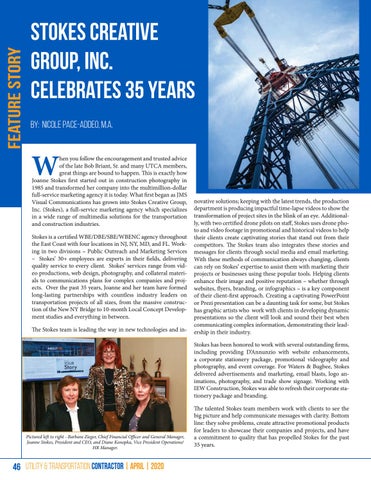
Pictured left to right - Barbara Zieger, Chief Financial Officer and General Manager, Joanne Stokes, President and CEO, and Diane Konopka, Vice President Operations/ HR Manager.
46 Utility & Transportation Contractor | april | 2020
The talented Stokes team members work with clients to see the big picture and help communicate messages with clarity. Bottom line: they solve problems, create attractive promotional products for leaders to showcase their companies and projects, and have a commitment to quality that has propelled Stokes for the past 35 years.
Feature Story
Stokes has built success upon a variety of remarkable multimedia services. Justin Williams, a recent University of Delaware graduate with a B.S. in Human Services Administration and Policy Studies, serves as the Business Development Manager for the thriving marketing services division. For starters, the Stokes video department has produced numerous award-winning documentaries as well as safety and training videos. Stokes Vice President of Technology and certified drone pilot Matthew Touhey leads the production team in his 12th year with the company alongside Producer and 11-year Stokes veteran Stephen Gonski, who was recognized last year with a Gold Telly Award with NJ Transit’s “Move Ahead with Us” short video. Stokes’ experienced video production team continues to stay ahead of the curve by integrating new technologies and delivering awe-inspiring results.
Throughout their 35-year history in business, Stokes has been involved in countless notable projects – many of which are still in progress right now. At Stokes’ Garden State headquarters, the New Jersey Turnpike Authority wrapped up the Interchange 14A Improvement Project in 2018 and started the Interchange 145 Improvement Project with AECOM in 2019. Stokes leads the public involvement efforts on these, as well as the previously completed 6-to-9 Widening Program. In the Big Apple, the NY team has led several outreach programs for big names such as the New NY Bridge (also referred to as The Hudson River Crossing Project and the replacement of the Tappan Zee Bridge) and the Long Island Rail Road Expansion Project, in addition to managing projects for the Delaware River Joint Toll Bridge Commission including the Scudder Falls Bridge Replacement Project. In the Maryland office, the Stokes team has been busy supporting the Purple Line Light Rail Construction Project and the Transform 66 Outside the Beltway Project in VA. Additionally, they’ve done work on the I-270 Corridor Innovative Congestion Management project. Lastly, the sun continues to shine on our Florida team working on projects for Florida’s Turnpike Enterprise, FDOT District 5 [US 301 Project Development and Environment (PD&E) Study], and US 17/92 Improvements. These exciting projects could never be completed without the hard work of a talented, dedicated staff of employees. Diane Konopka, serving her 31st year with the firm, manages operations, human resources, and personnel. Matthew Touhey leads the video production staff and web programming efforts. Chris Stokes, Creative Director, manages Stokes’ major projects. In 2019 two new leaders joined the team; Barbara Zieger was appointed as General Manager and Chief Financial Officer, and Valerie Burnette Edgar was appointed as Vice President of Public Outreach. Eight-year veteran Qiao Wu now serves as the Director of Public Outreach and leads the growing NY and NJ offices with new business development and technology support. The talented women leading each office’s public outreach include sixyear veteran manager Nicole Pace-Addeo in NJ, Marly Cardona Moz in MD, Mary Ann Rozengard in FL, and Adrienne Zicklin Kanter in NY. There are many other instrumental staff members handling accounting, photography, graphic design, proposal coordination, copywriting, administrative tasks, and much more. The staff is always focused on customer satisfaction and exceeding the goals of their valued clients. Stokes unique offerings have allowed the company to grow as a team, resulting in continued expansion of services and outstanding quality on each project. Their client-first philosophy has fostered numerous relationships with satisfied clients who return to Stokes time and again. Whether the job entails photos for a small utility job, coordinating media coverage, a company website, or assisting contractors with construction documentation, the Stokes team of experts is always ready to deliver products and services that help tell clients’ stories – today, tomorrow, and into the future. For more information on Stokes’ services, please contact Justin Williams at 844-572-8046 and jwilliams@stokescg.com.
Utility & Transportation Contractor | april| 2020 47
no water. no hygiene.
By: dan kennedy, director of environmental & utility operations
T
his section of the UTCA magazine is dedicated to timely issues related to environmental and utility topics that are likely of interest to our members. I am writing this article in late March 2020 during the response (hopefully the peak or the right side of the curve) to the coronavirus outbreak. I struggled to find a relevant topic that would draw the interest of our members who are likely focused on the disruption to everyday life or the reverberations from the actions taken during this time. I hope that at the time of print, construction work is continuing and/or accelerating and the impact to our community is minimized to the extent possible. As we navigate through these difficult times, we struggle to find positives. One positive aspect of society that has been steady and reliable is our access to safe drinking water and the ability to maintain treatment and safe disposal of the sewerage we generate.
I raise these historical facts about sanitation reform not to bore you, but to set up a point that I think needs to be made. The basis of the whole water infrastructure construction industry lies not in the environmental regulations of the 1970s and forward but with social reforms related to public health and hygiene. Fundamentally, the water infrastructure sector of the construction in-
Fast forward almost 200 years and under the gun of coronavirus, our public health agencies can tell our residents and businesses that tap water can be used as normal and that this virus has not been detected in drinking water supplies. The World Health Organization has stated that the “presence of the COVID-19 virus has not been detected in drinking-water supplies and based on current evidence the risk to water supplies is low.” The reason for this is partially due to how this virus interacts with the natural environment, but it is also because national, state, and most international drinking water regulations require treatment at public water systems to remove or kill pathogens, including viruses. Of all the things we have to worry about during this viral outbreak, water is a public good that thankfully is not a concern. The public health benefits of our work to upgrade and improve our water infrastructure are significantly undervalued. Some of the pipes we are replacing go back to the time when these original systems were constructed in the 1800s. Moving forward, UTCA will ensure that elected officials do not forget about the basic public health and societal benefits of the investments that need to be made in infrastructure such as our water systems. The national attention on the lead crisis led to a large push for more accountability and oversight of New Jersey’s water systems. Let this crisis increase the public’s appreciation of water infrastructure as it relates to public health. Infrastructure, once built, doesn’t run itself. During these challenging times, we should also recognize the value of the people who work for water utilities — all utilities, public and private. Utilities are triggering their response plans for continuity of operations so our toilets can flush, our lights can stay on, and we can heat our homes and cook in them. And yes, they are keeping our water supply safe and available. Utilities serve critical functions for society, and the essential personnel who work for them do not have the ability to work from home. The people who service these critical services must continue to work. In the face of the risk, utility employees such as construction employees are keeping these services and the economy going. We owe those who work for utilities, UTCA member companies, and our partners in the trades a debt of gratitude. Thank you for keeping us running during this difficult time.
The Pipeline
It hasn’t always been that way. In 1815, English Parliament was the first modern government to mandate that sewerage from private city lots be directed into a centralized stormwater system, albeit a crude system with no treatment. The elimination of sewerage from private city lots is a luxury of the last 200 years. Large-scale physical planning for water infrastructure is thus a modern construct, starting first in the United States in NYC and Boston. Around the 1840s, legends in the field of civil engineering such as England’s Edwin Chadwick and leaders in the medical and public health community such as NYC’s Dr. John Griscom started making the connection between sanitary conditions and diseases that ran rampart through urban settlements. At the time, wells, natural springs, and cisterns were common sources of drinking water, and untreated human waste from private lots and tenements were polluting these sources and causing disease. Widespread infectious disease was the issue of the day. Activists, including engineers and medical professionals, pushed society to centralize a function within government to provide reliable and safe drinking water. This was over 100 years before the first Earth Day.
dustry is first and foremost based on sanitation with the primary goal of cessation of disease.
Utility & Transportation Contractor | april| 2020 55
By: tim fitzpatrick, senior vice president - employee benefits
M
ARLTON, New Jersey. (Feb. 12, 2020) – Insurance Office of America (IOA) is excited to announce it has merged with New Jersey-based RDA Benefit Services, owned by Bob and Nancy Damato. The merger became effective Jan. 1, 2020 and further adds to IOA’s growing team in the Northeast region.
“We are proud to join forces with a company that shares our values and is as passionate about small business as we are. The combined portfolio of RDA and IOA will give our clients access to additional products and services that will enhance the benefits they already have in place,” said Bob and Nancy Damato. “We are also dedicated to continuing the exceptional customer service our clients have come to expect.” RDA has served the construction industry for over 30 years, providing expert guidance in the employee benefits arena. IOA shares the same market focus and provides comprehensive consulting services to contractors in the tri-state area for bonding, commercial insurance, employee benefits, and risk management. Powered through its proprietary program, RiskScore, IOA offers the most holistic insurance solution to this unique market. “IOA’s growth model is one of building around good people, and this merger with RDA and the Damatos is no different. The reputation they have built in the community of professionalism and service fits perfectly with our organization,” said Chris Labrecque, president of the employee benefits group for IOA. “We are excited about the opportunities both RDA and IOA now have to serve our mutual clients on an even deeper level, and we look forward to continuing the storied legacy the Damatos have created.” Bob and Nancy’s expertise combined with the resources and versatility of IOA will provide clients with a truly unique experience.
NEWS
insurance office of america announces merger with rda benefit services “We could not be happier to have Bob and Nancy as part of our team. They bring a tremendous amount of knowledge with them as well as a focused dedication to their clients,” said Tim Fitzpatrick, senior vice president of employee benefits for IOA. “We are excited to build upon their legacy by continuing to deliver excellent customer service to employers and by providing the tools and resources needed to effectively manage their total risk while helping them educate and empower their employees.” ABOUT RDA BENEFIT SERVICES: RDA Benefit Services LLC is a full-service employee benefits consulting firm that provides privately held companies with tax-advantaged individual and group insurance plans. Founded in 1987, it has over three decades of experience serving businesses throughout the mid-Atlantic region. RDA offers group employee benefits and voluntary benefits, as well as key employee benefits, such as employer- and employee-owned individual life and disability insurance for owners and key executives. ABOUT INSURANCE OFFICE OF AMERICA: Insurance Office of America (IOA) is a full-service insurance agency founded in 1988 by John Ritenour and Valli Ritenour. It is one of the fastest-growing independent agencies in the United States. IOA is ranked 13th on Insurance Journal’s 2019 Top 100 Independent Property/Casualty Agencies report and 23rd on Business Insurance’s 2019 100 Largest Brokers of U.S. Business list. IOA was named a National Underwriter Agency of the Year in 2018. Headquartered in Longwood, Florida, part of the greater Orlando community, IOA has more than 1,000 associates located in over 60 offices in the U.S. and London. For more information, visit www.ioausa.com.
Utility & Transportation Contractor | april| 2020 61
Feature Story
fun in the sun for utca's executive seminar 2020 By: patrick j. nasdeo
A
pproximately 130 UTCA members and their families traveled to Hawaii from February 27th to March 7th for this year’s Executive Seminar. Upon arriving on Oahu, the group was greeted by beautiful weather at the Kahala Hotel and Resort in Honolulu. Welcome lunch and drinks were sponsored by Hoffman Equipment, a perfect way to sate the hungry group that had just spent nearly 12 hours on a plane. On the first evening, many in the group enjoyed a quiet, early night, just trying to let their bodies adjust to running on “island time.” After enjoying breakfast sponsored by Foley, Inc. at Kahala’s Hoku Restaurant, attendees climbed aboard buses for the pilgrimage to Pearl Harbor. Attendees were treated to an incredibly scenic business meeting and luncheon on the USS Missouri, a battleship adjacent to the National Park. UTCA CEO, Bob Briant, Jr., and President of the Board Dave Smith took a deep dive into current legislative and political climate and updated the group on a number of the Association’s Trenton initiatives. The meeting adjourned and was followed by a tour of the entire USS Missouri, which is actually the sister-ship to the Battleship New Jersey stationed in Camden, NJ. While not present during the infamous attack on Pearl Harbor, the USS Missouri had major roles in the Pacific Theater of World War II, where she fought in the battles of Iwo Jima and Okinawa as well as in the Korean War from 1950 to 1953. After touring the Missouri, the group
Portion of the group getting a Docent guided tour aboard the USS Missouri.
70 Utility & Transportation Contractor | april | 2020
Bob Briant, Jr. and Association President Dave Smith pictured at the Farewell Luau in Maui
headed over to the site of the attack, USS Arizona National Park. The wreck of the USS Arizona remains at Pearl Harbor to commemorate the many lost that fateful December morning in 1941. A memorial was built across the ship's sunken remains where a turret remains visible above the water. The memorial must be accessed via naval ferry, and an unfortunate combination of high winds and sporadic rain prevented our group from accessing the actual memorial. We were still able to visit the smaller memorials spread throughout the national park, and watched an informative video explaining the context and events of the attack that memorialized December 7, 1941. Being able to experience such an important part of our nation’s history first-hand was a truly unique experience for everyone, with attendees awash in mixed feelings of admiration for the brave souls lost that morning and grief over the weight of our national tragedy. A busy, emotionally-moving day came to a close that evening as guests enjoyed the company of friends and contractors thanks to a Welcome dinner in the Kahala’s Maile Ballroom, sponsored by Florio Perrucci Steinhardt Cappelli Tipton & Taylor. The following morning, guests got to experience a hands-on lesson about the Kahala’s dolphin lagoon that houses six Atlantic bottlenose dolphins. Trainers gave background information on each dolphin and allowed them to demonstrate their tricks and flips for the crowd. After the dolphin show, which was sponsored by County Concrete, almost half of the group headed to Kualoa Ranch to tour their massive, privately-owned park. Kualoa Ranch was used in the filming of several movies from the “Jurassic Park” series, as well as several other adventure-themed films like “Journey to the Center of the Earth” and “Kong: Skull Island.” Most members chose to ride UTVs through the park, while a smaller group opted to tour the park on horseback. Both tours provided breathtaking views of Oahu’s coast via vantage points located around the property.
came up for a breath just feet away. It was a rare experience that made everyone appreciate Maui’s natural wonders even more.
Large portion of the group on the Whale Watch Boat Cruise.
Heading away from the coast, tours were led through old movie sets, some with original props like styrofoam buildings and dinosaur cages still intact. Tour guides let attendees take as many photos and videos as they desired, and even volunteered to take some group pictures. After approximately two hours, the tour concluded and guests were shuttled back to the Kahala. The following day, an hour-long flight was the only thing separating attendees from a week on the beautiful island of Maui. After checking in to the Four Seasons Resort at Wailea, attendees were astounded by the beauty of the lavish property. With stunning tropical landscapes, three pools to swim in, and two extravagant restaurants serving locally sourced food and beverages, there were very few reasons to leave the resort.
During the final business meeting, Seth Tipton provided an excellent in-depth explanation regarding New Jersey’s policies on marijuana in the workplace, specifically as they pertain to medicinal marijuana and employee/employer rights. Many were grateful for legal insight into the rapidly changing regulatory climate, especially since it is likely to change again when the issue is put on the ballot this November. The second presentation of the day was an engaging PowerPoint by George Pallas and Shawn Farrell of Cohen Seglias Pallas Greenhall & Furman. Using a very cool new technology, they presented facts from real construction cases to the group, then showed the results in real-time as the group voted on how they thought the case would be judged. George and Shawn then revealed the judge’s actual decisions on the cases, which were often the opposite of what the group had predicted!
Feature Story
Later in the week, a sizeable group sojourned along the Road to Hana, a 64.4-mile-long stretch of Hawaii Routes 36 and 360 that curve around ¾ of the island. Not for the faint of heart, the route is very windy, narrow, and passes over 59 bridges, many of which were built back in 1910 and most of which are only one lane wide. The harrowing but safe journey took members through tropical rainforests and small towns, even a stopping for a dip in a multitiered waterfall. It proved to be a long day, but the group was glad to experience the full array of what the island has to offer.
After another two days of rest and relaxation, the end of the trip
Adding to the enchantment was that the group arrived during the peak of humpback whale migrating season. Groups of whales were seen breaching and playing offshore at all hours of the day but seemed most active each morning during the private breakfast sponsored by Foley, Inc., a stunning treat for the whole group. Throughout the week, many in the group took advantage of the kayaks and paddleboards available to rent at the resort’s beach, along with snorkels and masks to inspect the crystal-clear ocean and see the beautiful array of sea life teeming just below the surface. At the second business meeting, the group was enthralled by a presentation from John Romanowski, who runs Jas. W. Glover Ltd. one of Hawaii’s oldest construction firms. An excellent speaker John gave a fascinating history of the islands and their unique construction industry. In fact, there were audible gasps in the room when our members heard how much it cost to import many of the materials and aggregates we take for granted on the mainland. There were two more group excursions while on Maui, each providing a taste of the incredible wonders of the island. A whale-watching boat trip proved a great success, with many sightings of the commuting humpback population as they played with their babies and competed for mates. The one that made it all worth while however, was an up-close encounter with a younger whale that swam right under the large catamaran and
Shawn Farrell and George Pallas present to the crowd during a morning business meeting in Maui.
settled onto the horizon. On Thursday night, the group enjoyed a luau to celebrate the final night in paradise. This memorable evening was sponsored by Cohen Seglias Pallas Greenhall & Furman and Wealth Preservation Solutions. After a very comical group hula lesson, an enthralling local fire dancer, and soothing serenades by local musicians, the group was ready to say farewell to their temporary island home, and enjoyed a fitting end to a trip that went by too fast. Special thanks to our additional sponsors: Brent Material Company, Creamer Environmental, North American Pipeline Services, Ritacco Construction, Stone Hill Contracting, Taylor Oil Company, Vollers and Weldon Materials. The 2021 Executive Seminar is scheduled for Grand Hyatt Baha Mar in Nassau, Bahamas.
Utility & Transportation Contractor | april| 2020 71
UTCA Annual Convention October 1-3, 2020 borgata hotel & casino
new program
announced
for 2020
Thursday, October 1st
Exhibits open with light food & drinks: 4:30pm - 6:30pm Welcome buffet dinner: 6:30pm
friday, october 2nd
exhibits: 8:30am - 12:00 Noon annual Luncheon program: 12:00 Noon Exhibits: 2:00pm - 4:30pm President's reception/PAC Auction Party: 6:00pm
Saturday, october 3rd
farewell buffet breakfast: 8:30am
100 exhibitors displaying the latest in equipment,
over
technology & services for the construction industry
Convention Registration and additional details will be distributed in july if you are interested in exhibiting or have questions, please email lauren@utcanj.org