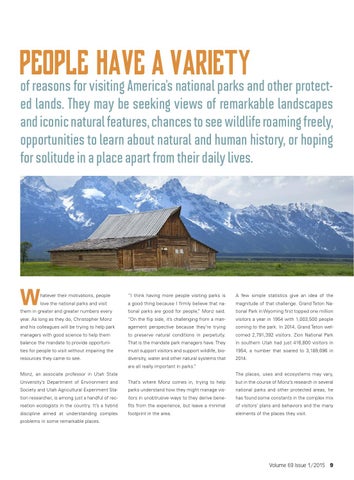
of reasons for visiting America’s national parks and other protected lands. They may be seeking views of remarkable landscapes and iconic natural features, chances to see wildlife roaming freely, opportunities to learn about natural and human history, or hoping for solitude in a place apart from their daily lives.
W
hatever their motivations, people
“I think having more people visiting parks is
A few simple statistics give an idea of the
love the national parks and visit
a good thing because I firmly believe that na-
magnitude of that challenge. Grand Teton Na-
them in greater and greater numbers every
tional parks are good for people,” Monz said.
tional Park in Wyoming first topped one million
year. As long as they do, Christopher Monz
“On the flip side, it’s challenging from a man-
visitors a year in 1954 with 1,003,500 people
and his colleagues will be trying to help park
agement perspective because they’re trying
coming to the park. In 2014, Grand Teton wel-
managers with good science to help them
to preserve natural conditions in perpetuity.
comed 2,791,392 visitors. Zion National Park
balance the mandate to provide opportuni-
That is the mandate park managers have. They
in southern Utah had just 416,800 visitors in
ties for people to visit without impairing the
must support visitors and support wildlife, bio-
1954, a number that soared to 3,189,696 in
resources they came to see.
diversity, water and other natural systems that
2014.
are all really important in parks.” Monz, an associate professor in Utah State
The places, uses and ecosystems may vary,
University’s Department of Environment and
That’s where Monz comes in, trying to help
but in the course of Monz’s research in several
Society and Utah Agricultural Experiment Sta-
parks understand how they might manage vis-
national parks and other protected areas, he
tion researcher, is among just a handful of rec-
itors in unobtrusive ways to they derive bene-
has found some constants in the complex mix
reation ecologists in the country. It’s a hybrid
fits from the experience, but leave a minimal
of visitors’ plans and behaviors and the many
discipline aimed at understanding complex
footprint in the area.
elements of the places they visit.
problems in some remarkable places.
Volume 69 Issue 1/2015 9