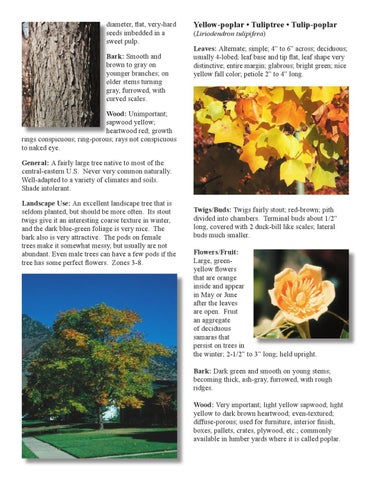
diameter, flat, very-hard seeds imbedded in a sweet pulp. Bark: Smooth and brown to gray on younger branches; on older stems turning gray, furrowed, with curved scales.
Yellow-poplar • Tuliptree • Tulip-poplar ((Liriodendron tulipifera)
Leaves: Alternate; simple; 4” to 6” across; deciduous; usually 4-lobed; leaf base and tip flat, leaf shape very distinctive; entire margin; glabrous; bright green; nice yellow fall color; petiole 2” to 4” long.
Wood: Unimportant; sapwood yellow; heartwood red; growth rings conspicuous; ring-porous; rays not conspicuous to naked eye. General: A fairly large tree native to most of the central-eastern U.S. Never very common naturally. Well-adapted to a variety of climates and soils. Shade intolerant. Landscape Use: An excellent landscape tree that is seldom planted, but should be more often. Its stout twigs give it an interesting coarse texture in winter, and the dark blue-green foliage is very nice. The bark also is very attractive. The pods on female trees make it somewhat messy, but usually are not abundant. Even male trees can have a few pods if the tree has some perfect flowers. Zones 3-8.
Twigs/Buds: Twigs fairly stout; red-brown; pith divided into chambers. Terminal buds about 1/2” long, covered with 2 duck-bill like scales; lateral buds much smaller. Flowers/Fruit: Large, greenyellow flowers that are orange inside and appear in May or June after the leaves are open. Fruit an aggregate of deciduous samaras that persist on trees in the winter; 2-1/2” to 3” long; held upright. Bark: Dark green and smooth on young stems; becoming thick, ash-gray, furrowed, with rough ridges. Wood: Very important; light yellow sapwood; light yellow to dark brown heartwood; even-textured; diffuse-porous; used for furniture, interior finish, boxes, pallets, crates, plywood, etc.; commonly available in lumber yards where it is called poplar.