UPDATE
Artful Connections Arts program provides a safe haven for at-risk youth.
C
REATIVE OUTLETS HAVE been proven to channel children’s energies away from the inevitable consequences of idle hands. Constructive ways to spend time are all the more critical for at-risk youth and young people who have had brushes with the criminal justice system. With annual funding of $7 million from the Department of Juvenile Justice, USF’s School of Social Work, in collaboration with the University Area Community Development Corporation, Bay Area Youth Services and 18 other community partners, provides the Prodigy Cultural Arts program to address the needs of these populations. In essence, Prodigy is an innovative year-round afterschool delinquency prevention program for ages 7 to 17 where life lessons emerge from carefully planned cultural arts activities. Students learn to sing, dance, write, paint, animate—basically all the arts—performing and visual. Artists, many with national and international reputations, are hired and trained in how to facilitate the learning of social skills while teaching the young people to explore and express their thoughts, feelings and values through art. “This differs from more traditional life skills trainings that focus on the skill sets directly,” says School of Social Work Director William Rowe, who serves as the program’s principal investigator. “What we do not only develops artistic skills, but also gives our instructors ways 8
USF MAGAZINE | WINTER 2009
to connect with the students who learn new ways to solve problems—in a safe environment,” Prodigy got its start in 2003 at the University Community Center located in a distressed neighborhood close to USF’s Tampa campus. Approximately 1,800 children and their families from the community as well as youth referred to the program by the juvenile justice system now participate in Prodigy each year. The program has expanded to six counties in west Central Florida—from Sarasota to Orange, with 4,000 students enrolled and serving an additional 10,000 family members and friends each year. Overall, Prodigy partners with 20 community organizations and operates in 18 inner-city and rural communities. The School of Social Work has a research team of social work faculty and research assistants continually evaluating the program to determine its effects on children, families and the communities
served. There are two key outcome measures: program completion and recidivism rate. In both those measures, Prodigy excels. “Eighty-five percent of the youth complete the program and nearly 90 percent do not recidivate,” says Rowe. “Both measures represent a very strong outcome.” The art projects are shared with the community at large through an annual showcase that draws nearly 1,000 attendees. Recently, some of the projects were displayed at University Mall and in USF Provost Ralph Wilcox’s office, where students met USF President Judy Genshaft along with Wilcox who hosted a reception last fall. “What a joy it was to experience the results of USF’s community engagement,” says Wilcox. “Their art serves as a reminder of how important USF’s contribution is to individual lives right in our – Barbara Melendez neighborhood.”
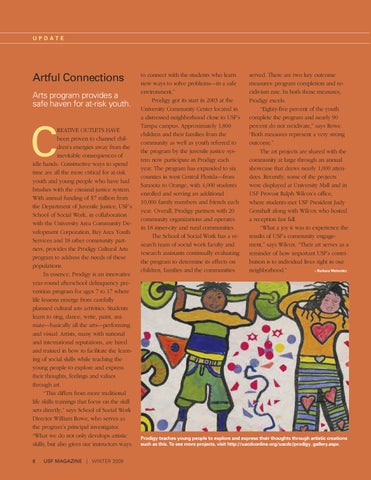
Prodigy teaches young people to explore and express their thoughts through artistic creations such as this. To see more projects, visit http://uacdconline.org/uacdc/prodigy_gallery.aspx.