P
erhaps your dressage dream, like many riders’ dreams, is to make it to the top—the very top. You know you have the work ethic, skills, and determination to become an elite
equestrian. There’s just one problem: You lack the horse to take you there. An ideal partnership with an exceptionally talented horse at the upper levels of FEI competition takes lots of hard work, a little luck, and, usually, a boatload of money. You may be somewhat lacking in the finance department, but you’ve heard there’s a creative solution: a syndicate, in which the horse is owned and financially supported by a group of people rather than by a sole owner. But you don’t know where to begin, what questions to ask, and what pitfalls may crop up along the way. We can help. We talked to riders, syndicate members, the owner of a high-performance horse, and a lawyer specializing in horse syndication, all of whom have successfully navigated the maze of questions, legalities, niceties, and being-in-the-right-place-at-the-right-time scenarios to set up syndicates to purchase their dream dressage mounts. Consider this Introduction to Horse Syndication 101, dressage edition.
JENNIFER BRYANT; COURTESY OF AMY EBELING
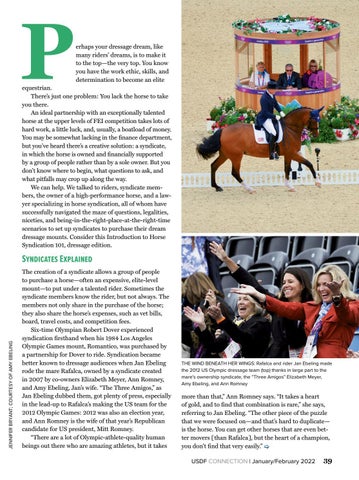
Syndicates Explained The creation of a syndicate allows a group of people to purchase a horse—often an expensive, elite-level mount—to put under a talented rider. Sometimes the syndicate members know the rider, but not always. The members not only share in the purchase of the horse; they also share the horse’s expenses, such as vet bills, board, travel costs, and competition fees. Six-time Olympian Robert Dover experienced syndication firsthand when his 1984 Los Angeles Olympic Games mount, Romantico, was purchased by a partnership for Dover to ride. Syndication became better known to dressage audiences when Jan Ebeling rode the mare Rafalca, owned by a syndicate created in 2007 by co-owners Elizabeth Meyer, Ann Romney, and Amy Ebeling, Jan’s wife. “The Three Amigos,” as Jan Ebeling dubbed them, got plenty of press, especially in the lead-up to Rafalca’s making the US team for the 2012 Olympic Games: 2012 was also an election year, and Ann Romney is the wife of that year’s Republican candidate for US president, Mitt Romney. “There are a lot of Olympic-athlete-quality human beings out there who are amazing athletes, but it takes
THE WIND BENEATH HER WINGS: Rafalca and rider Jan Ebeling made the 2012 US Olympic dressage team (top) thanks in large part to the mare’s ownership syndicate, the “Three Amigos” Elizabeth Meyer, Amy Ebeling, and Ann Romney
more than that,” Ann Romney says. “It takes a heart of gold, and to find that combination is rare,” she says, referring to Jan Ebeling. “The other piece of the puzzle that we were focused on—and that’s hard to duplicate— is the horse. You can get other horses that are even better movers [than Rafalca], but the heart of a champion, you don’t find that very easily.” [ USDF CONNECTION | January/February 2022
39