28
Alum ni Profiles
Magazine
Fall 2005
To complement the feature story on USC Law’s growing international programs (see Page 10), the following alumni profiles focus on a few of the many USC Law grads whose careers or activities are global in scope.
For women
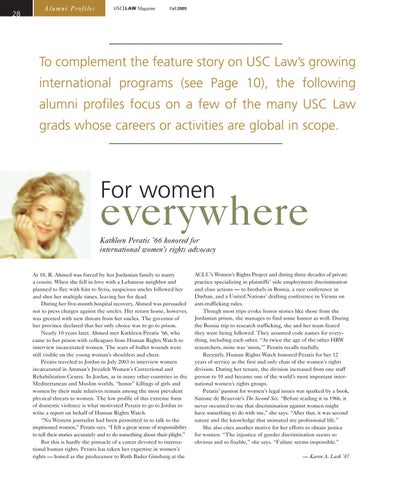
everywhere Kathleen Peratis ’66 honored for international women’s rights advocacy At 18, R. Ahmed was forced by her Jordanian family to marry a cousin. When she fell in love with a Lebanese neighbor and planned to flee with him to Syria, suspicious uncles followed her and shot her multiple times, leaving her for dead. During her five-month hospital recovery, Ahmed was persuaded not to press charges against the uncles. Her return home, however, was greeted with new threats from her uncles. The governor of her province declared that her only choice was to go to prison. Nearly 10 years later, Ahmed met Kathleen Peratis ’66, who came to her prison with colleagues from Human Rights Watch to interview incarcerated women. The scars of bullet wounds were still visible on the young woman’s shoulders and chest. Peratis traveled to Jordan in July 2003 to interview women incarcerated in Amman’s Jweideh Women’s Correctional and Rehabilitation Centre. In Jordan, as in many other countries in the Mediterranean and Muslim worlds, “honor” killings of girls and women by their male relatives remain among the most prevalent physical threats to women. The low profile of this extreme form of domestic violence is what motivated Peratis to go to Jordan to write a report on behalf of Human Rights Watch. “No Western journalist had been permitted in to talk to the imprisoned women,” Peratis says. “I felt a great sense of responsibility to tell their stories accurately and to do something about their plight.” But this is hardly the pinnacle of a career devoted to international human rights. Peratis has taken her expertise in women’s rights — honed as the predecessor to Ruth Bader Ginsburg at the
ACLU’s Women’s Rights Project and during three decades of private practice specializing in plaintiffs’ side employment discrimination and class actions — to brothels in Bosnia, a race conference in Durban, and a United Nations’ drafting conference in Vienna on anti-trafficking rules. Though most trips evoke horror stories like those from the Jordanian prison, she manages to find some humor as well. During the Bosnia trip to research trafficking, she and her team feared they were being followed. They assumed code names for everything, including each other. “At twice the age of the other HRW researchers, mine was ‘mom,’” Peratis recalls ruefully. Recently, Human Rights Watch honored Peratis for her 12 years of service as the first and only chair of the women’s rights division. During her tenure, the division increased from one staff person to 10 and became one of the world’s most important international women’s rights groups. Peratis’ passion for women’s legal issues was sparked by a book, Simone de Beauvoir’s The Second Sex. “Before reading it in 1966, it never occurred to me that discrimination against women might have something to do with me,” she says. “After that, it was second nature and the knowledge that animated my professional life.” She also cites another motive for her efforts to obtain justice for women: “The injustice of gender discrimination seems so obvious and so fixable,” she says. “Failure seems impossible.” — Karen A. Lash ’87