Sub Main() Dim Dim Dim Dim Dim
arrc:arrc=rhino.GetObjects("curves") scattractor:scattractor=rhino.getobject("attractor point",1) arrscattra:arrscattra=rhino.PointCoordinates(scattractor) roattractor:roattractor=rhino.getobject("ro attractor point",1) roarrscattra:roarrscattra=rhino.PointCoordinates(scattractor)
PERIMETER DIVIDED NUMBER: TOWER 1 12 TOWER 2 12 TOWER 3 12 TOWER 4 8 NUMBER OF FLOORS SHARE A UNIT: 2 REGULAR PILLOW COVERED
PERIMETER DIVIDED NUMBER: TOWER 1 12 TOWER 2 12 TOWER 3 12 TOWER 4 8 NUMBER OF FLOORS SHARE A UNIT: 2 SUNLIGHT RESPONSIVE PILLOW COVERED
PERIMETER DIVIDED NUMBER: TOWER 1 12 TOWER 2 12 TOWER 3 12 TOWER 4 8 NUMBER OF FLOORS SHARE A UNIT: 2 SUNLIGHT AND WIND RESPONSIVE PILLOW COVERED
Dim divc ReDim divc(30) Dim i For i=0 To ubound(arrc) divc(i)=Rhino.DivideCurve(arrc(i),8,False) Next Dim a,b For a=0 To 27 Step 2 For b=0 To 5 Step 2 Dim ribv1:ribv1=rhino.AddInterpCurve(array(divc(a)(b),divc(a+1)(7-b),divc(a+2)(b+2))) Dim ribv2:ribv2=rhino.AddInterpCurve(array(divc(a+2)(b),divc(a+1)(7-b),divc(a)(b+2))) Dim pillowcr v1:pillowcr v1=rhino.AddCur ve(array(divc(a+2)(b),divc(a+3)(7b),divc(a+2)(b+2),divc(a+1)(7-b),divc(a+2)(b))) Dim pillowcrv2:pillowcrv2=rhino.AddCurve(array(divc(a+1)(7-b),divc(a+2)(b+2),divc(a+1)(5b),divc(a)(b+2),divc(a+1)(7-b))) Dim pillowcrv3:pillowcrv3=rhino.AddCurve(array(divc(a+1)(1),divc(a+2)(8),divc(a+3)(1),divc (a+2)(6),divc(a+1)(1))) Dim ribv3:ribv3=rhino.AddInterpCurve(array(divc(a)(6),divc(a+1)(1),divc(a+2)(8))) Dim ribv4:ribv4=rhino.AddInterpCurve(array(divc(a+2)(6),divc(a+1)(1),divc(a)(8))) Dim ribv5:ribv5=rhino.AddInterpCurve(array(divc(28)(b),divc(29)(7-b),divc(30)(b+2))) Dim ribv6:ribv6=rhino.AddInterpCurve(array(divc(30)(b),divc(29)(7-b),divc(28)(b+2))) 'scale Call Rhino.ObjectLayer(array(pillowcrv1,pillowcrv2,pillowcrv3), "pillow") Call scro(pillowcrv1,arrscattra,roarrscattra) Call scro(pillowcrv2,arrscattra,roarrscattra) Call scro(pillowcrv3,arrscattra,roarrscattra)
End Sub
Next
Next
Call Call Call Call Call Call
segment segment segment segment segment segment
(ribv1) (ribv2) (ribv3) (ribv4) (ribv5) (ribv6)
Function segment(c1) Dim divc:divc= rhino.DivideCurve(c1,2,False) Dim divvecmid:divvecmid=Rhino.CurveClosestPoint(c1,divc(1)) Dim normalplanemid:normalplanemid=Rhino.CurvePerpFrame(c1, divvecmid) Dim circlemid:circlemid=rhino.AddCircle(normalplanemid,0.2) Dim divvec0:divvec0=Rhino.CurveClosestPoint(c1,divc(0)) Dim normalplane0:normalplane0=Rhino.CurvePerpFrame(c1, divvec0) Dim circle0:circle0=rhino.AddCircle(normalplane0,0.6)
IDEA WORK 08 09
Dim divvec2:divvec2=Rhino.CurveClosestPoint(c1,divc(2)) Dim normalplane2:normalplane2=Rhino.CurvePerpFrame(c1, divvec2) Dim circle2:circle2=rhino.AddCircle(normalplane2,0.6) segment= rhino.AddLoftSrf(array(circle0,circlemid,circle2)) Call rhino.DeleteObjects(array(circle0,circlemid,circle2)) End Function Function scro(pillowcrv,arrscattra,roarrscattra) Dim arrBBox:arrBBox= Rhino.BoundingBox(pillowcrv) Dim arrCntrPt:arrCntrPt = array((((arrBBox(2)(0)) + (arrBBox(0)(0))) / 2), (((arrBBox(2)(1)) + (arrBBox(0)(1))) / 2), (((arrBBox(0)(2)) + (arrBBox(4)(2))) / 2)) Dim scdistance:scdistance=rhino.Distance(arrCntrPt,arrscattra) Dim scale:scale= 0.01*scdistance+0.25 Dim scoutput:scoutput=rhino.ScaleObject(pillowcrv,arrCntrPt,array(scale,scale,scale)) Dim rodistance:rodistance=rhino.Distance(arrCntrPt,roarrscattra) Dim angle:angle=0.5*scdistance Dim rooutput:rooutput=rhino.rotateObject(scoutput,arrCntrPt,angle)
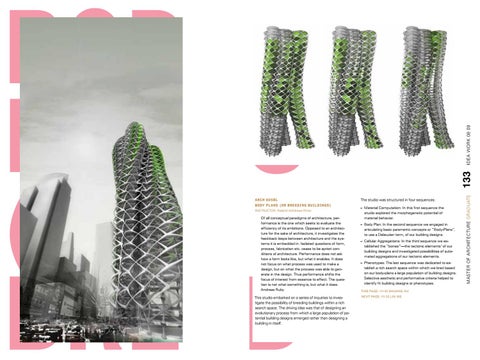
ARCH 605bL Body Plans (or breeding buildings) Instructor: Roland Wahlroos-Ritter
Of all conceptual paradigms of architecture, performance is the one which seeks to evaluate the efficiency of its ambitions. Opposed to an architecture for the sake of architecture, it investigates the feed-back loops between architecture and the systems it is embedded in. Isolated questions of form, process, fabrication etc. cease to be apriori conditions of architecture. Performance does not ask how a form looks like, but what it enables. It does not focus on what process was used to make a design, but on what the process was able to generate in the design. Thus performance shifts the focus of interest from essence to effect. The question is not what something is, but what it does. Andreas Ruby This studio embarked on a series of inquiries to investigate the possibility of breeding buildings within a rich search space. The driving idea was that of designing an evolutionary process from which a large population of potential building designs emerged rather than designing a building in itself.
The studio was structured in four sequences: – Material Computation: In this first sequence the studio explored the morphogenetic potential of material behavior. – Body Plan: In the second sequence we engaged in articulating basic parametric concepts or “Body-Plans”, to use a Deleuzian term, of our building designs. – Cellular Aggregations: In the third sequence we established the “bones”—the tectonic elements’ of our building designs and investigated possibilities of automated aggregations of our tectonic elements. – Phenotypes: The last sequence was dedicated to establish a rich search space within which we bred based on our body-plans a large population of building designs. Selective aesthetic and performative criteria helped to identify fit building designs or phenotypes. this page: |1| |2| Shuang Xu next page: |1| |2| Lin Xie
master of architecture graduate
133
End FunctionV End Function