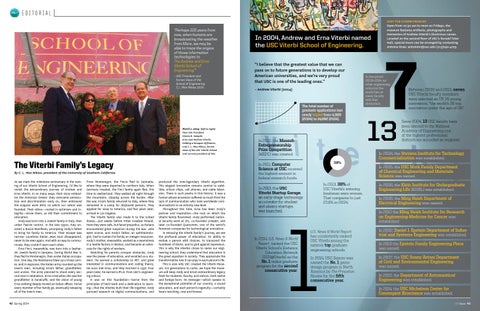
EDITORIAL "Perhaps 100 years from now, when humans are broadcasting the weather from Mars, we may be able to trace the origins of those information technologies to The Andrew and Erna Viterbi School of Engineering.” – USC President and former Dean of the School of Engineering C.L. Max Nikias (2004)
In 2004, Andrew and Erna Viterbi named the USC Viterbi School of Engineering. “I believe that the greatest value that we can pass on to future generations is to develop our American universities, and we’re very proud that USC is one of the leading ones.” – Andrew Viterbi (2004)
The total number of graduate applications has nearly tripled from 4,989 (2004) to 14,862 (2014). March 2, 2004: (left to right) then USC President Steven B. Sample; Erna and Andrew Viterbi, holding a bouquet of flowers; and C. L. Max Nikias, former dean of the USC Viterbi School and current president of USC.
The Viterbi Family’s Legacy By C. L. Max Nikias, president of the University of Southern California As we mark this milestone anniversary in the naming of our Viterbi School of Engineering, I’d like to revisit the extraordinary journey of Andrew and Erna Viterbi. In so many ways, their story embodies the American Dream: they overcame persecution and discrimination early on, then embraced the singular work ethic on which our nation was founded. Their ethos—rooted in optimism and integrity—drove them, as did their commitment to education. Andy was born into a Jewish family in Italy, then under Fascist control. In the late 1930s, Italy enacted a Racial Manifesto, prompting Andy’s father to bring his family to America. Their escape was narrow: countless Italian Jews soon disappeared, never to be seen again. And with no way to communicate, they couldn’t warn each other. Erna Finci, meanwhile, was born into a Sephardic Jewish family in Sarajevo. During World War II, they fled to Montenegro, then under Italian occupation. One day, the Resistance blew up a troop carrier, and in response, the Italian army rounded up the town’s men, including Erna’s father, grandfather, and uncles. The army planned to shoot every second man in retaliation. Erna cried when she saw her grandfather in handcuffs, and the vision of young Erna sobbing deeply moved an Italian officer. He let every member of her family go, eventually releasing all of the town’s men.
42 Spring 2014
From Montenegro, the Fincis fled to Dalmatia, where they were deported to northern Italy. When Germany invaded, the Finci family again fled, this time to Switzerland. They walked all night through the mountains, slipping across the border. After the war, Erna’s family returned to Italy, where they remained in a camp for displaced persons. They applied for visas to America, and five years later, arrived in Los Angeles. The Viterbi family also made it to the United States—just weeks before Hitler invaded Poland. Here they were safe, but faced prejudice, as Italians encountered great suspicion during the war. Jobs were scarce, and Andy’s father, an ophthalmologist, had to sustain his family on meager resources. Andy’s mother, meanwhile, worked as a seamstress in a textile factory in Boston, and became an advocate for the rights of workers. Watching his parents conquer obstacles, Andy saw the power of education, and excelled as a student. He earned a scholarship to MIT, and grew interested in communications and coding theory. He soon met Erna, and they married in 1958. Four years later, he earned a Ph.D. from USC’s engineering school. It was on this foundation—borne from the principles of hard work and a dedication to learning—that the Viterbis built their life together. Andy pursued research on digital communications, and
produced the now-legendary Viterbi algorithm. This elegant innovation remains central to satellites, silicon chips, cell phones, and cable television. There is such poetry in this history: it was a human whose ancestors suffered so much from the lack of communication who took worldwide communications to an entirely new level. Throughout this time, Erna has been Andy’s partner and inspiration—the rock on which the Viterbi family flourished. Andy performed national security work at JPL, co-founded Linkabit, and later co-founded Qualcomm, one of the world’s foremost companies for technological innovation. In retracing the Viterbi family’s journey, we see the profound power of education: its ability to endow a person with choices, to transcend the humblest of starts, and to gird against repression. This is why the Viterbis chose to name our engineering school: they understand that education is the great equalizer in society. They appreciate the transformative role it can play in each person’s life. This is also why USC created the Viterbi Museum. For generations to come, we hope the museum will keep Andy and Erna’s extraordinary legacy fresh for students, faculty, and visitors, both native and foreign-born. Its message—which speaks to the exceptional potential of our country, a sound education, and each person’s ingenuity—certainly bears revisiting, now and forever.
In 2010, the Maseeh Entrepreneurship Prize Competition (MEPC) was created.
In the period 2009–2014, no other engineering school in the world has as many faculty with this distinction.
13
Between 2009 and 2013, seven USC Viterbi faculty members were selected as TR 35 young innovators, "the world's 35 top innovators under the age of 35." Since 2004, 13 USC faculty have been elected to the National Academy of Engineering, one of the highest professional distinctions accorded an engineer.
In 2004, the Stevens Institute for Technology Commercialization was established. 38%
In 2011, Computer Science at USC received the highest amount in federal research funds.
In 2005, the USC Mork Family Department of Chemical Engineering and Materials Science was named. In 2013, 38% of USC Viterbi’s entering freshmen were women. That compares to just 23.6% in 2004.
1
In 2014, U.S. News & World Report ranked the USC Viterbi School’s Distance Education Network (DEN@Viterbi) as the No. 1 online graduate program for the second consecutive year.
VISIT THE VITERBI MUSEUM Open from 10:30 am to noon on Fridays, the museum features artifacts, photographs and mementos of Andrew Viterbi's illustrious career. Located on the second floor of USC's Ronald Tutor Hall, special tours can be arranged by contacting Antoine Rose: antoinmr@usc.edu (213)740-4175.
In 2006, the Klein Institute for Undergraduate Engineering Life (KIUEL) was established. In 2006, the Ming Hsieh Department of Electrical Engineering was named. In 2010 the Ming Hsieh Institute for Research on Engineering-Medicine for Cancer was established
U.S. News & World Report has consistently ranked USC Viterbi among the nation’s top graduate engineering schools.
In 2002, Daniel J. Epstein Department of Industrial and Systems Engineering was established.
In 2014, USC Games was named the No. 1 game design program in North America by The Princeton Review for the fifth consecutive year.
In 2007, the USC Sonny Astani Department of Civil and Environmental Engineering was named.
In 2013 the Epstein Family Engineering Plaza was named.
In 2010, the Department of Astronautical Engineering was established. In 2014, the USC Michelson Center for Convergent Bioscience was established. 43