S T U D EN T L I F E
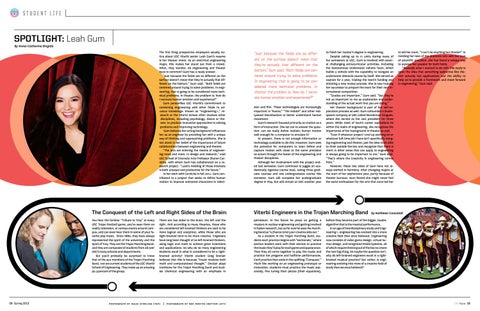
SPOTLIGHT: Leah Gum By Anna-Catherine Brigida The first thing prospective employers usually notice about USC Viterbi senior Leah Gum’s resume is her theater minor. As an electrical engineering major, this makes her stand out from a crowd. What, they wonder, do engineering and theater have in common? Gum has a ready answer. “Just because the fields are so different on the surface doesn’t mean that they’re actually that different on the bottom,” Gum said. “Both fields are centered around trying to solve problems. In engineering, that is going to be considered more technical problems. In theater, the problem is: how do I recreate human emotion and experience?” Gum personifies USC Viterbi’s commitment to combining engineering with other fields to advance knowledge. Known as “Engineering+,” research at the Viterbi School often involves other disciplines, including psychology, dance or theater, to produce innovative approaches to solving problems and improving technology. Gum believes her acting background influences her as an engineer by providing her with a unique way of thinking and approaching problems. She is not alone in her belief of the importance of future collaboration between engineering and theater. “The arts are entering the realms of engineering more and more, in design and research,” said USC School of Dramatic Arts Professor Sharon Carnicke, with whom Gum has collaborated on a research project. “Leah’s melding of these interests is both unusual and productive for the future.” In her work with Carnicke in fall 2012, Gum contributed to a project that seeks to define human motion to improve animated characters in televi-
18 Spring 2013
“Just because the fields are so different on the surface doesn’t mean that they’re actually that different on the bottom,” Gum said. “Both fields are centered around trying to solve problems. In engineering that is going to be considered more technical problems. In theater the problem is: How do I recreate human emotion and experience?” sion and film. These technologies are increasingly important in "Avatar," "The Hobbit" and other Hollywood blockbusters to better understand human movement. Gum’s research focused primarily on motion as a form of interaction. She set out to answer the question: can we really define realistic human motion well enough for a computer to emulate it? At present, there is not enough information or technology available to do this. However, Gum sees the potential for computers to soon define and capture motion with close to the same precision as actors through the fusion of the engineering and theater disciplines. Although her involvement with the project ended last semester, Gum continues to juggle an academically rigorous course load, taking three graduate courses and one undergraduate course this semester. Gum will complete her undergraduate degree in May, but will remain at USC another year
to finish her master’s degree in engineering. Despite taking up to 21 units during many of her semesters at USC, Gum is involved with several challenging extracurricular activities, including the Autonomous Underwater Vehicle Team, which builds a vehicle with the capability to navigate an underwater obstacle course by itself. She served as captain for a year, tripling the team’s funding and initiating a new review process. She is now training her successor to prepare the team for their next international competition. “Grades are important,” Gum said. “But they’re not as important to me as exploration and understanding of the actual work that you are doing.” Her theater background is part of her self-exploration process as well. Gum cofounded a Shakespeare company at USC called Slanderous Tongues, where she served as the vice president for three years. While most of Gum’s career aspirations lie within the realm of engineering, she recognizes the importance of her background in theater as well. “Even if whatever project I end up working on or whatever full-time job I have isn’t specifically merging engineering and theater, just the idea to be able to think outside the box and recognize that there is merit in other areas that can apply to engineering is always going to be important to me,” Gum said. “That’s where the creativity in engineering comes from.” However, these two sides of Gum have not always worked in harmony. After changing majors at the start of her sophomore year, partly because of theater burnout, Gum feared she might never feel the same enthusiasm for the arts that once led her
The Conquest of the Left and Right Sides of the Brain:
Viterbi Engineers in the Trojan Marching Band
You hear the familiar “Tribute to Troy” at every USC Trojan football game, you’ve seen them on reality television, at various events around campus, and can even hear them in some of your favorite pop music. Since 1880, they have always represented the spirit of the university and the Spirit of Troy. They are the Trojan Marching Band, and they are composed of students from all over USC’s many schools and departments. But you’d probably be surprised to know that of the 320 members of the Trojan Marching Band, 100 are current students of the USC Viterbi School of Engineering. They make up an amazing 30.3 percent of the group.
petroleum. In the future he plans on getting a masters in nuclear engineering and getting involved in fusion research, but as for now he sees the marching band as “a chance to let your creative side out.” As a student in the Trojan Marching Band, students each practice begins with “sectionals,” where section leaders work with their section to practice the music they’ll play for each game and appearance. Then they all come together to play the music and practice the pregame and halftime performances. Each practice then ends in the uplifting “Conquest.” Much like working on an engineering prototype or innovation, students must practice the music separately, fine tuning their pieces (their equations),
There are two sides to the brain, the left and the right. And according to many theories, those who are considered left-brained thinkers are said to be more logical and analytical, while those who are right-brained tend to be more creative. Engineers have long been thought of as left-brained thinkers, using logic and math to achieve great inventions and applications. So why do so many engineering students excel in what is considered to be a rightbrained activity? Viterbi student Greg Sinclair believes that this is because “music involves both math and computational thought.” Sinclair plays trombone for the Trojan Marching Band and studies chemical engineering with an emphasis in
P ho t ogr a ph b y I s a a c S t er l i n g ( t op )
P ho t ogr a ph b y Noe M o n t es ( bo t t om l ef t )
to tell her mom, “I can’t do anything but theater!” In melding her love of the dramatic arts with her love of scientific precision, she has found a unique way to express her passion for both fields. “Basically what I wanted to do with this study is open the idea that something subjective like theater actually has applications and the ability to help us to provide a framework and move forward in engineering,” Gum said.
by Kathleen Concialdi
before they become part of the bigger, louder, algorithm that is the musical performance. In an age of interdisciplinary study and Engineering+, engineering has evolved into a more creative field than once believed. Engineering now consists of video game design, virtual human design, and Integrated Media Systems, all of which require thinking out of the box to create the next big thing. So maybe the question isn’t, why do left-brained engineers excel in a rightbrained musical practice? But rather, is engineering evolving into more of a creative field of study than we once believed?
19