University of Southern California • Spring 2010
USC Viterbi // Engineer
The Viterbi Energy Tableau usc president steven b. sample on engineering and leadership tackling heart attack plaque // vizio co-founder remembers his usc days
Viterbi School’s Distance Education Network
USC Viterbi Engineer The Power//of Education – Anywhere, Anytime SPRING 2010
What happens when you get world-renowned policymakers, corporations and engineering academics together in a room?
face the challenge
The game changes. This is not your typical engineering conference. The National Academy of Engineering has identified 14 Grand Challenges where engineering can make the greatest impact to society. Addressing these problems requires innovation and cooperation from engineers from all disciplines, as well as policy leaders, economists and forward-thinking corporations. These challenges include securing cyberspace, reverse-engineering the brain and making solar energy economical. For more on the 14 NAE Grand Challenges, visit www.EngineeringChallenges.org
Join us October 6-8, 2010 for the
2010 Grand ChallenGeS SUmmit at USC’s Viterbi School of Engineering Who Should Attend? • Policymakers
• Corporate leaders • Engineers and Scientists • Innovators and Entrepreneurs
Learn more and register at www.NAEGrandChallengesSummit2010.org
IN ThIS ISSUE
face the challenge
face the challenge
Over 35 M.S. Degree Programs, Non-credit Courses & Certificate Programs
4
11
20
34
FEATURES
DEPARTMENTS
PEER REVIEW
24 < THE VITERBI ENERGY TABLEAU: An in-depth look at how the Viterbi School is tackling the world’s energy challenges.
12 < Board of Councilors 13 < From the Dean: Reflections Upon Time
22 < NEW SENSOR FOR HEART ATTACK PLAQUE: Tzung Hsiai on identifying cardiac emergencies.
33 < FROM THE CEO’S OFFICE: Talking Energy with SoCal Edison’s Technology Alan Fohrer.
• Watch courses via live webcast 34 < FIXING JOHNNY: or archive Terry Sanger attacks cerebral palsy
with the tools offor engineering • Full interactivity classes and medicine. viewed in real time
• Over 130 courses available online SPEcIAl FEATURE in fall and spring semesters 4 < STEVEN B. SAMPLE: USC's President on Engineering and Leadership.
New Programs PhoTo ESSAyfor 2010 M.S. in Green Technologies < 20
HOMECOMING 2009
anyone you know? Here are M.S. inSee Financial Engineering
PARTICLES
23 < UNDERWATER ROBOTS: 8 < GamePipe Lab Creation Hits Market Urbashi Mitra and the Navy study 9 < The Engineer, the Marketer Academics Students networked, submersible vehicles. and the Artist • 168 tenured andLuminaries tenure-track • Flexibility for professional 10 < IEEE Honors Two Viterbi ALUMNI NEWS < faculty members engineers to pursue career and 11 KIEUL Founder the Newest 36 < Promoting Viterbi School in China USC Trustee education simultaneously • Dedicated professors who are 38 < An IT Pioneer on the 'Road 12 < Algorithm Design Star Joins to Wealth'• Network of more than 1,000 leaders Viterbi Schoolin their fields 40 < VIZIO’s co-founder on his USCstudents days < 13 USC Hosts 2010’s NAE Grand • Interdisciplinary programs 41 < Calendar of professional Events Challenges Summit • M.S.Long students 42 < A Naval Officer’s Distancereceive identical 14 < NSF Career Awards for Two Love Affair with USC curriculum as on-campus students Assistant Professors 43 < In Memoriam < 15 A Presidential Award for a Viterbi Nanophotonics Expert Q&A 16 < John Slaughter Joins Viterbi Faculty 44 < Mark S. Humayun discusses his 17 < Remembering Dave Yen and quest to eradicate blindness. John Cohoon “My busy work schedule posed a huge obstacle for me 18 < Faculty Accolades; A Technical to attend classes in person. Fortunately, the online DEN Academy Award for Paul Debevec
What our students say:
M.S. in Electrical Engineering (Electric Power)
program at USC made it really easy for me to watch the classes during my free time at night and on the weekends. DEN made it possible for me to achieve my goal.”
...and exciting new short courses in a variety of disciplines
– Dennis Lee, Northrop Grumman Corporation
pictures from The Viterbi School’s
M.S. inbest-attended Health Systems Management Engineering picnic ever.
NAE GrANd ChALLENGES SUmmiT PArTNErS:
viterbi.usc.edu/mapp
Reflections Upon Time
Board of Councilors CHAIRMAN Dwight J. Baum Private Investor Dean K. Allen, BSME ’57 Retired, Parsons Corporation
Jay L. Kear, BSME ’60 Private Investor Ken R. Klein, BS BMEE ’82 Wind River Systems, Inc., USC Trustee
Gordon M. Anderson, BSME ’54 Retired, Santa Fe International Corporation
Marie L. Knowles, BSChE ’68, MSChE ’70, MBA ’74 Retired, ARCO
Sonny Astani, MSISE ’78 Astani Enterprises, Inc.
David A. Lane, BSEE ’81 ONSET Ventures
Wanda M. Austin, Ph.D. ISE ’88 The Aerospace Corporation
Alexis C. Livanos Northrop Grumman Corporation
William F. Ballhaus, Jr. Retired, The Aerospace Corporation
Alfred E. Mann Alfred Mann Foundation, USC Life Trustee
Ronald R. Barnes, BS ACCT ’76 Norris Foundation
Gordon S. Marshall, BS BUS ’46 Retired, Marshall Industries, USC Life Trustee
Carol A. Bartz Yahoo! Inc.
Fariborz Maseeh Picoco, LLC
Gregg E. Brandow, BSCE ’67 Brandow & Johnston, Inc.
Bryan B. Min, BSISE ’86 Epsilon Systems Solutions, Inc.
Edgar Brower, BSISE ’59 Retired, Pacific Scientific
John Mork, BSPE ’70 Energy Corporation of America, USC Trustee
Simon (Xiaofan) Cao, MA PHYS ’85, MSEE ’87, Ph.D. PHYS ’90 Venture Capitalist
Donald L. Paul USC Energy Institute
Yang Ho Cho, MBA ’79 Korean Airlines, USC Trustee David W. Chonette, MSME ’60, ENGME ’64 Private Investor Leo Chu Hollywood Park Casino and Crystal Park Casino Hotel Malcolm R. Currie Retired, Hughes Aircraft Company, USC Life Trustee Kenneth C. Dahlberg, MSEE ’69 Science Applications International Corporation John Deininger J.D. Investments, Inc. Feng Deng, MS CENG ’93 Northern Light Venture Capital
Allen E. Puckett Retired, Hughes Aircraft Company, USC Life Trustee F. Edward Reynolds, Jr., BSCE ’81, MSCE ’84, MBS ’86 The Reynolds Group George E. Scalise, BSEE ’88 TIAA-Cref Institute
Alan J. Fohrer, BSCE ’73, MSCE ’76 Southern California Edison
Andrew J. Viterbi, Ph.D. EE ’62 Viterbi Group, LLC, USC Trustee
Hester Gill
Warner M. Williams Chevron North America Exploration and Production Company
Jen-Hsun Huang NVIDIA Corporation Karl A. Jacob III, BME ’91, BS CSCI ’00 Coveroo
SPRING 2010 viterbi.usc.edu
Executive Director of Marketing and Communications Leslie DaCruz Managing Editor Lenora Chu Contributing Editors Bob Calverley, Eric Mankin Contributing Writers Bob Calverley, Lenora Chu, Eric Mankin Art Direction and Graphic Design Lime Twig Group Photography/Graphics Steve Cohn, Jon Vidar
Richard D. Stephens, BS NSMA ’74 The Boeing Company
Parviz Tayebati, Ph.D. PHYS ’89 Camros Capital, LLC
Ming Hsieh, BSEE ’83, MSEE ’84 Cogent, Inc., USC Trustee
Chief Executive Officer, External Relations Christopher Stoy
Patrick Soon-Shiong Abraxis BioScience, LLC
Daniel J. Epstein, BSISE ’62 ConAm Management Corporation, USC Trustee
Kenton Gregory, BSEE ’76, MD ’80 Providence St. Vincent Medical Center Oregon Laser Medical Center
Dean Yannis C. Yortsos
Darlene Solomon Agilent Technologies
Mark A. Stevens, BSEE ’81, BA ECON ’81, MS CENG ’84 Sequoia Capital, USC Trustee
Jeff J. Woodbury, BSPE ’83, MSPE ’90 ExxonMobil Development Company
Traditionally, the beginning of a new decade marks the occasion to reflect upon the past 10 years and look ahead to the next 10, but that’s a custom from much slower-moving times. Instead, I’d like to stop and reflect upon the fundamental change in what we now expect from a decade. An achievement which might once have been celebrated as outstanding following 10 years of hard work—in today’s era may barely be considered worthy of mention after two years of effort. In other words, events of significance now grow and decay within a much shorter period of time. Ten years used to be a characteristic measuring scale; that no longer holds true. Indeed, the concept of a linear relationship with time is becoming less and less relevant in the 21st century. Events evolve nonlinearly, and often exponentially in the 21st century.
SPRING 2010
John F. Shea, BS ENG ’49 J.F. Shea Co., Inc.
Albert Dorman, MSCE ’62 AECOM
M.C. Gill, BSChE ’37 Retired, M.C. Gill Corporation, Honorary USC Trustee
Technology is Accelerating the Pace at Which Change is happening
Volume 8, Issue 2 USC Viterbi Engineer is published twice a year for the alumni and friends of the Viterbi School of Engineering at the University of Southern California. Letters to the editor and comments are welcome. Please send them to: USC Viterbi Engineer Olin Hall 500 Los Angeles, California 90089-1451 Or email them to: viterbi.communications@usc.edu.
viterbi.usc.edu
“
At USC this fall, we will host the second 2010 NAE Grand Challenges Summit to discuss solutions that interweave technology, innovation and public policy.
”
Why? A major driver is the ever-accelerating growth of technological change. That’s one concept presented brilliantly by the noted computer scientist and futurist Ray Kurzweil in The Singularity is Near. Moore’s law—the observation that the capacity of semiconductors doubles roughly every two years— also reflects the rapid pace of change. As we enter the decade of the 2010s, we at the Viterbi School are acutely aware that work on the substantial new challenges facing our world needs to happen at that accelerated pace. What are these challenges? The National Academy of Engineering categorized their top priorities into four broad categories: Sustainability, Vulnerability, Health, and the Joy of Living. Our global problems require a solution that interweaves technology, innovation and public policy.
As engineers, we have a crucial role to play in answering NAE’s societal call to action. In that vein, we organized last year the first-ever Summit on the NAE Grand Challenges in collaboration with the Olin College of Engineering and Duke University’s Pratt School of Engineering, which hosted the conference. In the spring, a series of follow-up meetings will take place on university campuses across the country. And in the fall of 2010, we will host at the USC campus the sequel to that first summit. This will bring to campus policymakers, corporate leaders and renowned academics to discuss solutions that interweave technology, innovation and public policy. Speaking of game-changing, this issue’s feature article provides a glimpse into our own efforts in energy—one of the critical areas addressed by the Grand Challenges. I hope you enjoy reading about our work. And as I close out my reflections upon time, I’d like to speak about a man whose accomplishments are noteworthy whether measured in years or decades. In the nearly 20 years that Steven B. Sample has served as president of USC, he has helped elevate our institution to the level of the world’s truly elite universities. That’s a trajectory with true power-law growth in quality, quantity and reputation! He is an engineer equally at ease in the arenas of public policy, art, the humanities, social sciences and the health sciences. In short, he exemplifies what we call Engineering Plus. For his outstanding accomplishments, we will honor Steve at the 2010 Viterbi Awards later this Spring. In the meantime, enjoy this latest edition of the Viterbi Engineer, and I wish you exponentially large returns as we push ahead into this decade!
Yannis C. Yortsos Dean, USC Viterbi School of Engineering
From The Dean
2<
spec ial feature > 5
Steven B. Sample Reflections from the USC President’s Office An electrical engineer, inventor and author, Steven B. Sample has been president of the University of Southern California since March 1991. A tenured professor in the USC Viterbi School of Engineering, he is a member of the National Academy of Engineering and the American Academy of Arts and Sciences. His best-selling book, The Contrarian’s Guide to Leadership, was named one of six “must-reads” for leaders by Harvard Management Update of the Harvard Business School, and he co-teaches a popular undergraduate course with management professor Warren Bennis titled “The Art and Adventure of Leadership.” >> Widely considered one of America’s best university presidents, Dr. Sample has been
I’m an engineer by education, and a leader by occupation. Both are problem-solving professions that have dissimilar roots. Engineering employs well-defined mathematical, scientific and technological principles, while leadership is remarkably fluid, situational and contingent. Unlike the specificity of math and science, leadership has no set rules. This elusive quality of leadership makes it an art, not a science. Thus it is more like music, painting and poetry than it is like more routine endeavors. Nonetheless, aspiring leaders can be taught to develop their own potential for leadership by studying what’s worked for others. As part of my own study of leadership, I have co-taught with management expert Warren Bennis a course for juniors and seniors each spring called “The Art and Adventure of Leadership.” Each year it has been the most sought-after upper-division course at USC, attracting over 300 applicants for just 40 slots. Although most of the students in this leadership class aren’t engineering majors, I often tell them how the study of engineering has made me a better leader. It’s a way to remind them that leaders come from all types of disciplines and backgrounds. In other words, the path to political leadership is not necessarily through political science, nor is business school the only route to becoming a corporate CEO.
In fact, 30 or 40 years ago the doors were closed to engineers who wanted to be presidents of comprehensive universities. Today, among the 62 members of the Association of American Universities (which comprises America’s leading research universities), 10 are led by engineers (including USC). What lessons can be learned in engineering that can contribute to a person’s effectiveness as a leader? At the top of the list would be analytical thinking and judgment—key attributes of the engineering profession. These qualities can help leaders examine problems from various angles and assess situations through both qualitative and quantitative means. The downside of engineering as preparation for leadership occurs when engineers become so entrenched in a particular technology or methodology that they stop exploring new ideas. They may then lapse into rigid thinking that can stifle their own creativity and that of others. In addition, engineers—whose work directly affects people—sometimes gloss over the importance of moral and ethical considerations in the design and creation of new products or processes.
the driving force in solidifying USC’s status as a top research university. He will retire in August 2010. He earned his bachelor’s, master’s and doctoral degrees in electrical engineering from the University of Illinois, and holds honorary degrees from eight universities and colleges. >> Here, President Sample offers his thoughts to young engineers on problem solving and leadership.
SPRING 2010 viterbi.usc.edu
>>
6 < spec ia l feature
spec ial feature > 7
What I love most about engineering is that it cultivates skillful judgment and analysis—key ingredients in effective problem solving. Real engineers make judgments based on inadequate information and imperfect designs. They operate under constraints such as time, cost, size, reliability, customer appeal and what the competition is doing. Sometimes an engineer’s judgments are based as much or more on gut feeling than on precise analysis. One does not need to be a professional engineer to crank out closed-form analyses of problems that lend themselves to precise solutions; such work can be done by computers
What I love “
most about engineering is that it cultivates skillful judgment and analysis—key ingredients in effective problem solving.
”
SPRING 2010 viterbi.usc.edu
and technicians. Rather, the exquisite part of engineering involves deciding to move ahead with a solution based on reasonable professional judgment and analysis, when you know that the solution is not as good as the one you might develop if you were to keep working on the problem. In exploring possible solutions to a problem, engineers—just like leaders— must be careful not to fall into the proverbial rut of rigid and narrow thinking. Often the most important inventions in a particular field are made by people who are new to that field—people who are too naïve and ignorant to know why something can’t be done. These neophytes, unburdened by hidebound traditions and internal naysaying, are able to think more freely about seemingly intractable problems. They’re willing to explore radically new ideas and approaches. Unfortunately, some engineers feel threatened by new inventions. When I was a practicing engineer, I quickly found out that many of my colleagues, after just a few years in practice at one company and in one technology, become psychologically and emotionally wedded to that technology. Just consider this: When I was just starting out as an engineer, the leading vacuum tube manufacturer was RCA. Then the transistor was invented. One would think that RCA, as the dominating force in the development and manufacturing of electronic “switches, would have latched onto the transistor as a new technology that could take their business to greater heights of success. However, many of the engineers at
As an engineer, “
I’m especially pleased that top research universities such as USC are in the vanguard of pursuing solutions to societal problems.
RCA hated the transistor. So Texas Instruments became the rising star of the transistor business. And although an engineer at Texas Instruments later invented the integrated circuit, most of the engineers at TI had spent their whole lives with discrete transistors, and they found it difficult to love integrated circuits. So another firm— Intel—became dominant in that field. Although hidebound thinking can be stultifying, moral laxity can be downright dangerous. Leaders must develop a strong moral compass if they are to be good as well as effective leaders. Even the perception that a leader is dishonest, unfair, or unconcerned about the rights of other people can adversely affect the success of a company or organization. As engineers, many of us would like to think that engineering is somehow morally neutral. But engineering is all about empowering people to manipulate and exploit the natural world for their own purposes. Thus, engineering is inevitably involved in moral as well as technological issues. Sometimes the outcomes of our work as engineers are morally repugnant. For example, engineers are frequently asked to develop better methods for killing and maiming people.
”
However, engineers also have developed ways to make people safer, communication faster, infrastructures more reliable, and computer systems more secure. Engineers are at the forefront of developing new and better robots, biomedical devices, nanotechnologies and multimedia tools that enhance the health, education and well-being of people around the world. As an engineer, I’m especially pleased that top research universities such as USC are in the vanguard of pursuing solutions to societal problems. Most of society’s major
challenges are global in scope. They include sustainability, disease prevention, environmental quality, and fossil-fuel alternatives—all areas in which engineers can and do make important contributions to improving people’s lives. In conclusion, the best advice I can give to young people who are studying engineering or leadership is to cultivate their natural creativity, their intellectual independence and their moral integrity. These are the best tools for guarding against the rigid thinking and moral ambivalence that can drag down or prostitute new ideas. The goal of my work as an engineer—and as a university faculty member—has been to expand human potential. I encourage engineers who are inclined toward leadership to exploit the fact that their talents and predilections as engineers will serve them well as leaders. //
Partic l es > 9
particles The Engineer, the Marketer and the Artist Bringing Real-World Product Development to the Classroom
Company Releases Video Game Created at USC Reflection created at Viterbi School’s GamePipe Laboratory An award-winning video game created by a dozen USC students working on an interdisciplinary project has gone commercial. Reflection was created at the USC Viterbi School’s GamePipe Laboratory and released by Konani Digital Entertainment for the Nintendo DS handheld game console. The game was finished in the Final Game Projects yearlong course co-taught by Scott Easley, associate director of the GamePipe Lab; Chris Swain, associate professor in the USC School of Cinematic Arts; and Mike Zyda, GamePipe’s director. Reflection won the Independent Games Festival’s prestigious “Next Great Mobile Game” award, at the group’s March conference in San Francisco. A jury made the decision, which brought the team $2,000 and the attention of the game industry. The game’s premise is explained this way on its Web site (www. reflectionds.com): “The world splits when a powerful mirror is fragmented and its shards dispersed. Now to restore the world, thief-for-hire Kirra must navigate through a shattered reality to find and piece back together the broken shards of the mirror.
GamePipe students at work in the laboratory.
“Players control the agile Kirra as she jumps, slides and flips. But to successfully complete the different game levels, players need to use both of the Nintendo systems together.” The shattered reality has also split Kirra into two entities, one good and one evil. “Players are essentially forced to control both a normal character and an upside-down mirror image, simultaneously, with the same set of controls, all the while solving puzzles that involve manipulating both characters,” says the Konami announcement describing the game. “As the game alternates between these two sub-mechanics, gamers will have to learn to use both characters in order to prevail.”
Visit our website for the latest Viterbi news:
“The joy of a professor,” commented Zyda, “is to see your students start out from nothing and then get to the point where they’re actually doing just phenomenally great work.” More than a dozen USC students were part of the Reflection team, including students majoring in computer science, computer engineering, business, communications, creative writing, interactive media, video and cinematic arts. In addition to the design, writing, programming and artwork, the game featured original music the students composed. //
viterbi.usc.edu
SPRING 2010 viterbi.usc.edu
Top: Interdisciplinary Team Belkin with the project board for their energy-saving device; Bottom L: Viterbi students Joseph Benson, Urmila Mahadev, Roger Han; Bottom R: Viterbi students Pierre Johnson, Greg Lee, Eric Henderson
Throw together an engineer, an artist and a marketer. Then ask them to develop the next hot commercial product—together. Give these students 15 weeks to do it, and tell them their class grade depends partly on what their peers say about them. And require them to build a prototype by semester’s end. There are definitely a few “personnel” challenges, says Allan Weber, the Viterbi lecturer behind the ground breaking EE459 course, which has brought together students from three disciplines to develop products that incorporate advanced processing technology. Sometimes the dynamic personalities ended up running the show. Other times, the engineering students had trouble digesting the function of the marketing students, and vice versa. And inevitably, someone always felt another student wasn’t pulling his weight. “I’d tell them to get used to the real world and working with people they might not like,” Weber says. “And they did. The end result has engineers working with people in other fields as equals. This is a true interdisciplinary experience in product development.” The class is built around the idea of collaboration, and brings together faculty and students from three USC schools— The Viterbi School (Ming Hsieh Department of Electrical Engineering), the Marshall School of Business (Marketing) and the Roski School of Fine Arts—for a lecture series and laboratory time.
At the beginning of the semester, Weber and his collaborating professors—Therese Wilbur of the Marshall School and Tom Schorer of the Roski School—would divide students from each of the three disciplines into small teams. Each team would choose a brand such as Apple, Brookstone or Nike, and work with that brand’s concept to develop a product pre-selected by the professors. In EE459’s first year, the students developed working prototypes of an alarm clock capable of a different setting for each day of the week—fitting for a student’s varying academic schedule. The second year, the instructors chose an energysaving device for home entertainment centers. That year, a real-world company was bringing a similar product to market at a price point of $200, Weber says, which got the students excited about entrepreneurship possibilities for their product. “They were laughing, saying they’d done the research and that the product would never sell for $200,” Weber says, adding that student marketers found a $70 price sticker to be more realistic. For the semester-long course, students were assigned differing tasks: Engineers were responsible for the technological aspects of the product, the marketers conducted focus groups and market research, and the fine arts students built full-scale models of the final product, complete with logos and packaging. The teamwork is where the ingenuity emerged, Weber says, as cross-collaboration helps produce something a consumer might “actually want to pay money for.”
“
Past students have
told us that talking about the collaborative experience helped them at job interviews and people in industry say they want to hire engineers who can work across disciplines.
”
As EE459 enters its third year in spring 2010, enrollment is looking strong, and the professors are leaning towards an innovative water-conservation device as the next product for development. Weber says the class prepares Viterbi graduates well for the working world. “Past students have told us that talking about the collaborative experience helped them at job interviews,” Weber says. “And people in the industry say they want to hire engineers who can work across disciplines.” //
10 < Partic l es
Partic l es > 1 1
IEEE Honors Two USC Luminaries
KIUEL Founder the Newest USC Trustee
Andrew Viterbi will receive the Medal of Honor, while Barry Boehm earns the Simon Ramo Medal
Ken Klein: The “Cool”-est Addition to the Board
Andrew J. Viterbi
The Institute of Electrical and Electronics Engineers (IEEE) has bestowed its highest award, the Medal of Honor, on Andrew Viterbi, namesake of the Viterbi School; and it has given the Simon Ramo Medal to another Viterbi faculty member, Barry Boehm. Both will receive their medals in Montréal, Québec, on June 26 at the Barry Boehm Annual IEEE Honors Ceremony. “The award of the IEEE Medal of Honor to Andrew Viterbi is yet another affirmation of his unparalleled achievements in communication theory, business and practice,” said Dean Yannis C. Yortsos. “He has helped connect the world as never before and made better the life of humankind. We cannot be more proud.” Viterbi, who holds a Presidential Chair in Engineering at USC, received the National Medal of Science in 2007. He is a member of the National Academy of Engineering, the National Academy of Sciences and the American Academy of Arts and Sciences. He is a Marconi Fellow, and has received several other top honors in communication technology, including the IEEE Shannon Award and the Alexander Graham Bell Medal. In 2008, he was named a Millennium Technology Prize Laureate.
Barry Boehm is the 2010 IEEE Simon Ramo Medal winner. The IEEE established the medal in 1982 to recognize exceptional achievement in systems engineering and systems science. Boehm’s recognition is “for leadership in and innovative solutions to the integration of systems engineering and software engineering.” Boehm, USC’s TRW Professor of Software Engineering, is a member of the National Academy of Engineering, and a fellow of the primary societies in computing, aerospace, electronics and systems engineering. He has appointments in the Daniel J. Epstein Department of Industrial and Systems Engineering and the Department of Computer Science, and founded USC’s Center for Systems and Software Engineering in 1993. USC Provost and Executive Vice President C.L. Max Nikias, formerly dean of the Viterbi School, won the Ramo Medal in 2008. The medal is named in honor of Simon Ramo, one of the founders of TRW, Inc., now part of Northrop Grumman. Ramo and his late wife, Virginia, were founding co-chairs of the board of overseers of the Keck School of Medicine of USC, as well as co-recipients of the 2002 USC Presidential Medallion. Ramo also holds a Presidential Chair at USC. IEEE, with 370,000 members, is the world’s largest professional technical association. //
Viterbi School Celebrates 75th Birthday of Namesake Andrew Viterbi Faculty, staff, students and the USC Trojan Marching Band gathered in Tutor Hall on February 25th, 2010 to celebrate the 75th birthday of the Viterbi School’s namesake, Andrew Viterbi. USC Provost C. L. Max Nikias and Dean Yannis Yortsos were on hand for the unveiling of a bust of Andrew Viterbi. Its location on the ground floor of Tutor Hall is the most-traveled corridor in the engineering school. Viterbi, who received his PhD in electrical engineering from USC in 1962, is the co-founder of Qualcomm. Viterbi and his wife Erna named the engineering school with a $52 million gift in 2004. // Caption (L-R): Andrew Viterbi, Erna Viterbi, C. L. Max Nikias, Yannis Yortsos.
SPRING 2010 viterbi.usc.edu
“ ‘KIUEL’ is pronounced ‘cool.’ ” That was the tagline coined three years ago to promote the Viterbi School’s Klein Institute for Undergraduate Engineering Life, or KIUEL. And now Ken Klein, the namesake of that institute, has been elected to the USC Board of Trustees. Chairman of the board, CEO and president of Wind River Systems Inc., Klein established KIUEL with an $8 million gift in 2005, with the aim of enhancing the undergraduate experience, outside the classroom, for engineering majors. KIUEL sponsors personal and professional programs centered on leadership, cross-disciplinary networking, globalization and community service. “The engineering major is tough, any way you slice it,” says Klein, who holds dual bachelor’s degrees in biomedical and electrical engineering from USC. “I wanted to send a message of
encouragement to student engineers by establishing an institute that will enrich their lives outside of the classroom, and hopefully make things easier for them.” USC President Steven B. Sample sings Klein’s praises. “Ken Klein is an exemplary USC alumnus whose keen
“
his passion for giving back, for making sure that new generations of students at his alma mater will have opportunities to make the most of their experience here. We look forward to benefiting from his expertise and insights.” A global leader in device software optimization, Wind River has more than 1,600 employees in 15 countries. The company, which was founded in 1981 and is headquartered in Alameda, Calif., was acquired by Intel Corp. in 2009. Klein has more than two decades’ experience in the software industry. Before taking the helm of Wind River, he held a series of executive positions at Mercury Interactive Corp., a software company focused on business technology optimization. He previously held a variety of engineering, marketing and management posts at Interactive Development Environments, Daisy Systems and Hughes Aircraft Co. Klein serves on the boards of directors of AmberPoint Inc. and BigFix Inc. He is also a member of the USC Viterbi School of Engineering’s Board of Councilors. He has previously served on the boards of Tumbleweed Communications and Navis LLC. He lives with his wife, Natalie, and two sons in Atherton, Calif. //
Ken Klein is an exemplary USC alumnus whose
keen business sense and thorough knowledge of the entrepreneurial process, from inception to fruition, will make him a real asset to the board.
business sense and thorough knowledge of the entrepreneurial process, from inception to fruition, will make him a real asset to the board,” Sample said. “Another valuable strength he brings is
”
12 < Partic l es
face the challenge
Operations Research Star Joins the Viterbi School dorit hochbaum awarded epstein family chair A world-renowned scholar with wideranging operations research interests is the inaugural recipient of the Epstein Family Chair in the Daniel J. Epstein Department of Industrial and Systems Engineering (ISE). Dorit Simona Hochbaum, who has made major contributions to algorithm design and optimization, will join the Viterbi School in fall 2010 from UC Berkeley’s Haas School of Business and Berkeley’s College of Engineering’s Department of Industrial Engineering and Operations Research. “It’s not often we get our first choice when trying to recruit the very best faculty members, but on this occasion the Epstein ISE faculty got exactly what we wished for,” says the department’s chair, James E. Moore. Moore adds that Hochbaum’s expertise is “a natural fit” for ISE and Viterbi School initiatives in health systems, as well as the university’s existing Department of Homeland Security research agendas. In accepting the appointment, Hochbaum said, “I am thrilled about the prospect of becoming a chaired professor at the Daniel J. Epstein Department of Industrial and Systems Engineering.” Hochbaum’s research ranges from supply-chain management to efficient utilization of resources, computer algorithms and discrete optimization. She has worked on locations of plants and bank accounts; on movement of robots; on routing and distribution problems; on
SPRING 2010 viterbi.usc.edu
feasibility of VLSI designs; on distribution of databases on computer networks; on clustering problems; and on image segmentation and pattern recognition problems, among others. She contributed to the analysis of heuristics and approximation algorithms in the worst case and on the average, and to the complexity analysis of algorithms in general, and nonlinear optimization algorithms in particular. The latter involve devising best algorithms possible for some key problems, such as Markov Random Fields, and allocation problems, and demonstrating that non-linear optimization problems cannot be solved in strongly polynomial time. Her recent work focuses on particularly efficient techniques for network flow-related problems and inverse problems, with applications varying from medical prognosis, error correction, financial risk assessment and prediction, to group rankings and decision problems.
“
Hochbaum is the author of more than 130 research articles, with her work cited more than 4,000 times by other researchers. She has served as departmental editor of Optimization and Modeling for the Management Science department, and also held positions on the editorial board of Networks and on the advisory board of Algorithms and Operations Research. In the past, she has served on the editorial boards of Operations Research and Operations Research Letters, and was the founder and director of the UC Berkeley Supply Chain Initiative, which seeks to focus research activity and collaboration with industry for faculty and students with expertise in this area. In 2004, Hochbaum received a Doctor Honoris Causa in sciences from the University of Copenhagen Denmark for her contributions to approximation algorithms. And in 2005, she was named a fellow of the Institute for Operations Research and the
Hochbaum
is particularly well known for her work in optimization—working to prove that a particular solution is not just good, but as close as possible to being the best.
Hochbaum is particularly well known for her work in optimization— working to prove that a particular solution is not just good, but as close as possible to being the best. “I try to be an optimizer in whatever I do,” she says on her home page, including “baking cakes optimally.”
”
Management Sciences (INFORMS). Prior to joining UC Berkeley in 1981, Hochbaum held a faculty position at Carnegie Mellon University’s Graduate School of Industrial Administration (GSIA), now the Tepper School of Business. She earned a Ph.D. from the Wharton School of Business at the University of Pennsylvania. //
face the challenge
USC to Host 2nd NAE Grand Challenges Summit Leading Experts to Discuss Society’s Pressing Challenges
Engineers are in a unique position to help solve the world’s most pressing environmental, economic and societal problems. And as the first decade of the 21st century comes to a close, addressing these issues promptly has become a critical task. “The modern engineer is an innovator, a leader and an entrepreneur,” says Viterbi Dean Yannis C. Yortsos. Enter the National Academy of Engineering (NAE) Grand Challenges Summit. In October 2010, the USC Viterbi School of Engineering will host a conference to further the dialogue about how best to address today’s pressing challenges, including global security, our quality of life and a sustainable future. Duke University’s Pratt School of Engineering, Olin College of Engineering and the California Institute of Technology will co-host. “We’re bringing together the great engineering minds and experts from academia, government and industry to help work out the solution to the National Academy of Engineering’s 14 Grand Challenges,” Yortsos says. The 14 challenges are vast in scope; they encompass goals as wide-ranging as preventing nuclear terror, advancing healthcare informatics and providing all global citizens with access to clean water. This urgent call to action was sounded several years ago by the NAE, in partnership with the National Science Foundation. Students from universities across the nation will be invited to participate in the discussion. One of the NAE’s most critical goals is to enhance student interest in engineering and science.
“Our fundamental task must be to increase the number of U.S. citizens entering these fields,” says NAE President Charles Vest. “This requires two things: inspiration and improved education.” Summit organizers also plan to advance the idea that to be most effective, engineers should also school themselves in law, policy and business—the central concept of Engineering Plus. The 2010 summit will build on the momentum launched at the inaugural National Grand Challenges Summit in Durham, N.C., in 2009. For this two-day conference, the Viterbi School also partnered with the engineering school of Duke University and Olin College. Summit organizers hope to conclude the 2010 summit by laying the groundwork for future collaborations between leaders in science, business, law, social sciences and the humanities. //
Planning for the National Grand Challenges Summit at USC on October 6-8, 2010 is now underway. For more information, visit www.NAEGrandChallengesSummit2010.org For more detail about the National Academy of Engineering’s 14 Grand Challenges, visit EngineeringChallenges.org.
14 < Partic l es
Partic l es > 1 5
Two Viterbi Faculty Receive NSF CAREER Awards
Nanophotonics Expert Wins Presidential Award
Multi-year grants will enable study of nano-twins, network economics
Andrea Hodge
Rahul Jain
The National Science Foundation has awarded two Viterbi assistant professors with 2010 Faculty Early Career Development awards. Andrea Hodge and Rahul Jain received these multi-year awards in recognition of their exemplary research, leadership and education. Hodge, of the Department of Aerospace and Mechanical Engineering, was awarded a five-year, $500,000 grant to study the effect of nano-twins on the grain structure, behavior and performance of materials. Entitled “Exploring Nanoscale Growth Twins for the Development
of Grain Boundary Engineering at the Nanoscale,” her research project aims to further the field of materials development by studying how to improve nanostructured materials in terms of thermal stability and ductility. A native of Medellin, Colombia, Hodge also received a two-year, $175,000 BRIGE award in 2008 to study magnetron sputtering and the processing of metallic thin films. Her general research focus is processing and mechanical behavior at the nano- and micro-scale of engineered materials. Hodge received her Ph.D. in materials science and engineering from
Pinkston Tapped as Senior Associate Dean he will focus on faculty and student recruitment Viterbi Dean Yannis C. Yortsos has appointed a faculty member from the Ming Hsieh Department of Electrical Engineering (EE) to the school’s leadership team. Timothy Pinkston, who has more than 16 years of tenure, will serve as senior associate dean of engineering. His primary focus will be the enhancement of faculty and student recruitment, and retention efforts across the school. “Timothy’s appointment reaffirms our commitment to continuously building a strong and diverse body of outstanding faculty and students,” says Yortsos. Pinkston aims to continue to improve the quality and diversity of our faculty and student body. By casting a wide net and taking proactive steps to compete at the highest levels, we will identify and attract top talent, both nationally and internationally,” says Pinkston. Pinkston recently took a two-year leave from the Viterbi School to serve as a program director in the Directorate for Computer and Information Science and Engineering (CISE) at the National Science
Foundation (NSF). While in Washington, D.C., he managed an award portfolio of approximately $10 million for CISE’s Computer Systems Architecture program and $40 million for CISE’s flagship Expeditions in Computing program in its inaugural year. While at NSF, he served on a number of task forces and working groups, including CISE’s Strategic Planning Committee for Broadening Participation in Computing. Since returning from NSF in late 2008, Pinkston has been on sabbatical, completing “on-going projects and laying the groundwork for new research activities in the increasingly important area of computer systems interconnect architecture.” Prior to his NSF appointment, Pinkston served on USC’s Task Force on Graduate Education and chaired the Dean’s Ad Hoc Committee to Promote Diversity in the Viterbi School’s Graduate Programs. He’s also been a past director of EE’s Computer Engineering Division and former chair of the Viterbi School’s Engineering Faculty Council. Pinkston has published more than 100 technical articles and book chapters on topics related to computer systems architecture. Pinkston is an IEEE fellow and received his Ph.D. from Stanford. //
Northwestern University and her B.S. in mechanical engineering from the University of Nevada, Las Vegas. Jain, of the Ming Hsieh Department of Electrical Engineering, received a five-year, $425,000 grant to study the role economic incentives play in the efficient and reliable operation of the Internet and Wireless infrastructure. Entitled “Network Economics: Theory and Architectures for Incentive-Engineered Networks,” his project aims to develop a methodology for systematic network architecture design, taking user and network provider incentives into account. The end goal is benefiting existing wireless networks and the Internet by improving their quality of service, increasing their capacity and efficiency, and enhancing their reliability and commercial viability. A native of Chandigarh, India, Jain also received a three-year, $431,000 network science and engineering grant to study how best to enable sharing of wireless spectrum, such as the “white space” in TV broadcast bands among primary and secondary users. His general research focus is on analysis of communication networks and stochastic models that arise therein. Jain received his Ph.D. in electrical engineering and computer sciences and an M.A. in statistics from UC Berkeley; an M.S. in electrical and computer engineering from Rice University; and a B.Tech in electrical engineering from the Indian Institute of Technology, Kanpur. //
Povinelli wins U.S. Government’s Top Honor for Young Scientists Michelle L. Povinelli has won the U.S. government’s highest honor for scientists and engineers beginning their independent careers. The assistant professor in the Ming Hsieh Department of Electrical Engineering (EE) has won a Presidential Early Career Award for Scientists and Engineers. The Presidential award begins in the summer of 2010 and consists of a $200,000 grant per year for five years, for a total of $1 million. Povinelli will use the award to study “Light Assisted Assembly and Reconfig uration of Complex Optical Materials Using Microphotonic Templates,” the proposal for which she was awarded a three-year $150,000 Army Research Office Young Investigator Award last year. Povinelli was recommended for the Presidential Award by her Army Research Office program manager through the Department of Defense; the White House’s National Science and Technology Council makes the final selection. The Army grant will be rolled into the Presidential award. The Presidential award program was commissioned by President Bill Clinton to honor and support the extraordinary achievements of young professionals at the outset of their research careers in science and technology. According to the program statement, the award initiative embodies the government’s prioritization of maintaining the United States’ global leadership position in science. The Presidential award comes only months after Povinelli won a fiveyear $400,000 Faculty Early Career Development Award from the National Science Foundation. CAREER awards are bestowed in recognition of exemplary research, leadership and education,
and Povinelli’s winning proposal was entitled “Optical Forces in Integrated Microphotonic Devices.” “The awards are clearly a proof of Povinelli’s excellent research ideas and direction as well as her excellent accomplishments so far,” said Eun Sok Kim, Professor and Chair of EE-Electrophysics. “The research funds will be instrumental for her to lay down a solid foundation for her research programs, which we believe will be very impactful. We are proud of her, and have great confidence in her.” Povinelli studies nanophotonics, or the interaction of light with nanostructured and microstructured materials. The grants will jumpstart her goal of building a focused experimental effort on the fabrication and characterization of silicon microphotonic devices, including microscale waveguides and photonic crystals. Povinelli says her work involves the close connection between science and technology; advances in fabrication and synthesis of nanostructured materials continuously suggest new scientific questions as well as new technological applications, she says. Graduate students are already on hand to carry out the work. Povinelli has recruited four Ph.D. candidates since her arrival in August 2008, two of whom have already co-authored papers with her. Povinelli received a B.A. with honors in physics from the University of Chicago, an M. Phil in physics from the University of Cambridge, and a Ph.D. in physics from the Massachusetts Institute of Technology. She came to the Viterbi School from Stanford University, where she performed post-doctoral work in the Gintzon Laboratory. She holds the Women in Science and Engineering (WiSE) program Gabilan Assistant Professorship. //
16 < Partic l es
Partic l es > 1 7
John Brooks Slaughter Joins Viterbi Faculty engineer-educator is former director of the national science foundation John Brooks Slaughter has joined USC as professor of Education and Engineering. Slaughter has had a remarkably distinguished career, which began as an electrical engineer and includes leading two universities and heading the National Science Foundation (NSF) as its first African-American director, among many other accomplishments. Throughout his career, Slaughter has been both a pioneer and an intrepid advocate for diversity—in higher education and in the areas of science, technology, engineering and mathematics (STEM). In his new position, Slaughter will be looking at the intersection between engineering and education, with a focus on what has become his lifelong quest of increasing underrepresented minority participation in the STEM fields. “I was pleased to see strong interest in both the School of Education and the School of Engineering to combine their interests and work together. That’s rare in higher education on most campuses. These two deans have a common interest,” Slaughter said. “A truly effective STEM effort requires participation by science faculty, engineering faculty and faculty in the school of education to truly have an impact.” Dean Yannis C. Yortsos of the Viterbi School expressed his delight in having Slaughter join his School. “The nation urgently needs to increase the recruitment to engineering, and the retention, of students from all backgrounds. His impact in this effort will be immediate and significant, both at the Viterbi School and at the national level,” Yortsos said. Slaughter began his career in 1956 as an engineer at General Dynamics Convair. In 1960, he joined the United States Naval Electronics Laboratory Center in San Diego. After 15 years with the Navy, Slaughter embarked on a series of higher- and higher-profile leadership roles, including assistant director of the Astronomical, Atmospheric, Earth and Ocean Sciences Directorate of the NSF in Washington, D.C., and academic vice president and provost of Washington State University. In 1980, Slaughter accepted the historic appointment as the first African-American to direct the NSF. He returned
SPRING 2010 viterbi.usc.edu
to higher education in 1982 as chancellor of the University of Maryland and took the job of president of Occidental College in 1988. At both universities, Slaughter made major advancements in the recruitment and retention of AfricanAmerican students and faculty. He also taught courses in diversity and leadership for one year as Irving R. Melbo Professor of Leadership Education at USC, before accepting the position of president and CEO of the National Action Council for Minorities in Engineering. He is a member of the National Academy of Engineering and the Hall of Fame of the American Society for Engineering Education. Slaughter is also a fellow of numerous organizations, including the American Academy of Arts and Sciences and the American Association for the Advancement of Science. He is the founding editor of the international journal, Computers & Electrical Engineering. Slaughter holds honorary degrees from more than 25 institutions, and has received numerous awards, including the Martin Luther King, Jr. National Award in 1997; UCLA Medal of Excellence in 1989; the first U.S. Black Engineer of the Year award in 1987; and the NSF Distinguished Service Award in 1979. Slaughter holds a Ph.D. in engineering science from the University of California, San Diego (1971), an M.S. in engineering from the University of California, Los Angeles (1961), and a B.S. in computer sciences from Kansas State University (1956). //
“
I was pleased to see strong interest in both the School of Education and the School of Engineering to combine their interests and work together. That’s rare in higher education on most campuses. These two deans have a common interest.
”
Loss of a ‘Gentleman and Scholar’: Professor Dave Yen Teh Fu “Dave” Yen, an environmental chemist who was a member of the faculty at USC for more than 50 years, passed away peacefully January 12 in a hospital where he was being treated for a hip fracture and heart problems. He was 83 years old. Yen was a professor in the environ mental engineering program in the Sonny Astani Department of Civil and Environmental Engineering and had served on the USC faculty since 1969. “Dave Yen was a highly creative geochemistry researcher who specialized in developing innovative green technologies,” said Viterbi Dean Yannis C. Yortsos. “He was beloved by his students and deeply respected by faculty colleagues. We will all miss him greatly.” A few days before he died, Yen’s students visited him at the hospital to celebrate his 83rd birthday. “He was really happy, smiled a lot, talked to
each one of the students who went to his surprise birthday party,” said Chia-Yu “Iris” Yang, a doctoral student in environmental engineering. Raised in Kunming, the capital of Yunnan Province in China, Yen received his B.S. in chemistry from Huachung (Central China) University, an M.S. in chemistry and chemical engineering from West Virginia University, and his Ph.D. in organic chemistry and biochemistry from Virginia Polytechnic Institute. After a brief period on the faculty at California State University, Los Angeles, Yen joined the USC faculty in 1969 as an associate professor of biochemistry and chemical and environmental engineering. He was well-known for his research on the science and technology of alternative processes to achieve the environmentally benign use of fossil fuels. He pioneered an innovative process using bacteria, fungi and other parasites to clean up dangerous toxic waste and
developed an inter-metallic filter to remove sulfur from low-grade oil. Yen produced more than 500 papers and was the author, co-author, editor or co-editor of 26 books. He was a founder of the geochemistry division of the American Chemical Society and an editor, founding editor or editorial board member of numerous technical journals. “He was working on a book even in the hospital,” said Jean-Pierre Bardet, professor and chair of the Astani Department. “He was a gentleman and a scholar, much-loved by his students, and well-known in several areas of engineering and chemistry.” A fellow of the American Institute of Chemists and the Institute of Petroleum, he received the Distinguished Faculty Member Award from the USC Alumni Association in 1975, among many other honors. He lived in Altadena, Calif., and is survived by his wife, Shiao Ping. //
John Cohoon, Longtime USC PR Professional, Passes Away John Cohoon, who worked for USC as a public relations professional for 34 years, passed away January 9 in Pasadena. He was 66 and had been diagnosed with cancer the previous November. “John was an eloquent and masterful speechwriter, who cared deeply about USC and the Viterbi School,” said Viterbi Dean Yannis C. Yortsos. “He was our institutional memory. Every public relations challenge that we faced was one that he had already experienced. We will miss him greatly.” Cohoon began working for USC in November 1975, the same year that he received his M.A. degree in journalism from the university. For two decades, he managed a broad range of public relations activities at USC’s Institute for Safety and Systems Management
(ISSM), including communications, publications, marketing, advertising, events, volunteer activities and fundraising campaigns. In 1997 when ISSM was dissolved, Cohoon briefly served as the marketing manager at the Aviation Safety Program (now Aviation Safety and Security), before joining the external relations department at the School of Engineering. He served as a speechwriter for deans C.L. Max Nikias (now USC Provost) and Yortsos. He also created brochures, wrote news releases, and edited and proofread most publications from external relations. Although he suffered a serious stroke in 2003, which left him permanently disabled, he continued to work for the Viterbi School on a part-time basis. Cohoon was proud of teaching himself HTML coding, so he could help
create the Viterbi School’s first Web site. He was still updating it when he fell ill last November. “He was the best proofreader I ever met, and his loyalty to USC was extraordinary,” said Cohoon’s supervisor, Leslie DaCruz, executive director of communications and marketing at the Viterbi School. “The courage and determination with which he faced health problems in recent years was inspiring to all of us.” Cohoon also earned a B.A. degree in international business from Sophia University in Japan. From 1967 to 1972, he was stationed in Japan, in an intelligence unit in the U.S. Army. Cohoon is survived by his brother, Paul, of Brooklyn, N.Y. //
18 < Partic l es
Partic l es > 1 9
Faculty Accolades
Mark Humayun Elected to the Institute of Medicine
Viterbi professorial awards and achievements
Tzung "John" Hsiai
Theodore Berger
Bart Kosko
Gerhard Kramer
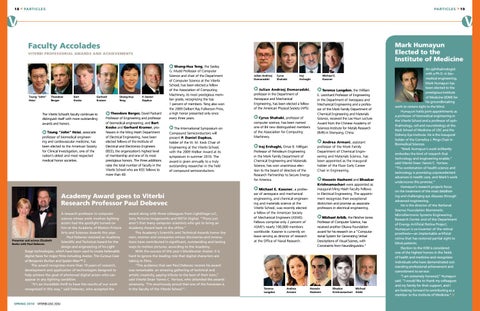
The Viterbi School’s faculty continues to distinguish itself with more outstanding awards and honors. Tzung “John” Hsiai, associate professor of biomedical engineering and cardiovascular medicine, has been elected to the American Society for Clinical Investigation, one of the nation’s oldest and most respected medical honor societies.
Shang-Hua Teng
P. Daniel Dapkus
Theodore Berger, David Packard Professor of Engineering and professor of biomedical engineering; and Bart Kosko and Gerhard Kramer, professors in the Ming Hsieh Department of Electrical Engineering, have been elected fellows of the Institute of Electrical and Electronics Engineers (IEEE), the organization’s highest level of membership and one of its most prestigious honors. The three additions raise the total number of faculty in the Viterbi School who are IEEE fellows to more than 40.
Shang-Hua Teng, the Seeley G. Mudd Professor of Computer Science and chair of the Department of Computer Science at the Viterbi School, has been elected a fellow of the Association of Computing Machinery, its most prestigious member grade, recognizing the top 1 percent of members. Teng also won the 2009 Delbert Ray Fulkerson Prize, a high honor presented only once every three years. The International Symposium on Compound Semiconductors will present P. Daniel Dapkus, holder of the W. M. Keck Chair of Engineering at the Viterbi School, with the 2009 Welker Award at its symposium in summer 2010. The award is given annually to a truly outstanding researcher in the field of compound semiconductors.
Academy Award goes to Viterbi Research Professor Paul Debevec A research professor in computer science whose work involves lighting actors had the spotlight turned on him at the Academy of Motion Picture Arts and Sciences Awards this year. Paul Debevec received an Academy Presenter and actress Elizabeth Scientific and Technical Award for the Banks with Paul Debevec. design and engineering of his Light Stage technologies, which have been used to create believable digital faces for major films including Avatar, The Curious Case of Benjamin Button and Spider-Man™ 2. The award recognizes more than 10 years of research, development and application of technologies designed to help achieve the goal of photoreal digital actors who can appear in any lighting condition. “It’s an incredible thrill to have the results of our work recognized in this way,” said Debevec, who accepted the
SPRING 2010 viterbi.usc.edu
award along with three colleagues from LightStage LLC, Sony Pictures Imageworks and WETA Digital. “There just aren’t that many computer scientists who get to bring an Academy Award back to the office.” The Academy’s Scientific and Technical Awards honor the men, women and companies whose discoveries and innovations have contributed in significant, outstanding and lasting ways to motion pictures, according to the Academy. With the success of this year’s blockbuster Avatar, it is hard to ignore the leading role that digital characters are taking in films. “The audience that saw Paul Debevec receive his award was remarkable: an amazing gathering of technical and artistic creativity, paying tribute to the best of their own,” said Viterbi Dean Yannis C. Yortsos, who attended the awards ceremony. “I’m enormously proud that one of the honorees is in the faculty of the Viterbi School.”//
Julian Andrzej Domaradzki
Cyrus Shahabi
Iraj Ershaghi
Julian Andrzej Domaradzki, professor in the Department of Aerospace and Mechanical Engineering, has been elected a fellow of the American Physical Society (APS). Cyrus Shahabi, professor of computer science, has been named one of 84 new distinguished members of the Association for Computing Machinery. Iraj Ershaghi, Omar B. Milligan Professor of Petroleum Engineering in the Mork Family Department of Chemical Engineering and Materials Science, has won unanimous election to the board of directors of the Research Partnership to Secure Energy for America. Michael E. Kassner, a professor of aerospace and mechanical engineering, and chemical engineering and materials science at the Viterbi School, was recently elected a fellow of the American Society of Mechanical Engineers (ASME). Fellows comprise only 2 percent of ASME’s nearly 100,000 members worldwide. Kassner is currently on leave serving as director of research at the Office of Naval Research.
Terence Langdon
Andrea Armani
Michael E. Kassner
Terence Langdon, the William E. Leonhard Professor of Engineering in the Department of Aerospace and Mechanical Engineering and a professor of the Mork Family Department of Chemical Engineering and Materials Science, received the Lee Hsun Lecture Award from the Chinese Academy of Sciences Institute for Metals Research (IMR) in Shenyang, China. Andrea Armani, assistant professor of the Mork Family Department of Chemical Engin eering and Materials Science, has been appointed as the inaugural holder of the Fluor Early Career Chair in Engineering. Hossein Hashemi and Bhaskar Krishnamachari were appointed as inaugural Ming Hsieh Faculty Fellows in Electrical Engineering. The appointment recognizes their exceptional distinction and promise as associate professors in electrical engineering. Michael Arbib, the Fletcher Jones Professor of Computer Science, has received another Okawa Foundation award for his research on a “Computational System for Generating Verbal Descriptions of Visual Scenes, with Constraints from Neurolinguistics.”
Hossein Hashemi
Bhaskar Krishnamachari
Michael Arbib
An ophthalmologist with a Ph.D. in biomedical engineering, Mark Humayun has been elected to the prestigious Institute of Medicine (IOM) for his groundbreaking work to restore sight to the blind. Humayun holds joint appointments as a professor of biomedical engineering in the Viterbi School and a professor of ophthalmology, cell and neurobiology at the Keck School of Medicine of USC and the Doheny Eye Institute. He is the inaugural holder of the Cornelius J. Pings Chair in Biomedical Sciences. “Mark Humayun’s work brilliantly embodies the kind of research that technology and engineering enable,” said Viterbi Dean Yannis C. Yortsos. “The combination of health science and technology is promising unprecedented advances in health care, and Mark’s work underscores this promise.” Humayun’s research projects focus on the treatment of the most debilitating and challenging eye diseases through advanced engineering. He is the director of the National Science Foundation Biomimetic MicroElectronic Systems Engineering Research Center and of the Department of Energy Artificial Retina Project. Humayun is co-inventor of the retinal prosthesis—an implantable artificial retina that has restored partial sight to blind patients. Election to the IOM is considered one of the highest honors in the fields of health and medicine and recognizes individuals who have demonstrated outstanding professional achievement and commitment to service. “I am extremely honored,” Humayun said. “I would like to thank my colleagues and my family for their support, and I am looking forward to contributing as a member to the Institute of Medicine.” //
20 < P h oto essay
P h ot o Essay > 2 1
Homecoming 2009 Margaritas and Mingling for V iterbi School’s Best-attended Picnic To Date. Nearly 500 Viterbi alumni and friends gathered on campus for the Viterbi School’s 2009 annual Homecoming picnic. Attendees began lining up at 8:30 a.m. for admission, hours before USC faced Stanford at Los Angeles Memorial Coliseum. Picnic food and drinks were plentiful: Margaritas, wine and beer, along with barbecue
4
chicken, egg and chorizo burritos, and fruit salads were on offer. A raffle brought in nearly $1,200 for Viterbi student scholarships, and winners walked away with prizes ranging from school sweatshirts and notepads to USC football highlights DVDs. Many generations of alums and future alums were on hand, including grandparents, grandchildren and great-grandchildren. Viterbi Dean Yannis C. Yortsos stopped in to greet alumni and friends. “Homecoming is always my favorite time of year,” says Alumni Relations Coordinator Kathleen Concialdi. “It brings everyone back to campus, to catch up with old friends and make new ones.” //
5
1
6
8
9
PHOTO CAPTIONS: 1. Alumni and friends begin lining up at 8:30 am for admission | 2. Viterbi staff register and greet picnic attendees | 3. Viterbi Homecoming picnic tables set up outside Doheny Library | 4. Bill Krenz (BSChE ’50) | 5. Lawrence Tenn (MSME ’65) and Lydia Tenn | 6. Viterbi Biomedical Engineering Professor Ted Berger, Dean Yannis Yortsos, USC Professor of Molecular Pharmacology and Toxicology Roberta Brinton | 7. Future Viterbi grads, perhaps? | 8. Lou Islander (BSME ’57, MSME ’62) | 9. Stephen Fryer (BSME ’60), Stephanie Fryer and Niles Pederson
2
3
SPRING 2010 viterbi.usc.edu
7
P eer R eview > 2 3
Peer Review Autonomous, Submersible and Networked New Sensor to Detect Heart Attack Plaque
Navy Taps Viterbi Professor to Lead Underwater Research Effort
new technology could be integrated into existing imaging platform
Tzung “John” Hsiai in his laboratory at the Viterbi School.
H
eart attack is the leading cause of death in the United States, accounting for approximately one-fifth of total annual mortality, says Tzung “John” Hsiai, a physician and associate professor in the Viterbi School. Hsiai is developing a new tool to help clinicians distinguish cardiac emergencies requiring immediate surgery from chronic problems that can be managed with drugs and a lifestyle change. Most heart attacks occur when plaque—a dangerous fatty deposit that builds up on the interior surface, or lumen, of the blood vessels in the heart—dislodges and subsequently causes a blockage further downstream in the artery. This produces a decrease in blood supply that severely damages heart-muscle tissue. Hsiai explains that plaque comes in different forms: Some plaques are metabolically stable and firmly fixed in the lumen. These can be treated with diet, exercise and medication. Other plaques are less viscous and pose a high risk to break loose and cause heart attacks. These require immediate primary coronary intervention in the form of angioplasty or heart bypass surgery.
SPRING 2010 viterbi.usc.edu
Angiograms, the images made when catheters are inserted through the groin and threaded into the arteries feeding the heart, offer clinicians an inside view of the lumen of these blood vessels and reveal plaque deposits. But they cannot distinguish between the different kinds of plaque. “Distinguishing stable from unstable plaque remains an unmet clinical challenge,” says Hsiai, who holds both M.D. and Ph.D. degrees. “Coronary artery disease is rising worldwide because of changes in diet in developing nations, and parallel increases in obesity and diabetes in the West.” In his laboratory, he has developed a new MicroElectroMechanical System (MEMS) sensor that uses minute heat perturbations as a proxy for blood flow and detects changes in bulk resistance for plaque characteristics. He has shown that the sensor can distinguish between stable and unstable plaque in laboratory examinations of specimens of plaqueclogged arteries extracted from rabbits fed a special diet to produce plaque. The same sensor can also be configured to measure the forces on the artery walls produced by blood flows, identifying spots where back currents could promote plaque formation. Hsiai says that the next step in the project will be to embed the MEMS sensors into catheters and show that they can accurately make the same distinctions, first in animals and then in humans.
“Distinguishing ”
stable from unstable plaque remains an unmet clinical challenge.
Hsiai’s lab recently received support to pursue the research through American Recovery and Reinvestment Act (ARRA) funds from the National Institutes of Health. Hsiai directs the USC Cardiovascular Research Core in the Viterbi School Department of Biomedical Engineering. Graduate students Fei Yu and Lisong Ai have co-authored presentations on the work. //
Urbashi “Ubli” Mitra and Shrikanth Narayanan.
I
magine you let loose a dozen robots into the ocean. The launch is easy. What’s harder is figuring out how best to program this “search party” to collect data, communicate with each other underwater and send information home to the mother ship. The Office of Naval Research has awarded a trio of Viterbi faculty members a three-year grant to find an effective way to use such a network of autonomous vehicles in dynamic environments, using advanced sensing technology. Urbashi Mitra, a professor of the Ming Hsieh Department of Electrical Engineering and a worldrenowned authority on wireless communications, is the lead principal investigator. Her novel effort is the first to tackle such a myriad of challenges in an underwater environment. “This project is a major undertaking,” says Mitra. “It requires an interdisciplinary and collaborative approach to develop a holistic solution to the problems of joint sensing, classification, communication and control.” Working on Mitra’s team are two professors with critical areas of expertise. Gaurav Sukhatme, a computer scientist who is a specialist in robotics and autonomous vehicles, has experience in underwater research; Shrikanth Narayanan, with appointments in electrical engineering, computer science, linguistics and psychology, is an expert in sensing and classification systems, and will also incorporate his research on the underlying language structure of human speech. The three are collaborating with researchers from MIT, Northeastern University and The Woods Hole Oceanographic Institution. USC undergraduate and graduate students will also contribute. There are a host of challenges central to communicating in an underwater domain. Radio-based technologies, such as those found in cell phones, are not effective. While sound can be used to transmit signals underwater, sending video
is much more challenging, due to bandwidth limitations. Using energy efficiently and selecting the best source of power for the autonomous vehicles are additional issues. “Where are you going to recharge your batteries when you’re 200 meters down in the ocean?” Mitra asks. Another challenge? “We can’t put sensors everywhere,” says Narayanan. “There’s also the question of how to process information while requiring the least amount of human intervention possible.” Ideally, the networked vehicles’ exploration will be guided by what they measure. Central to that task is programming them to make the right decisions about what to do next, over long ranges, with almost no error. “What’s the proper algorithm, the best sequence of instructions?” asks Sukhatme. “These are some of the issues we will be exploring.”
Gaurav Sukhatme with a robot prototype.
The team isn’t developing the actual autonomous vehicles, at least not yet. Instead, it’s focusing on working out the theory behind the networked systems. However, Sukhatme’s lab has long specialized in autonomous seagoing robots and may later test the team’s work. Graduate students from Mitra and Sukhatme’s research groups are currently collaborating to instrument Sukhatme’s robotic boats with Mitra’s underwater acoustic transducers, so that the boats can “talk” underwater. Potential applications encompass civilian, military and industrial uses. Deploying a large number of networked, autonomous vehicles can help identify underwater mines, collect data for environmental impact assessments, and improve navigation systems for ships and submarines. Ultimately, such systems may one day help chart the deep, unknown depths of the ocean. “Right now, we have a better map of Mars than of the ocean bottom,” says Sukhatme. //
24 < F E AT U R E S
The V terbi Energy ablea
F eatures > 2 5
Our world today would be unimaginable without energy on demand—power at our fingertips to fuel everything from computers and appliances to motorcycles and jetliners. Modern civilization depends on it, yet the 21st century presents a myriad of challenges concerning energy. Where will the power we need come from? How much will it cost? Will there be enough to sustain a rapidly expanding world? And can it be harnessed with the least amount of harm to the environment? Indeed, energy issues have emerged as one of the key grand challenges facing our society. Policymakers and scientists alike consider meeting these challenges as nothing less than fundamental to a global economic recovery—the key to the sustainability question. Enter the engineering disciplines. They are fundamental to answering these questions and providing solutions to a sustainable future. There’s nothing accidental about the connection between energy and engineering: Extracting useful amounts of energy requires vast technical and scientific know-how.
SPRING 2010 viterbi.usc.edu
26 < F E AT U R E S
F eatures > 2 7
The Promise of Nano: Big Benefits in Tiny Packages
The concept of energy itself is simple. Energy is stored within matter in multiple ways: through mechanical motion (kinetic energy), relative altitude (gravitational potential energy), and its thermal, chemical and nuclear states (internal energy). The variety of forms enables a broad portfolio of energy options: wind and wave (kinetic), hydroelectric (potential), fossil or bio fuels (internal), and nuclear (internal). What’s complex is the process of extracting or transforming the matter’s energy content. The engineered processes that enable this transformation and release energy that we can subsequently harness are varied and multifaceted, including combustion, nuclear reaction and photonic-electrical conversions. What also complicates the issue is that sources of energy that may be superior in terms of energy content—such as the fossil fuels coal, oil and gas—contribute to a carbon imbalance in the atmosphere if their carbon is not recaptured. Other byproducts, such as nuclear waste, must be safeguarded for thousands of years. Inefficiencies are another key concern involving the capture, conversion and utilization of energy; they alone account for as much as 30 to 40 percent of the global energy flow. The good news? Humankind possesses the tools to create the innovations that will solve these problems. “The breathtaking advances in information technology in the recent decade, and the continuous unlocking of mysteries at the nano- and molecular scales, promise unprecedented discoveries that will lead to a much-needed overhaul of the energy field,” says Viterbi Dean Yannis C. Yortsos.
SPRING 2010 viterbi.usc.edu
“Smart solutions in the information age demand the use of information-age tools. These tools are in our hands, and we need to use them.” One of these tools—nanotechnology—enhances the traditional engineering and scientific fields of physics and chemistry by enabling manipulation of substances at the atomic level to create new materials with new properties. In nanotechnology lies the promise of ingenious new materials and devices to help harness emerging sources of energy, such as solar. Informatics, another tool, employs computing power to analyze patterns previously too complicated to understand. For example, informatics can monitor the second-by-second changes in a huge system, like a city’s power grid to optimize efficiency and to provide instant feedback and control. The stories in this article detail how researchers at the Viterbi School are now attacking a whole range of energy and energy-environmental issues, aided by these technologies and supported by research funds from both private and public sources. They will show how research is boosting supply, decreasing demand, addressing environmental burdens and increasing livability. Indeed, stewardship and cultivation of our energy resources, with the protection of the planet as a paramount objective, will require nothing less than the most creative scientific and technological breakthroughs.
Imagine a world where solar rooftop panels that can easily power a home, and flat three-watt panels that can illuminate a room, are not a novelty. Rather, they’re affordable and readily available at Home Depot or Wal-Mart. The science of nanotechnology is helping to make this vision a reality, and ongoing Viterbi School research is paving the way. Nanotechnology focuses on scientific process at the level of atoms and molecules, and its application to energy issues has extraordinary potential. This year, the Viterbi School’s efforts in the nanotechnology field received a major boost with an award of a five-year, $12.5 million Department of Energy (DOE) grant establishing an Energy Frontier Research Center (EFRC). P. Daniel Dapkus, of the Ming Hsieh Department of Electrical Engineering (EE) and the Mork Family Department of Chemical Engineering and Materials Science (ChE/MS), will direct the new EFRC, which has a dual focus: applying nanotechnology to address the challenges of solar energy conversion and efficient illumination. “Light emission and light absorption are inverse processes,” says Dapkus, “and many of the same materials useful for solar cells are also potential light-emitters, which can be useful in producing low-cost renewable energy, and conserving energy in lighting as well.” An internationally recognized expert in the field, Dapkus says the goal of his project is not journal papers or theories—but more efficient and affordable solar cells and light-emitting diodes (LEDs). The best existing solar cells convert about 40 percent of light energy that falls on them to electricity and are extremely expensive. “We’ve set as our goal solar cells that are as efficient as 50 percent but are much cheaper,” says Dapkus. “These would produce power as cost-effective as that now generated from burning coal. That’s a difficult challenge, but that’s our goal.” “If it does not leave academe, we have not been a success,” adds Mark Thompson, (ChE/MS), who was also instrumental in bringing the DOE grant to USC. The scientists’ goals for better LEDs are similarly ambitious. Standard incandescent bulbs waste most of
the energy they use (and they use almost 20 percent of all the electricity produced in the United States). The now more widely used fluorescent bulbs are much more efficient, but also contain toxic mercury. LEDs can be twice as efficient as fluorescents, but cost 10 times as much at present. Dapkus and Thompson want to narrow or eliminate this differential. The EFRC team Dapkus and Thompson have assembled brings a wide range of skills to the job, and include the following members: • John O’Brien of Ming Hsieh (EE) • Steve Cronin and Chongwu Zhou, who have joint appointments in Mork (ChE/MS) and Ming Hsieh (EE) • Jia Grace Lu, with joint appointments in the USC College Department of Physics and Astronomy and Ming Hsieh (EE) • Priya Vashishta, Rajiv Kalia, and Aiichiro Nakano, with appointments in Physics and Astronomy, and in the Viterbi School Department of Computer Science (CS) • Richard Brutchey, Barry Thompson and Steve Bradforth, all of the USC College Department of Chemistry The EFRC efforts are not the only Viterbi pursuits of innovative solar power technologies. Denis Phares and Hai Wang, of the Viterbi School’s Department of Aerospace and Mechanical Engineering (AME), are working on developing a unitary panel that can be laid out in large thin films, able to cover large areas quickly, efficiently and cheaply. The fabrication method involves burning titanium oxide—an inexpensive and nontoxic material used as a white paint pigment—and depositing the particles on a specially prepared surface, where chemical reactions make it into a solar-sensitive material. The results so far are “highly promising,” says Wang, who directs the Viterbi Combustion Kinetic Laboratory.
“
We’ve set as our goal solar cells
that are as efficient as 50 percent but are much cheaper. These would produce power as cost-effective as that now generated from burning coal. That's a difficult challenge,
”
but that’s our goal.
P. Daniel Dapkus, director, energy frontier research center
28 < F E AT U R E S
F eatures > 2 9
Burning Brighter: Engineering Flames What about the process of combustion itself? Can it be better managed or streamlined to conserve energy? On the surface, nothing seems more simple than a flame; striking a match produces an effect that all understand. Yet in combustion, there’s much more than meets the eye, a “much more” that a large group of Viterbi researchers have long played a key role in researching. Indeed, the Viterbi School is examining every stage of the combustion process, from burning fuels more efficiently to better addressing the harmful byproducts of combustion, such as smoke, soot and greenhouse gases. This effort is fundamental to solving the energy problem, because more than 80 percent of the world’s energy production and use is based on combustion. “Combustion is ubiquitous in traditional energy conversion systems, such as automotive engines, stationary and aircraft gas turbines, rocket and space propulsion, electrical power generation, industrial furnaces, and home and institutional space heating,” notes the AME Web page for combustion research. A Viterbi collaboration with another EFRC—headquartered at Princeton University—is studying the way fuels burn in unprecedented detail, and will examine the combustion process from “fundamentals to multiscale predictive models,” particularly for 21st century transportation fuels. Because while flames are familiar, analysis of all the factors that affect their properties is dauntingly difficult. Its investigator is required to bring together at least three different physical realms—the flow behavior of gases, their chemical properties, and the effect of the radiant energy produced by the combustion on the process.
“
Combustion is ubiquitous in traditional energy conversion systems, such as automotive engines, stationary and aircraft gas turbines, rocket and space propulsion, electrical power generation, industrial furnaces,
”
and home and institutional space heating.
SPRING 2010 viterbi.usc.edu
To model these phenomena, scientists like Wang and Fokion Egolfopoulos (also of AME) must make some simplifying assumptions, rather than just plugging in set variables. Despite the obstacles, they recently recorded a big research win in combustion modeling: They showed a model of how jet fuel behaves when it is burned in turbines, like jet engines, opening a new area to computer modeling. Other challenges to combustion research remain. Engineers have been working with diesel oil for many decades, says Egolfopoulos, and have discovered ways to optimize its performance. However, new fuels now coming into use—such as vegetable oil (biodiesel)—have different properties and call for different optimization paths. (Theodore Tsotsis (ChE/MS) is also involved in combustion research.) As a part of yet another EFRC—headquartered at the University of Delaware—Wang is exploring ways to make good-quality gasoline fuels from vegetable oil by catalysis. Emissions from combustion are another major concern. The burning of many liquid fuels produces soot, a byproduct that results partly from incomplete combustion and partly from unburnable components that come out in exhaust; Wang is carrying on major research initiatives in this area to study ways to minimize soot, as well as its effects on climate change. At the same time, Constantinos Sioutas, of the Sonny Astani Department of Civil and Environmental Engineering (CEE), is leading the effort to measure the concentration of soot in the air and determine the health consequences of living in areas where large numbers of trucks pass in and out. Wildfires also produce soot, and Sioutas has found that they produce levels that are much higher and potentially more dangerous than previously thought. As engines burn most of the fuel consumed worldwide, the Viterbi School is looking at ways to make them more efficient and less polluting. Paul Ronney (AME) has studied combustion in all kinds of environments, including space. (Ronney qualified to be an astronaut and sent several experimental kits on a shuttle launch to investigate zerogravity combustion.) Fifteen years ago, Ronney developed a new, more efficient thermal throttle for gasoline car engines. More recently, he has been working in three different directions regarding engines. One area is micro-engines, tiny devices that burn fuel and can replace batteries in handheld and smaller applications. This is significant, Ronney says, because hydrocarbon fuels store 50 times as much energy as the same weight of the best available batteries. “So we could potentially have laptops that last more than a week on battery power, or cell phones that last a month on one charge,” says Ronney.
Another thrust is Ronney’s work with Martin Gundersen (EE) on a new way to ignite fuels in engines using “pulsed power.” These are very short bursts of high-energy radio waves; in experimental engines, pulsed power units replace spark plugs or other traditional ignition devices. Gundersen has studied pulsed power for more than a decade, and his latest research initiative involves working with Egolfopoulos to reduce the emissions from marine diesel engines. Gundersen will focus on developing lab-scale prototype transient plasma ignition (TPI) equipment to achieve more complete combustion, while Egolfopoulos will analyze and compare the efficiency of and pollutants resulting from both compression ignition and TPI. The work will be housed at USC’s new TCC Institute for Emissions Reduction from Marine Diesel Engines. Ronney’s final area of research involves a type of combustion that has nothing to do with flame. Working with geobiologist Ken Nealson of the College, Ronney is studying how a bacterium Nealson discovered might become a new, more efficient basis for microbial fuel cells. These bacteria “burn” metals, such as iron and manganese, to produce energy; and microbial fuel cells could leverage this metal consumption to generate electrical potential. Florian Mansfeld (AME) is also collaborating on this effort.
“
More Energy-Efficient Buildings and Cities: USC as a Smart Grid Test Bed Part of the solution to the energy conundrum involves making its use more efficient—using less energy to begin with. A much-touted means to this end is the Smart Grid, which deploys digital technology to help reduce cost, conserve energy and increase transparency in the energy system. But many questions remain, such as whether consumers are able to take full advantage of a world where appliances “talk back,” and information about energy usage is king. And more importantly, how best should such a world be scaled up for deployment on a commercial level?
The Smart Grid is a blending of IT infra-
structure with the power infrastructure, while at CiSoft we combined IT with an oil and gas infrastructure. We are employing digital feedback and control to the system, ultimately, to be able to manage a more efficient (and more secure) system. These demonstrations are not really traditional academic research programs, but demonstrations of new applications, complex systems integration, and customer behavioral response. DONALD PAUL, EXECUTIVE DIRECTOR OF THE USC ENERGY INSTITUTE
The Viterbi School has been tapped to find out. The USC campus will be outfitted as a laboratory of sorts—a microcosm of an entire city–for part of a $120 million Smart Grid demonstration project conducted by the Los Angeles Department of Water and Power (LADWP) and supported by the Department of Energy. “We will be using the entire USC campus as a living experiment—a test bed,” says Donald Paul, executive director of the university-wide initiative, USC Energy Institute, which will coordinate the effort. Paul, a Viterbi research professor of engineering, is also the former chief technology officer of Chevron Corporation. Using advanced information technology, the project will monitor energy consumption in campus residence halls, laboratories, office buildings, classrooms, gymnasiums, theaters, restaurants and other buildings. It will also test new cyber-security technologies and measure how plug-in electric vehicles impact energy flow, among other initiatives. All the while, the campus project needs to demonstrate real-world complexity and be sufficient in size, so that it will scale well for commercial use, according to Paul. An added benefit to being selected as a test site is that as one of LADWP’s largest customers, USC will be able to “get out in front” of the smart grid implementation that’s in every energy consumer’s future, says Paul. Paul will bring the expertise gleaned from a five-year collaboration between the Viterbi School and Chevron research scientists, known as the Center for Interactive Smart Oilfield Technologies (CiSoft). Indeed, CiSoft scientists have long studied how best to deploy the use of information technology to better solve a wide variety of oil and gas engineering and field management problems.
”
30 < F E AT U R E S
F eatures > 3 1
“The Smart Grid,” Paul says, “is a blending of IT infrastructure with the power infrastructure, while at CiSoft we combined IT with an oil and gas infrastructure. We are employing digital feedback and control to the system, ultimately, to be able to manage a more efficient (and more secure) system. These demonstrations are not really traditional academic research programs, but demonstrations of new applications, complex systems integration and customer behavioral response.” The Viterbi School will play a prominent role in yet another Smart Grid project, this one sponsored by Southern California Edison. The SoCal Edison effort will incorporate the work of Viterbi researchers, such as Clifford Neuman of the Information Sciences Institute (ISI). Neuman’s grid security research explores how best to keep computers and databases safe from malicious intrusion, and is now expanding his research focus to include what he calls “cyber-physical” systems. Such systems are vulnerable not only to hacker electronic attacks, but also to electronic jolts and shoves, planned physical destruction or alteration of components that could cause severe systemwide disruptions. “An attacker does not need to break into the computer,” Neuman noted in a recent paper, “to affect such a system, but could cause a coordinated series of physical actions that are sensed and make the system respond in an unexpected manner. How one protects such systems from this kind of attack requires an understanding of the system and its responses, not the typical computer security defense mechanisms.” For both Smart Grid projects, USC and the Viterbi School will collaborate with a number of partners, including UCLA, Caltech/JPL and UC Irvine, to create prototype systems designed to reduce energy use and decrease the risk of power outages from technical and malicious causes. Viktor Prasanna (EE, CS), Gordon Roesler (ISI) and Julie Albright of the College Department of Sociology will play lead roles in the USC efforts. (Peter Will, of ISI, helped to form the project before his retirement in December 2009.)
“
We want to compare these technologies and strategies
with actual building performances and human comfort factors. We hope to get insight into correlations between energy consumption and comfort, building design and comfort, and building design and energy consumption.
”
BURCIN BECERIk-gerber, usc viterbi school
SPRING 2010 viterbi.usc.edu
Other Viterbi School specialists will be involved, as well as investigators from the College, the Keck School of Medicine, the Marshall School of Business, the School of Policy, Planning, and Development, and the School of Architecture. Smart Grids are extremely complex systems, and another step in the energy conservation crusade is how best to work in elements of uncertainty and address difficultto-predict risks of internal failure. That’s where Roger Ghanem (AME) steps in; his latest project aims to predict grid behavior and manage risk at the point of intersection between networks, such as Smart Grids and social and other infrastructure networks. And, of course, creating and controlling such networks— which are often spread out geographically—has long been a Viterbi School strength. ISI’s role in developing the Internet is one example; ISI Fellow Carl Kesselman’s role in codeveloping grid computing is another. Other Viterbi scientists are looking at buildings, home construction, road-building and other urban structures and institutions, focusing on whether informatics can make them more energy-efficient. Massoud Pedram (CS) is tackling computing and data storage centers—which consume a tremendous amount of energy for computation and cooling needs. Pedram has published a series of papers on “Green Data Centers,” or data storage facilities that are efficient and minimize environmental impact. He has focused on finding ways to predict and distribute computing load in ways that reduce energy cost and minimize the carbon footprint of information processing systems. He’s also worked on minimizing the energy required to cool these giant data centers and power central servers. And in the green building arena, Burcin BecerikGerber (CEE) is focusing on streamlining management techniques in the construction process to maximize time, save costs and reduce energy use. In a current study, Becerik-Gerber is trying to measure how accurately the energy models used by her Building Information Modeling (BIM) system reflect actual building performance. “We want to compare these technologies and strategies with actual building performances and human comfort factors,” Becerik-Gerber says. “We hope to get insight into correlations between energy consumption and comfort, building design and comfort, and building design and energy consumption.” Other Viterbi research has wide-ranging energy implications. Take transmission, for example. Deploying a different type of cable for transmission lines may become a critical conservation strategy; the power grid has traditionally been comprised of plain, insulated steel-supported aluminum wires. Steve Nutt (ChE/MS) of the M.C. Gill Foundation Composites Center, in conjunction with the
Composite Technology Corporation of Irvine, Calif., has developed a composite cable consisting of a lightweight core of carbon and glass fiber, surrounded by aluminum wires. Such cables are lighter, easier to handle, and can carry up to twice the amount of energy in the same diameter cable. Finally, as automotive transport counts among society’s most energy-intensive uses, Viterbi researchers are helping to find ways to move people and goods more efficiently. Part of this effort involves the METRANS project, created in 1998, in which the Viterbi School partners with the School of Policy, Planning, and Development. Petros Iaonnou (EE) serves as METRANS’ associate director of research, and a major focus of his work is traffic-flow modeling and developing concepts for an automated highway system, in which computer controls in vehicles might be able to use existing highway space more efficiently. This work is particularly important in Southern California, one of the most congested metropolitan areas in the country.
Optimizing The Earth’s Energy Resources Finding energy sources, including fossil fuels, and improving methods of tapping into them, have long been a Viterbi School strength, particularly in the area of petroleum engineering. In recent years, the school has expanded on this strength, adding new informatics techniques to both broaden and deepen its expertise. The school has not only greatly improved oil-recovery technology, but also has expanded into newer areas, such as gas and geothermal, explored how best to sequester carbon dioxide produced by combustion, and even looked at harvesting electrical energy from the waves breaking along the California coast. A leading example in this area, again, is CiSoft. Chevron came to USC for this partnership because of the strengths of the school’s petroleum engineering program and information technology prowess. The corporation was also attracted to the pioneering research of that department’s director, Iraj Ershaghi (ChE/MS), its faculty, and the expertise of other researchers in the areas of information technology and integrated media systems.
At the time of CiSoft’s founding, Ershaghi, who holds the Viterbi School’s Omar B. Milligan Chair, was already a longtime specialist in using informatics to coax more petroleum out of the ground by combining detailed knowledge of the underground gas and oil deposits with improving physical production tools, such as pressure maintenance and fluid displacement processes. CiSoft expanded Ershaghi’s vision with a unique structure. Chevron engineers with real-world oil-extraction problems reached out to the Viterbi faculty to find expertise and create an exemplary model of interdisciplinary research. Now, some 80 Viterbi professors, post-docs and graduate students are addressing or have addressed a huge range of oil and gas field management problems using advances in information technology. To call the effort interdisciplinary is an understatement: Only a small number of these researchers are from specialties dealing with petroleum engineering, or even chemical engineering and materials science. Many more are from computer science, electrical engineering and systems engineering. The continuing flow of CiSoft papers—more than 50 in just the last two years—attests to the range of research. One example: Viktor Prasanna (EE), who will play a leading role in the SmartGrid projects, collaborated on “Semantic Web Technologies for Smart Oil Field Applications,” “Workflow Instance Detection: Toward a Knowledge Capture Methodology for Smart Oilfields,” “A Framework for Design Space Exploration in Oilfield Asset Development,” and several more papers in 2008 alone. Another component of CiSoft research involves the work of John Heidemann and Wei Yu, both of ISI, who have been working in recent years to model a new way to keep track of underwater oilfields, using low-power sensors. Such sensors will take advantage of the excellent sound-carrying capabilities of water to communicate with each other using sound, rather than radio. Resolving the communication issues of such sensors helps with the remote managing of deepwater resources, especially under rough weather conditions. They can also aid environmental monitoring of underwater structures in oceans, lakes and rivers. Applying signal processing techniques to underground mapping is another significant CiSoft effort in energy recovery. Antonio Ortega (EE) and Jerry Mendel (EE) published two papers proposing different ways to map underground fracture patterns in oil-bearing geological structures, using advanced signal processing techniques. Craig Knoblock and Cyrus Shahabi (both CS) are developing innovative subsurface mapping and data management algorithms.
32 < F E AT U R E S
“
F eatures > 3 3
Energy and sustainability are the critical
issues of our future, and indeed, we at Viterbi are attacking the problem on all possible fronts.
”
dean yannis c. yortsos, usc viterbi school of engineering
Some of the innovations developed at CiSoft have already found their path to prototyping. These include the “Concurrent Water Collection” developed by Behrokh Khoshnevis, of the Daniel J. Epstein Department of Industrial and Systems Engineering, for dewatering gas wells, and visualization schemes by Ulrich Neumann (CS) that help oil producers better understand underground structures. Besides Chevron, The Energy Corporation of America also has stepped up to fund ongoing research at the Viterbi School. The Energy Corporation—which owns and operates more than 5,000 gas and oil wells in the United States (and whose chief executive, John Mork, is the namesake of the Mork Family Department of Chemical Engineering and Materials Science)—is funding basic research led by Kristian Jessen (ChE/MS) and his colleagues on optimizing gas production from “tight” shale deposits. Jessen is concentrating on improving techniques to extract gas from these shales, techniques which have vastly boosted the estimated size of recoverable U.S. gas energy reserves. Jessen’s mission is to push the edge further, carry out advanced work leading to improved imaging and modeling of the gas resources, and increase the productivity and recovery from such reservoirs by better understanding underground structures. The use of these new subsurface imaging techniques is not limited to fossil fuels like gas and oil, however. Fred Aminzadeh (ChE/MS), who teaches one of the Smart Oilfield Technology courses and carries on research on soft computing, recently received $1.5 million in stimulus funding from the Department of Energy to carry out 3-D imaging and mapping of the Geysers Geothermal Field in Northern California. The work will be accomplished in collaboration with the Lawrence Berkeley National Laboratory and the Geysers Power Company, LLC, a subsidiary of Calpine and the operator of existing geothermal power plants in the area. Aminzadeh’s objective is to develop new methodologies to characterize the northwestern part of the Geysers reservoir; to gain better knowledge of its porosity, permeability, fracture size, fracture spacing, reservoir discontinuities (leaky barriers), and impermeable boundaries in order to prolong the life of the field; and to explore more effective heat recovery by water injection.
SPRING 2010 viterbi.usc.edu
The most exciting news? New technologies may soon allow capture of yet-untapped potential sources of energy. The newest ISI project leader is Gordon Roesler, a former Navy submarine officer who is creating a new Center for Energy Informatics and Systems at ISI, while leading the Smart Grid efforts. Additionally, Roesler has his eye on energy capture from waves, a technology which has the potential, “if applied to the Pacific Coast alone, to provide the equivalent of five nuclear power plants’ worth of completely clean energy, at a far higher reliability level than wind and solar energy,” according to a Center announcement. Roesler’s earlier work with waves included developing a new system for steering small boats that took wave forces into account to make them more maneuverable. And the Center will have a much broader focus than just ocean waves; besides the Smart Grid efforts, Venkata Pingali of ISI is now developing a “carbon intelligence tool” to help businesses get more detailed information about their energy use. Finally, substantial attention is being devoted to another major energy technology—carbon sequestration, or the long-term storage of CO2 and other forms of carbon to lessen the impact of global warming. Fossil fuel combustion releases enormous quantities of carbon dioxide, to a first approximation, of nearly four pounds of CO2 for every pound of coal burned. Energy theorists have discussed a wide range of possibilities, including injecting the CO2 produced by burning coal back into the earth and locking it up. The Viterbi School’s Don Zhang (CE, ChE/MS), who holds the Gordon S. Marshall Professorship in Engineering Technology, has been looking into the issue; indeed, known geological formations (underground saline aquifers) could potentially store 150 years’ worth of CO2 emissions at the planet’s current production level. But the practical problems are formidable. The capture must be tight: leakage of even 1 percent per year would be unacceptable, Zhang says. Zhang’s research agenda got a big boost this year, with $2 million awarded to him and Jessen from Stanford University’s Global Climate and Energy Project, to work on these issues with Peking University and China University of Geosciences at Wuhan. The effort will focus on applications in China, the world’s largest producer and consumer of coal. Zhang will direct a group that includes 39 researchers in the United States and China, including Jessen. This collaboration is important, as the world needs to come together to tackle the problem of carbon dioxide emissions and global warming, says Yortsos. “Energy and sustainability are the critical issues of our future,” says Yortsos, “and we are attacking the problem on all possible fronts.” //
From the CEO’s Office: Talking Energy with Alan Fohrer This Trojan believes that puzzling out the solution to the world’s energy problems begins in Southern California. Southern California Edison chairman and CEO Alan Fohrer (BSCE ’73, MSCE ’76) hopes to advance the national energy conversation by facilitating a collaboration between academia and industry. Alan Fohrer “It’s an exciting time to be an engineer,” says Fohrer during an in-depth conversation from Edison’s corporate offices in Rosemead, Calif. “I think the energy industry is going to change more in the next 10 years than it has in the last 30 or 40.” In 2009, Edison and USC sponsored two meetings of the inaugural Southern California Smart Grid Research Symposium. Nearly 200 experts from industry and academia gathered to discuss how to meet challenges by using the smart grid concept, which aims to reduce dependence on fossil fuels and increase efficiency. Edison has pushed ahead by distributing 5 million smart meters to its customers that will “literally communicate with their appliances,” says Fohrer. The goal? To reduce peak power consumption by an estimated 1,000 megawatts—about the output of one major power plant. Renewable energy credits and electric vehicles also figure prominently among Fohrer’s priorities, as does building a sufficient network of transmission lines to connect renewable power sources with customers—who often live miles away. The father of four chuckles that he has “no idea” how he ascended to the helm of one of the country’s most prominent utilities, but says USC helped pave the way. Among the first in his family to go to college, Fohrer grew up in the small town of Hobart, Ind., in the “shadow of the Golden Dome” at the University of Notre Dame. “Notre Dame was originally my first choice,” he says, “but then USC gave me scholarships, and I decided I liked being a Trojan.” Fohrer started in aerospace engineering, but gravitated toward the civil/structural classes. “I liked understanding how bridges and planes worked, but I was never good at building things,” he jokes. “My wife likes to say that I’m the least mechanical engineer she’s ever met.”
Originally, Fohrer planned to stay “no more than three years” when he started at Edison. He planned on a Ph.D. and an academic career. But Edison made it very hard to leave, providing tuition for his M.S., and also an M.B.A. from Cal State Los Angeles. After an executive training program and a year in finance, he learned that he not only enjoyed working on big projects, but also liked the “people” aspect of management. “That led me on a different career path,” Fohrer says. Today, he enjoys donning a hard hat and heading out of the executive suite to Edison plants. Precious free time is spent with his family or on the golf course with two of his three sons. He also goes to Catalina Island for a week each summer to camp, hike and canoe with his youngest son’s Eagle Scout troop. Fohrer is a member of the Viterbi School’s Board of Councilors. Through the Edison Challenge, the company also sponsors science contests at high schools throughout Southern California. His Trojan roots run deep; Fohrer’s wife attended the USC Marshall School of Business, as did his two eldest sons. He jokes that he “lost” his daughter to Georgetown University, but is working on imbuing his youngest son— currently in high school—with some Trojan pride. “He seems to really like engineering, and USC would be at the top of his list, I’d hope,” says Fohrer. He’s happy that USC supplies Edison with some of the company’s most promising employees. “Although we occasionally hire students from the ‘other’ school,” he jokes, “it pains us to do so.” //
“
It’s an exciting time to be an engineer. I think the energy industry is going to change more in the next 10 years than it has in the last 30 or 40.
”
ALAN FOHRER, SOUTHERN CALIFORNIA EDISON CHAIRMAN AND CEO
34 < F E AT U R E S
F eatures > 3 5
Fixing Johnny Terry Sanger has a vision to bring the tools of engineering, biology and medicine to bear on cerebral palsy Here’s how physician and engineer Terry Sanger— provost associate professor in the Department of Biomedical Engineering and an internationally known pediatrician specializing in cerebral palsy, recently recruited from Stanford University—likes to explain his ideal for biomedical engineering to a student: “Your job is not to build a better wheelchair. Your job is to fix Johnny.” And treating cerebral palsy is a far greater challenge than advancing wheelchair technology. In his office at Childrens Hospital Los Angeles, Sanger is pondering his examination of a teenage girl—call her Jane—whose muscle function is a fraction of normal, and whose wheelchair must accommodate a deformation of her spine. She has normal intelligence, can whisper a few words, but communicates primarily by pointing with a head-mounted assembly to targets or computer images. Sanger marshals the available information, combining the results of his examination with Jane’s medical records, which go back more than a decade. Her condition recently began to deteriorate, and his suspicion is that some metabolic processes may be compromised. He orders blood tests and imaging, and offers suggestions on how Jane can make herself more comfortable. And then it’s on to the next patient, a baby not yet a year old, who has difficulty focusing on external objects. Sanger begins glancing through a set of brain scans, completing the picture of an alert, concerned and formidably knowledgeable doctor. But Sanger is more than just a doctor. He is also an engineer, looking at an extraordinarily complex set of interacting systems, and he has a vision that he hopes will change the rules for the palsied girl and the vision-challenged baby, and that will raise the treatment of cerebral palsy—the name for a whole spectrum of conditions caused by brain injuries—to a higher level. In his other office at the Viterbi Biomedical Engineering complex, Sanger ponders a device he invented and prototyped, a two-part muscle biofeedback system currently being tested on a group of children with cerebral palsy. One part, the size of a small cell phone, is an electromyographic (EMG) sensor, which measures electrical potential in muscles. A wire connects the EMG to a black rectangle the size of a chess piece
bearing two nickel-size metal disks. When the sensor detects electrical activity, the disks vibrate. Sanger explains that some children have been unable to move muscles for so long, they can’t tell if they are sending a nerve signal. The device gives such children instant feedback, so they can learn to use their muscles. Much larger devices currently in use can detect the same signals on immobile patients during brief clinical examinations. Sanger optimized his device to be comfortably worn for hours at a time, every day, and hopefully allow his young patients to get back in touch with their muscles. Results of the trials are not complete—but are promising, he says. Sanger remembers clearly when he realized the vision that guides his work in this new medical engineering field, one that he and a growing number of like-minded scientists and engineers are creating. As an applied mathematics senior at Harvard University, he took a course that looked at mathematical approaches to biological modeling of retinal processing. “I was struck by how beautifully the explanations worked,” he says. “I just loved the link between the mathematical model and the biology.”
“
SPRING 2010 viterbi.usc.edu
It’s profound, it pervades a lot of the thinking in the biomedical engineering department, a lot of the thinking from Viterbi as a whole. They have really put their money where their mouth is.
”
His research focus soon shifted from vision to motor control. After earning both an M.D. from Harvard and a Ph.D. in electrical engineering from MIT, he plunged into a concerted attack on cerebral palsy. Since 2001, he has been principal investigator of a National Institutes of Health Taskforce on Childhood Motor Disorders, creating uniform definitions and measures of what had been a helter-skelter cluster of disorders. But he continues attempting to apply engineering thinking to understanding cerebral palsy.
“Medicine is very observational and very statistical,” Sanger explains. “We’ve got this evidence base; we see that for people with these symptoms, 29 percent will get better if you give them this drug. It’s inductive, pattern-matching and often very successful, but for some of these very complex conditions that are so multifactorial, it often breaks down.” The biological approach, which is distinct, is based on experiments and has a different set of limitations. It is hypothesis-driven but tends to ignore the big picture. “You have a very straightforward question: Does an alteration in this chemical cause this outcome? But it’s not about trying to model the system or about understanding how the system interacts,” he says. Engineers strive to understand with mathematics and modeling. An engineer creates a mathematical system that duplicates the multiple factors in play, creating the normal function of the organism and showing how and why changes in these factors produce the observed conditions. “For me to understand a disease as an engineer, I want to build a robot that mimics that disease,” Sanger says. The engineering approach crosses traditional medical boundaries. In one experiment, Sanger united three laboratories for more than a year to lead an intensive study of a single child with cerebral palsy. “Three days to prepare for each visit, three days to analyze the results. We were his after-school activity,” he says. At the end of the year, the project produced detailed knowledge that not only helped to design specific interventions for that child, but also led to the development of two new devices and a funded research project on new ways for similarly affected children to communicate with a computer. “If you’re going to fix a car, you don’t look at a hundred broken cars and do statistical analyses of randomized controlled trials. The same is true for a child. If you’re going to fix him or her, you need to figure out exactly what is wrong with that particular child,” Sanger says. Sanger’s vision led him to USC. “Here,” he says, “I am not alone.” He sees USC as very serious about the combination of medicine, biology and engineering applications, and not just in the Viterbi School but in the Keck School of Medicine as well. “A lot of places will say, if you’re an oncologist, and you want to work with a molecular biologist, that kind of makes sense. But if you’re a child neurologist, and you want to work with an engineer, that’s further out there. I think USC really believes those links are as important as traditional links. And I think this is because of the strength of the engineering program. “It’s profound,” he continues. “It pervades a lot of the thinking in the biomedical engineering department, a lot of the thinking from Viterbi as a whole. They have really put their money where their mouth is.” A prime example is the HST@USC, the Health Sciences & Technology collaboration between the Viterbi School and the
Terry Sanger with the muscle biofeedback sensor he designed and built.
Keck School of Medicine. There, Sanger’s message is now being incorporated into an educational program for M.D. and Ph.D. graduate students. Back at the hospital, Sanger looks at a tiny baby, the little boy whose brain images he has spent the last 20 minutes examining with minute care. He speaks to the mother, asks questions about her pregnancy and the baby’s longtime difficulties in breathing and getting enough oxygen, smiles at the baby, and pulls a small brass bell out of his pocket. He moves it to the left—the baby’s head turns to follow it. He moves it to the right—the baby’s movement is not as fast. Sanger pauses and thinks, engineer and doctor at work, trying to understand the system. The technology to repair damaged children’s nervous systems is coming together in his Viterbi School laboratories. Sanger intends to help fix “Jane” and her brothers and sisters. And soon. //
A l umni N ews > 3 7
Alumni News Robyn Strumpf
Your membership in the Trojan
Family does not end at graduation. The Viterbi School’s Office of Alumni Relations is here to build and sustain your connection to USC, to the Viterbi School and to your fellow Trojan Engineers— a connection that is truly lifelong and worldwide. You are part of a distinguished group of more than 55,000 Viterbi School alumni. We hope you take advantage of the many opportunities to build connections with this group through volunteering, guest lecturing, career mentoring and supporting the school. Alumni also stay connected to the engineering community through our online database, lifetime email forwarding, networking and attendance at annual events such as Homecoming and the Viterbi Awards.
Stay Connected We rely on your accurate mailing and email addresses to ensure you receive our many publications and invitations to special events. Please update your information online at http://viterbi.usc.edu/alumni or by contacting the VSoE Office of Alumni Relations at 213.821.2424.
SPRING 2010 viterbi.usc.edu
My Name: Robyn Strumpf, Systems Consultant, Literacy Warrior and Pizza Lover
Viterbi Dean Yortsos meets with Parents, Alumni, Corporate and University Partners
Dean Yortsos hosts a dinner function in Taipei attended by more than 80 Viterbi alums.
USC enrolls more students from abroad than any other American university. And a majority of those international Trojans graduate from the Viterbi School of Engineering. With that in mind, Viterbi Dean Yannis C. Yortsos embarked on a multistop tour of China—home to many of Viterbi’s international students—to strengthen those ties. “In the past two years, we had a 156 percent increase in the number of Chinese students applying to graduate school at Viterbi,” says Yortsos. “They’re an important constituency for us.” Stopping in Hong Kong, Shanghai and Taipei, Yortsos visited with alumni, corporate partners, university researchers and parents of current students. Included in the trip’s itinerary was the opening of USC’s office in Shanghai, China’s most populous city. The day after the office’s opening festivities, the Viterbi School inaugurated the Shanghai office with its first official event: a reception and meeting for parents of current Viterbi students
from throughout mainland China complete with Chinese tea, refreshments, interpreters and a presentation by the dean on the state of the school. Many parents traveled from all over China, hundreds of miles away, to learn about their children’s experiences at USC. “The parents told us that because of our high academic quality and lifelong alumni network, it’s prestigious for them to be sending a son or daughter to study engineering at USC,” said Katherine Aschieris, of the Viterbi School’s External Relations office, who accompanied the dean on this visit. “It has been incredibly heart-warming to see how much it means for the entire family to be connected with USC.” The Viterbi group then traveled to Taipei for a dinner attended by more than 80 Viterbi alumni, held in conjunction with USC’s Global Conference 2009. “Everyone came ready to network, and many business cards changed hands,” said Meagan Bataran, with the Viterbi School’s Alumni Relations Office. “It was amazing to see the beginnings of collaborations being
forged between Viterbi alumni from around the world.” The gathering’s keynote speaker was Viterbi alumnus Wanjiun Liao (PhDEE, ’97), who is a well-known and respected professor at National Taiwan University. She delivered a 20-minute address concerning the telecommunications industry in Taiwan; her research specialty is protocol design for wireless, multimedia and broadband access networks. The traditions of Asian culture were on display throughout the trip: Ten-course banquet meals were a common event, and cultural presentations such as martial arts and dragon dance performances abounded. Many Viterbi ties with corporate and university partners in China were strengthened or, in some cases, inaugurated. “We’re privileged and fortunate to be building a global engineering network with our friends, alumni, and corporate and university partners in Asia,” said Yortsos. “The future is exciting.” //
A Gift that helps shape the future Make it Your Will. Define your legacy at USC with a bequest from your estate. A Charitable Gift Annuity. Contribute a gift to USC that also provides you a guaranteed fixed income for life. To explore these and other estate planning options, contact the Viterbi School's Office of External Relations at 213.740.2502.
PROVENANCE: Los Angeles (native); Dodger Stadium; The Dodger Dog concessions line; Fanpages of Dodgers Russell Martin, Matt Kemp and Casey Blake Degree: B.S. Mechanical Engineering, 2009; M.S. Engineering Management, 2010
Engineering Me
Viterbi Alumni Relations
Promoting The Viterbi School in China
Job HUNT VICTORY: Snagging four full-time job offers, including positions at Nestle USA and global technology consulting firm Capgemini U.S. Job she accepted: Systems integration analyst at Accenture Childhood struggle: Learning to read What helped: Snuggling up with a cozy quilt, a book and a family member. Strumpf is now an avid reader How she now spreads the wealth: Founded 501(c)(3) literacy organization Project Books and Blankies, which provides books to shelters, literacy programs, classrooms and underserved communities (www.booksandblankies.com) Involving USC in the literacy quest: Struck up “Project Books and Blankies” partnerships with the Society of Women Engineers, the Joint Educational Project and others Best USC memory: French pastries by morning, Thermodynamics and Writing 340 by night at Viterbi’s Summer Study Abroad program in Paris Why engineering? Lifelong fascination with dismantling broken electronics, using power tools Engineering hero: MacGyver Favorite Viterbi professor: Professor Steve Nutt, for sparking her interest in materials science, and for providing hands-on opportunities galore Toughest USC class: Mechoptronics Favorite movie: Major League On the nightstand: Standing Next to History: An Agent’s Life Inside the Secret Service Bragging rights: Was named a USC Renaissance Scholar, which taps students who combine breadth and depth in their studies (Strumpf got her B.A. in political Science.) Words to live by: “Those who bring sunshine to the lives of others cannot keep it from themselves.”—James Barrie
Me...Engineered
38 < A lumni N ews
A l umni N ews > 3 9
Roberto Medrano: Steering the IT Ship
In Memoriam: Ruben Medrano
growing companies is the “quickest road to wealth” Roberto Medrano (BSEE ’80) has been very good for IT, and IT has been very good to him. This Trojan-for-life has worked for large and small companies, but mostly he’s worked for companies that got bigger—a lot bigger—while he was steering the ship. “The quickest road to wealth is to go into a small company and grow it,” says Medrano, who’s now executive vice president of SOA Software, a rapidly growing provider of governance auto mation products. “When I came to SOA, it was very, very small,” says Medrano, who has been a pioneer in the firewall, content security and security policy sectors of the information technology revolution. “Now we have more than 120 Fortune 1000 clients. I like to concentrate on the use of a new technology to start companies, and then grow them with marketing.” Medrano’s resume as a high-tech executive runs broad and deep. He’s been the CEO of security policy shop
Viterbi Store Visit the Viterbi Store. Show your pride with custom-designed Viterbi gear and gift items. Shop at the USC Bookstore on campus or online at the Viterbi Store, viterbi.usc. edu/viterbistore to purchase your Viterbi items today!
PoliVec, president of leading security firm Finjan Software and vice president of firewall pioneer Milkyway Networks (IPO 1996). Medrano also headed up Hewlett Packard’s strategic emerging business division, and made his mark at Sun Microsystems. “Sun was at a couple hundred million in revenues when I started, and two and a half billion when I left,” says Medrano. None of this was as easy as Medrano often makes it sound. Born in Mexico, he came to Los Angeles at age 19 to work in the garment industry by day, as he learned English at night. “I had a good education in Mexico— math all the way through calculus—but I didn’t have any money to go to college there,” he says. Within six months of arriving in L.A., he was enrolled at East Los Angeles College. His English still shaky, he had difficulty explaining that he was wellschooled in mathematics—so he had to start over in pre-calculus. But the diligent student took up to 12 units a semester, on top of working full-time, and eventually
attracted the attention of the late Eli Sandler, who was chair of engineering at the junior college. With Sandler’s referral, Medrano got a full scholarship and transferred to USC as a junior. Medrano mixed time in the EE lab while attending football and basketball games, and he also squeezed in music classes and a public administration course. “I lived in Marks Hall with other students who weren’t engineers. In general, they seemed to have more spare time than me,” he laughs. Medrano marvels at the deep relationships he formed at USC. “I met several interesting people who I still keep in contact with, like Mark Stevens (Silicon Valley venture capitalist and USC Trustee),” says Medrano, who served as president of the Society of Hispanic Professional Engineers while on campus. Since USC, Medrano has participated in the National Cyber Security Summit and the White House National Strategy to Secure Cyberspace. He was part of President Clinton’s White
House Security Summit. Oh, and he also garnered an M.S. in electrical engineering from MIT, and an M.B.A. from UCLA. Medrano’s been a lightning rod for “The Most” lists, landing spots on “The 100 Most Influential Hispanics in the United States,” among others. He’s also a co-founder and former CEO of HispanicNet, an organization that mentors budding Hispanic technology entrepreneurs. “My interest is in technology entrepreneurship. I’ve been in companies that were started by Israelis, Indians, Canadians and Americans,” he says. “Every time someone creates an Apple, a Google, a Yahoo or a Sun, it creates enormous wealth, and trains new people who can create new companies.” Medrano and his wife, Kathy, live in Manhattan Beach with their four children. //
VITERBI CAREER SERVICES If you’re interested in becoming involved in hiring current Viterbi engineers, or would like to know where to start for Alumni Career Services, please visit: viterbi.usc.edu/students/ undergrad/careers/alumni/.
On Feb. 17, Ruben Medrano (MSCS’83 & BSEE’81) passed away. He was 50 years old. (His brother, Roberto Medrano, is profiled on the opposite page.) A native of Sonora, Mexico, Ruben Medrano attended USC on a full scholarship and graduated Magna Cum Laude (M.S.) and Summa Cum Laude (B.S.). Despite being paralyzed from the neck down in a bus accident at age 27, he worked for Xerox for 30 years and led an active fulfilling life. “He couldn’t transport himself, but he attended more USC events than anyone I knew,” said Roberto Medrano of his brother. “He couldn’t use his fingers but somehow he found a way to type emails with just one finger to all of us. He couldn’t walk, but he left a trail behind him. And, he couldn’t feel anything with his hands, but he touched a lot of people.” Ruben Medrano was an avid Trojan fan at USC sporting events, especially football and basketball games. He was also a passionate supporter of Proyecto Pastoral, a non-profit communitybuilding organization in Boyle Heights, and active in the USC Mexican American Ruben and Roberto Medrano at a Trojans game. Alumni Association (MAAA). “Ruben had a sincere thirst for knowledge, a love for people and an unwavering Trojan spirit that will leave a void not only at MAAA, but across the campus of USC,” said Domenika Lynch, MAAA’s executive director. A funeral mass was held Feb. 20. In addition to his brother Roberto, he is survived by another brother Raul Medrano (BABusAd’99), and his mother Ofelia. //
Or visit the Career Services Office: 3710 S. McClintock Avenue Ronald Tutor Hall (RTH) 218 Los Angeles, CA 90089-2900 Phone (213) 740-9677 Fax (213) 740-9586 viterbi.careers@usc.edu Viterbi Dean Yannis C. Yortsos and USC Provost C.L. Max Nikias greet Ruben Medrano.
SPRING 2010 viterbi.usc.edu
40 < A lumni N ews
A l umni N ews > 4 1
Viterbi Alum Makes America’s Top-selling HDTV VIZIO Co-Founder Says Success = Time, Money and People William Wang (BSEE, ’86) freely admits he was anything but a stellar student at USC. Not because he couldn’t do the work—he simply had other priorities. “I spent a lot of time in the game room,” says Wang, 45, referring to a video arcade USC housed on campus at the time. “Robotron. I could put in a quarter and play almost five hours. I was always missing class.” But struggling through electrical engineering courses didn’t stop him from becoming America’s No. 1 success story in high-definition televisions. VIZIO—the LCD HDTV shop Wang started in 2002, with funding from family, a few friends and a second mortgage on his house—will surpass $2.4 billion in sales this year, shipping more flat-screen TVs in
the United States than any other consumer electronics company. The path to success wasn’t easy. Reflecting upon his journey from his office in Irvine, Calif., Wang calls himself an “accidental businessman,” and jokes that his struggles with computer theory and transform functions compelled him down the path to entrepreneurship. Upon graduating USC in 1986, while friends landed prestigious computer engineering jobs or headed on to master’s programs, Wang figured “I’d better get a job,” he says. “That’s how I got into the computer business.” He secured a job as a call center support technician for a Chinese company that sold computer monitors. He toiled four years there, soaking up everything he could and taking graduate electrical engineering classes at night.
Eventually, Wang says he realized he could build a better monitor than IBM’s standard. That led him to launching so many consumer electronics startups, he’s “lost count.” Some were successful, some weren’t. Surviving the crash of a Singapore Airlines 747 jet in November 2000 changed his life—and set the stage for launching VIZIO two years later. Upon takeoff, the plane hit a construction site, broke in half and caught fire. Wang was trapped in the business class cabin for several minutes without oxygen; a nearby exit door flew open at the right time. Wang walked away; 83 others did not. “There’s an end to everything, so you learn to appreciate the process more,” he says of the life lessons learned. Wang took the next two years to reevaluate his priorities, sell off a string
Dean Meets Qualcomm Alums WIRELESS GIANT EMPLOYS MANY VITERBI ALUMS Last fall, Viterbi Dean Yannis C. Yortsos traveled to San Diego to address about 75 enthusiastic Viterbi alumni at the headquarters of wireless technology giant Qualcomm. Qualcomm and the Viterbi School—which was named by Qualcomm co-founder Andrew Viterbi and his wife, Erna— have a rich history and a continuing relationship. “Since 1997, Qualcomm engineers in the United States have been able to earn advanced degrees in engineering and obtain continuing engineering education from the Viterbi School online,” said Yortsos. “Qualcomm was the first technology company to offer our DEN (Distance Education Network) program internationally.” Referring to Qualcomm as a symbol of America’s technological excellence, Yortsos said the partnership made a good match for the Viterbi School. He pointed out that the school now has four corporate-funded international research centers and partnership agreements with 16 universities in China, India, Korea, Mexico, the Czech Republic and the United Kingdom. “Our incoming graduate student class this year had some 27 different languages represented,” he said. SPRING 2010 viterbi.usc.edu
of struggling businesses and clear his plate to launch VIZIO. The company became successful almost immediately, with its aggressive pricing and value-driven business model. Today, VIZIO grabs the biggest slice of America’s LCD HDTV pie, with a 20 percent market share. And the company has boasted growth rates that astound industry watchers. In 2008, the company sold 3.5 million televisions. This year, VIZIO will move 6 million units, primarily through Wal-Mart, Costco and Target. “The economy’s actually helped us,” Wang says of the downturn and penny-pinching consumer habits. “People are staying home to watch TV.” Wang, who is VIZIO’s majority shareholder, says his parents have always provided a safety net of support—and sometimes capital—so he could take risks. “Any startup is based on a good idea,” says Wang, who no longer works 16-hour days. “But success depends on three things: having the time, money and people. And, you put all that together, I guess you might call it luck.” Although Wang holds the title of CEO, he leaves “management to the professionals” and prefers tinkering with HDTV design elements. Wang says he had five VIZIO screens installed at his Newport Beach home, so he can watch “three football games at once.” Wang married a Trojan; his wife, Sakura, has a master’s in music from USC. They met 12 years ago on a blind date orchestrated by one of Wang’s investment bankers, who also attended USC. Their 11-year-old daughter, Celine, has a penchant for karaoke, which she practices on a small CRT monitor in her bedroom. Wang says his four years at USC were the best of his life. “I miss school,” he says. “USC was a stepping stone to society for me.” //
Calendar of Events We look forward to seeing you at USC and Viterbi School events, where you’ll join fellow alumni and friends who share a passion for USC engineering. We have a fun and diverse schedule, so make plans now to join us at one or more of the following: Viterbi Awards Los Angeles, California April 7, 2010
Trojan Parents’ Weekend Los Angeles, California October 1-3, 2010
USC Alumni Awards Los Angeles, California April 24, 2010
NAE Grand Challenges Summit Los Angeles, California October 6-8, 2010
USC Commencement Los Angeles, California May 14, 2010 2nd Annual Tommy Awards New York City June 28, 2010 USC Fall Semester: Classes Begin August 23, 2010
2010 USC Alumni Association Bay Area Weekender Northern California Weekend of October 9, 2010 USC Homecoming: USC vs. Oregon Los Angeles, California October 30, 2010
Ronald Tutor Campus Center Grand Opening Los Angeles, California August 26, 2010
VIZIO co-founder William Wang with members of USC’s Trojan Marching Band.
Engineering indeed has become the discipline that “unlocks the mysteries of other sciences, the humanities and even the arts,” Yortsos continued, noting that new technologies were the key to restoring the global economy. He concluded by congratulating Qualcomm’s Viterbi alums, especially graduates of the popular systems architecting program: “You’re in the vanguard of where engineering education and industry are headed. We can all take pride that USC and Qualcomm are out in front together.” Representing Qualcomm at the event was Samir Soliman (MSEE ’80 & Ph.D. ’83). //
42 < A lumni N ews
A l umni N ews > 4 3
Getting to Know Tommy Trojan
In Memoriam
This alum’s first visit to the USC campus for Homecoming comes 25 years after graduation Dolphus “Pete” Rector graduated from USC’s School of Engineering in 1984, but he never set foot on campus until Homecoming last fall. “Tommy Trojan was a little smaller than I thought he’d be,” says Rector, 69, of his very first visit to the University Park Campus. His long-distance love affair with USC started nearly three decades ago, when he was with the U.S. Navy in Yokosuka, Japan. He’d worked his way up the ranks to become an officer with a specialty in point-to-point communications, including satellite networks. He saw an announcement in the base newsPrograms paper that USC would offer a master’s degree in science and systems management to officers, enlisted members of the Navy and civilians working for
ation Network
ation – e
& Certificate
Students • Flexibility for professional engineers to pursue career and education simultaneously • Network of more than 1,000 professional students • M.S. students receive identical curriculum as on-campus students
ts say:
ule posed a huge obstacle for me erson. Fortunately, the online DEN e it really easy for me to watch the e time at night and on the weekossible for me to achieve my goal.” Grumman Corporation
Nona and Pete Rector.
the Department of Defense (DOD) in Japan. The requirements? A bachelor’s degree and passing the GRE with a certain test score.
“I bought a GRE book, read it, took it, and hit the magic number,” Rector says. This launched Rector’s two-year journey to his master’s in systems management. After long days in uniform, he’d join fellow classmates from the Navy and a handful of civilians from the DOD for five-hour classes, two nights a week. “The USC instructors were flown over and stayed at military bases in Japan for the nine-week courses,” says Rector. “I started the program with trepidation and anticipation. I busted my heinie, but I made it.” Rector says he started life “very poor,” and that he was the first in his family to receive a college degree, which he earned from the University of La Verne while on the Navy’s payroll.
Carl Dundas Boland (MSEE ’54), of
enjoyed volunteering through
Rolling Hills Estates, Calif., passed away on
the Rotary Club and tutoring children. He
June 27, 2009. Boland served in the Army
is survived by Phyllis, his wife of 60 years;
and taught in Officer Candidate School at
his children, Glen, Susan and Jim; and
Ft. Monmouth, N.J., during World War II.
two grandchildren.
Boland was a member of the Military Officers Association of America. He received a bachPhoto in base newspaper congratulating the first graduating class of USC’s program in Yokosuka. USC associate professor Mary W. Magula (2nd from right), and Rector (right).
“I came into the Navy at the bottom of the enlisted ranks, and I left as a commissioned officer with a master’s from USC.” USC’s courses in human relations, organization theory, decision-making and systems integration gave him a new “self-awareness,” and armed him with more tools for the job. He jokes that the corporate equipment inspectors he dealt with as a naval officer saw him as a “country bumpkin” due to his North Carolina accent. “But my yeoman would tell them, ‘Mr. Rector has a master’s from USC.’ ” These days, he’s a proud retiree after a 28-year naval career. He plays golf and spends free time with his second wife, Nona, with whom he reconnected at their 50th high school reunion. “My wife of 46 years had just passed, and so had Nona’s husband,” he says. “It was kind of like another force brought us together.” Rector also teaches business courses at Victor Valley College as an adjunct professor. He wears his ID badge on a USC neck band, and says his students often ask him how they can also attend USC. “I tell them, make sure your grades are up there!” he says. //
George Leonard Mullich (BSEE ’50)
elor’s in engineering from Syracuse University
died March 15, 2009, at the age of 85. He
before coming to USC, and later worked
is survived by his wife, Gloria; his children,
at Hughes Aircraft. He was a wonderful
Blake Schwartzman, Scott Michaels, Glenn
husband, provider and father, and is survived
Schwartzman, David, John, Joe and Ellen
by Dorothy, his wife of 64 years; his children,
Chester; and six grandchildren.
Patricia Shoupe and Eric Boland; two grandchildren; and three great-grandchildren.
Richard Louis Nisbet (BSISE ’50) died
Aug. 7, 2009, in Cheyenne, Wyo. He was 83.
Gene David Cheak (BSCE ’51) passed
While growing up, the Pomona, Calif., native
away at home in Nassau Bay, Texas, on
worked in his father’s orange grove. He served
February 13, 2009. He was 83. The Sioux
on the USS Lexington during World War II.
Falls, S.D., native served in the Navy during
Following his service, he enrolled at USC
World War II and received a Distinguished
and began a career as an engineer and
Flying Cross and two air medals. He was
consultant. He retired as a systems analyst
an employee of Shell Oil for 38 years and
with the Small Business Administration in
enjoyed 21 years of retirement. He considers
the Cheyenne-Denver area. He is survived by
his greatest legacy instilling the importance
his wife, Toma; his children, Matthew Nisbet,
of an education in his family and the young
Allison Bryson, Meg Nisbet and Elizabeth
people he encountered. He is survived by
McNichols; and seven grandchildren.
Marilyn, his wife of 61 years; his children, Alan, David, Suzanne Furrow and Claudia Henderson; nine grandchildren; and one great-granddaughter.
George Douglas Wimer (BSCE ’52)
passed away peacefully in Cedar City, Utah, on March 8, 2009, following a stroke. He was 83. The college footballer was born in the
David Emery MacLeod (BSME ’47)
same room of the same house in Heber City,
passed away at home on the Peninsula in
Utah, that also welcomed his mother into the
Long Beach, Calif.—his favorite spot in the
world. Wimer served in the U.S. Army for two
world, according to his loved ones. The Los
years and was stationed in Japan. Following
Angeles native served in the U.S. Navy during
USC, he enjoyed a 30-year career with North
World War II and embarked on a career in
American Rockwell. He is survived by his
engineering at Preco Inc. before becoming
wife, Ilene; his children, Tracy Wimer and
head of Ameron’s engineering department.
Shelley Dahlin; seven grandchildren; and four
He directed subsidiaries of Ameron in the
great-grandchildren.
Netherlands, Germany, Saudi Arabia and Singapore. Following retirement, MacLeod
o&A q
q&A with Mark S. humayun Mark Humayun holds the Cornelius J. Pings Chair in Biomedical Sciences. A practicing vitreoretinal surgeon at the Doheny Eye
Institute, he is the director of the National Science Foundation Biomimetic MicroElectronic Systems Engineering Research Center (BMES ERC) and the Department of Energy's Artificial Retina Project. How can engineering and medicine work together to make a difference in biomedicine? This is the question Mark S. Humayun, M.D., Ph.D., grapples with daily, as he works to develop biomedical innovations, such as a mini-eye pump that personalizes the delivery of medicine to the eye. A professor of biomedical engineering, ophthalmology, and cell and neurobiology, with academic appointments in both the Viterbi School and the Keck School of Medicine of USC, Humayun sat down with Viterbi staff this fall to discuss his work.
Are you primarily a physician or an engineer? I’m both. As a physician, I want to, first and foremost, help relieve the suffering of patients; and as an engineer, I strive to solve health problems with cutting-edge biomedical technologies. Most M.D./Ph.D.s used to be 70 percent M.D. and 30 percent Ph.D. You could fund the research from clinical operations, but now clinical revenues are down. Now you have to compete for grants, and engineering is so advanced that you can’t just dabble in it. You need to spend the time in the labs.
How does engineering differ from medicine? In medicine, you learn to understand patterns, while engineering tries to quantify problems. I had to memorize anatomy in med school, and there are no equations, at least not yet, to tell me how the bones fit together. Engineers can begin to understand complex body parts, such as the retina, by treating it as a black box. By studying the outputs to certain inputs, one can use equations to understand a disease’s conditions and generate solutions. We used this black box approach, along with others, to develop a retinal implant.
How does science fit into this? Science strives to understand nature. Niels Bohr had to explore every theoretical aspect of the hydrogen atom. Even with everything we know, the glass of knowledge never seems to be more than half-full. Sometimes you have to act on incomplete information to make a
fundamental breakthrough. Thomas Edison might have tried a hundred filaments before his light bulb worked. He was less interested in why it worked and more in the fact that it did work. This is not to say that you should ignore the basic underlying science, but if I can help a patient without completely understanding why something works, I’ll do it.
Viterbi School’s Distance Education Network
The Power of Education – Anywhere, Anytime Over 35 M.S. Degree Programs, Non-credit Courses & Certificate Programs
What led you to study the retina? My grandmother went blind from diabetes. Also, I chose to work in this area because I believe I can make a difference. Though the problems are complex, with enough research investment, my vision is that we could come close to eradicating blindness. Other diseases are important, but are more complex. For example, if you put that same amount of money into cancer, you’d not be anywhere near to eradicating it.
Why USC and the Viterbi school? We have this wonderful focus here that’s leading to more personalized, preventive and restorative medicine. My own area is bio-electronics, blending electronics with the eye. Working with my colleagues in the BMES ERC such as Ellis Meng and Yuchong Tai of Caltech, we’ve made a mini-eye pump that absolutely personalizes the delivery of medicine to your eye. This device could prevent you from losing vision due to glaucoma, age-related macular degeneration and diabetic retinopathy. A startup company is already commercializing this technology. This sort of technology transfer from the ERC helps the local economy and brings the technology closer to patients. I also very much enjoy my interactions with students. I can help mentor engineering and medical students, as well as surgical residents and fellows. Through the BMES ERC K-12 program, I interact with pre-college students, and it is extremely refreshing and exciting to see the level of enthusiasm these young students possess. //
Technology
Academics
Students
• Watch courses via live webcast or archive
• 168 tenured and tenure-track faculty members
• Full interactivity for classes viewed in real time
• Dedicated professors who are leaders in their fields
• Flexibility for professional engineers to pursue career and education simultaneously
• Over 130 courses available online in fall and spring semesters
• Interdisciplinary programs
• Network of more than 1,000 professional students • M.S. students receive identical curriculum as on-campus students
New Programs for 2010
What our students say:
M.S. in Green Technologies
“My busy work schedule posed a huge obstacle for me to attend classes in person. Fortunately, the online DEN program at USC made it really easy for me to watch the classes during my free time at night and on the weekends. DEN made it possible for me to achieve my goal.”
M.S. in Financial Engineering M.S. in Health Systems Management Engineering M.S. in Electrical Engineering (Electric Power) ...and exciting new short courses in a variety of disciplines
viterbi.usc.edu/mapp
– Dennis Lee, Northrop Grumman Corporation
USC Viterbi // Engineer
Non-Profit Organization US Postage PAID University of Southern California
USC Viterbi School of Engineering University of Southern California Olin Hall 500 Los Angeles, CA 90089-1451
Office of the Dean Olin Hall 200 213.740.7832 Web: viterbi.usc.edu
Mork Family Department of Chemical Engineering and Materials Science Web: viterbi.usc.edu/mork
Back Cover
Office of External Relations Olin Hall 500 213.740.2502
Center for Engineering Diversity Ronald Tutor Hall 210 213.740.1999 Web: viterbi.usc.edu/ced
Alumni Relations Web: viterbi.usc.edu/alumni
Communications & Marketing Web: viterbi.usc.edu Corporate & Foundation Relations Web: viterbi.usc.edu/corporate
Office of Master’s and Professional Programs Olin Hall 106 213.740.4488 Web: viterbi.usc.edu/mapp
Distance Education Network Olin Hall 106 866.303.1313 Web: den.usc.edu
Office of Doctoral Programs
Chemical Engineering 213.740.2225 Materials Science 213.740.4339
Petroleum Engineering 213.740.0332 Sonny Astani Department of Civil and Environmental Engineering 213.740.0603 Web: viterbi.usc.edu/astani
Development Web: viterbi.usc.edu/giving
Olin Hall 332 213.740.6241 Web: viterbi.usc.edu/students/phd
Computer Science 213.740.4494 Web: viterbi.usc.edu/cs
Office of Admission and Student Affairs
Academic Departments
Ming Hsieh Department of Electrical Engineering Web: viterbi.usc.edu/hsieh
Ronald Tutor Hall 110 800.526.3347 Web: viterbi.usc.edu/admission Career Services Ronald Tutor Hall 218 213.740.9677 Web: viterbi.usc.edu/careers Women in Engineering Ronald Tutor Hall 212 213.740.9566 Web: viterbi.usc.edu/wie
Aerospace and Mechanical Engineering 213.740.5353 (Undergraduate) 213.740.1735 (Graduate) Web: viterbi.usc.edu/ame Astronautical Engineering 213.821.5817 Web: viterbi.usc.edu/astd Biomedical Engineering 213.740.7237 Web: viterbi.usc.edu/bme
Systems 213.740.4447 Electrophysics 213.740.4700 Daniel J. Epstein Department of Industrial and Systems Engineering 213.740.4893 Web: viterbi.usc.edu/epstein