Peer Review > 27
Chip Shots Hossein Hashemi’s radar chips are on the brink of commercial success
T
Phil Channing
hey could help cars avoid collisions, create highercapacity local area networks or find victims trapped in rubble. But by any measure, Hossein Hashemi’s new radar chips seem to be a winner. In 2007, Hashemi, an assistant professor in the Viterbi School’s Ming Hsieh Department of Electrical Engineering and holder of the Gordon S. Marshall Early Career Chair, unveiled two new radar chips that detect and generate radio signals at the Institute of Electrical and Electronics Engineers (IEEE) International Solid-State Circuits Conference in San Francisco, where they received the Lewis Winner Award for best paper. The chips are similar to those used in cell phones and other wireless devices, but they can accurately focus precise radio beams in specific directions. They also do the reverse-detecting and accurately determining the direction of incoming signals. And unlike other high-performance chips with these functions, the USC designs use an ordinary complementary metal-oxide semiconductor (CMOS) silicon base, which would allow them to be made in standard chip foundries, greatly reducing their cost. Hashemi has one chip operating in the 24-gigahertz range with an ingenious architecture that combines the functionality of multiple coherent transmitters-receivers, or transceivers, making it considerably more compact than previous arrays. This chip has attracted the attention of General Motors for possible use as automobile radar. Ten such devices could
“
…the application most intensely
pursued for the chip is ‘biometric radar.’ This kind of radar would allow rescuers to see through rubble and detect victims trapped underneath.
”
be installed in a car for a little more than $100—less than a tenth of what single devices currently used for car selfparking and blind-spot detection systems cost. Hashemi’s chips could not only guide parking and detect other vehicles, but also pedestrians. Hashemi believes the same chip could be used to create local area networks with far greater capacity than existing units. Support for the 24-gigahertz chip design came from the Charles Lee Powell Foundation and the National Science Foundation.
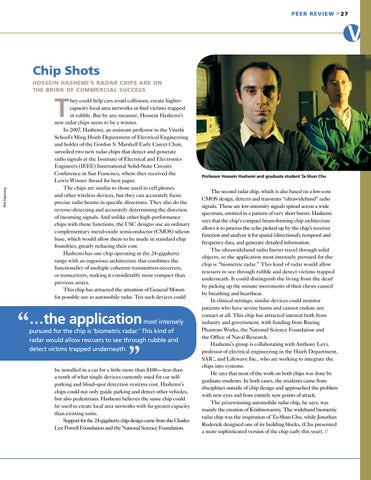
Professor Hossein Hashemi and graduate student Ta-Shun Chu
The second radar chip, which is also based on a low-cost CMOS design, detects and transmits “ultrawideband” radio signals. These are low-intensity signals spread across a wide spectrum, emitted in a pattern of very short bursts. Hashemi says that the chip’s compact beam-forming chip architecture allows it to process the echo picked up by the chip’s receiver function and analyze it for spatial (directional), temporal and frequency data, and generate detailed information. The ultrawideband radio bursts travel through solid objects, so the application most intensely pursued for the chip is “biometric radar.” This kind of radar would allow rescuers to see through rubble and detect victims trapped underneath. It could distinguish the living from the dead by picking up the minute movements of their chests caused by breathing and heartbeat. In clinical settings, similar devices could monitor patients who have severe burns and cannot endure any contact at all. This chip has attracted interest both from industry and government, with funding from Boeing Phantom Works, the National Science Foundation and the Office of Naval Research. Hashemi’s group is collaborating with Anthony Levi, professor of electrical engineering in the Hsieh Department, SAIC, and Lifewave Inc., who are working to integrate the chips into systems. He says that most of the work on both chips was done by graduate students. In both cases, the students came from disciplines outside of chip design and approached the problem with new eyes and from entirely new points of attack. The prizewinning automobile radar chip, he says, was mainly the creation of Krishnswarmy. The wideband biometric radar chip was the inspiration of Ta-Shun Chu, while Jonathan Roderick designed one of its building blocks. (Chu presented a more sophisticated version of the chip early this year). //