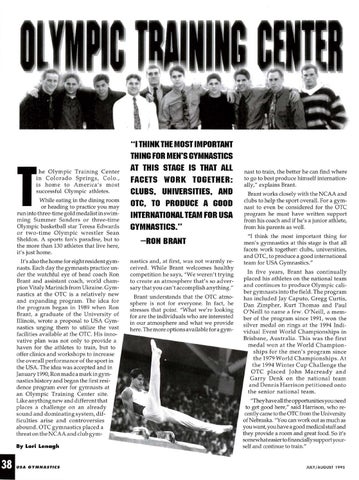
he Olympic Training Center in Colorado Springs, Co lo., is home to America's most successful Olympic athletes. While eating in the dining room or heading to practice you may run into three-time gold medalist in swimming Summer Sanders or three-time Olympic basketball star Teresa Edwards or two-time Olympic wrestler Sean Sheldon. A sports fan's paradise, but to the more than 130 athletes that live here, it's just home. It's also the home for eight resident gymnasts. Each day the gymnasts practice under the watchful eye of head coach Ron Brant and assistant coach, world champion Vitaly Marinich from Ukraine. Gymnastics at the OTC is a relatively new and expanding program. The idea for the program began in 1989 when Ron Brant, a graduate of the University of Illinois, wrote a proposal to USA Gymnastics urging them to utilize the vast facilities available at the aTe. His innovative plan was no t only to provide a haven for the athletes to train, but to offer clinics and workshops to increase the overall performance of the sport in the USA. The idea was accepted and in January 1990, Ronmadea mark in gymnastics history and began the first residence program ever for gymnasts at an Olympic Training Center site. Like anything new and different that places a challenge on an already sound and dominating system, difficulties arise and controversies abound. OTC gymnastics placed a threat on the NCAA and club gym-
"I THINK THE MOST IMPORTANT THING FOR MEN'S GYMNASTICS AT THIS STAGE IS THAT ALL FACETS WORK TOGETHER: CLUBS, UNIVERSITIES, AND OTC, TO PRODUCE A GOOD INTERNATIONAL TEAM FOR USA GYMNASTICS. " -RON BRANT nastics and, at first, was not warmly received. While Brant welcomes healthy competition he says, "We weren't trying to create an atmosphere that's so adversary that you can't accomplish anything." Brant understands that the OTC atmosphere is not for everyone. In fact, he stresses that point. "What we're looking for are the individuals who are interested in our atmosphere and what we provide here. The more options available for a gym-
-
nast to train, the better he can find where to go to best produce himself internationally," explains Brant. Brant works closely with the NCAA and clubs to help the sport overall. For a gymnast to even be considered for the OTC program he must have written support from his coach and if he's a junior athlete, from his parents as well. "I think the most important thing for men's gymnastics at this stage is that all facets work together: clubs, universities, and aTe, to produce a good international team for USA Gymnastics." In five years, Brant has continually p laced his athletes on the national team and continues to produce Olympic caliber gymnasts into the field. The program has included Jay Caputo, Gregg Curtis, Dan Zimpher, Kurt Thomas and Paul O'Neill to name a few. O' Neill, a member of the program since 1991, won the silver medal on rings a t the 1994 Individual Event World Championships in Brisbane, Australia. This was the first medal won at the World Championships for the men's program since the 1979 World Championships. At the 1994 Winter Cup Challenge th e OTC placed John Macready and Ga rry Denk on the national team and Dennis Harrison petitioned onto the senior national team .
By Lori Lenagh
"They have all the opportunities you need to get good here," said Harrison, who recently came to the OTC from the University of Nebraska. "You can work out as much as you want, you have a good medical staff and they provide a room and great food. So it's somewhat easier to financially support yourself and continue to train."
USA GYMNASTICS
JULY / AUGUST 1995
-
-
-
-
-