Polchrova in 12th, GDR's Ann Linder in 13th followed by Zheng Zhu (PRC), Kathy Johnson (USA), Jana Labacova (TCH), Zoja Grancharova and Galina Marinova (BUL), Birgitt Senff(GDR) and Tracee Talavera (USA). Throughout the four rounds of the four-event competition the three Russians were never seriously challenged in score. All the gymnasts were closer in ability than the scores indicate; political bias was evident as demonstrated by the range of score shown on the board for Zhu's beam routine - 9.10 to 9.70. In the end consistency and compulsories were the key factors in winning and in placement. The characteristics of flexibility, dance and powerful vaulting demonstrating height and distance were executed by the top gymnasts. Difficulty was not always the factor in winning or top score. The competition level among the top gymnasts in the world is superb and has never been closer or more competitive than today. The Russians are great, but many teams are close behind with their sights set on some future changes in the world rankings.
Julianne, Kathy, Tracee -
USA
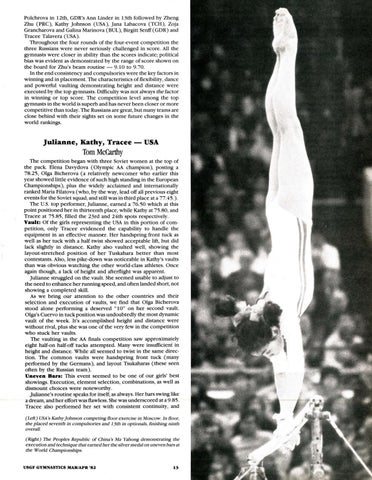
Tom McCarthy The competition began with three Soviet women at the top of the pack. Elena Davydova (Olympic AA champion), posting a 78.25, Olga Bicherova (a relatively newcomer who earlier this year showed little evidence of such high standing in the European Championships), plus the widely acclaimed and internationally ranked Maria Filatova (who, by the way, lead off all previous eight events for the Soviet squad, and still was in third place at a 77.45.). The U.S. top performer, Julianne, earned a 76.50 which at this point positioned her in thirteenth place, while Kathy at 75 .80, and Tracee at 75 .85 , filled the 23rd and 24th spots respectively. Vault: Of the girls representing the USA in this portion of competition, only Tracee evidenced the capability to handle the equipment in an effective manner. Her handspring front tuck as well as her tuck with a half twist showed acceptable lift, but did lack slightly in distance. Kathy also vaulted well, showing the layout-stretched position of her Tuskahara better than most contestants. Also, less pike-down was noticeable in Kathy's vaults than was obvious watching the other world-class athletes. Once again though, a lack of height and afterflight was apparent. Julianne struggled on the vault. She seemed unable to adjust to the need to enhance her running speed, and often landed short, not showing a completed skill. As we bring our attention to the other countries and their selection and execution of vaults, we find that Olga Bicherova stood alone performing a deserved "1 O" on her second vault. Olga's Cuervo in tuck position was undoubtedly the most dynamic vault of the week. It's accomplished height and distance were without rival, plus she was one of the very few in the competition who stuck her vaults. The vaulting in the AA finals competition saw approximately eight half-on half-off tucks attempted. Many were insufficient in height and distance. While all seemed to twist in the same direction. The common vaults were handspring front tuck (many performed by the Germans), and layout Tsukaharas (these seen often by the Russian team). Uneven Bars: This event seemed to be one of our girls' best showings. Execution, element selection, combinations, as well as dismount choices were noteworthy. J4lianne's routine speaks for itself; as always. Her bars swing like a dream, and her effort was flawless. She was underscored at a 9.85. Tracee also performed her set with consistent continuity, and (Left) USA 's Kathy Johnson competing floor exercise in Moscow. In floor, she placed seventh in compulsories and 13th in optionals, finishing ninth overall. (Right) The Peoples Republic of China's Ma Yahong demonstrating the execution and technique that earned her the silver medal on uneven bars at the World Championships.
USGF GYMNASTICS MAR/APR '82