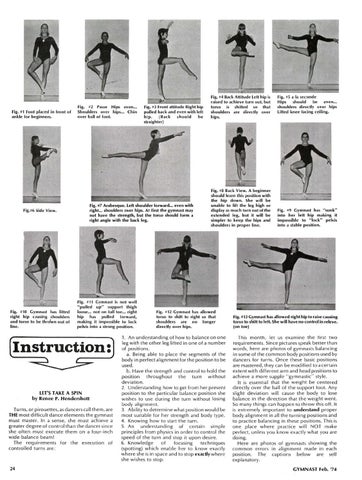
Fig. #1 Foot placed in front of ankle for beginners.
Fig. #2 Passe Hips even ... Shoulders over hips... Chin over ball of foot .
Fig. #7 Arabesque. Left shoulder forward ... even with right .•• shoulders over hips. At first the gymnast may not have the strength, but the torso should form a right angle with the back leg.
Fig.#6 Side View.
Fig. #10 Gymnast has lifted right hip causing shoulde rs and torso to be thrdwn out of line.
Fig. #11 Gymn ast is not we ll "pulled up" sup port thigh loose ... not on full toe ... right hip has pulled forward , making it impossible to lock pelvis into a strong position.
Instruction: LET' S TAKE A SPIN by Renee P. Hendershott Turns, or pirouett es, as dancers ca ll th em, are
THE most difficult d ance elements th e gymn as t must ma ster. In a se nse, she mu st ach ieve a grea ter deg ree of cont r o l th an th e d ancer since she often mu st execute th em o n a four-in ch wide bal ance beam! The requirements for th e execution of co ntroll ed turn s are:
24
Fig. #3 Front attitude Right hip pulled back and even with left hip. (Back should be straighter)
Fig. #4 Back Attitude left hip is raised to achieve turn out, but torso is shifted so that shoulders are directly over hips.
Fig. #8 Back View. A beginner should learn this position with the hip down. She will be unable to lift the leg high or display as much turn out of the extended leg, but it will be simpler to keep the hips and shoulders in proper line.
Fig. #12 Gymnast has allowed torso to shift to right so that shoulders are no longer directly over hips.
1. An understanding of how to bal an ce on one leg with the ot her leg lifted in one of a number of position s. a. Being ab le to place th e segments of the body i n perfect ali gnment for the position to be used . b . Have the strength and co ntrol to hold the position throughout th e turn without deviation. 2. Understandin g how to get from her present position to t he part icular balance position she w ishes to use during th e turn without losi ng body ali gnment. 3. Abilit y to d etermi ne what position wou ld b e mo st suitable for her strengt h and bod y type. 4. Kn ow in g how to start t he turn . 5. An underst anding of ce rtain simple prin cip les from physics in o rd er to contro l the speed o f the turn and stop it upon d esire. 6. Kn owledge of focu sing techniques (spotting) whi ch enab le her to kn ow exactly w h ere she is in space and to sto p exactly wher e she w ish es to stop.
Fig. #5 a la seconde Hips should be even ... shoulders directly over hips lifted knee facing ceiling.
Fig. #9 Gymnast has "sunk" into her left hip making it impossible to " lock" pelvis into a stable position.
Fig. #13 Gymnast has allowed right hip to raise causing torso to shift to left. She will have no control in releve. (on toe)
This month, let us exa mine th e lirst two requirements. Since pi ctures speak b etter than words, here are photos of gymnasts balancing in some of th e co mmon body position s used by dan ce rs for turn s. On ce these bas ic position s are mastered, they can be modified to a ce rtain ex tent with different arm and head positions to achi eve a more suppl e "gymnasti c" style. It is essential th at th e weight be ce ntered directly over th e ball of th e support foo t. Any sli ght devi ation wil l ca u se the body to lose bal ance in th e direction that th e we ight went. So man y thin gs ca n happ en to thr o w this off. It is ex tremely important to understand proper body ali gnment in al l th e turning pos itions and to practice balancin g in th ese positi o ns. Thi s is one pla ce wh ere pr acti ce w ill NOT mak e perfect, unl ess yo u kn ow exactl y what yo u are doing. H ere are photos of gym nas ts showing th e co mmon errors in alignment mad e in each position . Th e captions below are self exp lanat o ry.
GYMNAST Feb. '74