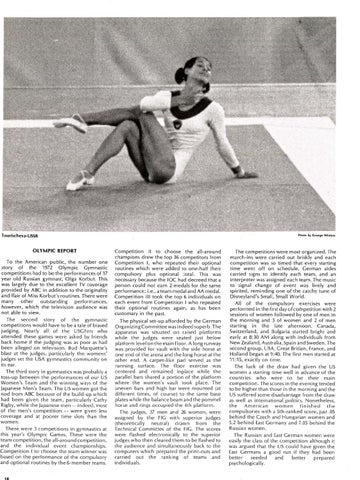
Tourischeva-USSR
Ot YMPIC REPORT To the American public, the number one story of the 1972 Olympic Gymnastic competitions had to be the performances of 17 year old Russian gymnast, Olga Korbut. This was largely due to the excell ent TV coverage provided by ABC in addition to the originality and flair of Miss Korbut's routines. There were many other outstanding performances, however, which the television aud ience was not able to view. The second story of the gymnastic competitions would have to be a tale of biased judging. Nearly all of the USGFers who attended these games were asked by friends back home if the judging was as poor as had been alleged on television. Bud Marquette' s blast at the judges, particularly the womens ' judges set the USA gymnastics community on its ear. The third story in gymnastics was probably a toss-up between the performances of our US Women 's Team and the winning ways of the Japanese Men 's Team. The US women got the nod from ABC because of the build-up wh ich had been g iven the team , particularly Cath y Rigby, while the Japanese men -- indeed, most of the men's competition -- were given less cove rage and at poorer time slots than the women . There were 3 competitions in gymnastics at this year's Olympic Games. These were the team competition , the all-around competit ion , and the indi vidual event championships. Competition I to choose the team winner was based on the performance of the compulsory and optiona l rout in es by the 6-member teams.
18
Pharo by George Winters
Competition II to choose the all-around champions drew the top 36 competitors from Competition I, who repeated their optional routines which were added to one-ha lf their compu lsory plus optional :otal. This was necessary because the IOC had decreed that a person could not earn 2 medals for the same performance; i.e., a team medal and AA medal. Competition III took the top 6 indi vidua ls on each event from Competition I who repeated their optional routines again , as has been customary in the past. The physical set-up afforded by the German Organizing Committee was indeed superb. The apparatus was situated on raised platforms whi le the judges were seated just below platform level on the main floor. A long runway was provided for vault with the side horse at one end of the arena and the long horse at the other end. A carpet-like pad served as the running surface. The floor exercise was centered and remained inplace while the parallel bars shared a portion of the platform where the women ' s vault took place. The uneven bars and high bar were mounted (at different times, of course) to the same base plates whi le the balance beam and the pommel horse and rings occupied the 4th platform. The judges, 37 men and 26 women, were assigned by the FIG with superior judges (theoretically neutral) drawn from the Technical Committes of the FIG. The scores were flashed electronically to the superior judges who then cleared th em to be flashed to the audience and simultaneousl y back to the computers which prepared the print-outs and carried out the ranking of teams and individuals.
Th e competit ions were most organized. The march-ins were carried out briskly and each competition was so timed that every starting time went off on schedule. German aides carried signs to identify each team, and an interpreter was assigned each team. The music to signal change of event was lively and spirited, reminding one of the catchy tune of Disneyland's Small, Small World. All of the compu lsory exercises were performed in the first day of competition w ith 2 sessions of women followed by one of men in the morning and 3 of women and 2 of men starting in the late afternoon. Canada, Switzerland , and Bulgaria started bright and early at 8:30 AM along with individuals from New Zealand, Australia , Spain and Sweden. The second group, USA, Great Britian, France, and Holland began at 9:40. The first men started at 11 :15, exactly on time. The luck of the draw had given the US women a starting time well in advance of the countries who were to be their main competit ion. The scores in the evening tended to be higher than those in the morning and the US suffered some disadvantage from the draw as we ll as international politics. Nonetheless, the American women finished the compu lsories with a 5th-ranked score, just .05 behind the Czech and Hungarian women and 5.2 behind East Germany and 7.05 behind the Russian women. The Russian and East German women were easily the class of the competition alth ough it was argued that the US cou ld have given the East Germans a good run if they had been better seeded and better prepared psychologically.