18
Environment
the ravages of
lady caycay A Beautiful Princess WHO ONCE
SHOOK PANAY IN 1948 BEYOND ITS DEPTH IS CURRENTLY ASLEEP BENEATH OUR LANDS. WILL SHE WAKE UP AGAIN TO MAKE MOUNTAINS BOW DOWN TO HER GLORY? By Erika Daniella M. Pepito
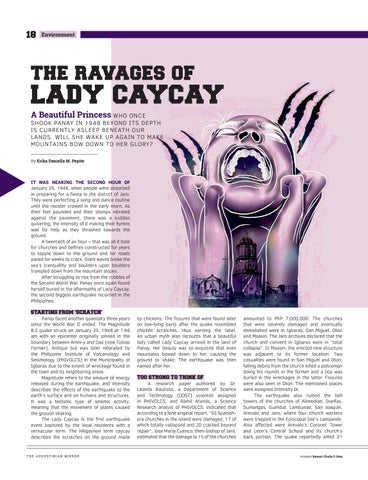
IT WAS NEARING THE SECOND HOUR OF January 25, 1948, when people were absorbed in preparing for a fiesta in the district of Jaro. They were perfecting a song and dance routine until the rooster crowed in the early morn. As their feet pounded and their stomps vibrated against the pavement, there was a sudden quivering, the intensity of it making their hymns wail for help as they thrashed towards the ground. A twentieth of an hour – that was all it took for churches and belfries constructed for years to topple down to the ground and for roads paved for weeks to crack. Giant waves broke the sea’s tranquillity and boulders upon boulders trampled down from the mountain slopes. After struggling to rise from the rubbles of the Second World War, Panay once again found herself buried in the aftermaths of Lady Caycay, the second biggest earthquake recorded in the Philippines. STARTING FROM ‘SCRATCH’ Panay faced another quandary three years since the World War II ended. The Magnitude 8.2 quake struck on January 25, 1948 at 1:46 am with an epicenter originally pinned in the boundary between Anini-y and Dao (now Tobias Fornier), Antique but was later relocated by the Philippine Institute of Volcanology and Seismology (PHIVOLCS) in the Municipality of Igbaras due to the extent of wreckage found in the town and its neighboring areas. Magnitude refers to the amount of energy released during the earthquake, and intensity describes the effects of the earthquake to the earth’s surface and on humans and structures. It was a tectonic type of seismic activity, meaning that the movement of plates caused the ground shaking. The Lady Caycay is the first earthquake event baptized by the local residents with a vernacular term. The Hiligaynon term caycay describes the scratches on the ground made
THE AUGUSTINIAN MIRROR
by chickens. The fissures that were found later on low-lying parts after the quake resembled chicken scratches, thus earning the label. An urban myth also recounts that a beautiful lady called Lady Caycay arrived in the land of Panay. Her beauty was so exquisite that even mountains bowed down to her, causing the ground to shake. The earthquake was then named after her. TOO STRONG TO THINK OF A research paper authored by Dr. Leonila Bautista, a Department of Science and Technology (DOST) scientist assigned in PHIVOLCS, and Ramil Atando, a Science Research analyst of PHIVOLCS, indicated that according to a lone original report, “55 Spanishera churches in the island were damaged, 17 of which totally collapsed and 20 cracked beyond repair”. Jose Maria Cuenco, then-bishop of Jaro, estimated that the damage to 15 of the churches
amounted to PhP 7,000,000. The churches that were severely damaged and eventually demolished were in Igbaras, San Miguel, Oton and Maasin. The Jaro archives declared that the church and convent in Igbaras were in “total collapse”. In Maasin, the erected new structure was adjacent to its former location. Two casualties were found in San Miguel and Oton; falling debris from the church killed a policeman doing his rounds in the former and a boy was buried in the wreckages in the latter. Fissures were also seen in Oton. The mentioned places were assigned Intensity IX. The earthquake also ruined the bell towers of the churches of Alimodian, Dueñas, Dumangas, Guimbal, Lambunao, San Joaquin, Arevalo and Jaro, where four church workers were trapped in the Episcopal See’s campanile. Also affected were Arevalo’s Coronet Tower and Leon’s Central School and its church’s back portion. The quake reportedly killed 21
Artwork Romari Charlz F. Diaz