B4-B5 Volume LIX Number 2 • October 11, 2013
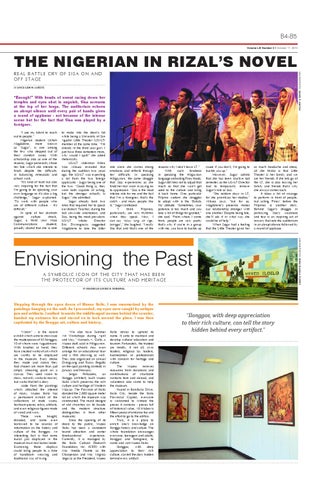
the Nigerian in rizal’s novel usa pub PHOTO / daniel p. abutas
r eal battle c r y of sisa o n a n d off sta g e by joyce gem m. cañete
“Enough!” With beads of sweat racing down her temples and eyes shut in anguish, Sisa screams at the top of her lungs. The auditorium echoes an abrupt silence until every pair of hands gives a round of applause - not because of the intense scene but for the fact that Sisa was played by a foreigner. “I use my talent to reach out to people.” Nigerian student Ucheh Magdalene, more known as “Sugar”, is one among the few who stepped out of their comfort zones. With scholarship also as one of the reasons, Sugar personally chose her fate which she intends to finish despite the difficulty in balancing rehearsals and school work. “It’s kind of hard but also very inspiring for the fact that I’m going to be speaking your own language so it’s also a big challenge,” Sugar explained. “To work with people who are of different culture - it’s difficult.” In spite of her skirmish against culture shock, Sugar, a third year Mass Communications student, proudly shared that she is able
to make into the dean’s list while being a University of San Agustin Little Theater (USALT) member at the same time. “I’m already in the third year gani. I just have three semesters more, why would I quit?” she asked rhetorically. USALT Alderman Khlea Mae Alibusa revealed that during the audition two years ago, the USALT was expecting a lot from the two foreign applicants - Sugar being one of the two. “Good thing is, they were both capable of acting, but the stronger actually is Sugar,” she admitted. Sugar already took two roles that required her to speak our dialect: Teacher, during the last uni-wide orientation, and Sisa, being the most prevalent. USALT Artistic Director Eric Divinagracia suggested Magdalene to take the latter
role since she carries strong emotions and reflects through her difficulty in speaking Hiligaynon, the same struggle that Sisa experiences as she finds her real voice in saying no to oppression. “Sisa is the most intense role for me and the fact that I’m a foreigner, that’s the catch - and many people like it,” Sugar confessed. “I think Filipinos, particularly, are very rhythmic when they speak. Now, I can say “okay lang, ah sige, bongga!,” she laughed. “I really like that and that’s one of the
reasons why I don’t leave LT.” With such fondness in speaking the Hiigaynon language and eating Pinoy foods, Sugar still tries not to adjust that much so that she won’t get used to the culture and bring it back home. One particular Filipino custom she struggles to adapt with is the ‘Bahala Na’ attitude. “Sometimes, your patience is too much and you take a lot of things for granted,” she said. ”From where I come from, people are very pushy that’s why if you’re in a group with me, you have to buckle up
cause if you don’t, I’m going to buckle you up.” However, Sugar admits that she has been inactive last semester, so the USALT Director had to temporarily remove Sugar’s role as Sisa. “She seldom stays in LT, for she prioritizes her studies,” Alibusa says; ”but for us, Magdalene’s presence makes our relationship stronger with one another. Despite being late, she’ll ask if in what way she could be of help.” When Sugar had a feeling that the Little Theater gives her
so much headache and stress, all she thinks is that Little Theater is her family and we are her friends. If she lets go of the LT, she is also leaving her family and friends that’s why she always comes back. It takes a lot of courage to perform in front of people, but acting ‘Pinoy’ before the Filipinos is another story. Behind Sugar’s struggle in portraying Sisa’s weakness and fear is an inspiring act of bravery that sets the auditorium in an abrupt silence followed by a round of applause.
a S Y M B O L I C I C O N O F T H E C I T Y T H A T has bee n the p r otecto r of I T s C U L T U R E A N D H E R I T A G E By rochelle louise d. doromal
Stepping through the open doors of Museo Iloilo, I was mesmerized by the paintings hanging on the wall. As I proceeded, my eyes were caught by antique jars and artifacts. I walked towards the middle-aged woman behind the counter, handed my entrance fee and moved on to look around the place. I was then captivated by the Ilonggo art, culture and history. “Vision” - is the recent exhibit which aims to showcase the masterpieces of 63 Ilonggos, 10 of whom were Augustinians. With brushes at hand, they have created works of art which are worthy to be displayed in the museum. Every stroke they made and colors they had chosen are more than just simply smearing paint on a canvas. They used vision to show, not only works to marvel, but works that tell a story. Aside from the paintings which attracted the interest of many, Museo Iloilo has a permanent exhibit of the collections of trade wares, heirloom pieces, relics, artifacts, and even religious figures made of wood and ivory. These were bought, donated, and some even borrowed to be sources of information on the history and culture of the Ilonggos. An interesting fact is that some burial jars displayed in the museum have real bones inside. Examining these displays could bring people to a time of handloom weaving and traditional way of living.
“We also have Summer Art Workshops during April and May,” Manuela A. Gullo, a Museo staff, said in Hiligaynon. Different schools may even arrange for an educational tour and a film showing as well. They also organized an annual Dinagyang and Paraw Regatta on-the-spot painting contests in January and February. Sergio Peñasales, an Ilonggo architect, built Museo Iloilo which preserves the rich culture and heritage of Western Visayas. The Province of Iloilo donated the 2,000 square meter lot on which the museum was constructed. The mural designs of old churches on its facade and the modern structure distinguishes it from other museums. Since the opening of its doors to the public, Museo Iloilo has been a consistent tourist attraction and center foreducational experience. Currently, it is managed by the Iloilo Cultural Research Foundation, Inc. (ICRFI) with Mrs. Imelda Florete as the Chairperson and Mrs. Virginia Segovia as the President, Museo
Iloilo strives to uphold its name. It aims to maintain and develop cultural education and tourism. Fortunately, the trustees are mostly, if not all, civic leaders, religious lay leaders, businessmen or professionals with concern for heritage and culture. The Museo receives resources from donations and contributions of charitable contacts here and abroad, and volunteers also come to help the museum. Found in Bonifacio Drive, Iloilo City, beside the Iloilo Provincial Capitol, everyone is welcomed to witness the pieces it contains - pieces full of historical value. All it takes is fifteen pesos of entrance fee and the effort to go to the edifice. Truly, it is a place to enrich one’s knowledge on Ilonggo history and culture. The whole foundation encourages everyone, teenagers and adults, Ilonggos and foreigners, to come and visit Museo Iloilo. Ilonggos, with deep appreciation to their rich culture, can tell the story hidden behind every artifact.
“Ilonggos, with deep appreciation to their rich culture, can tell the story hidden behind every artifact.”
usa pub PHOTOs / mara elaiza a. flores
Envisioning the Past