8
The Critical Care Communications A Bi-Monthly Newsletter of Indian Society of Critical Care Medicine
Abdominal Compartment Syndrome - The Pressure is On Dr. Yash Javeri, Consultant intensivist, Max Hospital Saket Background
Categories
Compartment syndrome occurs when a fixed compartment, defined by myofascial boundaries or bone, are subjected to increased pressure, leading to ischemia and organ dysfunction. The abdominal compartment syndrome (ACS) is the development of physiologic dysfunction in intra-abdominal and extra abdominal organs as the result of increased intra-abdominal pressure (IAP). The elevated IAP is a function of the rate of fluid accumulation within the abdominal cavity and the compliance of the abdomen. The pressure-volume curve for the abdominal cavity is nonlinear. Due to the decreasing compliance of the abdomen, as fluid within the peritoneal cavity progressively accumulates, a greater increase in IAP results. The ACS may occur in patients with a variety of conditions in which increased IAP occurs.
Primary or acute ACS: This occurs when intra-abdominal pathology is directly and proximally responsible for the compartment syndrome.
Clinical settings commonly associated with the syndrome include ruptured abdominal aortic aneurysm, ascites and intraperitoneal hemorrhage. Organ dysfunction caused by intra-abdominal hypertension (IAH) is considered to be abdominal compartment syndrome. The dysfunction may be respiratory insufficiency secondary to compromised tidal volumes, decreased urine output caused by falling renal perfusion, or any organ dysfunction caused by increased abdominal compartment pressure.
Secondary ACS: This occurs when no visible intra-abdominal injury is present but injuries outside the abdomen cause fluid accumulation. Chronic ACS: This occurs in the presence of cirrhosis and ascites, often in the later stages of the disease.
Recurrent ACS: in which the patient has recovered from the ACS once but because of secondary insults the cycle begins again. This variety is associated with very high mortality rate.
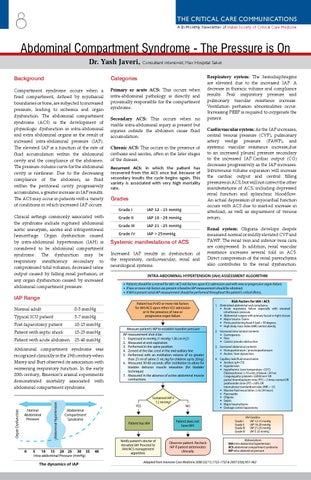
Grades Grade I
IAP 12 - 15 mmHg
Grade II
IAP 16 - 20 mmHg
Grade III
IAP 21 - 25 mmHg
Grade IV
IAP > 25mmHg
Systemic manifestations of ACS Increased IAP results in dysfunction of the respiratory, cardiovascular, renal and neurological systems.
0-5 mmHg
Typical ICU patient
5-7 mmHg
Post-laparotomy patient
10-15 mmHg
Patient with septic shock
15-25 mmHg
Patient with acute abdomen
25-40 mmHg
Normal Abdominal Pressure
0
Abdominal Hypertension
Organ Dysfunction
Abdominal compartment syndrome was recognized clinically in the 19th century when Marey and Burt observed its association with worsening respiratory function. In the early 20th century, Emerson’s animal experiments demonstrated mortality associated with abdominal compartment syndrome.
5 10 15 20 25 30 35 Intra-abdominal Pressure (mmHg)
The dynamics of IAP
40
Renal system: Oliguria develops despite measured normal or mildly elevated CVP and PAWP. The renal vein and inferior vena cava are compressed. In addition, renal vascular resistance increases several fold in ACS. Direct compression of the renal parenchyma also contributes to the renal dysfunction.
Patients should be screened for IAH / ACS risk factors upon ICU admission and with new or progressive organ failure. If two or more risk factors are present a baseline IAP measurement should be obtained. If IAH is present serial IAP measurement should be performed throughout the patient’s critical illness. Patient has PvVO or more risk factors for IAH/ACS upon either ICU admission or in the presence of new or progressive organ failure
Measure patient’s IAP to establish baseline pressure AP measurement shot d be: 1. Expressed in mmHg (1 mmHg-1.36 cm H2O 2. Measured at end-expiration 3. Performed in the spine position 4. Zeroed at the iliac crest in the mid-axillary line 5. Performed with an instillation volume of no greater than 25 ml of saline [1 mL/kg for children up to 20 kg] 6. Measured 30-60 seconds after instillation to allow for bladder detrusor muscle relaxation (for bladder technique) 7. Measured in the absence of active abdominal muscle contractions
Sustained IAP ≥ 12 mmHg?
YES
Abdominal Compartment Syndrome
Cardiovascular system: As the IAP increases, central venous pressure (CVP), pulmonary artery wedge pressure (PAWP), and systemic vascular resistance increase,due to an increased pleural pressure secondary to the increased IAP.Cardiac output (CO) decreases progressively as the IAP increases. Intravenous volume expansion will increase the cardiac output and central filling pressures in ACS, but will not correct the other manifestations of ACS, including depressed renal function and splanchnic bloodflow. An actual depression of myocardial function occurs with ACS due to marked increase in afterload, as well as impairment of venous return.
INTRA-ABDOMINAL HYPERTENSION (IAH) ASSESSMENT ALGORITHM
IAP Range Normal adult
Respiratory system: The hemidiaphragms are elevated due to the increased IAP. A decrease in thoracic volume and compliance results. Peak inspiratory pressure and pulmonary vascular resistance increase. Ventilation perfusion abnormalities occur. Increasing PEEP is required to oxygenate the patient.
NO
Patient has IAH
Patient does not have IAH
Notify patient’s doctor of elevated IAP. Proceed to IAH/ACS management algorithm.
Observer patient. Recheck IAP if patient deteriorates clinically.
Risk Factors for IAH / ACS 1. Diminished abdominal wall compliance Acute respiratory failure especially with elevated intrathoracic pressure. Abdominal surgery with primary fascial or tight closure Major trauma / barns Prone positioning head A bed > 30 degrees High body mass index (BMI) central obesity 2. Increased intra-luminal contents Gastroparesis Ileus Colonic pseudo-obstruction 3. Increased abdominal contents Hemoperitoneum / pneumoperitoneum Ascites / liver dysunction 4. Capillary leak/fluid resuscitation Acidosis (pH<72) Hypotension hypothermic (core temperature <33oC) Polytransfusion (>10 units of blood / 24 hrs) Coagulopathy (platelets 55000/mm3 OR partial thromboplastin time (PIT) > 2 times normal OR prothrombin time (PIT) <50% OR international standardised ratio (INR) > 15) Massive fluid resusctation (>5L/24 hours) Pancreatitis Oliguria Sepsis Major trauma/burns Damage control laparotomy
Grade I Grade II Grade III Grade IV
IAH Gradina IAP 12-15 mmHg IAP 16-20 mmHg IAP 21-25 mmHg IAP ≥ 25 mmHg
Abbreviations IAH-intra-abdominal hypertension ACS-abdominal compartment syndrome IAP-intra-abdominal pressure
Adapted from Intensive Care Medicine 2006:32(11):1722-1732 & 2007:33(6):951-962