CITY OBSERVER A BIANNUAL JOURNAL ON CITIES PUBLISHED BY URBAN DESIGN COLLECTIVE
n ig
Volume 2
JUNE 2016
Urban De s
INSIDE
GENDER PLANNING AND PLACE-MAKING
SCHRÖDINGER’S PROPOSITION
Issue 1
Collective
*
*
THE FOREVER GREEN BRICKWORKS
CITY OBSERVER Volume 02 | Issue 01 | June 2016 Free Publication City Observer is a biannual journal which aims to create a conversation on cities and to collaboratively interrogate our urban world. City Observer is published by the Urban Design Collective. Urban Design Collective (UDC) is a non-profit organization that works as a collaborative platform towards the creation of livable & sustainable cities through community engagement. www.urbandesigncollective.org info@urbandesigncollective.org
EDITORIAL TEAM Shruti Shankar Sunjana Thirumala Sridhar Vidhya Mohankumar COVER ILLUSTRATION Abinaya Rajavelu LAYOUT DESIGN Sunjana Thirumala Sridhar
Copyrights of images lie with the person/ party mentioned in the image caption. This magazine cannot be republished or reproduced without the permission of the publisher.
To Cities and People
Contents EDITORIAL
FEATURE ARTICLE
Shruti Shankar
Gender Planning and Place-making in Kisumu
8
Nasim Amini & Sunjana Thirumala Sridhar
10
COMMUNITY ENGAGEMENT
Participatory Design for Safe Access in Station areas Himadri Das
26
ART AND THE CITY
Schrödinger’s Proposition Naveen Mahantesh
MOBILITY AND THE CITY
Smart Cities: Utopian dreams and Hidden Perils Raquel Leonardo
44
FEATURE ARTICLE
CITY TRAILS
Cities of Sound
Storytrails: Experiencing Cities through Stories
Arshiya Syed
50
Vijay Prabhat Kamalakara
58
36
MOTION CAPTURED
Hanoi Adithya Rangarajan
66
LEARNING FROM CITIES
10 Urban Design Lessons from Hyderabad Nandini Ramakuru
78
ON LOCATION
The Forever Green Brickworks Shruti Omprakash & Jiya Benni
102
SPECIAL FEATURE
Film City Tower Archasm
110
TEACHING URBAN DESIGN
Procedural fairy tales about teaching productive Urban Design in Germany Monika Katharina Hagg & Oliver Schetter
134
CLOSING SCENE Vidhya Mohankumar
154
CITY OBSERVER
Malmรถ Amsterdam Toronto
New York City
Germany Dessau Istanbul Selรงuk
Chandigarh Delhi Mathura
Bursa
Mumbai
Hyderabad Chennai
Kisumu
Hanoi
Singapore Bangalore Kochi Trivandrum
Pondicherry
Cities profiled thus far... Current Issue Past Issues
EDITORIAL
As City Observer steps into its second year, all of us on the editorial team would like to begin by thanking you, our audience, for all the great feedback, support and enthusiasm that you have shared with us thus far. We’re thrilled with the response we’ve received to the first two issues of the journal and hope to keep up this momentum in the coming months! While individual issues of the City Observer are not thematic, there is an overarching theme for the journal itself, which is ‘Cities and People’. There is a reason for this seemingly generic approach. How each of us understands the phenomenon of the ‘City ‘is a reflection of our own experiences, training and our cultural bent of mind. Let’s call it perspective. Some of us approach urbanization as a set of problems to solve. Or maybe we are captivated by the potential of the future, given how fast many cities are changing. Some others tend to see the city primarily as the space of opportunity in the ‘sharing economy’ of the 21st century. For some, cities are a measure of speed and time, representing the fast pace of life, while others might regard them as a celebration of culture, diversity and so on. There are also those for whom the city is in many ways just a backdrop for their personal stories and daily lives. All of these are valid conceptions and reactions to the city and for many of us an understanding of the ‘City’ is more than just one thing at any point in time. For most of us, the experience of each city tends to be unique and grounded in its own truths. Despite these numerous nuances – and often because of them – in our contemporary methods of operating in the city, we have begun to classify the discussions on them into a few defined and tangible threads for convenience of discourse. ‘Smart’ cities, ‘Resilient’ cities, ‘Sustainable’ cities, ‘Informal’ cities and so on are a few of such themes associated with the conversation on cities today. These terms are definitely useful as frameworks to describe, analyse, promote and often even design cities. However, it is important to keep in mind that they are all lenses or tools that should ultimately refer to the complexity of relationships between individuals, societies and the places they inhabit. When they become removed from this fundamentally human aspect of cities, these
8
CITY OBSERVER | June 2016
themes serve as little more than simplifications, and fail to address the richness and essence of urban life. Unfortunately, a similar kind of segmented thinking is already seen, often to harmful effect, in the way many cities are developed and managed – with silos created for various functions and departments which are then responsible for their piece of the city alone, regardless of the numerous associations that each has with society at large. The city, however, is not a machine and to prevent oversimplification in our understanding, we should resist the temptation to treat it as one. Instead, we need to find ways to accommodate and reflect on the multitude of perspectives that have the potential to give us a richer snapshot of the urban condition. While we may still have a long way to go in terms of changing the way we operate in the urban fabric, attempting to consciously address this complexity in the conversation on cities is, we believe, an important place to start. And so while we encourage writing and reading about the city through an array of lenses in each issue, focusing on ‘Cities and People’ is our way of inviting both, our authors and our audience, to consciously consider the articles in a narrative about how people relate to cities and vice versa. In this issue, as in the past, the response to our prompt has been diverse and well-articulated, with a wide variety of topics and cities. We hope you find much to intrigue and interest you. Thank you once again for sharing this journey with us, and happy reading! Shruti Shankar On behalf of the Editorial Team
‘Drawing City Doodle’ by John Green
June 2016 | CITY OBSERVER
9
FEATURE ARTICLE
GENDER PLANNING AND PLACEMAKING IN KISUMU Inclusionary Planning through an Inquiry on Gender Roles
by Nasim Amini & Sunjana Thirumala Sridhar
10
CITY OBSERVER | June 2016
Manyatta in Kisumu City, Kenya. Image credit: Sunjana TS
In the context of the Millennium Development Initiatives for 2030, Kisumu in Kenya has been earmarked for intense development, and to pilot the implementation of the global Cities Without Slums (CWS) initiative. Combining this initiative with Kenya’s strategic move to decentralize its constitution has provided enormous potential to change livelihoods by bringing social services closer to the people.
June 2016 | CITY OBSERVER
11
FEATURE ARTICLE
Continent scale to the household scale. Image credit: Sunjana Thirumala Sridhar
Manyatta, Kisumu. Image credit: Nasim Amini
12
CITY OBSERVER | June 2016
SETTING THE STAGE This article focuses on Manyatta, an informal settlement/slum located along the peri-urban edges of Kisumu. The article investigates the existing and historic contexts, its impact on spatial configurations and social status and makes a case for participatory planning. The purpose is to reinforce that decentralized planning can only be effective if the end user is also the initiator of the planning process.
FORMING THE ARGUMENT FOR THE SITE IN KISUMU - MANYATTA As a result, and in-spite of little access to formal jobs, women have carved out a formidable position for themselves in the micro/informal sector of Kisumu. Research conducted by the GSAPP team highlights these women as the main driving force of a micro-economy in Kisumu and more specifically in Manyatta, identifying them as potential and critical drivers for the socio-economic prosperity of Manyatta. Simultaneously, Manyatta is at a juncture where it will need to respond to Kisumu’s earmarked urbanization - either by being indispensable to the City’s socioeconomic profile or by allowing itself to be absorbed/ obliterated by the force of Kisumu’s rapid expansion. This juncture is a critical window of opportunity to carefully guide this response- one which can deal with how the prevalent culture of Kisumu, and not only Manyatta, can highlight women as critical
socio-economic contributors in their workforce. In empowering women as agents of change, this article emphasizes the importance of all the elements that will benefit their inherent lifestyle the most- the varied scales and nature of social spaces , supporting building typologies and constitutional policies that recognize and emphasize the socio-economic identity of Manyatta. Since 2010, with the introduction of the new constitution in Kenya, important strides towards a more equitable society have been taken. Women have been legally granted the right to land ownership. They have equal representation in the new constitution including equal pay for equal work. While the government is taking crucial steps forward, the communities at large are yet to accept these new moves. By creating an inclusionary and participatory approach, the chasm between the new constitution and community acceptance can shrink. Critical to the growing recognition and acceptance of women as social and economic drivers are current facts that place women as 75% of the micro/informal workforce of Kisumu which in turn contributes to 20% of the GDP of the city. Site studies and research also show that this same category of working women are key occupants of the open spaces and streets in Manyatta.
Women being disconnected from the formal economy. Image credit: GSAPP core team
June 2016 | CITY OBSERVER
13
FEATURE ARTICLE
Impact of Colonization on the spatial fabric. Image credit: GSAPP core team
In the post colonization era, the woman’s role of MANYATTA - THE HISTORIC IMPACT OF COLONIZATION ON GENDER ROLES AND THE caretaking and providing food and water in the household did not change but her means to fulfil these SPATIAL FABRIC A majority of the local population in Kisumu and Manyatta belong to the Luo tribe. During the precolonial era, the traditional professions of the Luo tribe consisted of herding, fishing, and tending to pastors. This lifestyle was nomadic in nature and complemented the complex family structure . The expansion of ‘occupied’ land by the sons of each family enabled the spatial needs of each family to be met. However, the post-colonization era brought with it the process of land segregation among the various tribes of Kenya, thus limiting the scope for physical expansion. In essence, while the habits of the tribes remained intact, the spatial environment was drastically altered. Traditionally, women of the household were in charge of the farmlands and this enabled a degree of control, sharing of gender roles and recognition and respect for their contribution.
14
CITY OBSERVER | June 2016
responsibilities significantly changed. The lack of any additional farmlands to develop and the shrinking of grazing fields for the herds necessitated women to find alternate means of ‘providing’. Luo traditions do not deem it necessary for women to directly own land or property but allowed them to have any possible claim only through their spouse . In addition to these struggles, women are also faced with the difficulties of poor health, little access to capital and credit, lack of access to formal jobs, commoditisation of their bodies, multiple responsibilities of care-taking and sustaining households and often having to resort to derogatory and unhealthy methods of barter for goods . Additionally, formal education has often been a secondary priority for female children. While primary education was made available to all children, irrespective of gender, the dropout rate of girls in secondary education institutions is alarming. This
Manyatta traditional Lou land
1970’s World Bank Slum Upgrade: Infrastructure, water, sewage and power
The added infrastructure increased property value, enhanced land parcelization and change of ownership
No public spaces, as Government doesn’t own land
Tracing the changes in land. Image credit: GSAPP Core team
Cultural scenario and its impact on Gender. Image credit: Sunjana Thirumala Sridhar
June 2016 | CITY OBSERVER
15
FEATURE ARTICLE
Ratio of enrollment in private and public educational institutions. Image credit: GSAPP core team
Protests against gender based violence in Kisumu. Image credit: http://www.hivisasa.com/kisumu/news/137630
THE TRIPLE ROLE THAT WOMEN PLAY Reproduction role - In most low-income households, the ‘women’s work’- the childbearing and rearing responsibilities -is the work required to guarantee the maintenance and reproduction of the labour force Production role - They are often forced to be secondary income earners. In rural areas this usually takes the form of work in the informal sector enterprises located either in the home through sub-contracting or piece-rate work or at the neighbourhood level through service markets such as tailoring or prostitution. Community Management role - In addition, women are involved in community management work undertaken at a local community level within the settlement. With the increasingly inadequate state provision of housing and basic services such as water and health, it is women who not only suffer the most but who are also forced to take responsibility for the allocation of limited resources to ensure the survival of their households.
relates directly to the role of care-taking that girls take on at a young age, a phenomenon observed world over in developing countries. A lack of access to formal education inevitably results in the lack of access to formal jobs. Also, what was previously a matter-of-fact expansion of the family with an accompanying expansion of land is now a single plot of land constantly subjected to fragmentation and division with each passing generation. The result of this self-division of land is evident in the physical fabric of Manyatta. Besides a
16
CITY OBSERVER | June 2016
number of other reasons, this division of plots and the resulting spatial layout has also made it difficult for the government to access the settlement for laying basic infrastructure i.e. sewage lines, roads, electric lines and water pipes. A number of factors have reinforced the development of Manyatta into a slum belt, such as all land being privately owned, existence of multiple landowners within a ‘plot’, dense clusters of low-rise housing with no public space, lack of governmental regulation, support or control in terms of growth, infrastructure and resource allocation, and location within a low-lying land area.
Cultural scenario and its impact on Gender roles. Image credit: http://www.academia. edu/10120971/Social_and_ Cultural_Significance_of_the_ Sexual_Cleansing_Ritual_and_ its_Impact_on_HIV_Prevention_ Strategies_in_Western_Kenya
Kisumu in 2015. Image credit: GSAPP core team
Daily chores for a woman in Manyatta. Image credit: GSAPP core team
June 2016 | CITY OBSERVER
17
FEATURE ARTICLE
PRACTICAL GENDER NEEDS •
Easy access to clean drinking water
•
Adequate shelter against the elements [heat + rain]
•
Hygienic disposal of waste
•
Easy access to fuel for cooking
•
Access to cooling facilities to store perishables (fridges aren’t the norm)
•
Safe spaces for children to play and be watched over
•
Access to affordable medical care
•
Access to emergency trauma facilities
•
Provision for earning income from home
•
Access to micro-credit
STRATEGIC GENDER NEEDS •
Access to resources
•
Control over resources
•
Increased economic independence
•
Right to own land
•
Right to involvement in use and design of spaces
•
Freedom of time
•
Freedom of choice [child-bearing, child-rearing, education, employment]
•
Safe facilities for family care
•
Reliable infrastructure
•
Protection against sexual abuse
•
Political equality for representation
•
Removal of gender-based division of labour
•
Removal of prohibitory cultural mind-set of ‘natural capital’ [sexual, physical and gender superiority mind-set]
•
Alleviation from status of ‘second class citizens’
A closer look at the ‘triple role’ that the women of Manyatta play - reproduction, production and community management - reveals a growing inequity faced by them on a daily basis. Where there is open confrontation between community-level organizations and local authorities, in attempts to put direct pressure on the state or non-governmental organizations for infrastructural provision, again it is women who as an extension of their domestic role frequently take
18
CITY OBSERVER | June 2016
primary responsibility for the formation, organization and success of local-level protest groups. Women, within their gender-ascribed roles of wives and mothers, struggle to manage their neighbourhoods. In performing this third role, they also implicitly accept the sexual division of labour and the nature of their gender subordination. While gender inequality issues exist throughout the world, the impact of this inequity is felt differently in developing or underdeveloped
The scale of social space observed in Manyatta. Developed by the GSAPP’s core team during the 2014 Academic study
Re-allocation of time for daily activities. Developed by the GSAPP’s core team during the 2014 Academic study
June 2016 | CITY OBSERVER
19
FEATURE ARTICLE
‘
In the post colonization era, the woman’s role of caretaking and providing food and water in the household did not change but her means to fulfill these responsibilities significantly changed. The lack of any additional farmlands to develop and the shrinking of grazing fields for the herds necessitated women to find alternate means of ‘providing’.
countries. Often, fundamental needs of daily life that can be taken for granted in first world countries comprise the daily struggles of life in third world nations. These needs may be classified as Practical Gender Needs and Strategic Gender Needs.
CONNECTING THE DOTS BETWEEN GENDER NEEDS AND SPATIAL PLANNING The manner in which spaces are used, both within a household and in communal or public settings, is heavily influenced by gender roles. Women due to their predominantly communal roles are dependent on spaces which can act as gathering spots. These are areas where they communicate, take on their production role and go about fulfilling their everyday needs. This dependency is critical to recognize in the case of Manyatta as it coincides with the constitution’s new ruling of women legally being allowed to own property in Kenya. Bringing together political and social leverage opens a window of design opportunity - to guide the spatial planning of the currently informal settlement.
ADVOCATING A FORM OF SPATIAL PLANNING - FORM BASED ZONING While the creation of a Gender Inclusionary Development Policy (GIDP) requires implementation and enforcement by the Government (essentially top down planning), the proposed spatial design of Manyatta is guided by a set of gender-centric form based zoning, which guides the design of spaces where women can work, sell, produce collaboratively, increase productivity, share and ease domestic responsibilities and promote a healthier environment
20
CITY OBSERVER | June 2016
‘
for their families and the community at large. Open space is critical to the way Manyatta’s development is envisioned, and hence the proposed form of spatial planning works with existing courtyards and ‘left over’ spaces in order to achieve the appropriate variety and scale of social spaces. Social spaces are defined by cluster sizes and respond to the density of activity within them. The proposed building typology corresponds to the characteristics of the road it is in proximity to. The development of the ground space with respect to activities and facilities bears a two-fold purpose – the enhancement of economic productivity and integration with family activities.
For example, one combination of the form based zoning framework which uses a ‘double commercial’ [DC] + ‘residential production’ [RP] + ‘large courtyard’ [LC], provides the users with spaces to add-value to their raw products. The production spaces are complemented by support facilities such as storage spaces and easy access for distribution and sales. A proportion of the ground floor development also caters to support facilities such as day-care centres, learning spaces for children and play areas. The way in which women use their space can help to create better opportunities for women and thereby directly effect a higher quality of life for the family unit. This makes it essential to enable women and community-oriented spatial design, especially in concentrated population centres. A key premise of the proposed strategies is therefore to empower women who by nature have the capacity to empower those around them and subsequently the community and the city.
Form based planning. Image credit: GSAPP Core team
June 2016 | CITY OBSERVER
21
FEATURE ARTICLE
Form based planning. Image credit: GSAPP Core team
22
CITY OBSERVER | June 2016
‘
While gender inequality issues exist throughout the world, the impact of this inequity is felt differently in developing or underdeveloped countries. Often, fundamental needs of daily life that can be taken for granted in first world countries comprise the daily struggles of life in third world nations.
‘
THE ROAD AHEAD
To reap the envisioned benefits of the proposed strategies, an unprecedented policy change is also required. However, the potential pitfalls of relying entirely on a government-driven or top down agenda are many. Nevertheless, this case example seeks to make a case for a stronger bottom-up planning approach for a place-making scheme. What began with GSAPP’s core team’s investigations, led to the understanding that the other end of the spectrum- a solely grass-root approach towards place-makingcan have its shortcomings in that its momentum cannot be truly recognised without the involvement of larger institutions, cities and governments. Placemaking occurs through a social process, and a ‘place’ is utilized to its highest potential when its creation is driven by its critical users. While the development paths of Hong Kong and/or Los Angeles indicate that top down infrastructure with overlays of recreation can create bustling public spaces, the example of Plaza Mexico is a shining case in point for peoplemade place-making. This reinforces the impact of urban scale interventions through community-led participation. Successful public spaces are not merely waterfronts, landscaped plazas and streets which turn into prime real estate or shopping and recreational paradises. Instead, the case example of Manyatta in Kisumu advocates the creation of successful social spaces that are, coincidentally, public in nature. While the idea of creating space through the movement of people is not new, the issue, more importantly, is about a ‘transformation of the public space’ and acknowledging the participatory nature of planning as a right of each citizen. As demonstrated in the case of Kisumu, the citizen’s right is reinforced through careful gender-oriented planning.
A process of place-making which is moulded, defined and structured by the users of the place and is encouraged, recognized and facilitated by the government can truly benefit the city instead of marginalizing its most vulnerable members. This method requires a wide stakeholder group to come together - one which consists of residents as bearers of knowledge about the community and trained professionals. Government involvement in Manyatta is key to the legal recognition that the residents of Manyatta seek. Conventionally, a top-down approach by the government may result in the voice of the citizens remaining unheard. However, with a series of checks and balances through a proposed gender inclusionary dialogue involving women’s collectives, landlords and the government, there is a potential to marry the better of two opposing approaches. Decentralization can be effective and last long only if it involves ALL players –the city government, investors and users of the space- essentially anyone who has anything to do with ‘Forming, Performing and Maintaining’ the area. Increasingly, women in third world countries, are becoming key contributors to activities of Production, Reproduction and Community management, and this strongly influences the outcome of planned and unplanned social and spatial changes. It is therefore important to look beyond conventional methods of planning which rely solely on the most “influential” members, be it investors, property owners, or governments as advocates of planning changes Understanding the way things are done and seen historically and traditionally is undeniably critical in ensuring the effectiveness of new changes. Else, the result can be chaotic where the smallest of changes can damage long standing social structures and produce a ramification which can take years to be
June 2016 | CITY OBSERVER
23
FEATURE ARTICLE undone. In short, through the analysis of historic contexts, a reflection of gender-based roles on the spaces of occupation and a proposed scheme for converting policy into tangible spatial form, this project intends to make a case for gender-inclusionary development in Kisumu.
Petra Kemph and Viren Brambhatt, and through a core team whose members were Julianna Almeida, Nasim Amini, Priscilla Coli and Sunjana TS. The studio site was based in Kisumu, Kenya. Research techniques involved site visits, on-site interviews, site documentation and historic analysis.
NOTE:
REFERENCES
The research for this paper was carried out in conjunction with the Urban Design Studio at GSAPP, Columbia University during the Spring 2014 semester, under the guidance of director Richard Plunz, and critics Geeta Mehta, Kate Orff, Victor Body-Lawson,
1. ’Kenya‘s Devolution’. N.p., nd. Web. 26 Apr. 2014. <http:// www.worldbank.org/en/country/kenya/publication/kenyasdevolution>. 2. “Kenyans look to newly decentralized government to improve social services.” UPI. N.p., 28 May 2013. Web. 26 Apr. 2014. <http://www.upi.com/Top_News/ World-News/2013/05/28/Kenyans-look-to-newly-
Depiction of courtyards as social and productive spaces. Image credit: Nasim Amini
24
CITY OBSERVER | June 2016
decentralized-government-to-improve-social-services/PC9711369776182/#ixzz2zzzfVRJx>.
Identity of A Nation, New Africa Press, Pretoria, South Africa, 2008.
3. Nyangori, Ruth.”Factors influencing performance of micro and small enterprises: A case of Kisumu City Bus Park Kenya”. Thesis 2010: P.16 - 18
8. Okwany, C COmondi. “THE LUO CULTURE, HABITS, MIGRATION AND SETTLEMENT.”. N.p., 16 June 2011. Web. 27 Apr. 2014. <http://cliffmode.blogspot.com/2011/06/luoculture-habits-migration-and.html>.
4. “What Is Social Space?” Urban Times RSS. Thejas Jaganath, 27 Sept. 2013. Web. 27 Apr. 2014. <http:// urbantimes.co/2013/09/what-is-space-according-to-henrilefebvre/>. 5. Rock, Lucy. “What Britain could learn from Denmark’s childcare model?” The Observer. Guardian News and Media, 19 Feb. 2012. Web. 27 Apr. 2014. <http://www.theguardian. com/society/2012/feb/18/britain-learn-denmark-childcaremodel>. 6. Espinosa, Deborah. “In Kenya, Land Rights Bring New Hope for Women and Girls.” The Huffington Post. TheHuffingtonPost.com, 7 May 2013. Web. 27 Apr. 2014. <http://www.huffingtonpost.com/deborah-espinosa/inkenya-land-rights-brin_b_3224381.html>.
9. http://www.encyclopedia.com/topic/Luo.aspx 10. Lowen, Mark. “Kenya’s Battle to End ‘sex for Fish’ Trade.” BBC News. N.p., 16 Feb. 2014. Web. 27 Apr. 2014 11. Clara Irazábal & Surajit Chakravarty (2007): Entertainment–Retail Centres in Hong Kong and Los Angeles: Trends and Lessons, International Planning Studies, 12:3, P.245 [241-271] 12. Clara Irázabal & Macarena Gómez-Barris (2008): Bounded Tourism: Immigrant Politics, Consumption, and Traditions at Plaza Mexico, Journal of Tourism and Cultural Change, 5:3, 186-213
7. Huntington, New York, 2001; Godfrey Mwakikagile, Kenya:
About the Authors Sunjana Thirumala Sridhar is an urban designer and architect, with a keen interest in understanding the way design and research impacts our socio-economic lifestyles. After graduating from Columbia University, and with five years of prior professional experience in the architectural and urban field, she founded Ud-S (United design Studio), a design practice handling urban, architectural and furniture research and design. Her experience spans large scale urban planning, design for communities, architectural design and developing her personal passion of furniture design. She currently lives in New Jersey, and is always up for a good discussion! Connect with her via www.linkedin.com/in/sunjana Nasim Amini is an urban designer and architect. Most of her research has been on investigating design solutions that are relevant to the current socio-economic conditions of cities. After practicing as an architect in Europe for a few years, she continued her studies at Columbia University, and furthered her knowledge in Urban Design. She has experiences in community oriented design, research based planning, and digital design as well as building information modeling technologies that can improve the entire cycle of shaping the cities, from design to post-construction maintenances. She currently works in New York and is finishing her second graduate degree in construction managment at New York University. Connect with her via https://www.linkedin.com/in/nasim-amini-58651b44
June 2016 | CITY OBSERVER
25
COMMUNITY ENGAGEMENT
PARTICIPATORY DESIGN FOR SAFE ACCESS IN STATION AREAS The Safe Access Manual (SAM) interactive workshop as a participatory tool by Himadri Das
26
CITY OBSERVER | June 2016
Facing pageCollaborative explorations.
How many of us have experienced the frustration of not being able to walk conveniently to the bus stop or the metro station nearby? How many times have we avoided public transport because the last mile connectivity is not dependable? Growing motorization rates in Indian cities has increased the conflict on roads as pedestrians, cyclists and automobile users jostle for space. Furthermore, India has the highest number of road deaths in the world with 1,40,000 fatalities reported in the period 2003-2011. India accounts for almost 10% of worldwide fatalities due to road accidents. It goes without saying that creating facilities for pedestrians and other non-motorized transport users to safely access their destinations is critical to improve the urban experience in Indian cities. In response to growing urban challenges, a national-level recommendation has been to focus on developing world-class mass transit systems. However, providing safe access to mass transit stations turns out to be a critical urban issue that can be implemented for a fraction of the cost of mass transit systems. Enabling safe access to these transit stations is essential to not only improve ridership but subsequently reduce congestion and air pollution. World Resources Institute (WRI) has developed an interactive tool to help identify solutions for improving station areas not only from the perspective of giving pedestrians and cyclists priority but also parking management, enhanced safety and security, integration with feeder routes and an enhanced public realm. The interactive tool is based on the WRI publication, Safe Access Manual: Safe Access to mass transit stations in Indian cities.
WHY SAFE ACCESS? Indian cities have seen a massive investment of 15 billion USD directed towards various mass transit systems across the nation (19 bus rapid transit and 10 metro rail systems). In keeping with this, transit authorities and municipal corporations must make a concerted effort to provide safe access to these systems in order to increase the ridership and cause a modal shift from the private automobile to these more sustainable means of transport. In the Indian context, the street is more than just a connector. The public space aspect of streets is as unique as it is critical. So while creating spaces for pedestrians to safely access transit stations, it is equally important to address issues regarding informal vendors, local rituals, living heritage and needs of communities.
June 2016 | CITY OBSERVER
27
COMMUNITY ENGAGEMENT
The Safe Access Manual (SAM) focuses on safe access to transit stations in the context of Indian cities. The manual illustrates safe access strategies based on cases from the Indian context, focusing particularly on some projects by WRI India as well as some which are initiatives by other organizations. At the core of the safe access approach are 5 principles which when addressed, ensures safe access for users: 1 | Pedestrian and cyclist priority 2 | Creation of public spaces 3 | Feeder services 4 | Parking 5 | Safety and security The manual will be of particular interest to government agencies, policy makers, practitioners, students and citizens and can be accessed at this URLhttp://wricitieshub.org/publications/safeaccess-manual-safe-access-mass-transitstations-indian-cities
THE SAFE ACCESS MANUAL (SAM) INTERACTIVE WORKSHOP More recently, taking the work on safe access forward, WRI India has developed an interactive tool based on the Safe Access Manual: Safe Access to mass transit. The tool enables users to understand the key principles of safe access in a short one-hour exercise using a game board and role play cards. The game board shows the five principles of safe access in graphic form and offers graded solutions that can be applied to station areas. The role play cards ensure
28
CITY OBSERVER | June 2016
representation of government, private and citizens entities. The participants playing their allocated roles need to discuss and present compelling arguments based on their needs with group members and choose a solution collaboratively. The discussion that ensues allows participants to not only understand the significance of the principles of safe access but also the limitation of other stakeholders. When played to the hilt, citizen entities normally demand better infrastructure whether it is
Participants work collaboratively to devise strategies.
Participants explain their choices.
Discussions for reaching a consensus.
June 2016 | CITY OBSERVER
29
COMMUNITY ENGAGEMENT
‘
Safe access provides a way forward for transparency in the design of station areas in Indian cities, contributing at the same time to improving the overall urban experience in these cities.
‘
for pedestrians, universal access or even motorized vehicles; private entities look for opportunities for making profit and government entities have to find solutions that balance the needs and aspirations of all stakeholders while keeping in mind the resources available. The participants then apply these new-found solutions for designing safe access to a real station area that they use in everyday life. So far, the workshop has been conducted in 3 cities- Delhi, Bangalore and Kochi, with the latter two cities using the workshop to inform decisions on actual sites- Yeshwanthpur station in Bangalore and Kaloor station and Lissie station in Kochi. In terms of outcomes, the participants not only understand and grasp the tools quickly but they are also able to apply this knowledge to a given site and choose strategies that are relevant. This is to say the very least a huge leap forward. The Interactive workshop was originally developed to disseminate the learnings from the Safe Access Manual to stakeholders in a quick and concise manner. It aimed to enable participants to quickly understand the tools for implementing safe access based on the 5 principles listed above, and apply it to a real station area that they pass through for everyday commute. The interactive workshop is conducted in 2 parts, the first of which is about understanding the principles of safe access and selecting relevant solutions. The second part is about applying this knowledge to a real site and working with other participants to prioritize solutions for those selected areas. The interactive workshop is designed for a maximum of 30–35 participants. The participants are divided into 5 groups of 6–7 people. Each group gets one game board and as many role play cards as the number of participants. The first part of the exercise focuses on understanding the principles of safe
30
CITY OBSERVER | June 2016
access by collaborative role play. The role play cards establish the nature of the roles and the arguments that each participant has to put forward. Only one government and one private entity feature in each group. The other cards accommodate different citizen user groups such as a woman using a wheelchair, a car-owner, a grandfather, a teenager with a cycle and so on. The first iteration of the SAM interactive workshop was conducted in April 2015 at ConnectKaro2015, the WRI Annual conference in New Delhi. The primary focus here was to disseminate the knowledge of the SAM and therefore the workshop concentrated on helping the participants understand the tools that are available for designing station areas. The learnings from the first iteration of the workshop were that the game board is successful in simulating an environment of complex layering where the diverse aspirations and needs of stakeholders are negotiated and collaborations are formed to reach a consensus on solutions for a station area. The second iteration of the SAM interactive workshop was held in June 2015 as a master class in urbanism at the Indian Institute for Human Settlements (IIHS), Bangalore. The focus here was understanding the principles of SAM and extended to applying it to a real site. The site chosen was that of Yeshwanthpur railway station in Bangalore. This is a particularly interesting area as the railway station sits abutting a metro station and a highway on the same side with an urban village and a street leading to a bus station within 500 metres on the other side. The chosen site functions as a secondary transit hub for the city of Bangalore owing to the many modes of transit in close proximity to each other. The highway opposite the railway station has developed into an informal stopover point for private buses running to the northern and western regions of Karnataka
Group highlights the issues of safety.
Participants present their choices to the group.
Site explained with the help of a movie.
June 2016 | CITY OBSERVER
31
COMMUNITY ENGAGEMENT
SAM Board.
32
CITY OBSERVER | June 2016
June 2016 | CITY OBSERVER
33
COMMUNITY ENGAGEMENT as well as to other states like Maharashtra and Goa. The area also has a large wholesale vegetable market that functions out of the urban village. The participant group for this workshop was comprised of academicians, students and practitioners. The site was explained through a film and photographs of the area. The discussions were conclusive and specific to the issues. The participants were given maps and stationery to be able to communicate and articulate their ideas. The big issue here was that of providing connectivity across the barriers created by the railway tracks and the lack of pedestrian infrastructure in the network of streets in the area. This led to some safety and security issues as well. The participants debated possible solutions to enhance pedestrian connectivity between the transit stations such as underpasses. Safety for women passengers was flagged as an issue by some participants along with solutions ranging from CCTV cameras to eyes on the street. The third iteration of the SAM interactive workshop was held in September 2015 at the Kochi Metro Rail
Presentation of proposals.
34
CITY OBSERVER | June 2016
Ltd. office in Kochi, Kerala. The focus of this iteration was to understand the principles of the SAM and then engage actual stakeholders such as planning agencies, representatives of metro rail, traffic police, public and private bus operators and employees of businesses and institutions located near the station area to collaboratively prioritize and propose solutions. The site that was chosen was around the ‘under construction’ metro stations of Kaloor and Lissie. These stations were chosen for their proximity to the central city areas as well as the fact that they are both located close to other transit nodes- a bus station near Kaloor metro station and a commuter rail station near Lissie metro station. The Kaloor bus station is a regional and city-level bus station. The Ernakulam Town station adjacent to the proposed Lissie Metro station is a regional rail station that brings in commuters from the northern reaches of the Greater Kochi region. The issue in both cases is narrow, congested approach roads prone to traffic jams and very poor infrastructure for pedestrians. This is particularly exacerbated because there are many
commuters walking to connect to other modes during peak hours. The area was explained through a film and a presentation to highlight some of the issues. The participants were given maps and stationery to be able to communicate and articulate their ideas. Interestingly though, the users engaged in a rigorous debate over the principles of SAM and later about specific solutions that can be applied to the area. The nature of the solutions proposed went beyond the realm of site-specific improvements to target the highlighted issues. For instance, a proposal to create a pedestrian path to connect the Lissie metro station with the Ernakulam town railway station led to a discussion about creating a one-way system which in turn mandated the creation of a multi-level parking lot within walking distance. The gravity of the lack of pedestrian infrastructure was recognized by the participants and extensive measures were considered for top priority. It must be pointed out that this became possible only because the relevant stakeholders could sit at the same table and argue out their points.
LEARNINGS The SAM interactive workshop provides a platform for stakeholders to learn the tools of safe access to transit stations and apply them to real-life situations. The experiment shows that the accuracy of solutions increases by including participants who are actual users of transit stations. The solutions identified through this platform are owned by the participants, and therefore enjoy the support of the agencies and citizens present. This platform can also function as a repository of ideas for the chosen station areas. It is vital for the discussions to be documented carefully and for all the opinions and arguments to be recorded in detail. As a platform that can be used in varied city contexts, WRI’s interactive workshop for Safe access provides a way forward for transparency in the design of station areas in Indian cities, contributing at the same time to improving the overall urban experience in these cities.
All images in this article are courtesy WRI India.
About the Author Himadri Das is the Program Manager for the Integrated Urban Planning track of WRI- India based in Bangalore. He works to make managerial and technical inputs in urban design and urban planning projects. He also engages with other programs within WRI- India and Global to dove-tail components to create comprehensive outputs that flow seamlessly across the diverse areas of expertise. Himadri leads the Sustainable Communities’ initiatives and publications in WRI-India. He is a co-author of the Safe Access Manual: Safe Access to Mass Transit Stations in Indian Cities. Having previously worked for organizations that advised and consulted with planning institutions in New Delhi and Ahmedabad in India as well as in Libya, Africa, Himadri brings to the table more than 15 years of experience in conceptualizing and implementing planning, urban design and architecture projects. Himadri has been actively involved in research and academics through teaching in universities in Rajkot, Ahmedabad and Bangalore in India. His research interest has led him recently to pursue a second master’s degree in Belgium, Europe. In addition to a B.Arch (Architecture) degree and an M.Arch (Urban Design) from India, he also has an advanced master’s in Human Settlements from Katholieke University of Leuven, Belgium. Himadri has been an avid urban bicyclist since early days in New Delhi, and continues to enjoy the pleasures of riding a bicycle in the city of Bangalore. His other passions include travelling, reading, photography as well as meeting and interacting with people!
June 2016 | CITY OBSERVER
35
ART AND THE CITY
SCHRÖDINGER’S PROPOSITION by Naveen Mahantesh
36
CITY OBSERVER | June 2016
“To be or not be” Image credit: Image from an installation designed by Cresarc Architects. Photograph taken by Naveen Mahantesh.
“All roads leading to Rome are now expressways” In the 1972 film Roma, Fellini presents different mood pieces that represent his perceptions of the city; how it was perceived in his childhood, his first encounter of the city later and several other mood pieces that are typical to the city of Rome. The film builds itself through short but deeply rooted narratives of Rome’s theatre culture, military fascism, prostitution, the world war, religion, sexuality, fashion and archaeology of its time. Rome has strict conservation laws that protect any material evidence of its past that is encountered in the present, through whatever means, and also requires it to be studied and archived. City engineers work with the archaeologists on all infrastructure projects, with each excavation for construction treated as a chance encounter for archaeology. Infrastructural concerns of Rome become an impetus for building its historical past. In the film Roma, Fellini documents archaeology as a perpetual and prevalent condition within the future of the city, but also proposes speleology as its sister concern. Each excavation is not perceived as breaking of a virgin ground, but a careful dissection of fertile and pregnant land. “That is not an elephant’s tusk, young man; it was on a mammoth that died here thousands of years ago. We discovered it when we were tunnelling under Piazza Radio Roma…. ….the Roman subsoil is unpredictable. Every hundred yards you come across something of historical significance, and of course, this affects our work. It is an enormously complicated job, because at the start, all we wanted to do was solve a traffic problem by building a subway along the lines of those built in Munich and Copenhagen. But the subsoil here has eight layers, so we had to become experts in archaeology as well as speleology….” - A transcript from Roma, 1972. In 1972, the movie depicted the discovery of an old Roman villa during a subway excavation. It had bright coloured frescoes that quickly deteriorate from exposure to air that is caused by the excavation. The latest such non-fictional encounter in Rome has resulted in what will be the first archaeological subway station. If overhead train tracks provide a ‘flying flaneur’s view’ of the city and archaeological museums provide spaces for timeless consumption of artefacts, the archaeological stations could provide a new urban condition where 2000 year old Roman frescoes become “urban art” and engaging with such relics are fleeting moments in a train ride.
June 2016 | CITY OBSERVER
37
ART AND THE CITY
‘Buy a cozy cottage in our steel constructed choice lots, less than a mile above Broadway. Only ten minutes by elevator. All the comforts of the country with none of its disadvantages.’ – Celestial Real Estate Company. Image credit: Caricature by A.B.Walker originally published in Life Magazine of March, 1909.
38
CITY OBSERVER | June 2016
“SMART” ARCHAEOLOGY Facebook includes archaeology as a necessary attribute for user-retention on its social network. Memories are used as currency to barter the time of its users. It has a feature that brings back memories which are a year old at regular intervals. This feature allows easy access to data that made milestones of our everyday memories serving as a gambit to scroll, click and navigate within the back alleys of the social network. The back alleys form a rhizomatic network and getting lost becomes the social network experience. Digging through accumulated data is apparently easier to catalogue than digging through accumulated dust, while encountering a similarly layered experience. After re-imagining and positioning ‘mapping’ at the finger tips, it is probably the turn of archaeology. The archaeology of the future, someday, shall be studied by combing through data that is old but has never aged, in lines of ghost codes that makes up unused but still active email IDs, floating websites and still online but defunct servers. The archaeology of the future, probably, is a line of code.
“MODERNIST MATERIALS” &“CONCRETE JUNGLES” As per the census of India in 2001, about 72% of the population lived in rural areas, and 28% in urban areas. By 2011, these figures had changed to 69% rural population and 31% urban population. It is estimated that around 60,00,00,000 people are expected to make urban India their home by 2031, implying a 59% growth over 2011. The current housing deficit in India stands at 19 million units, which might double by 2031. [1] Urban Sprawl in India can be compared to the uninhibited takeover of the Kudzu vine over its surroundings with housing developments leading the charge. Billboards have become the menu cards of ambitious new skylines offered as lifestyle choices, with each proposal claiming to provide an exclusive choice for an urban life. The billboards propose a very hopeful future for the 600 million people who are expected to make urban India their home by 2031.They provide different pictures of typical plans turned into ambitious visions providing a home for its
consumers, thus solving ‘housing’ for the aspirational middle class. “Typical plan” is still the comprehensive modernist tool to market housing for a diverse set of livelihood aspirations. Concrete pavers, concrete columns, 4” concrete walls, glass railings etc., present the palette of urban housing within the city and sporadic exposed brickwork aesthetics address the agenda of the “sensible”. The materiality of the urban sprawl thus resulting from a still modernist design agenda is quite limited to an inherently monochromatic and non-malleable palette and the lines representing such land uses upon the city remain stubborn. The image of the city is thus represented by a comprehensive application of material to every visible forcefully-designedsurface with each material picked from a catalogue. “A Concrete Jungle”, “A Silicon Valley”, “A Smart City”.
‘CHANDIGARH MEIN MITTI KAHAAN HAI?’ & INVISIBLE CITIES “Chandigarh mein Mitti Kahaan hai?” We heard this line at the Chandigarh College of Art back in March 2016. A fellow artist and curator for Kochi Students’ Biennale, Paribartana Mohanty and the writer had gone to the Chandigarh College of Art for a preliminary visit. Both of us are working with government aided art schools across the country to curate work for the Students’ Biennale at Kochi that runs parallel to the upcoming main biennale event in December 2016. The protocol for the Kochi Students’ Biennale mandates that preliminary visits to such schools to get a few reference points on what the school is about. Subsequently, a curatorial brief is developed and a project is initiated with the students to produce content that represents the school at the Biennale. To break the ice with the students and to initiate a conversation, we asked them about what inspires them; “Aap ka art kahaan se aata hai?” (Where does your art come from?). A simple enough question which usually prompts the students to share a lot of their stories and in the process gives us an insight into the students’ sensibilities, their points of origin and points of departure. At the Chandigarh College of Art, during a similar conversation, one of the first year students
June 2016 | CITY OBSERVER
39
ART AND THE CITY
“Schrödinger’s Urbanism” Image credit: Original image from “Delirious New York”, Sourced from the internet. Meme by Naveen Mahantesh
“Forty two trenches in an excavation site at Keezhadi village on the southern bank of Vagai river.” Image credit Naveen Mahantesh
40
CITY OBSERVER | June 2016
‘
But if the site is considered as a laboratory for Schrödinger’s urbanism, the possibilities are probably infinite.
‘
spoke very passionately about his sculptures and what he was trying to express through the medium. The passion he displayed was distinct and we made more specific enquiries in our keenness to know more about what drove him. When asked why he chose to become a sculptor, (the school offered other disciplines like applied art, graphics and painting) he replied saying “Sir, mera rank nahi tha” (“Sir, my rank was too low for other disciplines”). This was a rather startling answer and a few more questions established the scene for us. Students wishing to join the college had to take a mandatory common entrance exam. Students could then choose their disciplines based on their rank order from the exam. What was most baffling though was the implicit hierarchy in choice of discipline- applied arts got filled up first, graphics was second, painting was third and sculpture was last! This was a fresh encounter for us and we persisted, trying to understand how this hierarchy of disciplines fell into place. The sculpture students were quick to establish that “smart ladke apna haath gandha nahi karna chahate” (“Smart students don’t want to get their hands dirty”). It became obvious that willingness to physically immerse oneself in the malleability of a material was a necessary pre-requisite to become a sculptor. As we pressed on more to understand the willingness of the sculpture students to sculpt and why sculpture was last in the hierarchy, one of the students exclaimed in a moment of epiphany saying, “Sir, Chandigarh mein mitti kahaan hai?” (“Where is mud in Chandigarh?”)
This exclamation presented a moment of conditional syzygy on how the materiality of a city could influence the culture of arts within an art school. Mud, earth and any material that can express its malleability is never the choice to articulate any surface within the urban context. (Any material that portrays signs of wilful malleability is otherwise termed as ‘vandalised’?) Mud or earth is seen as a residue and not as a material existing naturally and worthy of inhabitation; something that has a temporary existence until another material is picked from a catalogue and is laid upon it to render a more “utilitarian surface”. If this perspective is inverted, large scale excavations for basements, double basements and infrastructure in cities could be viewed as latent sites of archaeology of unbuilt cities of mud (or invisible cities). The JCB land digger could be re-imagined as analogous to a ‘reverse-3D-printer’ and soil testing agencies as the city’s teleological architects. One could easily make an argument that Chandigarh is a city that was designed, but not planned. Corbusier with his modernist obsessions of designing a house as a machine has designed Chandigarh as a city. It presents an interesting thought experiment to wonder what the hierarchy of art disciplines (or the lack of it) in the city would be if the city was designed by Laurie Baker. “Chandigarh mein miTTi kahaan hai?” is now the topic of a curatorial investigation.
June 2016 | CITY OBSERVER
41
ART AND THE CITY
GLOSSARY Archaeology - Archaeology, or archaeology, is the study of human activity through the recovery and analysis of material culture. The archaeological record consists of artefacts, architecture, biofacts or ecofacts, and cultural landscapes.[2] Speleology - Speleology is a cross-disciplinary field that combines the knowledge of chemistry, biology, geology, physics, meteorology and cartography to develop portraits of caves as complex, evolving systems. [3] Flying Flaneur - The city experienced from the point of view of superhuman individuals flying through the city. E.g. Spiderman, Batman etc. This perception of the city should not be confused with the bird’s eye view, which connotes a much more detached overview of the city. Smart Archaeology - Archaeology at the finger tips, preferably on a smart device. Malleability - A necessary attribute to a material, physical or textual, to allow deformity in its form and enable lightness and imagination. Modernist materials - Materials that are rigid, non-malleable and stubborn about their purpose in form. Invisible cities - Urban forms that are defined by absence of physical form i.e. by its negative space. E.g. Forty two trenches in an excavation site at Keezhadi village on the southern bank of Vaigai River. Mass excavated site impending construction. Syzygy - The syzygy originally comes from astronomy and denotes the alignment of three celestial bodies in a straight line. In a pataphysical context it is the pun. It usually describes a conjunction of things, something unexpected and surprising. Serendipity is a simple chance encounter but the syzygy has a more scientific purpose.[4] Reverse 3D printer - A tool for making negative forms and not a tool for collection. E.g. a scoop, a digger. Schrödinger’s Urbanism - Thought experiments designed to imagine extreme and opposite social, cultural and economic situations for an urban condition. The parameters of the urban conditions need not always present a binary supposition. For example “To be or not to be”, “Is the city dead or alive?”, “Should the artists be involved in urban planning or not?”, “Post Gentrified propositions versus Community building propositions”
42
CITY OBSERVER | June 2016
MODERNISM, NEGLECTED ARCHAEOLOGY & SCHRÖDINGER’S URBANISM The potential of an excavation in a city possibly ranges from finding material to displacing material. The content representative of a civilisation could be unearthed, inspired or displaced. Under modernist urban design/planning paradigms, the act of excavating a site presents a site of neglected archaeology. But if the site is considered as a laboratory for Schrödinger’s urbanism, the possibilities are probably infinite. REFERENCES [1] - http://realty.economictimes.indiatimes.com/realty-check/affordable-housing-inindia-challenges-opportunities/976 [2] - https://en.wikipedia.org/wiki/Archaeology [3] - https://en.wikipedia.org/wiki/Speleology [4] - https://en.wikipedia.org/wiki/%27Pataphysics#Concepts
About the Author Naveen Mahantesh’s practice lies at the intersection of art, architecture and the city. He is involved in creative research with a love for urban life. His past projects includes, working with teams of artists and curators and engaging with ideas of placing art in the public realm while considering the city as a studio. His projects provide alternate perspectives for the banal routines, take inspiration from urban myths, and engage within the ecologies that the city thrives upon. Naveen (born in 1985) is the principal architect of CRESARC based in Bangalore. His projects and propositions have been a part of Sarai-Reader-Exhibition’09(2013) and Insert (2014), curated by Raqs media collective; Mediating Modernities (2013) at Srushti School of Design; design for change at TEDxR.V.Vidyaniketan (2013), Bangalore; and FOA-FLUX-art|life|technology Symposium at Swissnex (2015). He received a grant from KHOJ (2013) for his collaborative project Ecologies of the excess, and as part of 080:30, he received a grant from India Foundation for the Arts - Project560-Found space(2014) project that intimately situated art within the fabric of Bangalore City. He has been aCity as Studio fellow(2013) at Sarai-CSDS., and a Visiting Faculty and critic for architectural design at design institutes in Bangalore including R.V School of Architecture and SIT, Tumkur. His recent talks include a presentation at the Washington Project for Arts; Washington DC, The department of Cultural Affairs for Arlington County (2015) and International Studio for Curatorial Practices, New York City. Naveen Mahantesh is currently one of the curators for the Students’ Biennale 2016, which shall run parallel to the Kochi Muziris Biennale 2016. Contact him at naveen.mahantesh@gmail.com
June 2016 | CITY OBSERVER
43
MOBILITY AND THE CITY
SMART CITIES: UTOPIAN DREAMS AND HIDDEN PERILS by Raquel Leonardo
44
CITY OBSERVER | June 2016
Smart technology such as driverless cars, demand management of traffic, digital mapping, Big Data etc. for reasons this article explains, will probably change the landscape of our cities and countryside in a significant way. As place-makers, we should start thinking about what these changes could mean not just for planning and urban design but also for the way cities are run and society in general.
DRIVERLESS CARS Some sources are suggesting that owning a car could, in 20 years’ time, be a thing of the past¹. Realistically, such a change would require a transformation in our relationship with the car that could take decades, but with driver-less cars already being trialled², there can be no doubt that they are destined to provide a realistic alternative to conventional cars and car ownership. Users of driver-less cars will be able to use an app to book a vehicle, which picks and drops them off at their chosen destination for a competitive price. This journey can be shared with other users in an efficient way, thus making the journey even cheaper¹. This on-demand service could result in car ownership being reduced dramatically¹ as there will be no need to purchase a car and pay for expensive car insurance and services. Whilst there will always be people who will want to own their own car, there is also a growing number who care about the environment, and choose to walk, cycle and/or use public transport and don’t necessarily want to spend that much money on a car. Instead the money they save can be spent in the local area, in restaurants and farmers markets creating thriving businesses and communities. The constant sharing of information together with the efficiency of driver-less vehicles could result in less congestion and much safer streets and highways – safer for pedestrians, cyclists, and children. The use of renewable energy in electric or fuel cell powered vehicles will be more efficient and widespread, reducing carbon emissions and noise in our cities. With the need for on-street parking completely gone³ (a shared vehicle either relocates itself to a station or proceeds to collect another passenger), new shops and offices will face and interact directly with the street which will enable the active, lively streets urban designers aspire to create but often fail due to policy requirements. Moreover, if places are designed and planned in a holistic way, together with an expected reduction of now very efficient off-street car parking of 80%³, this could also increase land-use efficiency across all types of developments, redevelopment of existing land and reduce pressures on the greenbelt.
Facing page- Driverless car. Image credit: Author
June 2016 | CITY OBSERVER
45
MOBILITY AND THE CITY
Pedestrian counts generated by the Internet of Things. Image credit: Author
46
CITY OBSERVER | June 2016
A Smart City. Image credit: Author
IMPACT ON URBAN AREAS With cars no longer dominating our urban landscapes, silent and safe streets will be reclaimed as true public spaces with the added space used to provide with green and blue infrastructure, play space, orchards, cycle ways, etc. It will be much safer to cycle and to walk and roads will become de-cluttered, calmer and healthier environments, making active travel much more appealing, especially for short distances. The potential for driver-less cars to change our life, our cities and our environment is significant especially at
high levels of market penetration. While there is little doubt that this technology could significantly increase network capacity there is also a large risk that if left unmanaged it could actually make congestion a lot worse – increasing capacity has shown in many cases to be an ineffective means of reducing congestion. Furthermore, in addition to making travelling very attractive as we’ve already discussed above, driverless vehicles will open up the possibility of travelling to people who wouldn’t normally be able to operate a vehicle. Add in ownership models and this situation it could become unmanageable.
June 2016 | CITY OBSERVER
47
MOBILITY AND THE CITY IOT, SMART TECHNOLOGY AND BIG DATA The emergence of other types of smart technology such as mobile applications, social media platforms, traffic information, mapping systems, CCTV footage, data generated from the Internet of Things, etc. have the potential to change the way cities are planned, run and exploited as a resource. These pieces of technology generate huge amounts of data, the so called Big Data - datasets so large or complex that traditional data processing applications are inadequate. How buildings operate and how much resources they consume, how we travel, where we go, how long it takes us to get there and what routes we choose, where we shop, what we shop, what we search for, what we discuss about, who we date, who our friends are, all of this data and more is being captured and utilised by private corporations and to a lesser extent by the public sector. This data can be used, for example, to improve service delivery and efficiencies, to increase public participation, to improve design approaches and create more responsive responses to planning and to improve sustainability.
Shared Urban Space. Image credit: Author
48
CITY OBSERVER | June 2016
However it also raises new dilemmas and generates problems of its own: Who should own the data we ourselves are producing when we use social media platforms and mobile applications? Who should own the data generated by the IoT? Who should own pieces of smart infrastructure which are being created such as Google maps? How can cities retain control over these pieces of technology and ensure they will be used towards the common good instead of enabling profitability driven large corporations from owning this infrastructure? How much of our private lives are we willing to open to these corporations? These are questions which highlight the importance of open data, but do local governments and local organisations even have the skills, budgets and pieces of equipment to create and manage this technology? If we are to create a smart city which is effectively connected, truly sustainable, green and enjoyable and which represents an equal and transparent society, open to challenge, change and not just profit making, the public sector needs to become much more proactive and engaged in these fields, act with leadership and take the necessary steps to ensure this technology actually delivers better towns and cities.
Shared Urban Space. Image credit: Author
References 1. http://www.itf-oecd.org/sites/default/files/docs/15cpb_self-drivingcars.pdf 2. http://www.tampa-xway.com/Portals/0/documents/Projects/AV/TAVI_8-CapacityPinjari.pdf
About the Author Raquel Leonardo is an experienced urban designer, town planner and Chartered landscape architect, with expertise in planning, regeneration and project management as well as a portfolio in masterplanning and detailed design. Raquel started her professional practice by working in small private design studios in Berlin, Lisbon and Dublin. This was followed by a role with a Scottish public regeneration company designing and delivering projects on the ground alongside local communities, combined with the design of two Building Schools for the Future projects in London (ECDA). Since 2011 she’s been working in the public sector as a project manager and consultee to the planning process. She is a member of the North Devon and Somerset Design Review Panel, the founder and chair of a design working group for urban designers in Local Authorities based in the west and south west and she sits on the CPRE Avonside’s Board of Trustees.
June 2016 | CITY OBSERVER
49
FEATURE ARTICLE
CITIES OF SOUND by Arshiya Syed
50
CITY OBSERVER | June 2016
Facing page- Bigger, brighter, louder festivities. Image credit: Author
INTRODUCTION The presence of loud sounds is ubiquitous in all cities. It is significant of the dynamic nature of cities where many different scales and varieties of activity happen simultaneously, contributing to urban life. It is an elaborate orchestra performed by the collective sounds in the urban environment referred to as the soundscape. Sound is an important component of cities that determines how we perceive an urban place and its quality of life.1 In planning cities or designing buildings, sound has rarely been identified as a modifier, and often seen as a byproduct of urbanization. In discussions about the sensory experience of the city, the visible sights take precedence over what is heard, felt or smelt. Sound as the science of acoustics, and noise pollution’s impact on human health are subjects that have a firm research basis. What we require today is a shift towards an understanding about the need to study sounds in the urban environment to have a positive impact in planning and design. In the urbanizing world, the percentage of green cover and open spaces are declining at a fast rate; every last inch of land is getting acquired and built upon. However, there is little awareness of the fact that the dwindling natural environment in the urban setup has a deep impact on our physical and mental well-being. To understand this, all one is required to do is to take a walk – a walk in the city, and a walk in the woods. Not all experiences in urban living are unpleasant or have a negative impact but life in cities that overtly disregard their pedestrians is fraught with difficulties. Once identified with dreams and possibilities, cities are now ever growing in noise and chaos. The allure of the countryside has always been a prospect for many to leave the city, and escape into rural life that is closer to the natural environment. But it also attracts the staunch lovers of the big noisy city, who take timely vacations in remote areas, sometimes specifically designed to evoke visceral experiences. There are umpteen differences between the life of the two. As Ebenezer Howard writes on Garden Cities2 - The Country declares herself to be the source of all beauty and wealth; There are in the country beautiful vistas, lordly parks, violet-scented woods, fresh air, sounds of rippling water, comfort; and the pure air to gladden the hearts of the people. The closer we are to nature, the closer we are to sounds generated from a natural source that are pleasing to the ears, have a positive impact on the brain, and that are known to relieve stress and fatigue, the hallmarks of city living. Natural sounds are also an important entry into the mystery of life, a kind of aural portal or window into the complexity and diversity around us. In an age where so many things seem to be known or knowable, there are many sounds that essentially convey a mystery and wildness that we lack in other dimensions of life.3
1 Thomas Elmqvist, 2013, The Nature of Cities, accessed 5th June 2016, http://www. thenatureofcities.com/2013/08/25/designing-the-urban-soundscape/ 2 Howard, E 1902, Garden Cities of To-Morrow, Swan Sonnenschien & Co. Ltd., London, pg. 16 3 Tim Beatley, 2013, The Nature of Cities, accessed 5th June 2016, http://www.thenatureofcities. com/2013/01/13/celebrating-the-natural-soundscapes-of-cities/
June 2016 | CITY OBSERVER
51
FEATURE ARTICLE
‘
...there is little awareness of the fact that the dwindling natural environment in the urban setup has a deep impact on our physical and mental wellbeing.
GOOD SOUND BAD SOUND The creation of sound is a collective activity, a sum of isolated or interconnected events under the humdrum of nature, man and machine that makes each city peculiar. It is a characteristic feature of the function of the city. What would be the city of Varanasi without the chanting of the priest, the activity at the ghats, and the sound of bells that makes the temple centre an auditory landmark?4 Nevertheless, our sense of place, as the term indicates, has to do with sensing and our perception. Every listener will describe sound in the city in a different way as our individual stream of consciousness defines how we perceive and experience the urban soundscape. Sound is always an integral part of cities, in fact often, the sound is the city. For example: the sound from the bells of clock towers played an important role in industrial cities, in facilitating people by telling the hour of the day, and also by organizing the urban space around it. The element of water in religious places is integral for the sound of flowing water as it has a tranquillizing effect, necessary for meditation to achieve spiritual elevation. The knowledge cities recognized the need for the universities, learning centres and libraries built for scholarship to have specific sound requirements or the lack thereof. The choice of their location is always idyllic, retiring into the heart of nature. At the same time there are commercial centres and markets thriving on cacophony making them attractive businesses. It is almost impossible to imagine trains and bus stations with constant movement and activity to be quiet or silent. We associate places with their characteristic sound, without which these places do not remain the same. This association value helps us to differentiate the function and form of places we inhabit. Sound then becomes a necessary stimulant for activity and 4 Dr. Wissmann Torsten, 1988, Geographies of Urban Sound, Surrey, Ashgate Publishing Ltd., pg.299
52
CITY OBSERVER | June 2016
‘
signifies vibrancy of places which in turn attracts people to cities. There is no absolute silence in human or natural habitation. The sense of sound is an involuntary action - unlike the other senses of sight, smell or touch we cannot withdraw from the auditory experience. It is because of this that we hear all ambient sounds, but perceive only the sounds through which we process information. Soundscapes consist of a combination of materials and activities and, of course, these materials and activities vary from culture to culture.5 Today we can safely add technology to the list which has vastly altered the way we create sound. The architecture critic Michael Kimmelman in his recent article addresses architects on the important character of sound in buildings. He writes - “sound may be invisible or only unconsciously perceived, but that doesn’t make it any less an architectural material than wood, glass, concrete, stone or light. It is shaped by design, albeit most architects rarely think much about it, except when their task is to come up with a pleasing concert hall or a raucous restaurant — and then acousticians are called in. We talk admiringly about green or energy-efficient buildings, with roof gardens, cross-ventilation and stairways that encourage residents to walk, because good design can aspire to improve public health. But we don’t talk nearly enough about how sound in these buildings, and in all the other spaces we design, make us feel.” 6 In the book Atmospheres, the architect, who evokes the immediacy of emotional response through building design, Peter Zumthor, writes on The Sound of a Space7: 5 David Howes, Sensing the City, accessed 3rd June 2016, http://www.david-howes.com/senses/sensing-the-city-lectureRMurraySchafer.htm 6 Micheal Kimmelman, 2015, NYTimes Arts, http://www.nytimes. com/interactive/2015/12/29/arts/design/sound-architecture. html?_r=1 7 Zumthor, Peter 2006, Atmospheres, Birkhauser, Basel, pg-29,30
Children playing in Jama Masjid, Delhi. Image credit: Author
SOUND LEVELS GENERATED BY VARIOUS NOISE SOURCES Sound Level dbA Quiet library, soft whispers
30
Quiet room 40 Normal conversation 60 Air conditioner at 20 feet, sewing machine
60
Vacuum cleaner, hair dryer, noisy restaurant
70
Moderate traffic
75
Heavy Traffic
85
Subway, motorcycle, truck traffic, lawn mower
90-100
Garbage truck, pneumatic drill
100
Chain saw 110 Rock band concert in front of speakers, thunderclap
120
Jackhammer 130
Source: http://earthjournalism.net/resources/noise-pollution-managing-the-challengeof-urban-sounds
June 2016 | CITY OBSERVER
53
FEATURE ARTICLE
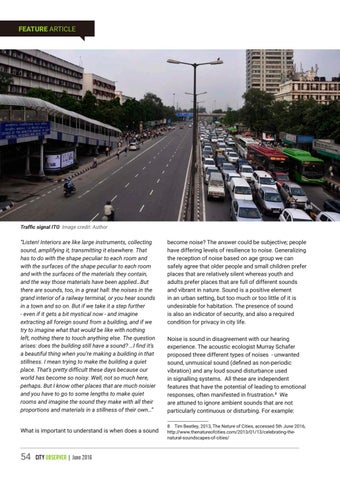
Traffic signal ITO Image credit: Author
“Listen! Interiors are like large instruments, collecting sound, amplifying it, transmitting it elsewhere. That has to do with the shape peculiar to each room and with the surfaces of the shape peculiar to each room and with the surfaces of the materials they contain, and the way those materials have been applied…But there are sounds, too, in a great hall: the noises in the grand interior of a railway terminal, or you hear sounds in a town and so on. But if we take it a step further - even if it gets a bit mystical now - and imagine extracting all foreign sound from a building, and if we try to imagine what that would be like with nothing left, nothing there to touch anything else. The question arises: does the building still have a sound? …I find it’s a beautiful thing when you’re making a building in that stillness. I mean trying to make the building a quiet place. That’s pretty difficult these days because our world has become so noisy. Well, not so much here, perhaps. But I know other places that are much noisier and you have to go to some lengths to make quiet rooms and imagine the sound they make with all their proportions and materials in a stillness of their own…” What is important to understand is when does a sound
54
CITY OBSERVER | June 2016
become noise? The answer could be subjective; people have differing levels of resilience to noise. Generalizing the reception of noise based on age group we can safely agree that older people and small children prefer places that are relatively silent whereas youth and adults prefer places that are full of different sounds and vibrant in nature. Sound is a positive element in an urban setting, but too much or too little of it is undesirable for habitation. The presence of sound is also an indicator of security, and also a required condition for privacy in city life. Noise is sound in disagreement with our hearing experience. The acoustic ecologist Murray Schafer proposed three different types of noises - unwanted sound, unmusical sound (defined as non-periodic vibration) and any loud sound disturbance used in signalling systems. All these are independent features that have the potential of leading to emotional responses, often manifested in frustration.8 We are attuned to ignore ambient sounds that are not particularly continuous or disturbing. For example: 8 Tim Beatley, 2013, The Nature of Cities, accessed 5th June 2016, http://www.thenatureofcities.com/2013/01/13/celebrating-thenatural-soundscapes-of-cities/
the sound of a passing automobile or the occasional honking, the sound from air conditioners, telephone ringers etc. However frequent loud sounds and noise levels that surpass hearing threshold can result in severe health issues – fatigue, hearing loss, cognitive impairment in children and adults etc. As a result, national and local governmental bodies are authorized to regulate the level of noise pollution in cities. Zoning ordinances are one such tool that set a limit for noise thresholds for different zones, and timings that they are required to keep in check.
INDIAN CENTRAL POLLUTION CONTROL BOARD (CPCB) STANDARD FOR ZONE WISE NOISE LIMIT Code
Zone
Day
Night
A
Industrial area
75
70
B
Commercial area
65
55
C
Residential area
55
45
D
Silence Zone
50
40
Source: http://envfor.nic.in/citizen/specinfo/noise.html/
NOISIER, NOISIEST Pata hai bahut saal pehle yahan ek jungle hota tha, ghana bhara jungle, phir yahan ek sheher bangaya saaf suthre makaan seedhe raste sab kuch saleeqe se hone laga, par jis din jungle kata uss din parindou ka ek jhund yahan se hamesha ke liye udd gaya ... [ You know, some years ago there used to be a forest here, a thick green forest, then one day a city got built here, neat and clean homes, straight roads, everything was organized; but the day the forest was cut, a flock of birds flew forever from here...]. These lyrics from the Bollywood film Rockstar (2011) epitomize the process of urbanization. The discussions about cities, a little more than two decades ago, are replete with the effervescent bird songs. The loss of natural habitat is to such a great extent that the sight of common birds has become rare. The first casualty of desensitized urbanization
is the natural environment. The trees are cut, the contours are altered, channels are blocked and local flora-fauna that rely on it disappear. It is required that we build cities that sustain a symbiotic natural and human environment, the benefits of which are undisputed. In recent debates and counter debates about the level of air pollution in developing and developed world and their efforts to mitigate, what is common is the amount of sound that is being generated. A positive thing about air or water pollution is that both of them are visible at some level making it difficult to dismiss them. On the other hand, the perception of noise as an individual experience can be easily ignored, but the sum of its experiences and effect on natural and human habitat needs to be actively pursued in designing cities. Noise has become inseparable to urban living and at the cost of human well-being. The biggest contributor to noise pollution is the movement of traffic – the permissible noise level for car is 82dB. Multiplied by the number of cars at any given point in addition to different other modes of transport and noise from various other sources at any given place can drive up human stress levels very high. In addition, the construction of elevated roads and metro rail lines also significantly adds to the noise at levels above ground. In such instances, high rise buildings for residential purpose are gaining momentum, so also inward housing developments restricting the openness of the built form to avoid the excess noise from traffic. The incessant construction activity of roads, metro rails, buildings, uses heavy machinery equipment, adding more noise. The invention of advanced machines has helped reduce extra human effort in doing simple manual work but made noise intrusions from them inevitable. In recent past the scale of festival celebrations has multiplied, by each year they become bigger, brighter, louder. This is true for our religion of cricket too, even truer during political campaign before elections. It has almost become impossible to have a moment of silence. In attempts to avoid hearing sounds that are unwanted we expose ourselves to sounds we like – often music. Our cities are undergoing significant transformations with least planning and design inputs. We need to recognize the long term consequence of rampant development that has no particular end or direction in sight. Any
June 2016 | CITY OBSERVER
55
FEATURE ARTICLE
kind of pollution does not simply affect the natural environment but the human habitation itself. Urban living has become synonymous with diseases, and noise pollution particularly affects mental wellbeing, potentially creating anti-social behaviours. The present noise mitigation efforts are neither sufficient nor have effective implementation. Monitoring the levels of noise in large cities is a difficult task in itself and making people actually follow regulations is all the more difficult in which case the question becomes how exactly can we pin down the source of noise to counteract it. Just as the sense of hearing cannot be controlled, so also, it appears, does effective noise mitigation. As a result, it must be on our list of priorities. The noise levels prescribed for different zones in cities that developed organically has mixed
56
CITY OBSERVER | June 2016
characteristics. In such instances there can be no one accepted level of noise - there are too many players to effectively come in the purview of a single blanket rule. Car ownership has been increasing year by year; their movement is not restricted to major roads, to avoid traffic delay people take detours through neighbourhoods totally destroying the character of community living. Such are the requirements for parking that there is little to no scope for open accessible public spaces for people. We need a healing environment for the sick but our hospitals are at the receiving end of noise from traffic movements. Parks or gardens provide a great buffer from the noise in the city, but it too has limitations. We cannot recreate an entire forest in the city to counter the effects of pollution, and after reaching its full limit natural environment itself starts degrading under the
Wall graffiti in low income neighbourhood. Image credit: Author
effects of pollution. It is often that noise pollution is accompanied by air, water and light pollution that are pervasive in all big cities. What we essentially need is better study and understanding of sound of our cities that are beneficial. Sensitization to the issues of noise is required at individual and collective level after all it affects all of us. We must integrate sound as an essential aspect of city planning and design and not
as an unpleasant by-product. We don’t have to subject ourselves to obnoxious sounds all the time, and to achieve this, we must engage citizens to participate in creating better cities for all. In reiteration not all sound is bad all. We need to work towards amplifying the sounds we enjoy, while reducing the ones we don’t. Until then we will rely on the sound of rain to momentarily to put an end to the excess noise in city.
About the Author Arshiya Syed studied Architecture, and did Masters in Urban Design from SPA, Delhi. She is works as an independent designer, and was a visiting faculty at an architecture school in Hyderabad. Currently she is engaged in finding the geometry behind the jaali patterns in heritage buildings.
June 2016 | CITY OBSERVER
57
CITY TRAILS
STORYTRAILS: EXPERIENCING CITIES THROUGH STORIES by Vijay Prabhat Kamalakara
58
CITY OBSERVER | June 2016
Facing page- Chennai Medley Image credit: Author
WHY TRAVEL? Look at any random personal profile today, and you are likely to spot an entry about food and travel in the ‘Interests’ section. Most of us are convinced that we are intrepid travellers. That begs the question, Why? Why would anyone want to travel? For most of us, it is a chance to get away from work and a monotonous routine. A good number of us travel because our neighbour just returned from an exotic holiday and can’t stop talking about it. And then, there is the 98.4% who travel because it is time to update their Facebook profile picture. A small, but surprisingly, swiftly growing segment of travellers seem to travel with the belief that it opens their minds to new experiences. The strangeness of people! They go around poking their noses into everything ‘local’. And what really seems to pique their interest is a chance to experience from close quarters, the way people live their lives - so differently in different parts of the world. Come to think of it, the notion is not completely absurd. In the right light it even makes some sense. After all, we’re told that every country and every region is different. And that is so true of every part of India. Ever wondered what makes it different? Could it be the varied landscapes or the beautiful architecture? Or is it the crowded markets and chaotic roads? Or, like most cases, is it all of these? India, like every other country is unique because of its people. It holds this exquisite uniqueness through its beliefs, values, customs, stereotypes and ways of life. It is these intangibles that make every place distinctly different from another. And far a visitor, you can’t blame me for yearning to experience this! But where exactly do you go looking for these intangibles? You will find them in stories; stories that have passed down generations, and stories that exist behind seemingly mundane and ordinary sights. Storytrails, (www.storytrails.in) is an organisation which attempts to showcase the local way of life through stories. A simple and profound idea? Yes it is. But wait! There is more!
June 2016 | CITY OBSERVER
59
CITY TRAILS
Peacock Trail. Image credit: Author
SELECTING A TOUR Let us try another tactic. All of us have planned our holidays at some time or the other. How do you decide what is a good tour? What do you look for in a tour experience while booking? We have all grown up looking at tour services as a commodity. And so typically, our mindset while evaluating a tour is to check HOW MUCH we are getting to see. More is better. It has to be. We are determined to get the utmost value for our money. Essentially implying we are willing to drive that extra hour to see but one more monument at the end of an otherwise tiring day - if, of course it can be included in the package at the same cost! Are we are interested in the monuments in the first place isn’t a question of any importance! Coming in a close second in tour decision making is one which can give you bragging rights.. ‘Oh you should have been there – they had this amazing troupe of dancers who perform a local traditional
60
CITY OBSERVER | June 2016
dance for an hour. It was mind blowing.’ At the end of it all, you may just have been bored out of your mind during that one hour. But, hey! You have been there and done that! You have earned yourself a right to brag incessantly, you think! While there may be nothing wrong in that notion, in that when we visit a new place, we want to check off the ‘must sees’ and the ‘must dos’, it clearly can’t be the only way. As a disclaimer, I am not suggesting that this kind of tourism is evil, at all. But say, you are in the mood to peel off a layer and dig a level deeper. That’s when the options start magically drying up. Then you start doing insanely adventurous things like sitting through a classical concert in the hope that you will soak in some local culture just by being in such an environment, or aimlessly wandering through a busy market. Or worse, you sign up for a ‘cultural immersion experience’ where soon after the expert introduces himself, you start wondering about the lunch menu.
Spice Trail. Image credit: Author
‘
Cultural experiences don’t have to be staged activities in sanitised environments. And you can go on a great city tour and come back without having done any sightseeing.
Our work has required us to toil against some of these stereotypes. Cultural experiences don’t have to be staged activities in sanitised environments. Tours can be designed to be both insightful and enjoyable at the same time. And you can go on a great city tour and come back without having done any sightseeing. Storytrails is not a walking tours company, although we walk on many of our trails. Our trails are not heritage tours although we talk about our heritage on some of them. And these are definitely not packaged as sight-seeing tours although there is so much to see in so many of them. As the name suggests, these are story-based experiences. Our tours are not about
‘
hidden places or lesser known attractions. Instead they are all about uncovering the not so visible stories behind ordinary everyday sights. Big promises and lofty ideals, you might think. But these are expectations we have met consistently over the last nine years. And the credit should probably go to the fact that none of us in Storytrails have a travel industry background. So we happily went around breaking myths that have had a stranglehold over the travel industry for far too long. There are many, and I have picked a few to talk about here:
June 2016 | CITY OBSERVER
61
CITY TRAILS Peacock Trail. Image credit: Author
Jewellery Trail. Image credit: Author
Dancer’s Trail. Image credit: Author
62
CITY OBSERVER | June 2016
Dancer’s Trail. Image credit: Author
WHAT TO SHOW ON A TOUR
NEED FOR EXPERTS
How do you design a tour? You pick a place that you want to showcase and then go around looking for points of interest there. Right? That’s how sight-seeing tours have always been designed. But what if you started by identifying the stories you wanted to share; stories that have a strong connect to the place being talked about and stories that give that place its unique character? And then you looked around for places or activities that would help set a context? We do it all the time. So we don’t have a Mylapore walk. We offer a Peacock trail, which uses the everyday sights in Mylapore as props. We also do a Jewellery trail in the same neighbourhood. Other than being in the same area, there is little else common to the two tours. People often ask us which places we will show them on a tour, and we always struggle with our answer. Because even when we do pass by a significant landmark on our tours, chances are that our storyteller could be pointing in a very different direction, at a more mundane everyday sight.
You would expect that if you wanted to create the best tour, you needed to get the best guide. An expert, with impeccable credentials. So a historical tour needs a historian, a dance tour needs a dancer and so on. That is true but only in some cases, especially when the need is an academic one. Most of the times, that expertise is less important than what the expert chooses to present or how he/she chooses to present it. We owe much of our success to our team of storytellers. And they come with neither doctorates in history nor in storytelling. They are well read, smart and friendly people. Kudos to their top notch presentation skills and that they genuinely enjoy talking to an audience. Most importantly, they train hard and work to a script that takes a serious bit of effort to master. And thus by the time they are ready to host a trail, they truly are experts on the trail’s subject. But we don’t call them that, and they don’t like calling themselves that either. Our engagement with subject experts happens at the trail design level, when we work on our scripts.
June 2016 | CITY OBSERVER
63
CITY TRAILS
Country roads. Image credit: Author
64
CITY OBSERVER | June 2016
LESS IS MORE, MORE IS BETTER It takes time and effort to design a tour. And much of this time goes into deciding what not to talk about. Any basic research will throw up volumes of material on any given subject under the sun. The challenge is to pick only those threads that are most relevant, and weave them into stories that have the potential to hold the attention of the audience. Leave out everything else. And that is easier said than done. We’ve all been on tours where a visit to any historical site is accompanied by a barrage of dates and names of kings and dynasties. That’s one way to present information. But when you choose to tell a story, you ignore some of these details and instead, build on other finer details that otherwise typically get left out; not dates or names, but elements that help you frame your story. Some of these elements may have no earth-shattering historical connotations, and they almost always end up making the talk much longer. But they could help you hold the attention of your audience. Conducting a tour is less about sharing information and more about engaging your audience.
IS THE PLACE ‘CULTURALLY RICH’ A natural expectation, if you are designing tours that talk about vague things like the ‘local way of life’. It doesn’t matter, really. Every place has a story to tell, and how you tell it makes all the difference between a great tour and a mediocre one. As we often tell people (only half-jokingly), we could create an enjoyable trail on any given stretch of a road - if there was a market for it.
KEEPING IT SUSTAINABLE Our trails revolve around ordinary every sights that don’t need special permissions or arrangements. But even so, we go all out to ensure that nothing is left to chance. Everyone in the value chain for a trail is a
stakeholder and has to see some benefit. Else it would never be a sustainable operation. The tourism industry especially needs to have an eye out for sustainability. Tours like the ones we do have a responsibility to the environment we operate in. Most of our walks are usually limited to small groups. That is by choice. If we choose to take a bus load of people on some of our tours, we end up changing the environment we operate in, turning it into another make believe, sanitised tour destination. So what does the traveller get out of it all? An experience that takes him up close and personal with the city, an understanding of why the city is just so and an appreciation of what makes the city just so. He hears stories that help him relate to the city, for we like to make our trails humorous, unpretentious takes on every day life in the city. At the end of it all, a trail is not about standing outside and peering in, it is about being in and enjoying the city. We’ve been in this line for a few years now, and going forward, we hope to replicate our tours in many other cities, starting with Pondicherry this month. So if you are a person who shares a passion for this line of work, drop us a line, and who knows, your next visiting card could read ‘storyteller’! Storytrails is an organisation that designs and conducts story-based walks and short tours. The trails take you through the very beat and pulse of the city; from its oldest parts to its busy bazaars, through dance and art to its rural heart. Currently offered in Chennai and Madurai, these award-winning walking tours are an easy introduction to the city and an enjoyable way to experience the local way of life. Popular trails include the Peacock trail the Bazaar trail, the Spice trail and the British Blueprints trail. You can read traveller reviews of the trails at www. tripadvisor.in/storytrails. Storytrails has been a regular recipient of the Tripadvisor certificate of excellence and these trails have been consistently ‘Top-rated’ on Viator.
About the Author Vijay Prabhat Kamalakara is the founder and Managing Director of Storytrails. An MBA from IIM Indore, Vijay has worked in the banking and IT industries. He was awarded the ‘Young creative entrepreneur award’ by the British Council and the Youth Achiever Award for innovative entrepreneurship by Yuva Shakti. He is a regular guest speaker at forums like TED, and Ignite and at many educational institutions. Vijay is a fanatic marathon runner, and enjoys singing and strumming on his guitar in his free time.
June 2016 | CITY OBSERVER
65
MOTION CAPTURED
HANOI by Adithya Rangarajan
Weekend Night Market, Hang Dao Street; Established for the locals, these markets used to predominantly sell clothes but are also dealing with souvenirs these days due to increased tourism. The streets which are full of traffic during the day transform into pedestrianized walkways. The shop houses that line the street - each unique in its own way and fighting the test of time form an impressive background for the commerce.
66
CITY OBSERVER | June 2016
On board the ‘Gemini’
Roadside Cultural Shows; Weekend markets are often accompanied by cultural shows.
June 2016 | CITY OBSERVER
67
MOTION CAPTURED
Low Chai; These road sides cafes, serving green tea form an integral part of the street scene. A typical cafe consists of a small rack of utensils and few low - slung plastic stools. A small and tight huddle is formed by groups visiting these shops as hot and a bitter tea is served..
68
CITY OBSERVER | June 2016
June 2016 | CITY OBSERVER
69
MOTION CAPTURED
‘Medusa’, up close and personal.
Road side shops selling souvenirs.
70
CITY OBSERVER | June 2016
‘Medusa’
Sharing the road; Streets that were built only for pedestrian movement now also accommodate vehicles. But there are no qualms about sharing space.
June 2016 | CITY OBSERVER
71
MOTION CAPTURED
A traditional kitchen in a conserved shop house.
72
CITY OBSERVER | June 2016
Banh Cam, Fried Sesame Balls with mung bean filling
June 2016 | CITY OBSERVER
73
MOTION CAPTURED
St. Joseph’s Cathedral; Remnants of the French Colonial era.
74
CITY OBSERVER | June 2016
Hanoi Opera House and a young couple.
MOTION CAPTURED
Temple of Literature- One of the oldest universities of Vietnam dating back to 11th Century is a huge complex of buildings organized around series of courtyards.
76
CITY OBSERVER | June 2016
About the Photographer Adithya Rangharajan is an architect and an amateur photographer currently based in Singapore working with WOHA. Check out his Instagram feed for more photos- https://www.instagram.com/ar_adithya/
June 2016 | CITY OBSERVER
77
LEARNING FROM CITIES
10 URBAN DESIGN LESSONS FROM HYDERABAD by Nandini Ramakuru
78
CITY OBSERVER | June 2016
Hyderabad is a city romanticised. It is an eternal love story that every Hyderabadi feels for their city. It is dreamy and poetic. It is awash with tales and folklore that you cannot escape from. And it is these intangibles that you can see, manifested in the tangible forms of the city. Just a stroll down Pather Gatti, the historic bazaar that leads you to the iconic Charminar, will transport you back in time, disconnecting you from your urban reality; and so will a gaze at the Nizami Chowmahal Palace complex. When I stepped into the city first, I couldn’t look beyond the immediate urban limitations that I was made to face every day, limitations typical to other cities of the world. But then I began to explore the city in my own way and in my own time, walking the streets, interacting with the food vendors, haggling with the auto-rickshaw drivers, and now and then visiting the origin of this settlement, that is, the old city. The myopic veil that I was wrapped in slowly began to drop and I began to see the city for what it truly was – a quintessential city with a blend of cultures, traditions, architecture and mannerisms that have now become uniquely Hyderabadi. Hyderabad grew in many layers with time, right from 500 BC. But it was established as a true city in the 16th century under the Qutb Shahi Dynasty. From then on it expanded socially, culturally and economically under the various administrators and ruling dynasties. It was a centre for trade with its renowned pearl production, diamond trade, and many colourful bazaars that exist even today. The old city is built on a grid iron pattern, with the Charminar at its centre. The city is influenced by the Indo-Saracenic, and later, the Neoclassical styles of architecture. Some of these exquisite structures still stand tall and are functional even today.
Hussain Sagar Lake, Hyderabad Image credit: https:// commons.wikimedia.org/wiki/ File:Hussain_Sagar_lake,_ Hyderabad.jpg
But Hyderabad in all its grandeur and magnificence is incomplete without its people. This struck me when I noticed that even in grim urban environments, people found their way to make the urban space livable. People found a way to channelize the building discomfort. And this is the underlying factor of a resilient city. This also helps understand the people’s movement patterns between invisible nodes. We can track where the magnetic points really are. If observed and studied carefully, we know what aspects need to be developed. And this is the crux of human centric planning. So here is an assortment of lessons from the city and the people who make the city livable.
June 2016 | CITY OBSERVER
79
LEARNING FROM CITIES
1
FALL IN LOVE WITH YOUR HERITAGE
The heritage of a city plays a pivotal role in keeping people on track. It could be the history of any city, structure, street or even an ancient park. It could be a 400 hundred year old market place that serves as today’s Sunday bazaar. Or it could be an intrinsically carved ancient Kamaan (gate), where today people come together in silent contemplation and pay homage to the ancient glories. But for this, it is necessary for people to recognize the value of heritage, and the people of Hyderabad do. Whether the locals really understand the technical idiosyncrasies in the construction, or how the vistas of the ancient market places unfold into a series of nodes for congregation, is beside the point. They are flat head over heels in love with their heritage. They are in complete awe of the ancient spaces they live amidst, and you don’t need to know the theory of city form to figure out why. You could chat up any local and expect a story to unfurl. Stories about the view from the very many lakes (both artificial and man-made) sprinkled around the city... Stories about the Nizami glory…. Stories about the midnight bazaar during the month of
Ramzaan…. Stories about the monumental Charminar… Everyone has a story. Whatever may be the version, a visit to Charminar and its precincts is an Alice in Wonderland experience. The avenue leading to the edifice is a riot of colour… the Chudi Bazaar. The mélange of hues is visually engaging. The lanes are interspersed with horses at rest beside the tongas and sugarcane kiosks. As you meander, the by-lanes open into the beautiful wholesale Pearl market that tugs at your heart strings. Further down, the lanes blend seamlessly into the modern city that is the hallmark of Hyderabad today. On the other hand, those looking for a more structured understanding, have the regularly conducted heritage walks to look forward to. Some are conducted by the local authorities while others by local conservationists and enthusiasts, who are more than keen to show you the very charming side of Hyderabad. While the authorities have restoration plans and proposals, to keep the heritage precinct intact, it is really the people that bind the city together.
A view of the Telangana State High court from the Otherside of the Musi river banks. The building was conceived in 1910, and is well maintained and functional even today. Image credit:https://commons.wikimedia.org/wiki/File:Hyderabad_High_ Court.jpg
80
CITY OBSERVER | June 2016
A heritage walk inititative at Golconda Fort by Hyderabad Trails. Image credit: Hyderabad Trails
June 2016 | CITY OBSERVER
81
LEARNING FROM CITIES
2
BECOME A CUSTODIAN TO YOUR CITY
The heritage of a city is its legacy, its personality. And while cherishing the past is important, it’s just as necessary to preserve it from decay. Thus, restoration is an integral part of urban design. There are never enough attempts made to restore ancient structures, and often, not in time. So, here is a success story to inspire. The Chowmahal Complex, a 250 year old Nizami palace and an example of European Neoclassical architecture, was reduced to shambles with time, due to neglect. Thus in the year 2000, the herculean task of restoration was taken up by RMA architects, who worked in tandem with INTACH (Indian National Trust for Art and Cultural Heritage), local practitioners and activists. The project involved a detailed survey of the
existing urban fabric and understanding of the land use pattern. This was followed by the stabilization of the structures and the actual restoration using traditional techniques to maintain the integrity of the structures. Today, the salvaged Chowmahal palace is re-adapted as a cultural centre and museum open to the public. The different sections of the complex now contain rooms for craftsmen and artisans to work and display their products, and other sections have been converted into a Nizami museum. This is a success story not only in reintegrating the complex with the adjoining urban fabric, but also bringing the heritage to the people.
Restoration work undertaken by RMA Architects. Image credit : RMA Architects. http://rmaarchitects.com/architecture/ restoration-of-the-chowmahalla-palace-complex/
82
CITY OBSERVER | June 2016
Restoration work undertaken by RMA Architects. Image credit : RMA Architects. http://rmaarchitects.com/ architecture/restoration-of-thechowmahalla-palace-complex/
June 2016 | CITY OBSERVER
83
LEARNING FROM CITIES
Restoration work undertaken by RMA Architects. Image credit: RMA Architects. http://rmaarchitects.com/architecture/ restoration-of-the-chowmahalla-palace-complex/
84
CITY OBSERVER | June 2016
Restoration work undertaken by RMA Architects. Image credit: RMA Architects. http://rmaarchitects.com/architecture/ restoration-of-the-chowmahalla-palace-complex/
June 2016 | CITY OBSERVER
85
LEARNING FROM CITIES
3
COMMEMORATE YOUR PAST. EMBRACE YOUR FUTURE.
Sustainable urban development requires a balance between progressive development and the conservation of the existing heritage, especially for a city layered with centuries of such legacy. It is a challenge to maintain the delicate balance within the urban fabric, such that the social and cultural realm are not disturbed. An over view of the Hyderabadi urban landscape shows you a dense urban fabric of the old city to the east, which is a synthesis of Neo Classical, Indo-Saracenic, and the occasional Kakatiyan architecture. As you move towards the west, you see the gradual shift in architectural styles, reflecting the time and period that they were conceived in. The eastern skyline is of intricate domes and tall minarets while the western skyline is a more
contemporary and minimal outline of housing colonies and industries. Today the western region of the city is undergoing the most development, with the commercial and industrial development at its centre. This is also an attempt to keep the old city untouched by urban pressures and prevents further congestion within the precarious area. This further allows the convenience of executing preservation projects in a planned manner for the historic structures. This sense of balance is reflected among the citizens as well, as they take urban development in its stride, and yet retain that sense of honour for the heritage.
A view of the old city skyline from the Charminar. On the left is the Nizamia General Hospital, and the building on the right is the Makka Masjid, one of the oldest mosques in Hyderabad, built in the 17th century. Image credit http://elevation.maplogs. com/poi/pratap_nagar_kothapet_hyderabad_telangana_india.168.html
86
CITY OBSERVER | June 2016
Hyderabad. Image credit : 1. http://ourindianodyssey.blogspot.in/2012/12/in-hyderabad.html
Tata Consultancy Services office in Hyderabad designed by Mario Botta. Image credit: http://openbuildings.com/buildings/ grid?countries%5B0%5D=88&sort_by=added_at&sort=asc
June 2016 | CITY OBSERVER
87
LEARNING FROM CITIES
88
CITY OBSERVER | June 2016
A view of the old city skyline from the Charminar. On the left is the Nizamia General Hospital, and the building on the right is the Makka Masjid, one of the oldest mosques in Hyderabad, built in the 17th century. Image credit: http://elevation. maplogs.com/poi/pratap_nagar_kothapet_hyderabad_telangana_india.168.html
June 2016 | CITY OBSERVER
89
LEARNING FROM CITIES
4
FACE THE WATER EDGE
Waterfronts are excellent areas of activation in the public realm. If well treated, they become a source of wonderful urban experiences. The added micro climate, owing to the adjoining water body, makes the environment conducive for outdoor activities and recreation.
The pedestrianised edge serves multiple purposes. People come here to exercise, cycle, and relax by the lake on a bench. It also provides a comfortable space for group activities and weekend get togethers. Friends and families are always seen lounging on the grass in the parks or taking a late evening stroll.
The Necklace road of Hyderabad is popular for its esplanade that runs along the Hussain Sagar Lake. The esplanade offers a series of activity points in the form of restaurants and eating joints, pockets of green parks at regular intervals, benches and viewing points. People from all over the city flock here at all times of the day and night, thus keeping this zone alive and vibrant.
The esplanade integrates the waterfront with the urban fabric, and the Necklace road creates a buffer between the pedestrianised recreational space along the edge and the dense urban structures on the other side. It is always advisable for a city to face a waterfront. It provides visual relief, not only to the people at the water edge, but also to commuters passing by.
Meandering path abutting the Hussain Sagar Lake. Image credit: http://hyderabadadvisor.com/necklace-road/
90
CITY OBSERVER | June 2016
Morning walks along the Hussain Sagar. Image credit: https://commons.wikimedia.org/wiki/File:People_Morning_walk_ Necklace_road.JPG
Singapore Management University: An urban campus. Image credit: http://admissions.smu.edu.sg/
June 2016 | CITY OBSERVER
91
LEARNING FROM CITIES
Meandering path abutting the Hussain Sagar Lake. Image credit: http://hyderabadadvisor.com/necklace-road/
View from the Eat Street. Image credit: http://my-foto-diary.blogspot.in/2006_10_01_archive.html
92
CITY OBSERVER | June 2016
The famous Gautam Buddha Statue, placed in the middle of the lake. Image credit: https://commons.wikimedia.org/wiki/ File:Gautam_Budhha_Statue_on_the_Hussain_Sagar_Lake.jpg
5
KEEP IT GREEN
In today’s times of rapid urbanization, where land is being acquired left, right and centre, and concrete dreams are being promised in exchange, it is quite a treat to see a public forest sitting snugly in the middle of all this development, relatively untouched by the greed of urban desires. KBR Park, a 390 acres forest that is often termed as the green jungle amidst a concrete jungle, is more than just the lungs of the city. It is a reprieve for the urban living. The park was once a palace complex of 400 acres belonging to the Nizams. With time it transformed into a green belt open to the public and maintained by the forest department, with only the palace remaining restricted. The park is double walled. Between the two walls is a pedestrian path, where residents are seen walking, jogging, taking a stroll, in the mornings and evenings.
The path rises and falls with the topography, thus preserving the natural contour. This adds to the experience as it gives varied views of the city at different heights. The undulating path also provides degrees of difficulty as one walks along it. Within the inner wall is the vast expanse of flora and fauna. It is home to over 600 species of fauna and about 140 species of birds. The premise even has small water bodies, thus making it an ecosystem in itself. It is open during the day to visitors with a nominal entry fee. The park has become a spot for people to gather for informal activities, peaceful protests and nature club get-togethers. It is more than just a designated green zone, it is a space to express and interact.
June 2016 | CITY OBSERVER
93
LEARNING FROM CITIES The undulating pathway sandwiched between the double layer walls of the park. Image credit: http://indianimagery. blogspot.in/2006_04_01_archive. html
Boundary treatments. Image credit: http://my-foto-diary. blogspot.in/2006_10_01_archive. html
94
CITY OBSERVER | June 2016
KBR Park. Image credit: https://commons.wikimedia.org/wiki/File:Mali_kbr_park.jpeg
6
LET THE STREETS COME ALIVE
The roads of Hyderabad are like any other Indian city. Traffic snarls, vehicles piling up, the hustle bustle of citizens about their daily business… A routine affair. But come night, as the traffic dies, you magically see food vendors sprout up all over the city. Food vendors, that come together to form long food streets, with even longer queues of famished customers. It is quite a sight to see, as these vendors eagerly wait to serve you with their eclectic platters of dosas, Irani chais, biryanis, shawarmas, momos…a gastronomical treat for Foodies. Customers stand hypnotized as the vendors dish out meals at top speed in a rhythm that is nothing short of acrobatic finesse. These mid night treats are something to look forward to.
What you see is a vibrant urban space where people come together to engage, interact and be a part of this informal community. Streets have tremendous scope for multiple public activities. These activities can transform the street into different experiences at various times of the day, with the added benefit of keeping the street safe. It is also interesting to note that, these vendors, who wouldn’t have space to put a foot on the road during the day, by night, claim their space to make a livelihood. The vendors melt into the darkness as the first rays of dawn light up the streets, and the road embraces another day of busy traffic.
June 2016 | CITY OBSERVER
95
LEARNING FROM CITIES
The night bazaar at Charminar lights up the streets during the month of Ramzaan. Image Source https://commons. wikimedia.org/wiki/File:Charminar_sumeet_photography_3.JPG
7
BE A PEDAL PUSHER
While private transport and wider roads are associated with the development of a city, there is a counter culture on the rise. In the last few years Hyderabad has witnessed a growing circle that has become more sensitive to the urban landscape, and has begun to understand the detrimental effects of ‘development’ on their immediate environment. Thus, cycling is catching on as a much sought after trend today. And to give that extra push of encouragement are the very many local cycling clubs as well. One such organization is the Hyderabad Bicycle Club, a nonprofit organization founded in 2007, in a quest to create awareness
96
CITY OBSERVER | June 2016
among the public. Today the club has over 7500 members. They have bike stations to rent out bikes and regularly planned cycling trips to rope in more people. Six in the morning and it is not an uncommon sight to see packs of cyclists in tights pedaling around town. And it is also, not so rare to see cyclists, in the peak hours, pedaling to work. This is a slow yet steady change towards healthier and better urban living. It is not easy to make a complete modal shift associated with cycling, but the effort to embrace cycling as often as one possibly can, needs to be appreciated.
Cyclists line up for an early morning ride. Image credit: http://www.gaadi.com/news/hyderabad-bicycling-club-organizes-afun-cycling-event-70117
Exploring the city, catching on big. Image credit: http://www.thehindu.com/news/cities/Hyderabad/cycling-catchingup-in-a-big-way/article6388710.ece
June 2016 | CITY OBSERVER
97
LEARNING FROM CITIES
8
RAISE YOUR VOICE
Protests are good. They show that people are alive and have a voice to express. And a protest for the right to a livable city only makes the city theirs. Hyderabad has seen two such protests in the last one year. The first being the fight to preserve a heritage structure that is over a 100 years old and the more recent one being the fight to save the KBR park - a fight that is still underway.Osmania General Hospital, conceived in the early 1900s, is a palatial structure exemplifying the Indo-Saracenic style of architecture. Today this proud structure, in spite of being functional, shows signs of dilapidation and decline. Seeing this, the government proposed to demolish the structure and construct multi-storied commercial towers in its place. This proposal brought on an uproar by the people of Hyderabad. A flurry of discussions, talks, awareness campaigns and heritage walks focused on the hospital
Girl holds poster for Human Chain around the KBR park to protest against the cutting of trees. Image credit : HydRising
A park protest. Images credit : HydRising
98
CITY OBSERVER | June 2016
followed. Activists and conservationists did a detailed survey that showed that the ancient hospital was structurally stable and simply required superficial restoration. But what was really admirable is the involvement of the public. The citizens participated in the campaigns and staged protests which eventually culminated in the proposal being dropped. The second and most recent protest is the fight to save the erstwhile KBR Park. When the authorities decided to chop down 3000 trees to make way for a strategic road development plan (SRDP), the citizens united in outcry. There were human chains formed and musical events planned around the Park to raise awareness. The issue is still under discussion but the citizens are firm in their belief that the green space clearly outweighs the proposal of more roads.
Above, Street play draws in people to raise awareness about the KBR park. Image credit : HydRising
A heritage walk conducted in the old city to emphasise the importance of Heritage conservation. Image credit: Sneha Parthasarathy
People listen as Anuradha Reddy, co-convenor of INTACH Hyderabad chapter talks about Osmania General Hospital. Image credit : Sneha Parthasarathy
June 2016 | CITY OBSERVER
99
LEARNING FROM CITIES
9
SHARE YOUR COMMUTE
In this tug of war of promoting public transport and pulling more people off private transport, there is a large section of the society that is getting crushed under this crack. From a commuter’s perspective, public modes of transport if not well connected, can be unfriendly and tedious, and private transport is unaffordable and can get you stuck in longer jams. For those, who do not want to commute beyond a 10km radius, travel becomes all the more cumbersome due to all the additional time spent, for example, walking to a bus station or looking for a parking spot - steps that don’t involve actual travel time. Here, enters the Hyderabadi share auto that fills this gap in the transport system. The share auto is nothing but the regular three wheeled auto-rickshaw that is shared between commuters who have similar pick
up and drop points. These autos operate within a preset route that doesn’t exceed 6-8 kms. From there, if a commuter needs to travel further, they can take a connecting share auto to their final destination. The USP of this infamous mode of transport is its efficiency. The autos are well connected, the different routes taken are point to point, and the furthest stop is usually not more than 2kms away. This is especially ideal for routine commuters who travel a fixed distance daily, that is, from home to work and back. While this is an informal mode of transport that is not specifically accounted for, it does solve so much of the transport problem. There are plenty of lessons to take away in the way it is operated and what sections of the society it serves.
Share Auto drivers call on commuters. Image credit: Sneha Parthasarathy
100 CITY OBSERVER | June 2016
10
SURPRISES ARE GOOD
Being amused in a city is a good state of mind. It is the added element of surprise and wonder that heightens one’s experience in an urban space. And an excellent way to visually activate a public space is by sprinkling sculptures at unexpected places. So, don’t be startled if, while waiting listlessly at a traffic signal in Hyderabad, all of a sudden you see a metal frog jump up at you from the divider, because at the next one you may find a large alligator. Many of the crossroads in the newer parts of the city, and some in the older ones, have sculptures of animals
made out of scrap metal. These sculptures were engineered in preparation of the COP11 Biodiversity Conference, held here in Hyderabad, in 2012. After the event, they were moved to different parts of the city and planted at traffic signals, on islands and dividers. The metal sculptures, provide a visual intrigue, especially due to the rawness of the scrap metal. It is unconventional, bold, and may not be to everyone’s taste, but you cannot deny its ability to visually engage. The sculptures also create a sense of identity to the immediate vicinity and improve the quality of the urban environment.
Sculptures scattered through the City. Image credit : Sriyanka Saha
About the Author Nandini Ramakuru is an architect, graphic designer, closet artist and urban enthusiast. She is fascinated by design in all shapes, sizes and forms. After working for a couple of years in an architecture firm, she decided to step out of her comfort zone and explore other avenues of design. Today, Nandini works as a graphic designer at PAD, an advertising agency based in Hyderabad, where she deals with branding, packaging and creative marketing; while simultaneously freelancing as an architect. She also immerses herself in architecture and urban design writing based on her reflections and observations, and intends on pursuing this passion earnestly. Theatre and the performing arts is her new found infatuation. She has been a part of the theatre group Dramanon (Hyderabad) for over a year now, where she is involved in set designing and production. Nandini is accused of having her fingers in too many puddings, but she staunchly believes that all forms of design, creativity and art have an underlying thread that strings them together; and it’s important to recognise the commonalities, and let inspiration and ideas intersperse.
June 2016 | CITY OBSERVER101
ON LOCATION
THE FOREVER GREEN BRICKWORKS by Jiya Benni & Shruti Omprakash
102 CITY OBSERVER | June 2016
Tucked away in a ravine outside downtown Toronto is the Evergreen Brickworks. The shorter version is that it is a former brick factory which has been converted to an environmental community centre. However, that description is only the beginning of the story. The different spaces at this site, however effortless they seem, regale a thousand stories if you are willing to listen to them. Even when you have left the site, their tales continue to capture your attention . It is then that you realize the many layers that make up these spaces – that is the longer story of Evergreen Brickworks. This article is not a close inspection of those layers, it is a translation of the sights and experiences of being present, into words. The layers are for you to subtly imbibe For almost a century, the site in question hosted a quarry and a brick-making factory - in fact, it supplied most of the bricks that was required to build Toronto. After a 100 years of changing owners, the city decided to acquire the site, given its partial location on a floodplain. Restoration of the site began in the 1990s with the goal of bringing the soil and its ecosystem back to its full health. At the end of it, what opened to visitors of all ages - was a sensitive and splendid educational and cultural environment centre. Sustainability seems to be the watchword at Evergreen. Right from its home
Facing page - Bird’s eye view of grown plants, to the ecofriendly promotion of its sponsors, to the food served the Evergreen Brickworks. Image credit: Evergreen Brickworks at Cafe Belong and the local goods sold at the Evergreen Garden Market! Subtle Visitor’s Guide lessons on environmental awareness are found everywhere you look!
Entry into Tiffany Commons. Image credit: Jiya Benni
June 2016 | CITY OBSERVER103
ON LOCATION Our exploration of Evergreen Brickworks starts at Tiffany Commons, the central open courtyard flanked by groups of buildings on three sides. In winter, one might be greeted by round planters with naked trees but in summer, one is greeted by a lush green landscape. In order to monitor this changing landscape, visitors are encouraged to upload photos of the area onto social media. There are plaques inserted on planters which describe the plants as the flowering, fragrant or the seed-producing kind(to name a few). The round planters gradually steer you into Tiffany Commons and towards the Watershed Consciousness wall which is an unique feature of the Commons! (no pun intended!) This installation on the exterior wall of the previous dry-press brick plant made of corten steel and vegetation, shows the five rivers (that empty into Lake Ontario) and their ravine systems that make up Toronto’s watershed regions. Looking at it, one realizes
how critical the rivers and ravines are to Toronto. The courtyard is connected to nearby buildings by boardwalks raised from the ground which help in creating areas of water retention during floods, and thus in the process, a dynamic ecological habitat. When you are done taking in the landscape and vegetation at the Tiffany Commons, you can take the boardwalk to the Young Welcome Centre (YWC). The doors of the small vestibule-like space at YWC opens into a double-height hall which serves as the visitor centre. Previously used as a holding room for raw bricks, it is now adorned with artworks and exhibits on the walls. A huge brick press stands tall and mighty in the background. Chairs and tables are strewn around the room making it a casual meeting space. The newly built multi-storey ‘Centre for Green Cities’ (CGC) contains classrooms, meeting rooms, labs, offices etc. is seamlessly attached to the YWC.
Tiffany Commons with the YWC at the back. Image credit: Jiya Benni
104 CITY OBSERVER | June 2016
The Watershed Consciousness Wall. Image credit: Jiya Benni
June 2016 | CITY OBSERVER105
ON LOCATION A corridor with informative displays tell us the story of how the site was used, the extent to which it was polluted by industries and what was done to revive the site and the ecosystem. These displays make one appreciate the Brickworks even more. Climbing up a staircase from here, one reaches an inward looking balcony on the first floor which gives you a bird’s eye view of the visitor centre, the previously old brick holding room. If you look closely, you may even see the brick-workers stacking the freshly made bricks! A series of doors on this level take you to an external terrace that runs the entire length of the building. This incidentally makes it an excellent vantage point for the Tiffany Commons as well the children’s play area behind it. The balcony, together with its ceiling and the floor, frames the surrounding greenery. Staircases at either ends of the balcony take you down to the Tiffany Commons or the Children’s Garden or back to the YWC. It is as if there are no dead-ends! Back at the Young Welcome Centre, there are more doors to open and more spaces to discover behind them. One of the doors opens to an open boardwalk
that takes one to the Kilns and the CRH Gallery. As the name suggests, this space houses the kilns where the bricks were fired. The alleys between the kilns now serve as display areas for exhibitions. The major exhibit – a permanent one at that – is the graffiti on the walls. A few decades ago, after the factory was abandoned, it had become a space for illicit activities. Among other things, it included illegal rave parties and consequently become a place which graffiti artists frequented. As a poignant testimony to those times, the graffiti is preserved and is now a major exhibit item. A few interesting exhibits, like the Arctic Adaptations, Canada’s official entry for the 2014 Venice Biennale, has found a temporary home in between these erstwhile kilns. The walls of a few kilns seemed to be getting ready for new exhibits. It’s almost like the kilns had found a new purpose - a new lease on life. One side of the Kilns and CRH Gallery open to the dreamy Koerner Gardens - a large semi-open area with an open truss with islands of trees providing interesting nooks and corners. During winter, this area is converted to an ice-skating rink. Open to sky with hanging strings of light, one can only imagine how magical the place would be at night or during winter.
Walls of the kilns with temporary exhibitions. Image credit: Jiya Benni
106 CITY OBSERVER | June 2016
Children’s Corner. Image credit: Jiya Benni
Getting ready for new exhibitions. Image credit: Jiya Benni
Permanent exhibition of the wall graffiti on the kilns. Image credit: Jiya Benni
June 2016 | CITY OBSERVER107
ON LOCATION
The “open to elements” Koerner Gardens. Image credit: Jiya Benni
Evergreen Garden Market. Image credit: Jiya Benni
108 CITY OBSERVER | June 2016
Acknowledging these qualities, both the CRH Gallery and the Koerner Gardens are rented out for events. From the Koerner Gardens, yet another open boardwalk connects you to the Young Welcome Centre on one side, and the Evergreen Garden Market and Cafe Belong on the other. Hard as it may be to leave, one takes the boardwalk to the other side and opens the door to what seems like a meeting area. Equipped with information booklets, washrooms and an ATM, the meeting area is a bustling activity space. It is flanked by Evergreen Garden Market - an artisan shop and nursery - on one side, and Cafe Belong - a rustic restaurant selling locally sourced food and drinks and overlooking the Tiffany Commons - on the other. Outside this building complex, one can take a leisurely stroll across Tiffany Commons and reach the Pavilions on the other side. The Pavilions, two large sheds which were previously locations for sand-lime brick production, now play host to temporary activities like farmer’s markets, food truck festivals and the like. On a weekday, kids who attend the outdoor school at Evergreen Brickworks are seen playing around here. A small complex of buildings that previously housed administrative activities, is now the location for the outdoor school. Between these buildings and the Pavilions lie the Mud Creek with the Water Treatment Plant at its head. In the past, they were used to provide the water critical for brick making while now
they stand witness to all that is changing around them. The northern end of the Pavilions open out onto the Frances and Tim Price Terrace that overlook the Quarry Garden and the pond, creating a zen environment of sorts. A perfect place to culminate the walk! Sitting on one of the red chairs, looking over the waterfilled quarry with the Brickworks as the backdrop, one tries to sum up the sights and experiences of the day. The built environment shouts sustainability (maybe even screams at the top of its lungs) and along with its purposes asks us to be aware of our environment. Evergreen Brickworks is one of those unique places that practices what it preaches, one of those places you will visit which has found a new lease on life - a new purpose and a new set of users. This new purpose does not overshadow the old one, rather it takes the old purpose under its wing, for only then is the story of the brick factory complete. Architecture, as it should be, plays a wonderful host to this story. Surely the spaces were present before, but by repurposing these old spaces for new activities and by using alternating open and closed spaces, each space becomes a new experience - each totally different from the other. By creating spaces that were flexible in their activities, purpose and experience, the architects have kept the element of surprise alive at Evergreen Brickworks. The controlled chaos one experiences at the Brickworks leads one to think if in fact that is how nature sees itself to be.
About the Authors Shruti Omprakash is an architect based in Chennai who runs her own practice, Drawing Hands Studio. A graduate of The Berlage at TU Delft, some of her core interests are use and design of temporary spaces, adaptive and flexible spaces, furniture design etc. This interest even led to her master thesis focusing on revitalizing vacant spaces through recurrent temporary programs. She is particularly keen to bring about a change in the current model of Work and Knowledge Environments. She can be contacted at https:// in.linkedin.com/in/shruti-omprakash-a9537918 Jiya Benni is an urbanist-architect whose major interests are water urbanism and urban regeneration. After graduating from TU Delft, where she did her master thesis on guiding urban growth along the ‘bluegreen grid’ of the city, she spent more than a year researching flood-prone slums as part of her work at Waterstudio.NL. During this time, she also co-authored a few published articles. Apart from her deep passion for cities and its workings, she also loves to read, write, paint and travel. She currently lives in Toronto and can be reached at https://ca.linkedin.com/in/jiya-benni-3996b717.
June 2016 | CITY OBSERVER109
SPECIAL FEATURE
FILM CITY TOWER MUMBAI Winning Entries Showcase
An International Open Ideas Competition hosted by Archasm
110 CITY OBSERVER | June 2016
On 1st November 2015, archasm announced the brief for an open ideas competition that was both challenging as well as bold in every way possible. It was titled ‘FILM CITY TOWER, in MUMBAI, with the aim of creating an iconic landmark representing Bollywood and its significant contribution to the cultural landscape of the subcontinent for over a hundred years. It was to be styled according to the suitability of this enormous industry and transform the skyline of Bombay. The impact of the tower was to be prolific, intense and symbolic that could be achieved by the factor of height, unique style of architecture, innovative structural systems, intriguing façades, interesting volumes and shapes, the art of contrast and material juxtaposition, interactive spaces and symbolic value. The competition sought to fulfil the mission of generating a new social and cultural hub for the residents of Bombay, giving them an opportunity to observe to the stars they have idolised. The proposal should insert a variety of public functions in the tower that would greet the public with a panorama view of the city. The proposal should innovate and distribute the aspect of social and community spaces equally in a tower, which in most of the cases, is absent as the building rises up. The competition received an overwhelming 283 registrations from all around the world and was a great hit among students and architects alike. The top 3 winning entries are presented here in the following pages.
June 2016 | CITY OBSERVER111
SPECIAL FEATURE FIRST PRIZE Jagoda Nowakowska, Magdalena Skop, Monika Woźniak (POLAND)
‘‘
The building as Spectacle was a very interesting idea - Shrouded in a translucent curtain of water subtly revealing the colourful layers of the program beyond. A not-so-subtle but well executed reference to traditional architectural motifs re-imagined in a contemporary form. Cyruss Patel - Partner, Collective Project, Bangalore
The idea behind the project is to transfer the film making process to the building. The whole process is exposed in a theatrical way, viewers don’t have to enter the tower to discover the inside. They may observe it from the audience. The is a new world of film being created, presenting a true spectacle surrounded by a curtain of water. The building behaves like water – during the day it remains in a gaseous state, becoming blurry, and after dark it transforms to a solid state, which is more transparent, so we can spot the columns more precisely. The building is entirely connected with nature. It rises from the water. Energy is provided from area resources. Moving water is used to produce electricity, and during the hot days it has a cooling effect on the city. It is renewable - rainfall renews the water in the reservoir, so the fuel is almost always there. The functional program is divided into parts that symbolize the process of creating. We start from the bottom, evolving the higher we go, we reach the peak which is the final effect we get to know at the end.
112 CITY OBSERVER | June 2016
June 2016 | CITY OBSERVER113
SPECIAL FEATURE
114 CITY OBSERVER | June 2016
June 2016 | CITY OBSERVER115
SPECIAL FEATURE
116 CITY OBSERVER | June 2016
‘‘
The building makes such a bold statement that is difficult to ignore, complying with the notion of an icon or a landmark. The amalgamation of traditionalism with contemporary form produces an interesting result, that completely transforms itself with the passing of the day. The dynamism of volume and sensory experience defined its winning prospects. Amit Gupta- Partner Studio Symbiosis, New Delhi
June 2016 | CITY OBSERVER117
SPECIAL FEATURE
118 CITY OBSERVER | June 2016
The idea behind the project is to transfer the film making process to the building. The whole process is exposed in a theatrical way, viewers don’t have to enter the tower to discover the inside. They may observe it from the audience. The is a new world of film being created, presenting a true spectacle surrounded by a curtain of water. The building behaves like water – during the day it remains in a gaseous state, becoming blurry, and after dark it transforms to a solid state, which is more transparent, so we can spot the columns more precisely. The building is entirely connected with nature. It rises from the water. Energy is provided from area resources. Moving water is used to produce electricity, and during the hot days it has a cooling effect on the city. It is renewable - rainfall renews the water in the reservoir, so the fuel is almost always there. The functional program is divided into parts that symbolize the process of creating. We start from the bottom, evolving the higher we go, we reach the peak which is the final effect we get to know at the end.
June 2016 | CITY OBSERVER119
SPECIAL FEATURE SECOND PRIZE Advait Potnis, Jinish Gadhiya, Vatsal Upadhyay (INDIA)
‘‘
The form of the building is secondary to a fun/ playful programmatic exercise that prioritizes the public domain and its direct engagement with the program. Wish it could still result in a slightly better looking building though! Cyruss Patel - Partner, Collective Project, Bangalore The idea of form is as important to ‘Cinema’ as is to ‘Architecture’ & therefore by questioning it, the project tries to establish a metaphoric link between the two. ‘Bollywood Odyssey’ subverts the idea of pure form in architecture in order to question the essentialization of Indian Cinema as ‘Bollywood’. The idea of exemplary form is subverted by bottom up design method which starts with a trefoil organization diagram. The trefoil module (48MX48M) works as an open loop which allows both the private & public programs to co-exist seamlessly. The module revolves to grow incrementally around a central core which opens up to the panoramic view of the maximum city. The central core with its 12 elevators & couple of staircases takes care of the private movement & the scenic elevators on the periphery make it easily accessible to the public. Large span column free volumes (60MX60M) which function as production studios are inserted between two modules, which invariably create a ground like condition (urbanscapes) in the sky above the studio levels. This resultant organization thus creates a public domain at every level in comparison to a typical high-rise with public space only at ground level. The organization transforms into an ‘A–Formal’ architecture when it fuses with varied programmatic components like film institute, film archives, media centers, corporate production offices, IMAX Dome theatre, preview theaters etc. The ferry terminal at ground level, easily accessible urbanscapes, the city premier screen, popular artefacts like ferries wheel & glass skywalk helps to subvert the idea of Bollywood from something exclusive to an art form rooted in ‘syncretic Indian culture’. The tower thus offers a pluralistic cultural experience & space where the cinema would intersect everyday life to create fiction by blending elements of reality & fantasy.
120 CITY OBSERVER | June 2016
Entry level Urbanscape
June 2016 | CITY OBSERVER121
SPECIAL FEATURE
SITE PLAN
The base of the tower functions as a large public gathering space which is also imagined to be a ferry terminal connecting to water transport hubs of the city. The base is pixelated into multiple levels to create different responses according to high and low tide. The levels are incorporated with ‘peizoelectric’ surfaces which facilitates the heavy public movement to generate electricity. The superstructure is oriented along NW-SE axis to optimize its solar exposure, minimize the wind resistance & to facilitate smooth air flow through the building.
122 CITY OBSERVER | June 2016
June 2016 | CITY OBSERVER123
SPECIAL FEATURE
COMPONENTS OF BOLLYWOOD ODYSSEY Public Terraces
continuous programmatic loop wrapped around the central core where private and public co-exist
Production Studios
large scale indoor shooting areas for films & series which can be further be subdivided to smaller spaces
City Preview Screen
Production Studio
Trefoil Module
Private Production Facilities
Sky Theme Hotel
Premier Theaters
Urbanscapes
Dining Club
City Preview Screen
live broadcast of an event to the city along with private screenings of the same to special audience
IMAX Dome Theater
Glass Skywalk
Seating Area
Sky Hotel Rooms
Auditorium
Ferris Wheel
Sky Theme Hotel
Backstage Area
multipurpose performative platform for film fraternity for awards, reharsals, drama, auditions etc.
popular artefact of the city adding to the recreational activities at the terrace level urbanscape
premium class bollywood themed hotel giving panoramic 360° view of city with lounge areas & casino
Urbanscape
Panoramic Screen
library and media center tucked under the urbanscape of temporary/ permanent exhibitions
270° Seating
Outdoor Seating
Film School
Dome Theater
Wine & Dine Club
Media Center & Archive
Urbanscapes
Media Center
Giant Wheel
premier class wine & dine restaurant with outdoor seating areas as social spaces for concerts and parties
Auditorium
IMAX theater for special public screening with the latest technology for 500 individuals
EVOLUTION DIAGRAMS AND VOLUMETRIC STUDY OF BOLLYWOOD ODYSSEY
Building rises up to a height of 300M & is supported by the central core along with high strength concrete scaffold which supports the Trefoil Module. 3M deep transfer girder at the production studio level shifts the load to the periphery to obtain a column free space for the same. Lift & Large girder also spans the height of the Rotate production studio level which is 12M high. 90° Central Core
Trefoil Module
The central core of the building is used for private movement with 12 elevators & 2 staircases. 8 out of 12 elevators connect the production studio levels & 4 connect intermediate levels. The Public Movement happens via a network of scenic elevators placed on the outer periphery of the building. This helps the public to reach the urbanscape level without disturbing the private movement.
Alternative Energy methods use the concepts of utilizing the waves created around the island to produce electricity which is stored in large cells for future use. Also introduced is concept of piezoelectricity where certain ceramic is laid on the steps around the jetty terminal and the urbanscape level where the movement of the public produces electric charge to light up the spaces. Also, the building is oriented in North West - South East axis for natural ventilation of all public spaces throughout the building.
12M X 12M Central Core
1.
2.
12 M X 12M central spine acts as the private circulation core. It also functions as main structural system.
Trefoil organization programmatic loop the spine where and private spaces
3. acts as around public coexist 270°
Lift & Rotate 180°
Wind Turbines
Central Core
Instead of simply stacking the module, the strategy is to lift and rotate it off the ground & grow vertically
Peripheral Elevators
Transfer Girder
Insertion of studio blocks
Wave Energy Tube
180° Scaffold
90° Peizoelectric Levels
0° Internal Elevators
4.
5.
6.
All the private programs occupy the interior areas vs the public takes over the outdoor terraces
The base module is rotated in 360° to get a complete panoramic view of the island city
60M X 60M studio blocks are inserted at intermediate levels which completes the organization
124 CITY OBSERVER | June 2016
7.
Structure Diagram 8.
Movement Diagram 9.
Energy Diagram
+325.0M Sky Theme Hotel Private Area : 6000 Sq. M. Public Area : 1200 Sq. M. The bollywood themed hotel at the top of the superstructure captures the undisturbed beautiful panoramic view of the maximum city. The hotel also has a casino floor at the top level as a part of recreational public area.
Ferris Wheel
Popular artefact of the city is added at top of the tower for recreational activity. It increases the public interaction at the top level with shopping markets and cafeterias.
+295.0M Trefoil Module 04: Private Area : 8000 Sq. M. Public Area : 2800 Sq. M. The fourth module has a mixed programs of public and private user groups. Major incubation offices and meeting areas for film fraternity with public shopping and gathering areas are located at this level.
Wine & Dine Club Private Area : 2000 Sq. M. Premier class wine and dine restaurant and a party pad with a capacity of 1000 pax for film stars and public equally. The deck captures the panoramic view of the city. +225.0M Central Core The core consists of 8 elevators which halt at production studio & urbanscape levels and also has secondary elevators for intermediate levels.
IMAX Dome Theater Private Area : 2800 Sq. M. The theater offers IMAX 3D experience with latest technology for public viewing of premier shows with a capacity of 500 pax.
Glass Skywalk Length of Skywalk : 35 M Located at 245M (735FT), the sky walk facilitates the space for ‘Bungee Jumping’ which becomes the second highest commercial decelerator descent facility in the world.
+245.0M
+225.0M Trefoil Module 03: Private Area : 8000 Sq. M. Public Area : 2800 Sq. M. The third module consists of major post production functions such as audio recording studios, VFX studios etc. for film editing.
+200.0M
Media Center & Library The archive consists of various multimedia collection for famous journeys of Bollywood icons and personalities through their lives. It also creates a platform for understanding Bollywood as an industry.
Stepped Urbanscape The multiple levels of urbanscape at this level creates an informal seating and play area for the public and an open air bollywood art gallery, cafeteria spaces etc.
+170.0M
Transfer Girder The intersection of girders at these levels transfers the load of the super structure evenly unto the next level.
+150.0M
Production Studio Area: Private Area : 4000 Sq. M. The shoot area consist of long time lease shooting sets such as for series etc. There are many of these sets on the large floor plate in subdivided area.
Digital Fresco Ceiling The underside of the production studio levels showcase the myths of Bollywood as a modern way of representing fresco art in a digital form of LEDs on the ceiling for the Urbanscapes.
Trefoil Module 02: Private Area : 8000 Sq. M. Public Area : 2800 Sq. M. The second module has more of the production houses and corporate offices of different film division & Censor Board.
Gantry The props and sets are transported to indoor production units & urbanscape level for outdoor shoots are pulled up by these heavy weight gantries.
City Preview Screen Public Area : 1000 Sq. M. The large screen acts as a premier screen for live broadcast of events to the city with two attached small previews screens for 100 pax each.
+95.0M
+75.0M
Production Studio Area: Private Area : 4000 Sq. M. These subdivided spaces serve as shoot areas for production houses. These indoor studios are column free large span areas.
Trefoil Module 01 Private Area : 8000 Sq. M. Public Area : 2800 Sq. M. The first module has the publicly associated functions such as Film School, Workshops, Set Designing Schools etc.
Scenic Elevators The public circulation is on the external facade which gives the users a scenic view of the maximum city as the people elevate to higher levels.
Ground Level Urbanscape Public plaza with Ferry terminal connecting major water transport hubs. +20.0M
Twilight View of Bollywood Odyssey Tower
‘‘
The proposal is a dramatic building and it has a good structure to accommodate all crazy ideas to be developed. The layout explains the project like a comic storytelling which emphasize its shape. Rafael González del castillo Sancho Director, DTF Magazine, Spain
June 2016 | CITY OBSERVER125
SPECIAL FEATURE
126 CITY OBSERVER | June 2016
June 2016 | CITY OBSERVER127
SPECIAL FEATURE THIRD PRIZE Marcello Galiotto, Alessandra Rampazzo (Italy)
‘‘
A strong yet elegant formal identity allowing the functions inside to detatch from the skin to create interesting spaces within. Also one of the only projects to even address sustainability. Cyrus Patel - Partner, Collective Project, Bangalore The ECO-CINEMA is design based on several facts – cultural, ecological and social facts that have been brought into consideration. The main approach of the design was to create an environment that can be added to the city of Mumbai, holding its characteristics which can be used to strengthen the connection between people and Bollywood. In addition the island is designed as an eco-park which includes a public green zone, an urban jungle and public cultural facilities such as galleries and performing art centres among the trees. The eco-park runs through the tower to the highest level which is the observatory. In addition, the program allocates a part of the facility to professionals and ones who are involved in the movie industry, providing conference rooms, research and education facilities and a room specialized for FilmFare awards auditorium. Moreover between the professional section (higher levels) and the public areas (the island lower level and) there is the Bollywood museum which illustrates the heritage and the achievements of Bollywood. The ECO-Cinema Tower holds the bold characteristics of historic Indian architecture such as, proportion, space hierarchy, the use of natural light, connection with the natural surrounding environment and the existence of “opened”, “semi closed” and “closed” spaces. The tower illustrates the local industry of weaving. Indians have been weaving baskets, mats etc. with natural materials for hundreds of years. In the middle of the building, there is a vertical double-skinned core. The inner skin consists of the vertical access for the levels. The outer skin is a gigantic drainpipe which conducts the rain water from the top of the tower to the gardens located in the lower levels.
128 CITY OBSERVER | June 2016
June 2016 | CITY OBSERVER129
SPECIAL FEATURE
130 CITY OBSERVER | June 2016
June 2016 | CITY OBSERVER131
SPECIAL FEATURE
132 CITY OBSERVER | June 2016
‘‘
The proposal is a dramatic building and it has a good structure to accommodate all crazy ideas to be developed. The layout explains the project like a comic storytelling which emphasize its shape. Rafael González del castillo Sancho Director, DTF Magazine, Spain
About archasm Archasm is an online international architectural competition organiser, blog and a comprehensive database. archasm aims to urge the architecture and design fraternity with a portal where they could express their creative talent, passion and vision through open-idea competitions in the fields of architecture and design. archasm welcomes professionals and students from around the world and all spheres and ranks of education (architecture, design, art, engineering etc.) to compete among the brightest and the most creative minds on Earth. Archasm is founded by three alumni of Chandigarh College of ArchitectureAnirudh Nanda, Nikhil Pratap Singh and Harmeet Singh Bhalla.
June 2016 | CITY OBSERVER133
TEACHING URBAN DESIGN
PROCEDURAL FAIRY TALES ABOUT TEACHING PRODUCTIVE URBAN DESIGN IN GERMANY by Monika Katharina Hagg and Oliver Schetter
134 CITY OBSERVER | June 2016
This article is about ‘Home Grown: Housing Alliances on the Rise’, the introductory studio for the 2015 batch’s first year students of the Master Program in Urban Design. While the article profiles some of the more inspiring results of the studio, it also critically reflects on the factors limiting teaching the discipline of Urban Design, the discipline itself and the relevance of the graphic material produced. In other words, the article also reasons the wider structural relations that the authors perceive as dominant in shaping both the profession and preparative teaching. This is the second edition of the studio: The first one last fall also reflected on an area in Berlin. Both studios have been double chaired by the Chair for Urban Design and Urbanization (CUD) and the Habitat Unit from the Institute of Architecture at Technical University Berlin and students are therefore condemned - participation is mandatory - to the task of pleasing both Greeks and Romans. Both chairs are roughly the same from certain perspectives (just as you may find columns in front of both classical culture’s temples) but quite different upon closer look - and if you try to speak with the members of one culture using the language of the other you will likely encounter communication difficulties.
The site of the studio ‘Home Grown: Housing Alliances on the Rise’, a former railway area in Pankow, Berlin. Image credit: Jam Session, WS 2015/16
June 2016 | CITY OBSERVER135
TEACHING URBAN DESIGN Also, in addition to being double chaired, these studios deal both with process and product but neither chair is geared specifically to either. Rather, despite differences in focus, both strive to be champions of process and product.
arguments of different stakeholders in relation to the topical subject of the studio. This is definitely more than equating designing with doing; it is doing to understand doing and, in doing so, designing processes.
In our studio, process driven urban design displays analogies to teaching process driven urban design. Any similarity of methods is not at all casual because processes can be conveyed by experiencing and simulating processes. Of course, teaching is not designing and the analogy only holds because, this being a design studio, it involves a decent amount of learning by doing, which, incidentally, there is plenty of in this particular story. In fact and for instance, one of the seminal four cornerstones or front columns of the studio faรงade is an enactment where students emulate the behaviour as well as ideological and functional
Having metaphorically mentioned the faรงade of the studio above there is that notorious question as well: representation. In this line of business everybody craves for convincing representation and representation is made to convince others of the quality of your argument - in short, that you are right which in architecture usually and tautologically remits back to representation. Therefore, no matter how much smart processing one claims, there has to be a product as well. And the product is always mounted on a solidly flawed base in architectural education, namely, that learning by doing - which conditions a lot
Some railway relicts in the former railway area in Pankow, Berlin. Image credit: Jam Session, WS 2015/16
136 CITY OBSERVER | June 2016
STEP 1: FRAMING THE STUDIO Around 40 students participated in both studios, coming from a great diversity of educational backgrounds and geographic origin. To maximize the co-learning effect among the students themselves, the studio commenced with exercises to get to know each other and established rules about forming gender-balanced and international working groups aggregating diverse expertise. The site of the studio was a brownfield on the former freight rail area in Pankow, the fastest growing district of Berlin. The studio kicked-off with a fieldtrip to a similar area which has already been fully transformed into an urban park surrounded by new housing development. This allowed us to meet some of the locally rooted parties in their natural habitats. Here students were greeted with some harsh realities and the diversity of positions impacting the realm of urban design, including alternative DIYprojects, business-as-usual condos and big scale housing cooperatives.
n Studio Urban Design Studio between cooperation between
CUD tollmann Prof. Jörg Stollmann During a short initial assignment students had to analyze and characterize one of Hagg the 12 Berlin districts, both in spatial and socio-economic terms, Dipl.-Ing. Katharina tharina Hagg
research an existing housing site within that district, the underlying procedures and planning documents, and a prototypical housing project showing both physical design, actors and processes. Thereby the students had to change between different scales and topics and understand how these are connected and interrelated. The groups practised constructing narratives by choosing their own focus and connecting the different elements of the analysis in a storyline.
A 806
Habitat Unit FIRST Prof. Philipp Misselwitz Misselwitz Dipl.-Ing. Oliver Schetter ver Schetter 2015/11/5
pankow-home
IMPRESSION
SUB-DIV
The subdistricts reflect this contr
Pankow, located in the northeastern of Berlin, is a quite famous district with a general impression as “a city within city”.
Pankow is divid The Average Are Pankow is 276m tics of the subdi (from high densi m 2/person):
As is known to all, the district is full of varied functions, histories and activities, etc. Most of which, however, are centralized in the southern part as in Prenzlauerberg, While some of the other zones feel more like suburban area. Thus an obvious characteristic of the whole district BUCH can be easily generated as that there is always a sharp contrast between southern and northern parts of Pankow from different aspects. For instance, from the development, landscape, urban morphology, density, population and so on. It can be either chaotic against well-organized morphology, or natural preserved land versus highly developed artificial urban space. BLANKENFELDE
A 624
FRANZÖSISCH BUCHHOLZ
1. Prenzlauer B 2. Pankow: 109 3. Weißensee: 1 4. Wilhelmsruh 5. Niederschön 6. Karow: 371 7. Rosenthal: 5 8. Heinersdorf: 9. Französisch 10. Blankenburg 11. Buch: 1333 12. Stadtrandsie 13. Blankenfelde
KAROW
ROSENTHAL WIHELMSRUL
BLANKENBURG NIEDERSCHÖNHAUSEN
These subdistri different densit er Berg has the people on 11 qkm with an area of 6 of people with 65
STADTRANDSIEDLUNG MALCHOW
KEY WORDS HEINERSDORF PANKOW
CITY WITHIN A CITY DIRECTION WEISSENSEE REPUTATION SUBURBAN PRENZLAUERBERG CONTRAST CHAOTIC & ORDERED NATURAL & DEVELOPED
OLD & NEW https://tagul.com/cloud/1
UD STUDIO
2/3
5.000 people 1.000 people
5.000 people
500 people
1.000 people 500 people
7
Results of the first assignment: Multi-scale research of the 12 Berlin districts, Group 07: Pankow. Image credit: UD Studio, WS 2015/16
HOME GROWN - HOUSING ALLIANCES ON THE RISE
UD STUDIO
A COOPERATION OF HABITAT UNIT . PROFESSOR PHILIPP MISSELWITZ . WM OLIVER SCHETTER CHAIR FOR URBAN DESIGN AND URBANISATION . PROFESSOR JÖRG STOLLMANN . WM KATHARINA HAGG
HOME GROWN - HOUSING ALLIANCES ON THE RISE
A COOPERATION OF HABITAT UNIT . PROFESSOR PHILIPP MISSELWITZ . WM OLIVER SCHETTER . WM1-A M : NTS. PROFESSOR JÖRG STOLLMANN ASSIGNMENT CHAIR FOR URBAN DESIGN AND URBANISATION KATHARINA HAGG
RICO DIEDERING FINYA EICHHORST YUSHAN CHEN
M : NTS
June 2016 | CITY OBSERVER137
ASSIGNM
TEACHING URBAN DESIGN of replication - can bring forth something interesting and ideally inventive in itself. Therefore, things are made to look interesting. Just as in real life, if you fire two or more rounds of shots with limited experience, maybe one hits the target. Or, put less brutally but nonetheless in an equally straightforward manner, in architecture and urban design education out of half a dozen student projects, one may be convincing. But luckily most of the projects can be made to look interesting (There are strong similarities with actual contemporary architectural and urban design practice here).
n Studio between
The underlying assumption in this whole representation game is, if it looks good, and it frequently looks good and if it has the looks of contemporary practice mentioned above (albeit in parenthesis), then surely it must be good. This forms a typical conditioned assumption based on which we make poor and superficial (in the whole though limited
tollmann tharina Hagg
Misselwitz ver Schetter
volumetric dimension of the term) consumer and life choices on a daily basis thereby negatively impacting our life expectation on this planet. Secondly and more importantly, it is assumed that if it looks good it is because of good teaching. This is indeed convenient reasoning: it looks good because of good teaching and of course good teaching is done by good teachers. You can travel far and wide through academia and everywhere you will find more people subscribing to this notion than to the equally plausible one that good teaching need not reflect in a student project’s good looks and that a good teacher will help you to get to the bottom of questions rather than chaining you to the surface. However, despite the possible validity of the counterargument, we apparently also promote good looks along with everybody else. So, did we hit a dead end? Maybe not: good is a derivative of normative
NEIGHBORHOOD ANALYSIS The property is surrounded by 22m high walls on two and a half sides. The street façade faces north and a listed church flanks one side. Responding to the difficult conditions, three different typologies were developed with unmistakable characteristics. The street-side townhouse construction is only 4 storeys high, to prevent overshadowing the three-storey firewall garden houses and garden. The buildings have several entrances providing independent access, while paths in the courtyard, lobby, garage and street repeatedly overlap. The projects size allowed a series of communal facilities, first of all the communal yard, which is not divided into individual gardens and the common roof terrace. The garden with its narrow modular grid and separate, yet overlapping accesses give the projects users a village-like character. With its huge windows the town houses open out towards the street level, providing much insight into the interior life of the residents and allowing actually the use by small businesses.
COORDINATION
-building hights -simplified style, material
COTRAST
-long unit vs small units -bigyard vs small yards -historical vs modern
UD STUDIO
HOME GROWN - HOUSING ALLIANCES ON THE RISE
Prototype of the first assignment: a Baugruppe in Pankow. Image credit: UD Studio, WS 2015/16
138 CITY OBSERVER | June 2016
A COOPERATION OF HABITAT UNIT . PROFESSOR PHILIPP MISSELWITZ . WM OLIVER SCHETTER CHAIR FOR URBAN DESIGN AND URBANISATION . PROFESSOR JÖRG STOLLMANN . WM KATHARINA HAGG
M : NTS
ASSIGNMENT 1-C
RICO DIEDERING FINYA EICHHORST YUSHAN CHEN
7
classifications and has multiple lives beyond word games. Good results in teaching require a good methodology. From personal experience, few teachers of architecture and urban design have a good teaching method and most of those who have one rely on truly limited ones. This may be due to a lack of pedagogic training since only a minority of architects and urban designers who dabble in teaching have any at all. Or it may be due to the vanity of design professionals who teach with an intrinsic focus on their own perception and work thereby seeing students’ projects as an extension of their professional oeuvre. Or maybe this is inherent to the urban design discipline and we simply do not understand or have never systematically researched how our own creative processes work or how it is possible to methodologically develop good, interesting, inventive projects.
gn Studio n between
Stollmann atharina Hagg
For many teachers engaging in design disciplines, teaching is a juggling exercise of showing exemplary designs (of whose true design circumstances and
t p Misselwitz liver Schetter
post-occupancy performance they frequently know little about) and commenting on them in a more or less inspiring fashion without providing adequate mechanisms to replicate these models. There are also those who brim with academic references and imply that they are the only trackers who could get you through the resulting maze but that your way out of it, once again and nonetheless, is replication. The interesting question is not whether urban designers or people who teach urban design are inspiring teachers or not but rather why it is apparently difficult to teach good urban design. This is becoming another structural question and leads us back to the initial one about products and processes. Therefore, moving back to all things structural, leads to the question- What is urban design? From what we understand, urban design is a mix of techniques that translate different interests, financial, social, and technical conditions based on objectives, rules,
PROTOTYPE Combined with the floor plans and section, it is clear and legible to understand the three housing types in Bigyard and how these living constructions integrated with the neighborhood and the private inner communal yard, where the inhabitants are encouraged to communicate and interact with on another as an actual real BauGruppe. The development reflects precisely that the perfect combination of community and privacy is realized here.
7
Prototype of the first assignment: Baugruppe Pankow, zoom-in on the typology. Image credit: UD Studio, WS 2015/16
UD STUDIO
HOME GROWN - HOUSING ALLIANCES ON THE RISE
A COOPERATION OF HABITAT UNIT . PROFESSOR PHILIPP MISSELWITZ . WM OLIVER SCHETTER CHAIR FOR URBAN DESIGN AND URBANISATION . PROFESSOR JĂ–RG STOLLMANN . WM KATHARINA HAGG
M : NTS
ASSIGNMENT 1-C
RICO DIEDERING FINYA EICHHORST YUSHAN CHEN
June 2016 | CITY OBSERVER139
TEACHING URBAN DESIGN
STEP 2: RPG The role playing game is one of the cornerstones of the studio. For this studio, 21 different actor-groups were defined as being involved in a fictionalized conflict yet based on real negotiations and tensions surrounding the development of the site in Pankow. There was a multitude of housing initiatives, several banks, the municipality, political parties, the site owner, neighbourhood activists and the media. The enactment was played out over two and a half days alternating between working and negotiation sessions, media coverage of the recent events and diverse formats like committee meetings and referendums. Participants gained an understanding of how decision-making processes unfold in society and how these kinds of projects are negotiated. They tested different strategies to achieve their role’s goals and used varying forms of communication according to the role they were playing. Through this exercise, most students understood the possibilities and limitations of the different stakeholders and became aware of the sort of spaces and programs different stakeholders demand in the city as well as the reason they are associated with specific locations and urban products. They gained a better understanding about the importance of alliances and compromise. In fact, the dynamics of the game made the students more willing to compromise and also opened their minds for more experimental contextualization of design tasks. Berlin 3
2 Berlin
Is our Referendum worth nothing?
„This is best you can get!“
Investor today
The result of the referendum yesterday was clear: 60% of Berliners voted for state rebuying the land of Pankower Tor from Mars Constructions. But in today‘s committee this result wasn‘t an issue! Mars Constructions presented the winner of the secret competition that took place yesterday evening. The Investor made compromises and offers GESOBAU to buy a part of the land to build affordable and social housing. „This is all you can get“, investor Mars commented addressing to the city. Is that all Berlin can achieve? Aren‘t politicians responsible for their voters?
What is that presentation for?
Berlin, buy your property back!
Residents angry!
Support needed As Jörg Franzen from GESOBAU assumes, if the company has to pay the offered land by its own, they won‘t be able to build any social housing on the plot! Do we have to collect donations to make the state to build social housing?
Each Taxpayer pays approximately 6.761 € taxes in Berlin each year. „Why is there no money for our wishes?“, Mrs. Schäfer, a resident, is asking.
Still not clear: What side is the elected SPD on? On their voter‘s or on the investor‘s?
„shall we pay for what politics have done wrong?“
„It was not our fault, that the land was sold to an investor. Why shall we pay for it?“ Maria Schäfer, 38 years old, is a resident in Pankow. She is a normal Pankower resident, has a family with two kids (5 and 13 years old) and a job in an architecture office. „We expect the politicians to react to our descision! Products of the RPG.
So erreichen Sie die Redaktion Straße des 17. Juni 152 Redaktion A202
KURIERHandyreporter SMS/MMS/Phone
Image credit: UD Studio, WS 2015/16
140 CITY OBSERVER | June 2016
0178 500 899 3
decisions, planning models, hypes, and ideologies into tangible, cohesive representational models, frameworks, projects, pictures, or spaces and things that anyone, including architects, public servants and a general public, can, if not necessarily understand, at least relate to - and then deliberate about it as if they understood it. Thus, is there a clear product? Maybe not. In order to understand this, let us focus on process for a bit. Urban design is itself part of a process. It can appear during different phases of urban projects of different referential scales. For instance, urban design can create spatial scenarios to sustain a political discussion. Urban design can thus be an instrument for creating specific design solutions to translate urban planning into spatial solutions.But it can also provide a sequential spatial design in the formulation of a specific urban plan which already includes a spatially defined model. Additionally, it can provide very specific spatial solutions for designing
public spaces in a project or an urban setting. It can be an instrument for the organization of existing and new urban or rural spaces and landscapes. It can engage in a host of different activities that remit back to its core competencies that stem from the discipline of urban planning, architecture and the social sciences. This multiplicity does not necessarily make it more interesting than these other disciplines. It just logically situates it somewhere in between them. Still this multiplicity of successive scales is a challenge for urban design as, on one side, it strives to be representational of a specific area but, on the other side, projects of successive scales have to code these areas differently to tie them into a spatial whole. Therefore, it needs strong and readable visual representation - images - to communicate its qualities, goals and overall core concept, yet at the same time show the underlying complexity of the design. In that sense, though every product applied to a specific space may be a clear product, cross-comparison with other products catering to different scales or functions
Gratis!
Next week for you!
Since 25 years in the rythmn of the capitol! We celebrate our anniversary! WWW.BERLINER-KURIER.DE
Thursday, 26.11.2015
0,80 €
No.323/2015
Zeitung für Berlin - Brandenburg
Confidentail file discovered
Today Mars-ellous! B r a n d - n ew plans for Pankow. WE have the insider knowledge
Page 2
Lifestyle
With glitter-beard to „Insta-Fame“ Seite 20
Weather forecast
4°
2 Berlin
Stasi - Gysi
How trustworthy is she? Products of the RPG. Image credit: UD Studio, WS 2015/16
June 2016 | CITY OBSERVER141
TEACHING URBAN DESIGN
STEP 3: THE DESIGN CHARETTE The physical design phase of the studio commenced with a two-day Urban Design Charette held in the form of a competition. Nine newly formed groups produced different urban design frameworks for the site. These frameworks aimed to be detailed enough to provide an image conveying spatial qualities but were to remain sufficiently abstract to allow exploring further design options. The Charette was structured in three sessions: during each session an external guest teacher was invited and each teacher worked intensely with three groups. After each session, the teachers switched groups so that each group received three distinct mentorships during the Charette. The outcome of this method was 9 very different designs ranging anywhere from experimental to conventional. After a final discussion involving guest teachers and external experts each member of the workshop – both students and teachers - cast votes on their favourite designs in order to choose the best 3 designs to be developed by all students during the remainder of the semester. The winning concepts included-
The workspace of the studio in full flow. Image credit: UD Studio, WS 2015/16
142 CITY OBSERVER | June 2016
a) The Spine – an almost two kilometre long housing wall parallel to the remaining rail line b) Housing Everywhere – a fairly traditional grid with mixed use buildings and c) Big Box Urbanism – consisting of scattered clusters in a park-like setting where large commercial, cultural, leisure, office and other uses are wrapped in a cladding of perimeter housing. Interestingly enough, an overwhelming majority of students had no problem to abandon their own design framework and continue exploring the possibilities of a design provided by others. Some of the winning team’s students even chose to develop one of the other two winning designs for further exploration. Above all, some students even voiced that the group they joined for the final round was more important to them than the design on which they were to concentrate.
Urban Framework- Housing Everywhere (above), Spine (below). Image credit: UD Studio, WS 2015/16
June 2016 | CITY OBSERVER143
TEACHING URBAN DESIGN in that same specific space may reduce the clarity of products. Or, the other way round, a design may look good and offer the perfect solution to create, for example, a beautiful public square but nevertheless the square will remain barren because it doesn’t relate to conditions on a bigger scale or take into account the complex relations that make a square a good public space - a space where people want to hang out. If urban design provides the spectrum of services referred to above, it does so because of the evolution of relations between architecture and planning. In this course, urban planning has incidentally retreated from substantial areas of engagement during the last half century. In the shift from substantial to procedural urban planning - these terms are used here in the Faludian sense - urban design partly occupied the void that planning left on the substantial side. There was a time, now commonly remembered as Post-modernism - the
Berlin wall was still intact then - when urban design was hailed as a great promise. And to some extent this is true because this was the time when urban design established itself as a proper and accepted academic (sub-?) discipline - even though, through the legacy of the likes of Camillo Sitte and Joseph StĂźbben, critical mass existed well before that. What limits urban design as a discipline is again related to the substitute effect described above: urban planning did not retreat from substantial planning because it could not provide solutions for substantial spaces but because of the increasing rejection of the underlying normative and ideological objective of its rational and abstract spaces which was derived from an industrial production of social space. Urban design filled this void by advancing concepts like genius loci and the analysis of existing conditions and unlocking the true potential of sites. It therefore
Final design based on the Urban Framework Big Box Urbanism. Image credit: Boxymoron, WS 2015/16
144 CITY OBSERVER | June 2016
STEP 4: FINALLY A PROJECT As an example for the range of the final outcome of the studio, two designs were showcased drawing on two different frameworks that were developed during the last 7 weeks of the studio: 1) The proposal “Boxymoron” further developed the framework “Big Box Urbanism”, marrying the big volume of the furniture retail shop and mall with the demand for housing by wrapping the big box in a layer of different housing typologies. The group managed to incorporate both an inventive concept, an architectural tool-box to create interesting synergies by combining different uses within and around the box, a possible process scenario and a convincing overall urban layout and landscape design. By arranging the rather uniform volumes, the group retained the wasteland beauty of the site and yet created a multiplicity of different open spaces and atmospheres. One could find all the diverse aspects introduced in the previous assignments of the studio, a sensibility for the sometimes clashing interests of different actors, a will to compromise, the necessity of contextual sensibility, a sense for different scales, a coherent and convincing storyline and a notion of beauty.
Visualization of the central green. Image credit: Boxymoron, WS 2015/16
June 2016 | CITY OBSERVER145
TEACHING URBAN DESIGN has a strong explicitly restorative side and lends itself much more easily to describing existing social values by way of defining spaces than inscribing entirely new ones. For many urban designers in the discipline, arguing urban design still builds on the dichotomy of rejecting modern spaces, advocating the merits of traditional local spaces and morphologies, and fast forwarding those into post-industrial relations. It is often reflective of an awkward discourse that pretends to be free of ideology while being laden with it. It seems almost impossible for anyone in the discipline to easily shake himself or herself free from this conflict. However, under rampant neo-liberal ideological world order, it has also become increasingly discernible that the loci of engagement for substantial urban design has proven to be limited. In other words, during the past quarter century, urban designers have had to understand that they cannot go everywhere.
Axonometric Masterplan. Image credit: Boxymoron, WS 2015/16
146 CITY OBSERVER | June 2016
Personally, we consider that this is due to the same or at least analogous structural reasons, which forced urban planning out of the equation. A less radical and more representational explanation could be that not every street can be transformed into a cozy pedestrian road or a fancy boulevard with BRT lanes and not every new city can be a smart one - despite numeric optimism currently showing good sportsmanship in many countries including India. As a consequence of this development, urban design, like urban planning, has a tendency of also going procedural. So far, we do not really have a theory about procedural urban design except for collective experience which shows that it happens and is a logical consequence of societal and professional developments. It involves stakeholders, participation and co-production.
Das Urban Design Studio untersucht aktuelle Themen der nutzergetragenen Quartiersentwicklung im westlichen Kreuzberg zwischen Spree und Flughafen Tempelhof – einem Gebiet mit vielseitiger Kultur, hoher transformativer Dynamik, und konfliktreicher Geschichte. Es greift dabei auf Kernkompetenzen der beiden Fachgebiete International Urbanism and Design / Urban Design and Urbanisation zurück und führt die Untersuchungen zu bezahlbarem Wohnen in Berlin weiter, welche das letztere nunmehr im dritten Jahr fortführt. Ausgehend von stadträumlichen Untersuchungen, der Dokumentation von bisheriger Praxis und Akteursanalysen, werden
Planungskriterien für mehrere Testfelder wie z.B. das Dragoner Areal am Mehringdamm entwickelt. Die resultierenden städtebaulichen Szenarien werden anschließend im Hinblick auf die Berliner Liegenschaftspolitik, Planungsverfahren, Finanzierungskonzepte, etc. untersucht.
21. Jahrhundert diversifizierter werdenden Lebens-, Arbeits- und Wohnformen und der Gestaltung der Zukunft der Berliner Gemeingüter. Design Studio 12 ECTS MA UD: PJ 1-3 EP
Das Studio arbeitet somit an der Schnittstelle von Politik, Verwaltung, Wirtschaft und Zivilgesellschaft und hebt die Bedeutung von politischen, juristischen, ökonomischen und partizipativen Parametern für die Entwicklung von innovativen und nutzungsgemischten Quartieren hervor. Nicht zuletzt geht es in diesem Studio auch um die Gestaltung vom Räumen für die im
Teaching day Thursday, 10 am - 6 pm, A815 First meeting October 9, 2014, 10 am - 6 pm, A815 Application Sign-up list at Habitat Unit, A624
Urban Design Studio cooperation between
Prof. Dr. Philipp Misselwitz Dipl.-Ing. Oliver Schetter
CUD Prof. Jörg Stollmann VARIATION Dipl.-Ing. Katharina Hagg SPATIAL PERSPECTIVES Variation
SPATIAL PERSPECTIVES Vastness
VASTNESS
A 806
WS 14
Habitat Unit Prof. Philipp Misselwitz Dipl.-Ing. Oliver Schetter A 624
DENSITY
macht Stadt
SIMPLICITY
euzberg
ngskriterien für mehrere der wie z.B. das Dragoner am Mehringdamm entwiDie resultierenden städchen Szenarien werden ießend im Hinblick auf die er Liegenschaftspolitik, ngsverfahren, Finanziekonzepte, etc. untersucht.
21. Jahrhundert diversifizierter SPATIAL werdenden Lebens-, Arbeits- und Wohnformen und der Gestaltung Density der Zukunft der Berliner Gemeingüter.
udio arbeitet somit an der tstelle von Politik, VerwalWirtschaft und Zivilgesellund hebt die Bedeutung olitischen, juristischen, mischen und partizipativen etern für die Entwicklung novativen und nutzungschten Quartieren hervor. zuletzt geht es in diesem auch um die Gestalom Räumen für die im
Design Studio 12 ECTS MA UD: PJ 1-3 EP
SHELLSHELL / horizonal / horizonal 80 x 6080mx 60 m SHELLSHELL / horizonal / horizonal SHELLSHELL / horizonal / horizonal height:max. height:max. 30 m 30 m 80 x 60 80 x 60 m m 80 x 6080mx 60 m SHELLSHELL / horizonal / horizonal min. 10min. m 10 m height:max. height:max. 30 m 30 m height:max. height:max. 30 m 30 m 80 x 6080mx 60 m min. 10min. m 10 m min. 10min. m 10 m height:max. height:max. 30 m 30 m min. 10min. m 10 m
BOX / horizonal BOX / horizonal 68 x 48BOX 68mx 48 m / horizonal BOX / horizonal BOX / horizonalBOX / horizonal height:height: 15 m 15 m 68 x 4868mx 48 m 68 x 48 68mx 48 m BOX / horizonal BOX / horizonal 15 m 15 m height:height: 15 m 15 m height:height: 68 x 4868mx 48 m SHELLSHELL VOLUME VOLUME ESSENTIALS / HEIGHT height: height: 15 m ESSENTIALS 15 m / HEIGHT
SHELL SHELL VOLUME VOLUME ESSENTIALS / HEIGHT / HEIGHT SHELLSHELL VOLUME VOLUME ESSENTIALS ESSENTIALS / HEIGHT / ESSENTIALS HEIGHT
PERSPECTIVES Das Urban Design Studio unter-
sucht aktuelle Themen der nutzergetragenen Quartiersentwicklung im westlichen Kreuzberg zwischen Spree und Flughafen Tempelhof – einem Gebiet mit vielseitiger Kultur, hoher transformativer Dynamik, und konfliktreicher Geschichte. Es greift dabei auf Kernkompetenzen der beiden Fachgebiete International Urbanism and Design / Urban Design and Urbanisation zurück und führt die Untersuchungen zu bezahlbarem Wohnen in Berlin weiter, welche das letztere nunmehr im dritten Jahr fortführt.
Planungskriterien für mehrere Testfelder wie z.B. das Dragoner Areal am Mehringdamm entwickelt. Die resultierenden städtebaulichen Szenarien werden anschließend im Hinblick auf die Berliner Liegenschaftspolitik, Planungsverfahren, Finanzierungskonzepte, etc. untersucht.
Spatial perspectives. Image credit: Boxymoron WS 2015/16
SPATIAL PERSPECTIVES SHELLSHELL VOLUME VOLUME ESSENTIALS ESSENTIALS / HEIGHT / HEIGHT
21. Jahrhundert diversifizierter werdenden Lebens-, Arbeits- und Wohnformen und der Gestaltung der Zukunft der Berliner Gemeingüter.
Simplicity
Design Studio 12 ECTS MA UD: PJ 1-3 EP
6UD STUDIO
Kreuzberg - Leben macht Stadt Das Studio arbeitet somit an der Schnittstelle von Politik, Verwaltung, Wirtschaft und Zivilgesellschaft und hebt die Bedeutung von politischen, juristischen, ökonomischen und partizipativen Parametern für die Entwicklung von innovativen und nutzungsgemischten Quartieren hervor. Nicht zuletzt geht es in diesem Studio auch um die Gestaltung vom Räumen für die im
shell slan sh Teaching day 19 Thursday, 10 am - 6 pm, A815 shell higher shell higher than the than boxthe box shell lower shell lower than the than boxthe box one corn on shell slan sh shell slanting shell slanting on at least on at leas SHELLSHELL / horizonal / horizonal HISAR ERSÖZ, ANNE GUNIA, MATEUSZ REJ, FREDERIK SPRINGER, PIROSKA SZABÓ First meeting October 9, 2014, 10 am - 6 pm, shell higher shell higher than the than boxthe shell box lower shell lower shell lower than the than boxthe box one corn on shell higher shell higher than the than box the box shell lower than the than box the box one corner one corner or side or side 80 x 60 80 x 60 BOX / horizonal BOX / horizonal m m A815 shell slanting shell slanting on at least on at leas SHELL SHELL / horizonal / horizonal SHELL SHELL / horizonal / horizonal Application 68 x 4868mx 48 m height:max. height:max. 30 m 30 m SHELL SHELL VOLUME VOLUME ESSENTIALS ESSENTIALS / OPENINGS / OPENINGS Ausgehend von stadträumlichen shell higher shell higher than the than box the box shell lower shell lower than the than box the box one corner one corner or side or side Application Sign-up list at Habitat Unit, A624 BOX / horizonal 80 x 60 80 x 60 BOX / horizonal BOX / horizonal m m 80 x 6080m x 60 m BOX / horizonal Untersuchungen, der DokumenSign-up list at HabitatSHELL Unit, A624SHELL / horizonal / horizonal height: height: 15 m 15 m min. 10 min. m 10 m tation von bisheriger Praxis Prof. Dr. Philipp Misselwitz 68 x 4868mx 48 m height:max. 30 m 30 m SHELLSHELL 68 x 4868mund x 48 m height:max. height:max. 30 m 30 height:max. m SHELL SHELL VOLUME VOLUME ESSENTIALS / OPENINGS / OPENINGS VOLUME VOLUME ESSENTIALS ESSENTIALS / OPENINGS / ESSENTIALS OPENINGS Dr. Philipp Misselwitz Dipl.-Ing. Oliver Schetter UrbanProf. Design BOX / horizonal BOX /Akteursanalysen, horizonalwerden 80Studio x 6080mx 60 m Dipl.-Ing. Oliver Schetter height:height: 15 m 15 m min. 10min. m 10 m Urban Design Studio SHELL / horizonal height: min. 10 min. m 68 x 48height: 6815 48 15 mx m mm height:max. height:max. 30 m 10 30 m m SHELLSHELL VOLUME VOLUME ESSENTIALS ESSENTIALS / OPENINGS / OPENINGS 80 x 60 m BOX / horizonal cooperation between SHELLSHELL VOLUME VOLUME ESSENTIALS / HEIGHT height: height: 15 m ESSENTIALS 15 m / HEIGHT min. 10min. m 10 m cooperation between SHELL / horizonal SHELL / horizonal m height:max. 68 x 48 80 x 60 m 30 m BOX / horizonal 80 x 60 m BOX / horizonal SHELL SHELL VOLUME VOLUME ESSENTIALS / HEIGHT / HEIGHT SHELLSHELL VOLUME VOLUME ESSENTIALS ESSENTIALS / HEIGHT / ESSENTIALS HEIGHT SHELL / horizonal height: 15 m min. 10 m height:max. 30 m 68 x 48 m m height:max. 30 m 68 x 48 80 x 60 m BOX / horizonal SHELLSHELL VOLUME VOLUME ESSENTIALS ESSENTIALS / HEIGHT / HEIGHT CUD height: 15 m min. 10 m height: 15 m min. 10 m CUD 68 x 48 m height:max. 30 m SHELL VOLUME / HEIGHT shell opened on theon side the side shell open shell on open the corner the corner shell ope sh height:ESSENTIALS 15 m shell opened min. 10 mon Prof. Jörg Stollmann Prof. Jörg Stollmann lenghtope len of theopened of box theopened box of theopen of boxtheon box of SHELL / HEIGHT SHELL VOLUME ESSENTIALS / HEIGHT shell shell on theon side the side shell shell open theon corner the corner shell sh shell VOLUME opened shell opened onESSENTIALS theon side the side shell open shellon open theon corner the corner shell opened shell opened on theon full the full Dipl.-Ing. Katharina Hagg SHELLSHELL Hagg / vertical / vertical Dipl.-Ing. Katharina lenght len of the of boxthe box of the of boxthe box of lenght lenght of the of box the box of the of box the box of the of box' the side box' side SHELL VOLUME ESSENTIALS / HEIGHT shell opened shell opened on theon side the side shell open shellon open theon corner the corner shell opened shell opened on theon fullthe full 60 x 2760mx 27 m BOX / vertical BOX / vertical / vertical / vertical SHELLSHELL / vertical / verticalSHELLSHELL of the of boxthe box of the of boxthe box of the of box' theside box' side lenghtlenght 48 x 15BOX 48mx 15 m height:max. SECTIONS 60 x 27height:max. 60mx 2769 / vertical mm 69 m 60 x 2760mx 27 m BOX / vertical BOX / vertical BOX / vertical A 806 SHELLSHELL / vertical / vertical height:height: 68 m 68 m min. 10min. m 10 m Vertical programme udio height:max. height:max. 69 m 69 m A 806 48 x 1548mx 15 m m height:max. 48 x 15 48mx 15 60 x 27height:max. 60mx 2769 BOX / vertical BOX / vertical mm 69 m 68 m 68 m min. 10min. m 10 m height:height: 68 m 68 m height:height: min. 10min. m 10 m udio 48 x 1548mx 15 m height:max. height:max. 69 m 69 m ween shell s height:height: 68 m 68 m min. 10min. m 10 m ween shell higher than the box shell lower than the box one shellcos shell slanting on at least Habitat Unit SHELL / horizonal Habitat Unit shell higher than the box shell lower than the box one co shell higher than the box shell lower than the box one corner or side BOX / horizonal 80 x 60 m shell slanting on at least SHELL / horizonal SHELL / horizonal Prof. Philipp Misselwitz 68 x 48 m height:max. 30 m Prof. Philipp Misselwitz SHELL VOLUME /inOPENINGS cutbox outcut out the shell in theon shell theon the cutbox outcut in out the shell in theon shell theon the shell higherESSENTIALS than the shell lower than the one corner or side cut outcuin mann 80 x 60 m BOX / horizonal BOX / horizonal 80 x 60 m SHELL / horizonal height: 15 m min. 10 m bottombottom middlemi ofOPENINGS the of shell the shell top of the top shell of the shell o Dipl.-Ing. Oliverheight:max. Schetter 68 x 48 m height:max. 30 m 68 x 48 m 30 m SHELL VOLUME /in SHELL VOLUME ESSENTIALS /inOPENINGS cut out the shell in theon shell theoncut theoutcut cut in out the shell in theon shell theoncut theoutcut cut in mann Dipl.-Ing. Oliver Schetter cut out cut out the shell inESSENTIALS theon shell theout oncut the in out the shell in theon shell theout oncut the in out the shell in theinshell the out in cu the 80 x 60 m BOX / horizonal na HaggHANDBOOKHANDBOOK height: 15 m min. 10 m height: min. 10 bottombottom middlemi of the of shell the shell top of the top shell of the shell o bottombottom middlemiddle ofOPENINGS the of shell the shell top shell of the shell top of the of the of shell the shell 68 x 48 15 mm height:max. 30 m m Basics Basics SHELL VOLUME ESSENTIALS /in cut outcut out the shell in theon shell theon the cut outcut in out the shell in theon shell theon the cut outcut in out the shell in theinshell the in the ina Hagg 32 SHELL VOLUME ESSENTIALS / HEIGHT height: 15 m min. 10 m bottombottom middlemiddle of the of shell the shell top of the top shell of the shell of the of shell the shell Teaching day Thursday, 10 am - 6 pm, A815
18
Urban Design Studio
First meeting October 9, 2014, 10 am - 6 pm, A815
WS 14
WS 14
SHELL VOLUME ESSENTIALS / HEIGHT SHELL VOLUME ESSENTIALS / HEIGHT
A 624
A 624
SHELL VOLUME ESSENTIALS / HEIGHT
rg
HANDBOOK Variations
Leben macht Stadt
selwitz selwitz 20 Schetter Schetter
20
Kreuzberg BOX / vertical 48 x 15 m BOX / vertical height: 68 m 48 x 15 m height: 68 m
g - Leben macht Stadt
HANDBOOK
BOX / vertical m 48 x 15 BOX / vertical height: 68 m 48 x 15 m height: 68 m
SHELL / vertical 60 x 27 m SHELL / vertical height:max. 60 x 27 m 69 m min. 10 m height:max. 69 m min. 10 m
6
HANDBOOK Variations
SHELL / vertical 60 x 27 m SHELL / vertical height:max. 60 x 27 m 69 m min. 10 m height:max. 69 m min. 10 m
SECTIONS Vertical programme
Kreuzberg - Leben macht Stadt UD STUDIO
Variations
HANDBOOK Variations
Samples
HANDBOOK Basics
shell open on the corner of theopen box on the corner shell shell open on the corner of the box of the box shell open on the corner
shell o lenghto shell shell opened on the full lenght of the box' side lenght shell opened on the full
of the box
of the box
lenght of the box' side
6UD STUDIO
HISAR ERSÖZ, ANNE GUNIA, MATEUSZ REJ, FREDERIK SPRINGER, PIROSKA SZABÓ
HANDBOOK Samples HANDBOOK
shell opened on the side of theopened box shell on the side shell opened on the side of the box of the box shell opened on the side
21
21
HISAR ERSÖZ, ANNE GUNIA, MATEUSZ REJ, FREDERIK SPRINGER, PIROSKA SZABÓ
32
cut out in the shell on the bottom of the shell cut out in the shell oncut theout in the shell on the bottom of the shell bottom of the shell cut out in the shell on the bottom of the shell
cut out in the shell on the top of the shell cut out in the shell oncut theout in the shell on the top of the shell top of the shell cut out in the shell on the top of the shell
cut ou middle cut out in the shell in cut the ou middle of the shell middle cut out in the shell in the middle of the shell
22 22
STUDIO 6UD 6UD STUDIO
HISAR ERSÖZ, ANNE GUNIA, MATEUSZ REJ, FREDERIK SPRINGER, PIROSKA SZABÓ
21
HANDBOOK Samples
21
Handbook: Basics, Variations, Samples. Image credit: Boxymoron, WS 2015/16
HISAR ERSÖZ, ANNE GUNIA, MATEUSZ REJ, FREDERIK SPRINGER, PIROSKA SZABÓ
20
22
June 2016 | CITY OBSERVER147
AXONOMETRY Glass house - School - Phase 2
BIRCH FOREST
GLASS HOUSE - SCHOOL
SWIMMING POOL
GLASS HOUSE FRO
NT
GAR
DEN
FRONT GARDENS
TEACHING URBAN DESIGN
AXONOMETRY AXONOMETRY Cinema - Phase 2 Cinema - Phase 2
CINEMA
SERVER FARM S
ORIGINAL BROWN FIELD PARK
AXONOMETRY Glass house - Baugruppe - Phase 4
AXONOMETRY AXONOMETRY Cinema - Association . Phase 3 Cinema - Association . Phase 3
54 54
CINEMA
Das Urban Design Studio untersucht aktuelle Themen der nutzergetragenen Quartiersentwicklung im westlichen Kreuzberg zwischen Spree und Flughafen Tempelhof – einem Gebiet mit vielseitiger Kultur, hoher transformativer Dynamik, und konfliktreicher Geschichte. Es greift dabei auf Kernkompetenzen der beiden Fachgebiete International Urbanism and Design / Urban Design and Urbanisation zurück und führt die Untersuchungen zu bezahlbarem Wohnen in Berlin weiter, welche das letztere nunmehr im dritten Jahr fortführt.
FRON
T GARD
ENS
GLASS HOUSE - BAUGRUPPE
52
Ausgehend von stadträumlichen Untersuchungen, der Dokumentation von bisheriger Praxis und Akteursanalysen, werden
Urban Design Studio cooperation between
POWER PLANT
Planungskriterien für mehrere Testfelder wie z.B. das Dragoner Areal am Mehringdamm entwickelt. Die resultierenden städtebaulichen Szenarien werden anschließend im Hinblick auf die Berliner Liegenschaftspolitik, Planungsverfahren, Finanzierungskonzepte, etc. untersucht.
Das Studio arbeitet somit an der Schnittstelle von Politik, Verwaltung, Wirtschaft und Zivilgesellschaft und hebt die Bedeutung von politischen, juristischen, ökonomischen und partizipativen Parametern für die Entwicklung von innovativen und nutzungsgemischten Quartieren hervor. Nicht zuletzt geht es in diesem Studio auch um die Gestaltung vom Räumen für die im
21. Jahrhundert diversifizierter werdenden Lebens-, Arbeits- und Wohnformen und der Gestaltung der Zukunft der Berliner Gemeingüter.
SWIMMING POOL - COROPORATION
Teaching day Thursday, 10 am - 6 pm, A815 First meeting October 9, 2014, 10 am - 6 pm, A815 Application Sign-up list at Habitat Unit, A624 Prof. Dr. Philipp Misselwitz Dipl.-Ing. Oliver Schetter
A 806
Habitat Unit Prof. Philipp Misselwitz Dipl.-Ing. Oliver Schetter
Urban Design Studio cooperation between CUD Prof. Jörg Stollmann Dipl.-Ing. Katharina Hagg
Urban Design Studio
AXONOMETRY AXONOMETRY Swimming pool pool -- Corporation Corporation -- Phase Phase 2-4 2-4 Swimming
BIRCH FOREST
Design Studio 12 ECTS MA UD: PJ 1-3 EP
SUPERMARKET
CUD Prof. Jörg Stollmann Dipl.-Ing. Katharina Hagg
CINEMA - ASSOCIATION
AXONOMETRY Supermarket - Investor - Phase 2
SUPER MARKET - INVESTOR
PP
WS 14
A 624
A 806 Habitat Unit Prof. Philipp Misselwitz Dipl.-Ing. Oliver Schetter A 624
Leben macht Stadt
Kreuzberg
AXONOMETRY AXONOMETRY Power Plant Plant -- Investor Investor -- Phase Phase 2-3 2-3 Power
POWER PLANT - INVESTOR 6UD STUDIO
51
HISAR ERSÖZ, ERSÖZ, ANNE ANNE GUNIA, GUNIA, MATEUSZ MATEUSZ REJ, REJ, FREDERIK FREDERIK SPRINGER, SPRINGER, PIROSKA PIROSKA SZABÓ SZABÓ HISAR
Kreuzberg - Leben macht Stadt
Energetic, economic & programmatic synergies within the cluster. Image credit: Boxymoron, WS 2015/16
gn Studio between
tollmann tharina Hagg
p Misselwitz iver Schetter
Model 1:500. Image credit: Boxymoron, WS 2015/16
model cluster photos model scale: 1: 2000
148 CITY OBSERVER | June 2016
AXONOMETRY Supermarket - Investor - Phase 4
SUPER MARKET - PARKING 6UD STUDIO HISAR ERSÖZ, ANNE GUNIA, MATEUSZ REJ, FREDERIK SPRINGER, PIROSKA SZABÓ
55
single appartment
luxury appartment
single
flow of interests
PROGRAM
FLOW OF INTERESTS
Urban Design Studio
21. Jahrhundert diversifizierter werdenden Lebens-, Arbeits- und Wohnformen und der Gestaltung der Zukunft der Berliner Gemeingüter. Design Studio 12 ECTS MA UD: PJ 1-3 EP Teaching day Thursday, 10 am - 6 pm, A815 First meeting October 9, 2014, 10 am - 6 pm, A815 Application Sign-up list at Habitat Unit, A624
library
neighbor
rain colecting
indoor sportshall
alternative developer
bike-workshop
secondary school
boule area
soccer field
office
basketball field
restaurant
urban farm
kita
car-workshop
printing-wokshop
baugenossenschaft
primery school
swimming pool
baugruppengemeinschaft
atellier
höffner
baugruppe
aquaponic
greenhouse
solar panel
market
brewery
housing investor
beer garden
local shop
theater
bar
baugemeinschat
cinema
Habitat Unit Prof. Philipp Misselwitz Dipl.-Ing. Oliver Schetter housing
A 624
retail
free space
education/culture
baugenossenschaft
greenhouse
solar panel
swimming pool
energie/agriculture
Kreuzberg
CUD Prof. Jörg Stollmann Dipl.-Ing. Katharina Hagg A 806
WS 14
Leben macht Stadt
biogas-plant
Urban Design Studio cooperation between
Prof. Dr. Philipp Misselwitz Dipl.-Ing. Oliver Schetter
resident
parking
Das Studio arbeitet somit an der Schnittstelle von Politik, Verwaltung, Wirtschaft und Zivilgesellschaft und hebt die Bedeutung von politischen, juristischen, ökonomischen und partizipativen Parametern für die Entwicklung von innovativen und nutzungsgemischten Quartieren hervor. Nicht zuletzt geht es in diesem Studio auch um die Gestaltung vom Räumen für die im
späti
Ausgehend von stadträumlichen Untersuchungen, der Dokumentation von bisheriger Praxis und Akteursanalysen, werden
Planungskriterien für mehrere Testfelder wie z.B. das Dragoner Areal am Mehringdamm entwickelt. Die resultierenden städtebaulichen Szenarien werden anschließend im Hinblick auf die Berliner Liegenschaftspolitik, Planungsverfahren, Finanzierungskonzepte, etc. untersucht.
shared kitchen
Das Urban Design Studio untersucht aktuelle Themen der nutzergetragenen Quartiersentwicklung im westlichen Kreuzberg zwischen Spree und Flughafen Tempelhof – einem Gebiet mit vielseitiger Kultur, hoher transformativer Dynamik, und konfliktreicher Geschichte. Es greift dabei auf Kernkompetenzen der beiden Fachgebiete International Urbanism and Design / Urban Design and Urbanisation zurück und führt die Untersuchungen zu bezahlbarem Wohnen in Berlin weiter, welche das letztere nunmehr im dritten Jahr fortführt.
Flow of Interests: connecting different rationalities of diverse stakeholders. Image credit: Jam Session, WS 2015/16
Kreuzberg - Leben macht Stadt
This diagramme shows different ways of connecting rationalitites.
It starts with the the respect and awareness of a wide range of stakeholders, that already exist in the neighbourhood. It then defines their possible fields of interests and filters possible crossing points. Together with the card game it helps to figure out a generell program setup, as well as finding and creating hybrids. This process takes part in the Lokschuppen, that plays the role of a catalyst.
housing with a solar-swimminggreenhouse
7UD STUDIO
SVENJA BINZ, JULIA BRENNAUER, LI AO, JIM REIFFERSCHEID
June 2016 | CITY OBSERVER149
investor
family
single
dormitory
affordable housing
social housing
condominium
rented flat
luxury
state-owned baugenossenschaft
baugruppe
In this way the final design could be nothing more than an idea, maybe an ideal. Yet despite some unresolved challenges and questions the project was a surprise package in its complexity, originality and the beauty of its visualizations and thereby came across as convincing aesthetically, graphically and conceptually.
family
dormitory
affordable housing
neighbor
social housing
condominium
luxury
rented flat
state-owned baugenossenschaft
investor
alternativ developments
baugruppe
alternativ developments
family appartment
baugruppengesellschaft
baugenossenschaft
investor
baugenossenschaft
baugruppe
2) The proposal ‘Jam Session’ showed a completely different approach: This group of students developed their final product starting from a process design for DIY-urbanism. Based on ‘The Spine’ framework, they designed an organizational proposal showing how the site could be developed bottom-up and piece-by-piece. Based on the role-play exercise, firstly they mapped different possible users for the site, stakeholders like the site-owner, the municipality and neighbours or different smaller groups. Secondly, they connected these users with possible programs by developing a card-game the users could play to define and negotiate their wishes, ambitions and goals. This ongoing negotiation process would take place on the site, in the former “Lokschuppen”, which would become a sort of start-up hub, innovation centre, workshop space, a fabrication lab and a sort of parliament for debate and decision-making. Thirdly, the students tested different possible spatial outcomes which resulted in a set of rules for the otherwise free development of the site.
neighbor
STEP 4: FINALLY A PROJECT
TEACHING URBAN DESIGN
MORPHOLOGY & PROGRAM
The diagram on the left side shows a set of rules that defines the
RULES
generell framework, as well as orientation and realtionship to the surrounding. The diagramme on the right side focuses on rules for the built structure in a longitudinal direction and the free space in a cross direction.
Design Studio 12 ECTS MA UD: PJ 1-3 EP Teaching day Thursday, 10 am - 6 pm, A815
0.05
R1.80
19.00
0.90 0.05 0.05
2.00
0.05
0.90 0.40 1.75 0.05
R1.80
4.50
R6.5
6.00
1.80
0.05
1.58
5.83
0.05
15.00 0.08
0.08
0.05 4.50
5.92
2.007.92
7.92
0,5-1,00
0.08 5.92 0.08 0.08 0,5-1,00 4.92 0.08 8.84 19.00 0.08 4.92 0.08
0.50 2.00 5.00
27.50 12.50
5.00 2.00 0.50 0.50
0.50
2.00
2.00
Urban Design cooperation b
5.00 5.00
0.50 2.00 27.50 12.50
27.50 12.50
5.00
27.50 12.50 5.00 5.00
Prof. Dr. Philipp Misselwitz Dipl.-Ing. Oliver Schetter
2.00 2.00 0.50 0.50
5.00 2.00 0.50 2.50
0.15 0.05
R1.80 19.00
4.50
4.80
5.83
0,5-1,00
6.00 2.00 15.00
1.80 0.05
0.05
1.58
r= 2.40
4.00 r= 6.25
2.00
0.08
0.05
4.50
0.05
5.92
1.00
4.92
1.00
0,5-1,00
32.00 28.00
7.92
0.05
0.08
R1.80
13.975
8.84
19.00
4.80
1.00
R1.80
5.83
R6.5
0.15 0.05
19.00
0.08
0.08
2.00
1.58
0.90 0.05 0.05 0.90 0.40 0.05 1.75
0.05 1.80
R1.80 R6.5
2.00
4.50
0.05
7.92 0.08
0.08
4.00 r= 6.25 r= 2.40
1.00
2.00
4.92
2.50
5.92 0.08
0.08
2.50 0.50 2.50
2.00 5.00 0.50
2.00 2.50
5.00 12.50 27.50
12.50 27.50 5.00 2.00 0.50 5.00 2.00 0.50 5.00 2.00 0.50
DENSITY OF HOUSING
A 806
2.00 0.05 4.50 15.00 6.00 0.05
0.05 1.80
0.15 0.05
R1.80
13.975
19.00
0.05
5.83
R6.5
0.05
32.00 28.00
4.50 2.00
1.58
2.00
4.80 r= 6.25
4.00
r= 2.40
1.00
1.00
1.00
WS 14
0.05
0.90 0.05 1.75 0.40 0.05
0.05
FIX POINTS ACC. TO SURROUNDING
CUD Prof. Jörg Sto Dipl.-Ing. Kath
2.00
13.975
32.00 28.00
0.90 0.05
2.00
15.00 6.00 0.05 4.50 2.00
0.50 2.00 5.00
12.50 27.50
5.00 2.00 0.50
0.50 2.00 5.00
12.50 27.50
0.90 0.05 0.05 0.90 0.40 0.05 1.75 R1.80
Urban Design Studio
FADE OF DENSITY
CUD Prof. Jörg Stollmann Dipl.-Ing. Katharina Hagg 2.00
Urban Design Studio
2.00
13.975
32.00 28.00
2.00
Application Sign-up list at Habitat Unit, A624
Urban Design Studio cooperation between
Prof. Dr. Philipp Misselwitz Dipl.-Ing. Oliver Schetter
PERMEABILITY OF THE SPINE
STREET NETWORK
First meeting October 9, 2014, 10 am - 6 pm, A815
2.50
Ausgehend von stadträumlichen Untersuchungen, der Dokumentation von bisheriger Praxis und Akteursanalysen, werden
Application Sign-up list at Habitat Unit, A624
Teaching day Thursday, 10 am - 6 pm, A815
0.05
First meeting October 9, 2014, 10 am - 6 pm, A815
Design Studio 12 ECTS MA UD: PJ 1-3 EP
Das Studio arbeitet somit an der Schnittstelle von Politik, Verwaltung, Wirtschaft und Zivilgesellschaft und hebt die Bedeutung von politischen, juristischen, ökonomischen und partizipativen Parametern für die Entwicklung von innovativen und nutzungsgemischten Quartieren hervor. Nicht zuletzt geht es in diesem Studio auch um die Gestaltung vom Räumen für die im
2.50
Das Studio arbeitet somit an der Schnittstelle von Politik, Verwaltung, Wirtschaft und Zivilgesellschaft und hebt die Bedeutung von politischen, juristischen, ökonomischen und partizipativen Parametern für die Entwicklung von innovativen und nutzungsgemischten Quartieren hervor. Nicht zuletzt geht es in diesem Studio auch um die Gestaltung vom Räumen für die im
21. Jahrhundert diversifizierter werdenden Lebens-, Arbeits- und Wohnformen und der Gestaltung der Zukunft der Berliner Gemeingüter.
21. Jahrhundert diversifizierter werdenden Lebens-, Arbeits- und Wohnformen und der Gestaltung der Zukunft der Berliner Gemeingüter.
2.50
Ausgehend von stadträumlichen Untersuchungen, der Dokumentation von bisheriger Praxis und Akteursanalysen, werden
Planungskriterien für mehrere Testfelder wie z.B. das Dragoner Areal am Mehringdamm entwickelt. Die resultierenden städtebaulichen Szenarien werden anschließend im Hinblick auf die Berliner Liegenschaftspolitik, Planungsverfahren, Finanzierungskonzepte, etc. untersucht.
Planungskriterien für mehrere Testfelder wie z.B. das Dragoner Areal am Mehringdamm entwickelt. Die resultierenden städtebaulichen Szenarien werden anschließend im Hinblick auf die Berliner Liegenschaftspolitik, Planungsverfahren, Finanzierungskonzepte, etc. untersucht.
0.15
Das Urban Design Studio untersucht aktuelle Themen der nutzergetragenen Quartiersentwicklung im westlichen Kreuzberg zwischen Spree und Flughafen Tempelhof – einem Gebiet mit vielseitiger Kultur, hoher transformativer Dynamik, und konfliktreicher Geschichte. Es greift dabei auf Kernkompetenzen der beiden Fachgebiete International Urbanism and Design / Urban Design and Urbanisation zurück und führt die Untersuchungen BUILDING zu bezahlbarem Wohnen in Berlin BOUNDARY weiter, welche das letztere nunmehr im dritten Jahr fortführt.
Das Urban Design Studio untersucht aktuelle Themen der nutzergetragenen Quartiersentwicklung im westlichen Kreuzberg zwischen Spree und Flughafen Tempelhof – einem Gebiet mit vielseitiger Kultur, hoher transformativer Dynamik, und konfliktreicher Geschichte. Es greift dabei auf Kernkompetenzen der beiden Fachgebiete International Urbanism and Design / Urban Design and Urbanisation zurück und führt die Untersuchungen zu bezahlbarem Wohnen in Berlin weiter, welche das letztere nunmehr im dritten Jahr fortführt.
4.80 4.00 r= 6.25 r= 2.40
1.00
A 806
WS 14
Habitat Unit BIG STRUCTURES Prof. Philipp Misselwitz Dipl.-Ing. Oliver Schetter A 624
Habitat Unit Prof. Philipp M Dipl.-Ing. Oliv
Leben macht Stadt
A 624
Kreuzberg Stadt WS72015/16 Framework rules & (examplary) design. ImageLeben credit:macht Jam Session,
Kreuzberg - Leben macht Stadt
UD STUDIO
Kreuzberg
M 1:10000
The morphology shows in grey the big structures, that provide accesses through the spine to the free space in regular distances. Everything inbetween is housing and small scale institutions. Towards the railway the morphology provides a more closed and dense structure. Also the street to access the buildings is located on that side. Towards the parc the structure opens up to the neighbourhood.
Kreuzberg - Leben macht Stadt offices & exhibition wood workshop
grow on the hoeffner.
prototype!
even more Housing.
social housing
2 cool 4 school. library as a bridge ?
a house on a house.
more Housing. workshops
primary school.
n Design Studio peration between
fresh food in the market hall. Housing.
i love Shopping.
JörgProgram. Stollmann Image credit: Jam Session, WS 2015/16 -Ing. Katharina Hagg
6
SVENJA BINZ, JULIA BRENNAUER, LI AO, JIM REIFFERSCHEID
150 CITY OBSERVER | June 2016
sports 4.325 qm expandable
kita 630qm library 4.100qm market hall 5.800qm primary school 7.000qm offices 7.500qm primary school 7.500qm
agriulture 12.000 qm
Workshops in Rundlokschuppen.
ORGANISATION
Das Urban Design Studio unterPlanungskriterien für mehrere 21. Jahrhundert diversifizierter sucht aktuelle Themen der nutTestfelder wie z.B. das Dragoner werdenden Lebens-, Arbeits- und zergetragenen Quartiersentwick- Areal am Mehringdamm entwiWohnformen und der Gestaltung lung im westlichen Kreuzberg ckelt. Die resultierenden städder Zukunft der Berliner Gemeinzwischen Spree und Flughafen tebaulichen Szenarien werden güter. Tempelhof – einem Gebiet mit anschließend im Hinblick auf die Berliner Liegenschaftspolitik, vielseitiger Kultur, hoher transagrees/disagrees gives building formativer Dynamik, und konPlanungsverfahren, Finanzie-to B-Plan Design Studio permission fliktreicher Geschichte. Es greift rungskonzepte, etc. untersucht. 12 ECTS dabei auf Kernkompetenzen der MA UD: PJ 1-3 EP beiden Fachgebiete International Das Studio arbeitet somit an der Urbanism and Design / Urban Schnittstelle von Politik, VerwalTeaching day Design and Urbanisation zurück tung, Wirtschaft und ZivilgesellThursday, 10 am - 6 pm, A815 und führt die Untersuchungen zu schaft und hebt die Bedeutung von politischen, juristischen, bezahlbarem Wohnen in Berlin First meeting weiter, welche das letztere nunökonomischen und partizipativen October 9, 2014, 10 am - 6 pm, mehr im dritten Jahr fortführt. Parametern für die Entwicklung A815 von innovativen und nutzungsContract B-Plan gemischten Quartieren hervor. Ausgehend von stadträumlichen Application Untersuchungen, der DokumenNicht zuletzt geht es in diesem Sign-up list at Habitat Unit, A624 tation von bisheriger Praxis Studio auch um die Gestalund Akteursanalysen, werden tung vom Räumen für die im Prof. Dr. Philipp Misselwitz Dipl.-Ing. Oliver Schetter
District Pankow
guarantees process + stable prices
organizes meetings for interested developers
Stadt neu denken, Open Berlin, Stadt von Unten, ...
Urban Design Studio cooperation between
enters B-Plan proposal hires
Project Management Office
Check maintainance of B-Plan rules
created alliances in Rundlockschuppen
YES / NO
1 vote per alliance
Purpose of alliance plans
develops Vorhabenbezogenen B-Plan
WS 14 CUD
Baugruppe
Wohn.baugenossenschaft
Private Developer
Mietshaussyndikat
BaugruppenGesellschaft
Private Developer
Committee
CUD Urban Design Studio Prof. Jörg Stollmann Dipl.-Ing. Katharina Hagg cooperation between A 806
Mr. Krieger
Existing organisations
already outside created alliances
Habitat Unit Prof. Philipp Misselwitz BOTTOM-UP POWER Dipl.-Ing. Oliver Schetter
LEGAL & FINANCIAL FRAMEWORK
GET TOGETHER
Prof. Jörg Stollmann A 624 Dipl.-Ing. Katharina Hagg
The diagram shows the legal and financial framework of the site. It includes the new defined organ of the „comitee“. The „get together“
stripe
part is an optional position in this diagram, that is provided in the Lokschuppen to those who don‘t have the possibility to go through
en macht Stadt
Kreuzberg the process on their own.
A 806
Organisation of the legal & financial framework. Image credit: Jam Session, WS 2015/16
STRIPE
GROUNDPLAN STRIPE
7UD STUDIO
Kreuzberg - Leben macht Stadt
SVENJA BINZ, JULIA BRENNAUER, LI AO, JIM REIFFERSCHEID
erien für mehrere e z.B. das Dragoner hringdamm entwiultierenden städSzenarien werden d im Hinblick auf die enschaftspolitik, fahren, Finanziete, etc. untersucht.
rbeitet somit an der von Politik, Verwalhaft und Zivilgesellebt die Bedeutung en, juristischen, en und partizipativen ür die Entwicklung ven und nutzungsQuartieren hervor. geht es in diesem um die Gestalumen für die im
21. Jahrhundert diversifizierter werdenden Lebens-, Arbeits- und Wohnformen und der Gestaltung der Zukunft der Berliner Gemeingüter. Design Studio 12 ECTS MA UD: PJ 1-3 EP Teaching day Thursday, 10 am - 6 pm, A815 First meeting October 9, 2014, 10 am - 6 pm, A815 Application Sign-up list at Habitat Unit, A624 Prof. Dr. Philipp Misselwitz Dipl.-Ing. Oliver Schetter
Das Urban Design Studio untersucht aktuelle Themen der nutzergetragenen Quartiersentwicklung im westlichen Kreuzberg zwischen Spree und Flughafen Tempelhof – einem Gebiet mit vielseitiger Kultur, hoher transformativer Dynamik, und konfliktreicher Geschichte. Es greift dabei auf Kernkompetenzen der beiden Fachgebiete International Urbanism and Design / Urban Design and Urbanisation zurück und führt die Untersuchungen zu bezahlbarem Wohnen in Berlin weiter, welche das letztere nunmehr im dritten Jahr fortführt.
Planungskriterien für mehrere Testfelder wie z.B. das Dragoner Areal am Mehringdamm entwickelt. Die resultierenden städtebaulichen Szenarien werden anschließend im Hinblick auf die Berliner Liegenschaftspolitik, Planungsverfahren, Finanzierungskonzepte, etc. untersucht.
21. Jahrhundert diversifizierter werdenden Lebens-, Arbeits- und Wohnformen und der Gestaltung der Zukunft der Berliner Gemeingüter. Design Studio 12 ECTS MA UD: PJ 1-3 EP
Habitat Unit Prof. Philipp Misselwitz Dipl.-Ing. Oliver Schetter Urban Design Studio cooperation between
Ausgehend von stadträumlichen Untersuchungen, der Dokumentation von bisheriger Praxis und Akteursanalysen, werden
Das Studio arbeitet somit an der Schnittstelle von Politik, Verwaltung, Wirtschaft und Zivilgesellschaft und hebt die Bedeutung kita von politischen, juristischen, ökonomischen und partizipativen Parametern für die Entwicklung von innovativen und nutzungsgemischten Quartieren hervor. Nicht zuletzt geht es in diesem Studio auch um die Gestaltung vom Räumen für die im
Teaching day Thursday, 10 am - 6 pm, A815
Application Sign-up list at Habitat Unit, A624 housing
housing offices
housing
local shop
Urban Design Studio
WS 14
A 624
Urban Design Studio cooperation between
Prof. Dr. Philipp Misselwitz Dipl.-Ing. Oliver Schetter
CUD Prof. Jörg Stollmann Dipl.-Ing. Katharina Hagg A 806
exhibition hall
square with playground
WS 14
o e
CUD Prof. Jörg Stollmann Dipl.-Ing. Katharina Hagg
green house
community spaces
A 806
boule area
Habitat Unit Prof. Philipp Misselwitz Dipl.-Ing. Oliver Schetter
housing
markethall
housing pool
First meeting October 9, 2014, 10 am - 6 pm, A815
sports facilities
Habitat Unit Prof. Philipp Misselwitz Dipl.-Ing. Oliver Schetter A 624
A 624 Leben macht Stadt
g
Kreuzberg Possible outcome of the negotiation - axonometry and groundfloor plan. Image credit Jam Session, WS72015/16
Leben macht Stadt
7
Kreuzberg - Leben macht Stadt
UD STUDIO
SVENJA BINZ, JULIA BRENNAUER, LI AO, JIM REIFFERS
UD STUDIO
SVENJA BINZ, JULIA BRENNAUER, LI AO, JIM REIFFERSCHEID
June 2016 | CITY OBSERVER151
UD STUDIO
Home Grown - HousinG AlliAnces on tHe rise a cooperation of haBitat unit . professor philipp misselwitz . wm oliver schetter chair for urBan design and urBanisation . professor jörg stollmann . wm Katharina hagg
stripe plan m 1:1000
TEACHING URBAN DESIGN
anungskriterien für mehrere stfelder wie z.B. das Dragoner eal am Mehringdamm entwielt. Die resultierenden städbaulichen Szenarien werden schließend im Hinblick auf die rliner Liegenschaftspolitik, anungsverfahren, Finanziengskonzepte, etc. untersucht.
s Studio arbeitet somit an der hnittstelle von Politik, Verwalng, Wirtschaft und Zivilgesellhaft und hebt die Bedeutung n politischen, juristischen, onomischen und partizipativen rametern für die Entwicklung n innovativen und nutzungsmischten Quartieren hervor. cht zuletzt geht es in diesem udio auch um die Gestalng vom Räumen für die im
rg
21. Jahrhundert diversifizierter werdenden Lebens-, Arbeits- und Wohnformen und der Gestaltung der Zukunft der Berliner Gemeingüter. Design Studio 12 ECTS MA UD: PJ 1-3 EP Teaching day Thursday, 10 am - 6 pm, A815 First meeting October 9, 2014, 10 am - 6 pm, A815 Application Sign-up list at Habitat Unit, A624
Urban Design Studio cooperation between
Prof. Dr. Philipp Misselwitz Dipl.-Ing. Oliver Schetter
CUD Prof. Jörg Stollmann Dipl.-Ing. Katharina Hagg A 806
WS 14
Habitat Unit Prof. Philipp Misselwitz Dipl.-Ing. Oliver Schetter A 624
VIEW TO THE STRIPE
Model 1:2000. Image credit: Jam Session, WS 2015/16
Das Urban Design Studio untersucht aktuelle Themen der nutzergetragenen Quartiersentwicklung im westlichen Kreuzberg zwischen Spree und Flughafen Tempelhof – einem Gebiet mit vielseitiger Kultur, hoher transformativer Dynamik, und konfliktreicher Geschichte. Es greift dabei auf Kernkompetenzen der beiden Fachgebiete International Urbanism and Design / Urban Design and Urbanisation zurück und führt die Untersuchungen zu bezahlbarem Wohnen in Berlin weiter, welche das letztere nunmehr im dritten Jahr fortführt. Ausgehend von stadträumlichen Untersuchungen, der Dokumentation von bisheriger Praxis und Akteursanalysen, werden
Planungskriterien für mehrere Testfelder wie z.B. das Dragoner Areal am Mehringdamm entwickelt. Die resultierenden städtebaulichen Szenarien werden anschließend im Hinblick auf die Berliner Liegenschaftspolitik, Planungsverfahren, Finanzierungskonzepte, etc. untersucht. Das Studio arbeitet somit an der Schnittstelle von Politik, Verwaltung, Wirtschaft und Zivilgesellschaft und hebt die Bedeutung von politischen, juristischen, ökonomischen und partizipativen Parametern für die Entwicklung von innovativen und nutzungsgemischten Quartieren hervor. Nicht zuletzt geht es in diesem Studio auch um die Gestaltung vom Räumen für die im
rg - Leben macht Stadt
21. Jahrhundert diversifizierter werdenden Lebens-, Arbeits- und Wohnformen und der Gestaltung der Zukunft der Berliner Gemeingüter. Design Studio 12 ECTS MA UD: PJ 1-3 EP Teaching day Thursday, 10 am - 6 pm, A815 First meeting October 9, 2014, 10 am - 6 pm, A815
7UD STUDIO
Application Sign-up list at Habitat Unit, A624 Prof. Dr. Philipp Misselwitz Dipl.-Ing. Oliver Schetter
Urban Design Studio SVENJA BINZ, JULIA BRENNAUER, LI AO, JIM REIFFERSCHEID cooperation between CUD Prof. Jörg Stollmann Dipl.-Ing. Katharina Hagg
WS 14
A 806
Habitat Unit Prof. Philipp Misselwitz Dipl.-Ing. Oliver Schetter A 624
ben macht Stadt View from the field to the strip. Image credit: Jam Session, WS 2015/16
Kreuzberg
Kreuzberg - Leben macht Stadt
152 CITY OBSERVER | June 2016
7UD STUDIO
SVENJA BINZ, JULIA BRENNAUER, LI AO, JIM REIFFERSCHEID
Examples for enlarging the professional scope of the discipline are being developed all around the world in the current millennium. In reinventing itself, urban design will have to move more radically beyond substantive relations and into procedural relations. This evolution also has the potential to turn the educational activity related to the profession into a more rewarding one for students and teachers alike. The authors hope that the ‘Home Grown: Housing Alliances on the Rise’ studio can contribute to this reinvention in the sense that it explores new procedural territory. Student participants of UD Studio WS 2015/16 include (listed project-wise): Big Box+: Bengt Kröner, Sebastian Kunz, Yisha Zhang, Yue Zhang Big M-F - Suitable Housing for Everyone: Samuel Barben, Louise Biehl, Lisa Brunner, Sabrina Hövener, José Velez Boxymoron: Hisar Ersöz, Anne Gunia, Mateusz Rej, Frederik Springer, Piroska Szabó
Jasper Lippert, Hannes Mundt, Phil von Lueder, Saba Khanghahi, Xianling Zhang Jam Session: Svenja Binz, Julia Brennauer, Li Ao, Jim Reifferscheid PanCo- Grow Together: Luisa Appenrodt, Minji Kim, Luisa Multer, Andrea Protschky, Selina Schöller-Mann Slices for Community: Christin Bernartz, Laurène Cendrey, Nadine Krell, Kerstin Parschat, Lisa Wagner Terrace Pankow!: Yushan Chen, Rico Samuel Diedering, Finya Eichhorst, Hilde Rosenboom, Farina Runge The Master Program Urban Design at the TU Berlin is a consecutive four-semester course for graduates with a bachelor degree in architecture, urban- and regional planning, landscape architecture or similar courses. The two-year program is offered as a multi- and transdisciplinary program in cooperation with the Institute of Architecture, the Institute of Urban- and Regional Planning, the Institute of Landscape Architecture and Environmental Planning and the Institute of Sociology. The Urban Design Studio profiled in this article is a compulsory course for all first year students
Co-Border! / Co-Nation? - Start Co-Operation:
About the Authors Monika Katharina Hagg graduated in architecture and urban design from the Karlsruher Institut für Technologie. Her main interest is described by the question: “Who is Urban Design?” referring to the various factors and actors that shape the city. Before moving to Berlin, Katharina Hagg worked as urban designer, project manager and head of urbanism at offices in the Netherlands, among others at KCAP architects & planners in Rotterdam. Here she specialized in urban master planning and sustainable transformation processes. In addition to office work, she taught at diverse international universities, academies and summer schools. She is currently a researcher at the Chair for Urban Design and Urbanization (CUD) at TU Berlin. To connect with Katharina, visit http://www.cud.tu-berlin.de/chair/ Oliver Schetter has been a researcher at the Habitat Unit at TU Berlin since June 2014. Oliver studied architecture at the Hochschule der Künste in Berlin and he holds a Master in International Development from Cornell University. His research circles around the design and user adaption of planned cities and spontaneous settlements, the dynamics of vernacular architecture, affordable housing, and the relation between imagined, planned, and social spaces of diverse cultural backgrounds. To connect with Oliver, visit http://habitat-unit.de/en/team/oliver-schetter/
June 2016 | CITY OBSERVER153
CLOSING SCENE
154 CITY OBSERVER | June 2016
Image credit: Vidhya Mohankumar
Published by