classifications and has multiple lives beyond word games. Good results in teaching require a good methodology. From personal experience, few teachers of architecture and urban design have a good teaching method and most of those who have one rely on truly limited ones. This may be due to a lack of pedagogic training since only a minority of architects and urban designers who dabble in teaching have any at all. Or it may be due to the vanity of design professionals who teach with an intrinsic focus on their own perception and work thereby seeing students’ projects as an extension of their professional oeuvre. Or maybe this is inherent to the urban design discipline and we simply do not understand or have never systematically researched how our own creative processes work or how it is possible to methodologically develop good, interesting, inventive projects.
gn Studio n between
Stollmann atharina Hagg
For many teachers engaging in design disciplines, teaching is a juggling exercise of showing exemplary designs (of whose true design circumstances and
t p Misselwitz liver Schetter
post-occupancy performance they frequently know little about) and commenting on them in a more or less inspiring fashion without providing adequate mechanisms to replicate these models. There are also those who brim with academic references and imply that they are the only trackers who could get you through the resulting maze but that your way out of it, once again and nonetheless, is replication. The interesting question is not whether urban designers or people who teach urban design are inspiring teachers or not but rather why it is apparently difficult to teach good urban design. This is becoming another structural question and leads us back to the initial one about products and processes. Therefore, moving back to all things structural, leads to the question- What is urban design? From what we understand, urban design is a mix of techniques that translate different interests, financial, social, and technical conditions based on objectives, rules,
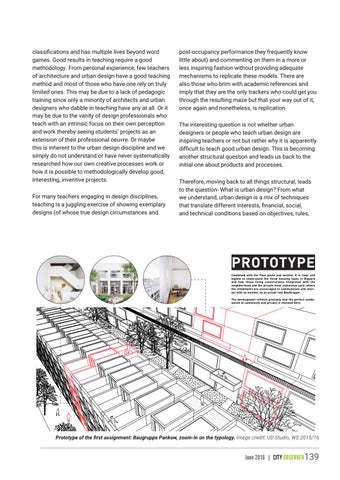
PROTOTYPE Combined with the floor plans and section, it is clear and legible to understand the three housing types in Bigyard and how these living constructions integrated with the neighborhood and the private inner communal yard, where the inhabitants are encouraged to communicate and interact with on another as an actual real BauGruppe. The development reflects precisely that the perfect combination of community and privacy is realized here.
7
Prototype of the first assignment: Baugruppe Pankow, zoom-in on the typology. Image credit: UD Studio, WS 2015/16
UD STUDIO
HOME GROWN - HOUSING ALLIANCES ON THE RISE
A COOPERATION OF HABITAT UNIT . PROFESSOR PHILIPP MISSELWITZ . WM OLIVER SCHETTER CHAIR FOR URBAN DESIGN AND URBANISATION . PROFESSOR JĂ–RG STOLLMANN . WM KATHARINA HAGG
M : NTS
ASSIGNMENT 1-C
RICO DIEDERING FINYA EICHHORST YUSHAN CHEN
June 2016 | CITY OBSERVER139