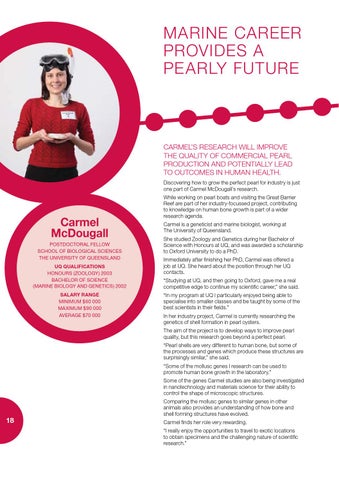
MARINE CAREER PROVIDES A PEARLY FUTURE
Carmel’s research will improve the quality of commercial pearl production and potentially lead to outcomes in human health. Discovering how to grow the perfect pearl for industry is just one part of Carmel McDougall’s research.
Carmel McDougall Postdoctoral Fellow School of Biological Sciences The University of Queensland UQ Qualifications HONOURS (ZOOLOGY) 2003 BACHELOR OF SCIENCE (MARINE BIOLOGY AND GENETICS) 2002 SALARY RANGE Minimum $60 000 Maximum $90 000 Average $70 000
While working on pearl boats and visiting the Great Barrier Reef are part of her industry-focussed project, contributing to knowledge on human bone growth is part of a wider research agenda. Carmel is a geneticist and marine biologist, working at The University of Queensland. She studied Zoology and Genetics during her Bachelor of Science with Honours at UQ, and was awarded a scholarship to Oxford University to do a PhD. Immediately after finishing her PhD, Carmel was offered a job at UQ. She heard about the position through her UQ contacts. “Studying at UQ, and then going to Oxford, gave me a real competitive edge to continue my scientific career,” she said. “In my program at UQ I particularly enjoyed being able to specialise into smaller classes and be taught by some of the best scientists in their fields.” In her industry project, Carmel is currently researching the genetics of shell formation in pearl oysters. The aim of the project is to develop ways to improve pearl quality, but this research goes beyond a perfect pearl. “Pearl shells are very different to human bone, but some of the processes and genes which produce these structures are surprisingly similar,” she said. “Some of the mollusc genes I research can be used to promote human bone growth in the laboratory.” Some of the genes Carmel studies are also being investigated in nanotechnology and materials science for their ability to control the shape of microscopic structures.
18
Comparing the mollusc genes to similar genes in other animals also provides an understanding of how bone and shell forming structures have evolved. Carmel finds her role very rewarding. “I really enjoy the opportunities to travel to exotic locations to obtain specimens and the challenging nature of scientific research.”