january 2012
U.P. News 9
UP Mindanao assists Typhoon Pablo victims
UPB prof proposes setting up of Cordillera Studies Center Program for Languages and Literatures
Rene Estremera, UPMin - Office of the Chancellor Photo courtesy of Rene Estremera, UPMin-OC
Ruth Tindaan, UPB
in education. In June 2012, the Department of Education (DepEd) implemented the Mother Tongue Based Multi-Lingual Education Program which mandates the use of children’s native language as medium of instruction in the first three years of elementary school. This shift in language policy was based on a theoretical ground which recognizes that children’s cognitive development is best fostered by a language they understand and use in everyday dealings instead of a language (e.g. English) that is alien to them. This policy maintains that the use of a foreign language in school impedes the children’s comprehension of concepts and their acquisition of academic skills. This new educational policy has created the need for instructional materials that are based on the specific native languages of communities in the country. Unfortunately, the DepEd is still in the process of producing ample and appropriate language-based materials. In the midst of this difficulty in elementary schools, the program can become useful by collaborating with the education department in the development of instructional materials for schools in Northern Luzon. The literary landscape Literature, of course, cannot be separated from language. As a cultural production, literature is a record of thoughts, practices and aspirations of a community. Besides entertaining readers with its aesthetic appeal, literature also heightens the readers’ awareness of certain aspects of life. This program takes an inclusive definition of literature to cover a wide range of literary practices from indigenous cultural forms to contemporary literary practices such as popular culture, media productions, emerging literatures, and other forms including those that have not been traditionally legitimized as literature. Indigenous communities like those in Northern Luzon have oral literature traditions that present views of the social order including desires, restrictions and projections of fear. Many of these traditions, however, have been undervalued or forgotten due to the colonial experience that either or both demonized and erased indigenous culture for colonialist ends. Undeniably, the residual effects of colonial design are prevalent today. An indication of this is the general lack of knowledge and unflattering opinion on cultural literary traditions compared, for instance, to western popular culture. It is therefore part of this program to recuperate buried or submerged indigenous literatures and to strengthen the use of these literatures in the education and socialization of children in Northern Luzon communities. Tempered with awareness of the debilitating effects of mere nostalgic return to origins, this effort may help bring about a consciousness among children that is anchored on or informed by their cultural circumstances, but which also looks beyond cultural boundaries. The program will treat literatures as important links to cultural, national and global identities as it is an effective device for education. Many scholars now, especially those of PAGE
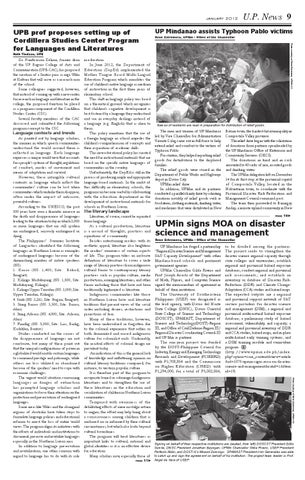
Names of residents are read in preparation for distribution of relief goods.
The men and women of UP Mindanao led by Vice Chancellor for Administration Vicente Calag came out in full force to help extend relief and comfort to the victims of Typhoon Pablo. For starters, they helped repacking relief goods for distribution to the displaced families. The relief goods were stored in the Department of Public Works and Highways depot in Davao City. UPMin relief drive In addition, UPMin and its partners conducted a parallel charity drive by soliciting donations notably of relief goods such as food items, clothing materials, drinking water, and medicines that were distributed in New
Bataan town, the hardest-hit municipality in Compostela Valley province. The relief drive began with the solicitation of donations from partners spearheaded by the UP Mindanao Office of Extension and Community Services (OECS). The donations in kind and in cash amounted to 40 sacks of rice, assorted goods and drinking water. The UPMin delegation left on December 14 for its first stop at the provincial capitol of Compostela Valley, located in the Nabunturan town, to coordinate with the Provincial Disaster Risk Reducation and Management Council command post. The team then proceeded to Barangay Andap, a remote upland community in New PAGE
10►
UPMin signs MOA on disaster science and management Rene Estremera, UPMin - Office of the Chancellor
UP Mindanao has forged a partnership “Regional Disaster Science and Management S&T Capacity Development” with other Mindana-based schools and pertinent government agencies. UPMin Chancellor Gilda Rivero and Prof. Joseph Acosta of the Department of Math, Physics, and Computer Science signed the memorandum of agreement in behalf of their institution. The University of Southeaster n Philippines (USEP) was designated as the lead agency, with Davao del Norte State College (DNSC), Davao Oriental State College of Science and Technology (DOSCST), SPAMAST, Department of Science and Technology(DOST)-Region XI, and Office of Civil Defense-Region XI/ Regional Disaster Coordinating Council-XI and UP Min as partners. The one-year project was funded by the DOST-Philippine Council for Industry, Energy and Emerging Technology Research and Development (PCIEERD) with P3,708,864 and the Commission on Higher Education (CHED) with P1,294,000, for a total of P5,002,864,
to be divided among the par tners. The project seeks to strengthen the disaster science regional capacity through state colleges and universities; establish regional and provincial hazard exposure databases; conduct regional and provincial risk assessments; and establish an inventory or database of Disaster RiskReduction (DDR) and Climate ChangeAdaptation (CCA) studies and hazard maps. The expected outputs are a regional and provincial support network of S&T service providers for disaster science and management (DSM); a regional and provincial multi-natural hazard exposure database; a preliminary study of hazard assessment, vulnerability, and capacity; a regional and provincial inventory of DDR and CCA studies, hazard maps, and in-place multi-hazard early warning systems; and a DSM training module and curriculum program. (h t t p : / / w w w. u p m i n . e d u . p h / i n d e x . php?option=com_content&view=article &id=1075:upmin-signs-moa-on-disasterscience-and-management&catid=1&Item id=19) Photo courtesy of Rene Estremera, UPMin-OC
Dr. Purificacion Delima, former dean of the UP Baguio College of Arts and Communication (UPB-CAC), has proposed the creation of a Sentro para sa mga Wika at Kultura that will serve as a research arm of the school. Some colleagues suggested, however, that instead of coming up with a new center for research in language and literature in the college, the proposed function be placed as a program component of the Cordillera Studies Center (CSC). Several faculty members of the CAC discussed and submitted the following program concept to the CSC. Language contexts and trends As pointed out by language scholars, the manner in which speech communities understand the world around them is reflected in language. Each language expresses a unique world view that accounts for a people’s systems of thought, regulations of conduct, modes of movement and means of adaptation and survival. However, these intangible cultural contents in language which reflect the communities’ culture can be lost when communities which underlie them disappear, often under the impact of intrusive, powerful cultures. According to the UNESCO, the past 300 years have seen a dramatic increase in the death and disappearance of languages leading to the situation today in which 3,000 or more languages that are still spoken are endangered, seriously endangered or dying. The Philippines’ Summer Institute of Linguistics identified the following languages in Northern Luzon as examples of endangered languages because of the diminishing number of native speakers (NS). 1. Karao (NS: 1,400; Site: Bokod, Benguet) 2. Kalinga Madukayang (NS: 1,500; Site: Madukayang, Kalinga) 3. Kalinga Upper Tanudan (NS: 3,000; Site: Upper Tanudan, Kalinga) 4. Iwak (NS: 3,261; Site: Itogon, Benguet) 5. Itneg Banao (NS: 3,500; Site: Banao, Abra) 6. Itneg Adasen (NS: 4,000; Site: Adasen, Abra) 7. Finallig (NS: 5,000; Site: Lias, Barlig, Kadaklan, Bontoc) Studies conducted on the causes of the disappearance of languages are not conclusive, but many of these point out that the unequal configurations of power in a globalized world enable certain languages to command prestige and patronage, while others are less utilized or abandoned because of the speakers’ need to cope with economic challenges. The urgent world situation concerning languages in danger of extinction has prompted language scholars and organizations to focus their attention on the protection and preservation of endangered languages. Some areas like Wales and the aboriginal regions of Australia have taken steps to formulate language policies and educational reforms to arrest the loss of entire world views. The program aligns its initiatives with the efforts of individuals and institutions to document, preserve and revitalize languages especially in the Northern Luzon area. In addition to language preservation and revitalization, one other concern with regard to language has to do with its role
Signing on behalf of their respective institutions are (seated, from left) DOSCST President Edito Sumile, DNSC President Jonathan Bayogan, UPMin Chancellor Gilda Rivero, USEP President Perfecto Alibin, and DOST-XI’s Mirasol Domingo. SPAMAST President Irvin Generalao was able to catch up and sign the agreement on behalf of his institution. The project team leader is Prof. 11► Angel de Vera of USEP.