2 U.P. News
january 2013
College of Law moves forward after 100 years Jo. Florendo B. Lontoc
Photos courtesy of the UP College of Law, UPSIO
The UP College of Law observed its centennial year last January 11with the unveiling of a historical marker outside Malcolm Hall. The marker embodied significant milestones in the annals of the country’s premier and influential law school, beginning with its organization through the initiative of former Philippine Supreme Court Associate Justice George Malcolm in
1910, with the help of the Young Men’s Christian Association. The school eventually found its way to the Diliman campus in 1948. The marker was installed by the National Historical Commission (NHC), led by Commisioner Ferdinand Llanes. The College prides itself with a rich history that produced Presidents Jose P. Laurel, Manuel Roxas, Elpidio Quirino,
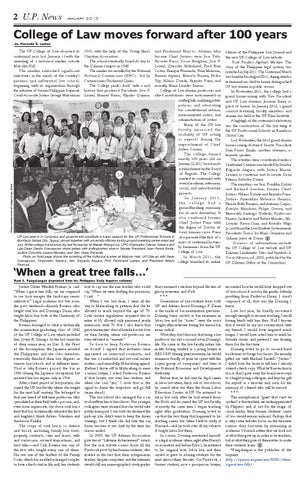
and Ferdinand Marcos. Alumni who became Chief Justices were Jose Yulo, Ricardo Paras, Cesar Bengzon, Jose P. Laurel, Querube Makalintal, Fred Ruiz Castro, Enrique Fernando, Felix Makasiar, Ramon Aquino, Marcelo Fernan, Pedro Yap, Hilario Davide, Reynato Puno, and recently, Maria Lourdes Sereno. College of Law alumni, professors and allied institutions were instrumental in crafting bills, analyzing public policies and advocating for constitutional reform, environmental justice, and administration of justice. Many of the UP law faculty increased the visibility of UP acting as exper ts during the impeachment of Chief Justice Corona. The college tur ned exactly 100 years old on January 12, 2011 based on its establishment by the Board of Regents. The College marked its centennial with several academic, extension, social, and infrastructure projects. In Januar y 2011, the college had a groundbreaking ceremony for its new dormitory. It also conferred for mer Chief Justice Puno with the degree of Doctor of Laws, honoris causa. Puno UP Law alumni in Congress and government constitute a major support for the UP Professional Schools in also presented the first of a Bonifacio Global City, Taguig, shown together with university officials during ground-breaking ceremonies last series of centennial lectures July. At the college’s homecoming last November at Makati Shangri-La, UPD Chancellor Caesar Saloma and by luminaries from the UP Law Dean Danilo Concepcion share tables with distinguished alumni Senate President Juan Ponce Enrile, College of Law. Justice Conchita Carpio-Morales, and Sen. Koko Pimentel. Photo on front page shows the unveiling of the historical marker at Malcom Hall, UP Diliman with Dean In March 2011, the Concepcion, Chancellor Saloma, Sen. Edgardo Angara, Prof. Ferdinand Llanes, and President Afredo college launched its online Pascual.
‘When a great tree falls…’
edition of the Philippine Law Journal and the new UP College of Law website. Prof. Pacifico Agabin’s Mestizo: The story of the Philippine legal system, was launched in July 2011. The Centennial March was launched in August 2011, during which a testimonial was held to honor distinguished UP law alumni in public service. In November 2011, the college had a grand homecoming with Vice President and UP Law alumnus Jejomar Binay as guest of honor. In January 2012, a grand concert featuring faculty members and alumni was held at the UP Film Institute. A highligh of the centennial celebration was the construction of the law wing at the UP Professional Schools in Bonifacio Global City. Last November, the 2012 grand alumni homecoming featured Senate President Juan Ponce Enrile, another alumnus, as keynote speaker. The activities were coordinated under a Centennial Commission headed by Senator Edgardo Angara, with Justice Marvic Leonen as convenor and Associate Dean Patricia Salvador Daway. The members are Sen. Franklin Drilon and Richard Gordon; for mer Chief Justices Hilario Davide and Reynato Puno; Justices Ameurfina Melencio Herrera, Flerida Ruth Romero, and Antonio Carpio; Estelito Mendoza, Felipe Gozon, and Mercedita Santiago Nolledo; Professors Francis Jardeleza and Rafael Morales; Ma. Lourdes Rausa-Chan, and Rodolfo Waga Jr.; and from the Law Student Government, Presidents Teresa Ira Maris Guanzon and Gilliane Joyce de Dumo. (Sources of information include the UP College of Law website and UP Diliman Landmarks: Sites and Symbols 2, Oscar Alfonso, ed., 2005, published by the UP Diliman Office of the Chancellor)
Raul C. Pangalangan (reprinted from his Philippine Daily Inquirer column)
Justice Oliver Wendell Holmes Jr. said: “When a great tree falls, we are surprised to see how meager the landscape seems without it.” Legal academia lost two icons the past weekend—Araceli Baviera who taught civil law and Domingo Disini who taught labor law, both at the University of the Philippines. Baviera belonged to what is technically the nonexistent graduating class of 1942 of the UP College of Law, which included Sen. Jovito R. Salonga. In the last semester of their senior year, on Dec. 8, the Feast of the Assumption, the Japanese invaded the Philippines and the class members eventually finished their law degrees in various law schools and at different times. That is why Baviera passed the bar in 1944 (during the Japanese occupation) but received her law degree only in 1954. After a brief period of law practice, she joined the UP law faculty where she taught for the next half century. She belonged to that rare breed of full-time professors who specialized in their field with a passion, and, even more impressive, she chose civil law, a field that has traditionally attracted the best and brightest (think Arturo Tolentino and Ambrosio Padilla). The scope of civil law is so diverse and broad, including family law, torts, property, contracts, sales and leases, wills and succession, secured transactions, and land titles—and Cely Baviera was one of the few who taught every one of them. She was one of the drafters of the Family Code, which has enabled estranged couples to have a fresh start in life and, her students
love to say, was the rare teacher who could say, “When we were drafting this provision, I said….” When I was law dean, I went all the way to Malacañang to petition that she be allowed to teach beyond the age of 70. Civil service regulations required her to retire at 65, allowed only piecemeal yearly extensions until 70. But I also knew that great universities abroad lavished more love on their faculty, where old professors are even elevated as “emeriti.” So how to keep Professor Baviera on board? I argued that lecturers were appointed on semestral contracts, and this was a contractual and not civil service matter—and mercifully, Malacañang agreed. (Before I drove off to Malacañang to meet a senior lawyer, I asked Professor Baviera if that lawyer was ever her student, and when she said “yes,” I took that as the signal to damn the torpedoes and go full steam ahead.) The law school also arranged for a car to chauffeur her to her classes. Her younger colleagues were worried that she would take public transport. I was told she declined the pick-up (she didn’t want to keep the driver waiting), but I think she did take the car home because it was dark by the time her classes ended. In 2009, the UP Alumni Association gave her its “Lifetime Achievement” award. But the real tribute comes from all the Facebook posts by her former students, who reveled in the fact that their octogenarian teacher, despite computers and the Internet, would still use mimeographed study guides
that contained a wisdom beyond the ken of glossy reviewers and iPads. *** Generations of law students from both UP and Ateneo know Domingo P. Disini as the oracle of bar examination questions. Doming twice served as bar examiner in labor law and his “notes” were the most sought-after reviewer during the annual bar exam ordeal. What they don’t know is that being a law professor was just a second act in Doming’s life. He came to the law faculty rather late in life, having worked as a young lawyer at ABS-CBN (during quiet moments, he would reminisce fondly of years he spent with the Lopez group of companies) and later at the National Economic and Development Authority. Before that, he did start his legal career in labor law when, fresh out of law school, he joined what was then the Asian Labor Education Center at UP. He returned to labor law only after he had retired from the Neda and he joined the UP law faculty, at exactly the same time I began teaching right after graduation. Doming loved to say that the best thing that happened to his teaching career was when I left to study at Harvard—and he took over all my subjects (I taught labor law then). In a sense, Doming reinvented himself as a legal academic when, right after Ninoy’s assassination and before Edsa 1, he returned to his original love, labor law, and then served as guru to adoring students for the next almost three decades. On Facebook, a former student, now a prosperous lawyer,
recounted how he would have dropped out of law school if not for the gentle, fatherly prodding from Professor Disini. I wasn’t surprised at all; that was the Doming I knew. Late last year, he briefly recovered enough strength to resume teaching. I recall having lunch with him then. Had I known that it would be my last conversation with my friend, I would have lingered much longer. I would have asked him to retell his favorite stories and pretend I was hearing them for the first time. Doming loved to go to second-hand bookstores to forage for classics. He recently gifted me with Michael Sandel’s “Justice.” I didn’t have the heart to tell him I already owned a fresh copy. What he’ll never know, too, is that I gave away the brand-new copy to a bright young colleague, and kept his gift for myself as a treasure and, now, for the memory of a friend who will be missed. *** The metaphorical “grief that can’t be spoken” is that teachers are underappreciated by Filipinos and, if not for the magic of social media, their former students’ sense of loss would remain unheard. Perhaps that is why some tributes focus on the lucrative careers they forswore by remaining in academia. I’d much rather that we look not at what they gave up in order to be teachers, but at what they gave of themselves to make their students learn. *Pangalangan is the publisher of the Inquirer. (http://opinion.inquirer.net/46381/whens s) a-great-tree-falls)