january 2012
U.P. News 11
Arlyn VCD Palisoc Romualdo
Asian Studies, a peer-reviewed journal by the AsianCenter of UPDiliman (UPD), recently published Islam and Philippine Society: The Writings of Cesar AdibMajul AdibMajul, a double issue commemorating one of the most brilliant minds in Philippine intellectual history. This volume reprints ten of Dr. Majul’s articles published in previous issues of Asian Studies over the past five decades. Released as a retrospective issue, it contains five articles on Islam and Muslims in the Philippines, and another five on Filipino nationalism and the Philippine Reform Movement. These include “The Role of Islam in the History of the Filipino People” (1966); “Islam in the Philippines and its China Link” (1999); “Social Background of Revolution” (1971); and “Principales, Ilustrados, Intellectuals and the Original Concept of a Filipino National Community” (1977). In his introduction, JulkipliWadi, dean of UPD’sInstitute of Islamic Studies, writes that the republication of Majul’s articles comes “auspiciously” after the signing of a Framework Agreement between the Philippine Government and the Moro Islamic Liberation Front. They offer a rich “historical canvas that can help determine the context and possible trajectories of the Framework’s vision of peace.” Moreover, the republication pays tribute to Dr. Majul’s seminal contribution to Philippine scholarship. He authored several books and penned numerous articles in reputable publications. This voluminous body of work spans five decades, and covers groundbreaking studies in Philippine history, the sociopolitical thought of ApolinarioMabini, and the history of Islam and Muslims in the Philippines. Educated in Cor nellUniversity, Majul occupied various academic and administrative positions in UP from the late 1940s to the late 1970s. He was once dean of the College of Arts and Sciences, which incorporated the now separate College of Arts and Letters, the College of Science, and the College of Social Sciences and Philosophy. He passed away in October 2003.
A Bulatlat scribe and a Philippine Daily Inquirer (PDI) reporter bagged 1st Chit Estella Journalism Awards last December 7 in rites held at the UP Diliman College of Mass Communication. Ina Alleco Silverio of Bulatlat.com won in the online media category for her stories, “Three months after Sendong, Iligan residents still far from rebuilding their lives” and “In Makati, the poor of Guatemala street know nothing about the city’s wealth.” On the other hand, Elizabeth Lolarga Silverio ruled in the print media category for her article “356 political prisoners go on hunger strike.” Each winner received a trophy and a P10,000 prize. Finalists in both categories received certificates prior to the announcement of the winners. Joining Silverio as finalists in the online media category were fellow Bulatlat.com reporters Ronalyn Olea for “Jonas Burgos, gentle and brave,” and Anne Marxze Umil for her “Privatization of government hospitals, further marginalizing the poor in the name of profit” and “K+12, worsening shortages to greet school opening.” Lolarga’s colleagues at the PDI, Tonette
Majul was an intellectual “giant,” says Asian Studies editor in chief, Eduardo C. Tadem, Ph.D. “We came out with this issue to allow veteran academics to look back at and reassess the significance of Dean Majul’s writings, perhaps with the benefit of hindsight. We also wanted to introduce new generations of scholars to his work, which is arguably unparalleled and relevant as ever.” To get a hard copy of Islam and Philippine Society: The Writings of Cesar AdibMajul AdibMajul, visit Room 205 of the AsianCenter, GTToyotaBuilding, Magsaysay cor. Guerrero Sts., University of the Philippines Diliman, Quezon City. The price is P300. Enrolled UP students get 30% off. A free online version will be available for download by April 2013. For inquiries, email upasianstudies@gmail.com or call (02) 981.8500 local 3586. (UP Asian Center)
Call for papers: Asian Studies Asian Studies, a peer-reviewed journal published twice a year by the Asian Center, UP Diliman, is looking for original contributions in the form of research articles (social sciences, humanities, and/ or culture), commentaries and documents, reviews (books, films, events, music, emedia, etc.), poetry and short fiction, and travel narratives. Consult the guidelines for content and submissions at http://journals.upd.edu. ph/index.php/asj. Send manuscripts to the editor in chief at upasianstudies@gmail. com. The journal welcomes submissions all year round. One of the pioneering journals of its kind in Asia, Asian Studies offers a critical and multidisciplinary forum where scholars, practitioners, researchers, and activists on Asia can dissect various issues that impact Asian societies and their peoples. Since 1965, the journal has published the works of (now) renowned scholars, both foreign and Filipino, including Cesar AdibMajul, Juan Francisco, Benedict
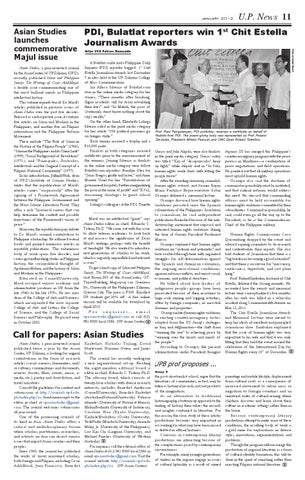
Prof. Raul Pangalangan, PDI publisher, receives a certificate on behalf of finalists from PDI. The award-giving body was represented by Prof. Roland Simbulan, President Alfredo Pascual, and CMC Dean Roland Tolentino.
Orejas and Julie Alipala, were also finalists in the print media category. Orejas’ entry was titled “Kin of ‘desaparecidos’ keep up fight,” while Alipala sent in “In Sulu, human rights work starts with letting the people know.” After the awarding ceremony, journalist, human rights activist, and former Bayan Muna Partylist Representative Satur Ocampo delivered a memorial lecture Ocampo discussed how human rights violations persisted since the Spanish colonization of the Philippines. In relation to journalism, he said independent publications flourished because of the antidictatorship movement that exposed and criticized human rights violations during the time of former President Ferdinand Marcos. Ocampo explained that human rights violations are “systemic and systematic,” and have evolved through time with organized struggles for self-determination against the Spanish and American colonizers, the ongoing neocolonial conditions, agrarian reform conflicts, and unjust social, economic, and political structures. He talked about how leaders of indigenous peoples groups have been persecuted because of their resistance to large-scale mining and logging activities, often by foreign companies, in ancestral domains and properties. Ocampo related human rights violations to existing counter-insurgency tactics adopted from the US Army’s strategies in Iraq and Afghanistan—the shift from “winning the war” to achieving peace by “winning over the hearts and minds of the people.” According to Ocampo, the present administration under President Benigno
Kerkvliet, Nicholas Tarling, David Sturtevant, Norman Owen, and James Scott. The journal has recently undergone a new organizational set-up. Heading the eight-member editorial board is editor in chief, Eduardo C. Tadem, Ph.D. ◄PAGE 9 The advisory board, which consists of the post-structuralist school, argue that the twenty-four scholars with diverse research literatures of communities, in fact, may be interests, includes Benedict Anderson taken as historical records, not just products (CornellUniversity), Benedict Kerkvliet of the imagination. As an alter native to traditional (AustralianNationalUniversity). Patricio historiography, a bottom-up approach to the Abinales (University of Hawaii at Manoa), writing of history then values the records MelaniBudianta (University of Indonesia), Caroline Hau (Kyoto University), and insights contained in literature. For KinhideMushakoji (Osaka University), this reason, the close study of these artistic VediHadiz (Murdoch University), Armado productions becomes very important in Malay, Jr. (University of the Philippines), accounting for what may have been missed Lau Kin Chi (Lingnan University), and or deleted in official histories. Concerns in contemporary literary Michael Pinches (University of Western productions are interesting because of Australia). For inquiries, call the editorial office of the complications posed by contemporary Asian Studies at 63.2.981.8500 local 3586 or circumstances. For example, many younger generations email upasianstudies@gmail.com. Visit the journal website http://journals.upd.edu. of writers in the regions engage in issues of cultural hybridity as a result of mixed ph/index.php/asj. (UP Asian Center)
Aquino III has merged the Philippine’s counter-insurgency program with the peace process in Mindanao—a combination of peace negotiations and field operations. He pointed out that all military operations must uphold human rights. Ocampo also said the doctrine of command responsibility must be instituted, and that judicial reforms would address this need. He stressed that commanding officers must be held accountable for human rights violations committed by their subordinates. Command responsibility, he said, could even go all the way up to the President, as he is the Commander-inChief of the Philippine military. Human Rights Commissioner Coco Quisumbing dropped by the event and advised aspiring journalists to do research and contextualize their reports. She also told students of Journalism that there is a “big burden in becoming a good journalist” and that there is no excuse for “inaccuracy, carelessness, hyperbole, and just plain lying.” Prof. Roland Simbulan, husband of Chit Estella, delivered the closing remarks. He recounted how the awards and memorial lecture were conceptualized a few months after his wife was killed in a vehicular accident along Commonwealth Avenue on May 13, 2011. The Chit Estella Journalism Awards and Memorial Lecture were meant to keep her ideals of excellent and principled journalism alive. Simbulan explained that the issue of human rights was very important to his wife and that it was only fitting that they hold the event around the celebration of the International Day for Human Rights every 10th of December.
UPB prof proposes ...
parentage and mobile lifestyle, displacement from cultural roots as a consequence of increased movement to urban areas or migration to foreign countries and an unnatural order of cultural rearing where children discover and learn about their culture in academic settings rather than in the home. Because contemporar y literar y productions attempt to make sense of these conditions, the resulting body of work is a gold mine for explorations in diverse styles, innovations, experimentations and problems. Though the program will encourage the production of regional literature as a form of cultural identity formation, this will be done in the spirit of enriching rather than rejecting Filipino national literature.
Photo by Misael Bacani
Asian Studies PDI, Bulatlat reporters win 1st Chit Estella launches Journalism Awards commemorative Majul issue