Extending expertise
PATIENT CARE
Stroke neurologists care for patients in remote areas BY AMBER SMITH
THIS IS A STORY ABOUT TWO WOMEN, living in different parts of rural Central New York. Each suffered a stroke. Each had a loved one who summoned help. Each saw a stroke neurologist from Upstate University Hospital long before arriving at the academic medical center in Syracuse. Upstate’s Telestroke partnership — which allows Upstate neurologists to provide clinical care from a distance — helped save the lives of Amanda Peer of Watertown and Mary Green of Clayton.
A headache that wouldn’t stop. Green, 49, is a licensed practical nurse who has worked for 30 years at River Hospital in Alexandria Bay. She was supposed to work there Oct. 25, but at 5:15 a.m. she remained sound asleep, snoring. Her husband, Marshall Green, tried to wake her up, twice. When he realized she was unresponsive, he called for their son, Dustin, to help while they waited for the ambulance. ey thought Mary Green might have overdosed on her medication. e day before, Green had a headache that wouldn’t stop. She remembers going to bed early. at’s all she remembers. “I don’t remember anything for about 38 days. I kind of lost a month of my life.” Her husband kept notes for her. At River Hospital, the doctors consulted with Upstate neurologist Elwaleed El Nour, MD, via Telestroke. His assessment allowed for a quick decision that Green needed prompt transport by helicopter for expert care in Syracuse. At Upstate, Green immediately underwent an angiogram, showing the blood flow — and the blockages — in the vessels of her brain. She had what is called a bilateral occipital stroke, affecting the lower back part of her brain. is region controls vision, coordination and balance, among other essential functions. Green spent 38 days in Upstate’s specialized neuroscience intensive care unit for patients with neurological problems. Medications helped her recover from her stroke. Aer she was stabilized, she was transferred to Upstate’s physical medicine and rehabilitation unit. She went home Dec. 13. She continues to see neurologist Carmen Martinez, MD, who is trying to determine why
summer 2017 l upstate.edu
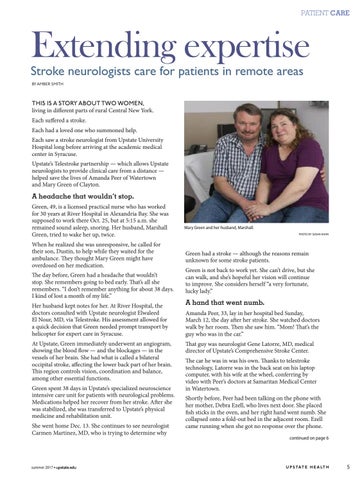
Mary Green and her husband, Marshall. PHOTO BY SUSAN KAHN
Green had a stroke — although the reasons remain unknown for some stroke patients. Green is not back to work yet. She can’t drive, but she can walk, and she’s hopeful her vision will continue to improve. She considers herself “a very fortunate, lucky lady.”
A hand that went numb. Amanda Peer, 33, lay in her hospital bed Sunday, March 12, the day aer her stroke. She watched doctors walk by her room. en she saw him. “Mom! at’s the guy who was in the car.” at guy was neurologist Gene Latorre, MD, medical director of Upstate’s Comprehensive Stroke Center. e car he was in was his own. anks to telestroke technology, Latorre was in the back seat on his laptop computer, with his wife at the wheel, conferring by video with Peer’s doctors at Samaritan Medical Center in Watertown. Shortly before, Peer had been talking on the phone with her mother, Debra Ezell, who lives next door. She placed fish sticks in the oven, and her right hand went numb. She collapsed onto a fold-out bed in the adjacent room. Ezell came running when she got no response over the phone. continued on page 6
U P S TAT E H E A LT H
5