“For many, the archaeology of the ancient Near East brings the Bible to life,” said Chamberlin. “Archaeology doesn’t change the Scripture, but illuminates it. In bringing these biblical artifacts to life we learn about the cultural construct on which history occurred. Watching people’s eyes light up when they see the real history of the Bible right in front of them has been worth the effort.” Life-size graphics and interactive media help tell the story behind the Khirbet el-Maqatir exhibit. To date, the museum has hosted more than 1,000 visitors. To understand the months of preparation that went into the project one would need to do a little digging. In 2015, the university’s alumni association hosted a seminar on the Temple Mount Sifting Project with noted Israeli archaeologist Gabriel Barkay, Ph.D.
“Archaeology doesn’t change the Scripture, but illuminates it.” The positive response after the event set Chamberlin on his quest. He learned that the Associates for Biblical Research, the organization supervising the Khirbet elMaqatir excavation, was looking for a university to host the exhibit, which had been on display in major cities. Without a host, the exhibit would go back to Israel, unlikely to ever return to the U.S. The rest is history. The idea wasn’t a hard sell but took many hours of planning and fundraising. Chamberlin spoke to community groups, businesses and the congregations of at least 30 churches. With each preview, he’d unpack the cartons; some containing rare artifacts in glass cases and some pieces of pottery, Old Testament-era idols and ancient stone artifacts audiences could touch. Supported by UPIKE’s Alumni Association, a committee of volunteers and student interns, Chamberlin forged partnerships with Associates for Biblical Research, The Institute of Archaeology, the Siegfried H. Horn Museum at Andrews University, the David A. Dorsey Museum of Biblical Archaeology and the Civil Administration for Judea and Samaria. A partnership with the City of Pikeville provided a physical space for the exhibit in the renovated historic York House downtown. Along the way,
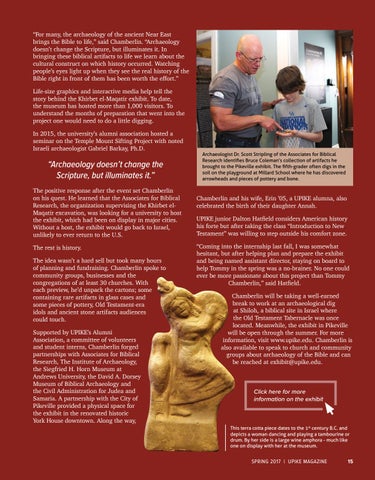
Archaeologist Dr. Scott Stripling of the Associates for Biblical Research identifies Bruce Coleman’s collection of artifacts he brought to the Pikeville exhibit. The fifth-grader often digs in the soil on the playground at Millard School where he has discovered arrowheads and pieces of pottery and bone.
Chamberlin and his wife, Erin ’05, a UPIKE alumna, also celebrated the birth of their daughter Annah. UPIKE junior Dalton Hatfield considers American history his forte but after taking the class “Introduction to New Testament” was willing to step outside his comfort zone. “Coming into the internship last fall, I was somewhat hesitant, but after helping plan and prepare the exhibit and being named assistant director, staying on board to help Tommy in the spring was a no-brainer. No one could ever be more passionate about this project than Tommy Chamberlin,” said Hatfield. Chamberlin will be taking a well-earned break to work at an archaeological dig at Shiloh, a biblical site in Israel where the Old Testament Tabernacle was once located. Meanwhile, the exhibit in Pikeville will be open through the summer. For more information, visit www.upike.edu. Chamberlin is also available to speak to church and community groups about archaeology of the Bible and can be reached at exhibit@upike.edu.
Click here for more information on the exhibit
This terra cotta piece dates to the 1st century B.C. and depicts a woman dancing and playing a tambourine or drum. By her side is a large wine amphora - much like one on display with her at the museum.
SPRING 2017 | UPIKE MAGAZINE
15