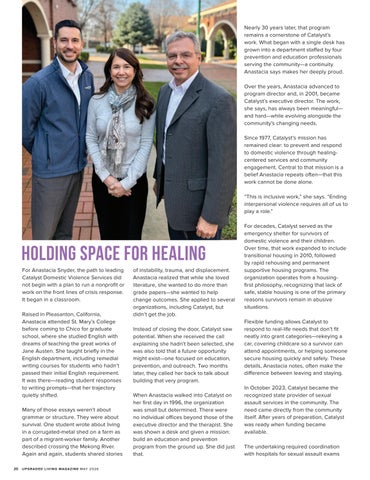
Nearly 30 years later, that program remains a cornerstone of Catalyst’s work. What began with a single desk has grown into a department staffed by four prevention and education professionals serving the community—a continuity Anastacia says makes her deeply proud. Over the years, Anastacia advanced to program director and, in 2001, became Catalyst’s executive director. The work, she says, has always been meaningful— and hard—while evolving alongside the community's changing needs. Since 1977, Catalyst’s mission has remained clear: to prevent and respond to domestic violence through healingcentered services and community engagement. Central to that mission is a belief Anastacia repeats often—that this work cannot be done alone. “This is inclusive work,” she says. “Ending interpersonal violence requires all of us to play a role.”
Holding space for healing For Anastacia Snyder, the path to leading Catalyst Domestic Violence Services did not begin with a plan to run a nonprofit or work on the front lines of crisis response. It began in a classroom. Raised in Pleasanton, California, Anastacia attended St. Mary’s College before coming to Chico for graduate school, where she studied English with dreams of teaching the great works of Jane Austen. She taught briefly in the English department, including remedial writing courses for students who hadn’t passed their initial English requirement. It was there—reading student responses to writing prompts—that her trajectory quietly shifted. Many of those essays weren’t about grammar or structure. They were about survival. One student wrote about living in a corrugated-metal shed on a farm as part of a migrant-worker family. Another described crossing the Mekong River. Again and again, students shared stories 20
U P G R A D E D L I V I N G M AG A Z I N E M AY 2 0 2 6
of instability, trauma, and displacement. Anastacia realized that while she loved literature, she wanted to do more than grade papers—she wanted to help change outcomes. She applied to several organizations, including Catalyst, but didn’t get the job. Instead of closing the door, Catalyst saw potential. When she received the call explaining she hadn’t been selected, she was also told that a future opportunity might exist—one focused on education, prevention, and outreach. Two months later, they called her back to talk about building that very program. When Anastacia walked into Catalyst on her first day in 1996, the organization was small but determined. There were no individual offices beyond those of the executive director and the therapist. She was shown a desk and given a mission: build an education and prevention program from the ground up. She did just that.
For decades, Catalyst served as the emergency shelter for survivors of domestic violence and their children. Over time, that work expanded to include transitional housing in 2010, followed by rapid rehousing and permanent supportive housing programs. The organization operates from a housingfirst philosophy, recognizing that lack of safe, stable housing is one of the primary reasons survivors remain in abusive situations. Flexible funding allows Catalyst to respond to real-life needs that don’t fit neatly into grant categories—rekeying a car, covering childcare so a survivor can attend appointments, or helping someone secure housing quickly and safely. These details, Anastacia notes, often make the difference between leaving and staying. In October 2023, Catalyst became the recognized state provider of sexual assault services in the community. The need came directly from the community itself. After years of preparation, Catalyst was ready when funding became available. The undertaking required coordination with hospitals for sexual assault exams
CB