The Scope of Impact
“People don’t look at it the way engineers do.” Carter has dedicated the majority of his 30-year career to improving efficiency in health care from the care at patients’ bedside, to policies that align systems across entire regions.
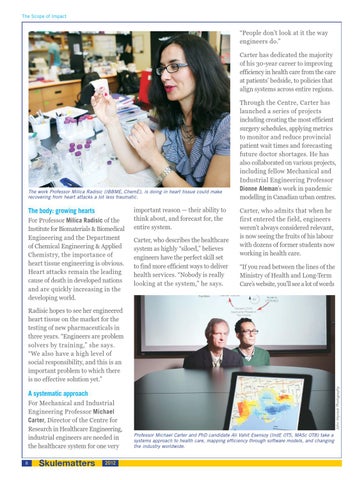
The work Professor Milica Radisic (IBBME, ChemE), is doing in heart tissue could make recovering from heart attacks a lot less traumatic.
The body: growing hearts For Professor Milica Radisic of the Institute for Biomaterials & Biomedical Engineering and the Department of Chemical Engineering & Applied Chemistry, the importance of heart tissue engineering is obvious. Heart attacks remain the leading cause of death in developed nations and are quickly increasing in the developing world.
important reason — their ability to think about, and forecast for, the entire system. Carter, who describes the healthcare system as highly “siloed,” believes engineers have the perfect skill set to find more efficient ways to deliver health services. “Nobody is really looking at the system,” he says.
Through the Centre, Carter has launched a series of projects including creating the most efficient surgery schedules, applying metrics to monitor and reduce provincial patient wait times and forecasting future doctor shortages. He has also collaborated on various projects, including fellow Mechanical and Industrial Engineering Professor Dionne Aleman’s work in pandemic modelling in Canadian urban centres. Carter, who admits that when he first entered the field, engineers weren’t always considered relevant, is now seeing the fruits of his labour with dozens of former students now working in health care. “If you read between the lines of the Ministry of Health and Long-Term Care’s website, you’ll see a lot of words
John Hryniuk Photography
Radisic hopes to see her engineered heart tissue on the market for the testing of new pharmaceuticals in three years. “Engineers are problem solvers by training,” she says. “We also have a high level of social responsibility, and this is an important problem to which there is no effective solution yet.”
A systematic approach For Mechanical and Industrial Engineering Professor Michael Carter, Director of the Centre for Research in Healthcare Engineering, industrial engineers are needed in the healthcare system for one very 8
Skulematters
2012
Professor Michael Carter and PhD candidate Ali Vahit Esensoy (IndE 0T5, MASc 0T8) take a systems approach to health care, mapping efficiency through software models, and changing the industry worldwide.