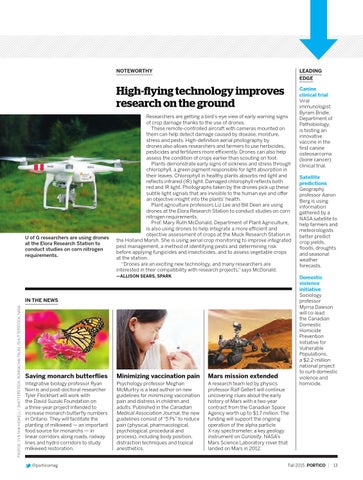
U of G researchers are using drones at the Elora Research Station to conduct studies on corn nitrogen requirements.
NOTEWORTHY
LEADING EDGE
High-flying technology improves research on the ground
Canine clinical trial Viral immunologist Byram Bridle, Department of Pathobiology, is testing an innovative vaccine in the first canine osteosarcoma (bone cancer) clinical trial.
Researchers are getting a bird’s-eye view of early warning signs of crop damage thanks to the use of drones. These remote-controlled aircraft with cameras mounted on them can help detect damage caused by disease, moisture, stress and pests. High-definition aerial photography by drones also allows researchers and farmers to use herbicides, pesticides and fertilizers more efficiently. Drones can also help assess the condition of crops earlier than scouting on foot. Plants demonstrate early signs of sickness and stress through chlorophyll, a green pigment responsible for light absorption in their leaves. Chlorophyll in healthy plants absorbs red light and reflects infrared (IR) light. Damaged chlorophyll reflects both red and IR light. Photographs taken by the drones pick up these subtle light signals that are invisible to the human eye and offer an objective insight into the plants’ health. Plant agriculture professors Liz Lee and Bill Deen are using drones at the Elora Research Station to conduct studies on corn nitrogen requirements. Prof. Mary Ruth McDonald, Department of Plant Agriculture, is also using drones to help integrate a more efficient and objective assessment of crops at the Muck Research Station in the Holland Marsh. She is using aerial crop monitoring to improve integrated pest management, a method of identifying pests and determining risk before applying fungicides and insecticides, and to assess vegetable crops at the station. “Drones are an exciting new technology, and many researchers are interested in their compatibility with research projects,” says McDonald. —ALLISON SEARS, SPARK
PHOTOS: CYNTHIA KIDWELL / SHUTTERSTOCK; RONNACHAI PALAS /SHUTTERSTOCK; NASA
IN THE NEWS
Saving monarch butterflies
Minimizing vaccination pain
Mars mission extended
Integrative biology professor Ryan Norris and post-doctoral researcher Tyler Flockhart will work with the David Suzuki Foundation on a three-year project intended to increase monarch butterfly numbers in Ontario. They will facilitate the planting of milkweed — an important food source for monarchs — in linear corridors along roads, railway lines and hydro corridors to study milkweed restoration.
Psychology professor Meghan McMurtry is a lead author on new guidelines for minimizing vaccination pain and distress in children and adults. Published in the Canadian Medical Association Journal, the new guidelines consist of “5 Ps” to reduce pain (physical, pharmacological, psychological, procedural and process), including body position, distraction techniques and topical anesthetics.
A research team led by physics professor Ralf Gellert will continue uncovering clues about the early history of Mars with a two-year contract from the Canadian Space Agency worth up to $1.7 million. The funding will support the ongoing operation of the alpha particle X-ray spectrometer, a key geology instrument on Curiosity, NASA’s Mars Science Laboratory rover that landed on Mars in 2012.
@porticomag
Satellite predictions Geography professor Aaron Berg is using information gathered by a NASA satellite to help farmers and meteorologists better predict crop yields, floods, droughts and seasonal weather forecasts. Domestic violence initiative Sociology professor Myrna Dawson will co-lead the Canadian Domestic Homicide Prevention Initiative for Vulnerable Populations, a $2.2-million national project to curb domestic violence and homicide.
Fall 2015 PORTICO | 13