I
& Study Looks at Sports-Related Heart Failure
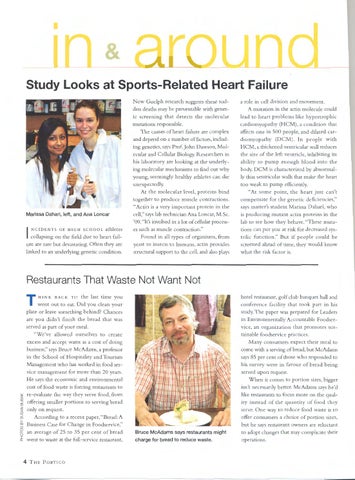
Marissa Dahari, left, and Ana Loncar
I
NCIDENTS OF HIGH SCHOOL athletes collapsing on the field due to heart failure are rare but devastating. Often they are linked to an underlying genetic condition.
New Guelph research suggests these sudden deaths may be preventable with genetic scree ning that detects the molecular mutations responsible. The causes of heart failure are complex and depend on a number of factors, incl uding genetics, says Prof. John Dawson, Molecular and Cellular Biology. Researchers in his laboratory are looking at the und erlying molecular mechanisms to find out why young, seemingly healthy athletes can die un expectedly. At the molecular level, proteins bind together to produce muscle contractions. "Actin is a very important protein in the cell," says lab technician Ana Loncar, M.Sc. '09. "It's involved in a lot of cellular processes such as muscle contraction." Found in all types of organisms, from yeast to insects to hum ans, actin provides structural support to the cell, and also plays
a role in cell division and movement. A mutation in the actin molecule could lead to heart problems like hypertrophic cardiomyopathy (HCM), a condition that affects one in 500 people, and dilated cardiomyopathy (DCM) . In people w ith HCM, a thickened ventricular wall reduces the size of the left ventricle, inhibiting its ability to pump enough blood into th e body. DCM is characterized by abnormally thin ventricular walls that make the heart too weak to pump efficiently. "At some point, the heart just ca n't compensate for the genetic deficiencies," says master's student Marissa Dahari, who is producing mutant actin proteins in the lab to see how they behave. "These mutations can put you at risk for decreased systolic function." But if people could be screened ahead of time, they would know what the risk factor is.
Restaurants That Waste Not Want Not
T
~
ffi ~ ~
~
ยง if
4
RINK BACK TO the last time yo u went out to eat. Did you clean your plate or leave something behind? Chances are you didn't finish the bread that was served as part of your meal. "We've allowed ourselves to create excess and accept waste as a cost of doing business," says Bruce McAdams, a professor in the School of Hospitality and Tourism Management who has worked in food service management for more than 20 years. He says the economic and environmental cost of food waste is forcing restaurants to re-evaluate the way they serve food, from offering smaller portions to serving bread only on requ est. According to a recent paper, "Bread: A Business Case for Change in Foodservice," an average of 25 to 35 per cent of bread went to waste at the full-service restaurant,
THE PoRTICO
Bruce McAdams says restaurants might charge for bread to reduce waste.
hotel restaurant, golf club banquet hall and conferen ce facility that took part in his study. The paper was prepared for Leaders in Environmentally Accountable Foodservice, an organization that promotes sustainable foodservice practices. Many consumers expect their meal to come with a serving of bread, but McAdams says 85 per cent of those who responded to his survey were in favour of bread being served upon request. When it comes to portion sizes, bigger isn't necessarily better. McAdams says he 'd like restaurants to focus more on the quality instead of the quantity of food they serve. One way to reduce food waste is to offer consumers a choice of portion sizes, but he says restaurant owners are reluctant to adopt changes that may complicate their operations.