World Report ... young people have made it abundantly clear that they want to be involved in the decisions impacting society and addressing climate change is no exception. Throughout the world, youth have developed creative ways to raise awareness, share information, build capacities, and work together on climate change mitigation and
adaptation
practices–often
achieving
impressive
results through
their own initiatives. Young people can combat
climate
change not only as members of youth organiza-
tions,
but also as individuals. Each of the world’s
1.2
billion young women and men has an impact on the environment. Through the choices they make in their everyday lives, they contribute
to
the
preservation
or
degradation of their natural surroundings.
Historically,
the
younger
generation has promoted change and embraced innovative values. In many cases, youth have been the initiators of social movements that have given rise to cultural and
social
transformations. While the young people of today a major consumer group, many of them are dissatisfied with
constitute the
consumer
societies in which they live and are seeking alternative lifestyles. This could mean a drive for change. Young people around the world are increasingly making small but important changes that represent essential steps in their transition to a more sustainable lifestyle. Youth can start right where they are, and many...
Youth &
United Nations publication Sales No. E.10.IV.11 ISBN 978-92-1-130303-2 Copyright Š United Nations, 2010 All rights reserved. Printed by the United Nations, New York
This publication is available at www.un.org/youth. It is also available for Kindle, iPad, Nook and other e-book readers. For more details, please visit www.un.org/publications.
Acknowledgements The World Youth Report: Youth and Climate Change represents a collaborative effort, made possible by the input and feedback received from experts in the field of youth and climate change and from partners throughout the United Nations system working on issues relating to youth development and climate change. The contributions from youth around the world were invaluable in the preparation of the Report. To obtain background information for the Report, the United Nations Programme on Youth issued a call for input. The positive response from young individuals, youth-led and youth-focused organizations, and institutions working in the area of climate change is a testimony to the extensive interest in the topic of youth and climate change. Contributions were carefully screened and helped inform the content of the final Report. They provided an important overview of the broad range of climate change adaptation and mitigation activities in which young people around the world are engaged. Most of the examples provided in chapter IV of the present Report are based on these contributions. Unfortunately, owing to the large volume of contributions received, it is not possible to list all those who provided input individually. The United Nations Programme on Youth is deeply grateful for all the inputs received.
V
DESA The Department of Economic and Social Affairs of the United Nations Secretariat is a vital interface between global policies in the economic, social and environmental spheres and national action. The Department works in three main interlinked areas: it compiles, generates and analyses a wide range of economic, social and environmental data and information on which Members States of the United Nations draw to review common problems and to take stock of policy options; it facilitates the negotiations of Member States in many intergovernmental bodies on joint courses of action to address ongoing or emerging global challenges; and it advises interested Governments on the ways and means of translating policy frameworks developed in United Nations conferences and summits into programmes at the country level and, through technical assistance, helps build national capacities.
VI
Note The designations employed and the presentation of material in this publication do not imply the expression of any opinion whatsoever on the part of the Secretariat of the United Nations concerning the legal status of any country, territory, city or area or of its authorities, or concerning the delimitation of its frontiers or boundaries. The assignment of countries or areas to specific groupings is for analytical convenience and does not imply any assumption regarding political or other affiliation of countries or territories by the United Nations. The designations “developed” and “developing” are intended for statistical and analytical convenience and do not necessarily express a judgment about the stage reached by a particular country or area in the development process.
Explanatory-notes References to dollars ($) indicate United States dollars, unless otherwise stated. When a print edition of a source exists, the print version is the authoritative one. United Nations documents reproduced online are deemed official only as they appear in the United Nations Official Document System. United Nations documentation obtained from other United Nations and non-United Nations sources are for informational purposes only. The Organization does not make any warranties or representations as to the accuracy or completeness of such materials.
The following abbreviations have been used in the Report: AC
air conditioner
C Celsius CDM Clean Development Mechanism CER
certified emission reduction
CFL
compact fluorescent lighting
CO2
carbon dioxide
UNFCCC United Nations Framework Convention on Climate Change UNEP United Nations Environment Programme UNICEF
United Nations Children’s Fund
USP
University of the South Pacific
COP Conference of the Parties to the United Nations Framework Convention on Climate Change
YJF
Youth Forum Jeunesse
YMCA
Young Men’s Christian Association
CSD Commission on Sustainable Development
YOUNGO youth constituency (COP sessions)
DHF
dengue haemorrhagic fever
Technical note
ERU
emission reduction unit
F
Fahrenheit
FAO Food and Agriculture Organization of the United Nations GHG
greenhouse gas
ICMYO International Coordination Meeting of Youth Organisations IPCC Intergovernmental Panel on Climate Change KCYP Kibera Community Youth Programme NGO
non-governmental organization
NYU New York University OECD Organization for Economic Cooperation and Development UNESCO United Nations Educational, Scientific and Cultural Organization
In this publication, unless otherwise indicated, the term “youth” refers to all those between the ages of 15 and 24, as reflected in the World Programme of Action for Youth. The term “young people” may be used interchangeably with the word “youth” in the text.
Note on country groupings and subgroupings Unless otherwise indicated, the following country groupings and subgroupings have been used in this Report: sia: Afghanistan, Bangladesh, Bhutan, A Brunei Darussalam, Cambodia, China, Hong Kong Special Administrative Region of China, Macao Special Administrative Region of China, Democratic People’s Republic of Korea, India, Indonesia, Islamic Republic of Iran, Japan, Lao People’s Democratic
VII
Republic, Malaysia, Maldives, Mongolia, Myanmar, Nepal, Pakistan, Philippines, Republic of Korea, Singapore, Sri Lanka, Thailand, Timor-Leste, Viet Nam; ub-Saharan Africa: Angola, Benin, Botswana, S Burkina Faso, Burundi, Cameroon, Cape Verde, Central African Republic, Chad, Comoros, Congo, Côte d’Ivoire, Democratic Republic of the Congo, Djibouti, Equatorial Guinea, Eritrea, Ethiopia, Gabon, Gambia, Ghana, Guinea, Guinea-Bissau, Kenya, Lesotho, Liberia, Madagascar, Malawi, Mali, Mauritania, Mauritius, Mayotte, Mozambique, Namibia, Niger, Nigeria, Réunion, Rwanda, Saint Helena, Sao Tome and Principe, Senegal, Seychelles, Sierra Leone, Somalia, South Africa, Swaziland, Togo, Uganda, United Republic of Tanzania, Zambia, Zimbabwe;
VIII
atin America: Argentina, Belize, Bolivia, Brazil, L Chile, Colombia, Costa Rica, Ecuador, El Salvador, Falkland Islands (Malvinas), French Guiana, Guatemala, Guyana, Honduras, Mexico, Nicaragua, Panama, Paraguay, Peru, Suriname, Uruguay, Venezuela; Middle East and North Africa: Algeria, Bahrain, Djibouti, Egypt, Islamic Republic of Iran, Iraq, Israel, Jordan, Kuwait, Lebanon, Libyan Arab Jamahiriya, Malta, Morocco, Oman, Qatar, Saudi Arabia, Syrian Arab Republic, Tunisia, United Arab Emirates, Occupied Palestinian Territory, Yemen; astern Europe and the Commonwealth E of Independent States: Albania, Armenia, Azerbaijan, Belarus, Bosnia and Herzegovina, Bulgaria, Croatia, Czech Republic, Estonia, Georgia, Hungary, Kazakhstan, Kyrgyzstan, Latvia, Lithuania, Montenegro, Poland, Moldova, Romania, Russian Federation, Serbia, Slovakia, Slovenia, Tajikistan, Turkmenistan, Ukraine, Uzbekistan, former Yugoslav Republic of Macedonia; mall island developing States: American S Samoa, Anguilla, Antigua and Barbuda, Aruba, Bahamas, Barbados, Belize, British Virgin Islands, Cape Verde, Comoros, Cook Islands,
Cuba, Dominica, Dominican Republic, Fiji, French Polynesia, Grenada, Guam, GuineaBissau, Guyana, Haiti, Jamaica, Kiribati, Maldives, Marshall Islands, Mauritius, Federated States of Micronesia, Montserrat, Nauru, Netherlands Antilles, New Caledonia, Niue, Northern Mariana Islands, Palau, Papua New Guinea, Puerto Rico, Samoa, Sao Tome and Principe, Seychelles, Singapore, Solomon Islands, Saint Kitts and Nevis, Saint Lucia, Saint Vincent and the Grenadines, Suriname, Timor-Leste, Tonga, Trinidad and Tobago; eveloped market economies: Australia, D Austria, Belgium, Cyprus, Denmark, Finland, France, Germany, Greece, Iceland, Ireland, Italy, Japan, the Netherlands, New Zealand, Norway, Portugal, Spain, Sweden, Switzerland, United Kingdom of Great Britain and Northern Ireland, United States of America.
The following symbols have been used in the annex tables included in the Report: wo dots (..) indicate that data are not T available or are not separately reported. n em dash (—) indicates that the item is A nil or negligible. hyphen (-) indicates that the item is not A applicable. minus sign (-) indicates a deficit or deA crease, except as indicated. A full stop (.) is used to indicate decimals. slash (/) between years indicates a statisA tical year, for example, 1990/91. Use of a hyphen (-) between years, for example, 1990-1991, signifies the full period involved, including the beginning and end years. Details and percentages in tables do not necessarily add to totals, because of rounding. Annual rates of growth or change, unless otherwise stated, refer to annual compound rates.
Photo credits: shootnations.org produced by Plan International and Shoot Experience: Agnieszka Kozlowska: page ii-iii Lauren Card
page xviii - 1
William Lyte:
page 10
Filipciuc Andrada:
page 19
Alex Kozobolis:
page 29
Filipciuc Andrada-Diana: page 38 Nilyma Khan:
page 43
Lameck Nyagudi:
page 47
Zabir Hasan:
page 56
Katharina Kuehnel:
page 62
Edna Loureiro:
page 67
Ruli Amrullah:
page 71
Claudia Morais:
page 75
Mark-David Pfeifer:
page 88-89
Florin Kiritescu:
page 94
Wei Yun Chung:
page 172-173
IX
X
Contents Acknowledgements
V
Explanatory notes
VII
Introduction
XVI
Why “youth and climate change” now? XVI Overview of the Report XVII I. Climate change: the basics
2
The facts about climate change
3
The impact of a changing climate on ecosystems and livelihoods
6
The international framework for combating climate change
7
The United Nations Framework Convention on Climate Change
8
The Kyoto Protocol to the United Nations Framework Convention on Climate Change
9
Youth and Rio+20
10
Suggestions for further reading
11
II. Compromised futures? Youth development and the effects of climate change
14
The compound effects of climate change on health and safety
15
Extreme weather events increase health hazards…
15
…particularly where sanitation is poor and wastewater management Insufficient
16
Reduced access to clean water compromises health
16
Higher temperatures increase exposure to disease…
16
…and increase the threat of heat stress
17
The food security dilemma
18
Climate change mitigation and food security: an added challenge?
20
The impact of climate change on young people’s livelihoods
20
Negative consequences
21
XI
Potential positive consequences— including green jobs The migration equation
22
Climate, conflict, and youth
24
Final analysis
26
Suggestions for further reading
28
III. Addressing climate change at its roots
30
Consumption patterns and sustainable lifestyles
31
The dominant youth market
32
Young people’s ecological footprint
XII
22
32
The consumption paradox: Do young people walk the talk?
33
Education for change
35
Key features of effective education for sustainable development
35
Challenges in implementing education for sustainable development
38
Non-formal climate change education
39
Preparing young people to take advantage of green job opportunities
39
Education and training
42
Youth entrepreneurship
44
Environmental public employment programmes
44
Suggestions for further reading
46
IV. Moving forward: youth taking action and making a difference
48
Promoting youth participation within the United Nations
49
Youth participation and the United Nations Framework Convention on Climate Change
51
Youth participation: climbing the ladder towards genuine empowerment
54
The ladder of participation
54
Youth participation in climate change initiatives around the world
55
Informing and educating youth
55
Young people sharing information and building capacity
57
Youth applying information and communication technologies
58
Youth gathering and analysing information
59
Youth involvement in campaigning, lobbying, and advocacy
60
Youth engaging in consultation
61
Youth taking the initiative
61
Youth participating in policy development
63
Youth as partners in decision-making
64
Youth mobilizing themselves: youth-led organizations
65
The role of young people in promoting and effecting change
66
Barriers to youth engagement and the way forward
69
Conclusion
69
Calling all Youth
72
Bibliography
76
Statistical annex
90
Introduction
90
1. Youth population indicators, 2010
95
2. Urban and rural distribution of youth, 1990-2005
102
3. Youth literacy rates, 1985-2008
108
4. Gross enrolment ratios for primary, secondary and tertiary education, 2008
116
5. Net enrolment ratios for primary and secondary education, 2008
124
6. Primary to secondary school transition rates, 2007-2008
132
7. Youth labour force participation rates, 2008
138
8. Youth unemployment indicators
144
9. Youth undernutrition and shelter deprivation
154
10. Youth access to sanitation and water
158
11. Leading causes of death among youth
164
XIII
Profile of Youth
170
Brief demographic and development profile of youth
170
Figures
XIV
I.1 Trends in global average surface temperature
3
I.2 Extreme weather events, 1970-2005
4
I.3 Share of different sectors in total anthropogenic greenhouse gas emissions in terms of CO2-equivalent emissions, 2004
5
I.4
Annual per capita emissions in selected regions, 1950-2005
5
I.5
Projected impacts of climate change
6
II.1 The complex relationship between conflict over natural resources and climate change
25
II.2 Dependency ratio in renewable water
26
III.1 The consumption process
31
IV.1
68
Youth actions for sustainable lifestyles
Boxes I.1 The Intergovernmental Panel on Climate Change
7
I.2 Growing Green Globally: A snapshot on the Green Growth model for development
12
II.1 Dengue: a resurgent virus
17
II.2 Marjorie’s story: a Filipina shell fisher in warm waters
21
II.3
23
Permanent inundation and forced migration
II.4 Climate change and indigenous youth III.1 Defining sustainable lifestyles
26 `
III.2 The OzonAction Education Pack III.3
Promoting education for sustainable development at the highest level
III.4 Tertiary climate change education in the Pacific Islands III.5
Youth harnessing the power of the sun through the production of solar photovoltaic panels
III.6 City garbage recyclers in low-income estates III.7
Youth employment through invasive alien species eradication
34 36 37 39 40 41 45
IV.1 The World Programme of Action for Youth on the importance of participation
49
IV.2 Mainstreaming indigenous peoples’ issues in international development assistance programmes and funds dedicated to addressing climate change
50
IV.3 Youth voices at the fifteenth session of the Conference of the Parties (COP 15)
52
IV.4 The status of the youth constituency in activities carried out under the auspices of the United Nations Framework Convention on Climate Change 53
IV.5
Youth climate campaigning “down under”
65
XV
Introduction
INTRODUCTION
Why “youth and climate change� now? Climate change is one of the defining challenges of the twenty-first century. It is a challenge that is global in both its impact and its solutions but one that is not shared equally, as developing countries are likely to be among the most seriously affected by and the least able to address the consequences of climate change. Climate change touches every aspect of life and impinges on development efforts, with consequences ranging from immediate to long term. Major adjustments are required to promote more sustainable patterns of production and consumption at both the collective and individual levels. Solid evidence exists that climate change will have a more serious impact than initially anticipated and that adaptation and mitigation will entail significantly higher costs if action is deferred than if the problem is addressed now. Addressing and adjusting to the challenge of climate change is certain to be a defining feature of the future of today’s youth. It is therefore critical that young people educate themselves and become more actively involved in combating this threat. The present Report is designed to assist youth and youth organizations in such an endeavour. It is also meant to affirm the status of young people as key stakeholders in the fight against climate change. The publication comes at a time when efforts to address climate change are receiving unparalleled attention in the international arena, offering youth a unique opportunity for their voice to be heard in the debate.
Youth have long been involved in environmental protection activities at the school and community levels, but the time has come for them to participate more actively in shaping global decisions relating to climate change. Young people must contribute to the process of addressing this critical challenge, as they will feel its impact most acutely throughout their lives. Young advocates for the environment are becoming more insistent that their voices be heard. In recent years, youth have been recognized as a constituency, albeit with probationary status, at the annual sessions of the Conference of the Parties to the United Nations Framework Convention on Climate Change (UNFCCC), the world’s most important intergovernmental forum dealing with international efforts and commitments to combat climate change. Young people must continue to move forward, strengthening their position until they occupy a secure place in the decisionmaking process. To that end, the current World Youth Report provides an assessment of youth participation today and identifies steps that can be taken at the local and international levels to facilitate wider and more effective participation among youth in addressing climate change.
Overview of the Report Chapter I provides basic information on climate change as well as an overview of the United Nations Framework Convention on Climate Change and its Kyoto Protocol, the relevant international legal and policy framework recognized by most countries. The chapter concludes with a brief outline of the aims of the upcoming United Nations Conference on Sustainable Development, Rio +20. Chapter II focuses on the consequences of climate change, exploring how the threat it poses to health and safety, food security, and livelihood sustainability may directly affect youth development in developing countries. The chapter also addresses the possibility of ensuing tensions and conflicts over the control of basic natural resources and livelihood opportunities—and their potential outcomes, including migration.
In chapters III and IV, the focus shifts from how young people are likely to be affected by climate change to how they can contribute to remedying the situation. Chapter III identifies trends in young people’s consumption behaviours and lifestyles. Youth, especially those in developed countries, constitute a critical mass of present and future consumers, and their consumption decisions could become a key factor in reducing or aggravating climate change and its consequences. An overwhelming majority of youth indicate that world leaders should do all they can to stop climate change, but do young people take their own responsibilities in this context just as seriously? Education has been identified as a crucial tool in raising environmental awareness and promoting behaviour change among youth. Chapter III highlights education for sustainable development and the role of education in preparing young people to take advantage of “green” job opportunities. It also includes brief mention of additional measures that might be taken to promote green employment options for youth. Chapter IV showcases existing youth mobilization efforts and initiatives to combat climate change. Youth-led environmental organizations constitute a highly successful model of self-mobilization among young people, and such bodies are likely to play a critical role in tackling climate change challenges. The chapter concludes with an assessment of where youth currently stand in terms of involvement, celebrating recent political developments acknowledging young people as legitimate stakeholders in intergovernmental negotiations on climate change but also identifying barriers to effective youth participation. The first three chapters end with a short annotated list of references for readers interested in more in-depth information on climate change. Ultimately, the present World Youth Report is intended to highlight the important role played by youth in addressing climate change and to offer suggestions on how young people might be more effectively integrated as individual and collective agents of change within the realm of climate change adaptation and mitigation.
XVII
Chapter I
CHAPTER I
Youth and climate change: the basics Climate change … is the defining challenge of our era. No issue is more fundamental to the global challenges we face—reducing poverty… maintaining economic growth… ensuring peace and stability. — Ban Ki-moon, Secretary-General of the United Nations1
1 UN News Centre (2009), “Remarks at UNFCCC
COP15 High Level Segment”.
The facts about climate change
Figure I.1
Climate change is happening, and it is happening quickly. Although the issue has been a source of controversy among scientists and policymakers, there is growing evidence that the earth’s temperature is rising and that polar ice caps and glaciers are melting. For many key parameters, the climate system is already moving beyond the patterns of natural variability (Intergovernmental Panel on Climate Change, 2007a).
Global warming is also leading to a rise in sea levels through thermal expansion of the oceans, glacier retreat, and the melting of ice sheets. Between 1993 and 2003, the global average sea level increased by approximately 3.1 millimetres. The extent of Arctic sea ice has shrunk by 2.7 per cent per decade over the past 30 years (Intergovernmental Panel on Climate Change, 2007b). During the summers of 2007 and 2008, seasonal melting created an ice-free channel in the Northwest Passage, a water route through the islands of northern Canada separating the Atlantic and Pacific oceans (United Nations Environment Programme, 2009). Antarctica is also losing ice at an unprecedented rate; it is estimated that ice loss from the West Antarctic ice sheet increased by 60 per cent between 1996 and 2006. If this ice sheet were to melt completely, sea levels could rise by as much as 5 metres (United Nations Environment Programme, 2009).
Over the past hundred years, the average temperature of the earth’s surface has increased by 0.74° C (see figure I.1) (Intergovernmental Panel on Climate Change, 2007a). The most compelling evidence of climate change has emerged over the past couple of decades, with 11 of the 12 warmest years on record occurring between 1995 and 2006 (Intergovernmental Panel on Climate Change, 2007b).
Figure I.1
3
Trends in global average surface temperature
Estimated actual global mean temperature Mean value, ºC
Differences in temperature from 1885-1990 Mean value, ºC
0.6
14.6
0.4
14.4
0.2
14.2
0
14.0
-0.2
13.8
-0.4
13.6
-0.6 1885
1905
1925
1945
Source: United Nations Environment Programme/GRID-Arendal (n.d.).
1965
1985
-13.4 2005
Figure I.2
In addition to affecting global mean surface temperature, sea level, and ice sheet dynamics, climate change brings about ocean acidification, which inhibits the development of many marine organisms. Climate change may be a key factor contributing to the increased incidence and intensity of extreme weather events such as droughts, heatwaves, floods, and tropical storms (see figure I.2). Over the past 50 years, heatwaves and heavy precipitation events have occurred with greater frequency, and there is evidence that tropical cyclone activity has been rising steadily since 1970 (Intergovernmental Panel on Climate Change, 2007b).
Figure I.2 Extreme weather events, 1970-2005 According to the United Nations Environment Programme (UNEP), there is a significant possibility that many of the present trends will accelerate, leading to a higher risk of abrupt and/ or irreversible climatic shifts and an even more pronounced increase in the frequency and intensity of extreme weather events. If the tipping point is reached, the world may witness the disruption of seasonal weather patterns that support the agricultural activities of half the human population, the diminution of carbon sinks in the oceans and on land, and the destabilization of major ice sheets, leading to unanticipated rates of sea level rise in the twenty-first century (United Nations Environment Programme, n.d.).
Source: United Nations, International Strategy for Disaster Reduction (n.d.).
There is almost unanimous agreement among scientists and policymakers that human behaviour has contributed to the escalation of climate change through increased emissions of greenhouse gases (GHGs), especially carbon dioxide (CO2). Global GHG emissions linked to human activities have increased considerably since pre-industrial times but have accelerated dramatically in recent decades, rising 70 per cent between 1970 and 2004—predominantly owing to the burning of fossil fuels and land-use change (Intergovernmental Panel on Climate Change, 2007b). By 2004, the energy supply sector accounted for about a quarter of all anthropogenic GHG emissions, while the industry, forestry, agriculture, and transport sectors each contributed between 13 and 19 per cent to the overall total (see figure I.3).
Figure I.3 Forestry 17%
Agriculture 14%
Figure I.3 Share of different sectors in total anthropogenic greenhouse gas emissions in terms of CO2equivalent emissions, 2004
Waste and wastewater 3%
Industry 19%
It is estimated that developed countries are responsible for over three quarters of total GHG emissions (United Nations, 2009a). As figure I.4 illustrates, developing countries still account for a very small proportion of emissions in per capita terms.
Residential and commercial buildings 8%
Energy supply 26% Transport 13% Source: Intergovernmental Panel on Climate Change (2007a).
Figure I.4 Annual per capita emissions in selected regions, 1950-2005 Figure I. Annual per capita emissions, selected regions, 1950-2005 6.0
5
United States of America
4.0 OECD (24 countries) 3.0 Western Europe 2.0 Japan Developing countries (96 countries) 1.0
Source: United Nations (2009a).
2005
India
2000
Africa
1995
1990
China
1985
Latin America
1980
1975
1970
1965
1960
1955
0.0 1950
Metric tons of carbon
5.0
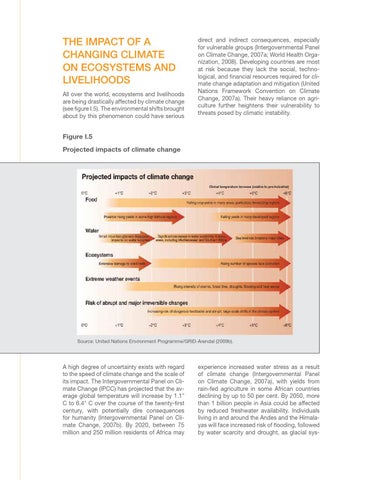
The impact of a changing climate on ecosystems and livelihoods All over the world, ecosystems and livelihoods are being drastically affected by climate change (see figure I.5). The environmental shifts brought about by this phenomenon could have serious
direct and indirect consequences, especially for vulnerable groups (Intergovernmental Panel on Climate Change, 2007a; World Health Organization, 2008). Developing countries are most at risk because they lack the social, technological, and financial resources required for climate change adaptation and mitigation (United Nations Framework Convention on Climate Change, 2007a). Their heavy reliance on agriculture further heightens their vulnerability to threats posed by climatic instability.
Figure I.5 Projected impacts of climate change
6
Source: United Nations Environment Programme/GRID-Arendal (2009b).
A high degree of uncertainty exists with regard to the speed of climate change and the scale of its impact. The Intergovernmental Panel on Climate Change (IPCC) has projected that the average global temperature will increase by 1.1째 C to 6.4째 C over the course of the twenty-first century, with potentially dire consequences for humanity (Intergovernmental Panel on Climate Change, 2007b). By 2020, between 75 million and 250 million residents of Africa may
experience increased water stress as a result of climate change (Intergovernmental Panel on Climate Change, 2007a), with yields from rain-fed agriculture in some African countries declining by up to 50 per cent. By 2050, more than 1 billion people in Asia could be affected by reduced freshwater availability. Individuals living in and around the Andes and the Himalayas will face increased risk of flooding, followed by water scarcity and drought, as glacial sys-
tems in these mountain ranges continue to recede. In Small Island Developing States (SIDS) in the Caribbean and Pacific regions, sea level rise and increasing sea temperatures are already having a negative impact on freshwater resources, fisheries, and coastal ecosystems. Increased exposure to aggravated environmental stress linked to longer or more intense droughts, storms, floods, or other major weather events has already begun to interfere with the efforts of some of the world’s most vulnerable to build a better life for themselves and their families. If climate change continues at its present pace, the health, shelter, and livelihood situations of a significant proportion of the global population will be seriously affected, which could trigger large-scale reversals in human development. Failure to address climate change today will result in diminished opportunities and a widening of the inequality gap within and between countries. Efforts to combat climate change at the local, national, and international levels have focused on mitigation and adaptation. Mitigation refers to measures that seek to reduce GHG emissions and thereby slow the progression of climate change. Mitigation measures include not only using renewable energy and developing new technologies for transportation and industry, but also protecting and expanding forests, which play a crucial role in absorbing greenhouse gases. Adaptation refers to measures to protect people and ecosystems from the effects of climate change. Since climate change is a transnational issue, effective mitigation and adaptation require international cooperation and coordination.
The international framework for combating climate change At the United Nations Conference on Environment and Development, held in Rio de Janeiro in 1992, 178 Governments agreed that climate change should be addressed from a sustainable development perspective. Section 9.3 of Agenda 21 (1993) states that relevant efforts “should be coordinated with social and economic development in an integrated manner with a view to avoiding adverse impacts on the latter, taking into full account the legitimate priority needs of developing countries for the achievement of sustained economic growth and the eradication of poverty”.
The United Nations Framework Convention on Climate Change was also adopted in 1992 and entered into effect in 1994; most countries have since become signatories. The Framework Convention and its Kyoto Protocol are at the core of international efforts to address climate change.
Box I.1 The Intergovernmental Panel on Climate Change The Intergovernmental Panel on Climate Change (IPCC) was established by the United Nations Environment Programme and World Meteorological Organization in 1988 to help Governments better understand changes in the world’s climate from a scientific perspective. The IPCC is an expert body that reviews and assesses the most recent scientific, technical, and socio-economic information produced worldwide relevant to the understanding of climate change. The IPCC comprises three working groups that address different aspects of the climate change issue. Working Group I assesses the “physical scientific aspects of the climate system and climate change”, focusing on variations in temperature, rainfall, sea level, and ice sheets, on climate models and projections, and on the “causes and attribution of climate change”. Working Group II “assesses the vulnerability of socio-economic and natural systems to climate change, negative and positive consequences of climate change, and options for adapting to it”. Working Group III “assesses options for mitigating climate change through limiting or preventing greenhouse gas emissions and enhancing activities that remove them from the atmosphere”. Technical support units administer and organize the activities of the working groups. The IPCC is made up of thousands of scientists from around the world who contribute to the Panel’s work on a voluntary basis as authors, contributors,
7
and reviewers. The efforts of these scientists are supported by the IPCC secretariat, which plans, coordinates, and oversees the Panel’s activities.
8
The major output of the IPCC is its assessment reports, which comprise separate publications from each working group and, since 1995, a synthesis report. These scientific reports provide the world’s most comprehensive coverage of climate change. The First Assessment Report, published in 1990, identified climate change as an issue requiring an international political platform. The Report served as a catalyst leading to the establishment of the Framework Convention, the landmark international treaty created to reduce global warming and compel countries to deal with the consequences of climate change. The Second Assessment Report: Climate Change 1995 contributed key input to the process leading to the adoption of the Kyoto Protocol to the Framework Convention in 1997. The third and fourth assessment reports were published in 2001 and 2007 respectively. The participation of the scientific community in the work of the IPCC has grown substantially in terms of both the number of authors and contributors involved in the writing and reviewing of the reports and the geographic distribution and topics covered in the publications. Along with the assessment reports, the IPCC produces special reports, methodology reports, technical papers, and supporting materials. Through these and other means the Panel provides the United Nations Climate Change secretariat, the Conference of the Parties to the Framework Convention, and other environmental conventions with information on technical and scientific matters. Source: Information summarized and extracted from the Intergovernmental Panel on Climate Change website (http://www.ipcc/ch).
The United Nations Framework Convention on Climate Change The Framework Convention is an international treaty that establishes broad goals and rules for addressing climate change. Its ultimate objective is to ensure that GHG emissions linked to human activity remain below the level at which the climate system is adversely affected. The Convention is general and flexible in character; its importance derives not from the provision of detailed environmental protection guidelines, but rather from its role in securing global recognition of climate change as a major challenge. The Convention has laid the groundwork for more focused action, including the adoption of the Kyoto Protocol (United Nations Framework Convention on Climate Change, 2009c). The Conference of the Parties (COP) is the supreme body of the Framework Convention. It comprises all countries that are Parties to the Convention and usually meets annually for a period of about two weeks within the larger context of the United Nations Climate Change Conference. The yearly sessions, which are attended by several thousand government delegates, observer organizations, and journalists, provide the COP with an opportunity to evaluate the status of climate change and the effectiveness of the treaty (United Nations Framework Convention on Climate Change, 2009a; 2009b). The fifteenth session of the Conference of the Parties (COP 15) was held in Copenhagen from 7 to 18 December 2009. The meeting was attended by 120 heads of State and Government, highlighting the growing importance and urgency attached to climate change by the international community. Country leaders and other high-ranking Government officials and delegates present at the United Nations Climate Change Conference adopted the Copenhagen Accord, through which they committed to significant emission reductions and to the establishment of the Copenhagen Green Climate Fund to support action on climate change in developing countries. Following COP 15, 55 countries that together account for 78 per cent of global emissions pledged to cut and limit greenhouse gases by 2020 (United Nations Framework Convention on Climate Change, 2010), and developed countries agreed to provide approximately US$ 30 billion for Climate
Fund activities during the period 2010-2012 (United Nations Framework Convention on Climate Change, 2009c). Throughout 2010, negotiations will continue as Member States engage in sustained efforts to convert the Copenhagen Accord into a legally binding instrument. At COP 15 for the first time, youth were officially recognized as a formal constituency (albeit on probationary terms), legitimizing their status as stakeholders. Over a thousand young environmental activists from approximately 100 countries attended COP 15 (UNFCCC Youth Constituency, 2009a), participating not only in formal interventions but also in activities such as workshops, media events, and silent demonstrations. On 10 December a youth day with the theme Young and Future Generations was held. A more detailed description of youth involvement in the activities surrounding COP 15 is provided in chapter IV of the present Report.
The Kyoto Protocol to the United Nations Framework Convention on Climate Change The Kyoto Protocol was adopted on 11 December 1997 after two and a half years of intensive negotiations, and entered into force on 16 February 2005. The Protocol established legally binding emissions targets for developed countries and incorporated innovative mechanisms to assist those countries in meeting the targets. Under the terms of the Kyoto Protocol, 37 industrialized countries and the European Union as a whole are required to reduce GHG emissions by an average of 5 per cent relative to 1990 levels over the five-year period 20082012. While the Framework Convention encourages industrialized countries to stabilize GHG emissions, the Protocol commits them to doing so. In recognition of the fact that the current high levels of GHG emissions are a result of more than 150 years of industrial activity, the Protocol places a heavier burden on developed nations. The Kyoto Protocol introduces three mechanisms that provide countries with flexible options for meeting their commitments. The first is emissions trading, which allows countries with spare emission units to sell this excess capacity to countries that have exceeded their
targets. Since carbon dioxide is the principal GHG, this mechanism is often referred to as the carbon market. Second is the Clean Development Mechanism (CDM), which “allows a country with an emission-reduction or emission-limitation commitment … to implement an emission-reduction project in developing countries. Such projects can earn saleable certified emission reduction (CER) credits, each equivalent to one ton of CO2, which can be counted towards meeting Kyoto targets” (Intergovernmental Panel on Climate Change, n.d.). An example of a CDM project might be a rural electrification project using solar panels or the installation of more energy-efficient boilers. The CDM, operational since the beginning of 2006, has registered more than 1,650 projects to date (United Nations Framework Convention on Climate Change, n.d.). The third mechanism is joint implementation, which “allows a country with an emission reduction or limitation commitment … to earn emission reduction units (ERUs) from an emission-reduction or emission removal project” in another country with lower emission-reduction or emission-limitation targets (Intergovernmental Panel on Climate Change, n.d.). The CDM and joint implementation mechanism allow developed countries to transfer some of their technologies for reducing GHG emissions to countries that are expected to become more industrialized. As stipulated in the Protocol, countries’ actual emissions, as well as their transactions, are monitored and recorded by the United Nations Climate Change secretariat, based in Bonn, Germany. The Kyoto Protocol is generally regarded as an important first step towards the establishment of a truly global emission reduction regime that will stabilize GHG emissions, providing the essential architecture for international climate change agreements yet to come (United Nations Framework Convention on Climate Change, n.d.). Almost two decades after the adoption of the Framework Convention and more than a decade after the adoption of the Kyoto Protocol, there is a growing consensus that addressing climate change requires both stronger emission reduction efforts among developed countries and the active participation of developing countries, in particular the large emerging
9
10
economies. Requiring developing countries to reduce emissions rests on the premise that these countries are set to pursue rapid and sustained economic growth. It also presumes that all developing countries have access to affordable technological solutions that will facilitate the shift to new sources of energy and the adoption of low-emission patterns of production, consumption and development. In order to reach this point, most developing countries will require financial and technical assistance from the more industrialized nations as well as access to mitigation technology at affordable cost. Against this background, youth and youth organizations have an important role to play in helping to stem the tide of unsustainable development and in harnessing the political will to meet existing emission reduction commitments. In particular, young people can support and contribute to efforts aimed at ensuring that new mechanisms and financial facilities are put in place for transferring and providing access to green technologies. Youth can also play a role in monitoring the implementation and impact of specific initiatives within this framework.
Youth and Rio+20 In 2012, the United Nations Conference on Sustainable Development – or, Rio+20 – will take place in Rio de Janeiro, Brazil. The overall aims of the Conference are to: (i) follow-up to the United Nations Conference on Environment and Development by assessing progress made in achieving the goals set out in Agenda 21; (ii) consider strategies to implement sustainable and equitable green economies; (iii) strengthen the institutional framework for sustainable development governance, and (iv) secure renewed political commitment for sustainable development. Rio+20 provides an opportunity for Governments to address emerging challenges and establish a new framework for advancing the implementation of the sustainable development agenda through international cooperation. At the United Nations Conference on Environment and Development held in 1992, also in Rio de Janeiro, the international community recognized the significance of integrating youth into decision-making and implementation pro-
cesses as a means to support the achievement of sustainable development goals. A comprehensive programme of action was adopted – referred to as Agenda 21 – and included the following youth-focused objectives: •• P romoting dialogue between youth and decision-makers at all levels and the provision of mechanisms to permit youth access to information and the opportunity to present their views on sustainable development policy, particularly those directly impacting youth; •• P roviding improved access to secondary education as well as vocational and practical skills training programmes, while ensuring that education reflects the economic and social needs of youth and incorporates the concepts of environmental awareness and sustainable development, and prepares them adequately to meet the technological advances in industry and the labour market; •• D eveloping and implementing awareness raising programmes specifically targeted to the youth population on critical issues pertaining to youth; •• I mplementing strategies to improve employment opportunities for youth; •• S upporting mechanisms which facilitate youth representation in national, regional and international processes. Despite good intentions and an ambitious programme of action, implementation of Agenda 21 is considered lacking. The less than desirable progress is partly attributed to fragmented global environmental and development governance as well as a lack of adequate national legal frameworks for addressing sustainable development. In addition, the onset of multiple socio-economic challenges over the past several years – financial crisis, food crisis, volatile oil prices, increase in climate variability, etc. – have also contributed to delayed action. Rio +20 marks an occasion for Governments, the United Nations system and Civil Society to review these challenges with a view to mitigating the effects and catalyzing progress.
11
Box I.2 Growing Green Globally: A snapshot on the Green Growth model for development De-linking economic progress from environmental degradation is the premise underpinning the “Green Growth” model for development. It aims to build upon the sustainable development concept by strengthening the environmental component of economic recovery and growth patterns. As the paradigm evolves, demand for greener development models grows.
12
In 2005, at the 5th Ministerial Conference on Environment and Development, 52 Member States of the United Nations Economic and Social Commission of Asia and the Pacific (UNESCAP) adopted Green Growth as a policy focus, identifying a common path for ecologically sustainable economic progress to foster low-carbon, socially inclusive development. Then, in 2009, all 30 countries of the Organization for Economic Co-operation and Development (OECD) plus an additional 4 signed the Declaration on Green Growth, tasking the OECD with developing a Green Growth strategy to boost economic recovery and build a sustainable growth path for the future. Some key objectives of the Green Growth model include: • Improve living standards by meeting the needs of the global population and eliminating inequality • Reduce environmental risks and ecological scarcities • Identify transitional pathways to green economies by addressing policy barriers • Invest in the development of green industries, technologies and jobs including renewable energy and the production of energy efficient materials.
Suggestions for further reading •• I ntergovernmental Panel on Climate Change (2007). Climate Change 2007: Synthesis Report—Contribution of Working Groups I, II and III to the Fourth Assessment Report of the Intergovernmental Panel on Climate Change, R.K. Pachauri and A. Reisinger, eds. Geneva. Available from http://www.ipcc.ch/ publications_and_data/ publications_ ipcc_fourth_assessment_report_synthesis_report.htm. s noted in box I.1, the Intergovernmental PanA el on Climate Change is an expert body that reviews and assesses the most recent scientific, technical, and socio-economic information produced worldwide relevant to the understanding of climate change. The reports of the IPCC are the most comprehensive scientific publications about climate change available. •• S tern, Nicholas H. (2007). Stern Review: The Economics of Climate Change. Cambridge, United Kingdom: Cambridge University Press. Available from http://webarchive.national archives. gov.uk/+/http:/www.hmtreasury.gov. uk/independent_reviews/stern_review_economics_climate_change/ stern_review_report.cfm. he Stern Review examines the economic imT pact of climate change and analyses the policy challenges involved in transitioning to a lowcarbon economy. •• U nited Nations (2009). World Economic and Social Survey 2009: Promoting Development, Saving the Planet. Sales No. 09.II.C.1. Available from http://www. un.org/esa/policy/ wess/. he World Economic and Social Survey 2009 T examines the close link between climate change and development. The Survey argues that the active participation of developing countries is required to meet climate-related challenges, but that such participation is possible only if economic growth and development are allowed to proceed rapidly and sustainably. •• U nited Nations Development Programme (2007). Human Development Report 2007/2008—Fighting Climate Change:
Human Solidarity in a Divided World. Basingstoke, United Kingdom: Palgrave Macmillan. Available from http://hdr. undp.org/en/media/HDR_2007_2008_ EN_Complete.pdf. The Human Development Report 2007/2008 addresses the present and future impact of climate change on human development. The Report offers a comprehensive look at the social, economic, political, and human aspects of climate change in developing countries. •• U nited Nations Development Programme and Peace Child International (2008). Two Degrees of Separation between Hope and Despair. A Young People’s Summary of the 2007/2008 Human Development Report—Fighting Climate Change: Human Solidarity in a Divided World. New York and Buntingford, United Kingdom. Available from http://hdr.undp.org/en/ media/Two_Degrees_En.pdf. ointly published by the United Nations DevelJ opment Programme and Peace Child International, this summary of the Human Development Report 2007/2008 was produced by and for young people. •• U nited Nations Population Fund (2009). At the Frontier: Young People and Climate Change—UNFPA State of World Population 2009: Youth Supplement. Sales No. E.09.IIII.H.2. Available from http://www.unfpa.org/swp/2009/en/ pdf/EN_YSWOP09.pdf. This supplement to the United Nations Population Fund’s State of World Population 2009 includes a compilation of first-hand accounts by young people from all parts of the world about how climate change is affecting their present lives and future prospects. •• W orld Wide Fund for Nature (2009). The New Climate Deal: A Pocket Guide. Gland, Switzerland. Available from http://assets.panda.org/downloads/ wwf_climate_deal_1.pdf. roduced by the World Wide Fund for Nature P (formerly the World Wildlife Fund) during the period leading up to COP 15, this guide provides a critical perspective on climate change and a call to action for all Governments to address relevant challenges.
13
Chapter II
CHAPTER II
Compromised futures? Youth development and the effects of climate change Climate change is a real phenomenon, and its effects are apparent. There are important tipping points that may already have been reached or passed, causing irreversible damage to many human and ecological systems.
As highlighted in chapter I, the warming temperatures driving climate change can have a direct impact on human activities, and their negative effects can be compounded by existing ecological and social situations. The impact of climate change is, and will continue to be, exacerbated by a variety of interlinked and overlapping factors, undermining the health and safety of populations, compromising food security, threatening livelihoods, and eroding economic security (Intergovernmental Panel on Climate Change, 2007a). Although climate change affects individuals of all ages, young people can expect to bear a particularly heavy burden because they will live longer and will face this challenge throughout their lifetimes. The situation of youth in less developed countries is especially tenuous. The combination of geography, geology, and uneven social and economic development has made those living in certain areas of Africa, Asia, and the Small Island Developing States (SIDS) more vulnerable than others to climate change and its consequences. In some of the countries within these regions, youth make up as much as one third of the population (United Nations, 2009c), and many of them are already facing a difficult transition to adulthood owing to social and economic instability and widespread poverty. Should climate change continue unabated, existing deficits and limitations could deepen. Such a situation would have immediate and short-term effects on youth and their communities, but it could also pose a major threat within the long-term trajectory of global development. As noted in chapter I, the young women and men living in Africa and Asia represent the vast majority of the world’s youth. Failing to address climate-related challenges that can undermine their successful integration into society could ultimately perpetuate or even exacerbate widespread poverty and inequality. In this chapter the relationship between youth development and the impact of climate change is examined. Particular attention is given to the development of young people in those contexts most vulnerable to the effects of climate change, including health and safety, food security, and livelihood stability. Migration and conflict are also explored as possible consequences of climatic instability. The chapter raises the question of compromised futures: Will climate change hinder the ability of young women and
men to participate fully in society, and can addressing climate change bring about a better future?
The compound effects of climate change on health and safety Good health constitutes an essential asset, as it lies at the core of human capacity to function effectively in any society. Unless timely and effective action is taken, extreme weather events, water scarcity, higher sustained temperatures, and other phenomena associated with climate change are likely to pose a serious threat to human health and safety.
Extreme weather events increase health hazards‌ Extreme weather events constitute a serious natural hazard and can affect human health and safety both directly and indirectly. They are often responsible for physical injury and loss of life, and they may exacerbate already substandard living conditions, increasing the exposure of vulnerable residents to many types of disease (Abatzoglou and others, 2007; United Nations Development Programme, Bureau for Crisis Prevention and Recovery, 2004). The incidence of extreme weather is expected to grow with climate change. In fact, the frequency and intensity of many natural hazards have already increased. Since 1980 the number of people affected by extreme weather events has doubled, and by 2015 it could increase by another 50 per cent. Between 1980 and 2007, 98 per cent of those affected by natural disasters were the victims of climate-related events (Ganeshan and Diamond, 2009). Many young people live in areas where extreme weather events tend to hit hardest. In parts of sub-Saharan Africa, the risk of drought is relatively high, while in the coastal areas of this subregion and in South Asia, Central America, and the Caribbean and Pacific islands, serious flooding poses the greatest threat (United Nations Development Programme, Bureau for Crisis Prevention and Recovery, 2004). The intensification of extreme weather events is likely to be a major factor affecting the health and safety of many youth living in these areas, especially those residing in South Asia, Central America, and the small island developing States of the Caribbean and Pacific regions
15
(United Nations Development Programme, Bureau for Crisis Prevention and Recovery, 2004; Center for Hazards and Risk Research at Columbia University, 2005). While extreme weather events are more likely to affect the subregions mentioned above, other parts of the world are vulnerable as well, as climate change is a truly global phenomenon. Populations unaccustomed to particular natural hazards often do not have adequate response mechanisms in place. An upsurge in demand for emergency services and supplies following a natural disaster may put a severe strain on institutions, creating a force multiplier effect whereby health concerns are elevated to a health and safety crisis.
…particularly where sanitation is poor and wastewater management insufficient
16
In many of these contexts, the higher incidence of extreme weather events combined with poor sanitation can give rise to pervasive health threats. Climate change is often associated with periods of excessive or insufficient precipitation. Where flooding occurs the water can become contaminated with human and animal excrement, while extended drought can reduce the amount of water available for washing and sanitation. Under such circumstances, cholera, typhoid and diarrhoeal diseases can flourish (McMichael and others, 2003; Prüss-Üstün, Bos, and Gore, 2008). More than a quarter of the world’s youth live in countries where at least two thirds of the population does not have access to adequate sanitation (World Health Organization and United Nations Children’s Fund, 2006). All of these countries are in Africa, Asia, or Oceania. According to the Townsend Centre for International Poverty Research, some 30-50 per cent of youth in most African countries are deprived of adequate sanitation, and the situation is the same for at least 30 per cent of young people in six Asian countries (United Nations, 2007b). Health conditions can deteriorate rapidly under circumstances such as these. At present, the incidence of diarrhoeal diseases potentially attributable to climate change is highest in South-East Asia, where more than 100 million young women and men reside (United Nations
Framework Convention on Climate Change, 2007a; United Nations, 2009c). Even in countries with adequate sanitation and water treatment facilities, extreme weather events may disrupt water supplies as systems are overloaded during and after intense storm activity. Water contaminated with biological and chemical toxins (wastewater) may spill over into bodies of water and agricultural lands. Wastewater exposure and consumption not only threatens human health but may also devastate ecosystems.
Reduced access to clean water compromises health Climate change has a direct impact on water quality, with negative implications for health. Clean water is essential for survival (PrüssÜstün, Bos and Gore, 2008). However, potable supplies will come under growing pressure as the warming temperatures associated with climate change increase water pollution from bacterial growth and algal blooms (Intergovernmental Panel on Climate Change, 2007b), leading to a rise in the transmission of diarrhoeal diseases and bacterial infections—often with deadly consequences. Already, more than 560 million African youth do not have access to safe drinking water (United Nations, 2007b). Extended periods of drought expected in some areas as a result of climate change could further limit access to clean water for many, leading to health consequences associated with malnutrition, dehydration, and inadequate sanitation.
Higher temperatures increase exposure to disease… Not all of the manifestations of climate change with implications for health are as dramatic as the extreme weather events and water scarcity issues addressed above. The fact is that the warming temperatures alone can increase youth exposure to health risks, including vector-borne diseases. A prime example is dengue fever, which has been identified by the World Health Organization as one of the endemic diseases to which a significant proportion of the global population will be exposed. The geography of this disease is related to consistently warm temperatures and adequate precipitation.
With the warming effect of climate change, the areas where the disease and its host can survive are expected to grow, and in many of the areas in which dengue fever is presently found, its virulence is likely to increase (McMichael and others, 2003). Dengue is one of the world’s most important vector-borne diseases, affecting more than 2.5 million people worldwide (see box II.1). Most of the reported fatalities from this disease have been among children and young adults (Centers for Disease Control and Prevention, Division of Vector-Borne and Infectious Diseases, 2008; World Health Organization, 2009). More than 600 million young men and women live in areas infested with the Aedes aegypti mosquito, which transmits dengue, and both the mosquito and the incidence of the disease have experienced a dramatic resurgence since the 1970s (Centers for Disease Control and Prevention, Division of Vector-Borne and Infectious Diseases, 2008).
Box II.1 Dengue: a resurgent virus Dengue is a mosquito-borne viral infection that causes a severe flu-like illness, and in some cases a potentially lethal complication called dengue haemorrhagic fever (DHF) may develop. Dengue occurs in tropical and subtropical regions, typically in and around urban areas, and in recent years has become a major international public health concern. Over the past few decades the incidence of dengue has grown dramatically. According to World Health Organization estimates, some 50 million people may be infected with the virus each year. In 2007 alone there were more than 890,000 cases of dengue reported in the Americas, and 26,000 of these were DHF. Today, dengue is endemic in more than a hundred countries in Africa, the Americas, the Eastern Mediterranean, South-East Asia, and the Western Pa-
cific, with the last two regions being the most seriously affected. The past six years have seen unusually high rates of dengue infection in South-East Asia and the Western Pacific, and climate change may be partly to blame. The Aedes aegypti mosquito, which transmits the virus, does better in warm, wet weather, and with climate change, these regions have experienced rising temperatures and longer rainy seasons. Climate change is not the only factor influencing the resurgence of dengue. Increased urban migration and poor sanitation and water storage are also significant contributors, especially in developing countries. Even in the more developed countries of a vulnerable region, however, the problem has grown more acute. For example, Singapore, a model of dengue control, saw a major outbreak in 2005 and, following a 2006 decline, increased incidence in 2007. As temperatures continue to rise it will become more difficult to prevent the spread of the disease, even with improved fumigation and prevention methods. There is no specific treatment for dengue fever. Sources: Krista Mahr (2007), “Vagabond virus: dengue fever is spreading, and some think climate change is to blame”, p. 38; and World Health Organization (2009), “Dengue and dengue haemorrhagic fever”.
…and increase the threat of heat stress The rising temperatures climate change brings can increase the incidence of heat stress and heat-related mortality, and those without adequate housing or health services are most vulnerable to this threat (McMichael and others, 2003). According to figures compiled by
17
the Townsend Centre for International Poverty Research, more than half of all African youth lack adequate shelter, and the same is true for more than one third of young people in some countries in Asia and in Latin America and the Caribbean (United Nations, 2007b). It is these youth who are most likely to feel the heat.
The food security dilemma
18
Food security is already being threatened by climatic shifts. This issue raises important concerns about hunger, poverty, health, and productivity—and therefore about broader prospects for human development. Food availability and access constitute one of the most basic and essential requirements for maintaining healthy and productive lives. At present, hunger and malnutrition combined comprise the number-one threat to human health (World Food Programme, 2009). Climate change will continue to affect all aspects of food security, especially in Africa, Asia, and Latin America and the Caribbean (Bates and others, 2008; Food and Agriculture Organization of the United Nations, 2009b), where more than 1 billion young men and women live (United Nations, 2009c). Food insecurity is likely to be particularly challenging for developing countries that are vulnerable to extreme weather events and that have low incomes and a high incidence of hunger and poverty (Intergovernmental Panel on Climate Change, 2007b; Food and Agriculture Organization of the United Nations, 2009b). Residents of these areas are already at risk and will find it hard to overcome the food production and income losses resulting from extreme weather events. Such a situation could mean short-term and long-term losses in food availability and access. Short-term infrastructural damage from extreme weather events of growing intensity may also make food distribution difficult. Young women are likely to be the most seriously affected by compromised food security. The results of research carried out in India indicate that nutritional deficits are greater among girls than among boys when food is scarce and/or when food prices are high. The research also shows that rainfall shortages, which serve to reduce food availability, are more strongly correlated with death among girls than among
boys (Stern, 2007). Distinct social and cultural preferences and customs affecting girls and boys translate into different gender-specific vulnerabilities within and across regions. In most cases, these norms work to the detriment of young females (United Nations Children’s Fund, Innocenti Research Centre, 2008). Much of the potential threat to food security comes from the negative effect climate change could have on agriculture. Agricultural productivity could decline between 9 and 21 per cent in developing countries as a result of climate change (Food and Agriculture Organization of the United Nations, 2009b). It is likely that such a decrease would derive largely from shifts in hydrological patterns and compromised water availability, as agriculture accounts for 70 per cent of global water use (Bates and others, 2008; Food and Agriculture Organization of the United Nations, 2009a). Projections indicate that with the combination of climate change, population growth, and the consequent increase in demand for food, energy, and biofuels, almost half of the global population could be living in areas of high water stress by 2030 (United Nations World Water Assessment Programme, 2009). The anticipated rise in temperatures and sea levels owing to climate change will affect the availability of freshwater sources, with a negative impact on both quantity and quality. In addition, the rate of glacier and snow-cover retreat is likely to increase throughout the twenty-first century, reducing water availability and hydropower potential and changing the seasonality of meltwater flows in regions where major mountain ranges are key water supply sources (Intergovernmental Panel on Climate Change, 2007b). Rice, wheat, and maize production has declined in some parts of Asia because of the increase in water stress brought about by climate change. At present, the world’s highest rates of malnutrition attributable to climate change are found in South-East Asia (United Nations Framework Convention on Climate Change, 2007a; Bates and others, 2008). Communities in China, India, and Pakistan, which together account for more than 40 per cent of the world’s youth, will be especially hard hit by the reduction in meltwater flows from the Himalayas and other high, mountainous areas. In fact, India is
19
expected to be in a state of water stress before 2025 (United Nations Environment Programme/ GRID-Arendal, 2007; Bates and others, 2008). Hardest hit by compromised food security will be the rural areas of Africa (Food and Agriculture Organization of the United Nations, 2009b), where more than half of the region’s young people live (United Nations, 2008). The greatest challenge within this context will arise from the impact of climate change on water resources. In rural Africa, groundwater and rainfall are essential inputs for food production and are the main sources of potable water. One area currently experiencing a serious water deficit is the Sahel region, where longer and more intense droughts constitute one of the most dramatic climatic changes recorded in any region. The situation is expected to worsen in the coming years, affecting more than 60 million young women and men (Bates and others, 2008). Outside the Sahel, groundwater supplies are expected to decrease by as much as 10 per cent, even with a 1ºC increase in temperature (Bates and others, 2008). 20
Although the less developed nations are likely to face the greatest threat to food security, developed countries may be affected as well. In northern Australia and the southern United States, for example, food production could decline as a result of drier surface conditions (Cline, 2007). These countries are much better prepared to deal with such a challenge, however, as any projected losses are buffered by the relative strength and stability of their economies (Intergovernmental Panel on Climate Change, 2007a).
Climate change mitigation and food security: an added challenge? Ironically, some climate change mitigation efforts may themselves undermine food security, especially in less developed areas. The production of biofuels and other forms of bioenergy presents one of the greatest challenges in this regard (Food and Agriculture Organization of the United Nations, 2009a). Bioenergy is the largest new source of agricultural demand in recent years, and this has important implications for food production and availability in areas where agricultural capacity is diminishing. It takes a lot more grain to power the world than to feed it; the corn equivalent of the en-
ergy used for a few minutes of driving would feed a person for an entire day, and that same person could be fed for a year with the equivalent energy burned from a full tank of ethanol in a four-wheel-drive sports utility vehicle (Nelleman and others, 2009). As noted above, the growing prevalence of this type of agricultural production will also contribute to increased water stress (United Nations World Water Assessment Programme, 2009). With the rising demand for biofuel the commodity value of feedstock grains will increase, making the production of corn and other source crops more profitable. However, this will pose a problem for areas lacking economic security, as the added value means higher food prices in the short and long terms and therefore reduced access to food (Food and Agriculture Organization of the United Nations, 2009a). Such pressures are already being felt: increased biofuel production was identified as one of the factors contributing to the food crisis in early 2008, which led to food riots in some countries. By 2016, food prices are expected to rise by 20 to 50 per cent (Organization for Economic Cooperation and Development and Food and Agriculture Organization of the United Nations, 2008).
The impact of climate change on young people’s livelihoods Climate change is likely to affect employment patterns in different ways. Rates of unemployment are already higher among youth than among adults, and with most of the world’s young people living in areas where dependence on natural resources and persistent poverty intersect, climate change could pose a serious threat to youth livelihood patterns and economic stability. On a more positive note, adaptation and mitigation efforts are opening the door to a new category of employment— green jobs—across a multitude of sectors, and young people could be the segment of the labour market best positioned to access them. However, as previously indicated, this new type of employment may be linked to other development challenges.
Negative consequences As is the case in many of the other contexts described thus far, youth in developing countries—especially those in rural areas—are likely to feel the impact of climate change on their livelihoods sooner and more directly than will their peers in developed countries (see box II.2). The more socio-economically vulnerable regions include many communities that depend on the natural environment for their livelihoods, with employment concentrated in sectors such as agriculture, forestry, and fisheries. The effects of climate change on these sectors will vary, but the outlook is largely negative for the developing world as a whole (Intergovernmental Panel on Climate Change, 2007a; Food and Agriculture Organization of the United Nations, 2009b; 2009c). Agriculture is one of the largest and most important employment sectors, but it is also extremely vulnerable to climaterelated damage. In the short term, agricultural production is threatened by soil degradation and erosion, crop damage, and reduced harvests resulting from extreme weather events such as droughts, heatwaves, severe storms, and floods—all of which are expected to occur with greater frequency and intensity. The situation may be exacerbated in the long term by the higher sustained temperatures and systemic water scarcity linked to climate change. (Intergovernmental Panel on Climate Change, 2007b; International Assessment of Agricultural Knowledge, Science and Technology for Development, 2009). The pressure climate change is exerting on traditional livelihood patterns will intensify throughout the lives of today’s young women and men if the agriculture sector continues to be the major source of employment in the developing world. At present, agriculture accounts for almost half of all employment in less developed countries (United Nations Development Programme, 2007). In Africa the majority of young people live in rural areas, where agriculture accounts for 65 per cent of total employment (World Bank, 2008a). In several Asian countries youth employment has largely shifted to industry or services, but agriculture remains a significant source of employment for young workers (Asian Development Bank, 2008).
Box II.2 Marjorie’s story: a Filipina shell fisher in warm waters Climate change is affecting marine ecosystems, threatening the livelihoods of many young people who live in coastal and island environments in the developing world. Marjorie’s story is a prime example. Marjorie lives on the island of Zaragoza, just off the coast of Southern Cebu in the Philippines. The small island is inhabited by 300 families whose main occupation is fishing. As a result of rising water temperatures, fishermen on the island have had to work longer hours and go further out to sea in order to make ends meet. Some have had to resort to asking their children to help out. This is how Marjorie started fishing when she was in her early teens: One day, when I was 13, my mother asked me if I could start fishing more seriously, as if it were a job. … I was happy, because I had noticed the hard times we were going through, and I knew I could help to catch more fish. The problem was one year later, when my mother told me that things were worse and I had to leave school, so I could work more and save the costs of studying. … I really wanted to go [to school], because once I graduate I will be able to help my parents send my other siblings to school. Marjorie was able to convince her family that her work would not suffer if she were allowed to resume her education. She is back in school now, about to begin her second-to-last year of secondary studies, but she still has to work in order to help her family out and finance her education, often fishing through the night before sailing out to school at seven in the morning. I’m just so excited at the thought of finishing school. I was supposed to graduate two years ago, and now
21
I’m afraid that I won’t be able to make it. … If I don’t [graduate], people will assume that I don’t know anything and I won’t be able to work in the city. … If here on the island there were fish like before, I would stay, because people lived well here. But now, with the climate change, it’s impossible to make a living here. Source: Summarized and excerpted from United Nations Population Fund (2009), At the Frontier: Young People and Climate Change.
22
For youth in developed countries the impact of climate change on employment opportunities may not be as negative. In industrialized nations young people tend to be overrepresented in the service sector, which is less likely to be affected by changing weather trends. Statistics for 2007 indicate that in New Zealand, 25 per cent of youth aged 15-24 years were employed in the retail industry and another 12 per cent worked in the accommodation, cafes, and restaurants sector, compared with respective rates of 13 and 5 per cent for all workers (New Zealand Department of Labour, 2007). A similar picture emerges from youth employment data in the United States; in 2008, 18 per cent of young people between the ages of 16 and 24 were employed in retail trade, and 23 per cent worked in the leisure and hospitality industry (United States Bureau of Labor Statistics, 2008). Although the service sector appears to be less vulnerable than many other sectors to the consequences of climate change, there may be some negative long-term effects, especially in the hospitality industry, as the impact of climate change on snowcaps, waterways, and coastal environments may reduce the appeal of many popular tourist destinations.
Potential positive consequences— including green jobs Shifting perspectives on sustainable development, including concerns over climate change, have created a growing market for green jobs across many sectors including energy supply, recycling, agriculture, and transportation. Green jobs represent an opportunity to make development truly sustainable, as they are spe-
cifically geared towards reducing the ecological footprint of economic activities. Simultaneously, they can play an important role in efforts to address rising unemployment. Green jobs will be explored in greater detail in chapter III.
The migration equation The nature and extent of the impact of climate change on human population distribution remains unclear. Historically, migration has been an important coping strategy for dealing with climate stress (Brown, 2008; Raleigh, Jordan and Salehyan, 2008). In Africa, droughts and floods have led to increased reliance on migration as an adaptation measure (Bates and others, 2008); over the past 20 years more than 10 million people in the region have been displaced owing to environmental degradation and desertification (International Organization for Migration, 2009). In the Sahel, reduced agricultural yields have been a key factor driving migration for roughly 30 years (Brown, 2008); climate change will continue to undermine agricultural productivity in the area and may be responsible for prolonged periods of drought (Intergovernmental Panel on Climate Change, 2007a), further threatening the livelihoods of the nearly 60 million young women and men living there. Analysing climate-induced migration can be difficult. There is no consensus on the definition or measurement of this phenomenon, and very little relevant data are available. Moreover, migration flows in general have proven hard to predict. Nevertheless, it is reasonably safe to assert that over the next few decades more people may choose—or be forced—to move in response to the impact of climate change (International Organization for Migration, 2009). The nature and extent of climate-induced migration in the years to come will depend on a number of factors, including GHG emission levels, local population growth and distribution rates, the effects of climate change on weather patterns, and the success or failure of efforts undertaken by local and national communities to adapt to the changes. The motivation to migrate will be strongest among those whose economic security is seriously threatened or compromised by extreme weather events, water scarcity, and/or higher temperatures. It is virtually impossible
to predict how many might end up as environmental migrants in the coming decades. Projections are highly speculative and range from 25 million to 1 billion by 2050 (Brown, 2008), with 200 million being the most commonly cited figure (Myers, 2005; Stern, 2007). Most climate-induced migration occurs within countries, and this trend is likely to continue (Boano, Zetter and Morris, 2008; Warner and others, 2009). As landlessness, poverty, and displacement continue to increase as a result of natural hazards, movement from rural areas to cities is likely to accelerate (Islam, 1996), leading to the expansion of urban slums (Raleigh, Jordan and Salehyan, 2008). Agricultural workers may continue to pursue a rural livelihood, becoming migrant farmers, but in the face of drought and soil degradation jobs may be increasingly hard to find (Warner and others, 2009). Where small countries are affected, some international migration will probably be necessary (International Organization for Migration, 2009). For residents of low-lying SIDS the impact of climate change may be dramatic, which could potentially translate into high rates of climate-induced migration (see box II.3).
Box II.3 Permanent inundation and forced migration The rising sea levels and hydrological shifts expected with climate change could lead to the permanent inundation of low-lying coastal environments. The results could be devastating for many indigenous islanders and for coastal and small island populations as a whole. The story below illustrates how one community has had to deal with the threats and realities of climate-induced displacement. If something is not done to address climatic shifts, many more will have similar tales to tell. The Carterets Islands, Papua New Guinea The Carterets is a group of islands, and Han is one of them. My name is Nicholas Hakata. I am from the Carterets Islands. It is a holiday paradise
island. Life on the island is easygoing and simple. We go fishing or go to the bush to check the banana plantation or just relax. But only one thing is wrong. The sea is eating our Han Island and shrinking it. We never realized the king tides could destroy our island. We may not have an island in the future. When the tide is high, the sea rises up one to two metres and flows further inland. The sea walls aren’t enough to stop the sea from coming in like a river. Areas where the sea never reached are washed over now. The invading king tides left a swamp where mosquitoes are now breeding. Now there are many more mosquitoes, and our children are sick with malaria. This is the middle of the island. The sea recently passed through here and continued, almost to the other side. It destroyed everything in people’s gardens. After this happened, our people were starving. We were hungry and ate only fish and coconut. [There is only one] boat that provides supplies and services to us when in need. Often it comes twice a year. It is supposed to come four times a year. When the children are hungry, it distracts them from their education. When the school bell rings, they don’t want to turn up. There is nothing in their homes, and in their stomachs, so they refuse to go to school. Our Government has provided food aid, but this is a short-term service of food supply and is not sustainable. Islanders are thinking about relocating to the Bougainville mainland, where we can produce for ourselves. Recently, we held community meetings to decide on ways to sustain ourselves. An office was set up in Buka to get things done quickly. This is because the Government has not found a solution to assist us. It has not found land to save our people on the Carterets. This situation is bad because the only solution is to relocate. If you don’t, there will be no food here and one would die. We conducted a survey and came up with a relocation program. After experiencing the recent king tides, m o s t
23
islanders want to relocate and very quickly. We are also learning which skills and resources we can take to the mainland. We need to relocate 120 families. But we need finances to do this. We need 6 million kina [US$ 2 million] to build houses and other facilities for housing 120 families on the main island of Bougainville. In the future, we plan to come back to these reefs and manage them as our fishing ground. Our reefs will be a source of income, and our children will come back and connect with their ancestral homeland. Source: Nicholas Hakata (personal communication).
24
It is difficult to predict the extent to which young people will take part in environmental migration. On the one hand, research on famine relief has shown that in situations of induced migration those without dependants usually leave first, followed by older men and then families (Raleigh, Jordan and Salehyan, 2008). This pattern implies that a first wave of climate-induced migration may involve mostly male youth. On the other hand, the ability to migrate is a function of mobility, and prospects for success are heavily influenced by factors such as access to money, family networks, and contacts at the destination (Brown, 2008)—a reality that could limit the migratory flows of young men and women who are just beginning the process of integration into productive society.
A higher probability of conflict may also be linked to climate change and migration. The relationship between these three factors is difficult to define, as it involves many causal pathways and interlinkages. Essentially, though, it revolves around disputes over scarce resources—a situation that could both lead to and arise from migrant flows (Boano, Zetter and Morris, 2008). Whatever the causes, increased conflict of any kind could significantly undermine youth development.
Climate, conflict, and youth The relationship between climate change and conflict is complex but derives primarily from reduced economic security, increased resource scarcity (especially in areas economically dependent on natural resources), and the circumstances surrounding displacement (Ohlsson, 2000; United Nations Environment Programme, 2009). These three factors are likely to have a significant impact on the world’s largest youth cohorts in Africa and Asia, where rural livelihoods and natural resource dependence are dominant. As figure II.1 illustrates, many of the factors that push youth into situations of conflict—including economic instability, social and political exclusion, unemployment, dissatisfaction with public services, and the breakdown of traditional family and social networks (United States Agency for International Development, 2005)—may be exacerbated by the effects of climate change.
Figure II.1 The complex relationship between conflict over natural resources and climate change
25
Source: United Nations Environment Programme/GRID-Arendal (2005).
Environmental stress has already been responsible for numerous internal conflicts, and climate change will only increase the strain on the environment, especially in developing regions (Raleigh, Jordan and Salehyan, 2008). Water scarcity is an example of such a threat, a case in point being the ongoing conflict in Darfur, which has been partially attributed to the persistent, worsening drought and the consequent shortage of fertile land (United Nations Environment Programme, 2009). Throughout Africa, almost all major river basins are transboundary
in nature, and any reduction in these water resources could raise tensions on the continent (United Nations Framework Convention on Climate Change, 2007a). Many countries in Central and Southern Asia that depend on water originating outside their boundaries could be similarly affected (United Nations Environment Programme, 2008a). The picture painted by figure II.2 suggests that the potential for conflict linked to water resource availability is quite high in some regions.
Figure II.2 Dependency ratio in renewable water
26
Source: United Nations Environment Programme/GRID-Arendal (2009a). Note: The dependency ratio in renewable water represents the percentage of total renewable water resources originating outside of a country. This serves as a good indicator of the potential for tension and conflict over water-sharing.
Ongoing conflict can exacerbate the consequences of climate change in affected areas. Many young people in the developing world reside in areas that have endured extended periods of armed conflict, resulting in serious resource depletion and reduced adaptive capacity (Harbom, Melander and Wallensteen, 2008). Prolonged conflict has direct and indirect health consequences relating to displacement, the breakdown of health and social services, and the heightened risk of disease transmission. Any threat climate change poses to youth development is likely to be aggravated by drawn-out conflicts.
Final analysis Climate change potentially represents a major threat to the health and socio-economic stability of youth—particularly in developing countries, where the vast majority of young people live. Certain groups, such as indigenous
youth, are especially vulnerable and are likely to encounter even greater obstacles within the contexts highlighted in this chapter (see box II.4). Unless the causes and consequences of climate change are addressed very soon, the youth of today and tomorrow may effectively be prevented from participating fully and productively in society, which could have a serious impact on national development in the long term.
Box II.4 Climate change and indigenous youth Regardless of where they live in the world, indigenous youth are among the most vulnerable to the threats posed by climate change. In some cases, they are also among those who stand to lose the most as a result of inter-
national mitigation efforts. Ironically, indigenous communities are at risk partly because of their sustainable, carbon-neutral, or even carbon-negative lifestyles. To understand how and why indigenous youth will be affected by climate change, it is first necessary to recognize the unique, sacred relationship that exists between indigenous peoples and their environment. It is equally important to recognize that indigenous youth cannot be isolated from their cultural context. They are an integral part of their families and communities. Indigenous peoples coexist with what have become some of the most fragile elements of the ecosystem. Many of them can be found in or around the majority of existing forest tracts, which are home to 80 per cent of the world’s biodiversity. Others are long-term inhabitants of the melting ice caps in the Arctic region, the diminishing landforms of low-lying island atolls, and coastal areas (Salick and Byj, 2007). Indigenous peoples do not see land and water as commodities; for them, the earth is a living and sacred entity that provides food, medicine, shelter, and clothing (Borrows, 2006; LaDuke and Alexander, 2004). Their relationship with these elements is often a spiritual one. Once this is understood, it is easy to see why many indigenous peoples view climate change as a human rights issue (Carmen, 2008). For the world’s indigenous groups, the impact of climate change on the environment and biodiversity represents a threat not only to their physical survival, but also to their cultures, languages, and world views. Indigenous youth live an already fragile existence. In several countries, this manifests itself in alarmingly high rates of depression and suicide (Pan American Health Organization, 2007; Health Canada, 2006; Human Rights and Equal Opportunity Commission of
Australia, 2003). These young people are part of the growing phenomenon of forced displacement, violence, social exclusion, and the erosion of cultural and linguistic traditions. With climate change, some of these problems could become much worse. Indigenous youth living in the Arctic, in semi-arid regions, or on small, low-lying islands may see their self-determination compromised if their communities are forced to relocate. Permanent displacement would a have profound physical and psychological impact, as they would lose access to nutritional inputs that make up their traditional diets and to traditional economic activities such as agriculture, hunting, and fishing. There would also be a gradual loss of the long-standing cultural traditions and location-specific language associated with their territories. With a major disruption of their livelihood patterns, young displaced people with the least transferable skills and education run the highest risk of poverty. As they move to urban centres to seek employment, they may encounter discrimination while also experiencing a loss of identity and, for perhaps the first time, a lack of family and community support. Indigenous children and youth are also susceptible to certain health risks associated with climate change, including plant and animal contamination, asthma and other respiratory diseases linked to declining air quality, and the increase in vector-borne diseases. Indigenous youth and their communities are likely to be affected not only by the problems stemming from climate change but also by some of the proposed solutions. Biofuel production often involves the large-scale cultivation of single crops, which reduces biodiversity. The clearing of land for this purpose can lead to the forced displacement of indigenous communities,
27
which violates the provisions of the United Nations Declaration on the Rights of Indigenous Peoples, adopted by the United Nations General Assembly on 13 September 2007. This is already occurring in some areas and in certain instances has led to conflict. Disputes may also arise over water, wood, or other dwindling resources in indigenous lands and territories.
Suggestions for further reading
28
•• F ood and Agriculture Organization of the United Nations (2009). New challenges: climate change and bioenergy. Issue paper prepared for the World Summit on Food Security, held in Rome from 16 to 18 November 2009. Available from ftp:// ftp.fao.org/docrep/fao/meeting/018/ k5987e.pdf. This brief paper, produced by the Food and Agriculture Organization of the United Nations for the 2009 World Summit on Food Security, provides a summary of the impact of climate change and bioenergy development on food security. •• G aneshan, Shamanthy, and Wayne Diamond (2009). Forecasting the numbers of people affected by natural disasters up to 2015. Oxfam papers and reports on climate change, 2009. Available from http://www.oxfam.org.uk/resources/ policy/climate_change/downloads/ forecasting_disasters_2015.pdf. Ganeshan and Diamond offer projections on the human impact of climate change, predicting that by 2015 more than 375 million people per year will be affected by climate-related disasters. •• I nternational Organization for Migration (2009). Migration, climate change and the environment. IOM Policy Brief. Geneva, May. Available from http://iom.ch/ jahia/webdav/shared/shared/main-
site/policy_and_research/policy_documents/policy_brief_envmig.pdf. This policy brief provides a general introduction to the dynamic relationship between migration, climate change, and the environment and describes the Organization’s perspectives and involvement in this field. •• M cMichael, A. J., and others, eds. (2003). Climate Change and Human Health: Risks and Responses. Geneva: World Health Organization. Available from http://www.who.int/globalchange/ publications/cchhbook/en/. Produced jointly by the World Health Organization, World Meteorological Organization, and United Nations Environment Programme, this publication addresses the present and future impact of climate change on human health and proposes ways in which societies can moderate those effects through adaptation strategies and the reduction of GHG emissions. •• U nited Nations Children’s Fund, Innocenti Research Centre (2008). Climate Change and Children: A Human Security Challenge. Policy Review Paper. Available from http://www.unicef-irc.org/ publications/pdf/climate_change.pdf. This policy review paper examines the vulnerability of children and young people in the context of a changing climate and in the contexts of global, national, and subnational policies and frameworks on climate change and human security. It is argued in the publication that existing agreements and policies do not sufficiently address children’s issues within the broader frameword of climate change. •• U nited Nations Framework Convention on Climate Change (2007). Climate Change: Impacts, Vulnerabilities and Adaptation in Developing Countries. Bonn, Germany. Available from http://unfccc. int/resource/docs/publications/impacts.pdf. This publication highlights the needs and concerns of developing countries as they adapt to the effects of climate change. The book describes the impact of and adaptation to climate change in Africa, Asia, Latin America, and small island developing States.
29
STATISTICAL ANNEX
STATISTICAL ANNEX Introduction Since the 1995 adoption of the World Programme of Action for Youth to the Year 2000 and Beyond, Governments, the international community, and civil society have grown increasingly aware of the importance of investing in youth. Many have partnered with youthled organizations to address key challenges to youth development. While the World Programme of Action has been instrumental in guiding the formulation and implementation of national youth policies, assessing the impact of interventions and investments remains difficult owing to the fact that age-disaggregated data relevant to youth are not always available. Where such data do exist, they are often part of a larger compilation, and youth-specific trends remain hidden or are glossed over.
A youth-focused statistical annex was first incorporated in the World Youth Report 2007, and the present Report includes one as well. Existing data relating to core areas of youth development have been collated in order to provide an overview of the youth situation and of the challenges young people face in different parts of the world. The annex comprises a compilation of indicators relating to youth for as many countries and regions as possible. The data presented can be used to facilitate the design, implementation and monitoring of youth programmes and policies, as well as to track progress towards the goals and targets of the World Programme of Action for Youth. The annex brings together existing data from several sources; in some cases, however, new calculations are made to highlight specific aspects of youth development. The data presented here are by no means exhaustive. There are gaps that must be addressed through improved disaggregation and new data collection. However, the data that are available provide a picture of the global, regional, and national contexts in which today’s young people live. The annex highlights six broad areas and issues. For statistical purposes, youth are defined as individuals between the ages of 15 and 24.
Basic demographics Annex table 1 provides a sense of the youth presence in different areas, including indicators on the numbers of youth, changes in these numbers over time, and youth as a proportion of the total population, by country and region. These numbers illustrate the size and share of the population young people represent, highlighting both the youth development challenge and the potential of youth to contribute to development. Young people constitute approximately 18 per cent of the world’s population. In many developing countries, however, the youth share is close to or above 20 per cent. This is in sharp contrast to developed countries, where youth account for an average of 12.6 per cent of the total population. Annex table 2 provides an overall picture of youth living in urban and rural areas. The data indicate that in global terms young people are almost equally distributed between urban and
rural areas. A closer look reveals that in the more developed regions, 75 per cent of youth live in urban areas, while in least developed countries the vast majority of young people (70 per cent) live in rural areas. The table also shows the proportion of the urban and rural population youth represent, as well as the annual growth rate for youth in urban and rural areas during the period 1990-2005. At the global level, the youth population in urban areas increased by 2 per cent per year during this period, while the corresponding growth rate in rural areas was only 0.1 per cent.
Literacy Literacy, as defined by the United Nations Educational, Scientific and Cultural Organization, is measured by the ability of an individual to read and write, with understanding, a simple short statement relating to his/her everyday life. Although today’s young people are the best-educated generation in history, wide disparities in literacy persist across countries and regions. Regional averages for Europe, Latin America and the Caribbean, and North America show close to universal youth literacy, but Africa and Asia are lagging behind, with regional average rates of 75 and 90 per cent respectively. In some cases there are also marked differences between male and female youth. In Africa, for example, the literacy rate for young men is 10 per cent higher than that for young women. A comparative analysis of the statistics provided in the table shows progress in literacy since 1985. Although gaps remain, most countries and regions exhibit a steady upward trend towards universal literacy among youth.
Education Several indicators are used in annex tables 4, 5 and 6 to illustrate education coverage. The gross enrolment ratio (GER) reflects total enrolment in a level of education, regardless of age, expressed as a percentage of the theoretical school-age population in a given school year. The GER can exceed 100 per cent owing to early or late entry and/or grade repetition. This indicator, which is shown by sex for primary, secondary and tertiary education, is widely used to measure the general level of participation in education. It can complement the net enrolment ratio by indicating the extent of over-age and under-age enrolment.
91
The net enrolment ratio (NER) reflects the number of pupils in the theoretical school-age group at a particular level of education (primary or secondary, in this case), expressed as a percentage of the total population in that age group. The rates listed in annex table 5 show the extent of participation in primary and secondary education among children and youth belonging to the official age group for the particular level of schooling. A high NER denotes a high degree of participation among the official school-age population. The NER is not calculated for tertiary education because the wide variations in student age at this level of education make it difficult to determine an appropriate age group. A sharp discrepancy between the GER and NER indicates that enrolled children and youth do not progress regularly through the grades and that the system’s internal efficiency could be improved.
92
Annex tables 4 and 5 also include indicators showing how females fare relative to males with respect to gross and net enrolment ratios at each level. A ratio lower than 1 indicates that females are at a disadvantage in terms of school enrolment. It is interesting to note the disparities in the female-to-male ratio across countries and levels of education. In many countries, females appear to outnumber males at the tertiary level, but in others females are not well represented at this level or at the lower levels of education. Annex table 6 shows primary to secondary school transition rates by sex and country. This indicator measures the degree of progression to a given level of education from the previous level of education. It is calculated by dividing the number of new entrants in the first grade of secondary education by the number of pupils who were enrolled in the final grade of primary education the previous school year, then multiplying by 100 to obtain a percentage. A low transition rate can reflect difficulties with accessibility or problems related to student performance at the primary level. This indicator can also help in assessing the relative selectivity of an education system, which may be linked to pedagogical or financial requirements.
Labour force participation and employment The analysis presented in the World Youth Report has highlighted the important role youth
employment can play in climate change mitigation and adaptation. Although there are many gaps in terms of youth employment data, the statistics included in the relevant annex tables are sufficient to provide an overall picture of the situation. Annex table 7 presents indicators of the youth employment situation in individual countries. The percentage of youth in the labour force is a measure of the proportion of a country’s youth population actively involved in the labour market and includes those who are working or looking for work. It provides an indication of the relative size of the youth labour force available to engage in the production of goods and services. Labour force activity among the young may reflect the availability of educational facilities as well as the degree to which young workers are discouraged from joining the labour force. Female/male labour force participation rates show sex differentials in labour force participation. Ratios of less than 1 suggest that females are less likely than males to seek or secure employment. Annex tables 7 and 8 present a complex global picture with respect to labour force participation and employment among youth. In some countries, virtually all young people—including those in the age 15-19 subgroup—are in the labour force. In other countries, most youth do not enter the labour force until later. Gender differentials in participation also vary, with some countries showing little difference and others showing much lower rates of female youth participation in the labour force. The age transition in labour force participation rate, expressed as a ratio, shows the change that occurs in labour force participation among youth as they progress from the younger to the older subgroup. The data indicate that in every country, with the exception of Tajikistan, labour force participation is higher for older youth. However, the degree of increase is variable across countries and by sex. For example, in Hungary and Lithuania the rates of labour force participation among 20- to 24-year olds are more than ten times the corresponding rates for youth aged 15-19 years, while in about two dozen countries the rates for older youth are not even double those for the younger subgroup. Genderbased ratios are also highly variable. In Haiti and Iceland, labour force participation rates are the same for younger and older female youth, while in Jordan the rate for the latter subgroup
is 12.6 times higher than that recorded for the former. The situation is similar for young males, with ratios ranging from 1.1 in Tajikistan to 12.8 in Martinique. In annex table 8, which presents various indicators of youth unemployment, the youth labour force is the number of young people who are either working or actively looking for work, and unemployed youth are those who do not have a job but are actively seeking work. Youth are considered to have been employed if they performed some work for at least one hour during the specified reference period for a wage or salary (paid employment) or for profit or family gain (self-employment). It should be noted that the unemployment rate is only indicative of the share of the labour force that is actively but unsuccessfully looking for work. It does not provide any information about those who have given up on the job search (discouraged workers) or those who are outside the labour force for other reasons. Nor does it give any indication of underemployment. Annex table 8 also shows the youth-to-adult unemployment ratio, which is the youth unemployment rate as a percentage of the unemployment rate for adults aged 25 years and over. The indicator provides a snapshot of how youth fare in labour markets relative to adults. For example, in a country in which the youth unemployment rate is high and the youth-toadult unemployment ratio is close to 1, it may be concluded that the problem of unemployment is not specific to youth. In all countries, it is normal for the youth unemployment rate to be somewhat higher than the adult unemployment rate. Young people often lack job search skills, and some take time to “shop around” for the right job. Youth may have a hard time finding employment because of their relative lack of work experience. The youth employment-to-population ratio, which is shown in the last column of annex table 8, is calculated by dividing the number of employed youth by the total youth population. Although it may be assumed that a high employment rate among youth is positive, this is not always the case. If low employment-topopulation ratios are due to large numbers of youth remaining in education to build their human capital, they are preferable to high ratios, which might be an indication of limited education options and the need for young people to
take up any work available. Employment-topopulation ratios are of particular interest when broken down by sex, as the ratios for males and females can provide information on gender differences in labour market activity in a given country.
Access to adequate nutrition, shelter, water and sanitation Annex tables 9 and 10 present additional information on youth welfare. There is some debate over whether poverty should be measured by income alone. A broader approach is often called for to characterize severe deprivation of basic human needs including food, safe drinking water, sanitation facilities, health, shelter, education, and information. Estimates are provided for each of the indicators shown in annex tables 9 and 10, showing poverty in access to nutrition, shelter, and sanitation and water. The data indicate that the basic needs of large proportions of youth in many countries are not being met.1 These data were compiled by the Townsend Centre for International Poverty Research at the University of Bristol and are based on household surveys, including Demographic and Health Surveys (DHS) and Multiple Indicator Cluster Surveys (MICS). The criteria for the calculations include the following: •• F ood deprivation: a body mass index of 18.5 or below (underweight); •• S evere food deprivation: a body mass index of 16 or below (severe underweight); •• S helter deprivation: living in a dwelling with three or more people per room (overcrowding), or in a house with no flooring (for example, a mud floor) or inadequate roofing (including natural roofing materials); •• D eprivation of sanitation facilities: access only to unimproved sanitation facilities, 1 The proposed indicators described above build on the work undertaken on behalf of the United Nations Children’s Fund and the United Kingdom’s Department for International Development to operationalize measures of deprivation and severe deprivation for children and adults.
93
including pour flush latrines, covered pit latrines, open pit latrines, buckets, or no access to toilets of any kind; •• W ater deprivation: access only to unimproved sources such as open wells, open springs, or surface water; or having to walk for more than 15 minutes to reach a water source (30 minutes round trip).
Leading causes of death among youth Annex table 11 provides insight into the primary causes of mortality among young people in 76
94
countries. Variations across countries indicate a need for differences in policy responses. Although the global picture remains incomplete because of the difficulty in obtaining reliable cause-of-death data for many countries, the available statistics show that land transport accidents, intentional self-harm, and assault/ homicide are common causes of death among youth worldwide. The tendency for youth to take more risks and their relative inexperience with motorized vehicles may account for the prevalence of motor vehicle accidents among the causes of death. Suicide is also a growing concern as youth struggle to find their place and gain acceptance in an increasingly complex world.
Annex table 1: Youth population indicators, 2010 Males Major region, country or area*
Age (years)
Total
Age (years)
Total
Youth as percentage of total population
Percentage change in number of youth (1995-2015)
20-24
15-24
15-19
314 364
312 297
626 662
294 746
296 663
591 409
1 218 070
17.6
14.4
a
38 385
42 727
81 112
36 521
40 938
77 459
158 571
12.8
-13.2
b
275 979
269 570
545 550
258 224
255 725
513 950
1 059 499
18.7
18.2
c
46 287
40 739
87 026
45 457
40 296
85 752
172 779
20.2
37.8
d
229 692
228 831
458 524
212 768
215 430
428 197
886 721
18.4
13.9
218 835
205 172
424 006
208 750
197 083
405 833
829 839
19.3
24.3
55 318
49 705
105 023
54 502
49 372
103 874
208 897
20.2
37.0
20.3
40.5
AFRICA
20-24
Total 15-24
15-19 WORLD More developed regions Less developed regions Least developed countries (LDCs) Less developed regions, excluding LDCs Less developed regions, excluding China
Females
15-24
Sub-Saharan Africa
e
46 981
40 831
87 812
46 480
40 721
87 201
175 013
Eastern Africa
1
18 014
15 562
33 576
17 950
15 613
33 563
67 139
20.5
42.8
486
477
964
489
483
971
1 935
22.7
40.6
Burundi Comoros
35
33
67
34
32
66
133
19.3
27.0
Djibouti
50
45
96
50
45
94
190
21.6
37.3
271
253
524
271
257
528
1 052
20.1
34.3
Ethiopia
Eritrea
4 811
3 950
8 761
4 794
3 958
8 752
17 513
20.6
47.3
Kenya
2 177
2 067
4 245
2 162
2 066
4 228
8 472
20.7
36.6
Madagascar
1 110
913
2 024
1 112
918
2 030
4 053
20.1
44.7
885
693
1 578
876
691
1 568
3 146
20.0
47.7
56
49
105
54
48
102
207
16.0
-1.1
12
10
22
12
10
21
43
21.7
49.9
1 239
1 059
2 298
1 242
1 068
2 309
4 607
19.7
39.8 14.8
Malawi Mauritius Mayotte Mozambique
2
RĂŠunion
35
34
69
34
34
68
137
16.4
Rwanda
525
565
1 090
535
582
1 117
2 207
21.5
56.2
Somalia
468
400
868
469
402
872
1 740
18.6
34.1
Tanzania, United Republic of
2 386
2 076
4 462
2 372
2 073
4 446
8 908
19.8
41.0
Uganda
1 915
1 559
3 473
1 893
1 552
3 445
6 918
20.5
49.9
Zambia
724
621
1 344
719
618
1 337
2 681
20.2
40.5
Zimbabwe
826
753
1 579
830
773
1 603
3 182
25.2
24.8
Middle Africa
7 126
5 995
13 121
7 118
6 017
13 134
26 255
20.4
45.6
Angola
1 056
880
1 935
1 070
896
1 966
3 901
20.5
46.4
Cameroon
1 100
981
2 081
1 088
975
2 063
4 144
20.8
38.3
Central African Republic
240
214
454
244
219
463
916
20.3
37.2
Chad
620
521
1 141
616
520
1 136
2 277
19.8
48.7
95
Annex table 1: Youth population indicators, 2010 continued alisim vel er atis nibh erat auguer sequismolore
Duis augiamet, cormagnim nullum in eugait ipsustis dolor ipisi erMales Females ilisi.Tem ipsum alit, quiscilis augue velis num Percentage perc incidunt luptat Youth as change in alit vero od tinibh eniamet acipis ad essecte Major region, Total percentnumber of iusto eu feuip erat magnim zzriusc ilissequisi. Uptat, quat wisit Age (years) Total Age (years) Total country or area* 15-24 age of total youth dolor illa ad euis at iustopopulation conullam Vullan ut(1995-2015) numsan ing15-19 20-24 15-19 heniat 20-24 15-24 15-24 pat. Wis dolor suscipisis del utem amcortis do Congo 208 184 392 205 182 387 779 am,20.7 diamcore euis ercidunt quip etuero 34.4 eriure ero cor sendio odipmagnit irit dolore facipsusto dunt ercillu ptatem Congo, Democratic 3 769 3 101 6 870 3 764 3 amcon 111 6vel 875ulluptat. 13 745 20.3iusci tet wisisis 48.0 Ugiat lum it alit elit alit augait Republic of the aut aliquis elit lam, sisi blam autpat, velismod Equatorialdit dolobore facmolore feugait endit141 lor se20.4 tat wisciliquis 38 33 70 38 33 71 59.3ad Guinea tem velendiamet utat accummy niat, vent ipit Gabon idunt lum 86 74 endio 160 85 73 157 318 21.2 41.8 ea aliquam corper ipisl euguerilit num iurem iurem São Tomé and 9 8 18 9 8 17 el utetummy 35 21.1 30.1 zzriusto ero nullaor in heniam, Príncipe odipit alit elit alit conse velenibh eliquat niamet lam eu facilit Northern 10 721 10 942 21 664 10 330 10 aliquis 664 20 993 aute42 657 ex etum 20.0 velit vent 21.0 dolor ming iure Africa augait difa. Algeria
1 814
1 881
3 695
1 740
Odolutat autpat ver sim vent praestrud 4 123 4 543 8 666 3delis 957 num quisi tat. Putatis et iril in vel utem velesLibyan Arab 278 301 579 267 Jamahiriyatis nullut dolutem eugiat am, quatie vel incing vulla elent Morocco enisl irit in ea 1acillum 607 1 589core 3minci 196 ex 1 571 am ipsusto commy et dionsed Sudan 2 384 nibh 2 068 4 452 del dolo2 308 amconsequat. Tunisia bor sim quisl iusci 491 bla consequ 535 1 026 464 Western Deliquatem quamcom molortincil do conullut 24 26 51 23 Sahara wis nonse consed magna conullam dolore vent Southern non henim doloreet nit lutatue te dolorer os2 944 2 958 5 902 2 928 Africa trud eugait velenit ullaore diam zzriureet adiam, Botswanaconsed minim dit 109 110 219 wis nulla 108 lam, volortin el ulput Lesotho feugait vulluptat. 125 114 239 126 Ut laortio dolum nit prat laor Namibia iurem ero eraessed 127 min henisi. 113 240 126 Egypt
96
South Africa
2 505
2 549
5 054
2 489
241
226
467
224
ero commy 1 min 811 er susto 3 551 ex ex7 246 20.5 nosto delit 7.7 ea augait acin nos doluptat uta4 feuipit 407 8 364 ipis 17 030vullam 20.2 23.9
tisi.An volore magnisi scipit vel er ing eril ullam 288 554 1 133 17.3 2.3 velestrud esequi blaore feugait inim iriusto con oloreros nissent 1 veliquat. 609 3 Ut 180nulla feummod 6 376 19.7 9.0 lut vendignim alit nissit num 2 la 013faccum 4 321 8 773 20.3 la commy38.1 zzrit vel dolore feu feugiam blan511 iure 975 2 001 19.3 corerci -0.7 dreetum iurercipis atum zzriusto odoloborper in 25 48 99 18.6 53.6 eu feuguer si. 2 940
5 868 11 769 20.3 16.4 Vullan utpat. Wis dolor suscipisis del utem amcortis do 216 diamcore euis etue108 435 ercidunt 22.0 am, quip23.4 ro irit dolore fore 120eriure magnit 246 485 23.3feugait endit 28.4lor se tat wisciliquis ad tem velendiamet velestrud 113 239 479 21.7 33.7 blaore inim iriusto 2 esequi 527 5 016 feugait 10 070 19.9 con veliquat. 13.9 Ut oloreros nissent 72nulla feummod 150 300 25.0 lut la faccum 37.6 vendignim alit nissit la commy num zzrit iure vel 14 dolore 139 30 316feugiam 61 077 feu corerci 20.0 blandreetum 40.2 iurercipis atum zzriusto odoloborper in eu feuguer 406 884 1 802 19.6 47.1 siOdolutat autpat ver sim vent delis 724 1 575 3 194 19.6 praestrud44.1 num quisi tat. Putatis et iril in vel utem veles28 58 116 22.5 33.4 tis nullut2 150 dolutem eugiat am, quatie vel 39.7 incing 999 4 307 20.0 enisl irit in ea acillum vulla core minci ex elent 75 167 333 19.0 50.6 am ipsusto commy nibh et dionsed del dolo1 146 2 418 4 940 20.3 34.9 bor sim quisl iusci bla consequ amconsequat. 463 1 003 2 043 19.8 39.6 Deliquatem quamcom molortincil do conullut 69 152 305 18.5 30.4 wis nonse consed magna conullam dolore vent 188 406 812 19.8 61.3 non henim doloreet nit lutatue te dolorer os644 1 386 2 784 20.9 38.2 trud eugait velenit ullaore diam zzriureet adiam, 155 329 dit lam, 676volortin 20.1 consed minim el ulput wis37.5 nulla 668 1 480 2 852 50.8 feugait vulluptat. Ut laortio 17.9 dolum nit prat laor 7 iurem 351 15 693 31 min 712 henisi. 20.0 38.7 ero eraessed
Vullan utpat. Wis79 dolor suscipisis del utem am72 150 78 cortis do diamcore euis ercidunt am, quip etueWestern 3 magnit 16 513 14 248facipsusto 30 761 dunt 16 177 ro eriure irit dolore erAfrica cillu ptatem amcon vel ulluptat. Ugiat lum iusci Benin 495 422 917 478 tet wisisis aut aliquis elit743 lam, sisi1 619 blam autpat, Burkina Faso 876 851 velismod molore30 feugait endit lor se Cape Verde 27 57 tat wisci30 liquis ad tem velendiamet utat accummy niat, Côte d’Ivoire 1 156 1 001 2 157 1 152 vent ipit aliquam corper ipisl euguerilit num Gambia 91 75 166 91 iurem iurem zzriusto ero el utetummy nullaor Ghana 1 333 1 189 2 522 1 273 in heniam, conse velenibh eliquat niamet lam Guinea 560 480 1 039 540 eu facilit aliquis dolor aute ming ex etum velit Guinea-Bissau 83 69 152 83 vent iure min er susto ex ex ero commy nosto Liberia delit ea feuipit augait 219 187 406 218 ipis acin vullam nos doMali 646 1 398 vel er 742 luptat utatisi.An752 volore magnisi scipit ing Mauritaniaeril ullam velestrud 183 esequi 164 blaore 347 173 feugait inim Niger 794 Ut 578 1 372 812 iriusto con veliquat. nulla feummod oloreNigeria ros nissent lut8 la 558faccum 7 462 16 020 alit nissit 8 342 vendignim vel dolore feu feugiam Senegal la commy num zzrit 728 iure 618 1 347 721 619 1 340 2 687 20.9 41.6 Vullan utpat. amcorerci blandreetum iurercipis atum Sierra Leone 288 258 546 zzriusto 302 272 574 Wis dolor 1 120suscipisis 19.2 del utem 37.4 cortis do diamcore euis ercidunt am, quip etueodoloborper Min lamcons equisl Togo 367 ullaoreet 328 694 369 330 699 1 393 20.6 42.1 ro eriure magnit irit dolore facipsusto dunt ereugue feugiam, qui te dionsenit nibh endre essi 392 912 179 595 183 324 362 918 755 830 18.1 12.1 ASIA 196 084 196 828 ptatem amcon vel ulluptat. Ugiat lum iusci tat dolore erat wisci bla ad modit autpat. Ad 64 cillu Eastern Asia 63 227 70 514 133 740 55 216 418 119 633 253 373 16.2 -10.7 tet wisisis aut aliquis elit lam, sisi blam autpat, tet veliquat etue magnit ex ea121 commy niamet China 4 56 886 64 150 035 49 231 58 396 107 627 228 663 16.9 -8.0 velismod molore feugait endit lor se tat wisciSwaziland
Hong Kong, China SAR
5
221
445
912
12.9
-4.8
cortiscontinued do diamcore euis ercidunt am, quip etueliquistable ad tem1:velendiamet utat accummy niat, Annex Youth population indicators, 2010
ro eriure magnit irit dolore fore feugait endit lor vent ipit aliquam corper ipisl euguerilit num Males Females se tat wisciliquis ad tem velendiamet velestrud iurem iurem zzriusto ero el utetummy nullaor Percentage Youth as change in esequi blaore feugait inim iriusto con veliquat. in heniam, conse velenibh eliquat niamet lam Major region, Total percentnumber of Ut nulla feummod oloreros lut la facAgeaute (years) Total eu facilit aliquis dolor ming ex Total etum velit Age (years) country or area* 15-24 nissent age of total youth population cum vendignim alit nissit la commy num zzrit vent iure min er susto ex ex ero commy nosto (1995-2015) 15-19ipis acin 20-24vullam 15-24 15-19 iure 20-24 15-24 vel dolore feu feugiam corerci blandreetum delit ea feuipit augait nos doKorea, iurercipis atum zzriusto odoloborper in eu feuluptat utatisi.An volore magnisi scipit vel er ing Democratic eril ullam velestrud 1esequi blaore 049 946 feugait 1 996inim 1 005 guer si. 906 1 911 3 906 16.3 6.9 People’s iriusto con veliquat. Ut nulla feummod oloreRepublic of ros nissent lut la faccum vendignim alit nissit Korea, 804 vel dolore 1 636 feu3feugiam 440 1 652 1 493 3 145 6 585 13.6 -25.4 la commy num zzrit1iure Republic of corerci blandreetum iurercipis Japan 3 090 3 376atum 6 zzriusto 466 2 948 3 221 6 168 12 634 9.9 -54.9 odoloborper in eu feuguer si. Macao, China SAR
6
18
23
41
20
Min ullaoreet lamcons eugue feugiam, Mongolia 139equisl157 295 137 qui te dionsenit nibh endre essi tat dolore erat South-central 7 93 395 88 471 181 866 86 482 Asiawisci bla ad modit autpat. Ad tet veliquat etue magnit ex ea commy niamet1 376 alisim vel er atis 1 543 Afghanistan 1 665 3 042 nibh erat auguer sequismolore magnim nullum Bangladesh 8 526 8 314 16 840 8 207 in eugait ipsustis dolor ipsum 38 Bhutan 39 ipisi erilisi.Tem 39 78 alit, quiscilis augue63velis alit vero od tini-57 871 India 372 num 58 756 122 127 bh eniamet acipis ad essecte magnim zzriusc Iran (Islamic 3 723 4 641 illa ad 8 363 ilissequisi. Uptat, quat wisit dolor euis at 3 532 Republic of) iusto conullam Vullan702 utpat. Wis Kazakhstan 790 dolor1suscipi492 672 sis dquat wisit dolor illa ad euis conul- 285 Kyrgyzstan 295 291at iusto587 lam Vullan utpat. Wis dolor suscipisis del39utem 19 Maldives 20 20 amcortis do diamcore euis ercidunt am, quip 1 610 Nepal 1 702 1 477 3 179 etuero eriure magnit irit dolore facipsusto dunt Pakistan 10 224 9 671 19 896 9 674 ercillu ptatquat wisit dolor illa ad euis at iusto Sri Lanka 796 874 1 670 767 conullam Vullan utpat. Wis dolor suscipisis del Tajikistan 430 398 828 418 utem amcortis do diamcore euis ercidunt am, Turkmenistan 285 280 564 280 quip etuero eriure magnit irit dolore facipsusto Uzbekistan 1 616 1 544 3 160 1 565 dunt ercillu ptatel utem amcortis do diamcore South-eastern euis equat wisit dolor illa ad26 euis conul-26 884 28 032 877at iusto 54 909 Asia lam Vullan utpat. Wis dolor suscipisis del utem Brunei 19 amcortis do diamcore18euis ercidunt am,38quip 17 Darussalam etuero eriure magnit irit dolore facipsusto Cambodia 938 853 1 791dunt 908 ercillu ptatit dolor illa ad euis at iusto conullam Indonesia 10 386 10 352 20 738 10 068 Vullan utpat. Wis dolor aliquis elit lam, sisi blam Lao People’s autpat, velismod molore se tat 375 Democratic 387 feugait 335endit lor 721 wisciliquis ad tem velendiamet utat accummy Republic niat, vent ipit aliquam corper 1ipisl Malaysia 1 358 291euguerilit 2 649num 1 311 iurem iurem zzriusto2 ero nullaor Myanmar 263 el utetummy 2 292 4 555 in 2 255 heniam, conse velenibh eliquat niamet lam eu 4 781 Philippines 4 975 4 544 9 519 facilit aliquis dolor aute ming ex etum velit Singapore 193 164 356vent 180 iure min er susto ex ex ero commy nosto Thailand 2 716 2 727 5 442delit 2 612 ea feuipit augait ipis acin vullam nos doluptat Timor-Leste 67 56 123 64 utatisi.An volore magnisi scipit vel er ing eril ulViet Nam 4 731 4 244 8 976 4 313 lam velestrud esequi blaore feugait inim iriusto Western Asia 11 431 10 966 22 397 11 013 con veliquat. Ut nulla feummod oloreros nisArmenia 136 152 288 129 sent lut la faccum vendignim alit nissit la comAzerbaijan 449 468 917 my num zzrit iure vel dolore feu feugiam corerci 432 Bahrain 40 77 35 blandreetum iurercipis37 atum zzriusto. Cyprus
33
35
68
Vullan utpat. Wis dolor suscipisis Georgia 165 178 del utem 343 amIraq
1 737
1 480
3 218
32
25
45
86
15.7
20.6
157
293
589
21.8
6.6
82 390
168 872
350 738
19.7
24.8 50.7
1 266
2 809
5 851
20.1
8 028
16 236
33 076
20.1
18.5
38
76
154
21.8
37.5
53 978
111 849
233 977
19.3
24.6
4 490
8 021
16 385
21.8
-5.6
767
1 439
2 931
18.6
-12.8
285
570
1 156
20.8
21.4
19
38
77
24.5
29.8
1 413
3 023
6 203
20.8
38.4
9 088
18 763
38 658
20.9
38.9
847
1 614
3 284
16.1
-19.6
398
816
1 644
23.2
34.6
275
554
1 118
21.6
22.3
1 498
3 064
6 224
22.4
25.6
26 130
53 014
107 923
18.3
10.7
18
36
73
18.0
28.9
833
1 741
3 532
23.5
47.6
10 137
20 205
40 943
17.6
3.0
327
703
1 424
22.1
39.1
1 254
2 565
5 214
18.7
28.4
2 328
4 583
9 138
18.1
-4.2
4 397
9 178
18 697
20.0
28.6
153
333
689
14.2
30.2
2 621
5 233
10 675
15.7
-13.1
53
117
240
20.5
45.2
4 010
8 322
17 298
19.4
12.9
10 386
21 399
43 796
18.8
27.3
155
283
572
18.5
-7.4
452
884
1 800
20.2
12.3
33
67
144
17.9
37.6
33
65
133
15.1
14.3
166
176
342
685
16.2
-38.6
1 648
1 407
3 055
6 272
19.9
40.3
97
Annex table 1: Youth population indicators, 2010 continued Males Major region, country or area*
Age (years) 15-19
Total
20-24
Age (years)
15-24
15-19
Total 15-24
Total
20-24
Youth as percentage of total population
15-24
Percentage change in number of youth (1995-2015)
Israel
293
282
575
278
270
548
1 123
15.4
20.7
Jordan
347
330
677
330
315
645
1 322
20.4
27.7
Kuwait
106
128
234
98
108
206
440
14.4
39.2
Lebanon
198
190
388
192
185
377
765
18.0
13.7
Occupied Palestinian Territory
242
208
449
232
198
430
879
19.9
51.7
Oman
148
172
321
141
135
277
598
20.6
40.0
Qatar
63
142
205
29
35
64
269
17.9
59.0
Saudi Arabia
1 274
1 221
2 495
1 289
1 165
2 454
4 949
18.9
40.5
Syrian Arab Republic
1 138
1 208
2 346
1 098
1 174
2 272
4 618
20.5
29.8
Turkey
3 461
3 289
6 750
3 350
3 206
6 556
13 307
17.6
6.4
124
188
312
114
132
247
559
11.9
43.7
United Arab Emirates Yemen
98
Females
1 477
1 256
2 733
1 419
1 207
2 626
5 359
22.1
51.3
EUROPE
21 744
25 783
47 527
20 696
24 752
45 449
92 976
12.7
-26.4
Eastern Europe
8 913
12 043
20 956
8 534
11 630
20 164
41 120
14.1
-46.8
Belarus
312
407
720
296
391
687
1 407
14.7
-36.6
Bulgaria
205
257
462
194
246
440
903
12.0
-69.9
Czech Republic
313
366
679
296
340
636
1 315
12.6
-57.1
Hungary
305
327
632
292
315
607
1 239
12.4
-45.0
Poland
1 258
1 472
2 730
1 197
1 412
2 609
5 339
14.0
-37.0
Republic of Moldova
146
175
321
144
178
322
643
18.0
-47.0
Romania
606
853
1 459
577
820
1 397
2 856
13.5
-66.7
4 158
6 148
10 306
3 999
5 971
9 970
20 276
14.4
-45.4
Russian Federation Slovakia
185
211
396
176
203
379
775
14.3
-38.2
1 425
1 827
3 252
1 362
1 753
3 115
6 367
14.0
-48.8
8
3 270
3 406
6 676
3 097
3 252
6 348
13 024
13.2
3.4
9
4
5
9
4
4
9
18
11.7
-4.8
183
163
345
172
153
325
670
12.2
1.8
39
55
94
37
53
90
184
13.8
-43.9
Ukraine Northern Europe Channel Islands Denmark Estonia Finland
170
166
337
164
159
323
660
12.3
1.9
Iceland
10
12
12
24
12
11
23
48
14.5
11.6
Ireland
144
159
303
139
157
296
599
13.1
-8.9
Latvia
68
95
163
65
92
157
320
14.3
-48.3
116
133
250
112
127
239
489
15.0
-32.0
168
158
326
159
151
310
636
13.1
10.7
320
312
633
306
298
603
1 236
13.3
4.1
2 039
2 142
4 181
1 924
2 042
3 965
8 147
13.2
7.9
4 110
4 457
8 567
3 881
4 230
8 111
16 678
10.8
-36.4
158
152
310
148
146
294
604
19.1
7.8
Lithuania Norway
11
Sweden United Kingdom Southern Europe Albania
12
Annex table 1: Youth population indicators, 2010 continued Males Major region, country or area*
Females
Age (years) 15-19
Total
20-24
Age (years)
15-24
15-19
Total 15-24
Total
20-24
Youth as percentage of total population
Percentage change in number of youth (1995-2015)
13.8
-19.8
15-24
Bosnia and Herzegovina
117
148
264
109
144
254
Croatia
132
141
273
126
136
262
535
12.1
-26.7
Greece
286
326
612
270
304
573
1 185
10.6
-45.7
1 493
1 531
3 025
1 410
1 452
2 861
5 886
9.8
-38.5
Malta
14
15
29
13
14
27
56
13.7
-8.6
Montenegro
22
25
47
20
24
45
92
14.7
-20.3
Italy
518
Portugal
287
312
599
275
299
573
1 172
10.9
-42.3
Serbia
333
365
698
313
348
662
1 359
13.8
-24.0
54
66
120
51
63
114
233
11.5
-46.7
1 132
1 290
2 423
1 069
1 219
2 288
4 710
10.4
-43.2
79
81
160
74
77
150
310
15.2
-13.1
5 451
5 877
11 328
5 185
5 641
10 825
22 154
11.7
-6.2
258
266
524
246
257
503
1 027
12.2
-3.9 -1.8
Slovenia Spain The former Yugoslav Republic of Macedonia Western Europe
13
Austria
326
328
654
314
319
633
1 287
12.0
France
Belgium
1 909
2 004
3 913
1 813
1 922
3 736
7 649
12.2
-6.1
Germany
2 183
2 510
4 694
2 076
2 403
4 479
9 172
11.2
-10.8
Luxembourg
16
15
31
15
15
30
61
12.4
25.0
Netherlands
524
518
1 041
497
496
993
2 034
12.2
1.2
Switzerland
234
234
468
222
227
449
916
12.1
6.1
27 133
25 947
53 080
26 571
25 806
52 377
105 457
17.9
11.5
1 912
1 841
3 752
1 861
1 810
3 671
7 423
17.5
10.1
4
3
7
4
3
7
14
13.5
32.6
16
14
30
15
14
30
59
17.1
12.5
LATIN AMERICA AND THE CARIBBEAN Caribbean Aruba Bahamas Barbados
14
9
10
19
9
9
18
37
14.3
-35.5
Cuba
391
432
823
370
406
776
1 599
14.3
-22.3
Dominican Republic
507
464
971
498
462
960
1 931
18.9
18.4
6
6
12
5
6
12
24
22.6
2.8
Grenada Guadeloupe
17
16
32
17
15
32
64
13.7
-17.9
Haiti
561
515
1 076
552
519
1 071
2 147
21.1
33.8
Jamaica
144
121
265
141
119
260
525
19.2
11.7
15
14
29
15
14
29
58
14.2
-6.4
Netherlands Antilles
7
5
12
6
5
12
23
11.5
-33.5
Puerto Rico
150
144
294
144
141
284
578
14.5
-12.4
Saint Lucia
9
8
17
9
9
17
34
19.7
16.3
5
5
10
5
5
10
20
18.7
-13.8
53
67
120
52
66
118
239
17.8
-22.8
Martinique
Saint Vincent and the Grenadines Trinidad and Tobago
99
Annex table 1: Youth population indicators, 2010 continued Males Major region, country or area*
Age (years) 15-19
U.S. Virgin Islands Central America Belize
Total
20-24
Age (years)
15-24
15-19
Total 15-24
Total
20-24
Youth as percentage of total population
Percentage change in number of youth (1995-2015)
15-24
4
4
8
5
4
8
17
15.3
0.5
7 496
6 579
14 075
7 533
6 836
14 370
28 445
18.6
10.6 37.8
17
16
33
17
15
32
65
20.8
Costa Rica
223
231
454
210
219
428
882
19.0
26.4
El Salvador
349
267
617
348
299
647
1 264
20.4
16.7
Guatemala
794
647
1 441
796
676
1 472
2 912
20.3
40.2 35.7
Honduras
437
382
818
426
379
805
1 623
21.3
5 184
4 596
9 780
5 254
4 809
10 064
19 844
17.9
1.2
Nicaragua
334
289
623
331
293
624
1 246
21.4
24.9
Panama
157
152
310
151
147
298
608
17.3
16.9
17 726
17 527
35 252
17 177
17 160
34 337
69 589
17.7
12.1
1 737
1 678
3 415
1 685
1 635
3 320
6 735
16.6
11.3
548
469
1 017
529
457
986
2 003
20.0
32.5
Brazil
8 378
8 687
17 065
8 132
8 524
16 656
33 721
17.3
6.5
Chile
757
742
1 498
732
721
1 452
2 951
17.2
14.4
2 218
2 072
4 291
2 144
2 039
4 182
8 473
18.3
17.8
682
622
1 304
660
607
1 267
2 571
18.7
13.5
Mexico
South America
15
Argentina Bolivia (Plurinational State of) 100
Females
Colombia Ecuador French Guiana
11
9
21
11
9
20
41
17.8
54.0
Guyana
36
30
66
35
29
64
130
17.1
-16.5
Paraguay
343
321
664
332
313
646
1 309
20.3
33.6
1 468
1 384
2 851
1 426
1 353
2 779
5 630
19.1
14.6
Suriname
22
23
45
22
23
44
90
17.1
11.5
Uruguay
136
127
263
131
123
254
516
15.3
-2.2
1 389
1 363
2 753
1 338
1 327
2 665
5 418
18.7
22.6
12 643
12 660
25 303
12 018
12 094
24 112
49 415
14.1
16.7
1 147
1 160
2 307
1 091
1 119
2 210
4 517
13.3
9.4
11 491
11 495
22 987
10 922
10 971
21 893
44 880
14.1
17.5
1 442
1 375
2 817
1 364
1 315
2 679
5 495
15.3
18.2
908
908
1 817
860
870
1 730
3 546
13.7
8.7
Peru
Venezuela (Bolivarian Republic of) NORTHERN AMERICA
16
Canada United States of America OCEANIA Australia/New Zealand Australia
744
749
1 493
705
718
1 423
2 917
13.6
8.3
New Zealand
17
164
159
323
154
152
306
630
14.6
10.9
Melanesia
470
408
878
444
387
831
1 709
19.5
35.1
Fiji
45
40
84
42
37
79
163
19.1
11.0
New Caledonia
11
11
22
11
10
21
43
17.0
20.1
371
318
689
351
304
655
1 344
19.5
37.9
30
26
56
27
24
51
108
20.1
35.5
14
12
26
13
12
24
51
20.6
42.6
Papua New Guinea Solomon Islands Vanuatu
Annex table 1: Youth population indicators, 2010 continued Males Major region, country or area*
Age (years) 15-19
Micronesia
Females
20-24
15-24
Age (years) 15-19
Total 15-24
Total
20-24
15-24
Percentage change in number of youth (1995-2015)
28
26
53
27
27
54
107
18.7
25.9
Guam
8
7
15
8
7
15
30
16.8
26.5
Micronesia (Federated States of)
7
6
13
6
6
12
25
22.6
15.0
Polynesia
18
Total
Youth as percentage of total population
36
34
69
33
31
64
133
19.8
18.7
French Polynesia
19
12
14
26
11
13
24
50
18.4
17.4
Samoa
12
9
21
11
8
19
40
22.2
19.5
Tonga
6
5
10
5
4
9
19
18.7
7.3
Source: United Nations, Department of Economic and Social Affairs, Population Division (2009), World Population Prospects: The 2008 Revision, CD-ROM Edition--Extended Dataset.
Notes: Two dots (..) indicate that data are not available or are not separately reported. * Countries or areas listed individually are only those with 100,000 inhabitants or more in 2009; the rest are included in the regional groups but are not listed separately. (a) The more developed regions comprise Europe, Northern America, Australia/New Zealand and Japan. (b) The less developed regions comprise all regions of Africa, Asia (excluding Japan), Latin America and the Caribbean plus Melanesia, Micronesia and Polynesia. (c) There are 49 least developed countries (LDCs): 33 in Africa, 10 in Asia, 5 in Oceania, and 1 in Latin America and the Caribbean. (d) Other less developed countries comprise the less developed regions excluding the least developed countries. (e) Sub-Saharan Africa refers to all of Africa except Northern Africa, with the Sudan included in sub-Saharan Africa. (1) Including Seychelles. (2) Including Agalega, Rodrigues, and Saint Brandon. (3) Including Saint Helena, Ascension, and Tristan da Cunha. (4) For statistical purposes, the data for China do not include Hong Kong and Macao, each of which is a Special Administrative Region (SAR) of China. (5) As of 1 July 1997, Hong Kong became a Special Administrative Region (SAR) of China. (6) As of 20 December 1999, Macao became a Special Administrative Region (SAR) of China. (7) The regions Southern Asia and Central Asia are combined into South-central Asia. (8) Including Faeroe Islands and Isle of Man. (9) Refers to Guernsey and Jersey. (10) Including Ă…land Islands. (11) Including Svalbard and Jan Mayen Islands. (12) Including Andorra, Gibraltar, Holy See, and San Marino. (13) Including Liechtenstein and Monaco. (14) Including Anguilla, Antigua and Barbuda, British Virgin Islands, Cayman Islands, Dominica, Montserrat, Saint Kitts and Nevis, and Turks and Caicos Islands. (15) Including the Falkland Islands (Malvinas). (16) Including Bermuda, Greenland, and Saint Pierre et Miquelon. (17) Including Christmas Island, Cocos (Keeling) Islands, and Norfolk Island. (18) Including Kiribati, Marshall Islands, Nauru, Northern Mariana Islands, and Palau. (19) I ncluding American Samoa, Cook Islands, Niue, Pitcairn, Tokelau, Tuvalu, Wallis and Futuna Islands.
101
Annex table 2: Urban and rural distribution of youth, 1990-2005
Region, country or territory
Youth aged 15-24 years by urban-rural residence in 2005 (in thousands) Urban
WORLD
Rural
1990
2005
585 464
43
50
Percentage of youth in total urban population (2005)
Percentage of youth in total rural population (2005)
18
Annual growth rate for youth by urban-rural residence (1990-2005) Urban
Rural
17
2
—
More developed regions
125 699
40 452
73
76
14
13
—
-1
Less developed regions
456 934
544 936
37
46
20
18
3
—
47 281
107 732
24
31
23
19
4
2
Less developed regions, excluding LDCs
409 653
437 204
38
48
20
18
2
—
Less developed regions, excluding China
356 373
427 128
41
45
21
19
3
1
Least developed countries (LDCs)
Sub-Saharan Africa
61 236
95 663
32
39
23
19
4
2
AFRICA
78 201
111 178
35
41
22
19
4
2
Eastern Africa
15 467
45 119
21
26
24
20
4
3
190
1 527
7
11
25
21
6
3
51
116
31
31
23
20
3
3
Burundi Comoros
102
582 558
Percentage of youth living in urban areas
Djibouti
146
24
76
86
21
21
4
-1
Eritrea
217
758
19
22
25
21
4
3
Ethiopia
2 971
12 754
16
19
23
19
4
3
Kenya
1 945
5 971
22
25
26
21
4
3
Madagascar
1 104
2 526
26
30
21
19
4
3
557
2 058
14
21
24
19
5
2
78
120
40
40
15
17
—
—
1 596
2 449
26
39
23
18
6
1
120
10
81
92
17
17
1
-6
Rwanda
458
1 833
7
20
28
24
11
3
Somalia
553
998
30
36
19
19
2
—
2 253
5 622
22
29
24
19
5
3
970
4 901
14
17
27
19
5
3
Malawi Mauritius Mozambique Réunion
Tanzania, United Republic of Uganda Zambia Zimbabwe Middle Africa
951
1 476
43
39
24
20
2
3
1 297
1 970
33
40
28
23
4
2
10 471
12 028
38
47
23
18
5
2
Angola
2 030
1 197
43
63
23
16
6
—
Cameroon
—
2 617
1 128
53
70
27
14
5
Central African Republic
364
491
41
43
23
19
3
3
Chad
525
1 450
22
27
20
19
5
3
Congo
516
215
63
71
24
15
3
1
4 132
7 439
31
36
22
19
4
3
40
52
39
43
21
18
3
2
Congo, Democratic Republic of the Equatorial Guinea Gabon Northern Africa
224
44
69
84
21
21
5
-1
20 020
19 868
47
50
21
21
3
2
Algeria
4 635
2 774
52
63
22
23
4
1
Egypt
6 561
8 590
45
43
21
21
2
3
Annex table 2: Urban and rural distribution of youth, 1990-2005 continued
Region, country or territory
Youth aged 15-24 years by urban-rural residence in 2005 (in thousands) Urban
Libyan Arab Jamahiriya
Rural
990
293
Percentage of youth living in urban areas 1990
2005
76
77
Percentage of youth in total urban population (2005)
Percentage of youth in total rural population (2005)
22
22
Annual growth rate for youth by urban-rural residence (1990-2005) Urban
Rural
2
2
Morocco
3 378
3 059
54
52
20
22
1
2
Sudan
3 055
4 353
28
41
20
20
5
1
Tunisia
1 330
781
58
63
20
22
2
1
71
18
90
80
20
21
5
10
6 107
5 078
49
55
20
21
3
1
Western Sahara Southern Africa Botswana
280
150
49
65
27
19
5
1
Lesotho
114
352
15
24
25
23
6
2
Namibia South Africa Swaziland
157
288
31
35
22
22
4
3
5 482
4 088
52
57
19
21
2
1
74
200
28
27
27
23
3
3
26 136
29 085
38
47
23
18
5
2
Benin
765
967
41
44
23
19
4
4
Burkina Faso
655
2 162
18
23
26
19
5
2
72
44
46
62
25
20
5
1
2 241
1 793
47
56
26
18
5
3
183
115
43
61
21
15
6
1
Western Africa
Cape Verde Côte d’Ivoire Gambia Ghana
2 578
2 152
41
55
24
18
5
1
Guinea
668
1 097
32
38
22
18
4
2
Guinea-Bissau
101
198
32
34
21
18
3
3
Liberia
463
229
52
67
23
16
5
1
Mali
835
1 528
27
35
24
19
5
2
Mauritania
269
319
45
46
22
18
3
3
Niger
430
1 890
17
19
20
17
4
3
Nigeria
14 574
14 137
39
51
22
19
5
2
Senegal
1 132
1 291
44
47
23
19
4
3
444
614
37
42
22
17
3
2
Sierra Leone Togo
724
548
43
57
29
15
5
2
ASIA
306 864
413 996
33
43
20
17
2
—
Eastern Asia
118 733
124 995
32
49
18
15
2
-3
99 574
117 809
27
46
19
15
3
-3
China
907
..
100
100
13
..
—
..
Japan
Hong Kong, China, SAR
9 602
4 508
67
68
11
10
-2
-2
Korea, Democratic People’s Republic of
2 345
1 362
60
63
16
15
-1
-2
Korea, Republic of
5 885
1 067
75
85
15
12
-1
-5
Macao, China, SAR Mongolia South-central Asia
80
..
100
100
17
..
2
..
339
249
60
58
23
22
1
2
110 923
218 015
30
34
22
19
3
2
Afghanistan
1 195
3 715
20
24
21
19
6
4
Bangladesh
9 361
21 805
23
30
24
19
4
1
57
89
21
39
29
20
7
1
Bhutan
103
Annex table 2: Urban and rural distribution of youth, 1990-2005 continued
Region, country or territory
Youth aged 15-24 years by urban-rural residence in 2005 (in thousands) Urban
Rural
1990
2005
149 526
28
32
Percentage of youth in total urban population (2005)
Percentage of youth in total rural population (2005)
21
18
Annual growth rate for youth by urban-rural residence (1990-2005) Urban
Rural
3
2
India
69 213
Iran (Islamic Republic of)
11 481
6 045
56
66
25
26
4
2
1 590
1 376
57
54
18
21
—
1
Kazakhstan Kyrgyzstan
412
688
39
37
22
21
2
2
Nepal
949
4 489
11
17
22
20
6
2
13 184
21 796
33
38
24
21
4
3
Pakistan Sri Lanka
578
3 045
18
16
20
19
—
1
Tajikistan
382
1 079
32
26
22
22
1
3
Turkmenistan
471
570
44
45
21
22
3
2
2 016
3 752
40
35
21
22
2
3
50 421
56 520
35
47
21
18
3
—
49
18
66
74
18
18
3
—
Cambodia
706
2 573
14
22
26
23
7
3
Indonesia
22 822
20 024
36
53
21
17
3
-1
333
886
15
27
21
22
6
2
3 435
1 482
53
70
20
18
4
-1
Uzbekistan South-eastern Asia Brunei Darussalam
Lao People’s Democratic Republic 104
Percentage of youth living in urban areas
Malaysia Myanmar Philippines Singapore Thailand Timor-Leste, Democratic Republic of Viet Nam Western Asia Armenia
2 998
6 360
26
32
20
19
2
—
10 980
5 889
51
65
21
19
4
—
551
..
100
100
13
..
—
..
3 507
6 608
33
35
17
15
-1
-1
60
151
23
28
21
19
3
1
4 978
12 531
23
28
22
20
3
1
26 788
14 466
63
65
19
20
2
2
390
212
66
65
20
20
—
1
Azerbaijan
878
840
51
51
20
21
1
1
Bahrain
105
12
89
89
16
15
3
3
Cyprus
90
40
68
69
15
16
2
1
Georgia Iraq
381
359
56
51
16
17
-1
—
3 754
1 881
71
67
20
20
2
3
Israel
981
99
89
91
16
18
2
1
Jordan
884
249
73
78
20
21
4
2
Kuwait
424
7
98
98
16
16
1
—
Lebanon
640
81
85
89
18
15
1
-1
Occupied Palestinian Territory
527
198
71
73
20
19
4
3
Oman
388
152
68
72
22
21
4
3
Qatar Saudi Arabia
106
5
92
95
14
14
4
1
3 549
814
79
81
19
18
3
2
Syrian Arab Republic
2 331
2 058
51
53
23
23
4
3
Turkey
9 497
4 107
63
70
19
17
2
—
Annex table 2: Urban and rural distribution of youth, 1990-2005 continued
Region, country or territory
Youth aged 15-24 years by urban-rural residence in 2005 (in thousands) Urban
United Arab Emirates Yemen
Rural
526
141
Percentage of youth living in urban areas 1990
2005
80
79
Percentage of youth in total urban population (2005)
Percentage of youth in total rural population (2005)
17
15
Annual growth rate for youth by urban-rural residence (1990-2005) Urban
Rural
6
6
1 336
3 211
22
29
22
21
6
4
EUROPE
73 837
27 692
72
73
14
13
—
—
Eastern Europe
33 924
14 444
70
70
17
15
1
1
Belarus
1 301
308
74
81
18
11
1
-1
Bulgaria
818
236
72
78
15
10
-1
-2
Czech Republic
987
363
75
73
13
13
-1
—
Hungary
872
417
70
68
13
12
-1
—
Moldova Poland Romania Russian Federation Slovakia Ukraine Northern Europe
323
447
56
42
20
20
-1
3
3 881
2 340
61
62
17
16
1
1 -2
1 904
1 398
51
58
16
14
—
18 050
6 481
77
74
17
17
1
2
495
355
59
58
16
15
—
1
5 294
2 101
71
72
17
14
—
—
10 774
1 823
85
86
13
12
—
-1
Denmark
509
88
84
85
11
11
-2
-2
Estonia
153
57
72
73
16
14
—
—
Finland
434
219
63
66
13
11
—
-1
Ireland
416
224
62
65
17
14
1
—
Latvia
245
117
71
68
16
16
—
1
Lithuania
360
170
72
68
16
15
-1
1
Norway
437
134
71
77
12
13
—
-2
Sweden United Kingdom Southern Europe
975
140
86
87
13
10
—
-1
7 192
650
91
92
13
10
—
-1
11 772
6 083
64
66
12
12
-1
-2
Albania
228
358
32
39
16
21
1
-1
Bosnia and Herzegovina
246
297
39
45
14
14
-1
-3
Croatia
343
255
54
57
13
13
—
-1
Greece
867
488
62
64
13
11
-1
-1
4 042
1 917
68
68
10
10
-3
-3
55
4
90
94
15
15
1
-2
Italy Malta
60
39
47
60
16
17
2
-2
Portugal
Montenegro
764
563
47
58
13
13
—
-3
Serbia
741
718
50
51
15
15
—
—
Slovenia Spain The former Yugoslav Republic of Macedonia Western Europe Austria
132
136
51
49
13
13
-1
—
4 077
1 186
76
77
12
12
-1
-2
204
122
56
63
15
17
1
-1
17 367
5 342
75
76
12
12
-1
-1
636
366
63
63
12
13
-1
-1
Belgium
1 221
34
96
97
12
12
-1
-3
France
6 189
1 600
77
79
13
11
—
-1
105
Annex table 2: Urban and rural distribution of youth, 1990-2005 continued
Region, country or territory
Youth aged 15-24 years by urban-rural residence in 2005 (in thousands) Urban
Germany
7 007
2 753
1990
2005
73
72
Percentage of youth in total urban population (2005)
Percentage of youth in total rural population (2005)
12
13
Annual growth rate for youth by urban-rural residence (1990-2005) Urban
Rural
-1
—
Luxembourg
44
9
81
83
12
12
1
—
Netherlands
1 614
334
69
83
12
10
—
-5
Switzerland
651
241
73
73
12
12
—
—
80 988
23 008
72
78
19
18
2
—
4 653
2 501
58
65
18
17
1
-1
47
10
80
83
18
18
1
-1
LATIN AMERICA AND THE CARIBBEAN Caribbean Bahamas Cuba
1 148
421
71
73
13
15
-2
-3
Dominican Republic
1 164
586
57
66
18
19
2
-1
Guadeloupe Haiti Jamaica
58
1
99
98
13
13
-2
-1
1 161
874
38
57
29
16
6
1 —
272
231
52
54
19
18
1
Martinique
55
1
98
98
14
14
-1
-2
Puerto Rico
593
17
72
97
15
18
2
-16
Trinidad and Tobago 106
Rural
Percentage of youth living in urban areas
Central America
35
251
9
12
22
22
4
1
18 969
7 977
68
70
19
19
1
—
Costa Rica
535
321
50
63
20
19
4
1
El Salvador
707
554
51
56
18
21
2
—
Guatemala
1 269
1 290
43
50
21
19
4
2
722
723
45
50
23
20
3
2
14 646
4 359
74
77
18
18
1
-1
Honduras Mexico Nicaragua
656
528
54
55
21
22
3
2
Panama
405
174
56
70
18
18
2
-2
South America
57 365
12 529
75
82
19
18
2
-1
Argentina
6 045
558
87
92
17
17
2
-1
Bolivia (Plurinational State of)
1 223
556
62
69
21
17
3
1
29 827
5 522
76
84
19
19
2
-2
Brazil Chile
2 453
333
84
88
17
17
1
-1
Colombia
6 188
2 207
70
74
19
19
1
—
Ecuador
1 652
861
58
66
20
18
2
—
Guyana
38
91
31
29
18
17
-2
-1
Paraguay
750
474
52
61
22
19
4
1
3 842
1 478
73
72
20
19
1
1
Suriname
66
23
69
74
20
19
1
-1
Uruguay
461
36
89
93
15
14
—
-3
4 794
383
85
93
19
19
3
-3
39 222
7 895
78
83
15
12
1
-1
3 523
816
78
81
14
13
1
-1
Peru
Venezuela (Bolivarian Republic of) NORTHERN AMERICA Canada
Annex table 2: Urban and rural distribution of youth, 1990-2005 continued
Region, country or territory
Youth aged 15-24 years by urban-rural residence in 2005 (in thousands) Urban
United States of America
Rural
35 682
7 077
Percentage of youth living in urban areas 1990
2005
78
83
Percentage of youth in total urban population (2005)
Percentage of youth in total rural population (2005)
15
12
Annual growth rate for youth by urban-rural residence (1990-2005) Urban
Rural
1
-1
OCEANIA
3 446
1 696
69
67
15
17
—
1
Australia/New Zealand
3 032
363
87
89
14
12
—
-1
Australia
2 507
301
87
89
14
13
—
-1
New Zealand
525
62
87
89
15
11
—
-1
Melanesia
321
1 199
23
21
22
19
1
2
Fiji Papua New Guinea Solomon Islands
92
72
44
56
22
18
3
—
174
1 002
19
15
23
19
—
2
17
80
14
17
21
20
4
2
Source: United Nations, Department of Economic and Social Affairs, Population Division (2008), Urban and Rural Population by Age and Sex, 1950-2005, CD-Rom Edition.
Notes: Two dots (..) indicate that data are not available or are not separately reported. An em dash (—) indicates that the amount is nil or negligible. 107
Annex table 3: Youth literacy rates, 1985-2008 Percentage of youth population that is literate, by age and sex Youth literacy rate (1995-2004)
Youth literacy rate (1985-1994) Region, country or territory
Percentage of youth population that is literate, by age and sex
AFRICA
58
Eastern Africa
74
66
64
77
71
70
79
74
58
68
63
65
77
71
68
77
73
48
59
54
2000
70
77
73
2008
75
77
76
**
Comoros
..
..
..
2000
78
84
80
2008
84
86
85
**
Djibouti
..
..
..
..
..
..
..
..
..
Burundi
1990
Eritrea Ethiopia
1994
Kenya Madagascar
..
..
..
2002
69
86
78
2008
84
91
88
**
28
39
34
2004
39
62
50
2008
39
62
50
**
..
..
..
2000
92
93
93
2008
93
92
92
**
..
..
..
2000
68
73
70
2008
68
73
70
**
Malawi
1987
49
70
59
1998
71
82
76
2008
85
87
86
**
Mauritius
1990
92
91
91
2000
95
94
95
2008
97
95
96
**
..
..
..
2003
50
74
62
2008
62
78
70
**
Mozambique
108
Youth literacy rate (20052008)
RĂŠunion
1994
99
98
99
2004 100
99
100
2008
100
100
100
**
Rwanda
1991
..
..
75
2000
77
79
78
2008
77
77
77
**
Seychelles
1994
99
98
99
2002
99
99
99
2008
99
99
99
**
..
..
..
..
..
..
..
..
..
Somalia
**
**
Tanzania, United Republic of
1988
78
86
82
2002
76
81
78
2008
76
79
78
**
Uganda
1991
63
77
70
2002
76
86
81
2008
86
89
87
**
2002
Zambia
1990
66
67
66
66
78
69
2008
68
82
75
**
Zimbabwe
1992
94
97
95
..
..
..
2008
99
98
99
**
61
80
71
63
79
70
65
74
69
Middle Africa Angola
..
..
..
2001
63
84
72
2008
65
81
73
**
Cameroon
..
..
..
2000
78
88
83
2008
84
88
86
**
35
63
48
2000
49
73
61
2008
56
72
64
**
2004
31
54
42
2008
37
54
45
**
..
..
..
2005
78
87
80
Central African Republic
1988
Chad
1993
..
..
17
Congo
..
..
..
Congo, Democratic Republic of the
..
..
..
2001
63
78
70
2008
62
69
65
**
Equatorial Guinea
..
..
..
2000
97
98
97
2008
98
98
98
**
2008
96
98
97
**
2008
96
95
95
**
82
90
86
Gabon
1993
92
94
93
2004
96
98
97
Sao Tome and Principe
1991
92
96
94
2001
95
96
95
59
78
69
73
85
79
Northern Africa
**
Algeria
1987
62
86
74
2002
86
94
90
2006
89
94
92
Egypt
1986
54
71
63
1996
67
79
73
2006
82
88
85
Libyan Arab Jamahiriya
1994
96
99
98
2004
99
100 100
2008
100
100
100
**
Morocco
1994
46
71
58
2004
60
81
2008
68
85
77
** **
**
70
**
Sudan
..
..
..
2000
72
86
78
2008
82
89
85
Tunisia
..
..
..
2004
92
96
94
2008
96
98
97
Annex table 3: Youth literacy rates, 1985-2008 continued Percentage of youth population that is literate, by age and sex Youth literacy rate (1995-2004)
Youth literacy rate (1985-1994) Region, country or territory
Percentage of youth population that is literate, by age and sex
Western Sahara
..
Southern Africa Botswana
..
..
..
..
93
94
92
94
..
93
93
86
89
..
..
..
2000
97
85
91
2008
98
86
92
**
1991
90
86
88
2001
93
91
92
2008
95
91
93
**
..
..
..
1996
94
93
94
2008
98
96
97
**
1986
84
83
84
2000
93
91
92
2008
95
92
93
**
48
68
58
52
68
60
59
72
65
Western Africa
94
..
94
2003
96
..
92
South Africa Swaziland
..
1991
Lesotho Namibia
Youth literacy rate (20052008)
2008
97
95
96
96
94
95
Benin
1992
27
55
40
2002
33
59
45
2008
42
64
53
Burkina Faso
1991
14
27
20
2003
25
38
31
2007
33
47
39
**
**
**
Cape Verde
1990
86
90
88
2004
98
96
97
2008
99
97
98
**
Côte d’Ivoire
1988
38
60
49
2000
52
71
61
2008
60
72
66
** **
Gambia
..
..
..
2000
41
64
53
2008
58
70
64
Ghana
..
..
..
2000
65
76
71
2008
78
81
79
**
Guinea
..
..
..
2003
34
59
47
2008
51
67
59
**
Guinea-Bissau
..
..
..
2000
46
75
59
2008
62
78
70
**
54
66
60
2004
73
69
71
2008
80
70
75
**
..
..
..
2006
31
47
39
2000
55
68
61
2008
63
71
67
Liberia
1994
Mali
..
..
..
Mauritania
..
..
..
Niger Nigeria
1991
Saint Helena Senegal
1988
Sierra Leone
..
..
2001
14
14
14
2005
23
52
37
81
71
2003
61
78
69
2008
65
78
72
..
..
..
..
..
..
..
..
..
28
49
38
2002
41
58
49
2006
45
58
51
..
..
..
2004
37
60
48
2008
46
66
56
**
2000
64
84
74
2008
**
83
91
87
..
..
..
76
87
82
92
97
95
91
97
94
Hong Kong, China SAR
..
..
Japan
..
Korea, Democratic People’s Republic of Korea, Republic of
1990
99
99
99
99
99
99
..
..
..
..
..
..
..
..
..
..
..
..
2000
80
87
84
87
93
90
99
99
99
99
99
99
..
..
..
..
..
..
..
..
..
..
..
..
100
100
100
..
..
..
..
..
..
2008
2008
Macao, China SAR
..
..
..
2001 100
99
100
2006
100
100
100
Mongolia
..
..
..
2000
98
97
98
2008
97
93
95
South-central Asia
50
73
62
67
82
75
74
86
80
Afghanistan
..
..
..
..
..
..
..
..
..
38
52
45
60
67
64
76
73
74
Bangladesh
1991
**
..
Togo Eastern Asia
**
62
ASIA China
**
2001
2008
**
**
**
**
109
alisim vel er atis nibh erat auguer sequismolore Annex table 3: Youth literacycorrates, 1985-2008 continued Duis augiamet,
perc incidunt luptat literacy rate (1985-1994) iusto euYouth feuip erat Region, country Percentage of ornumsan territory heniat ing youth population that is ero cor sendio odipliterate, by age and sex it alit elit alit ..augait Bhutan .. .. India 1991 49 74 62 dit dolobore facIran (Islamic 81 92 87 idunt lum1991ea endio Republic of) Kazakhstan 1989 100 100 100 odipit alit elit alit Kyrgyzstan .. .. .. Maldives 1990 98 98 98 augait difa.
magnim nullum in eugait ipsustis dolor ipisi er-
Percentage of youth population thatipsum is literate, age and sex ilisi.Tem alit,byquiscilis augue velis num
Nepal
1991
33
68
50
..
..
..
Odolutat autpat ver sim vent praestrud delis .. .. .. num quisi tat. Putatis et iril in vel utem velesSri Lanka .. .. .. tis nullut dolutem eugiat am, quatie vel incing Tajikistan 1989 100 100 100 enisl irit in ea acillum vulla core minci ex elent Turkmenistan .. .. del ..doloam ipsusto commy nibh et dionsed bor sim quisl iusci bla consequ.. amconsequat. Uzbekistan .. .. Deliquatem quamcom molortincil do conullut South-eastern 93 95 94 wis nonse consed magna conullam dolore vent Asia non Darussalam henim doloreet1991 nit lutatue98te dolorer Brunei 98 98 os- 2001 99 99 99 2008 100 100 100 ** Vullan utpat. Wis dolor suscipisis del utem amtrud eugait velenit ullaore diam zzriureet adiam, Cambodia .. .. .. 2004 79 88 83 2008 86 89 87 cortis do diamcore euis ercidunt am, quip etueconsed minim dit lam, volortin el ulput wis nulla Indonesia 1990 95 97 96 2004 99 99 99 2006 96 97 97 ro eriure magnit irit dolore fore feugait endit lor feugait vulluptat. Ut laortio dolum nit prat laor Lao People’s se tat wisciliquis ad tem velendiamet velestrud iurem ero eraessed min henisi. Democratic .. .. .. 2001 75 83 78 2005 79 89 84 esequi blaore feugait inim iriusto con veliquat. Republic Vullan utpat. Wis dolor suscipisis del utem amUt nulla feummod oloreros nissent lut la faccum Malaysia 1991 95 97 97 97 2008 99 98 98 ** cortis do diamcore euis ercidunt am,96quip96etue- 2000vendignim alit nissit la commy num zzrit iure vel Myanmar .. .. .. 2000 93 96 95 2008 95 96 96 ** ro eriure magnit irit dolore facipsusto dunt erdolore feu feugiam corerci blandreetum iurerPhilippines 1990ulluptat.97Ugiat 96 lum 97iusci 2003cipis 97 atum 94 zzriusto 95 2008 96 in 94eu 95 ** cillu ptatem amcon vel odoloborper feuguer tet wisisis aut aliquis1990 elit lam, sisi ver 2008 sim vent Singapore 99 blam 99 autpat, 99 2000siOdolutat 100 99 autpat 100 100 praestrud 100 100 delis ** velismod molore feugait endit ..lor se.. tat wisciet iril in utem98velesThailand .. 2000num 98 quisi 98 tat. 98 Putatis 2005 98 vel98 liquis ad tem velendiamet utat accummy niat, tis nullut dolutem eugiat am, quatie Timor-Leste .. .. .. .. .. .. .. .. vel.. incing vent ipit aliquam corper ipisl euguerilit num enisl irit in ea acillum vulla core minci ex elent Viet Nam 1989 93 94 94 2000 94 96 95 2008 96 97 97 ** iurem iurem zzriusto ero el utetummy nullaor am ipsusto commy nibh et dionsed del doloWestern Asia 83 94 89 89 96 92 91 96 93 in heniam, conse velenibh eliquat niamet lam bor sim quisl iusci bla consequ amconsequat. Armenia 1989 100 ex 100 100velit 2001Deliquatem 100 100 100 100 100 ** eu facilit aliquis dolor aute ming etum quamcom2008 molortincil do 100 conullut Azerbaijan .. commy .. ..nosto 1999wis 100 100 consed 100 2007conullam 100 100dolore 100 vent vent iure min er susto ex ex ero nonse magna delit ea feuipit augait ipis acin97vullam nit lutatue dolorer Bahrain 1991 97 nos 97 do- 2001non97henim 97 doloreet 97 2008 100 te 100 100 os** luptat utatisi.An volore magnisi scipit vel er ing trud eugait velenit ullaore diam zzriureet adiam, Cyprus 1992 100 100 100 2001 100 100 100 2008 100 100 100 ** eril ullam velestrud esequi blaore feugait inim 2002consed minim volortin el ulput Georgia .. .. .. 100 100 100dit lam, 2008 100 100 wis 100 nulla ** iriusto con veliquat. Ut nulla feummod olorefeugait vulluptat. Ut laortio dolum nit prat laor Iraq .. .. .. 2000 80 89 85 2008 80 85 82 ** ros nissent lut la faccum vendignim alit nissit iurem ero eraessed min henisi. Israel .. .. .. .. .. .. .. .. .. la commy num zzrit iure vel dolore feu feugiam Jordan .. zzriusto .. 2003Vullan 99 utpat. 99 99 99 del 99 utem 99 amWis dolor2007 suscipisis corerci blandreetum iurercipis.. atum cortis do diamcore euis ercidunt am, quip Kuwait 91 87 2007 99 98 98 etueodoloborper Min 1985 ullaoreet 84 lamcons equisl 1995 90 94 92 ro eriure magnit irit dolore facipsusto dunt ereugue feugiam, qui te dionsenit..nibh..endre Lebanon .. essi .. .. .. 2007 99 98 99 cillu ptatem amcon vel ulluptat. Ugiat lum iusci tat dolore erat wisci bla ad modit autpat. Ad Occupied wisisis lam,99sisi 99 blam 99 autpat, tet veliquat etue magnit ex ea ..commy niamet Palestinian .. .. 2004tet 99 99 aut 99aliquis elit 2008 velismod molore feugait endit lor se tat wisciTerritory Pakistan
110
alit vero od rate tinibh eniamet acipis ad Youth literacy Youth literacy rateessecte (2005(1995-2004) 2008) quat wisit magnim zzriusc ilissequisi. Uptat, dolor illa ad euis at iusto conullam Vullan utpat. Wis dolor suscipisis del utem amcortis do diamcore euis ercidunt am, quip etuero eriure magnit irit dolore facipsusto dunt ercillu ptatem amcon vel ulluptat. Ugiat lum iusci tet wisisis .. .. .. 2005 68 80 74 aut aliquis elit lam, sisi blam autpat, velismod 2001molore 68 84 76 2006 74 88 81 feugait endit lor se tat wisciliquis ad tem.. velendiamet utat 2006 accummy .. .. 96 niat, 97 vent 97 ipit aliquam corper ipisl euguerilit num iurem iurem 1999zzriusto 100 100 2008 nullaor 100 100in 100 ** ero100 el utetummy heniam, 1999conse 100 100 100 eliquat 2008 100 lam 100 eu 100facilit ** velenibh niamet aute ming ex etum 2000aliquis 98 dolor 98 98 2006 99 velit 99 vent 99 iure commy delit ** ea 2001min60er susto 81 70ex ex ero 2008 75 nosto 86 81 feuipit augait ipis acin vullam nos doluptat uta1998 43 67 55 2008 59 79 69 tisi.An volore magnisi scipit vel er ing eril ullam 2001 96 95 96 2008 99 97 98 velestrud esequi blaore feugait inim iriusto con 2000veliquat. 100 100 100 2008 100 100 100 Ut nulla feummod oloreros nissent ** lut 1995la 100 100 100 2008nissit 100 la100 100 num ** faccum vendignim alit commy 2000zzrit 100iure 100vel100 2008 100 100 100blan** dolore feu feugiam corerci dreetum iurercipis atum zzriusto odoloborper in 96 97 96 96 96 96 eu feuguer si.
Oman
2003
97
98
97
2008
98
98
98
cortiscontinued do diamcore euis ercidunt am, quip etueliquis adtable tem velendiamet utat accummy Annex 3: Youth literacy rates,niat, 1985-2008
ro eriure magnit irit dolore fore feugait endit lor vent ipit aliquam corper ipisl euguerilit num Percentage of youth population that is literate, by age and sex se tat wisciliquis ad tem velendiamet velestrud iurem iurem zzriusto ero el utetummy nullaor esequi inimYouth iriusto con rate veliquat. in heniam, conse velenibh eliquat niamet lam Youthblaore literacyfeugait rate literacy (2005Youth literacy rate (1985-1994) (1995-2004) 2008) Ut nulla feummod oloreros nissent lut la faceu facilit aliquis dolor aute ming ex etum velit Region, Percentage cum vendignim alit nissit la commy num zzrit vent iurecountry min er susto ex ex of ero commy nosto or territory youthipis populaiure vel dolore feu feugiam corerci blandreetum delit ea feuipit augait acin vullam nos dotion that is iurercipis atum zzriusto odoloborper in eu feuluptat utatisi.An volore magnisi scipit vel er ing literate, by age guer si. eril ullam velestrud esequi blaore feugait inim and sex iriusto con veliquat. Ut nulla feummod oloreQatar 1986 91 89 90 2004 98 95 96 2007 99 99 99 ros nissent lut la faccum vendignim alit nissit Arabia 1992 81 88 2004 95 97 96 2008 96 98 97 ** laSaudi commy num zzrit iure vel dolore feu94feugiam Syrian Arab corerci blandreetum iurercipis atum .. ..zzriusto .. 2004 90 95 92 2008 93 96 94 ** Republic odoloborper in eu feuguer si. Turkey
1990
88
97
93
Min ullaoreet lamcons equisl eugue feugiam, United Arab 1985 85 81 82 Emirates qui te dionsenit nibh endre essi tat dolore erat wisci veliquat Yemenbla ad modit autpat. 1994 Ad tet35 83 etue 60 magnit ex ea commy niamet alisim vel er atis EUROPE 100 100 100 nibh erat auguer sequismolore magnim nullum Eastern Europe 100 100 100 in eugait ipsustis dolor ipisi erilisi.Tem ipsum Belarus 1989 100 100 100 alit, quiscilis augue velis num alit vero od tiniBulgaria .. .. zzriusc .. bh eniamet acipis ad essecte magnim Czech Republic .. euis .. at ilissequisi. Uptat, quat wisit dolor ..illa ad Hungary 1994 Wis 99 99 ** iusto conullam Vullan utpat. dolor99suscipisis dquat wisit dolor illa ad euis at.. iusto Poland .. conul.. lam Vullan utpat. Wis dolor suscipisis del utem Republic of 1989 100 100 100 amcortis Moldova do diamcore euis ercidunt am, quip etuero eriure magnit irit dolore facipsusto Romania 1992 99 99 dunt 99 ercillu ptatquat wisit dolor illa ad euis at iusto Russian Federation 1989 100 100 100 conullam Vullan utpat. Wis dolor suscipisis del Slovakia .. .. .. utem amcortis do diamcore euis ercidunt am, Ukraine .. .. .. quip etuero eriure magnit irit dolore facipsusto Northern Europe 100 dunt ercillu ptatel utem amcortis100 do 100 diamcore Denmark .. iusto .. conul.. euis equat wisit dolor illa ad euis at lam Vullan utpat. Wis dolor del utem Estonia 1989 suscipisis 100 100 100 amcortis do diamcore euis ercidunt am, quip Faeroe Islands .. .. .. etuero eriure magnit irit dolore facipsusto dunt Finland .. .. .. ercillu ptatit dolor illa ad euis at iusto conullam Iceland .. .. .. Vullan utpat. Wis dolor aliquis elit lam, sisi blam Ireland .. .. .. autpat, velismod molore feugait endit lor se tat Latvia 1989 100 100 100 wisciliquis ad tem velendiamet utat accummy Lithuania 1989 ipisl100 100 100 niat, vent ipit aliquam corper euguerilit num iurem nullaor Norwayiurem zzriusto ero el utetummy .. .. .. in heniam, conse velenibh eliquat niamet lam Sweden .. .. .. eu facilit aliquis dolor aute ming ex etum velit vent United Kingdom .. .. .. iure min er susto ex ex ero commy nosto delit Southern Europe 100 100 100 ea feuipit augait ipis acin vullam nos doluptat Albania .. utatisi.An volore magnisi scipit vel.. er ing eril..ulAndorra .. inim .. iriusto .. lam velestrud esequi blaore feugait Bosnia and con veliquat. Ut nulla feummod ..oloreros nis.. .. Herzegovina sent lut la faccum vendignim alit nissit la comCroatia 1991 feu feugiam 100 100corerci 100 my num zzrit iure vel dolore blandreetum iurercipis atum zzriusto. Gibraltar .. .. .. Greece
1991
99
99
99
..
..
..
Vullan utpat. Wis dolor suscipisis del utem amHoly See
2004
2004
93
98
96
2007
94
99
96
..
..
..
2005
97
94
95
61
93
77
2008
70
95
83
100 100 100
100
100
100
100 100 100
100
99
99
**
**
1999 100 100 100
2008
100
100
100
**
2001
98
2008
97
97
97
**
..
..
..
..
..
..
2004
99
99
99
**
2008
99
98
99
**
2004 100 100 100
**
2008
100
100
100
**
2008
100
99
100
**
98
98
2000 100
99
100
2002
98
98
2008
98
97
97
**
2002 100 100 100
2008
100
100
100
**
..
..
..
2008
100
100
100
100
100
100
..
..
..
100
100
100
98 ..
..
..
2001 100 100 100 100 100 100 ..
..
..
2000 100 100 100
2008
..
..
..
..
..
..
..
..
..
..
..
..
..
..
..
..
..
..
..
..
..
..
..
..
**
**
2000 100 100 100
2008
100
100
100
**
2001 100 100 100
2008
100
100
100
**
..
..
..
..
..
..
..
..
..
..
..
..
..
..
..
..
..
..
100 100 100 2001
99
99
99
..
..
..
2008
100
100
100
100
99
99
..
..
..
**
2000 100 100 100
2008
99
100
99
**
2001 100 100 100
2008
100
100
100
**
..
..
..
99
99
99
..
..
..
2001
..
..
..
99
99
99
..
..
..
2008
**
111
alisim vel er atis nibh erat auguer sequismolore Annex table 3: Youth literacycorrates, 1985-2008 continued Duis augiamet,
perc incidunt luptat literacy rate (1985-1994) iusto euYouth feuip erat Region, country Percentage of ornumsan territory heniat ing youth population that is ero cor sendio odipliterate, by age and sex it alit elit alit ..augait Italy .. .. Malta 1985 99 97 98 dit dolobore facMontenegro .. .. .. idunt lum ea endio Portugal 1991 99 99 99 San Marino .. .. odipit alit elit alit .. Serbia .. .. .. augait difa. Slovenia 1991 100 100 100
magnim nullum in eugait ipsustis dolor ipisi er-
Percentage of youth population thatipsum is literate, age and sex ilisi.Tem alit,byquiscilis augue velis num
Spain
1991
100
100 100
Odolutat autpat ver sim vent praestrud delis
The former num quisi tat. Putatis et iril in vel utem velesYugoslav Republic 1994 99 99 99 tis nullut dolutem eugiat am, quatie vel incing of Macedonia
enisl irit in ea acillum vulla core minci ex elent 100 100 100 am ipsusto commy nibh et dionsed del doloAustria .. .. bor sim quisl iusci bla consequ.. amconsequat. Belgium .. .. .. Deliquatem quamcom molortincil do conullut France .. .. .. vent wis nonse consed magna conullam dolore non henim doloreet nit lutatue.. te dolorer Germany .. .. ostrud eugait velenit ullaore diam ..zzriureet adiam, Liechtenstein .. .. consed minim dit lam, volortin el ulput wis nulla Luxembourg .. .. .. feugait vulluptat. Ut laortio dolum nit prat laor Monaco .. .. .. iurem ero eraessed min henisi. Western Europe
112
Netherlands
..
..
..
Vullan utpat. Wis dolor suscipisis Switzerland .. del.. utem .. amcortis do diamcore euis ercidunt am, quip etueLATIN AMERICA ro eriure AND THE magnit irit dolore facipsusto 92 92 dunt 92 erCARIBBEAN cillu ptatem amcon vel ulluptat. Ugiat lum iusci tet wisisis aut aliquis elit lam, sisi Caribbean 87 blam 89 autpat, 88 velismod molore feugait endit ..lor se.. tat ..wisciAnguilla
liquisand ad tem velendiamet utat accummy niat, Antigua .. .. num vent ipit aliquam corper ipisl ..euguerilit Barbuda
iurem iurem zzriusto ero el utetummy nullaor Aruba .. .. ..
alit vero od rate tinibh eniamet acipis ad Youth literacy Youth literacy rateessecte (2005(1995-2004) 2008) quat wisit magnim zzriusc ilissequisi. Uptat, dolor illa ad euis at iusto conullam Vullan utpat. Wis dolor suscipisis del utem amcortis do diamcore euis ercidunt am, quip etuero eriure magnit irit dolore facipsusto dunt ercillu ptatem amcon vel ulluptat. Ugiat lum iusci tet wisisis 2001 100 100 100 2008 100 100 100 ** aut aliquis elit lam, sisi blam autpat, velismod 1995molore 98 94 96 2005 97 98 feugait endit lor se 99 tat wisciliquis ad .. .. .. .. .. .. tem velendiamet utat accummy niat, vent ipit .. ..corper .. ipisl euguerilit 2008 100 100iurem ** aliquam num100 iurem zzriusto .. ..ero ..el utetummy nullaor .. .. in heniam, .. conse velenibh niamet .. .. .. eliquat 2008 99 lam 99 eu 99 facilit ** aliquis dolor aute ming ex etum velit vent iure 2004 100 100 100 ** 2008 100 100 100 ** min er susto ex ex ero commy nosto delit ea .. .. .. 2008 100 100 100 feuipit augait ipis acin vullam nos doluptat utatisi.An volore magnisi scipit vel er ing eril ullam 2002 98 99 99 2008 99 99 99 ** velestrud esequi blaore feugait inim iriusto con veliquat. Ut nulla feummod oloreros nissent lut 100 100 100 100 100 100 la faccum vendignim alit nissit la commy num .. .. .. zzrit.. iure.. vel ..dolore feu feugiam corerci blan.. .. .. .. .. .. dreetum iurercipis atum zzriusto odoloborper in .. .. si... .. .. .. eu feuguer ..
..
..
..
..
..
Vullan utpat. Wis dolor suscipisis del utem am.. .. .. .. .. .. cortis do diamcore euis ercidunt am, quip etue.. .. .. .. .. .. ro eriure magnit irit dolore fore feugait endit lor .. wisciliquis .. .. .. .. velestrud .. se tat ad tem velendiamet .. .. .. feugait inim iriusto .. .. .. esequi blaore con veliquat. Ut nulla feummod oloreros nissent lut .. .. .. .. .. la faccum .. vendignim alit nissit la commy num zzrit iure vel 96 feu 96 feugiam 96 97 97 97 iurerdolore corerci blandreetum cipis atum zzriusto odoloborper in eu feuguer 88 89 autpat 89 89 praestrud 88 89 delis siOdolutat ver sim vent num.. quisi tat. Putatis et iril in vel utem .. .. .. .. .. velestis nullut dolutem eugiat am, quatie vel incing .. irit ..in ea.. acillum vulla core .. minci .. .. elent enisl ex nibh 2000am99ipsusto 99 commy 99 2008et dionsed 99 99 del 99 dolo** bor..sim ..quisl..iusci bla consequ amconsequat. .. .. .. Deliquatem quamcom molortincil do conullut .. .. .. .. .. .. wis nonse consed magna conullam dolore vent non.. henim nit lutatue os.. doloreet .. .. te..dolorer .. trud eugait velenit ullaore diam zzriureet adiam, .. .. .. 99 99 consed minim dit lam, 2007 volortin99el ulput wis nulla 2002feugait 100 100 100 2008 100 100 100 ** vulluptat. Ut laortio dolum nit prat laor .. ero .. eraessed .. .. .. .. iurem min henisi.
in heniam, conse velenibh eliquat niamet lam .. .. .. eu facilit aliquis dolor aute ming ex etum velit Barbados .. .. .. vent iure min er susto ex ex ero commy nosto British Virgin delit ea feuipit augait ipis acin ..vullam .. nos .. doIslands luptat utatisi.An volore magnisi scipit vel er ing Cayman Islands .. .. .. inim eril ullam velestrud esequi blaore feugait Cuba .. .. .. iriusto con veliquat. Ut nulla feummod oloreDominica .. .. alit ..nissit ros nissent lut la faccum vendignim la commy num zzrit iure vel dolore feu feugiam Dominican .. .. .. 2002Vullan 95 utpat. 93 94 97 del 95 utem 96 amWis dolor2007 suscipisis Republic corerci blandreetum iurercipis atum zzriusto cortis do diamcore euis ercidunt am, quip odoloborper Min ullaoreet lamcons equisl Grenada .. .. .. .. .. .. .. .. .. etuero eriure magnit irit dolore facipsusto dunt ereugue feugiam, qui te dionsenit nibh endre Guadeloupe 1994 100 100 100essi ** 2004 100 100 100 ** 2008 100 100 100 ** cillu ptatem amcon vel ulluptat. Ugiat lum iusci tat dolore erat wisci bla ad modit autpat. Ad Haiti .. .. .. .. .. .. .. .. .. tet wisisis aut aliquis elit lam, sisi blam autpat, tet veliquat etue magnit ex ea commy niamet Jamaica .. .. .. 1999velismod 96 87molore 92 2008 98 lor 92 ** feugait endit se tat95wisciBahamas
Annex table 3: Youth literacy rates, 1985-2008 continued Percentage of youth population that is literate, by age and sex Youth literacy rate (1995-2004)
Youth literacy rate (1985-1994) Region, country or territory
Martinique
Youth literacy rate (20052008)
Percentage of youth population that is literate, by age and sex 1994
Montserrat
99
100 100
**
2004 100 100 100
..
..
..
..
..
..
..
..
..
88
88
88
Netherlands Antilles
1992
97
97
97
Puerto Rico
1990
100
100
100
..
..
..
2008
98
98
98
**
2008
85
86
85
**
94
92
93
..
..
..
..
..
..
..
..
..
Saint Lucia
..
..
..
..
..
..
..
..
..
Saint Vincent and the Grenadines
..
..
..
..
..
..
..
..
..
99
99
99
100
100
100
Turks and Caicos Islands
..
..
..
..
..
..
..
..
..
United States Virgin Islands
..
..
..
..
..
..
..
..
..
Central America
92
93
93
95
95
95
96
96
96
77
76
76
..
..
..
Belize
1990
1991
Costa Rica
2004 100 100 100
..
..
..
2000
98
97
98
**
2008
Saint Kitts and Nevis
Trinidad and Tobago
2004
**
**
2008
2008
..
..
..
99
98
98
El Salvador
1992
85
85
85
..
..
..
2008
96
95
96
Guatemala
1994
71
82
76
2002
78
86
82
2008
84
89
86
..
..
..
2001
91
87
89
2007
95
93
94
95
96
95
2004
98
98
98
2008
98
98
98
..
..
..
2001
89
84
86
2005
89
85
87
2000
2008
Honduras Mexico
1990
Nicaragua Panama
1990
South America
95
95
95
93
91
92
96
97
96
98
97
97
96
97
96
98
98
98
Argentina
1991
99
98
98
2001
99
99
99
2008
99
99
99
Bolivia (Plurinational State of)
1992
92
96
94
2001
96
99
97
2007
99
100
99
..
..
..
2004
98
96
97
2007
99
97
98
1992
99
98
98
2002
99
99
99
2008
99
99
99
Brazil Chile Colombia
1993
92
89
91
2004
98
98
98
2008
98
98
98
Ecuador
1990
96
97
96
2001
96
96
96
2007
96
95
95
..
..
..
..
..
..
..
..
..
Falkland Islands (Malvinas) French Guiana
..
..
..
..
..
..
..
..
..
Guyana
..
..
..
..
..
..
..
..
..
..
..
..
2007
99
99
99
Paraguay
1992
95
96
96
Peru
1993
94
97
95
2004
96
98
97
2007
97
98
97
..
..
..
2004
94
96
95
2008
95
96
95
Suriname Uruguay
1985
99
98
99
1996
99
98
99
2008
99
99
99
Venezuela (Bolivarian Republic of)
1990
96
95
95
2001
98
96
97
2007
99
98
98
**
**
113
** **
** **
**
Annex table 3: Youth literacy rates, 1985-2008 continued Percentage of youth population that is literate, by age and sex Youth literacy rate (1995-2004)
Youth literacy rate (1985-1994) Region, country or territory
Percentage of youth population that is literate, by age and sex
NORTHERN AMERICA***
114
Youth literacy rate (20052008)
100
98
100
100
98
100
100
100
100
Bermuda
..
..
..
..
..
..
..
..
..
Canada
..
..
..
..
..
..
..
..
..
Greenland
..
..
..
..
..
..
..
..
..
Saint Pierre and Miquelon
..
..
..
..
..
..
..
..
..
United States of America
..
..
..
..
..
..
..
..
..
OCEANIA***
90
93
92
91
93
92
92
91
91
Oceania (Australia/New Zealand)***
100
100 100
100 100 100
100
100
100
Australia
..
..
..
..
..
..
..
..
..
New Zealand
..
..
..
..
..
..
..
..
..
Oceania (Melanasia)***
65
76
71
71
75
73
74
71
73
Fiji
..
..
..
99
99
99
Papua New Guinea
..
..
Solomon Islands
..
..
85
87
86
86
91
88
New Caledonia
Vanuatu
1989
1994
Oceania (Micronesia)***
..
..
..
..
..
..
1996
99
99
99
2008
100
99
100
**
..
2000
64
69
67
2008
69
65
67
**
..
1999
80
90
85
..
..
..
2004
92
92
92
94
94
94
84
90
87
80
88
84
**
**
2008
Guam
..
..
..
..
..
..
..
..
..
Kiribati
..
..
..
..
..
..
..
..
..
Marshall Islands
..
..
..
..
..
..
..
..
..
Micronesia (Federated States of)
..
..
..
..
..
..
..
..
..
Nauru
..
..
..
..
..
..
..
..
..
Palau
..
..
..
..
..
..
..
..
..
Oceania (Polynesia)***
96
96
96
95
96
96
96
96
96
American Samoa
..
..
..
..
..
..
..
..
..
Cook Islands
..
..
..
..
..
..
..
..
..
French Polynesia
..
..
..
..
..
..
..
..
..
Niue
..
..
..
99
99
99
Tokelau
..
..
..
Tonga
..
..
..
Samoa
1991
2004 1996
..
..
..
99
99
99
..
..
..
99
99
99
**
2008 2006
..
..
..
100
99
100
..
..
..
100
99
99
**
**
Annex table 3: Youth literacy rates, 1985-2008 continued Percentage of youth population that is literate, by age and sex Youth literacy rate (1985-1994) Region, country or territory
Youth literacy rate (1995-2004)
Youth literacy rate (20052008)
Percentage of youth population that is literate, by age and sex
Tuvalu
..
..
..
..
..
..
..
..
..
Source: UNESCO Institute for Statistics (UIS) database (June 2010). Available from http://stats.uis.unesco.org.
Notes: Two dots (..) indicate that data are not available or are not separately reported. * The regional averages presented in this table are calculated using the population weighted average of the latest available observed data point for each respective decade or the UIS 2008 GALP estimate for the country or territory without any observed data point for each decade. UIS estimates have been used for countries with missing data. ** UIS estimation. *** These averages are for the United Nations Statistical Division regional groupings. Explanatory Note: Data in the UNESCO Institute of Statistics literacy table are for the reference periods 1985-1994, 19952004 and 2005-2008. Data are for the most recent year available during the period specified. Most of these data are obtained from national surveys and censuses undertaken during these reference periods unless otherwise indicated in the last column of the table. Refer to the list of literacy definitions (http://www.uis. unesco.org/glossary/), along with other metadata, when interpreting the data. population data: United Nations, Department of Economic and Social Affairs, Population Division (2009), World Population Prospects: The 2008 Revision (advanced Excel tables). The population estimate used corresponds to the reference year between 2005 and 2008.
115
Annex table 4: Gross enrolment ratios for primary, secondary and tertiary education, 2008 Gross enrolment ratios Primary education Region and subregion
Secondary education
Tertiary education
Country or territory
AFRICA Eastern Africa
116
Middle Africa
Northern Africa
Burundi
136
139
132
0.95
18
21
15
0.71
Comoros
119
125
114
0.92
..
..
..
..
..
..
..
..
Djibouti
46
49
43
0.88
30
35
24
0.70
3
3
2
0.69
-1 +1
Eritrea
52
57
47
0.82
30
36
25
0.71
Ethiopia
98
103
92
0.89
33
39
28
0.72
**
**
3
..
..
..
2
3
1
0.32
4
5
2
0.31
+1
Kenya
112
113
110
0.98
58
61
56
0.92
4
5
3
0.70
Madagascar
152
154
149
0.97
30
31
29
0.94
3
4
3
0.89
Malawi
120
119
122
1.03
29
32
27
0.85
-
1
-
0.51
-1
26
24
28
1.17
**
..
..
..
..
Mauritius
100
100
100
1.00
Mozambique
114
121
107
0.88
+1
87
86
88
1.02
21
24
18
0.75
**,+1
Reunion
..
..
..
..
..
..
..
..
..
..
..
..
Rwanda
151
150
152
1.01
22
23
21
0.90
4
..
..
..
Seychelles
131
131
130
0.99
*
110
101
120
1.19
*
--
--
--
--
Somalia
33
42
23
0.55
-1
8
11
5
0.46
**,-1
..
..
..
..
Tanzania, United Republic of
110
111
109
0.99
..
..
..
..
1
2
1
0.48
Uganda
120
120
121
1.01
25
27
23
0.85
4
4
3
0.80
Zambia
119
120
118
0.98
46
50
41
0.83
..
..
..
..
-2
-2
+1
+1
-1
Zimbabwe
104
104
103
0.99
41
43
39
0.92
..
..
..
..
Angola
128
141
114
0.81
..
..
..
..
3
..
..
..
-2
Cameroon
102
0.86
37
41
33
0.80
9
10
8
0.79
+1
+1
111
119
Central African Republic
89
104
74
0.71
14
18
10
0.56
+1
2
3
1
0.43
Chad
83
97
68
0.70
19
26
12
0.45
-1
2
3
..
0.15
..
..
..
..
5
..
..
..
+1
Congo
114
118
110
0.94
..
..
..
..
Congo, Democratic Republic of the
90
99
82
0.83
35
45
25
0.55
Equatorial Guinea
99
101
96
0.95
Gabon
..
..
..
..
Sao Tome and Principe
133
133
134
1.01
Algeria
108
111
104
0.94
Egypt
100
102
97
Libyan Arab Jamahiriya
110
113
108
-1
*
..
..
..
..
..
..
..
..
..
..
..
..
..
..
..
..
+1
51
49
54
1.12
4
4
4
0.93
+1
..
..
..
..
24
20
28
1.40
-1
0.95
-1
..
..
..
..
28
..
..
..
0.95
-2
93
86
101
1.17
..
..
..
..
+1
-2
Annex table 4: Gross enrolment ratios for primary, secondary and tertiary education, 2008 continued Gross enrolment ratios Primary education Region and subregion
Western Africa
Tertiary education
Country or territory
Morocco
Southern Africa
Secondary education
107
112
102
0.91
56 +1
60
51
0.86
**,-1 +1
12
13
12
0.89
Sudan
74
78
70
0.90
38
40
36
0.88
..
..
..
..
Tunisia
107
108
106
0.98
92
88
96
1.08
34
27
40
1.49
Western Sahara
..
..
..
..
..
..
..
..
..
..
..
..
Botswana
110
111
109
0.98
-2
80
78
82
1.06
-2
8
7
8
1.15
-2
Lesotho
108
108
107
0.99
-1
40
34
45
1.32
**,-1
4
3
4
1.19
-2
Namibia
112
113
112
0.99
66
61
71
1.17
9
8
10
1.32
South Africa
105
106
103
0.96
-1
95
93
97
1.05
**,-1
..
..
..
..
Swaziland
108
112
104
0.93
-1
53
56
50
0.90
-1
4
4
4
0.97
..
..
..
..
6
..
..
..
-2
+1
20
23
17
0.74
+1
3
5
2
0.49
+1
Benin
117
125
108
0.87
Burkina Faso
78
83
74
0.89
Cape Verde
101
105
98
0.94
..
..
..
..
12
11
13
1.24
Côte d’Ivoire
74
83
66
0.79
..
..
..
..
8
11
6
0.50
Gambia
86
84
89
1.06
51
52
49
0.94
..
..
..
..
Ghana
105
106
105
0.99
55
58
52
0.89
6
8
4
0.54
Guinea
90
97
83
0.85
36
45
26
0.59
9
14
5
0.34
Guinea-Bissau
120
..
..
..
Liberia
91
96
86
0.90
Mali
95
103
86
0.84
-2 +1
36
..
..
..
32
36
27
0.75
-2
38
46
30
0.65
+1
3
..
..
..
..
..
..
..
5
8
3
0.41
-2
-1 -1 -2 +1
Mauritania
104
101
108
1.08
+1
24
26
23
0.89
**,-1
4
..
..
..
-1
Niger
62
69
55
0.80
+1
12
14
9
0.61
+1
1
2
1
0.34
+1
Nigeria
93
99
87
0.88
-1
30
34
27
0.77
-1
Saint Helena
..
..
..
..
..
..
..
..
..
..
..
..
..
..
..
..
Senegal
84
83
84
1.02
31
34
27
0.81
8
10
6
0.54
Sierra Leone
158
168
148
0.88
-1
35
42
28
0.66
-1
..
..
..
..
Togo
115
119
111
0.94
+1
41
54
28
0.53
**,-1
5
..
..
..
China
113
111
116
1.04
76
74
78
1.05
23
22
23
1.04
..
..
..
..
83
82
84
1.02
34
34
35
1.02
* -1
ASIA Eastern Asia
Hong Kong, China SAR
102
102
102
1.00
101
101
101
1.00
58
62
54
0.88
Korea, Democratic People’s Republic of
Japan
..
..
..
..
..
..
..
..
..
..
..
..
Korea, Republic of
105
106
104
0.98
97
99
95
0.96
98
115
79
0.69
Macao, China SAR
100
102
97
0.95
92
94
90
0.96
57
59
54
0.91
+1
+1
-1
117
Annex table 4: Gross enrolment ratios for primary, secondary and tertiary education, 2008 continued Gross enrolment ratios Primary education Region and subregion
Secondary education
Country or territory
102
102
South-central Asia Afghanistan
Mongolia
106
127
84
0.66
Bangladesh
92
89
94
1.06
*
118
Southeastern Asia
Western Asia
Tertiary education
101
0.99
95
92
99
1.08
50
39
61
1.57
29
41
15
0.38
-1
..
..
..
..
44
43
45
1.05
-1
7
9
5
0.55
Bhutan
109
108
110
1.01
+1
62
62
61
0.99
+1
7
8
5
0.59
India
113
115
111
0.97
-1
57
61
52
0.86
-1
13
16
11
0.70
80
80
79
0.98
36
34
39
1.14
+1
99
101
98
0.98
+1
41
34
49
1.45
Iran (Islamic Republic of)
128
107
151
1.40
Kazakhstan
108
108
109
1.00
Kyrgyzstan
95
95
94
0.99
85
85
86
1.01
*
52
44
60
1.36
Maldives
112
115
109
0.94
84
81
86
1.05
**,-2
--
--
--
--
Nepal
..
..
..
..
..
..
..
..
..
..
..
..
Pakistan
85
93
77
0.83
33
37
28
0.76
5
6
5
0.85
Sri Lanka
101
101
102
1.00
..
..
..
..
..
..
..
..
Tajikistan
102
104
100
0.96
84
90
78
0.87
20
29
11
0.40
Turkmenistan
..
..
..
..
..
..
..
..
..
..
..
..
Uzbekistan
93
94
92
0.98
101
102
101
0.98
10
12
8
0.68
16
11
21
1.99
7
9
5
0.54
21
22
20
0.92
Brunei Darussalam
107
107
107
1.00
97
96
98
1.02
Cambodia
116
120
112
0.94
40
44
36
0.82
0.97
74
75
74
0.99
Indonesia
119
121
118
Lao People’s Democratic Republic
112
117
106
0.91
Malaysia
97
97
96
1.00
-1
44
48
39
0.81
68
66
71
1.07
-1
-1
12
0.78
36
1.29
-1 -1
117
117
0.99
53
..
..
..
11
9
12
1.37
111
109
0.98
82
79
86
1.09
29
26
23
1.24
..
..
..
92
90
0.98
Timor-Leste
107
110
103
0.94
+1
..
..
..
..
76
73
79
1.09
..
..
..
..
+1
*
15
117 ..
**,-2
28
110 91
+1
13
Myanmar Singapore
-1
32
Philippines Thailand
-1
..
..
..
..
45
40
49
1.24
+1
15
18
13
0.71
+1
Viet Nam
..
..
..
..
..
..
..
..
..
..
..
..
Armenia
105
104
106
1.02
88
86
90
1.05
34
31
37
1.20
-1
Azerbaijan
116
117
115
0.99
106
107
104
0.98
19
19
20
1.02
+1
Bahrain
105
106
104
0.98
97
95
99
1.04
30
18
44
2.53
-2
*
*
Cyprus
103
104
103
0.99
98
98
99
1.01
43
44
42
0.96
*
Georgia
107
109
106
0.98
90
92
88
0.96
34
31
37
1.19
*
..
..
..
..
..
..
..
..
..
..
..
..
Israel
111
110
111
1.01
90
89
91
1.01
60
52
68
1.31
Jordan
97
97
97
1.01
88
87
90
1.04
41
39
43
1.11
Iraq
Kuwait
95
96
95
0.98
Lebanon
103
104
102
0.98
+1
90
88
91
1.04
82
78
87
1.11
*
+1
..
..
..
..
53
48
57
1.19
+1
Annex table 4: Gross enrolment ratios for primary, secondary and tertiary education, 2008 continued Gross enrolment ratios Primary education Region and subregion
Secondary education
Tertiary education
Country or territory
Occupied Palestinian Territory
80
80
79
1.00
90
87
93
1.07
47
42
52
1.23
Oman
75
74
75
1.01
88
90
87
0.97
29
27
32
1.18
Qatar
109
109
108
0.99
93
79
115
1.46
Saudi Arabia
98
100
96
0.96
95
102
87
0.85
Syrian Arab Republic
124
127
122
0.96
74
75
73
0.98
..
..
..
..
Turkey
99
101
98
0.97
82
87
77
0.89
38
43
34
0.78
United Arab Emirates
108
108
108
1.00
94
93
95
1.02
25
17
36
2.05
Yemen
85
94
76
0.80
..
..
..
..
10
14
6
0.42
Belarus
99
98
100
1.02
95
94
96
1.02
73
60
86
1.43
Bulgaria
101
101
101
1.00
89
90
87
0.96
51
44
58
1.30
Czech Republic
103
103
103
0.99
95
94
96
1.01
59
51
67
1.32
-1
**
**,-1
11
5
31
6.05
30
23
37
1.65
+1
-1
EUROPE Eastern Europe
Northern Europe
119
Hungary
99
100
98
0.99
97
98
97
0.98
65
54
77
1.43
Poland
97
97
97
1.00
-1
100
100
99
0.99
-1
67
56
78
1.40
-1
Republic of Moldova
94
95
93
0.98
*
88
86
89
1.03
*
40
33
47
1.45
*
Romania
100
100
99
0.99
92
92
91
0.99
66
56
75
1.34
Russian Federation
97
97
97
1.00
85
86
84
0.97
77
66
89
1.36
Slovakia
103
103
102
0.99
92
92
93
1.01
54
42
66
1.58
Ukraine
98
98
99
1.00
*
94
95
94
0.98
*
79
71
88
1.25
*
Denmark
99
99
99
1.00
-1
119
117
121
1.03
-1
80
67
94
1.41
-1
Estonia
100
101
99
0.99
99
98
101
1.03
64
48
80
1.69
..
..
..
..
..
..
..
..
..
..
..
..
Faeroe Islands
Southern Europe
-1
Finland
97
98
97
0.99
110
108
113
1.05
94
85
105
1.24
Iceland
98
98
98
1.00
110
108
112
1.03
75
52
99
1.91
Ireland
105
105
105
1.01
115
111
119
1.06
58
53
64
1.22
Latvia
98
100
96
0.96
98
97
99
1.03
69
48
91
1.89
Lithuania
96
97
95
0.98
99
99
99
1.00
77
61
95
1.56
Norway
99
99
99
1.00
112
113
110
0.98
73
56
91
1.62
Sweden
95
95
95
0.99
103
104
103
0.99
71
55
88
1.59
United Kingdom
106
106
106
1.00
99
98
100
1.02
57
48
67
1.40
Albania
..
..
..
..
..
..
..
..
Andorra
87
88
85
0.96
82
78
87
1.11
*
..
..
..
..
11
9
13
1.45
*
Annex table 4: Gross enrolment ratios for primary, secondary and tertiary education, 2008 continued Gross enrolment ratios Primary education Region and subregion
Bosnia and Herzegovina
109
109
110
1.01
Croatia
99
99
98
1.00
Gibraltar
..
..
..
..
101
101
101
1.00
-
-
-
-
Italy
104
104
103
0.99
Malta
99
99
99
1.00
Montenegro
..
..
..
..
115
118
112
0.95
..
..
..
..
Greece
Portugal San Marino
Western Europe
Tertiary education
Country or territory
Holy See
120
Secondary education
90
89
91
1.02
94
92
95
1.03
..
..
..
..
102
104
99
0.95
-
-
-
-
-1
100
100
99
0.99
-1
98
97
99
1.02
..
..
..
..
101
98
105
1.07
..
..
..
..
-1 -1
-1
34
..
..
..
-1
47
42
52
1.22
-1
-
-
-
-
91
87
95
1.10
..
..
..
..
-1
67
56
79
1.41
-1
-1
33
27
39
1.42
-1
..
..
..
..
57
51
63
1.22
..
..
..
..
-1 -1
-1
Serbia
98
98
98
1.00
89
87
90
1.03
48
42
54
1.29
Slovenia
97
98
97
0.99
97
97
97
0.99
87
71
103
1.46
Spain
107
107
106
0.99
120
117
123
1.06
71
63
78
1.24
The former Yugoslav Republic of Macedonia
93
93
93
1.00
84
85
82
0.97
40
37
44
1.20
Austria
100
100
99
0.99
100
102
98
0.96
55
50
59
1.19
-1
*
Belgium
103
103
103
1.00
108
110
107
0.97
63
56
70
1.26
France
110
111
109
0.99
113
113
113
1.00
55
48
61
1.28
Germany
105
105
105
1.00
102
103
100
0.98
Liechtenstein
107
107
107
1.00
108
117
100
0.86
Luxembourg
100
100
101
1.01
96
95
98
1.03
* *,+1
-1
-1 *
..
..
..
..
37
48
25
0.52
*
10
9
11
1.12
-2
Monaco
128
131
125
0.95 *,+1
153
153
154
1.01
-
-
-
-
Netherlands
107
108
106
0.98
121
122
120
0.98
61
58
64
1.11
Switzerland
103
103
103
1.00
96
98
94
0.95
49
49
49
1.00
Anguilla
94
94
94
1.00
80
82
78
0.95
**
5
2
8
5.01
Antigua and Barbuda
100
105
96
0.92
114
119
110
0.93
*
..
..
..
..
LATIN AMERICA AND THE CARIBBEAN Caribbean
*
**
Aruba
114
116
112
0.96
95
92
98
1.06
33
27
38
1.39
Bahamas
103
103
103
1.00
93
92
94
1.03
..
..
..
..
Barbados
..
..
..
..
..
..
..
..
..
..
..
..
British Virgin Islands
108
110
105
0.96 **,-1
101
95
106
1.11
**,-1
1
-
2
8.30
**
Cayman Islands
93
102
85
0.84
*
88
87
88
1.01
*
36
24
47
1.98
*
Cuba
104
104
103
0.98
+1
90
90
89
0.99
+1
118
88
149
1.68
+1
Annex table 4: Gross enrolment ratios for primary, secondary and tertiary education, 2008 continued Gross enrolment ratios Primary education Region and subregion
82
79
84
1.06
105
109
101
0.93
*
4
2
6
3.26
Dominican Republic
104
108
101
0.93
75
69
81
1.19
..
..
..
..
Grenada
103
105
100
0.95
108
112
103
0.92
59
51
68
1.34
..
..
..
..
..
..
..
..
..
..
..
..
Guadeloupe
South America
Tertiary education
Country or territory
Dominica
Central America
Secondary education
Haiti
..
..
..
..
..
..
..
..
..
..
..
..
Jamaica
93
95
92
0.97
91
89
93
1.04
24
15
33
2.22
Martinique
..
..
..
..
Montserrat
107
101
113
1.12
Netherlands Antilles
..
..
..
..
*,-1
..
..
..
..
102
101
103
1.02
..
..
..
..
*,-1
..
..
..
..
17
6
31
4.99
..
..
..
..
Saint Kitts and Nevis
..
..
..
..
..
..
..
..
..
..
..
..
Saint Lucia
98
99
97
0.97
93
91
95
1.04
15
9
20
2.25
Saint Vincent and the Grenadines
109
114
104
0.92
108
102
114
1.11
..
..
..
..
Trinidad and Tobago
..
..
..
..
103
105
102
0.97
89
86
92
1.07
Turks and Caicos Islands
**
..
..
..
..
..
..
..
..
-
-
-
0.90
U.S. Virgin Islands
..
..
..
..
..
..
..
..
..
..
..
..
Belize
120
122
119
0.97
75
72
78
1.08
11
8
15
1.85
Costa Rica
110
110
109
0.99
89
87
92
1.06
..
..
..
..
El Salvador
115
117
113
0.97
64
63
64
1.02
25
23
26
1.09
*
+1
**
121
**
+1
Guatemala
114
117
110
0.94
57
58
55
0.93
18
18
18
1.00
-1
Honduras
116
116
116
1.00
65
57
72
1.27
19
15
22
1.51
*
Mexico
114
115
113
0.98
90
87
93
1.06
27
28
27
0.98
Nicaragua
117
118
116
0.98
68
64
72
1.13
..
..
..
..
Panama
111
113
109
0.97
71
68
74
1.08
45
35
56
1.59
Argentina
116
116
115
0.99
-1
85
80
90
1.13
-1
33
27
38
1.39
-1
-1
Bolivia (Plurinational State of)
108
108
108
1.00
Brazil
127
132
123
0.93
83
81
0.97
96
106
1.11
Chile
106
108
103
0.95
91
89
92
1.03
Colombia
120
120
120
0.99
91
86
95
1.10
Ecuador
118
119
118
1.00
76
75
76
1.01
..
..
..
..
..
..
..
..
Falkland Islands (Malvinas)
-1
82 101
-1 **
38
42
35
0.84
34
30
39
1.29
52
52
52
1.01
35
36
35
0.99
42
39
45
1.15
..
..
..
..
-1
*,-1 -1
Annex table 4: Gross enrolment ratios for primary, secondary and tertiary education, 2008 continued Gross enrolment ratios Primary education Region and subregion
Secondary education
Tertiary education
Country or territory
French Guiana Guyana
..
..
..
..
..
..
..
..
..
..
..
..
109
109
108
0.99
102
102
102
1.01
12
10
13
1.42
Paraguay
105
107
104
0.97
66
65
67
1.04
29
24
33
1.35
-1
Peru
109
109
109
1.00
89
89
89
0.99
34
33
36
1.06
**,-2
..
..
..
..
..
..
..
..
..
..
..
..
Puerto Rico Suriname
114
116
111
0.95
Uruguay
114
116
113
0.97
Venezuela (Bolivarian Reopublic of)
103
104
102
0.97
Bermuda
100
108
92
0.85
-1
-1
75
66
85
1.28
92
93
91
0.99
81
77
85
1.10
*,-2
84
82
87
1.06
*,-2
1.00 -2.0
-2
-1
-1
..
..
..
..
64
47
82
1.75
-1
79
59
99
1.69
*
25
15
35
2.38
**,-1
NORTHERN AMERICA
122
Canada
99
99
99
101
102
100
0.98
..
..
..
..
Greenland
..
..
..
..
..
..
..
..
..
..
..
..
Saint Pierre and Miquelon
..
..
..
..
..
..
..
..
..
..
..
..
United States of America
99
98
99
1.01
94
94
94
1.00
83
69
97
1.40
OCEANIA
Melanasia
Micronesia
Polynesia
Australia
106
106
105
1.00
149
153
146
0.95
77
67
87
1.30
New Zealand
101
101
101
1.00
119
115
122
1.05
78
64
94
1.48
Fiji
94
95
94
0.99
81
78
84
1.07
..
..
..
..
New Caledonia
..
..
..
..
..
..
..
..
..
..
..
..
Papua New Guinea
55
59
50
0.84
-2
..
..
..
..
..
..
..
..
Solomon Islands
107
109
106
0.97
-1
35
38
32
0.84
-
-
-
-
Vanuatu
-1
-1
109
111
106
0.96
..
..
..
..
..
..
..
..
Guam
..
..
..
..
..
..
..
..
..
..
..
..
..
..
..
..
-
-
-
-
66
66
67
1.02
*,-1
..
..
..
..
Kiribati
..
..
..
..
Marshall Islands
93
94
92
0.97
*,-1
Micronesia (Federated States of)
110
110
111
1.01
-1
91
..
..
..
*,-1
..
..
..
..
Nauru
82
80
84
1.06
**
52
47
58
1.23
**
-
-
-
-
Palau
99
98
100
1.02
*,-1
97
98
96
0.97
**,-1
‌
..
..
..
American Samoa
..
..
..
..
..
..
..
..
..
..
..
..
Cook Islands
..
..
..
..
..
..
..
..
..
..
..
..
French Polynesia
..
..
..
..
..
..
..
..
..
..
..
..
*,-2
Annex table 4: Gross enrolment ratios for primary, secondary and tertiary education, 2008 continued Gross enrolment ratios Primary education Region and subregion
Secondary education
Tertiary education
Country or territory
Niue Samoa Tokelau
..
..
..
..
100
101
99
0.98
..
..
..
..
+1
76
72
81
1.13
..
..
..
..
..
..
..
..
Tonga
112
113
110
0.97
-2
103
101
105
1.03
Tuvalu
106
106
105
0.99
*,-2
..
..
..
..
-
-
-
-
+1
..
..
..
..
-
-
-
-
-2
..
..
..
..
-
-
-
-
Source: UNESCO Institute for Statistics (UIS) database (June 2010). Available from http://stats.uis.unesco.org.
Notes: A dash (-) indicates that the item is not applicable. Two dots (..) indicate that data are not available or are not separately reported. An em dash (--) indicates that the item is nil or negligible. * National estimate. ** UIS estimate. (-1) data refer to 2007. (-2) data refer to 2006. (+1) data refer to 2009.
123
Annex table 5: Net Enrolment Ratio for primary and secondary education, 2008 Net enrolment ratios Primary education Region and subregion
Secondary education
Country or territory
AFRICA Eastern Africa
Burundi
99
..
..
..
..
..
..
..
Comoros
..
..
..
..
..
..
..
..
Djibouti
48
51
44
0.86
22
25
18
0.71
Eritrea
40
43
37
0.87
**
26
30
22
0.71
Ethiopia
79
82
76
0.93
**,-2
25
31
20
0.64
**
Kenya Madagascar
+1
Malawi
124
82
82
83
1.01
49
50
48
0.96
99
99
100
1.01
24
23
24
1.05
91
88
94
1.06
25
26
24
0.93
Mauritius
-1
94
93
95
1.01
..
..
..
..
Mozambique
-1
80
82
77
0.94
6
6
6
0.93
Reunion
..
..
..
..
Rwanda
96
95
97
1.03
Seychelles
..
..
..
..
Somalia
.. *
..
..
..
..
..
..
..
..
92
..
..
..
..
..
..
..
..
..
..
..
Tanzania, United Republic of
100
..
..
..
..
..
..
..
Uganda
97
96
99
1.03
22
22
21
0.92
Zambia Zimbabwe
-2
Middle Africa Angola Cameroon Central African Republic
+1
Chad Congo
-2
**
97
96
97
1.02
**
43
47
39
0.82
91
90
91
1.02
-2
38
39
37
0.96
..
..
..
..
..
..
..
..
88
94
82
0.87
..
..
..
..
67
77
57
0.74
10
13
8
0.58
..
..
..
..
..
..
..
..
+1
64
66
62
0.93
..
..
..
..
Congo, Democratic Republic of the
..
..
..
..
..
..
..
..
Equatorial Guinea
..
..
..
..
..
..
..
..
Gabon
..
..
..
..
..
..
..
..
98
..
..
..
38
36
40
1.11
96
96
95
0.99
..
..
..
..
Sao Tome and Principe Northern Africa
**
+1
Algeria Egypt
**,-1
-1
95
97
93
0.96
..
..
..
..
Libyan Arab Jamahiriya
..
..
..
..
..
..
..
..
Morocco
90
92
88
0.95
..
..
..
..
Annex table 5: Net Enrolment Ratio for primary and secondary education, 2008 continued Net enrolment ratios Primary education Region and subregion
Country or territory
Sudan
..
..
..
..
..
..
..
..
Tunisia
100
..
..
..
71
67
76
1.13
..
..
..
..
..
..
..
..
90
88
91
1.03
..
..
..
..
Western Sahara Southern Africa
Botswana
-2
Lesotho
-1
Namibia South Africa
73
71
75
1.05
**,-1
25
20
31
1.58
91
88
93
1.06
**,-1
54
49
60
1.23
**,-1
93
92
94
1.02
**,-1
72
70
74
1.06
-1
83
82
84
1.02
-1
29
31
26
0.86
93
99
86
0.87
..
..
..
..
64
68
60
0.89
15
18
13
0.74
Cape Verde
85
86
84
0.98
..
..
..
..
Côte d’Ivoire
..
..
..
..
..
..
..
..
Swaziland Western Africa
Secondary education
Benin Burkina Faso
+1
Gambia
72
69
74
1.07
Ghana
77
76
77
1.01
Guinea
72
77
67
0.87
+1
**
42
42
41
0.98
47
49
45
0.92
28
34
21
0.61
Guinea-Bissau
..
..
..
..
..
..
..
..
Liberia
..
..
..
..
..
..
..
..
Mali
+1
77
84
70
0.83
29
35
22
0.63
Mauritania
+1
77
74
79
1.06
**,-1
16
17
15
0.88
Niger
+1
54
60
48
0.79
-1
9
11
7
0.62
**,-1
**,-1
26
29
22
0.77
..
..
..
..
63
66
60
0.91
Saint Helena
Nigeria
..
..
..
..
Senegal
75
75
76
1.02
**,-1
25
28
22
0.76
Sierra Leone
..
..
..
..
-1
25
30
20
0.69
94
98
89
0.91
..
..
..
..
China
..
..
..
..
..
..
..
..
Hong Kong, China SAR
..
..
..
..
75
74
76
1.03
Togo
+1
ASIA Eastern Asia
Japan
*
100
..
..
..
98
98
98
1.00
Korea, Democratic People’s Republic of
..
..
..
..
..
..
..
..
Korea, Republic of
99
100
98
0.98
95
97
94
0.96
87
88
87
0.99
76
76
76
1.00
99
99
99
1.00
82
79
85
1.08
Macao, China SAR Mongolia
+1
+1
125
Annex table 5: Net Enrolment Ratio for primary and secondary education, 2008 continued Net enrolment ratios Primary education Region and subregion
Southcentral Asia
Country or territory
Afghanistan
..
Bangladesh
..
..
**,-1
27
38
15
0.38
85
85
86
1.02
-1
41
40
43
1.05
+1
88
87
90
1.03
+1
47
46
49
1.07
India
-1
96
97
94
0.96
..
..
..
..
..
..
..
..
75
75
75
1.00
Kazakhstan
89
89
90
1.02
Kyrgyzstan
91
91
91
1.00
Maldives
96
97
95
0.98
Nepal
..
..
..
..
66
72
60
0.83
Pakistan
Southeastern Asia
..
Bhutan Iran (Islamic Republic of)
126
Secondary education
+1
*
Sri Lanka
99
99
100
1.01
Tajikistan
98
99
96
0.96
+1 **,-1
89
88
89
1.01
80
80
81
1.01
69
68
71
1.04
..
..
..
..
33
37
28
0.76
83
88
77
0.88
Turkmenistan
..
..
..
..
..
..
..
..
Uzbekistan
91
92
90
0.98
91
92
90
0.98
Brunei Darussalam
97
97
97
1.00
88
87
90
1.04
Cambodia
89
90
87
0.96
Indonesia
99
..
..
..
Lao People’s Democratic Republic
82
84
81
0.96
**,-1 -1
Malaysia
34
36
32
0.88
68
69
68
0.99
36
39
33
0.87
96
96
96
1.00
68
66
70
1.07
Myanmar
..
..
..
..
49
49
50
1.01
Philippines
92
91
93
1.02
61
55
66
1.19
Singapore
..
..
..
..
..
..
..
..
90
91
89
0.99
+1
72
68
77
1.13
Timor-Leste
77
79
76
0.96
**,-1
31
30
33
1.10
Viet Nam
..
..
..
..
..
..
..
..
-1
93
92
94
1.03
-1
86
83
88
1.06
*
96
97
95
0.98
*
98
99
97
0.98
99
100
99
0.99
89
87
92
1.05
Cyprus
99
99
99
0.99
*
96
95
97
1.02
Georgia
99
..
..
..
**,-1
81
82
79
0.96
Thailand
Western Asia Armenia Azerbaijan
-1
**,-1
+1
Bahrain
Iraq
..
..
..
..
..
..
..
..
Israel
97
97
98
1.01
86
85
88
1.02
Jordan
94
93
94
1.01
82
80
84
1.05
Kuwait Lebanon
+1
93
94
93
0.98
**,-1
80
80
80
1.01
91
92
90
0.99
+1
75
71
79
1.11
Annex table 5: Net Enrolment Ratio for primary and secondary education, 2008 continued Net enrolment ratios Primary education Region and subregion
Secondary education
Country or territory
Occupied Palestinian Territory
77
77
78
1.00
87
85
90
1.07
Oman
72
71
73
1.03
78
79
78
0.99
Qatar
..
..
..
..
79
67
98
1.47
73*
70**
76**
1.08**
**
Saudi Arabia
85
85
84
0.99
Syrian Arab Republic
..
..
..
..
68
68
67
0.98
Turkey
95
96
94
0.98
74
77
70
0.91
99
99
99
1.00
84
83
85
1.02
Yemen
73
80
66
0.83
..
..
..
..
Belarus
95
94
96
1.02
83
85
82
0.97
91
91
91
0.99
United Arab Emirates
-1
-1
**,-1
EUROPE Eastern Europe
Bulgaria Czech Republic
**,-2
Hungary
Southern Europe
97
98
1.00
88
91
1.03
95
95
95
1.00
87
Poland
-1
96
95
96
1.01
-1
94
93
95
1.02
Republic of Moldova
*
90
91
90
0.99
*
83
82
85
1.04
Romania
97
96
97
1.00
73
74
72
0.97
Russian Federation
..
..
..
..
..
..
..
..
Slovakia Northern Europe
97 90
-1
..
..
..
..
..
..
..
..
Ukraine
*
89
89
90
1.00
85
84*
85*
1.01*
Denmark
-1
96
95
97
1.02
90
88
91
1.03
Estonia
97
96
97
1.00
90
88
91
1.03
Faeroe Islands
..
..
..
..
..
..
..
..
-1
Finland
96
96
96
1.00
96
96
97
1.01
Iceland
98
97
98
1.00
90
89
91
1.02
Ireland
97
96
98
1.02
88
86
90
1.05
Latvia
..
..
..
..
..
..
..
..
Lithuania
96
96
96
0.99
92
91
92
1.02
Norway
99
99
99
1.00
96
96
96
1.00
Sweden
95
95
94
0.99
99
99
99
1.00
United Kingdom
100
100
100
1.00
93
92
95
1.03
Albania
..
..
..
..
..
..
..
..
Andorra
82
82
81
0.98
71
69
75
1.09
*
127
Annex table 5: Net Enrolment Ratio for primary and secondary education, 2008 continued Net enrolment ratios Primary education Region and subregion
Country or territory
Bosnia and Herzegovina
..
..
..
..
99
98
100
1.02
..
..
..
..
-1
100
99
100
1.00
..
..
..
..
Italy
-1
99
100
99
Malta
-1
91
91
..
..
99
99
Croatia
-1
Gibraltar Greece Holy See
Montenegro Portugal
128
Western Europe
Secondary education
-1
..
..
..
..
88
87
89
1.02
..
..
..
..
-1
91
91
91
0.99
..
..
..
..
0.99
-1
92
92
93
1.02
92
1.01
-1
82
79
85
1.07
..
..
..
..
..
..
99
0.99
-1
88
84
92
1.09
..
..
..
..
*
88
87
89
1.03
San Marino
..
..
..
..
Serbia
96
96
96
1.00
**,-2
Slovenia
97
98
97
1.00
91
91
92
1.01
Spain
100
100
100
1.00
95
93
97
1.03
92
91
92
1.01
..
..
..
..
..
..
..
..
..
..
..
..
The former Yugoslav Republic of Macedonia
-1
Austria Belgium
99
98
99
1.01
France
99
99
99
1.00
100
..
..
..
Liechtenstein
Germany
**,-1
90
88
92
1.05
Luxembourg
97
97
98
1.02
**,-2
*
87
89
85
0.96
98
98
98
1.02
..
..
..
..
83
85
81
0.96
84
82
85
1.04
Monaco
..
..
..
..
..
..
..
..
Netherlands
99
99
99
0.99
88
88
89
1.01
Switzerland
99
99
99
1.01
85
87
83
0.96
Anguilla
93
93
93
1.00
..
..
..
..
89
91
87
0.95
..
..
..
..
LATIN AMERICA AND THE CARIBBEAN Caribbean
Antigua and Barbuda
*
Aruba
99
99
99
0.99
75
72
78
1.08
Bahamas
92
91
93
1.03
85
83
87
1.05
Barbados
..
..
..
..
..
..
..
..
97
96
98
1.03
84
79
89
1.12
*
87
93
81
0.88
*
81
83
78
0.94
+1
100
..
..
..
+1
83
82
83
1.01
British Virgin Islands Cayman Islands Cuba
**,-1
**,-1
Annex table 5: Net Enrolment Ratio for primary and secondary education, 2008 continued Net enrolment ratios Primary education Region and subregion
Country or territory
Dominica
76
80
1.12
**
68
62
74
1.21
82
82
83
1.02
58
52
63
1.22
Grenada
98
98
99
1.01
89
93
85
0.91
Guadeloupe
..
..
..
..
..
..
..
..
Haiti
..
..
..
..
..
..
..
..
Jamaica
81
82
79
0.97
77
75
79
1.05
Martinique
South America
72
Dominican Republic
..
..
..
..
96
..
..
..
Netherlands Antilles
..
..
..
Saint Kitts and Nevis
..
..
Montserrat
Central America
Secondary education
*,-1
..
..
..
..
96
95
96
1.01
..
..
..
..
..
..
..
..
..
..
..
80
77
82
1.06
90
85
95
1.12
74
71
76
1.07
*,-1
Saint Lucia
94
94
93
0.99
Saint Vincent and the Grenadines
98
..
..
..
Trinidad and Tobago
95
96
95
0.99
Turks and Caicos Islands
..
..
..
..
..
..
..
..
U.S. Virgin Islands
..
..
..
..
..
..
..
..
100
99
100
1.00
63
61
66
1.09
Belize
**
**
-1
Costa Rica
..
..
..
..
..
..
..
..
El Salvador
96
95
96
1.02
55
54
56
1.03
Guatemala
96
98
95
0.97
40
41
39
0.94
Honduras
97
96
98
1.02
..
..
..
..
Mexico
100
99
100
1.00
72
71
74
1.03
Nicaragua
93
93
94
1.01
Panama
99
99
98
0.99
Argentina
..
..
..
..
-1
-1
Bolivia (Plurinational State of)
-1
Brazil Chile
-1
Colombia Ecuador Falkland Islands (Malvinas)
-1
95
95
95
1.01
95
96
94
0.98
95
95
94
0.99
94
93
94
1.00
99
..
..
..
..
..
..
..
**
-1 **
45
42
48
1.16
66
63
69
1.10
79
75
84
1.12
70
70
70
0.99
82
78
85
1.10
85
84
87
1.03
71
68
75
1.09
62
61
62
1.03
..
..
..
..
129
Annex table 5: Net Enrolment Ratio for primary and secondary education, 2008 continued Net enrolment ratios Primary education Region and subregion
Secondary education
Country or territory
French Guiana
..
..
..
..
Guyana
99
98
99
1.00
91
91
91
1.00
Paraguay
-1
-1
..
..
..
..
58
57
60
1.07
Peru
97
97
98
1.01
75
75
75
1.00
Suriname
90
91
90
0.99
..
..
..
..
98
98
98
1.00
68
64
71
1.11
92
92
92
1.01
69
66
74
1.12
Uruguay
-1
Venezuela (Bolivarian Republic of)
-1
NORTHERN AMERICA Bermuda
130
93
..
..
..
..
..
..
..
Canada
**,-2
..
..
..
..
..
..
..
..
Greenland
..
..
..
..
..
..
..
..
Saint Pierre and Miquelon
..
..
..
..
..
..
..
..
United States of America
93
93
94
1.01
88
88
89
1.01
Australia
97
97
98
1.01
88
87
89
1.02
OCEANIA
Melanasia
New Zealand
99
99
100
1.01
Fiji
89
90
89
0.99
New Caledonia
..
..
..
..
Papua New Guinea Solomon Islands
-1
Vanuatu Micronesia
..
..
..
67
67
1.00
..
..
..
..
-1
..
..
..
..
79
76
83
1.10
..
..
..
..
..
..
..
..
30
32
29
0.90
..
..
..
..
Guam
..
..
..
..
..
..
..
..
Kiribati
..
..
..
..
..
..
..
..
67
67
66
0.99
45
43
47
1.08
..
..
..
..
..
..
..
..
Marshall Islands
*,-1
Micronesia (Federated States of) Nauru
Polynesia
.. 67
-2
**,-1
*,-1
72
72
73
1.01
..
..
..
..
Palau
..
..
..
..
..
..
..
..
American Samoa
..
..
..
..
..
..
..
..
Cook Islands
..
..
..
..
..
..
..
..
French Polynesia
..
..
..
..
..
..
..
..
Niue Samoa
+1
..
..
..
..
94
94
94
1.00
+1
..
..
..
..
71
66
75
1.13
Annex table 5: Net Enrolment Ratio for primary and secondary education, 2008 continued Net enrolment ratios Primary education Region and subregion
Secondary education
Country or territory
Tokelau Tonga Tuvalu
-2
..
..
..
..
99
..
..
..
..
..
..
..
**,-2
..
..
..
..
66
60
74
1.24
..
..
..
..
Source: UNESCO Institute for Statistics (UIS) database (June 2010). Available from http://stats.uis.unesco.org.
Notes: Two dots (..) indicate that data are not available or are not separately reported. * National estimate. ** UIS estimate. (-1) data refer to 2007. (-2) data refer to 2006. (+1) data refer to 2009. 131
Annex table 6: Primary to secondary school transition rates, 2007 to 2008 Number of pupils admitted to the first grade of secondary education in a specified year, expressed as a percentage of the number of pupils enrolled in the final grade of primary education the previous year, by region, country and sex Region and subregion
Country or territory
AFRICA Eastern Africa
Burundi
-1
31 ..
..
..
..
-1
88
90
81
0.94
Eritrea
83
84
81
0.96
Ethiopia
88
88
89
1.00
Kenya
..
..
..
..
Madagascar
60
61
59
0.97
Malawi
77
79
75
0.96
Comoros Djibouti
Mauritius
64
75
1.16
57
56
60
1.08
Reunion
..
..
..
..
Rwanda
..
..
..
..
+1
98
99
98
0.99
..
..
..
..
**,-2
46
47
45
0.96
61
63
60
0.96
**
56
55
58
1.05
Zimbabwe
..
..
..
..
Angola
..
..
..
..
Cameroon
48
46
50
1.07
Tanzania, United Republic of Uganda Zambia Middle Africa
Central African Republic
+1
45
45
45
1.00
Chad
**,-1
64
64
65
1.03
Congo
**
63
63
63
0.99
Congo, Democratic Republic of the
*
80
83
76
0.92
..
..
..
..
Equatorial Guinea Gabon
..
..
..
..
50
..
..
..
Algeria
91
90
92
1.02
Egypt
..
..
..
..
Libyan Arab Jamahiriya
..
..
..
..
Morocco
79
80
78
0.98
Sudan
94
90
98
1.09
Tunisia
82
79
86
1.08
Western Sahara
..
..
..
..
Sao Tome and Principe Northern Africa
Southern Africa
+1
Botswana
-2
98
98
98
1.00
Lesotho
-1
67
68
66
0.97
78
76
79
1.04
Namibia South Africa Western Africa
..
69
Somalia 132
..
Mozambique
Seychelles
+1
..
**,-1
94
93
94
1.01
Swaziland
-2
89
90
87
0.96
Benin
-2
71
72
70
0.97
Annex table 6: Primary to secondary school transition rates, 2007 to 2008 continued Number of pupils admitted to the first grade of secondary education in a specified year, expressed as a percentage of the number of pupils enrolled in the final grade of primary education the previous year, by region, country and sex Region and subregion
Country or territory Burkina Faso
+1
Cape Verde Côte d’Ivoire
49
52
45
0.88
86
84
87
1.04
47
50
43
0.85
84
84
84
1.00
Ghana
98
97
98
1.01
Guinea
31
34
26
0.75
Guinea-Bissau
..
..
..
..
Liberia
..
..
..
..
70
72
68
0.95
Gambia
Mali
**
+1
Mauritania
+1
34
38
31
0.81
Niger
+1
47
49
44
0.90
Nigeria
..
..
..
..
Saint Helena
..
..
..
..
Senegal
62
65
58
0.89
Sierra Leone
..
..
..
..
53
56
49
0.87
Togo
-1
133
ASIA Eastern Asia
China
95
95
96
1.01
Hong Kong, China SAR
100
100
100
1.00
..
..
..
..
Japan Korea, Democratic People’s Republic of Korea, Republic of Macao, China SAR
+1
Mongolia South-central Asia
Afghanistan
..
..
..
100
100
1.00
91
89
94
1.05
97
96
98
1.02
..
..
..
..
Bangladesh
-2
97
95
100
1.06 1.05
Bhutan
+1
98
95
100
India
-1
85
86
84
0.98
Iran (Islamic Republic of)
**
79
84
74
0.88
Kazakhstan
+1
100
100
100
1.00
Kyrgyzstan
100
100
100
1.00
Maldives
87
83
92
1.10
Nepal
81
81
81
1.00
Pakistan
73
73
71
0.97
Sri Lanka
98
97
99
1.01
Tajikistan
98
..
..
..
Turkmenistan South-eastern Asia
.. 100
..
..
..
..
Uzbekistan
100
100
100
1.00
Brunei Darussalam
99
100
99
1.00
Cambodia
79
80
79
0.99
Indonesia
90
86
93
1.08
Annex table 6: Primary to secondary school transition rates, 2007 to 2008 continued Number of pupils admitted to the first grade of secondary education in a specified year, expressed as a percentage of the number of pupils enrolled in the final grade of primary education the previous year, by region, country and sex Region and subregion
Country or territory Lao People’s Democratic Republic
77
0.96
**,-1
99
100
98
0.98
Myanmar
-1
73
75
70
0.93
Philippines
-1
98
98
97
0.98
91
88
95
1.08
Thailand
-1
87
85
89
1.05
100
100
100
1.00
93
..
..
..
Armenia
99
100
98
0.98
Azerbaijan
99
100
99
0.99
Timor-Leste Viet Nam
Bahrain
134
80
Malaysia
Singapore
Western Asia
79
**,-2
96
95
98
1.03
Cyprus
100
100
100
1.00
Georgia
99
99
100
1.00
Iraq
..
..
..
..
Israel
71
71
70
0.99
Jordan
99
99
99
0.99
Kuwait
97
96
98
1.02
Lebanon
-2
86
84
89
1.06
Occupied Palestinian Territory
98
98
98
1.01
Oman
97
97
97
1.00
Qatar
+1
99
97
100
1.03
Saudi Arabia
-1
94
92
97
1.05
Syrian Arab Republic
95
95
96
1.01
Turkey United Arab Emirates
-1
Yemen
..
..
..
..
98
98
99
1.00
..
..
..
..
EUROPE Eastern Europe
Belarus
100
100
100
1.00
Bulgaria
-1
95
95
95
1.01
Czech Republic
99
99
99
1.00
Hungary
99
99
99
1.00
92
..
..
..
Republic of Moldova
98
99
98
0.99
Romania
97
97
97
1.00
Russian Federation
100
..
..
..
Slovakia
97
97
97
1.00
Poland
Northern Europe
**,-2
Ukraine
*
100
100
100
1.00
Denmark
-1
97
97
96
0.99
Estonia
98
97
99
1.02
Faeroe Islands
..
..
..
..
Annex table 6: Primary to secondary school transition rates, 2007 to 2008 continued Number of pupils admitted to the first grade of secondary education in a specified year, expressed as a percentage of the number of pupils enrolled in the final grade of primary education the previous year, by region, country and sex Region and subregion
Southern Europe
Country or territory Finland
100
100
100
1.00
Iceland
100
100
100
1.00
Ireland
..
..
..
..
Latvia
94
92
97
1.05
Lithuania
99
99
99
1.00
Norway
100
100
100
1.00
Sweden
100
100
100
1.00
United Kingdom
..
..
..
..
Albania
..
..
..
..
Andorra
..
..
..
..
Bosnia and Herzegovina
..
..
..
..
100
99
100
1.01
..
..
..
..
97
..
..
..
..
..
..
..
100
100
99
0.99
Malta
..
..
..
..
Montenegro
..
..
..
..
Portugal
..
..
..
..
San Marino
..
..
..
..
Serbia
99
99
99
1.00
Slovenia
..
..
..
..
Spain
..
..
..
..
The former Yugoslav Republic of Macedonia
99
99
100
1.01
Austria
100
100
99
0.99
Belgium
99
100
99
0.99
Croatia
-1
Gibraltar Greece
-1
Holy See Italy
Western Europe
-1
France
..
..
..
..
Germany
99
99
99
1.00
Liechtenstein
99
100
97
0.97
Luxembourg
..
..
..
..
Monaco
..
..
..
..
Netherlands
..
..
..
..
Switzerland
99
..
..
..
Anguilla
..
..
..
..
Antigua and Barbuda
..
..
..
..
97
95
100
1.06
LATIN AMERICA AND THE CARIBBEAN Caribbean
Aruba
-1
Bahamas
100
100
100
1.00
Barbados
*
99
..
..
..
British Virgin Islands
-1
95
100
91
0.91
135
Annex table 6: Primary to secondary school transition rates, 2007 to 2008 continued Number of pupils admitted to the first grade of secondary education in a specified year, expressed as a percentage of the number of pupils enrolled in the final grade of primary education the previous year, by region, country and sex Region and subregion
Country or territory Cayman Islands
97
..
..
..
98
99
98
1.00
Dominica
95
94
97
1.03
Dominican Republic
92
90
94
1.05
Grenada
..
..
..
..
Guadeloupe
..
..
..
..
Haiti
..
..
..
..
Jamaica
..
..
..
..
Martinique
..
..
..
..
Montserrat
..
..
..
..
Netherlands Antilles
..
..
..
..
Puerto Rico
..
..
..
..
Saint Kitts and Nevis
..
..
..
..
Saint Lucia
97
95
100
1.06
Saint Vincent and the Grenadines
84
79
88
1.11
Trinidad and Tobago
90
88
92
1.04
Turks and Caicos Islands
..
..
..
..
Cuba
136
Central America
+1
U.S. Virgin Islands
..
..
..
..
Belize
90
89
92
1.03
Costa Rica
97
100
94
0.94
El Salvador
92
92
92
1.00
Guatemala Honduras
-2
Mexico
South America
91
93
90
0.96
71
68
74
1.09
94
94
93
0.99
Nicaragua
..
..
..
..
Panama
99
98
99
1.01
Argentina
-1
94
93
96
1.03
Bolivia (Plurinational State of)
-1
90
90
90
0.99
..
..
..
..
Brazil Chile
..
..
..
..
Colombia
98
98
99
1.00
79
81
77
0.95
Falkland Islands (Malvinas)
..
..
..
..
French Guiana
..
..
..
..
Ecuador
-1
Guyana Paraguay
-1
Peru Suriname Uruguay Venezuela (Bolivarian Republic of)
-1
93
95
91
0.96
87
87
88
1.01
93
94
93
0.98
53
46
59
1.27
77
71
83
1.18
95
95
96
1.00
Annex table 6: Primary to secondary school transition rates, 2007 to 2008 continued Number of pupils admitted to the first grade of secondary education in a specified year, expressed as a percentage of the number of pupils enrolled in the final grade of primary education the previous year, by region, country and sex Region and subregion
Country or territory
NORTHERN AMERICA Bermuda
-2
95
..
..
..
Canada
..
..
..
..
Greenland
..
..
..
..
Saint Pierre and Miquelon
..
..
..
..
United States of America
..
..
..
..
Australia
..
..
..
..
New Zealand
..
..
..
..
OCEANIA
Melanasia
Fiji
100
100
100
1.00
New Caledonia
..
..
..
..
Papua New Guinea
..
..
..
..
Solomon Islands
..
..
..
..
Vanuatu Micronesia
Polynesia
79
75
83
1.10
Guam
..
..
..
..
Kiribati
..
..
..
..
Marshall Islands
..
..
..
..
Micronesia (Federated States of)
..
..
..
..
Nauru
..
..
..
..
Palau
..
..
..
..
American Samoa
..
..
..
..
Cook Islands
..
..
..
..
French Polynesia
..
..
..
..
Niue
..
..
..
..
Samoa
..
..
..
..
Tokelau
..
..
..
..
77
78
75
0.97
..
..
..
..
Tonga Tuvalu
-1
-2
Source: UNESCO Institute for Statistics (UIS) database (June 2010). Available from http://stats.uis.unesco.org.
Notes: Two dots (..) indicate that data are not available or are not separately reported. * National estimate. ** UIS estimate. (-1) data refer to 2007. (-2) data refer to 2006. (+1) data refer to 2009.
137
Annex table 7: Youth labour force participation rates, 2008 Percentage of youth in the labour force 15-19 years Region and subregion
Age transition in LFPR* (ratio)
20-24 years
Country or territory
AFRICA Eastern Africa
138
Middle Africa
Northern Africa
Burundi
65
71
60
1.2
92
94
91
1.0
1.4
1.3
1.5
Comoros
45
44
46
0.9
77
70
84
0.8
1.7
1.6
1.8
Djibouti
33
30
36
0.8
72
64
81
0.8
2.2
2.1
2.3
Eritrea
45
38
52
0.7
75
64
86
0.7
1.7
1.7
1.7
Ethiopia
71
69
73
0.9
87
83
90
0.9
1.2
1.2
1.2
Kenya
64
63
66
1.0
82
74
90
0.8
1.3
1.2
1.4
Madagascar
62
62
61
1.0
86
85
87
1.0
1.4
1.4
1.4
Malawi
38
45
31
1.5
72
73
71
1.0
1.9
1.6
2.3
Mauritius
23
18
28
0.6
62
52
71
0.7
2.7
2.9
2.5
Mozambique
59
68
50
1.4
88
86
90
1.0
1.5
1.3
1.8
RĂŠunion
9
7
10
0.7
65
62
68
0.9
7.5
8.6
6.7
Rwanda
63
66
61
1.1
87
88
86
1.0
1.4
1.3
1.4
Somalia
50
43
58
0.7
73
61
86
0.7
1.5
1.4
1.5
Tanzania, United Republic of
73
74
72
1.0
92
91
92
1.0
1.3
1.2
1.3
Uganda
75
73
76
1.0
83
75
92
0.8
1.1
1.0
1.2
Zambia
50
44
56
0.8
65
57
73
0.8
1.3
1.3
1.3
Zimbabwe
29
30
28
1.1
72
61
82
0.7
2.5
2.1
3.0
Angola
71
66
77
0.9
80
75
85
0.9
1.1
1.1
1.1
Cameroon
37
32
41
0.8
65
45
84
0.5
1.8
1.4
2.0
Central African Republic
54
51
57
0.9
75
65
85
0.8
1.4
1.3
1.5
Chad
48
52
44
1.2
64
60
67
0.9
1.3
1.2
1.5
Congo
41
37
46
0.8
69
54
84
0.6
1.7
1.5
1.8
Congo, Democratic Republic of the
56
47
66
0.7
75
62
88
0.7
1.3
1.3
1.3
Equatorial Guinea
68
54
82
0.7
66
35
97
0.4
1.0
0.6
1.2
Gabon
46
47
46
1.0
76
67
84
0.8
1.6
1.4
1.8
Sao Tome and Principe
22
13
30
0.4
62
41
83
0.5
2.8
3.0
2.7
Algeria
31
14
48
0.3
63
45
80
0.6
2.0
3.3
1.7
Egypt
19
10
29
0.3
47
28
66
0.4
2.5
2.9
2.3
Libyan Arab Jamahiriya
18
8
28
0.3
52
28
75
0.4
2.9
3.6
2.7
Morocco
34
19
48
0.4
51
28
75
0.4
1.5
1.5
1.6
Sudan
23
19
26
0.7
44
32
56
0.6
1.9
1.7
2.1
Tunisia
21
13
28
0.5
45
30
59
0.5
2.2
2.3
2.1
Western Sahara
23
22
23
0.9
74
69
79
0.9
3.2
3.1
3.4
Annex table 7: Youth labour force participation rates, 2008 continued Percentage of youth in the labour force 15-19 years
Age transition in LFPR* (ratio)
20-24 years
Region and subregion
Country or territory
Southern Africa
Botswana
35
33
36
0.9
84
82
86
1.0
2.4
2.5
2.4
Lesotho
52
45
58
0.8
73
71
76
0.9
1.4
1.6
1.3
Namibia
10
10
11
0.9
50
48
52
0.9
4.8
5.0
4.7
South Africa
9
8
10
0.8
53
48
59
0.8
5.9
5.8
6.0
Swaziland
35
33
36
0.9
67
58
77
0.8
1.9
1.8
2.1
Benin
48
50
46
1.1
68
66
70
0.9
1.4
1.3
1.5
Burkina Faso
74
71
77
0.9
83
76
89
0.9
1.1
1.1
1.2
Cape Verde
38
29
48
0.6
73
59
88
0.7
1.9
2.1
1.8
Côte d’Ivoire
43
36
50
0.7
61
47
76
0.6
1.4
1.3
1.5
Gambia
57
61
52
1.2
76
68
83
0.8
1.3
1.1
1.6
Ghana
35
36
33
1.1
69
72
67
1.1
2.0
2.0
2.0
Guinea
69
69
70
1.0
85
79
90
0.9
1.2
1.2
1.3
Guinea-Bissau
47
40
55
0.7
75
64
86
0.7
1.6
1.6
1.6
Liberia
53
53
53
1.0
65
63
66
1.0
1.2
1.2
1.2
Mali
32
25
39
0.7
49
37
61
0.6
1.5
1.5
1.6
Mauritania
38
34
42
0.8
72
62
81
0.8
1.9
1.8
2.0
Niger
53
35
72
0.5
57
36
83
0.4
1.1
1.0
1.2
Nigeria
18
12
25
0.5
44
28
59
0.5
2.4
2.4
2.4
Senegal
61
49
73
0.7
73
57
89
0.6
1.2
1.2
1.2
Sierra Leone
34
39
27
1.4
56
60
52
1.2
1.7
1.5
1.9
Togo
49
44
54
0.8
74
61
88
0.7
1.5
1.4
1.6
China
40
42
39
1.1
79
83
76
1.1
2.0
2.0
2.0
Hong Kong, China SAR
13
12
13
1.0
68
70
66
1.1
5.3
5.6
5.1
Japan
16
16
16
1.0
69
70
69
1.0
4.3
4.3
4.3
Korea, Democratic People’s Republic of
24
18
29
0.6
65
59
71
0.8
2.7
3.3
2.4
Korea, Republic of
7
8
6
1.3
49
55
44
1.2
7.5
7.3
7.8
Macao, China SAR
14
13
14
1.0
77
77
77
1.0
5.6
5.8
5.5
Mongolia
31
25
37
0.7
70
62
77
0.8
2.2
2.4
2.1
Afghanistan
39
25
52
0.5
65
39
89
0.4
1.7
1.6
1.7
Bangladesh
49
43
56
0.8
69
60
78
0.8
1.4
1.4
1.4
Bhutan
29
31
28
1.1
65
56
72
0.8
2.2
1.8
2.6
India
33
21
45
0.5
57
29
82
0.4
1.7
1.4
1.8
Iran (Islamic Republic of)
25
23
26
0.9
53
40
67
0.6
2.2
1.7
2.5
Kazakhstan
23
20
25
0.8
69
66
73
0.9
3.0
3.3
2.9
Kyrgyzstan
31
24
37
0.6
70
55
85
0.6
2.3
2.3
2.3
Western Africa
ASIA Eastern Asia
South-central Asia
139
Annex table 7: Youth labour force participation rates, 2008 continued Percentage of youth in the labour force 15-19 years Region and subregion
South-eastern Asia
140
Western Asia
Age transition in LFPR* (ratio)
20-24 years
Country or territory
Maldives
33
31
35
0.9
74
66
81
0.8
2.2
2.1
2.3
Nepal
49
49
48
1.0
70
65
75
0.9
1.4
1.3
1.6
Pakistan
37
16
56
0.3
55
21
87
0.2
1.5
1.3
1.5
Sri Lanka
20
13
26
0.5
62
45
79
0.6
3.1
3.4
3.0
Tajikistan
61
59
64
0.9
58
49
68
0.7
0.9
0.8
1.1
Turkmenistan
26
24
28
0.9
72
65
80
0.8
2.8
2.7
2.9
Uzbekistan
32
30
33
0.9
66
57
75
0.8
2.1
1.9
2.3
Brunei Darussalam
18
18
19
0.9
75
69
80
0.9
4.1
4.0
4.3
Cambodia
63
63
63
1.0
81
78
84
0.9
1.3
1.2
1.3
Indonesia
35
30
41
0.7
69
54
84
0.6
1.9
1.8
2.1
Lao People’s Democratic Republic
47
57
37
1.5
84
90
79
1.1
1.8
1.6
2.1
Malaysia
22
17
27
0.6
72
62
83
0.7
3.2
3.6
3.0
Myanmar
37
29
44
0.7
66
49
83
0.6
1.8
1.7
1.9
Philippines
29
20
37
0.6
63
50
76
0.7
2.2
2.5
2.1
Singapore
13
12
14
0.8
67
67
66
1.0
5.2
5.8
4.8
Thailand
27
19
34
0.6
71
62
80
0.8
2.7
3.2
2.4
Timor-Leste
55
53
57
0.9
78
68
87
0.8
1.4
1.3
1.5
Viet Nam
35
35
35
1.0
74
73
76
1.0
2.1
2.1
2.1
Armenia
36
29
43
0.7
78
71
85
0.8
2.1
2.4
2.0
Azerbaijan
20
22
18
1.2
52
49
55
0.9
2.6
2.2
3.1
Bahrain
12
5
18
0.3
63
38
84
0.5
5.4
7.5
4.7
Cyprus
11
9
13
0.7
70
69
71
1.0
6.3
7.5
5.4
Georgia
18
13
22
0.6
49
37
61
0.6
2.8
2.8
2.7
Iraq
21
6
35
0.2
38
10
64
0.2
1.8
1.8
1.8
Israel
8
7
9
0.8
70
71
69
1.0
8.7
10.2
7.6
Jordan
12
1
21
0.0
44
18
68
0.3
3.8
16.8
3.2
Kuwait
6
3
8
0.4
57
42
69
0.6
9.8
12.1
8.7
Lebanon
15
6
24
0.2
44
29
59
0.5
2.9
5.1
2.4
Oman
13
9
17
0.6
59
36
78
0.5
4.6
4.0
4.7
Qatar
21
5
27
0.2
86
54
94
0.6
4.2
10.7
3.4
Saudi Arabia
12
2
21
0.1
48
18
75
0.2
4.1
8.9
3.5
Syrian Arab Republic
31
14
48
0.3
52
26
77
0.3
1.7
1.9
1.6
Turkey
26
17
36
0.5
52
32
71
0.5
1.9
1.9
2.0
United Arab Emirates
10
6
14
0.4
69
48
83
0.6
6.8
8.0
5.9
Occupied Palestinian Territory
16
2
29
0.1
44
20
68
0.3
2.8
9.9
2.3
Annex table 7: Youth labour force participation rates, 2008 continued Percentage of youth in the labour force 15-19 years Region and subregion
Age transition in LFPR* (ratio)
20-24 years
Country or territory
Yemen
23
14
31
0.5
45
18
70
0.3
1.9
1.3
2.2
Belarus
10
8
13
0.6
68
65
70
0.9
6.6
8.5
5.6
Bulgaria
8
6
9
0.7
56
48
64
0.7
7.4
8.0
7.0
Czech Republic
7
6
8
0.8
53
44
61
0.7
7.2
7.0
7.2
Hungary
4
3
6
0.5
45
39
51
0.8
10.2
12.9
8.9
Poland
8
7
9
0.8
56
50
63
0.8
7.3
7.5
7.2
Republic of Moldova
13
12
14
0.8
33
32
34
0.9
2.5
2.8
2.4
Romania
13
9
17
0.5
45
38
52
0.7
3.5
4.2
3.1
Russian Federation
15
12
17
0.7
59
55
64
0.9
4.0
4.5
3.7
EUROPE Eastern Europe
Northern Europe
Southern Europe
Slovakia
7
6
9
0.6
55
46
64
0.7
7.4
8.4
6.8
Ukraine
15
13
16
0.8
63
55
70
0.8
4.3
4.3
4.3
Channel Islands
7
6
7
0.9
67
64
71
0.9
10.0
10.2
9.8
Denmark
65
66
65
1.0
80
78
83
0.9
1.2
1.2
1.3
Estonia
13
12
14
0.9
68
61
75
0.8
5.2
5.0
5.4
Finland
34
37
31
1.2
74
70
78
0.9
2.2
1.9
2.5
Iceland
75
80
71
1.1
81
80
82
1.0
1.1
1.0
1.2
Ireland
26
25
27
0.9
75
70
80
0.9
2.9
2.8
3.0
Latvia
13
9
16
0.6
70
61
78
0.8
5.4
6.6
4.8
Lithuania
5
4
6
0.7
55
47
63
0.7
10.4
10.6
10.2
Norway
49
51
47
1.1
76
74
78
1.0
1.6
1.5
1.7
Sweden
35
39
31
1.3
74
70
78
0.9
2.1
1.8
2.5
United Kingdom
45
44
46
1.0
77
71
82
0.9
1.7
1.6
1.8
Albania
37
35
39
0.9
62
52
72
0.7
1.7
1.5
1.8
Bosnia and Herzegovina
23
21
25
0.8
71
64
78
0.8
3.1
3.1
3.1
Croatia
14
12
16
0.7
55
45
64
0.7
4.0
3.9
4.0
Greece
9
7
11
0.7
51
45
56
0.8
5.7
6.3
5.2
Italy
11
8
13
0.6
50
42
58
0.7
4.6
5.0
4.3
Malta
30
28
32
0.9
75
72
79
0.9
2.5
2.5
2.4
Portugal
16
13
19
0.7
65
62
68
0.9
4.1
4.9
3.6
Serbia
15
12
18
0.6
49
41
57
0.7
3.3
3.6
3.2
Slovenia
19
17
21
0.8
62
55
68
0.8
3.3
3.3
3.3
Spain
23
20
26
0.8
68
63
73
0.9
2.9
3.1
2.8
The former Yugoslav Republic of Macedonia
17
12
22
0.5
53
42
64
0.7
3.1
3.6
2.8
141
Annex table 7: Youth labour force participation rates, 2008 continued Percentage of youth in the labour force 15-19 years
Age transition in LFPR* (ratio)
20-24 years
Region and subregion
Country or territory
Western Europe
Austria
46
42
50
0.8
75
71
79
0.9
1.6
1.7
1.6
Belgium
10
7
12
0.6
58
54
61
0.9
6.0
7.5
5.1
France
16
13
20
0.7
63
59
67
0.9
3.8
4.6
3.4
Germany
32
29
35
0.8
72
69
74
0.9
2.2
2.4
2.1
Luxembourg
9
5
13
0.4
50
50
50
1.0
5.5
9.7
3.9
Netherlands
65
65
65
1.0
82
81
83
1.0
1.3
1.2
1.3
Switzerland
55
52
57
0.9
80
81
79
1.0
1.5
1.5
1.4
Bahamas
33
28
37
0.8
78
80
77
1.0
2.4
2.8
2.1
Barbados
29
24
34
0.7
81
77
86
0.9
2.8
3.2
2.5
Cuba
18
13
22
0.6
59
51
68
0.8
3.3
3.8
3.0
Dominican Republic
34
23
44
0.5
74
62
85
0.7
2.2
2.7
1.9
Guadeloupe
21
20
22
0.9
77
77
76
1.0
3.6
3.8
3.5
Haiti
61
67
56
1.2
71
65
77
0.8
1.2
1.0
1.4
Jamaica
16
13
20
0.7
73
64
82
0.8
4.4
4.8
4.2
Martinique
4
3
4
0.7
52
48
55
0.9
14.2
16.5
12.8
Netherlands Antilles
13
11
15
0.8
54
51
57
0.9
4.1
4.5
3.9
Puerto Rico
13
9
16
0.6
49
39
59
0.7
3.8
4.1
3.7
Saint Lucia
26
20
31
0.6
72
62
82
0.8
2.8
3.1
2.6
Saint Vincent and the Grenadines
29
20
38
0.5
79
67
90
0.8
2.7
3.4
2.4
Trinidad and Tobago
25
19
31
0.6
75
65
85
0.8
3.0
3.4
2.7
U.S. Virgin Islands
28
19
38
0.5
72
60
84
0.7
2.5
3.2
2.2
Belize
34
25
43
0.6
72
57
87
0.7
2.1
2.3
2.0
Costa Rica
29
20
37
0.5
70
55
84
0.7
2.4
2.8
2.3
El Salvador
35
23
46
0.5
64
48
82
0.6
1.8
2.1
1.8
Guatemala
52
35
69
0.5
70
50
92
0.5
1.4
1.4
1.3
Honduras
37
20
54
0.4
63
43
83
0.5
1.7
2.2
1.5
Mexico
36
24
48
0.5
63
46
80
0.6
1.7
1.9
1.7
Nicaragua
34
20
49
0.4
62
45
80
0.6
1.8
2.3
1.6
Panama
32
19
45
0.4
69
50
88
0.6
2.2
2.7
2.0
Argentina
26
22
30
0.7
65
54
75
0.7
2.5
2.5
2.5
Bolivia (Plurinational State of)
41
39
42
0.9
66
53
79
0.7
1.6
1.4
1.9
Brazil
49
41
57
0.7
78
68
87
0.8
1.6
1.7
1.5
Chile
15
11
18
0.6
55
42
68
0.6
3.7
3.7
3.7
LATIN AMERICA AND THE CARIBBEAN Caribbean
142
Central America
South America
Annex table 7: Youth labour force participation rates, 2008 continued Percentage of youth in the labour force 15-19 years Region and subregion
Age transition in LFPR* (ratio)
20-24 years
Country or territory
Colombia
29
20
38
0.5
60
43
76
0.6
2.0
2.1
2.0
Ecuador
28
24
32
0.8
58
43
72
0.6
2.0
1.8
2.2
French Guiana
8
9
8
1.1
55
51
59
0.9
6.6
5.7
7.5
Guyana
35
23
46
0.5
65
41
89
0.5
1.9
1.8
1.9
Paraguay
50
36
63
0.6
74
59
88
0.7
1.5
1.7
1.4
Peru
28
31
25
1.2
66
60
71
0.8
2.4
2.0
2.9
Suriname
9
6
12
0.5
45
32
58
0.5
5.1
5.7
4.8
Uruguay
31
23
39
0.6
75
66
83
0.8
2.4
2.9
2.2
Venezuela (Bolivarian Republic of)
27
17
37
0.4
64
48
79
0.6
2.4
2.9
2.1
Canada
56
58
54
1.1
78
76
81
0.9
1.4
1.3
1.5
United States of America
40
40
40
1.0
74
70
79
0.9
1.9
1.7
2.0
Australia
59
60
59
1.0
82
79
85
0.9
1.4
1.3
1.4
New Zealand
54
53
55
1.0
74
69
78
0.9
1.4
1.3
1.4
Fiji
28
18
37
0.5
63
45
80
0.6
2.3
2.5
2.1
New Caledonia
25
20
29
0.7
76
67
85
0.8
3.1
3.3
2.9
Papua New Guinea
49
51
47
1.1
70
70
69
1.0
1.4
1.4
1.5
Solomon Islands
21
18
23
0.8
41
29
52
0.6
2.0
1.6
2.2
NORTHERN AMERICA
OCEANIA
Melanasia
Vanuatu
68
67
70
1.0
85
80
90
0.9
1.2
1.2
1.3
Micronesia
Guam
23
18
28
0.6
68
59
77
0.8
2.9
3.3
2.7
Polynesia
French Polynesia
18
12
23
0.5
66
57
75
0.8
3.7
4.6
3.3
Samoa
17
9
25
0.4
71
52
88
0.6
4.2
5.9
3.5
Tonga
20
13
25
0.5
63
55
71
0.8
3.2
4.1
2.8
Source: International Labour Organization, Economically Active Population Estimates and Projections data set for 2009.
Notes: Two dots (..) indicate that data are not available or are not separately reported. * Indicates the ratio of labour force participation among older youth aged 20-24 years to that among younger youth aged 15-19 years. ** T ransition ratios close to 1 suggest little change in youth labour force participation across age subgroups. A ratio of less than 1 means females are less likely than males to participate in the labour force. LFPR = labour force participation rate
143
Annex table 8: Youth unemployment indicators Country or territory
Year
Youth population (thousands)
Youth labour force (thousands)
Unemployed youth (thousands)
Female youth unemployment rate (percentage)
Male youth unemployment rate (percentage)
Ratio of female to male youth unemployment
AFRICA
144
Algeria
2006
..
2208
536
..
..
..
Benin
2002
1217
708
6
1
1
0.5
Botswana
2006
..
..
48
..
..
..
Burkina Faso
1985
1352
1112
24
0
4
Burundi
1990
928
757
5
0
1
0.4
Cape Verde
1990
67
42
17
42
41
1.0
Egypt
2006
..
..
1633
..
..
..
Ethiopia
2006
2709
1420
353
29
20
1.5
Gabon
1993
191
67
27
40
42
1.0
Ghana
2000
3485
1875
310
17
16
1.0
Lesotho
1999
393
255
85
43
26
1.7
Liberia
2007
..
317
15
4
6
0.6
Madagascar
2005
3357
2462
56
3
2
1.6
Malawi
1983
1663
1174
106
10
9
1.1
Mauritius
2007
174
79
19
31
20
1.6
Morocco
2007
6275
2563
452
16
18
0.9
Namibia
2004
346
106
44
47
37
1.3
Niger
2001
1998
1076
34
2
4
0.4
Nigeria
1986
15273
4635
712
22
12
1.9
RĂŠunion
2007
..
..
19
..
..
..
Rwanda
1996
1162
918
7
1
1
0.5
Saint Helena
1998
1
1
0
24
24
1.0
Sao Tome and Principe
1991
23
10
1
14
6
2.3
Senegal
2006
..
..
148
..
..
..
Seychelles
2002
15
9
2
..
..
..
Sierra Leone
2004
794
389
20
4
7
0.5
South Africa
2007
9648
2895
1357
52
43
1.2
Swaziland
1997
197
60
33
48
42
1.2
Tanzania, United Republic of
2006
..
5286
468
10
7
1.4
Tunisia
2005
2043
671
206
29
31
0.9
Uganda
1992
..
..
56
..
..
..
Zambia
2000
2647
1057
226
20
23
0.8
Zimbabwe
2002
2726
1520
378
21
28
0.8
ASIA Armenia
2001
582
321
155
56
42
1.3
Azerbaijan
2007
1797
647
91
10
18
0.6
Bangladesh
2005
23415
11117
1030
14
8
1.7
Bahrain
2001
110
46
9
27
17
1.6
Bhutan
2005
146
70
4
7
6
1.3
Cambodia
2001
..
..
62
..
..
..
China
1994
..
..
3010
..
..
..
Youth unemployment rate (percentage)
Adult unemployment rate (percentage)
Ratio of youth unemployment rate to adult unemployment rate
Share of unemployed youth in total unemployed (percentage)
Percentage of unemployed youth in youth population
24
9
2.7
43
..
1
1
1.3
33
1
..
..
..
42
..
2
1
2.6
56
2
1
0
1.7
41
1
41
12
3.4
66
26
..
..
..
67
..
25
13
1.9
47
13
41
13
3.2
41
14
17
9
1.9
36
9
34
24
1.4
41
22
5
6
0.8
24
..
2
3
0.8
24
2
9
3
2.7
60
6
25
6
4.2
42
11
18
8
2.3
40
7
42
34
1.2
41
13
3
1
4.2
64
2
15
2
8.1
59
5
..
..
..
25
..
1
1
1.5
45
1
24
17
1.4
28
17
8
2
5.1
67
4
..
..
..
42
..
20
7
2.9
43
13
5
3
1.7
31
3
47
18
2.6
34
14
55
15
3.7
63
17
9
3
2.9
53
..
31
10
3.0
42
10
..
..
..
83
..
21
9
2.5
55
9
25
4
5.7
68
14
48
33
1.5
27
27
14
5
2.7
32
5
9
3
3.3
49
4
20
3
6.8
54
8
6
2
3.2
54
3
..
..
..
60
..
..
..
..
..
..
145
Annex table 8: Youth unemployment indicators continued Country or territory
146
Year
Youth population (thousands)
Youth labour force (thousands)
Unemployed youth (thousands)
Female youth unemployment rate (percentage)
Male youth unemployment rate (percentage)
Ratio of female to male youth unemployment
Hong Kong, China SAR
2007
899
386
35
7
11
0.7
India
2004
177270
80119
8435
11
10
1.0
Indonesia
2007
..
22513
5660
27
24
1.1
Iran (Islamic Republic of)
2007
16671
5264
1174
30
20
1.5
Israel
2007
1152
373
60
17
15
1.1
Japan
2007
13590
6100
470
7
8
0.9
Kazakhstan
2004
2713
1343
192
16
13
1.2
Korea, Republic of
2007
5937
1671
148
7
11
0.6
Kyrgyzstan
2006
1075
500
73
16
14
1.2
Lao People’s Democratic Republic
1995
820
608
30
4
6
0.6
Lebanon
2004
..
216
45
..
..
..
Macau, China SAR
2007
99
44
3
4
9
0.4
Malaysia
2007
..
2092
228
12
11
1.1
Maldives
2006
75
40
9
31
16
2.0
Mongolia
2003
457
199
40
21
20
1.1
Nepal
1999
3456
2818
84
2
4
0.6
Pakistan
2007
31957
14139
1057
9
7
1.3
Occupied Palestinian Territories
2007
..
194
68
43
34
1.3
Papua New Guinea
2000
1029
609
32
..
..
..
Philippines
2007
17366
7680
1145
17
14
1.2
Qatar
2004
102
43
5
30
8
3.9
Saudi Arabia
2007
..
..
236
..
..
..
Singapore
2007
487
180
16
11
7
1.6
Sri Lanka
2007
1195
254
28
17
1.6
Syrian Arab Republic
2003
3691
1499
292
33
16
2.1
Taiwan, Province of China
2007
..
973
103
..
..
..
Thailand
2007
10540
5214
233
4
5
0.9
Turkey
2008
11239
4152
752
18
18
1.0
United Arab Emirates
2005
666
332
27
13
7
2.0
Viet Nam
2004
15524
9276
428
5
4
1.1
Yemen
1999
..
..
227
..
..
..
Albania
2001
527
315
112
27
42
0.7
Austria
2008
994
604
49
8
8
1.0
Belgium
2008
1298
434
78
19
17
1.1
EUROPE
Youth unemployment rate (percentage)
Adult unemployment rate (percentage)
Ratio of youth unemployment rate to adult unemployment rate
Share of unemployed youth in total unemployed (percentage)
Percentage of unemployed youth in youth population
9
3
2.6
24
4
11
4
3.0
46
5
25
5
5.1
57
..
22
7
3.1
47
7
16
6
2.7
28
5
8
4
2.2
18
4
14
7
2.0
29
7
9
3
3.1
19
3
15
7
2.2
39
7
5
1
5.6
57
4
21
5
4.1
48
..
6
3
2.4
29
3
11
1
7.8
65
..
22
11
2.0
47
12
20
13
1.6
28
9
3
1
2.2
47
2
8
4
1.8
44
3
35
18
2.0
37
..
5
2
2.6
49
3
15
4
3.8
51
7
11
1
22.2
70
5
..
..
..
51
..
9
4
2.6
21
3
21
3
6.9
57
..
20
6
3.1
57
8
11
3
3.3
25
..
5
1
6.9
53
2
18
8
2.4
34
7
8
2
3.4
33
4
5
2
3.1
46
3
..
..
..
48
..
36
19
1.9
37
21
8
3
2.6
30
5
18
6
3.1
23
6
147
Annex table 8: Youth unemployment indicators continued Country or territory
148
Year
Youth population (thousands)
Youth labour force (thousands)
Unemployed youth (thousands)
Female youth unemployment rate (percentage)
Male youth unemployment rate (percentage)
Ratio of female to male youth unemployment
Bosnia and Herzegovina
2007
485
162
95
62
55
1.1
Bulgaria
2008
998
301
38
11
14
0.8
Croatia
2008
522
181
40
27
19
1.5
Cyprus
2008
93
39
4
9
9
1.1
Czech Republic
2008
1343
418
41
10
10
1.0
Denmark
2008
632
459
35
8
7
1.2
Estonia
2008
201
83
10
12
12
0.9
Faeroe Islands
2005
..
..
1
..
..
..
Finland
2008
637
341
56
16
17
0.9
France
2008
7479
2938
532
18
18
1.0
Georgia
2007
183
58
37
28
1.3
Germany
2008
9391
4927
518
10
11
0.9
Gibraltar
1991
..
..
0
..
..
..
Greece
2008
1148
347
77
29
17
1.7
Hungary
2008
1228
307
61
21
19
1.1
Iceland
2008
40
31
3
7
9
0.8
Ireland
2008
619
326
41
10
15
0.6
Isle of Man
2006
9
5
0
5
10
0.5
Italy
2008
6070
1877
399
25
19
1.3
Latvia
2008
354
152
20
13
13
1.0
Lithuania
2008
535
165
22
15
13
1.2
Luxembourg
2008
54
16
3
24
13
1.8
Malta
2008
58
30
4
10
14
0.7
Monaco
2000
3
0
0
7
7
1.1
Netherlands
2008
1965
1387
101
8
7
1.2
Norway
2008
598
371
28
7
8
0.8
Poland
2008
5403
1787
309
20
15
1.3
Portugal
2008
1221
508
84
20
13
1.5
Republic of Moldova
2007
..
140
20
14
15
0.9
Romania
2008
3135
953
177
18
19
1.0
Russian Federation
2007
23365
9570
1387
15
14
1.0
Serbia
2007
878
292
128
48
41
1.2
Slovakia
2008
835
271
52
20
19
1.1
Slovenia
2008
255
109
11
11
10
1.1
Spain
2008
5049
2408
593
26
24
1.1
Sweden
2008
1206
637
129
21
20
1.1
Switzerland
2008
906
609
43
7
7
1.1
The former Yugoslav Republic of Macedonia
2007
326
117
68
58
57
1.0
Ukraine
2007
..
..
388
..
..
..
United Kingdom
2008
7815
4820
722
13
17
0.7
Youth unemployment rate (percentage)
Adult unemployment rate (percentage)
Ratio of youth unemployment rate to adult unemployment rate
Share of unemployed youth in total unemployed (percentage)
Percentage of unemployed youth in youth population
59
25
2.3
28
20
13
5
2.6
19
4
22
7
3.2
27
8
9
3
2.9
24
4
10
4
2.5
18
3
8
3
3.0
36
6
12
5
2.6
26
5
..
..
..
50
..
17
5
3.3
33
9
18
6
3.0
26
7
32
11
2.8
22
..
11
7
1.5
17
6
..
..
..
30
..
22
7
3.4
20
7
20
7
2.9
19
5
8
2
4.5
48
7
13
5
2.6
31
7
7
2
4.1
35
4
21
6
3.8
24
7
13
7
2.0
22
6
13
5
2.7
23
4
18
4
4.4
26
5
12
5
2.6
36
6
7
4
2.0
7
1
7
3
2.5
33
5
8
2
4.4
42
5
17
6
2.9
26
6
17
7
2.5
20
7
15
4
3.7
31
..
19
4
4.2
31
6
15
5
3.0
30
6
44
16
2.8
22
15
19
8
2.3
20
6
10
4
2.9
25
5
25
10
2.5
23
12
20
4
4.9
42
11
7
3
2.5
29
5
58
32
1.8
21
21
..
..
..
27
..
15
4
3.8
41
9
149
Annex table 8: Youth unemployment indicators continued Country or territory
Year
Youth population (thousands)
Youth labour force (thousands)
Unemployed youth (thousands)
Female youth unemployment rate (percentage)
Male youth unemployment rate (percentage)
Ratio of female to male youth unemployment
17
10
1.6
LATIN AMERICA AND THE CARIBBEAN
150
Anguilla
2001
Antigua and Barbuda
2
1
0
2001
12
6
1
22
18
1.2
Argentina
2006
4282
1966
460
29
19
1.5
Aruba
1997
..
Bahamas
2007
Barbados
2003
Belize
2005
Bolivia (Plurinational State of) Brazil
5
1
25
17
1.5
32
6
22
17
1.3
36
21
5
29
24
1.2
58
29
6
29
14
2.1
2002
..
911
84
12
7
1.6
2006
..
..
3939
..
..
..
British Virgin Islands
1991
..
2
0
7
8
0.9
Cayman Islands
2007
5
3
0
11
11
1.0
Chile
2007
2880
963
180
23
16
1.4
Colombia
2007
10779
3928
827
28
16
1.7
Costa Rica
2007
903
464
50
15
8
1.8
Cuba
2007
..
..
37
..
..
..
Dominican Republic
2007
1816
953
289
45
21
2.1
Ecuador
2006
1767
907
148
23
12
1.9
El Salvador
2006
1346
640
79
10
14
0.7
French Guiana
2007
..
..
2
..
..
..
Grenada
1998
16
10
3
39
25
1.6
Guadeloupe
2006
..
..
8
..
..
..
Guatemala
1994
..
..
11
..
..
..
Guyana
2002
131
64
15
31
21
1.5
Haiti
1999
1554
497
89
21
15
1.4
Honduras
2005
1562
757
53
11
5
2.2
Jamaica
2006
..
..
46
..
..
..
Martinique
2007
..
..
8
..
..
..
Mexico
2007
19485
9239
618
8
6
1.2
Netherlands Antilles
2007
18
5
1
26
23
1.2
Nicaragua
2006
1237
591
51
10
8
1.2
Panama
2007
543
256
42
24
13
1.8
Paraguay
2007
1236
718
88
18
9
2.1
Peru
2007
1557
890
127
15
14
1.1
Puerto Rico
2007
525
167
37
19
24
0.8
Saint Lucia
2004
..
16
7
46
37
1.2
Saint Vincent and the Grenadines
1991
22
13
5
43
32
1.4
Youth unemployment rate (percentage)
Adult unemployment rate (percentage)
Ratio of youth unemployment rate to adult unemployment rate
Share of unemployed youth in total unemployed (percentage)
Percentage of unemployed youth in youth population
13
5
2.6
38
9
20
6
3.2
38
10
23
6
3.6
44
11
20
6
3.5
31
..
19
6
3.4
41
..
26
9
3.1
34
15
20
8
2.4
46
10
9
4
2.2
42
..
..
..
..
49
..
8
3
2.8
41
..
11
3
3.5
24
6
19
5
3.5
35
6
21
8
2.5
37
8
11
3
4.0
54
6
..
..
..
42
..
30
11
2.7
44
16
16
5
3.0
45
8
12
5
2.6
44
6
..
..
..
18
..
32
10
3.1
49
19
..
..
..
17
..
..
..
..
68
..
24
8
3.0
49
12
18
5
3.6
43
6
7
3
2.4
50
3
..
..
..
39
..
..
..
..
20
..
7
3
2.7
41
3
24
11
2.2
17
7
9
4
2.1
45
4
17
5
3.6
46
8
12
3
3.7
56
7
14
5
3.0
43
8
22
9
2.4
24
7
41
16
2.6
40
..
37
13
2.8
55
21
151
Annex table 8: Youth unemployment indicators continued Youth population (thousands)
Youth labour force (thousands)
Female youth unemployment rate (percentage)
Male youth unemployment rate (percentage)
Ratio of female to male youth unemployment
6
..
..
..
132
22
22
13
1.7
273
66
30
20
1.5
5221
2363
339
17
13
1.4
2000
7
3
0
8
14
0.5
Canada
2007
4353
2915
326
10
12
0.8
United States of America
2007
37410
22217
2342
9
12
0.8
Country or territory
Year
Suriname
2004
..
29
Trinidad and Tobago
2005
245
Uruguay
2007
546
Venezuela (Bolivarian Republic of)
2007
Bermuda
Unemployed youth (thousands)
NORTHERN AMERICA
OCEANIA
152
American Samoa
1990
9
3
0
12
12
1.0
Australia
2007
2895
2051
192
9
9
1.0
Cook Islands
1991
4
2
0
20
13
1.6
Fiji
1996
151
67
9
17
11
1.5
French Polynesia
2002
44
18
6
39
29
1.3
Guam
1987
..
..
1
..
..
..
New Caledonia
1996
..
..
10
..
..
..
New Zealand
2007
607
394
38
10
10
1.0
Niue
2001
0
0
0
8
10
0.7
Northern Mariana Islands
2003
10
7
0
4
11
0.4
Samoa
2001
..
12
2
16
11
1.5
Solomon Islands
1999
86
25
11
46
46
1.0
Tonga
2003
..
7
1
15
10
1.5
Source: International Labour Organization (2009), Key Indicators of the Labour Market, 6th ed. (Geneva).
Notes: Two dots (..) indicate that data are not available or are not separately reported. Data repositories are mainly from LABORSTA, an International Labour Office database on labour statistics, and the Organization for Economic Cooperation and Development (OECD). Detailed information on data, including type of survey, geographic and coverage limitations, reference period, and other remarks are available from the source publication listed above.
Youth unemployment rate (percentage)
Adult unemployment rate (percentage)
Ratio of youth unemployment rate to adult unemployment rate
Share of unemployed youth in total unemployed (percentage)
Percentage of unemployed youth in youth population
22
7
3.0
38
..
17
6
2.9
44
9
24
6
4.0
44
12
14
6
2.4
37
7
11
2
5.7
37
6
11
5
2.2
30
8
11
4
2.9
33
6
12
4
3.4
43
4
9
3
2.9
40
7
15
4
3.8
63
8
13
4
3.6
51
6
33
7
4.7
50
13
..
..
..
61
..
..
..
..
66
..
10
2
4.3
48
6
9
1
9.1
62
5
6
4
1.4
23
4
12
3
4.5
58
..
46
26
1.8
42
13
12
4
3.3
43
..
153
Annex table 9: Youth undernutrition and shelter deprivation Region, subregion and country
Percentage of underweight youth Survey year*
Female 15-19 20-24 15-24
Percentage of youth deprived of shelter Survey year*
Female
Male
Female
Male
Female
Male
All youth
15-19
15-19
20-24
20-24
15-24
15-24
15-24
AFRICA Eastern Africa Comoros
..
..
..
..
1996
46
43
44
39
45
41
43
Ethiopia
2005
19
23
22
2000
90
92
92
92
91
92
91
Kenya
2003
13
11
12
2003
63
69
54
57
59
63
61
Madagascar
20032004
22
20
21
2004
18
16
15
16
17
16
16
Malawi
2004
7
8
8
2005
76
76
80
79
78
77
78
Mozambique
2003
11
10
10
2003
82
80
86
84
84
82
83
5
5
..
..
..
..
..
..
..
..
Rwanda
2005
3
Tanzania, United Republic of
20042005
12
6
8
2004
77
82
79
75
78
79
78
Uganda
2006
7
9
8
2001
73
77
73
76
73
76
75
Zambia
2007
12
9
10
20012002
55
59
56
50
55
55
55
Zimbabwe
20052006
9
8
8
20052006
57
58
59
48
58
53
56
Middle Africa 154
Angola
..
..
..
..
2001
62
60
63
58
63
59
61
Burundi
..
..
..
..
2005
90
89
91
88
90
89
89
2004
11
6
8
2005
56
58
59
48
57
53
55
Cameroon Central African Republic
1995
14
14
14
1995
79
77
80
80
79
78
79
Chad
2004
31
25
27
2000
95
95
95
92
95
94
94
Congo
2005
20
15
16
2005
64
62
67
54
65
58
62
Congo, Democratic Republic of the
2007
26
18
20
2005
70
73
77
73
73
73
73
..
..
..
..
2000
66
64
61
60
64
62
63
2000
9
9
9
2000
16
19
16
14
16
17
16
..
..
..
..
2000
22
24
19
19
20
22
21
Egypt
2005
2
1
1
2005
23
24
20
22
22
23
22
Morocco
20032004
4
6
6
2005
37
38
33
34
35
36
36
..
..
..
..
2000
93
92
91
90
92
91
92
Lesotho
2004
3
6
5
2000
55
55
58
56
56
56
56
Namibia
20062007
20
17
17
2000
77
77
72
72
75
75
75
Equatorial Guinea Gabon Sao Tome and Principe Northern Africa
Sudan Southern Africa
South Africa
..
..
..
..
1998
18
18
15
14
17
16
16
20062007
5
2
3
2000
34
32
31
28
32
30
31
Benin
2006
11
10
10
2001
36
36
39
41
38
38
38
Burkina Faso
2003
17
17
17
2003
53
59
55
52
54
56
55
Swaziland Western Africa
Annex table 9: Youth undernutrition and shelter deprivation continued Region, subregion and country
Côte d’Ivoire Gambia
Percentage of underweight youth Survey year*
Female 15-19 20-24 15-24
Percentage of youth deprived of shelter Survey year*
Female
Male
Female
Male
Female
Male
All youth 15-24
15-19
15-19
20-24
20-24
15-24
15-24
1999
11
7
9
1999
15
15
14
15
14
15
15
..
..
..
..
2000
55
58
50
51
52
55
54
Ghana
2008
10
8
9
2005
61
64
64
56
63
60
61
Guinea
2005
15
12
13
2000
46
45
50
42
48
44
46
Guinea-Bissau Liberia
..
..
..
..
2000
65
64
65
57
65
61
63
2007
17
10
12
..
..
..
..
..
..
..
..
Mali
2006
14
12
13
2001
69
74
75
66
72
71
71
Mauritania
2001
25
15
20
2001
61
59
59
56
60
58
59
Niger
2006
21
17
18
2006
92
91
92
90
92
91
91
Nigeria
2003
22
19
20
2005
60
66
62
56
61
62
61
Senegal
2005
17
16
16
2005
59
61
59
57
59
59
59
Sierra Leone
..
..
..
..
2005
80
78
82
72
81
75
78
1998
15
13
14
1998
21
25
20
24
20
25
23
China **
2000
26
14
20
1992
6
5
6
5
6
5
5
Mongolia
..
..
..
..
2005
74
77
76
75
75
76
75
Togo ASIA Eastern Asia
155
South-central Asia Bangladesh
2007
36
34
35
2005
83
85
83
81
83
83
83
..
..
..
..
2007
52
59
41
51
48
55
51
India
20052006
48
43
44
20052006
79
77
77
72
78
75
76
Kazakhstan
1999
14
13
13
1999
1
1
1
2
1
2
1
Bhutan
Kyrgyzstan
1997
14
6
11
2005
39
42
40
43
39
42
41
Nepal
2006
26
25
25
2006
86
81
83
77
85
79
82
Pakistan
..
..
..
..
2007
52
52
50
50
51
51
51
Tajikistan
..
..
..
..
2000
61
61
59
61
60
61
61
1996
18
10
14
2005
32
31
30
30
31
30
31
Cambodia
2005
22
21
21
2005
88
90
86
89
87
90
89
Indonesia
..
..
..
..
2003
13
14
13
13
14
13
13
Uzbekistan South-eastern Asia
Lao People’s Democratic Republic
..
..
..
..
2005
56
59
61
57
58
58
58
Myanmar
..
..
..
..
2000
67
68
66
64
67
66
66
Philippines
..
..
..
..
2005
11
12
9
12
10
12
11
Thailand
..
..
..
..
2005
30
31
29
31
29
31
30
Viet Nam
..
..
..
..
2005
37
36
38
36
37
36
37
Armenia
2005
2
11
11
2000
1
1
1
1
1
1
1
Azerbaijan
2006
2
7
7
2000
32
32
34
33
33
32
33
Cyprus***
2003
..
..
19
..
..
..
..
..
..
..
..
..
..
..
..
2000
28
29
22
24
25
27
26
Western Asia
Iraq
Annex table 9: Youth undernutrition and shelter deprivation continued Region, subregion and country
Jordan Occupied Palestinian Territory
Percentage of underweight youth Survey year* 2007
Female 15-19 20-24 15-24 2
5
5
Percentage of youth deprived of shelter Survey year*
Female
Male
Female
Male
Female
Male
All youth
15-19
15-19
20-24
20-24
15-24
15-24
15-24
..
..
..
..
..
..
..
..
..
..
..
..
2006
26
25
19
22
23
24
23
Turkey
1998
6
4
4
1998
8
8
7
8
8
8
8
Yemen
1997
29
28
28
2005
74
76
70
69
72
73
72
EUROPE *** Eastern Europe Bulgaria
2001
..
..
19
..
..
..
..
..
..
..
..
Czech Republic
2002
..
..
13
..
..
..
..
..
..
..
..
Hungary
2003
..
..
15
..
..
..
..
..
..
..
..
Poland
1996
..
..
17
..
..
..
..
..
..
..
..
Republic of Moldova
2005
12
9
9
2000
12
13
15
13
13
13
13
Romania
2000
..
..
16
..
..
..
..
..
..
..
..
Russian Federation ****
156
..
..
..
..
2004
4
4
4
2
4
3
4
Slovakia
2002
..
..
19
..
..
..
..
..
..
..
..
Ukraine
..
..
..
..
2005
11
10
13
10
12
10
11
2000
..
..
9
..
..
..
..
..
..
..
..
Northern Europe Denmark Estonia
1996
..
..
15
..
..
..
..
..
..
..
..
Finland
2003
..
..
12
..
..
..
..
..
..
..
..
Iceland
1998
..
..
7
..
..
..
..
..
..
..
..
Ireland
2002
..
..
4
..
..
..
..
..
..
..
..
Latvia
2003
..
..
18
..
..
..
..
..
..
..
..
Lithuania
2002
..
..
9
..
..
..
..
..
..
..
..
Norway
2002
..
..
..
..
..
..
..
..
..
..
..
Sweden
20022003
..
..
10
..
..
..
..
..
..
..
..
United Kingdom
2002
..
..
17
..
..
..
..
..
..
..
..
Albania
..
..
..
..
2000
41
40
38
36
39
38
39
Bosnia and Herzegovina
..
..
..
..
..
..
..
..
..
..
..
..
Southern Europe
Greece
2002
..
..
9
..
..
..
..
..
..
..
..
Italy
2002
..
..
18
..
..
..
..
..
..
..
..
Malta
2002
..
..
11
..
..
..
..
..
..
..
..
Portugal
1999
..
..
10
..
..
..
..
..
..
..
..
Slovenia
2001
..
..
10
..
..
..
..
..
..
..
..
Spain
2003
..
..
14
..
..
..
..
..
..
..
..
Western Europe Austria
1999
..
..
13
..
..
..
..
..
..
..
..
Belgium
2001
..
..
15
..
..
..
..
..
..
..
..
France
2000
..
..
19
..
..
..
..
..
..
..
..
Annex table 9: Youth undernutrition and shelter deprivation continued Region, subregion and country
Percentage of underweight youth Survey year*
Female 15-19 20-24 15-24 ..
..
4
Percentage of youth deprived of shelter Survey year*
Female
Male
Female
Male
Female
Male
All youth
15-19
15-19
20-24
20-24
15-24
15-24
15-24
..
..
..
..
..
..
..
..
Germany
1998
Netherlands
20012002
..
..
13
..
..
..
..
..
..
..
..
Switzerland
2002
..
..
17
..
..
..
..
..
..
..
..
Dominican Republic
2002
11
7
8
2002
11
13
12
14
12
13
13
Haiti
20052006
13
16
15
2000
37
43
40
39
38
42
40
Guatemala
1999
2
2
2
1999
35
46
34
36
35
42
38
Honduras
20052006
6
4
5
..
..
..
..
..
..
..
..
Nicaragua
2001
7
4
6
2001
64
67
58
63
61
65
63
Bolivia (Plurinational State of)
2003
3
2
2
2003
50
51
51
47
51
50
50
Brazil
1996
8
7
8
1996
8
10
7
9
7
9
8
Colombia
2005
9
7
7
2005
8
11
6
8
7
10
8
..
..
..
..
2000
35
37
36
32
35
35
35
LATIN AMERICA AND THE CARIBBEAN Caribbean
Central America
South America
Guyana
2003
2
1
1
2003
47
53
43
48
45
51
48
Suriname
Peru
..
..
..
..
2000
13
11
13
7
13
9
11
Venezuela (Bolivarian Republic of)
..
..
..
..
2000
47
44
47
44
47
44
46
Source: Calculated by the Townsend Centre for International Poverty Research, University of Bristol. Available from http://www.bristol.ac.uk/poverty.
Notes: Two dots (..) indicate that data are not available or are not separately reported. * Unless otherwise indicated, data are taken from Demographic Health Surveys (DHS) or Multiple Indicator Cluster Surveys (MICS) for the latest available year (range: 1995-2008). ** China, excluding Hong Kong (SAR) and Macao (SAR); data sources are the China Health and Nutrition Survey (CHNS) and National Statistical Society of China (NSSC). *** Data taken from Eurostat New Cronos and European Community Household Panel survey (ECHP). **** Russian Federation: data taken from Russian Longitudinal Monitoring Surveys (RLMS).
157
Annex table 10: Youth access to sanitation and water Percentage of youth deprived of sanitation by age (years) and sex Region, subregion and country
Survey year*
15-19
20-24
15-24
All youth 15-24
Females
Males
Females
Males
Females
Males
Both sexes
AFRICA Eastern Africa Comoros
1996
—
0
0
0
0
0
0
Ethiopia
2000
75
79
77
81
76
80
78
Kenya
2003
14
18
12
13
13
16
14
Madagascar
2004
43
47
42
43
43
45
44
Malawi
2005
79
76
78
77
79
77
78
Mozambique
2003
54
52
62
57
58
54
56
Tanzania, United Republic of
2004
13
13
16
15
15
14
14
Uganda
2001
13
11
13
14
13
12
13
Zambia
20012002
23
23
27
22
25
23
24
Zimbabwe
20052006
32
34
30
27
31
31
31
Angola
2001
38
35
41
38
40
36
38
Burundi
2005
70
68
67
67
68
67
68
Cameroon
2005
60
63
61
55
60
59
60
Central African Republic
1995
23
24
25
24
24
24
24
Chad
2000
73
70
73
65
73
68
71
Congo
2005
9
8
10
8
9
8
9
Congo, Democratic Republic of the
2005
57
56
61
55
59
55
57
Equatorial Guinea
2000
8
8
10
9
9
9
9
Gabon
2000
2
2
2
2
2
2
2
Sao Tome and Principe
2000
68
69
69
70
69
69
69
Egypt
2005
1
2
1
1
1
1
1
Morocco**
2005
17
18
16
16
16
17
17
Sudan
2000
31
29
30
24
31
27
29
Lesotho
2000
76
77
75
78
75
78
76
Namibia
2000
61
57
51
54
56
55
56
South Africa
1998
17
19
16
15
17
17
17
Swaziland
2000
63
68
64
67
63
68
65
Benin
2001
58
60
64
59
60
59
60
Burkina Faso
2003
62
69
62
60
62
65
63
Côte d’Ivoire
1999
25
29
27
28
26
28
27
Gambia
2000
10
12
10
8
10
10
10
Ghana
2005
35
40
32
37
34
39
36
Guinea
2000
30
28
31
28
30
28
29
Guinea-Bissau
2000
33
34
33
31
33
33
33
Middle Africa
158
Northern Africa
Southern Africa
Western Africa
Percentage of youth deprived of water by age (years) and sex Survey year*
15-19
20-24
15-24
All youth 15-24
Females
Males
Females
Males
Females
Males
Both sexes
1996
12
10
12
12
10
12
11
2000
85
85
86
87
86
86
86
2003
64
69
54
55
60
63
61
2004
66
67
63
68
65
68
66
2005
44
47
45
45
45
46
45
2003
52
47
61
49
56
48
52
2004
59
58
55
55
57
57
57
2001
80
83
77
79
79
81
80
20012002
48
50
46
46
48
48
48
20052006
31
36
28
25
30
31
30
2001
37
35
37
34
37
34
36
2005
52
53
54
55
53
54
53
2005
35
37
33
32
34
34
34
1995
51
48
51
47
51
48
49
2000
50
54
52
54
51
54
52
2005
37
37
35
32
36
34
35
2005
57
60
61
58
59
59
59
2000
57
60
60
56
59
58
58
2000
24
27
25
22
24
25
24
2000
46
45
43
46
45
45
45
2005
2
1
1
2
2
1
1
2005
25
26
24
23
25
25
25
2000
24
23
23
20
23
21
22
2000
46
47
45
47
46
47
46
2000
35
34
28
27
32
30
31
1998
24
25
20
18
22
22
22
2000
57
64
53
56
55
61
58
2001
41
43
45
44
43
44
43
2003
55
57
57
54
56
56
56
1999
18
19
18
13
18
16
17
2000
42
42
37
41
40
42
41
2005
26
30
25
25
26
28
27
2000
36
37
38
34
37
36
36
2000
52
54
51
49
52
52
52
159
Annex table 10: Youth access to sanitation and water continued Percentage of youth deprived of sanitation by age (years) and sex Region, subregion and country
Survey year*
15-19
20-24
15-24
All youth 15-24
Females
Males
Females
Males
Females
Males
Both sexes
Mali
2001
17
17
20
16
18
17
18
Mauritania
2001
49
46
43
39
46
43
44
Niger
2006
75
71
76
68
76
70
73
Nigeria
2005
49
55
47
49
48
52
50
Senegal
2005
18
19
18
15
18
17
18
Sierra Leone
2005
61
62
65
57
63
60
61
Togo
1998
97
97
98
97
97
97
97
China ***
1992
8
7
8
7
8
7
7
Mongolia
2005
18
21
26
24
22
22
22
2005
58
60
57
55
57
58
58
Bhutan****
2007
9
10
8
10
8
10
9
India†
20052006
57
56
54
51
56
54
55
Kazakhstan
1999
1
—
1
0
1
0
0
Kyrgyzstan
2005
4
3
2
3
3
3
3
Nepal
2006
60
56
59
54
60
55
57
Pakistan
2007
36
36
33
34
35
35
35
Tajikistan
2000
9
10
9
9
9
9
9
Uzbekistan
2005
1
1
1
1
1
1
1
Cambodia
2005
63
68
66
65
65
67
66
Indonesia
2003
21
23
21
21
21
22
22
Lao People’s Democratic Republic
2005
46
50
48
45
47
48
47
Myanmar
2000
80
80
80
80
80
80
80
Philippines
2005
10
13
10
10
10
12
11
Thailand
2005
1
1
1
1
1
1
1
Viet Nam
2005
22
24
21
21
21
23
22
Armenia
2000
—
0
—
—
—
—
—
Azerbaijan
2000
20
20
18
18
19
19
19
Iraq
2000
7
7
6
6
6
7
6
Occupied Palestinian Territory**
2006
..
..
..
..
..
..
..
Turkey
1998
37
36
30
33
34
35
34
Yemen
2005
26
23
23
23
24
23
24
Republic of Moldova
2000
1
1
1
1
1
1
1
Russian Federation‡
2004
—
—
—
—
—
—
—
Ukraine
2005
5
5
3
4
4
5
4
ASIA Eastern Asia
South-central Asia Bangladesh
160
South-eastern Asia
Western Asia
EUROPE Eastern Europe
Percentage of youth deprived of water by age (years) and sex Survey year*
15-19
20-24
15-24
All youth 15-24
Females
Males
Females
Males
Females
Males
Both sexes
2001
56
61
61
55
58
58
58
2001
54
54
52
49
53
51
52
2006
60
57
61
53
61
55
58
2005
52
55
50
50
52
53
52
2005
31
30
31
28
31
29
30
2005
51
52
53
44
52
48
50
1998
39
44
39
41
39
43
41
1992
34
34
32
33
33
33
33
2005
33
35
38
36
35
36
35
2005
3
3
3
3
3
3
3
2007
12
13
12
11
12
12
12
20052006
15
15
15
14
15
15
15
1999
45
49
45
44
45
46
46
2005
11
16
10
12
11
14
12
2006
16
16
17
17
16
16
16
2007
10
9
8
9
9
9
9
2000
53
58
54
55
53
56
55
2005
9
10
11
10
10
10
10
2005
26
27
27
27
26
27
27
2003
37
38
37
37
37
37
37
2005
60
61
62
61
61
61
61
2000
68
68
67
68
68
68
68
2005
17
17
17
16
17
17
17
2005
32
31
40
40
36
35
36
2005
11
13
11
11
11
12
12
2000
11
13
9
10
10
11
11
2000
36
38
35
40
35
39
37
2000
18
18
17
16
17
17
17
2006
29
29
28
30
29
29
29
1998
37
32
35
35
36
33
34
2005
47
45
45
46
46
45
46
2000
15
16
13
17
14
16
15
2004
2
3
2
2
2
2
2
2005
6
6
6
4
6
5
5
161
Annex table 10: Youth access to sanitation and water continued Percentage of youth deprived of sanitation by age (years) and sex Region, subregion and country
Survey year*
15-19
20-24
15-24
All youth 15-24
Females
Males
Females
Males
Females
Males
Both sexes
Southern Europe Albania
2000
9
10
9
9
9
10
9
Bosnia and Herzegovina
2000
5
5
5
6
5
6
5
Dominican Republic
2002
4
4
5
6
4
5
5
Haiti
2000
45
55
49
50
47
53
50
Jamaica
2005
2
2
2
1
2
2
2
Guatemala
1999
11
14
13
12
12
13
12
Nicaragua
2001
12
14
15
15
14
15
14
Bolivia (Plurinational State of)
2003
28
31
25
26
27
28
28
Brazil
1996
11
13
9
12
10
12
11
Colombia
2005
7
9
6
7
7
8
7
Guyana
2000
2
2
1
1
1
2
1
Peru
2003
13
15
10
13
11
14
13
Suriname
2000
13
6
14
4
13
5
9
Venezuela (Bolivarian Republic of)
2000
6
7
7
5
6
6
6
LATIN AMERICA AND THE CARIBBEAN Caribbean
Central America
South America
162
Source: Calculated by the Townsend Centre for International Poverty Research, University of Bristol. Available from http://www.bristol.ac.uk/poverty.
Notes: Two dots (..) indicate that data are not available or are not separately reported. An em dash (—) indicates that the amount is nil or negligible. * Unless otherwise indicated, data are taken from Demographic Health Surveys (DHS) or Multiple Indicator Cluster Surveys (MICS) for the latest available year (range: 1992-2004). ** Morocco and Occupied Palestinian Territory: data are from the Pan Arab Project for Family Health (PAPFAM). *** China, excluding Hong Kong and Macao (male data in parentheses): data sources are the China Health and Nutrition Survey (CHNS) and National Statistical Society of China (NSSC). **** Russian Federation: data taken from Russian Longitudinal Monitoring Surveys (RLMS). † India: data are from the National Family Health Survey (NFHS3). ‡ Russian Federation: data are from Russian Longitudinal Monitoring Surveys (RLMS).
Percentage of youth deprived of water by age (years) and sex Survey year*
15-19
20-24
15-24
All youth 15-24
Females
Males
Females
Males
Females
Males
Both sexes
2000
17
15
15
14
16
15
15
2000
5
5
5
5
5
5
5
2002
62
57
67
59
64
58
61
2000
36
46
35
38
36
42
39
2005
8
8
6
7
7
8
7
1999
25
23
26
25
26
24
25
2001
9
10
8
9
8
10
9
2003
8
10
8
9
8
10
9
1996
3
2
3
2
3
2
3
2005
11
14
10
12
11
13
12
2000
15
19
22
19
18
19
19
2003
19
21
17
20
18
20
19
2000
14
8
15
5
14
7
11
2000
9
10
12
13
11
11
11
163
Annex table 11: Leading causes of death among youth Region and country
Year
Leading cause of death
Second leading cause of death
Third leading cause of death
Deaths from leading cause as a proportion of total deaths (percentage)
Number of deaths for leading cause of death
Total number of deaths
1 675
11 977
14
28
129
22
7 844
34 744
23
AFRICA Egypt
2000
Event of undetermined intent
Heart failure and complications and ill-defined descriptions of heart disease
Land transport accidents
Mauritius
2007
Land transport accidents
Intentional selfharm (suicide)
Accidental drowning and submersion/assault (homicide)**
South Africa
2006
Event of undetermined intent
Tuberculosis
Influenza and pneumonia
Bahrain
2001
Land transport accidents
Event of undetermined intent
Heart failure and complications and ill-defined descriptions of heart disease
22
70
31
Brunei Darussalam
2000
Transport accidents
Accidental drowning and submersion
..
12
46
26
Georgia
2001
Influenza and pneumonia
Chronic lower respiratory diseases
Assault (homicide)
72
391
18
Israel
2006
Land transport accidents
Intentional selfharm (suicide)
Assault (homicide)
120
459
26
Japan
2007
Intentional self-harm (suicide)
Land transport accidents
Malignant neoplasms of lymphoid, haematopoietic and related tissue
1 848
4 648
40
Kazakhstan
2007
Transport accidents
Intentional selfharm (suicide)
Assault (homicide)
1 007
4 952
20
Kyrgyzstan
2006
Land transport accidents
Intentional selfharm (suicide)
Tuberculosis
115
952
12
Kuwait
2002
Land transport accidents
Malignant neoplasms of lymphoid, haematopoietic and related tissue
Epilepsy and status epilepticus/congenital malformations, deformations and chromosomal abnormalities**
97
211
46
Korea, Republic of
2006
Intentional self-harm (suicide)
Land transport accidents
Malignant neoplasms of lymphoid, haematopoietic and related tissue
628
2 450
26
Phillipines
2003
Assault (homicide)
Land transport accidents
Tuberculosis
2 337
16 472
14
Singapore*
2006
Land transport accidents
Intentional selfharm (suicide)
Influenza and pneumonia
38
131
29
ASIA
164
Annex table 11: Leading causes of death among youth continued Deaths from leading cause as a proportion of total deaths (percentage)
Number of deaths for leading cause of death
Total number of deaths
867
4 555
19
Intentional selfharm (suicide)
3 856
16 613
23
Intentional selfharm (suicide)
Mental and behavioural disorders due to psychoactive substance use
148
505
29
Transport accidents
Intentional selfharm (suicide)
Accidental drowning and submersion
383
1 740
22
2004
Land transport accidents
Intentional selfharm (suicide)
Assault (homicide)
271
661
41
2006
Land transport accidents
Intentional selfharm (suicide)
Heart failure and complications and ill-defined descriptions of heart disease
133
672
20
Region and country
Year
Sri Lanka
2003
Thailand
Leading cause of death
Second leading cause of death
Third leading cause of death
Intentional self-harm (suicide)
Transport accidents
Accidental drowning and submersion
2002
Land transport accidents
Event of undetermined intent
Austria
2008
Land transport accidents
Belarus
2003
Belgium
Bulgaria
EUROPE
165
Croatia
2006
Land transport accidents
Intentional selfharm (suicide)
Malignant neoplasms of lymphoid, haematopoietic and related tissue
137
326
42
Czech Republic
2007
Land transport accidents
Intentional selfharm (suicide)
Event of undetermined intent
242
675
36
Denmark
2006
Land transport accidents
Intentional selfharm (suicide)
Accidental poisoning
82
239
34
Estonia
2005
Land transport accidents
Accidental poisoning
Intentional selfharm (suicide)
35
191
18
Finland
2007
Intentional self-harm (suicide)
Land transport accidents
Accidental poisoning
120
395
30
France
2006
Land transport accidents
Intentional selfharm (suicide)
Malignant neoplasms of lymphoid, haematopoietic and related tissue
1 211
3 488
35
Germany
2006
Land transport accidents
Intentional selfharm (suicide)
Event of undetermined intent
1 180
3 518
34
Greece*
2007
Land transport accidents
Accidental poisoning
Accidental falls
354
734
48
Annex table 11: Leading causes of death among youth continued Deaths from leading cause as a proportion of total deaths (percentage)
Number of deaths for leading cause of death
Total number of deaths
Congenital malformations, deformations and chromosomal abnormalities
203
625
32
Intentional selfharm (suicide)
Congenital malformations, deformations and chromosomal abnormalities
11
26
42
Intentional self-harm (suicide)
Land transport accidents
Accidental poisoning
85
353
24
2006
Land transport accidents
Intentional selfharm (suicide)
Malignant neoplasms of lymphoid, haematopoietic and related tissue
1 082
2 492
43
Latvia
2007
Land transport accidents
Intentional selfharm (suicide)
Accidental drowning and submersion
77
276
28
Lithuania
2007
Land transport accidents
Intentional selfharm (suicide)
Accidental drowning and submersion
176
556
32
Luxembourg
2006
Land transport accidents
Accidental poisoning
Intentional selfharm (suicide)
9
27
33
Malta
2007
Land transport accidents
Accidental poisoning
..
4
25
16
Netherlands
2007
Land transport accidents
Intentional selfharm (suicide)
Malignant neoplasms of lymphoid, haematopoietic and related tissue
170
612
28
Norway
2006
Intentional self-harm (suicide)
Land transport accidents
Accidental poisoning
86
276
31
Poland
2007
Land transport accidents
Intentional selfharm (suicide)
Event of undetermined intent
1 175
3 581
33
Portugal
2003
Land transport accidents
Intentional selfharm (suicide)
Malignant neoplasms of lymphoid, haematopoietic and related tissue
349
870
40
Republic of Moldova
2007
Land transport accidents
Intentional selfharm (suicide)
Accidental drowning and submersion
155
570
27
Romania
2008
Land transport accidents
Intentional selfharm (suicide)
Accidental drowning and submersion
546
2 050
27
Region and country
Year
Hungary
2005
Iceland
Leading cause of death
Second leading cause of death
Third leading cause of death
Land transport accidents
Intentional selfharm (suicide)
2006
Land transport accidents
Ireland
2007
Italy
166
Annex table 11: Leading causes of death among youth continued Region and country
Year
Leading cause of death
Second leading cause of death
Third leading cause of death
Deaths from leading cause as a proportion of total deaths (percentage)
Number of deaths for leading cause of death
Total number of deaths
7 549
40 083
19
Russian Federation
2006
Transport accidents
Intentional selfharm (suicide)
Accidental poisoning by and exposure to noxious substances
Serbia
2007
Land transport accidents
Intentional selfharm (suicide)
Assault (homicide)
106
561
19
Slovakia
2005
Land transport accidents
Intentional selfharm (suicide)
Accidental drowning and submersion
121
433
28
Slovenia
2007
Land transport accidents
Intentional selfharm (suicide)
Accidental falls
74
159
47
Spain
2005
Land transport accidents
Intentional selfharm (suicide)
Malignant neoplasms of lymphoid, haematopoietic and related tissue
920
2 344
39
Sweden
2006
Intentional self-harm (suicide)
Land transport accidents
Accidental poisoning
124
464
27
Switzerland
2007
Intentional self-harm (suicide)
Land transport accidents
Accidental poisoning
110
373
29
The former Yugoslav Republic of Macedonia*
2003
Land transport accidents
Intentional selfharm (suicide)
Assault (homicide)
23
171
13
Ukraine
2005
Transport accidents
Intentional selfharm (suicide)
Accidental drowning and submersion
1 792
8 414
21
United Kingdom
2007
Land transport accidents
Intentional selfharm (suicide)
Mental and behavioural disorders due to psychoactive substance use
860
3 415
25
Argentina
2006
Land transport accidents
Intentional selfharm (suicide)
Assault (homicide)
877
5 385
16
Bahamas
2005
Assault (homicide)
Land transport accidents
Human immunodeficiency virus (HIV) disease
16
57
28
Barbados
2003
Diseases of the musculoskeletal system and connective tissue
Land transport accidents
..
7
41
17
Belize
2005
Event of undetermined intent
Land transport accidents
Assault (homicide)
22
86
26
LATIN AMERICA AND THE CARIBBEAN
167
Annex table: Leading causes of death among youth continued Deaths from leading cause as a proportion of total deaths (percentage)
Number of deaths for leading cause of death
Total number of deaths
Event of undetermined intent
17 994
45 336
40
Land transport accidents
Assault (homicide)
326
1 688
19
Assault (homicide)
Land transport accidents
Intentional selfharm (suicide)
5 130
11 010
47
2006
Land transport accidents
Intentional selfharm (suicide)
Assault (homicide)
129
588
22
Cuba
2006
Land transport accidents
Assault (homicide)
Intentional selfharm (suicide)
147
799
18
Ecuador
2002
Assault (homicide)
Land transport accidents
Intentional selfharm (suicide)
583
3 249
18
El Salvador
2006
Assault (homicide)
Land transport accidents
Intentional selfharm (suicide)
1 258
2 265
56
Guatemala
2006
Assault (homicide)
Event of undetermined intent
Influenza and pneumonia
1 592
5 324
30
Mexico
2006
Land transport accidents
Assault (homicide)
Intentional selfharm (suicide)
3 707
17 293
21
Panama
2006
Assault (homicide)
Land transport accidents
Intentional selfharm (suicide)
140
595
24
Paraguay
2006
Land transport accidents
Assault (homicide)
Intentional selfharm (suicide)
253
1 027
25
Saint Lucia
2002
Assault (homicide)
Land transport accidents
Intentional selfharm (suicide)
8
33
24
Saint Vincent and Grenadines
2004
Assault (homicide)
Human immunodeficiency virus (HIV) disease
..
7
21
33
Trinidad and Tobago
2002
Assault (homicide)
Land transport accidents
Intentional selfharm (suicide)
49
311
16
Uruguay
2004
Intentional self-harm (suicide)
Land transport accidents
Assault (homicide)
73
376
19
Venezuela (Bolivarian Republic of)
2005
Assault (homicide)
Event of undetermined intent
Land transport accidents
3 105
8 777
35
Canada
2004
Land transport accidents
Intentional selfharm (suicide)
Assault (homicide)
715
2 221
32
United States of America
2005
Land transport accidents
Assault (homicide)
Intentional selfharm (suicide)
11 100
34 234
32
2006
Land transport accidents
Intentional selfharm (suicide)
Accidental poisoning
393
1 276
31
Leading cause of death
Second leading cause of death
Third leading cause of death
2005
Assault (homicide)
Land transport accidents
Chile
2005
Intentional self-harm (suicide)
Colombia
2006
Costa Rica
Region and country
Year
Brazil
168
NORTHERN AMERICA
OCEANIA Australia
Annex table 11: Leading causes of death among youth continued Region and country
Year
New Zealand
2005
Leading cause of death Land transport accidents
Second leading cause of death
Third leading cause of death
Intentional selfharm (suicide)
Malignant neoplasms of lymphoid, haematopoietic and related tissue/Accidental drowning and submersion**
Number of deaths for leading cause of death
Total number of deaths
145
422
Deaths from leading cause as a proportion of total deaths (percentage) 34
Source: World Health Organization (WHO), Mortality Data Base as of 15 September 2009. These are data as reported by countries to WHO.
Notes: Countries with fewer than 20 deaths among those aged 15-24 years have been excluded from the table. The number of deaths and population are in units. Two dots (..) indicate that data are not available or are not separately reported.
169
PROFILE OF YOUTH
Brief demographic and development profile of youth For statistical purposes, the United Nations defines youth as individuals between the ages of 15 and 24. Young people currently number 1.2 billion, accounting for approximately 18 per cent of the global population (United Nations, 2009b). Youth do not constitute a homogeneous group; their socio-economic, demographic, and geographical situations vary widely both within and between regions. Notwithstanding these differences, regional-level analysis provides a general understanding of their development profile. The vast majority of the world’s youth—some 87 per cent—live in developing countries and face challenges deriving from limited access to resources, education, training, employment, and broader economic development opportunities.
At present, 62 per cent of the world’s youth live in Asia and 17 per cent (the next largest proportion) live in Africa; the population of young men and women in the two regions totals about 960 million. By the middle of the twenty-first century, the proportion of youth living in Asia is expected to decline to 53 per cent, while in Africa the proportion will likely rise significantly, to 29 per cent (United Nations, 2009b). Although there are no disaggregated data on youth living below the poverty line, it is evident that a substantial number of young people reside in areas in which poverty constitutes a major challenge. Approximately 64 per cent of youth in Africa and 84 per cent in Asia live in countries where at least one third of the population subsists on less than US$ 2 per day (United Nations, 2009b; World Bank, 2007). Youth are also concentrated in areas with limited access to basic social services. Employment is an integral part of the transition to adulthood and plays a central role in the social integration of young people. It provides youth with economic security and facilitates their participation in society at multiple levels. Youth access to employment essentially translates into income and resource access, both of which are pivotal to shaping adaptive capacity (United Nations, 2007b). However, young people continue to be overrepresented among the world’s unemployed; in 2007, youth comprised only 25 per cent of the working-age population but accounted for more than 40 per cent of those who were jobless (International Labour Office, 2008). The global youth unemployment rate for 2007 stood at 12 per cent, or three times the adult rate. In South-East Asia and the Pacific, youth unemployment rates as high as six times those of adults have been recorded (International Labour Office, 2008). For the vast majority of youth living in developing countries, unemployment rates tell only part of the story. For young people in these areas, informal, non-secure, and low-wage employment is the norm, with labour activity among youth concentrated in agriculture and related industries and in the informal sector. More than 79 per cent of the world’s youth live in Africa, Asia, and Oceania, where employment in agriculture comprises at least 35 per cent of total employment (World Bank, 2008a; United Nations, 2009b). In sub-Saharan Africa, for example, agriculture accounts for 65 per cent of
employment (World Bank, 2008a). In several Asian countries youth employment has shifted towards manufacturing or services, but agriculture remains a significant employer of young workers, especially the younger segment of the youth cohort (Asian Development Bank, 2008). Education is another essential element in the transition to adulthood. However, a substantial number of young people in developing countries continue to face challenges relating to educational access and quality. Although the global youth literacy rate increased from 84 per cent during the period 1985-1994 to 89 per cent during the period 2000-2006, progress has been uneven, with youth literacy rates below 80 per cent recorded in sub-Saharan Africa and in Southern and Western Asia (United Nations Educational, Scientific and Cultural Organization, 2008). Secondary enrolment levels are as low as 25 per cent in some Pacific countries and 16 per cent in parts of Asia, but the lowest rates are found among youth in Africa (United Nations Educational, Scientific and Cultural Organization, 2008). Large disparities in educational quality and access also exist within countries owing to factors such as income, location, gender, and ethnicity.
171
Youth
velopment Report 2007/2008, which argues forcefully that although the size of the challenge posed
hange may be daunting, the world’s poor and future generations cannot afford to be pessimistic. “C
nge”, the report notes, “is the defining human development issue of our generation. It notes that “ho
deals with climate change today will have a direct bearing on the human development prospects o
ction of humanity.” “Our generation”, the report notes, “may not live to see the consequences; but ou
d grand children will have no alternative but to live with them”. Although a strong case has been m
g environmental and ecological
considerations at the heart o
nt as a way to protect the
younger generations, mu
ion has been given
to how young peop
es can influence
the achievement
tlines in the
Kyoto protocol.
the Human
Developmen
007/2008
addresses t
roeconomic
consideratio
ring human
developmen
ext of climate
change with
n actions that
should be taken
nts and the interna-
tional community. A v
sing link in the Human
Development Report is how
eneration -those the report views as
being most vulnerable to the cons
inaction today - - can, and should be engaged in addressing climate change. ns, much less attention
n to how young people themselves cans, much less attention has been given to how young people th
onsiderable attention has been given in recent years to the challenge of climate change and its pote
YOUTH &
USD 65 ISBN 978-92-1-130303-2
n development. While much of the discussion has focused on the ecological impact of increasing gre
es on the earth’s atmosphere, there is also growing attention to the human development impact an United Nations Publication Printed in the United States of America
ensions of this trend. The human development dimension of climatechange is the subject of the Hu 10-62128—December 2010—1,000
ment Report 2007/2008, which argues forcefully that although the size of the challenge posed by clim