Recent trends in economic inequality
35
D. The power of redistribution A significant part of the difference observed in disposable income disparities across countries can be explained by the redistributive impact of social transfers and taxes. Both should have immediate, direct effects on income distribution, although the magnitude of their impact will depend on the degree of progressiveness of the tax system (income and property taxes are usually progressive, while indirect taxes are regressive) and on the degree to which the poor benefit from social transfers and social insurance. The negative effects of indirect taxes on the incomes of the poor, or nearly-poor, can be stronger than the positive effects of cash transfers (Lustig, 2012). According to the empirical literature, social transfers have had a larger redistributive impact than taxes. Wang and Caminada (2011) estimated that social transfers accounted for 85 per cent of the observed reduction in inequality
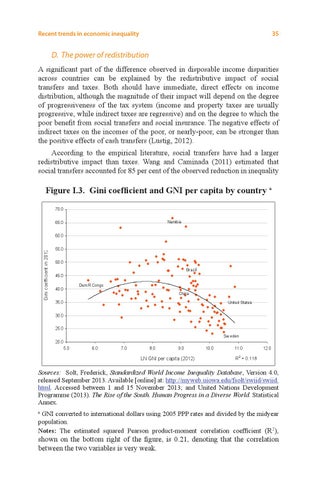
Figure I.3. Gini coefficient and GNI per capita by country a 70.0 Namibia
65.0
Gini coefficient in 2012
60.0 55.0 50.0 Brazil
45.0 Dem.R.Congo
40.0
China
35.0
United States
30.0 25.0 Sw eden 20.0 5.0
6.0
7.0
8.0
9.0
LN GNI per capita (2012)
10.0
11.0
12.0
2
R = 0.118
Sources: Solt, Frederick, Standardized World Income Inequality Database, Version 4.0, released September 2013. Available [online] at: http://myweb.uiowa.edu/fsolt/swiid/swiid. html. Accessed between 1 and 15 November 2013; and United Nations Development Programme (2013). The Rise of the South. Human Progress in a Diverse World. Statistical Annex. GNI converted to international dollars using 2005 PPP rates and divided by the midyear population. Notes: The estimated squared Pearson product-moment correlation coefficient (R2), a
shown on the bottom right of the figure, is 0.21, denoting that the correlation between the two variables is very weak.