World humanitarian data and trends 2014
World humanitarian data and trends 2014
Introduction World Humanitarian Data and Trends presents globaland country-level data-and-trend analysis about humanitarian crises and assistance. Its purpose is to consolidate this information and present it in an accessible way, providing policy-makers, researchers and humanitarian practitioners with an evidence base to support humanitarian policy decisions and provide context for operational decisions. The information presented covers two main areas: humanitarian needs and assistance in 2013, and humanitarian trends, challenges and opportunities. The report intends to provide a comprehensive picture of the global humanitarian landscape, and to highlight major trends in the nature of humanitarian crises, their drivers, and the actors that participate in prevention, response and recovery. The 2014 edition of the report builds on previous iterations of the report, providing an overview of 2013 as well as selected case studies that can be used for humanitarian advocacy. This edition also features the winner of the inaugural OCHA Data Visualization Challenge and an example of analysis using the Index for Risk Management (InfoRM). Previous editions of the report have featured a reference table showing selected indicators by country. This table will be available online to facilitate exploring the data and performing analysis. There are many gaps in the available information due to the complexity of humanitarian crises. Even the concepts of humanitarian needs and assistance are flexible. There are also inherent biases in the information. For example, assistance provided by communities and by local and national Governments is less likely to be reported. The outcomes and impact of assistance are difficult to measure and rarely reported. Funding data is more available than other types of information. There are also limitations on the availability and quality of data. Further information on limitations is provided in the ‘User’s Guide’. The data presented in this report is from a variety of source organizations with the mandate, resources and expertise to collect and compile relevant data, as well as OCHA-managed processes and tools, such as the inter-agency appeal process and the Financial Tracking Service (FTS). All the data presented in this report is publically available through the source
iv
organizations. Further information on data sources is provided in the ‘User’s Guide’. World Humanitarian Data and Trends is an initiative of the Policy Analysis and Innovation Section of OCHA’s Policy Development and Studies Branch. This report is just one part of OCHA’s efforts to improve data and analysis on humanitarian situations worldwide and build a humanitarian data community. This edition of the report was developed with internal and external partners, whose contributions are listed in the ‘Sources and References’ section. OCHA extends its sincere gratitude to all those partners for their time, expertise and contributions.
Interpreting the visuals and data The report uses many visual representations of humanitarian data and trends. There is also some limited narrative text and analysis, which provides basic orientation and helps to guide individual interpretation. However, there may be multiple ways to interpret the same information. The ‘User’s Guide’ contains more detailed methodological information and specific technical notes for each figure. Readers are encouraged to refer to the technical notes for more detailed descriptions of decisions and assumptions made in presenting the data. For the latest information on needs and funding requirements for current inter-agency appeals, see www.unocha.org/cap/ or fts.unocha.org/.
Accessing the data All the data presented in this report can be downloaded from www.unocha.org/ and through the Humanitarian Data Exchange (https://data.hdx.rwlabs.org/).
Contents Highlights
2
The year in review – 2013
5
Humanitarian assistance in 2013 Overall funding, capacity and reporting
6
Humanitarian needs – inter-agency appeals, funding and visibility Inter-agency appeal analysis; public awareness
8
Humanitarian needs – sector funding Funding per sector; CERF contributions per sector
12
Conflict in 2013 Overall numbers of refugees, IDPs and asylum seekers; number of political conflicts; urban violence
14
Natural disasters in 2013 Overall trends in natural disasters; number of affected people; cost of disasters 16 Global challenges and risks Migration; global demographics; health; technology; energy; poverty
18
Trends, challenges and opportunities
21
Delivering in conflict situations – Syria
22
Foreign military assets in support of humanitarian operations – Philippines
27
Gender-equality programming – the information gap
28
Adapting to complex emergencies – Yemen
30
Languages – the communication challenge
32
Remote-sensing technology in humanitarian situations
34
Social media and natural disasters
36
Mobile phones in disaster response – Bangladesh
40
Humanitarian assistance – a multiplicity of systems
42
InfoRM – uses in risk analysis
45
Humanitarian Data Visualization Challenge 2014
51
User’s Guide
55
1
Highlights
1
The year in review – 2013
The average size of an appeal rose to $676 million, an increase of more than $200 million compared with 2012. There was also a slight increase in funding. On average, 65 per cent of humanitarian requirements were funded, compared with 62 per cent in 2012. The Syria Humanitarian Assistance Response Plan (SHARP) and the associated Regional Response Plan (RRP) received the most funding in absolute terms. However, there is a question of whether this crisis “pulled” funds away from other appeals. Excluding the SHARP and RRP from calculations, the average amount funded per appeal dropped to 61 per cent in 2013. Further, the Syria response plans received the largest amount of overall funding: 38 per cent ($3.1 billion). This amount was larger than the combined funding received by DRC, Somalia, South Sudan and Sudan. Together, these appeals had accounted for over half of funding requirements and funding provided in recent years.
20
80
18
70
16
60
14 12
50
10
40
8
30
6
20
4
10
2 0
2002 2004 2006 2008 2010 2012 2014
0
of country-page visits revealed that Somalia and South Sudan received the most attention (and ranked highly in funding). Surprisingly, the inverse correlation did not hold true: Mauritania and Niger received the least attention but just over 80 per cent of the appeals’ requirements were met. 2013 was the most dangerous year for humanitarian workers on record, with 251 security incidents recorded, affecting more than 461 aid workers. There were 45 highly violent political conflicts, mostly in Asia and Africa. By the end of the year, 51.2 million people had been forcibly displaced because of conflict, an increase of 6 million compared with 2012.
Introducing a new metric for analysis, this report attempted to calculate the level of awareness of a particular emergency. A study of the ratio of reports published in ReliefWeb compared with the number
1
2
ll the information in this section is featured in infographics A throughout the report. For specific sources, please refer to the appropriate figure as well as the ‘Sources and References’ section in the ‘User’s Guide’.
People in need (at mid-year, millions)
The crisis in Syria and the immediate region stretched the humanitarian community due to the speed and magnitude of the emergency: by the end of 2013, 2.5 million refugees in the region needed assistance, and 6.8 million people inside Syria. The ensuing two appeals resulted in the largest ever financial requirement at the time: $4.4 billion.2 Interestingly, the appeals for the Democratic Republic of the Congo (DRC) and Yemen targeted more people (14.7 million and 7.7 million respectively) than the response plans for Syria and the region.
Figure A: Trends in funding requirements and people in need
Requirements (US$ billion)
In 2013, 148.2 million people were affected by natural disasters or displaced by conflict. Protracted, conflict-driven emergencies, more so than natural emergencies, tested the humanitarian community’s capacity.
2
he 2014 Syria response plans now surpass that amount, T requiring a combined total of $6 billion.
Highlights
Trends, challenges and opportunities – enhancing cooperation and effectiveness The case studies show the increasing need for the international humanitarian community to strengthen its partnerships with local, national and regional actors to overcome operational challenges, such as language barriers. Cumulatively, there were more than 1,000 local languages spoken in the 18 countries that had an appeal in 2013. In six cases, the language of official UN correspondence did not match the country’s official language(s). Partnerships can also help to make better use of opportunities available, such as remote-sensing technology. In 2013, unmanned aerial vehicles and/ or satellites were used in 22 countries to cover a number of humanitarian situations, with at least eight agencies participating in data collection. Delivering in conflict situations and protracted crises also necessitates the use of partners to cope with increasing needs and difficult operational conditions. For example, in the aftermath of Super Typhoon Haiyan, 21 countries provided military assets, without which it would have been near impossible to provide emergency relief in those early days. Super Typhoon Haiyan was also a testing ground for the role of social media in humanitarian response: of more than 440,000 tweets, 44 per cent related to needs and donations. Delivering in a protracted crisis also highlighted the importance of partnerships to meet affected people’s needs. In Yemen, the number of organizations included in the Humanitarian Response Plan more than trebled from 25 in 2010 to 89 in 2013. The most recent year for which complete data is available is 2013. Therefore, this publication is not intended to provide information on the status of current emergencies. Despite the focus being on 2013 trends and analysis, the material included serves to track some of the root causes of today’s crises and understand the provenance of humanitarian requirements. As demands placed on the international humanitarian community continue to expand, the next couple of years present an opportunity to shape the aid world and bring cooperation and resilience to the centre of global aid and development efforts, primarily to
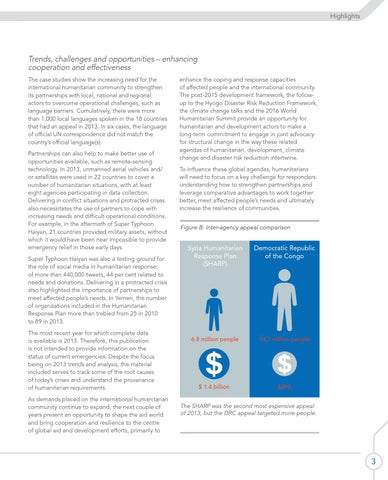
enhance the coping and response capacities of affected people and the international community. The post-2015 development framework, the followup to the Hyogo Disaster Risk Reduction Framework, the climate change talks and the 2016 World Humanitarian Summit provide an opportunity for humanitarian and development actors to make a long-term commitment to engage in joint advocacy for structural change in the way these related agendas of humanitarian, development, climate change and disaster risk reduction intertwine. To influence these global agendas, humanitarians will need to focus on a key challenge for responders: understanding how to strengthen partnerships and leverage comparative advantages to work together better, meet affected people’s needs and ultimately increase the resilience of communities. Figure B: Inter-agency appeal comparison
Syria Humanitarian Response Plan (SHARP)
Democratic Republic of the Congo
6.8 million people
14.7 million people
$ 1.4 billion
$892
The SHARP was the second most expensive appeal of 2013, but the DRC appeal targeted more people.
3
148.2 million
people were affected by natural disasters or displaced by conflict
It was the most dangerous year on record for humanitarian workers, with
Of more than 440,000 tweets posted after Super Typhoon Haiyan,
251 security
related to needs and donations.
incidents affecting
44 per cent
461 aid workers.
China had the
The 2013 Syria Humanitarian Response Plan
largest number of people affected by natural disasters (27.5 million).
was 209 times bigger than the average appeal.
Ten key facts about 2013
Somalia was
The total cost of damages due to natural disasters was
the most viewed emergency in ReliefWeb.
$118 billion.
The Syria response plans received the largest amount of overall funding: 38 per cent of appeal funding ($3.1 billion). This amount was larger than the combined funding received by DRC, Somalia, South Sudan and Sudan.
On average, 45 per cent of humanitarian projects had a gender component.
$22.2 billion
were provided in international humanitarian funding.
THE YEAR IN REVIEW – 2013
The year in review – 2013
Humanitarian assistance in 2013 In 2013, overall needs and requirements increased, putting even more strain on responders. Notwithstanding current crises, 2013 was a record year on many fronts: requirements ($12.84 billion), overall contributions ($22.2 billion), people targeted (73 million) and security incidents (251).3 In trying to meet these needs, the international community also worked to strengthen its capacity: compared with 2012, 4,000 more jobs were advertised and approximately 80 more organizations participated in inter-agency appeals.
Affected people
97 million affected people by natural disasters
51.2 million people forcibly displaced by violence and conflict
73 million
people targeted by inter-agency appeals
3
I n 2012, $8.8 billion were requested to help 62 million people at the time of the appeals’ launch. In 2012, there were 170 security incidents affecting 277 aid workers.
Sources: FTS, ReliefWeb, CRED, Aid Worker Security, Development Initiatives, IDMC.
6
Humanitarian assistance in 2013
It is still difficult to gauge the impact of international humanitarian assistance. Assistance is often measured in terms of funding, which is turned into organizational capacity to implement projects. However, there is currently no standardized reporting on the services provided or their impact, especially over the long term. Affected people are routinely helped first and foremost by their community and national responders, but this help is difficult to measure and rarely reported. Recognizing these limitations, the international community has placed renewed emphasis on the use of data to promote evidence-based policymaking and calling for information standards to better understand and meet affected people’s needs. FIGURE 1
Funding Reporting Capacity
Mine Action Gender
1,364 organizations hiring
Humanitarian Financing
International humanitarian funding $22.2 billion
Number of reports 641 257
OECD-DAC Donors
254
through ReliefWeb
$14.1 billion
(represents 10.8% of ODA)
251 aid worker security incidents in 2013 461 aid workers affected by
security incidents in 2013
Most reported themes on ReliefWeb in 2013 Protection and Human Rights Food and Nutrition Health
Number of reports 12,373
Non-DAC Donors $2.3 billion
International
23,036 jobs advertised on ReliefWeb
Least Reported themes on ReliefWeb in 2013
11,383 11,137
Private Donors $5.6 billion
702 humanitarian organizations participating in inter-agency appeals
Requirements for consolidated appeals $12.84 billion Funding for consolidated appeals $8.3 billion Per cent covered 65% Unmet requirements $4.54 billion
7
The year in review – 2013
Humanitarian needs – inter-agency appeals, funding and visibility During 2013, humanitarian organizations’ requirements increased yet again, with the crisis in Syria playing a large role in driving funding requirements upwards to new heights. The Syria response plans received the largest amount of overall funding – 38 per cent of appeal funding ($3.1 billion). This amount was larger than the combined funding received by DRC, Somalia, South Sudan and Sudan. Together, these appeals had accounted for over half of funding requirements and funding provided in recent years. The size of appeals varied widely, from $70 million for Djibouti to $2.9 billion for the Syria Regional Response Plan. The number of people targeted per appeal also varied widely, from 300,000 in Djibouti to 14.7 million in DRC. Globally, the average amount of funding received per person was $154.
Country details Country details
Funds requested/received Funds requested/received
Awareness Awareness
Afghanistan Afghanistan RequestedRequested $474m $474m Funded $349m Funded $349m 74% of requirement met 74% of requirement met Targeted people 8.8people million 8.8 million Targeted Funding per personper $40person $40 Funding
1,691
1,691
22,760
1:14
22,760
1:14
BurkinaBurkina Faso Faso RequestedRequested $139m $139m Funded $76m Funded $76m 55% of requirement met 55% of requirement met Targeted people 1.4people million 1.4 million Targeted Funding per personper $54person $54 Funding
877
4,880 877
4,880
1:6
1:6
1,997
32,056
1:17
1:17
CentralCentral AfricanAfrican Republic Republic RequestedRequested $195m $195m Funded $103m Funded $103m 53% of requirement met 53% of requirement met Targeted people 1.6people million 1.6 million Targeted Funding per personper $64person $64 Funding
1,997
32,056
Chad Chad RequestedRequested $510m $510m Funded $298m Funded $298m 58% of requirement met 58% of requirement met Targeted people 4.2people million 4.2 million Targeted Funding per personper $71person $71 Funding
1,082
7,542 1,082 1:7
7,542
1:7
Djibouti Djibouti RequestedRequested $70m $70m Funded $25m Funded $25m 36% of requirement met 36% of requirement met Targeted people 0.3people million 0.3 million Targeted Funding per personper $83person $83 Funding
Sources: FTS, ReliefWeb, inter-agency appeal documents
8
293
2,130 293 1:8
2,130 1:8
Humanitarian needs - inter-agency appeals, funding and visibility
Introducing a new metric, i.e. the ratio of reports to webpage visits, this report attempted to calculate the level of attention to different appeals. Somalia and South Sudan received the most attention (and ranked highly in funding). Surprisingly, this did not correlate to countries that received little attention. Mauritania and Niger received the least attention but the appeals had just over 80 per cent of requirements met, though these were smaller appeals. This metric is constrained in its ability to truly measure public awareness, but the overall trend indicates that while public interest can sometimes be aligned with humanitarian funding, donors’ interests can also diverge.
Country details
Funds requested/received
FIGURE 2
Awareness
Democratic Republic of the Congo Requested $893m Funded $630m 71% of requirement met Targeted people 14.7 million Funding per person $43
3,631
56,749
1:16
Haiti Requested $152m Funded $70m 46% of requirement met Targeted people 0.9 million Funding per person $78
25,678
1,341
1:20
Kenya Requested $663m Funded $370m 56% of requirement met Targeted people 1.7 million Funding per person $218
1,481
36,978
1:25
Mali Requested $477m Funded $264m 55% of requirement met Targeted people 3.9 million Funding per person $68
2,898
41,829
1:15
Amount requested
Reports published
Amount received
Webpage visits
0:0 Ratio of reports:visits
9
The year in review – 2013
Country details Country details
Funds requested/received Funds requested/received
Awareness Awareness
Mauritania Mauritania RequestedRequested $107m $107m Funded $88m Funded $88m 82% of requirement met 82% of requirement met Targeted people 0.4people million0.4 million Targeted Funding per personper $207 Funding person $207
761
761 3,378 1:5
3,378
1:5
Niger Niger RequestedRequested $355m $355m Funded $287m Funded $287m 81% of requirement met 81% of requirement met Targeted people 1.8people million1.8 million Targeted Funding per personper $158 Funding person $158
1,210
7,166 1,210 1:6
7,166
1:6
occupied Palestinian territory occupied Palestinian territory RequestedRequested $401m $401m Funded $265m Funded $265m 66% of requirement met 66% of requirement met Targeted people 1.8people million1.8 million Targeted Funding per personper $147 Funding person $147
1,663 12,611
1,663
1:8
12,611
1:8
Philippines (Mindanao ActionAction Plan) Plan) Philippines (Mindanao RequestedRequested $95m $95m Funded $53m Funded $53m 56% of requirement met 56% of requirement met Targeted people 0.5people million0.5 million Targeted Funding per personper $100 Funding person $100
3,068
3,068
1:13
39,473
39,473
1:13
Somalia Somalia RequestedRequested $1,153m $1,153m Funded $585m Funded $585m 51% of requirement met 51% of requirement met Targeted people 3.8people million3.8 million Targeted Funding per personper $154 Funding person $154
1,754
1,754
1:33
56,953
56,953
1:33
South South Sudan Sudan RequestedRequested $1,072m $1,072m Funded $773m Funded $773m 72% of requirement met 72% of requirement met Targeted people 3.0people million3.0 million Targeted Funding per personper $258 Funding person $258
2,232
2,232
1:28
Sources: FTS, ReliefWeb, inter-agency appeal documents
10
62,116
1:28
62,116
Humanitarian needs – inter-agency appeals, funding and visibility
Country details
Funds requested/received
Awareness
Sudan Requested $985m Funded $548m 56% of requirement met Targeted people 4.3 million Funding per person $127
2,755
32,351 1:12
Syria Humanitarian Assistance Response Plan (SHARP) Requested $1,409m Funded $955m 68% of requirement met Targeted people 6.8 million Funding per person $140
113,973
4,603
1:25
Syria Regional Response Plan (RRP) Requested $2,981m Funded $2,158m 72% of requirement met Targeted people 2.5 million Funding per person $874
n/a4
n/a
Yemen Requested $706m Funded $396m 56% of requirement met Targeted people 7.7 million Funding per person $51
4
11,402
928 1:13
Amount requested
Reports published
Amount received
Website views
0:0 Ratio of reports:visits
The ratio of reports : visits to the RRP cannot be calculated because it is a multi-country response and webpage visits could be duplicated.
11
The year in review – 2013
Humanitarian needs – sector funding Apart from multi-sectoral programmes, in 2013 the food assistance sector was again the sector under which the most funds were requested ($2.7 billion and $2.4 billion respectively). Emergency food aid is a vital part of humanitarian response, but there is no concrete evidence that the same levels of support are being channelled to activities that promote the long-term resilience of affected communities. In 2013, mine action received extra funding, making it the best funded sector with
Agriculture
Coordination and support services
Economic recovery and infrastructure
Education
32%
77%
33%
40%
866.5
274
540.5
14%
418.4
5%
491.8 160.9
1%
409.8 163
3%
17%
3% 14%
2% 54.5 103.4
4139.3
595.6 179
35.6 10.4
190%
64%
30%
29%
Mine action
Multi-sector
Protection/ human rights
Safety and security
Sources: FTS, inter-agency appeal documents, CERF
12
2628.9
Humanitarian needs – sector funding
190 per cent of requirements met. This was likely due to ad hoc funding for particular projects, as the sector tends to be under funded. Over the last five years, its funding average has been 44 per cent. CERF contributions comprised 6 per cent of the total funding available in 2013 ($482 million). Its largest contribution went towards shelter and non-food items (including camp management) and water and sanitation, providing 17 per cent of total funds available for each sector. FIGURE 3
Food
Health
86%
58%
2780.9
2401.9
1542.2
894.5
5% 12%
Total required in appeal 6%
65% Per cent funded
17%
17%
$8.3bn $12.84bn
452.6
682.4 283.2
693.1 333.2
42%
48%
Shelter and NIFs
Water and sanitation
KEY CERF % of total funds
Sector not specified
Total requested (US$m)
Total funded (US$m)
Percentage funded
13
The year in review – 2013
Conflict in 2013 There were 45 highly violent political conflicts in 2013. Most were intra-State conflicts in Asia and Africa. Out of three level-three emergencies in 2013, two were caused by conflict (Syria and the Central African Republic). A direct consequence of intra-State conflicts was a massive increase in the number of refugees and people forcibly displaced because of persecution, violence or human rights violations. By the end of 2013, this number totalled 51.2 million people, 33.3 million
Number of people affected by conflict
1.2 million
33.3 million
16.7 million
Asylum-seekers
IDPs
Refugees
51.2 million Number of individuals forcibly displaced because of persecution, conflict, generalized violence or human rights violations by the end of 2013
45
Highly violent political conflicts
414
Political conflicts
Sources: UNHCR, CRED, IDMC, UNODC, Heidelberg Institute for International Conflict Research, UN-Habitat, UNDP
14
Conflict in 2013
of whom were Internally Displaced Persons (IDPs). This represented a 16 per cent increase in the number of IDPs compared with last year. People now live in displacement for an average of 17 years. Globally, Syria accounted for 43 per cent of the world’s IDPs, and it surpassed Colombia as the country with the highest total number of IDPs. Over five years, Syria has also moved from being the world’s second largest refugee-hosting country to the second largest refugee-producing country. FIGURE 4
Focus on: urban violence 6.3 million Expected urban population by 2050 (66% of the world’s expected population)
Latin America
All future population growth is expected to occur in urban areas, mainly in Africa, Asia and Latin America
80%
7 out of 10
Population in Latin America living in urban areas currently, making it the most urbanized region in the world.
Number of urban residents that live in the developing world
In Latin America, citizens perceive that regular criminals are their main threat to security. This ranks above other threats, including gangs and organized crime/drug dealers.
36% Global homicide rate
Percentage of global homicide deaths that occurred in the Americas (2012)
6.2 per 100,000 people
437,000 Homicide rate in Central America
Number of global homicide deaths (2012)
24 per 100,000 people
460
Number of people that are affected by sexual violence every day in Latin America
Homicide rate in South America
16-23 per 100,000 people 30%
Urban violence is an emerging trend, potentially related to intra-State conflict. Latin America is the region with the highest incidence of urban violence stemming from regular criminal activities and gang activities, coupled with its high level of urbanization. Citizens rank insecurity as a threat to development. As a region, Central America has the world’s highest homicide rate. Such situations such as this raise the question of how can the humanitarian community support the needs of people affected by intra-city conflict?
Percentage of homicides related to organized crime/gangs in the Americas
11% Percentage by which Latin America's homicide rate grew between 2000 and 2010 Countries with the highest national-level homicide rates per 100,000 people (2012) Honduras
Venezuela
Belize
El Salvador
90.4
53.7
44.7
41.2 15
The year in review – 2013
Natural disasters in 2013 2013 witnessed roughly the same number of disasters as 2012, though the number of affected people decreased from 124.5 million in 2012 to 97 million in 2013. This number has been steadily decreasing, especially when compared with an average of 268 million people affected per year between 2002 and 2011. This may be partially attributed to preparedness work and the role of national disaster management agencies.
Number of natural disasters
Number of countries affected
Number of affected people5
Total damage
109
97 million
$118 billion
352
Top five countries by number of people affected China
27.5 million
Philippines
25.7 million
India
16.7 million
Vietnam
4.1 million
Thailand
3.5 million
Top five costliest disasters (US$ billions) Austria, Czech Republic, Germany, Hungary, Poland, Switzerland
Philippines, Vietnam, China, Taiwan
China
Canada
15.2
10.5
6.8
5.7
5.7
Floods
Super Typhoon Haiyan and storm surge
Earthquake
Floods and severe storms
Typhoon Fitow
Top three reported disasters in 2013 Sahel: food insecurity
3,275 reports
Super Typhoon Haiyan
1,856 reports
India/Nepal: floods and landslides
467 reports
5
he number of affected people includes people displaced due to natural disasters (22 million) as well T as the overall number of people requiring immediate assistance during a period of emergency.
Sources: Munich RE, ReliefWeb, EM-DAT CRED
16
China, Japan
Natural disasters in 2013
The overall number of large-scale natural disasters has slowly decreased, but disasters associated with the effects of climate change, such as storms and floods, increased by roughly 10 occurrences a year when compared with 2012. The data also showed that floods are the most reported types of disaster, whether for information, prevention or updates in a crisis.
FIGURE 5
Occurance of disaster types 184 155
148
137
106
95
84
90
25
30
29
20
16
16
2010
2011
2012
28 9 2013
Number of reports on disaster types
13,772 The increase in reporting coincides with an increase in the occurrence of floods.
10,233 7,310
7,638
7,246
4,208 3,556
7,161 5,953 3,614
4,702
2,705
2,389
1,995
2011
2012
2013
2,134
385 2010 Earthquake
Flood
Storm
Drought
17
The year in review – 2013
Global challenges and risks In the past, conflicts and natural disasters have been seen as the main drivers of humanitarian need. They are often treated as discrete events, with little analysis of the underlying causes and warning signs. In the twenty-first century, the risk landscape is changing more rapidly than ever. Global risks are recognized as increasingly central to humanitarian crises. They can make people more vulnerable and prevent them from building the resilience necessary to cope with shocks. The protracted and recurrent crises we see around the world today are a direct result of this vulnerability.
Climate change
Food security
BASELINE: 2013 was the fourth consecutive year when economic losses caused by disasters exceeded $100 billion. Climate-related disasters, primarily floods and storms, caused the displacement of over 20.7 million people.
BASELINE: Between 2010 and 2014, 805 million people were estimated to be chronically undernourished, representing a decrease of more than 100 million over the last decade.
PROJECTION: Economic losses due to natural disasters now regularly exceed $100 billion annually and are projected to double by 2030. One billion people could be displaced by climate change between now and 2050.
PROJECTION: The hunger target of the Millennium Development Goals – halving the proportion of undernourished people in developing countries by 2015 – is within reach.
Energy
Migration
BASELINE: More than 1.3 billion people still lack access to electricity, with more than 90 per cent of them located in sub-Saharan Africa and developing Asia.
BASELINE: Globally, there were 232 million international migrants in 2013. Of these, nearly 59 per cent lived in developed regions. In 2014, at least 4,077 migrants died, with approximately 75 per cent of these deaths occurring in the Mediterranean.
PROJECTION: Global energy demand is expected to rise by one-third by 2030. Electricity demand alone will increase by 70 per cent by 2035, with China and India accounting for over 50 per cent of that demand.
PROJECTION: Migration will be affected by future economic development, and as economic gaps decrease, the majority of resulting movement is likely to be short-distance and short-term.
Health
Population
BASELINE: In 2013, nearly 800 women died every day from maternal causes. Estimates indicate that one child dies every 20 seconds from a water-borne illness, such as diarrhoea.
BASELINE: The global population in 2013 was estimated to be 7.2 billion people.
PROJECTION: By 2015, malaria mortality rates are projected to decrease by 52 per cent while tuberculosis mortality rate will decrease by 50 per cent.
PROJECTION: By 2050, the global population is expected to rise to 9.6 billion people. Virtually all population growth will take place in less developed countries and among the poorest populations.
Sources: UNDP, IOM, OCHA, DESA, KPMG, World Bank, FAO, ILO, IOM, UN-MDG Gap Task Force, IPCC, IDMC, UN-Water
18
Gobal challenges and risks
FIGURE 6
Technology
Poverty and inequality
BASELINE: In 2012, 34 per cent of the global population had access to the internet, and 75 per cent had access to a mobile phone.
BASELINE: In 2010, 20.5 per cent of the global population was estimated to be living below the poverty line ($1.25 per day).
PROJECTION: By 2030, half of the world’s population will have access to the internet.
PROJECTION: By 2015, 15.5 per cent of the global population is estimated to be living in poverty. By 2030, it is estimated that 60 per cent of people will be middle class (middle class being defined as earning between $10−100 per day).
Urbanization
Water scarcity
BASELINE: In 2013, it was estimated that 54 per cent of the world’s population lived in urban areas.
BASELINE: An estimated 768 million people remain without access to an improved source of water and 2.5 billion people remain without access to improved sanitation.
PROJECTION: By 2050, 66 per cent of the world’s population could live in urban areas, adding 2.5 billion people to urban populations. India, China and Nigeria will account for 37 per cent of the projected growth of global urban population between 2014 and 2050.
PROJECTION: Global water demand is projected to increase by 55 per cent by 2050, mainly because of growing demands from manufacturing, thermal electricity generation and domestic use. By 2050, more than 40 per cent of the global population will be living in areas of severe water stress.
Youth BASELINE: In 2009, youth unemployment peaked with 75.8 million young people unemployed. In 2013, youth unemployment was estimated at 12.6 per cent of the workforce, comprising 73.4 million young people. PROJECTION: By 2018, the global youth unemployment rate is projected to rise to 12.8 per cent, with the Middle East and North Africa becoming the regions with the highest youth unemployment rate.
Decreasing concern
Increasing concern
19
TRENDS, CHALLENGES AND OPPORTUNITIES
Trends, challenges and opportunities
Trends
Delivering in conflict situations – Syria The conflict in Syria posed one of the greatest challenges to the international humanitarian community in terms of resources required for emergency relief, the speed and scale of the conflict, access to affected people and the regional implications. What began as a political protest, in line with the Arab revolutions of 2011, quickly descended into a large-scale humanitarian crisis that shows no signs of abating. Lack of access to affected people has constrained the effectiveness of relief providers, and this has highlighted the need to work with local and other partners to provide relief.
Social impact of the conflict (2011-2013) Available safe water of pre-crisis levels
Number of persons in poverty
Population in extreme poverty
54%
1/3
Number of casualties (March 2011 – April 2014)
20%
EXTREME POVERTY
ABJECT POVERTY
BELOW
MORE THAN
3/4
650,000
191,369
Population in abject poverty
50%
Number of injuries
Children enrolled in education
50%
Devaluation of Syrian Pound
Financial impact on the humanitarian community (US$ million) 374,000 298,000 228,000 141,000
542
419
676
595
2011
2012
2013
2014
SHARP
RRP
Sources: OCHA, UNHCR, World Bank, ReliefWeb, Syrian Center for Policy Research, FTS
22
Average amount requested per appeal
Delivering in conflict situations – Syria
In terms of magnitude, the Syria crisis is one of the worst on record given the sheer size of damages in the country and the effect on the region. The number of people in need inside Syria has increased by 2.6 million per year since 2012. By the end of 2013 over 54 per cent of the Syrian population lived in extreme poverty and the cost of the Syria Humanitarian Response Plan (SHARP) and the Regional Response Plan (RRP) have each increased by $1 billion in the last year. The total cost of damages to infrastructure is hard to quantify, but the Syrian conflict is testament of the positive effect that assistance from neighbours and multiple relief providers can have in supporting the Syrian people. FIGURE 7
Human Human impact impact of of the the conflict conflict 6,450,000 6,450,000 10,800,000 10,800,000
2014 2014
3,018,794 3,018,794 6,500,000 6,500,000 6,800,000 6,800,000
2013 2013
2,468,400 2,468,400 2,000,000 2,000,000 4,000,000 4,000,000
2012 2012
729,000 729,000 2011 2011
19,900 19,900
IDPs IDPs
People People in in need need inside inside Syria Syria
Refugees Refugees
Financial Financial requirements requirements for for agencies agencies in in the the region region (US$ (US$ million) million)
RRP RRP Total Total
2,981 2,981 2,118 2,118
71% 71%
Lebanon Lebanon
1,216 1,216 882 882
73% 73%
Jordan Jordan
Turkey Turkey
976 976 737 737
372 372 138 138
75% 75%
37% 37%
KEY KEY
Iraq Iraq
311 311 165 165
53% 53%
Egypt Egypt
67 67 35 35
52% 52%
Total Total Total requested requested Total funded funded Percentage funded Percentage funded
23
Trends, challenges and opportunities
Trends
Delivering in conflict situations – Syria (continued) The human impact of the conflict is staggering. Since 2012, the number of people in need in Syria has more than doubled and Syria is now the world’s largest refugee-producing nation. As of September 2014, 3 million Syrian refugees had fled to neighbouring countries and North Africa. Over 150 agencies and aid groups are working with local partners and national authorities to provide relief, but funding shortfalls impede their progress.
Regional impact at the end of 2013
Refugees
Total funding required (SHARP and RRP)
2.47 million
$4.39 billion
Regional achievements Education 314,868 Syrian refugee children enrolled in formal education
Food
Health
1,394,000 beneficiaries of food vouchers or cash assistance for food
More than 22 million people were vaccinated against polio and measles
Shelter
WASH
More than 163,000 tents and shelters distributed
792,000 individuals benefited from access to water supply networks
Core relief 1.6 million blankets and quilts distributed
Sources: UNHCR, OCHA, USAID Sources: UNHCR, OCHA, USAID
24
Delivering in conflict situations – Syria
Lebanon has received the largest number of refugees. The influx of refugees has caused strained public services and in some cases, tensions in host communities. This highlights the importance of supporting neighbouring countries in providing humanitarian relief during protracted crises.
FIGURE 8
Persons of concern in Lebanon
2014
2013
1,125,122 331
2012
242 12,936
2011
367 124
2010
141 64
851,284
Asylum Seekers
Refugees
Refugees in Lebanon
30% Are unemployed
86% Relocated to communities already hosting 66% of Lebanon's most vulnerable populations.
88% Of employed refugees are unskilled/semi-skilled. Those in the labour market are paid 40 per cent less than the minimum wage in Lebanon.
Refugees are dispersed over 1,700 locations (August 2014) Physical access to health care is a challenge for some refugees in remote areas. Access is also limited by short working hours and lack of trained health personnel. Mobile medical units are addressing this issue.
25
Trends, challenges and opportunities
Proportion of organizations reporting on Syria Trends 100% 90% Delivering in conflict situations – Syria (continued) 80%
Reporting varies widely across crises. In the case of Syria, the amount of reports published 70% on ReliefWeb about the crisis has steadily increased by approximately 1,000 since 2010 60% as the situation has deteriorated. Proportions and types of reporting organizations have 50% also changed. At the early onset of the conflict (2010), international organizations were 40% responsible for the majority of reporting. But in the early period of interest about the 30% conflict (2011), the media carried out the majority of reporting. This decreased as the 20% conflict progressed, coming full circle so that international organizations are once again the 10% top reporters on the crisis. An interesting trend relates to the reporting carried out by NGOs and governments, which has steadily increased since 2011, presumably due to 0% 2011 multiple facets2012 2013 their increased2010 involvement in addressing of the crisis.
Syria was the 9th most “googled” event of 2013, after the Boston Marathon, Super Typhoon Haiyan, the US Government Shutdown, 2014 FIFA World Cup, Chinese New Year, Australian Open, Eurovision Song Contest and Wimbledon.
Proportion of organizations reporting on Syria FIGURE 9
Proportion of reports by organization type 100% 90% 80% 100% 70% 90% 60% 80% 50% 70% 40% 60% 30% 50% 20% 40% 10% 30% 0% 20%
2010
2011
2012
2013
2010
2011
2012
2013
10% 0%
Proportion ofResearch reports by organization type Proportion organizations on Syria Academic andof Institutions reporting Government Media
Red Cross/Red Crescent Movement
Other
NGO
International Organization
100% 100% 90% 90% 80% 80% 70% 70% 60% 60% 50% 50% 40% 40% 30% 30% 20% 20% 10% 10% 0% 0%
2010 2010
2011 2011
2012 2012
Academic and Research Institutions
Government
International Organization
Media
Other
Red Cross/Red Crescent Movement
NGO
Proportion of reports by organization type
Sources: ReliefWeb, Google
26
2013 2013
100% 90%
Military assets in humanitarian operations
Foreign military assets in support of humanitarian operations – Philippines The use of foreign military assets in natural disaster relief operations is becoming commonplace. Yet it is still hard to understand their full impact. Some assets are used for immediate relief, such as evacuations, while others are used for early recovery, such as re-building infrastructure. There is also a challenge in measuring the contribution of foreign militaries. The inter-agency system normally measures humanitarian support in financial terms. However, not all activities involving the use of military assets are given a monetary value and reported to central tracking systems. Reporting is voluntary, and in most cases countries do not count military operating expenses as a separate humanitarian contribution given that these operating expenses are already covered under their national budget. Despite these challenges, the support offered by foreign militaries represents an important avenue to meet affected people’s needs.
Foreign military assets in support of humanitarian operations – Philippines
FIGURE 10
Foreign military assets in the context of Super Typhoon Haiyan Water purification to produce clean drinking water
Logistics support for the delivery of humanitarian supplies
Strategic airlifts of food, shelter, health facilities, and water purification units
Number of assets
Evacuation of disaster victims
Establishment of field hospitals Ships
Aircraft
Helicopters
27
72
29
Casualties
6,201 Operational and tactical airlift of relief supplies
UN Member States People affected that deployed assets 16 million
21
Identification of potential sites for assistance
Total cost of damages
$2 billion Fumigation of living areas to contain secondary threats like the outbreak of epidemics
Deployment of mobile medical teams to treat injuries
Engineering to assist in clearing debris, opening roads, re-establishing electricity, rehabilitating schools and assessing infastructure
Sources: OCHA, CEF-DMHA, NDRRMC
27
Trends, challenges and opportunities
Challenges
Gender-equality programming – the information gap Gender-equality programming is key to ensuring that the distinct needs and concerns of women, girls, boys and men are identified, prioritized and met. The integration of gender into the programme cycle is a critical step. This is enabled by the collection, analysis and use of sex- and age- disaggregated data and information that informs a gender- and vulnerabilityanalysis. There is, however, a gap between information collection, analysis and use despite the development of frameworks. The IASC Gender Marker is a practical tool that aims to enable analysis and good programming.
Amount committed/contributed to gender responsive projects (US$ million) 16,250 13,480
1.8 2.3 2010
12,972
2,077 144 2011
14,387
3,380 145
2,706 315 2012
Total Committed/Contributed to all projects 2a-The project is designed to contribute significantly to gender equality 2b-The principal purpose of the project is to advance gender equality
2013
Global gender marker performance by country in 2013 Code 2a
Code 2b
Total
Sudan
69%
5%
74%
South Sudan
67%
4%
71%
occupied Palestinian territory
65%
4%
69%
Mauritania
53%
13%
66%
Philippines
38%
17%
55%
Burkina Faso
49%
4%
53%
Djibouti
48%
0%
48%
Somalia
43%
4%
47%
Yemen
45%
2%
47%
Kenya
42%
4%
46%
Mali
40%
5%
45%
Zimbabwe
30%
0%
30%
Democratic Republic of the Congo
24%
2%
26%
Chad
15%
4%
19%
Niger
16%
0%
16%
Central African Republic
8%
5%
13%
Sources: FTS, ReliefWeb, IASC Gender Marker, OCHA-Yemen, Yemen Humanitarian Needs Overview and Yemen Humanitarian Response Plan
28
Gender-equality programming – the information gap
Efforts in Yemen in 2014 are an example of good practices. The commitment and leadership from the Humanitarian Country Team and OCHA, and the deployment of a GenCap Adviser resulted in a systematic increase in gender-responsive projects. Preliminary estimates for 2014 indicate that 83 per cent of projects have a gender component. In addition, the Country Team commissioned the development of a tool to support the collection of cluster-specific sex- and age-disaggregated data. Despite these advances, more efforts are needed to systematize the use of available data.
FIGURE 11
Yemen Yemen overview overview
22
People People in in need need
Gender Gender inequality inequality ranking ranking
Women Women in in need need
Gender-gap Gender-gap ranking ranking
Food Security and Agriculture
Gender-Based Violence
Health
Multi-sector
Nutrition
Protection
Shelter
Water, Sanitation and Hygiene
136 136 (last) (last)
Education
152 152 (last) (last)
Early Recovery
7.3 7.3 million million
Child Protection
14.7 14.7 million million
YY
YY
YY
N N
YY
YY
YY
YY
YY
YY
YY
Collect Collect disaggregated disaggregated data data of of people people reached reached
N N
N N
YY
YY
N N
YY
YY
YY
N N
N N
N N
Disaggregated Disaggregated data data used used in in official official documents documents
School School dropout dropout rates rates Female Female students students are are especially especially at at risk, risk, as as they they are are typically typically the the first first to to be be withdrawn withdrawn from from school school to to save save money money or or be be engaged engaged in in early early marriages. marriages. 2008 2008 Female Female 604,458 604,458
2010 2010
2011 2011
567,702 567,702
597,188 597,188
Male Male
359,743 359,743
289,600 289,600
351,746 351,746
Total Total
964,201 964,201
857,302 857,302
948,934 948,934
500,000 500,000 Number Number of of pregnant pregnant or or lactating lactating women women that that are are at at risk risk of of suffering suffering from from acute acute malnutrition. malnutrition. 1.7 1.7 million million Number Number of of female female IDPs, IDPs, migrants, migrants, refugees, refugees, returnees returnees and and host host community community members members in in Hajjah, Hajjah, Sa'ada Sa'ada and and Abyan Abyan governorates governorates affected affected by by gaps gaps in in access access to to obstetric obstetric and and new new born born care. care.
Gender-specific Gender-specific examples examples in in official official documents documents
Yes YY Yes N No N No
29
30
Sources: World Bank, DESA, UNESCO, WHO, UNHCR, OCHA (CRD, CAP, FTS, MYR), CERF, ERF, UNdata Source:
Vulnerability becomes a driver of humanitarian need, thereby increasing funding requirements.
2009-2010
OCHA presence established in Yemen. First CAP launched.
2010
President Saleh agrees to sign the Gulf Cooperation Council initiative and steps downs after 33 years in power and ten months of protests.
November
2011
2012
The Abyan Response Plan is launched to assist 320,000 of the most vulnerable people. Estimates indicate that 200,000 people were displaced from Abyan and the livelihoods of another 200,000 were destroyed.
July
2013
2014
National dialogue concludes but there continue to be bouts of fighting in Amran, Al-Dhale'e, Abyan and Shabwah Governorates. The Government intervenes in some. Since April 2013, at least 550,000 Yemeni migrants have been deported to Saudia Arabia with many of them requiring assistance upon their arrival back in country. The overall humanitarian situation remains precarious with approximately 15 million people in need of assistance.
January – June
Fighting erupts between al-Houthis and Salafis in Sa'ada Governorate, affecting 29,000 people, destroying 160 houses, six mosques, two health clinics, two schools and four water pumps.
August
The National Dialogue is launched as part of the political transition process.
March
Over the next six months, more than 90 per cent of those displaced from Abyan Governorate return home. However, their livelihoods are gone, infrastructure is destroyed, the area has been contaminated with explosive remnants of war (ERW) and there is no security or basic services.
June
Government launches an offensive against Al-Qaeda in the Arabian Peninsula.
May
More than 200,000 people have been displaced from Abyan Governorate. Many have sought shelter in schools in Aden, and the massive influx of people disrupts education and puts increased pressure on other services, such as health care, water and sanitation.
More than 100,000 people have been displaced from Abyan Governorate. The violence in the capital escalates to such an extent that the UN significantly reduces its presence.
September
Al-Qaeda in the Arabian Peninsula (AQAP) and affiliates take control of Abyan Governorate.
June
Al-Houthis (an armed group) take control of Sa'ada Governorate and become the de facto authorities.
February
Abdu Rabbu Mansour Hadi is elected as transitional president. A transitional Government of National Unity is established in line with the Gulf Cooperation Council initiative.
Uprisings against the President start in major cities. In the coming months, the Government loses control of areas outside the capital, basic services start to collapse and there is active fighting, including in the capital.
March
February
January
Trends, challenges and opportunities
Challenges
Adapting to complex emergencies – Yemen
A major trend of current protracted crises is the underlying vulnerability of a country, driven by under-development and a lack of basic services, rule of law and State authority. Yemen is an example of such a crisis. Major political upheaval began in 2011 following the Arab revolutions, but Yemen had been receiving CERF funding since 2007. More than half of the country’s population is in need, and the resumption of normal livelihoods is undermined by the collapse of basic services. In such a difficult scenario—where access is restricted, aid workers operate in volatile conditions and resources
GDP ($ billion)
Population (millions)
ERF
CERF
Mortality rate, under 5 (per 1,000 births)
School enrollment, primary (% gross)
Adult literacy rate (% of population)
Life expectancy at birth
Socio-economic indicators
CERF and ERF funding ($ million)
Number of organizations in Response Plan
Amount Funded (US$ million)
Amount Requested (US$ million)
People Targeted (million)
Yemen humanitarian response plan
Measles – number of confirmed cases
Refugees residing in Yemen
Registered IDPs
Number of people without access to healthcare (millions) Number of people without access to safe water and basic sanitation (millions)
Food insecure (millions)
Number of people in need (millions)
Humanitarian needs
2010
2011
2012
60
96.9 96.7 62 92 64
66.4
63
31.99
23.8
8.5
23.5
66
325
586
6
2,177
237,182
385,320
12.7
5
10
63.3
63
29.21
23.3
3.7
14.8
29
194
290
5
2,676
214,270
347,295
7.2
63.9
63
31.74
22.7
0.2
14.5
25
121
187
2.5
510
190,092
220,994
7.3
12.7
2013
2011
2013
35.95
24.4
9.5
18.8
Life expectancy in Yemen remains below the global average − in 2012, the global average life expectancy was 70 years old.
2012
Conflict and insecurity caused extensive damage to public health services and interrupted routine 7.7 immunization of children. Measles 702 re-emerged in epidemic proportions. 396 Overcrowding in IDP shelters, lack of clean 89 water and sanitation, and high malnutrition rates in young children increased the risk of infection.
241,288
306,614
13
10.5 Around 42.5% of Yemen's population 6.4 is food insecure.
13.1
Adapting to complex emergencies – Yemen
are scarce—the international humanitarian community has moved to adapt to continue serving affected people the best way it can. Since 2010, when an OCHA presence was established in Yemen, the number of organizations participating in the response plan has quadrupled from 25 in 2010 to more than 100 in 2014, potentially increasing the reach and scope of projects helping Yemeni people.
FIGURE 12
31
Trends, challenges and opportunities
Challenges
Languages – the communication challenge Communicating with affected communities is a challenge for international aid workers. In 2013, there was an average of 59 living languages (or dialects) spoken in countries with an appeal. In six countries (Afghanistan, Mauritania, occupied Palestinian territory, Somalia, Syria and Yemen), the language of official UN correspondence was not the same as the country’s official language(s). The language barrier also extends to oral communications, creating a need for international humanitarians to work closely with local partners to ensure that communication channels with affected communities remain open.
Syria Official language Arabic Local languages
16
occupied Palestinian territory Official language Arabic Local languages
6
Mauritania Official language Arabic Local languages
7
Haiti Official language French, Creole Local languages
3
Mali Official language French Local languages
66
Burkino Faso Official language French Local languages
69
Niger Official language French Local languages
21
Chad Official language French, Arabic Local languages
131
Central African Republic Official language French Local languages
72 Source: Ethnologue, The World Factbook, UN
32
Languages – the communication challenge Language of official UN correspondence
Local languages
English
10 languages
French
Arabic
FIGURE 13
Sudan Official language English, Arabic Local languages
75
Afghanistan Official language Persian, Pashto Local languages
40
South Sudan Official language English, Arabic Local languages
68
Philippines Official language English, Filipino Local languages
181
Yemen Official language English, Arabic Local languages
10
Djibouti Official language French, Arabic Local languages
5
Democratic Republic of the Congo
Kenya
Somalia
Official language French Local languages
Official language English, Kiswahili Local languages
Official language Somali, Arabic Local languages
212
67
13
Local languages 10 languages
Language of official UN correspondence English
French
Arabic
33
Trends, challenges and opportunities
Opportunities
Remote sensing technology in humanitarian situations The proliferation of remote sensing technologies, primarily satellites and unmanned aerial vehicles (UAVs), has resulted in their use by the humanitarian and human rights fields. In 2013, satellites and UAVs were used to primarily monitor and document events resulting from natural disasters and armed conflict. Specific humanitarian activities using remote sensing included IDP and refugee camp mapping, flood monitoring, damage assessments, conflict analysis, and response planning. Satellite imagery was used in most cases, but both technologies carry unique operational benefits and limitations. UAVs are increasingly being employed, such as in the aftermath of Super Typhoon Haiyan.
Emerging trend – Crowdsourced Mapping Whether analysing satellite imagery of a flooded area, making street maps after an earthquake, or texting and tweeting reports during a conflict to a common platform, the use of crowdsourced mapping as part of a humanitarian response continued to become increasingly mainstream in 2013. The US Government launched the Imagery to the Crowd programme to support these efforts. DigitalGlobe purchased Tomnod, a crowdsourced mapping platform. OCHA has partnered with several voluntary technical organizations, including OpenStreetMap and Standby Task Force, to create crowdsourced maps following a natural disaster.
Turkey UNITAR/UNOSAT March 31, 2013
Syria AAAS Geospatial Technologies and Human Rights August 2, 2013 UNITAR/UNOSAT June 10, 2013 July 3, 2013
Gaza UNITAR/UNOSAT December 19, 2013a
Dominican Republic
Jordan
Matternet Early 2013
UNITAR/UNOSAT August 30, 2013
Haiti Drone Adventures w/ IOM and OpenStreetMap April 1, 2013 Matternet Early 2013
Mali UNITAR/UNOSAT September 7, 2013 October 17, 2013
Nigeria UNITAR/UNOSAT November 5, 2013 Human Rights Watch May 1, 2013
Chad UNITAR/UNOSAT August 9, 2013
CAR UNITAR/UNOSAT December 14, 2013 Human Rights Watch November 26, 2013 Source: Harvard Humanitarian Initiative
34
Remote sensing technology in humanitarian situations
FIGURE 14
Iraq
Sudan
UNITAR/UNOSAT May 9, 2013 July 9, 2013
Satellite Sentinel Project Jan 2010 to present Human Rights Watch June 18, 2013 UNITAR/UNOSAT August 12, 2013 September 17, 2013
Bangladesh UNITAR/UNOSAT May 17, 2014 October 29, 2013
Myanmar UNITAR/UNOSAT May 3, 2013 August 5, 2013 Human Rights Watch April 1, 2013
South Sudan Satellite Sentinel Project Jan 2010 to present
Philippines Direct Relief, Team Rubicon November 1, 2013
UNITAR/UNOSAT March 11, 2013 December 23, 2013
UNITAR/UNOSAT September 20, 2013
Somalia UNITAR/UNOSAT July 19, 2013 September 4, 2013
Cambodia
Mozambique
UNITAR/UNOSAT October 23, 2013
UNITAR/UNOSAT January 23, 2013 February 4, 2013
Zimbabwe UNITAR/UNOSAT December 11, 2013
DRC UN-MONUSCO December 2013 to present
UAV
Satellite
Natural disaster
Natural disaster and conflict
Conflict
Other
35
Trends, challenges and opportunities
Opportunities
Social media and natural disasters Affected people’s use of social media during a crisis has become a common practice in recent years. Twitter, with its oneto-many format, is the platform of choice for many Internet users during a crisis. The infographic below presents a sample of 13 recent crises caused by natural hazards that generated over 100,000 Twitter messages or “tweets”. The information provided in the tweets, and the type of sources who tweet the most, vary widely between crises. For example, Government sources produced far more tweets during the Alberta floods (2013) in Canada than during Super Typhoon Haiyan (2013) in the Philippines. Overall, social media data is still an experimental field for humanitarian practitioners. But with a few frameworks of reference—including hashtag standardization in emergencies—the humanitarian community only stands to benefit from these technological opportunities. FIGURE 15 General General public public
36% 36%
Other Other useful useful information information
25% 25% Infrastructure Infrastructure and and utilities utilities
36% 36%
For-profit For-profit business business Caution Caution and and advice advice
News News media media
9% 9%
14% 14%
3% 3% 6% 6%
Government Government sources sources
20% Sympathy and and emotional emotional support support 20% Sympathy 7% 7%
12% 12%
15% 15% Affected Affected individuals: individuals: injured, injured, dead dead or or missing missing
Eyewitnesses Eyewitnesses NGOs NGOs
17% 17% Needs Needs and and donations donations
Authors Authors of of tweets tweets in in natural natural disasters disasters Type Type of of information information provided provided in in tweets tweets
Sources: Qatar Computing Research Institute, École Polytechnique Fédérale de Lausanne
36
Social media and natural disasters
Sympathy and emotional support
Needs and donations
Affected individuals: injured, dead, or missing
Caution and advice
Infrastructure and utilities
Other useful information
News media
Eyewitnesses
NGOs
Government sources
For-profit business
General public
FIGURE 16
18%
8%
16%
5%
8%
45%
48%
7%
5%
8%
1%
31%
14%
4%
28%
8%
5%
41%
60%
3%
4%
2%
0%
31%
18%
12%
13%
17%
5%
35%
36%
10%
5%
4%
3%
42%
12%
38%
22%
12%
8%
7%
18%
39%
13%
3%
3%
24%
24%
13%
17%
24%
4%
17%
40%
14%
6%
9%
2%
30%
15%
24%
9%
11%
22%
19%
28%
24%
9%
13%
9%
18%
17%
4%
8%
22%
8%
41%
40%
10%
5%
12%
1%
32%
52%
4%
16%
4%
7%
17%
24%
7%
3%
2%
0%
65%
9%
17%
23%
8%
19%
25%
54%
7%
7%
9%
3%
21%
19%
30%
5%
31%
4%
12%
23%
22%
17%
9%
2%
26%
10%
7%
14%
25%
14%
31%
44%
16%
4%
7%
2%
27%
29%
16%
14%
14%
6%
22%
31%
3%
4%
4%
1%
57%
19%
44%
12%
9%
2%
13%
25%
1%
10%
2%
4%
58%
Colorado wildfires, USA
2012
Guatemala earthquake Northen Italy earthquakes Manila floods, Philippines Typhoon Pablo, Philippines
Alberta floods, Canada New South Wales wildfires, Australia
2013
Bohol earthquake, Philippines Colorado floods, USA Manila floods, Philippines Queensland floods, Australia Sardinia floods, Italy Super Typhoon Yolanda, Philippines
Information provided in tweets
Authors of tweets in natural disasters
37
Trends, challenges and opportunities
Opportunities
Social media and natural disasters (continued) The Philippines has a large population active on social media. In recent emergencies, the Government has suggested using specific hashtags to make it easy to find information related to each crisis, such as #YolandaPH for Super Typhoon Haiyan in November 2013. An analysis of more than 440,000 tweets posted during the first 48 hours of this event shows that about 15 per cent of the tweets are potentially relevant to the activity that relates to different humanitarian clusters. This translates to thousands of tweets that can be sorted by digital volunteers and/or computer algorithms.
Of the 15% of tweets potentially relevant to the humanitarian community:
Overview Number of tweets in the first 48 hours
442,560 4.1%
Education and Child Welfare
18,076 tweets
RT @AdamsonUni: Classes and work at all levels are suspended today Nov 8 in anticipation of Typhoon Yolanda. Stay safe Adamsonians. #wala
3.3%
Early Recovery
14,602 tweets
Doing relief efforts now for #YolandaPH. Need free shipping line info.
1.8%
Telecommunication
8,002 tweets
MTSAT enhanced-IR satellite image of #YolandaPH as of 2:30 am 09 November 2013: http://.../ RT @govph
1.8%
Safety and Security
7,884 tweets
7000 kid's parents have been killed by the storm in the Philippines and #StayStrongJustin is trending... Ridiculous http://.../
1.1%
Food and Nutrition
4,712 tweets
Red Cross asks for help from police / military. their trucks w/ food and water for 25000 families are stopped in Tanauan
Sources: Qatar Computing Research Institute, École Polytechnique Fédérale de Lausanne
38
Social media and natural disasters
FIGURE 17
0.5%
Logistics and Transportation
2,290 tweets
RT @DepEd_PH: DSWD needs volunteers to help repack relief goods. Call DSWD-NROC at 851-2681 to schedule your shift. #YolandaPH http://.../
0.4%
Camp and Shelter
1,870 tweets
Roxas says many homes in Leyte's coastal areas destroyed: They're like matchsticks that were flung inland & talagang sira
0.3%
Water, Sanitation, and Hygiene
1,210 tweets
No potable water supply power outage & impassable roads in Leyte. Immediate needs clean water food & shelter-staff in OrmocMai #haiyan
0.2%
Health
1,008 tweets
@KarloPuerto: Davao City 911 sends rescue and medical equipment and personnel to Tacloban City #YolandaPH
Other
86.5% 382,906
39
Opportunities Trends, challenges and opportunities
Opportunities
Mobile phone data and disaster response – Bangladesh Mobile phones are becoming an increasingly important tool in disaster risk management, as they facilitate mass-alert systems and allow affected people to stay in touch with family, friends and their community. In addition to serving as a communication tool, mobile phone operators automatically record information about all mobile phones on their network. In anonymous format, this data may give valuable information on population displacement during and after a disaster, and the extent to which areas have suffered economically (through decreases in mobile spending and mobile top-ups). Cyclone Mahasen made landfall in southern Bangladesh on 16 May 2013. The infographic below depicts trends observed from mobile phone data during and after the disaster.
Large spending on airtime before Mahasen: ability to communicate is paramount in a disaster Day before Mahasen Mobile airtime purchases
Mobile phone credit top-ups peaked shortly before the cyclone made landfall, showing the importance that at-risk communities placed on being able to access communications. This could also show that as communities were warned of the impending natural disaster, as people began preparations to have access to communications.
1
8
15
22
29
6
13
April
20
27
3
10
May
17
24
June
2013
Mobile phone calling frequency peaked as the cyclone made landfall, but only in the affected areas. The increase was small in the areas predicted to be hit the hardest, but which were actually not affected.
Change of calling frequency (number of times compared to normal call patterns)
Calling frequency 12 11 10 9 8 7 6 5 4 3 2 1 0
12 11 10 9 8 7 6 5 4 3 2 1 0 5/14
5/15
5/16 DATE AND TIME
Sources: Flowminder Foundation, Grameenphone, Telenor Research, UNU-EHS and ICCCAD
40
5/17
MobileMobile phonephones data and in disaster response – Bangladesh
The Department of Disaster Management (DDM) in Bangladesh made use of mobile phone and community-driven mass-alert systems in preparations for Cyclone Mahasen. This was an example of disaster risk management, and such preparedness efforts have already yielded results in the country: in 1991, a category-four cyclone made landfall south of Chittagong killing 138,000 people. In 2007, a category-five cyclone struck south-western Bangladesh, killing 3,500 people. In 2012, DDM was established. Cyclone Mahasen, a category-one cyclone, resulted in 17 deaths in Bangladesh. Through careful planning, communities at risk were alerted in time and lives were saved. FIGURE 18
BARISAL
Population movements inPopulation risk area movements in risk areahits an area, it is When a cyclone paramount that people arearea, in it is When a cyclone hits an cyclone-resistant shelters. During paramount that people are in Cyclone Mahasen, population cyclone-resistant shelters. During movements were still population observed after Cyclone Mahasen, landfall. This could be due to people movements were still observed after staying behind to check on assets, such landfall. This could be due to people as houses or cattle heading to shelter staying behind to check on assets, such very late or seeking alternative out of as houses or cattle heading to shelter danger zones, since the cyclone changed very late or seeking alternative out of path just before landfall. danger zones, since the cyclone changed path just before landfall.
BARISAL CHITTAGONG
CHITTAGONG
Affected area Non-impacted area Affected area
Non-impacted area
41
Trends, challenges and opportunities
Opportunities
Humanitarian assistance – a multiplicity of systems Humanitarian assistance involves a multi-polarity of systems comprising Government, community, military, private sector, diaspora and the multilateral humanitarian system. To improve the effectiveness of humanitarian assistance, it is vital to develop a better understanding of these different actors or systems, including their motivation, capacity and added value, and to identify opportunities to increase cooperation, compatibility and synergies between them. The goal of such
Local NGOs
Affected people It is rarely acknowledged that affected people are often the first to meet their own needs. They have sophisticated coping mechanisms and resilience strategies following a disaster or in response to protracted crises. They rely on each other, sharing resources, creating collaborative labour forces and integrating into areas where they have been displaced.
Local NGOs and religious organizations, among others, act as early responders in many cases. They use more culturally relevant approaches to help support their communities. They also face fewer access restrictions and remain after international actors leave. One issue that curtails local NGOs’ capacity is a lack of access to funding. Many do not meet the funding criteria established by major donors. In 2013, 93 national NGOs and 22 local NGOs received international humanitarian funds, compared with 294 international NGOs.
Private sector The term “private sector” encompasses a range of institutions, from multinational corporations to national and regional industries and local businesses. In 2013, the private sector contributed $5.6 billion to global humanitarian response. Its contribution has remained constant over the last four years, totalling about a quarter of global contributions. The private sector can add significant value in meeting humanitarian needs due to its technical knowledge, access to data, and its ability to rapidly respond, provide financial support and concentrate on immediate relief and long-term investments. Per cent of overall humanitarian assistance from private donors 29%
26%
24%
25%
2010
2011
2012
2013
Meeting the needs
Non-DAC donors Non-DAC donors are increasing their humanitarian activities and contributions. They provided 14 per cent of global humanitarian funding in 2013. Per cent of overall humanitarian assistance 14% from Non-DAC donors 11% 2013 6% 6% 2012 2010
Sources: Development Initiatives, OCHA, World Bank, IRIN, Overseas Development Institute, FTS, OCHA
42
2011
Humanitarian Trends, assistance Challenges – a multiplicity and Opportunities of systems
‘interoperability’ is to optimize the response to affected people by making different networks and systems work together in a more predictable, systematic, and coordinated manner, based on their comparative advantages and capacities. This infographic is not an exhaustive list of the many actors involved in humanitarian response, but it provides an overview of some of the most common actors. FIGURE 19
Traditional donors The bulk of humanitarian contributions comes from traditional Government and multilateral donors. In 2013, OECD-DAC donors provided $14.1 billion of the overall humanitarian response ($22 billion).
Regional organizations
Per cent of overall humanitarian assistance from OECD-DAC donors 94%
95%
2010
2011
90%
Regional organizations can often respond faster than international organizations and sometimes they may be preferred from a political standpoint. They can help build and support national capacity in disaster response.
86%
2012 2013
Affected States / Host Governments More and more countries do not request international assistance, preferring to handle crises on their own through their national disaster management authorities, especially in middleincome nations. For example India’s disaster risk reduction policies are credited with reducing the number of fatalities in Tropical Cyclone Phailin in 2013, which killed 45 people.
of affected people
Military
Diaspora The diaspora plays many roles in responding to crises, including through advocacy, fundraising, and technical expertise. They are also an important provider of direct funding to affected people, as remittances to developing countries were estimated at $404 billion in 2013. They also send relief volunteers, doctors, nurses and engineers, who return to their countries to assist with the benefit of first-hand knowledge, cultural and language skills, and connections with affected people and groups.
The use of military assets in early recovery is paramount, with activities such as supporting air lifts, field hospitals and logistics. Foreign military assets are often deployed due to bilateral negotiations between Governments, or even between national militaries, based on established relationships.
43
InfoRM – uses in risk analysis
xxxxxxxxxxx
InfoRM – uses in risk analysis The Index for Risk Management (InfoRM) is a way to understand and measure the risk of humanitarian crises and how the conditions that lead to them affect sustainable development. Understanding risk—and emphasizing preparedness—is fundamental in saving lives. InfoRM is a composite index that takes into account hazards and exposures, ultimately providing a risk ranking that shows a country’s ability to cope with shocks.
Asia Asia Africa
Brunei Brunei Mauritius 10 10 6 8
8 8 6
6
4
LOWEST LOWEST RISK RISK INDEX INDEX LOWEST RISK INDEX Risk Risk index index Natural Natural hazard hazard and and exposure exposure Human Human hazard hazard and and exposure exposure Lack Lack of of coping coping capacity capacity
106
85
These figures provide an overview of the countries with the highest and lowest risk index in Africa and Asia. The graphs show a correlation between human hazards (e.g. social unrest) and an increase in the risk index. Those countries in Asia and Africa with a high-risk rating generally had continuous inter-agency appeals.
KEY KEY
46
5 4
6 43
6 43
4 22
4 22
2 1 0
2 1 0
0
0
0
Singapore Singapore Sao Tome and Principe
0
2.5 2.5
2.5 2.5
8
8
27 2
27 2
1.5 1.5 5
1.5 1.55
14 1
14 1
0.52 0.5
0.5 2 0.5
0 00
0 0 0
6
6
3
3
1
1
Qatar Qatar Seychelles 666
66 6
555
55 5
444
44 4
333
33 3
222
22 2
111
11 1
000
00 0
2010 2010 2010 Sources: InfoRM, Development Initiatives, OCHA
10
2011 2011 2011
2012 2012 2012
2013 2013 2013
2014 2014 2014
InfoRM – uses xxxxxxxxxxxxxxx in risk analysis
FIGURE 20
Afghanistan Afghanistan Afghanistan Amount of ODA received ($ billions) Amount Amount of received received billions) billions) 6.5 of ODA 6.6ODA 6.5 (US$(US$ 6.5 6.5
6.6 6.6 6.5 6.5 Amount of humanitarian aidof received ($ millions) Amount of humanitarian Amount humanitarian
aid received (US$ millions) (US$ millions) 678 aid received 894 514 489
357
12
12
12 12 10
12 12 10
10 10 8
10 10 8
8
8 6
8
8 6
678 678
894 894Inter-agency 514 514 appeal 489 489
357 357
6
6 4
6
6 4
Yes
Yes Yes appealYes Inter-agency Inter-agency appeal
Yes
4
4 2
4
4 2
2
2 0
2
2 0
0
0
0
0
Yes Yes
Yes Yes
Yes Yes
Yes Yes
Yes Yes
615.13 402.93 615.13 615.13402.93 402.93
141 141 141 Yes Yes Yes
Amount of humanitarian Amount of humanitarian Amount humanitarian aidof received ($ millions) aid received millions) aid received (US$(US$ millions) 295 436 453 281 295 295 436 436 453 453 281 281 Inter-agency appeal Inter-agency Inter-agency appeal appeal Yes Yes Yes Yes Yes Yes Yes Yes Yes Yes Yes Yes
12 12 12
12 12 12
10 10 10 8 8 8
10 10 10 8 8 8
6
6 6
6
6 6
4
4 4
4
4 4
2
2 2
2
2 2
0
0 0
0
0 0
HIGHEST HIGHEST RISK RISK INDEX INDEX
Amount of ODA received ($ billions) Amount Amount of ODA of ODA received received (US$(US$ millions) millions)
HIGHEST RISK INDEX
Yemen Yemen Yemen
Myanmar Myanmar Myanmar Amount ODA received ($ billions) Amount Amount of ODA of of ODA received received (US$(US$ millions) millions) 412.55 375.16 412.55 412.55 375.16 375.16 Amount ofhumanitarian humanitarian Amount Amount of humanitarian of received ($ millions) aid received aidaid received (US$(US$ millions) millions) 143 143 143
82 82 82
101 205 205 128 205 128 128 101 101
No No No
Inter-agency appeal Inter-agency Inter-agency appeal appeal Yes Yes Yes Yes No Yes Yes No No No No No
2014 201020112011 201120122012 201220132013 201320142014 20102010 Risk index
Natural hazard and exposure
10 10 10 9 99
10 10 10 9 99
88 77 66
88 77 66
8
55 44
5 3
2
33 22
2
33 22
1 0
11 00
1 0
11 00
8 7 6 5 4 3
7 6 4
55 44
2010 20112011 2011 20122012 2012 20132013 2013 20142014 2014 20102010 Human hazard and exposure
Lack of coping capacity
47
USER’S GUIDE
User’s Guide
User’s Guide Limitations
Technical notes
This report is intended to provide a comprehensive overview of global humanitarian data and trends. However, there are many gaps and inconsistencies in the information available. There is no single, comprehensive source of humanitarian information and data. There are no widely used standards for measuring humanitarian needs or response, even less so for measuring the longterm effectiveness of assistance. And there are no agreed definitions of humanitarian needs or assistance.
Countries
Humanitarian emergencies and their drivers are extremely complex. By definition, crises are chaotic. They arise due to the interrelationships between multiple causes, which are not easily measured or understood. Political and practical difficulties can prevent the collection and sharing of information about humanitarian needs and assistance. Humanitarian assistance involves a plethora of actors, from affected people and communities to local and national Governments, civil society and international aid organizations. Organizations account for what they do in varying ways, and the efforts of many actors are not reported at all. Some humanitarian actors may not be willing or able to share the information they collect, which often leads to biases or gaps in the information available. There are also technical limitations that affect the availability, consistency, reliability and comparability of data. There is a lack of common standards for data and sharing protocols, and statistical systems in many countries are still weak. Statistical methods, coverage, practices and definitions differ widely. Comparison between countries and across time zones involves complex technical and conceptual problems that cannot be resolved easily or unequivocally. Data coverage may not be complete because of special circumstances affecting the collection and reporting of data, such as problems arising from conflicts. These factors are more prominent in countries that are experiencing or vulnerable to major humanitarian emergencies. Because of these limitations, the data presented in this report should only be interpreted to indicate major trends and characterize major differences between emergencies and countries. Readers should consult the original sources for detailed information on the limitations of the data.
56
The term “country” refers to any territory for which authorities or other organizations report separate statistics. It does not necessarily imply political independence.
Regions and country groupings Regional groupings are based on the World Bank’s classification of major world regions: East Asia and Pacific, Europe and Central Asia, Latin America and the Caribbean, Middle East and North Africa, South Asia, and sub-Saharan Africa. Income groups are based on the World Bank’s classification (http://data.worldbank.org/about/country-classifications). Countries are divided according to annual GNI per capita, calculated using the World Bank Atlas method. In 2013, these income cut-offs are low income, US$1,045 or less; lower-middle income, $1,046–$12,746; and high income, $12,746 or more. Low-income and lower-middle-income countries are sometimes referred to as “developing countries”.
Humanitarian funding Humanitarian aid/humanitarian assistance – This includes the aid and actions designed to save lives, alleviate suffering, and maintain and protect human dignity during and following emergencies. The characteristics that separate this from other forms of assistance are 1) it is intended to be governed by the principles of humanity, neutrality, impartiality and independence; 2) it is intended to be short term in nature and provide for activities during and in the immediate aftermath of an emergency. In practice, these phases are difficult to define, especially in protracted emergencies or situations of chronic vulnerability. Humanitarian aid can also include risk reduction, preparedness activities and recovery. Humanitarian aid is given by Governments, individuals, NGOs, multilateral organizations, domestic organizations and private companies. Different actors have different definitions of “humanitarian”, and some may not differentiate humanitarian aid from other forms of assistance. For the purposes of this report, aid is considered to be humanitarian if it is reported as such by the actor that provides it.
Limitations and technical notes
Humanitarian aid contributions from Governments in this report include: 1) T he humanitarian aid expenditures as consolidated by Development Initiatives using data from the OECD DAC and FTS. The 29 OECD DAC members6 and some non-members report annually on Official Development Assistance (ODA) flows to OECD. Reports include bilateral humanitarian aid contributions plus ODA flows to multinational organizations. Data is in 2012 constant prices. 2) Funding through inter-agency appeals reported by donors to FTS. Data is in current prices. Official Development Assistance (ODA) – This comprises a grant or loan from an official source to a developing country (as defined by OECD) or multilateral agency (as defined by OECD) to promote economic development and welfare. It is reported by DAC members, along with several other Government donors and institutions, according to strict criteria. Humanitarian aid typically accounts for about 10 per cent of total ODA each year.
Humanitarian appeals To raise money for humanitarian activities, humanitarian organizations often issue appeals. Appeals may contain information on the number of people affected by emergencies and their needs, the proposed activities to respond to those needs and the funding required. To respond to ongoing crises or after a major emergency, humanitarian organizations may participate in an interagency appeal process. This brings aid organizations together to jointly plan, coordinate, implement and monitor their emergency response. At the country level, the Humanitarian Coordinator leads the process, in collaboration with the Humanitarian Country Team. Types of inter-agency appeals include:
1) Consolidated appeals, which are used when several organizations appeal together for funds for the same crisis. The consolidated appeal process (CAP) is used by aid organizations to plan, coordinate, fund, implement and monitor their activities. Consolidated appeals last for as long as necessary. An appeal can be issued for one year or more. Projects included can be planned for more than a year, but their budgets must be broken into 12-month periods. 2) Flash appeals, which are used to structure a coordinated humanitarian response for the first three to six months of an emergency. Flash appeals are issued within one week of an emergency and are triggered by the Humanitarian Coordinator in consultation with all stakeholders. The appeal provides a concise overview of urgent life-saving needs and may include recovery projects that can be implemented within the appeal’s time frame. The CAP was discontinued in September 2013, in line with the IASC Transformative Agenda. Appeals are now organized through the Humanitarian Programme Cycle, into needs assessments and strategic response plans. For the purposes of this report, inter-agency appeals that are not termed consolidated appeals or flash appeals but follow similar principles and processes are included, as well as pilot strategic response plans. See www.humanitarianresponse. info/programme-cycle/space.
Years, symbols and conventions 2013 is the most recent year for which complete data was available at the time of publication. Where 2013 data is not available, the latest year is shown and this is noted. A dash ( - ) means that data is not available or that aggregates cannot be calculated because of missing data in the years shown. 0 or 0.0 means zero or small enough that the number would round to zero at the number of decimal places shown. A billion is 1,000 million.
6 Australia, Austria, Belgium, Canada, Czech Republic, Denmark,
Finland, France, Germany, Greece, Iceland, Ireland, Italy, Japan, Korea, Luxembourg, the Netherlands, New Zealand, Norway,
Poland, Portugal, Slovak Republic, Slovenia, Spain, Sweden, Switzerland, the United Kingdom, the United States and the European institutions.
57
User’s Guide
Technical notes by figure Humanitarian assistance in 2013
Humanitarian needs – sector funding
Figure 1. The overall number of people targeted for assistance through inter-agency appeals is derived from the Overview of Global Humanitarian Assistance at Mid-Year 2013. This number is different from numbers reported in the Global Humanitarian Assistance Report 2014, FTS and the Global Overview of Humanitarian Needs 2014, as there are variations in the data used for those analyses. The number of people forcibly displaced by violence and conflict reflects the findings contained in UNHCR’s annual Global Trends Report (2013) and IDMC’s Global Estimates 2014: People internally displaced by disasters. The number of people affected by natural disasters is sourced from the Centre for Research on the Epidemiology of Disasters International Disaster Database (CRED EM-DAT). Funding figures for international humanitarian assistance reflect the findings of the Global Humanitarian Assistance Report 2014.
Figure 3. Sectors are reflective of the ‘Criteria for inclusion of reported humanitarian contributions into the Financial Tracking Service database, and for donor/appealing agency reporting to FTS’. Full descriptions of the sectors and activities are at http://fts.unocha.org/exception-docs/ AboutFTS/FTS_criteria_for_posting_contributions.pdf.
Humanitarian needs – inter-agency appeals, funding and visibility Figure 2. The numbers for this figure are derived from An Overview of Global Humanitarian Action at 2013 Mid-Year, with the exception of funding received, which was sourced from FTS. Zimbabwe is not featured in this graph to keep it consistent with its FTS classification as “other appeals” rather than a consolidated appeal. The Strategic Response Plan for Super Typhoon Haiyan (Philippines) is not included in this figure as contributions under the plan were formally recorded under 2014. It will be featured in the next iteration of the report. The amounts under ‘funding per targeted person’ were calculated by using the figures under the category ‘people to receive help’ featured in An Overview of Global Humanitarian Action at 2013 Mid-Year and funding data from FTS (data captured in August 2014). The figures for people in need for Mali are drawn from the original planning document. Original planning for the Syria Regional Response Plan predicted 3.45 million refugees by the end of 2013 and 5.3 million people to receive help. This report uses the actual number of refugees that UNHCR had registered and assisted by the end of 2013, which was 2.5 million. The level of attention an appeal receives was derived using data from ReliefWeb, namely by calculating the ratio between the number of reports published on a particular country to the number of webpage visits for that country. This metric is merely an approximation of public interest, since it is based on a single source (ReliefWeb), albeit a prime information source for humanitarian practitioners.
58
For CERF funding, logistics, support services and telecoms have been folded into the overall ‘Coordination and Support Services’ sector. Camp management funding has been folded into ‘Shelter and NFI’ based on the activities outlined in the above-mentioned criteria.
Conflict in 2013 Figure 4. The number of highly violent political conflicts is defined per the methodology used in the Conflict Barometer of the Heidelberg Institute for International Conflict Research. A political conflict is defined as “a positional difference, regarding values relevant to a society … between at least two assertive and directly involved actors” carried out through conflict measures beyond normal regulatory procedures. A highly violent political conflict (a limited war or war) is determined through five proxies: (i) weapons, (ii) personnel, (iii) casualties, (iv) refugees, and (v) IDPs and destruction. For more detailed information, see www.hiik.de/en/.
Natural disasters in 2013 Figure 5.The data in this figure is for disasters associated with natural hazards. The total number of natural disasters does not include biological disasters, such as epidemics or insect infestations. The total number of disasters differs from the CRED EM-DAT Annual Disaster Statistical Review 2013, as it was downloaded directly from the database to showcase the most up-to-date information for 2013. The rest of the overall natural hazard information is sourced from the Statistical Review. To allow for ease of comparison between the graphs that map the occurrence and reporting of natural disasters, natural hazards are classified according to the natural disaster groupings used in ReliefWeb. These are earthquakes (including tsunamis), floods (including flash floods) and storms (including extra-tropical cyclone/winter storms, severe local storms, snow avalanches, storm surges and tropical cyclones).
Technical notes by figure
Global challenges and risks Figure 6. Each baseline and predictive statistic is drawn from one or various sources. Users are encouraged to refer to the reference list and corresponding reports for the full descriptors and further statistics. The baseline statistic for poverty is for 2010. That is the last year for which the World Bank released poverty estimates (figures released in 2013).
Delivering in conflict situations – Syria Figure 7. Numbers for the graphic on ‘Human impact of the conflict’ come from planning documents, as well as UNHCR and IDMC databases. The indicators on the social impact of the conflict are derived from a 2013 UN-commissioned study carried out by the Syrian Center for Policy Research (see reference list). Per indicators in the report, “population in extreme poverty” refers to people unable to secure the most basic food and non-food items required for the survival of their households; “population in abject poverty” refers to people unable to meet their basic food needs. Poverty rates were estimated using national lower and upper poverty lines (based on poverty research from Household Income and Expenditure Surveys (HIES) in 2009) and using elasticises of the real per capita expenditure to the poverty headcount ratios until June 2013. The number of casualties reflects UN reporting from March 2011 to April 2014. The figures for the graphic on financial requirements for the region are derived from the fifth revision to the Syria Regional Response Plan (Syria RRP 5 – 2013 Final Report) and cross checked against the original planning document. The statistics focus on agency requirements. As such, there is a discrepancy in numbers between the RRP 5 and the original planning document. The original planning document included funding requirements for two Governments: Lebanon and Jordan for $449 million and $380 million respectively. These amounts were not included in the Syria RRP 5 – 2013 Final Report and consequently they are not included in this infographic. Figure 8. The number of IDPs and refugees was retrieved from UNHCR’s ‘Statistical Population’ databases. Other statistics can be found in UNHCR’s monthly updates (http://data.unhcr.org/syrianrefugees/country.php?id=122). Figure 9. The numbers of reports per organization are only approximations. Some have multiple tags and may be counted multiple times in ReliefWeb, but the numbers provide a good overview of reporting trends. For more information on Google searches and trending topics in 2013, visit www.google.com/trends/.
Foreign military assets in support of humanitarian operations – Philippines Figure 10. The total cost of damages reflects figures from April 2014, as reported by the Philippines National Disaster Risk Reduction and Management Council (NDRRMC). The actual amount reported as total damages is PhP 85,598,068,634.88, which is equivalent to $1,995,060,482.72 ($1 = 44.91 PhP). For this report, the figure has been rounded up to $2 billion. The number of foreign countries reflects only those UN Member States that provided a military asset to support the humanitarian operation. Other organizations reported a different number of countries participating in the military relief operation, but these may not have necessarily provided assets. For example, the Government of the Philippines counted 29 countries, which included military liaison officers.
Gender-equality programming – the information gap Figure 11. The dollar amounts reflect data in FTS current up to August 2014. The amounts may fluctuate as more contributions are reported. The definitions for the IASC Gender Marker are as follows: • 2A: gender mainstreaming. The project has the potential to contribute significantly to gender equality. • 2b: targeted action. The project’s principal purpose is to advance gender equality. • 1: the project has potential to contribute in some limited way to gender equality. • 0: no visible potential to contribute to gender equality. For more information, please refer to www.humanitarianresponse.info/topics/gender/page/iascgender-marker. The examples of collection and reporting of gender-disaggregated data can be found in the 2014 Yemen Humanitarian Needs Overview (HNO) and the Strategic Response Plan (SRP). The gender-inequality ranking refers to Yemen’s ranking under the Gender Inequality Index 2013 (see UNDP Human Development Report 2014). The gender-gap ranking refers to Yemen’s ranking in the Gender Gap Index (see World Economic Forum, Gender Gap Index 2013).
Adapting to complex emergencies – Yemen Figure 12. The figures under ‘humanitarian needs’, ‘funding required’ and ‘number of organizations’ are derived from the Yemen inter-agency appeal documents (midyear reviews) of various years. The exceptions are ‘data
59
User’s Guide
for refugees and IDPs’, which is drawn from UNHCR’s ‘Population Statistics’ database, and ‘amount funded’, which is drawn from FTS for the most up-to-date data (data retrieved in June 2014). CERF and ERF funding data comes from the funds’ databases. Under socioeconomic indicators, population data was retrieved from DESA’s ‘Population Division’ database and GDP from the World Bank’s database. The other socio-economic indicators were retrieved from various databases within the UNdata portal (data.un.org) and the World Bank.
Languages – the communication challenge Figure 13. The language of official UN correspondence is the working language of the UN Secretariat (French or English) used in formal communications. A country’s official language, which may differ from a national or most spoken language, is the language designed by the State authorities as having a special legal status (e.g., being enshrined in the Constitution). It is usually the language in which a Government conducts its business operations. The percentage of people who speak the official language(s) of a country also varies widely, though this information was not available at the time of printing.
Remote-sensing technology in humanitarian situations Figure 14. For further information on the data used in the infographic, please refer to the United Nations Institute for Training and Research/United Nations Operational Satellite Application Programme (UNITAR/UNOSAT), UAViators Humanitarian UAV Network, Human Rights Watch, the Satellite Sentinel Project, and the American Association for the Advancement of Science. For further information on the uses of unmanned aerial vehicles in humanitarian situations, please refer to OCHA’s Occasional Policy Paper Unmanned Aerial Vehicles in Humanitarian Response (https://docs. unocha.org/sites/dms/Documents/Unmanned%20 Aerial%20Vehicles%20in%20Humanitarian%20 Response%20OCHA%20July%202014.pdf).
60
Social media and natural disasters Figures 15, 16 and 17. For further information on the methodology used to collect and sort tweets, please refer to source material from QCRI and EPFL. For further information on the use of hashtags in emergencies, please refer to OCHA’s Think Brief Hashtag Standards for Emergencies (https://docs.unocha.org/sites/dms/ Documents/TB%20012_Hashtag%20Standards.pdf).
Mobile phones data and disaster response – Bangladesh Figure 18. Researchers from Flowminder Foundation, Grameenphone, Telenor Research, UNU-EHS and ICCCAD analysed anonymous mobile call records from Grameenphone, covering several million people in the Barisal Division and Chittagong district before and after Cyclone Mahasen. For further technical information, refer to Flowminder.
Humanitarian assistance – a multiplicity of systems Figure 19. The private sector encompasses individuals, private foundations, trusts, private companies and corporations. OCHA is currently working on a comprehensive study on humanitarian effectiveness, which will explore these various humanitarian systems in more detail. The study is expected to be launched in April 2014.
InfoRM – uses in risk analysis Figure 20 and 21. Data used in these figures is from the 2014 beta version of InfoRM. The latest results are available at www.inform-index.org. ODA and humanitarian assistance reflect the latest information available from Development Initiatives’ databases. For descriptors of ODA and humanitarian assistance, see the general technical notes in this guide.
Humanitarian Data Visualization Challenge More information about the challenge is available on OCHA’s website: www.unocha.org/what-we-do/policy/ humanitarian-data-challenge.
Data sources and references
Data sources and references This report presents a compilation of data from various sources, which are determined to be the most comprehensive and authoritative available. Much of the information is originally collected by Governments and compiled into global data sets by international organizations. Some information is collected directly by international organizations and research institutes, or gathered from other third-party sources. Below are brief descriptions of the source organizations and the data they make available. Readers are directed to those organizations for additional data and information. Active Learning Network for Accountability and Performance in Humanitarian Action (ALNAP). ALNAP conducts research on humanitarian practices and evaluation. www.alnap.org/ Center for Excellence in Disaster Management and Humanitarian Assistance (CEF-DMHA). CEF-DMHA was established to enhance civil-military coordination in international disaster management response efforts, and to advance disaster management and humanitarian assistance capability. www.cfe-dmha.org/information-resources/ lessons-learned/2013-typhoon-haiyan-philippines.html Centre for Research on the Epidemiology of Disasters International Disaster Database (CRED EM-DAT).The EMDAT disaster database contains data on over 18,000 disasters from 1900. It is compiled from various sources, including United Nations agencies, NGOs, insurance companies, research institutes and press agencies. Data in this report is based on the Annual Disaster Statistical Review 2013. www.emdat.be/. Development Initiatives (DI). DI is an independent organization providing information and analysis that supports action on poverty. The Global Humanitarian Assistance programme at DI is a leading centre of research and analysis on international financing flows to situations of humanitarian crisis. www.devinit.org/ and Global Humanitarian Assistance Report 2014 www.globalhumanitarianassistance.org/report/ gha-report-2013. École Polytechnique Fédérale de Lausanne (EPFL). EPFL is one of the two Swiss Federal Institutes of Technology. EPFL is a multi-cultural institution that stimulates interdisciplinary research and fosters partnerships with other institutions and companies, with theoretical and applied research being carried out. EPFL has more than 350 laboratories and research groups on campus. www.epfl.ch/.
Ethnologue. Ethnologue is a comprehensive reference work cataloguing all of the world’s known living languages. www.ethnologue.com/. Financial Tracking Service - United Nations Office for the Coordination of Humanitarian Affairs (OCHA FTS). FTS is a global, real-time database that records all reported international humanitarian aid, including that for NGOs and the Red Cross/Red Crescent Movement, bilateral aid, in-kind aid and private donations. FTS features a special focus on consolidated appeals and flash appeals. All FTS data is provided by donors or recipient organizations. OCHA manages FTS. fts.unocha.org. Flowminder Foundation. Flowminder Foundation aims to improve public-health outcomes by working with NGOs and Government agencies with method development, capacitybuilding, implementation and scaling of processes related to collecting, aggregating, analysing and disseminating anonymized mobile phone location data and satellite data. www.flowminder.org/. Food and Agriculture Organization of the United Nations (FAO). FAO works to raise levels of nutrition, improve agricultural productivity, improve the lives of rural populations and contribute to the growth of the world economy. It collates and disseminates a wide range of food and agricultural statistics. www.fao.org/economic/ess/ and The State of Food Insecurity in the World 2014 (www.fao.org/3/a-i4037e.pdf). Harvard Humanitarian Initiative (HHI). HHI is a Harvard University-wide centre that provides expertise in public health, medicine, social science, management and other disciplines to promote evidence-based approaches to humanitarian assistance. hhi.harvard.edu/. Heidelberg Institute for International Conflict Research (HIIK). HIIK is an independent and interdisciplinary association located at the Department of Political Science at the University of Heidelberg. HIIK is a leading authority in researching and disseminating knowledge on the emergence, course and settlement of interstate and intrastate political conflicts. hiik.de/en/index.html and Conflict Barometer 2013 (hiik.de/de/downloads/data/ downloads_2013/ConflictBarometer2013.pdf).
61
User’s Guide
Humanitarian Outcomes – Aid Worker Security Database (AWSD). AWSD records major incidents of violence against aid workers, with incident reports from 1997 through the present. aidworkersecurity.org/. Inter-agency appeal documents – OCHA. The interagency appeal process brings aid organizations together to jointly plan, coordinate, implement and monitor their response to natural disasters and complex emergencies. The appeal process results in appeal documents, which contain information on the number of people affected by emergencies, their needs and the funding required to respond to those needs. OCHA facilitates the appeal process. www.unocha.org/cap/. International Labour Organization (ILO). ILO aims to promote rights at work, encourage decent employment opportunities, enhance social protection and strengthen dialogue on workrelated issues www.ilo.org/ and Global Employment Trends for Youth 2013 (www.ilo.org/global/research/global-reports/ global-employment-trends/youth/2013/WCMS_212423/ lang--en/index.htm). Inter-governmental Panel on Climate Change (IPCC). IPCC is the international body for assessing the science related to climate change. It was established to provide policymakers with regular assessments of the scientific basis of climate change, its impacts and future risks, and options for adaptation and mitigation. http://ipcc-wg2.gov/AR5/. International Organization for Migration (IOM).IOM helps to ensure the orderly and humane management of migration, to promote international cooperation on migration issues, to assist in the search for practical solutions to migration problems and to provide humanitarian assistance to migrants in need, be they refugees, displaced people or other uprooted people. www.iom.int/cms/en/sites/iom/home. html and Fatal Journeys, Tracking Lives Lost during Migration (http://www.iom.int/files/live/sites/iom/files/pbn/docs/FatalJourneys-Tracking-Lives-Lost-during-Migration-2014.pdf). Internal Displacement Monitoring Centre (IDMC). IDMC, part of the Norwegian Refugee Council, monitors and analyses internal displacement caused by conflict, generalized violence, human rights violations and naturalhazard-induced disasters to provide policymakers across the humanitarian and development fields with independent information and analysis. www.internal-displacement.org/ and Global Estimates 2014: People displaced by disasters (www.internal-displacement.org/publications/2014/globalestimates-2014-people-displaced-by-disasters/).
62
KPMG. KPMG International operates as a network of member firms offering audit, tax and advisory services, including for Governments. See Future State 2030: the global megatrends shaping governments (www.kpmg.com/Global/ en/IssuesAndInsights/ArticlesPublications/future-stategovernment/Documents/future-state-2030-v3.pdf). Munich Re. Munich RE combines primary insurance and re-insurance, specializing in risk management. www.munichre.com/en/homepage/index.html. Organisation for Economic Co-operation and Development’s Development Assistance Committee (OECD DAC). OECD DAC is a forum for selected OECD member states to discuss issues surrounding aid, development and poverty reduction. OECD DAC provides comprehensive data on the volume, origin and types of aid and other resource flows to over 180 aid recipients. www.oecd.org/dac/stats/idsonline. ReliefWeb. ReliefWeb provides reliable disaster and crisis updates and analysis to humanitarians, so they can make informed decisions and plan effective assistance. http://labs.reliefweb.int/. Qatar Computing Research Institute (QCRI). QCRI conducts innovative, multidisciplinary applied computing research that addresses national priorities by enhancing the quality of life for citizens, enabling broader scientific discoveries and making local businesses more competitive globally. http://www.qcri.com/, Olteanu, Castillo and Vieweg 2014, Technical Report and Olteanu, Vieweg, Castillo, 2015, What to Expect When the Unexpected Happens: Social Media Communications Across Crises in Proceedings of the ACM 2015 Conference on Computer Supported Cooperative Work and Social Computing (CSCW ‘15). Syrian Center for Policy Research. The Syrian Center for Policy Research contributes to policy-oriented research in Syria, social dialogue, accountable and transparent policymaking, and the capacity-building of policy institutions in order to promote sustainable inclusive development. http://scpr-syria. org/en/ and Socioeconomic Impacts of the Syrian Crisis (http://scpr-syria.org/en/S34/%E2%80%9CSocioeconomicRoots-and-Impact-of-the-Syrian-Crisis%E2%80%9D-2013). United Nations Central Emergency Response Fund (CERF). CERF is a humanitarian fund that was established by the United Nations General Assembly in 2006 to enable more timely and reliable humanitarian assistance to people affected by natural disasters and armed conflicts. www.unocha.org/cerf/.
Data sources and references
United Nations Children’s Fund (UNICEF). UNICEF provides long-term humanitarian and development assistance to children and mothers in developing countries. It tracks progress through data collection and analysis and updates global databases. See www.unicef.org/statistics/.
United Nations Human Settlements Programme (UN-HABITAT). UN-Habitat promotes socially and environmentally sustainable towns and cities. It collects, analyses and disseminates human settlements statistics. www.unhabitat.org/stats/.
United Nations Department of Economic and Social Affairs (UNDESA). DESA promotes development and works on issues including poverty reduction, population, macroeconomic policy, development finance and sustainable development. It generates and compiles a wide range of data and information on development issues. http://unstats.un.org/unsd/ • The State of the Global Partnership for Development - MDG Gap Task Force Report 2014 (www.un.org/en/development/ desa/publications/mdg-gap-task-force-report-2014.html), • World Urbanization Prospects, 2014 Revision (www.un.org/en/development/desa/publications/2014revision-world-urbanization-prospects.html), • Report of the Secretary-General on International Migration and Development A/69/207 (http://daccess-dds-ny. un.org/doc/UNDOC/GEN/N14/488/55/PDF/N1448855. pdf?OpenElement), • the International Migration Report 2013 (www.un.org/en/ development/desa/population/publications/migration/ migration-report-2013.shtml), • Technical Paper 2013/6: Global Migration – Demographic Aspects and its Relevance for Development (www.un.org/en/development/desa/population/events/ pdf/expert/19/EGM.Skeldon_17.12.2013.pdf).
United Nations Office on Drugs and Crime (UNODC). UNODC is mandated to assist Member States in their struggle against illicit drugs, crime and terrorism. UNODC works through field-based technical cooperation projects; research and analytical work to increase knowledge and understanding of drugs and crime issues; and normative work to assist States in the ratification and implementation of the relevant international treaties. www.unodc.org/ and www.unodc.org/unodc/en/data-and-analysis/statistics/ index.html.
United Nations Development Programme (UNDP). UNDP supports countries to reach their development objectives and internationally agreed goals, including the Millennium Development Goals. It collects, analyses and disseminates human development data, including through the preparation of the Human Development Index and its components. http://hdr.undp.org/en/statistics/, Disaster Risk Reduction makes development sustainable (www.undp.org/content/ dam/undp/library/crisis%20prevention/UNDP_CPR_ CTA_20140901.pdf) and Human Development Report 2014 (http://hdr.undp.org/en/content/human-developmentreport-2014). United Nations High Commissioner for Refugees (UNHCR). UNHCR is mandated to lead and coordinate international action to protect refugees and resolve refugee problems worldwide. It provides data and statistics about people of concern to UNHCR, including refugees, asylum-seekers, returned refugees, the internally displaced and stateless people. www.unhcr.org/statistics and The Global Report 2013 (www.unhcr.org/pages/49c3646c278.html).
UN-Water. UN-Water is the United Nations inter-agency coordination mechanism for all freshwater- and sanitationrelated matters. World Water Development Report 2014 (www.unwater.org/publications/publications-detail/ en/c/218614/). World Bank. The World Bank provides financial and technical assistance to developing countries. It provides access to a comprehensive set of data about all aspects of development. It also works to help developing countries improve the capacity, efficiency and effectiveness of national statistical systems. http://data.worldbank.org/, PovcalNet (http://iresearch.worldbank.org/PovcalNet/index.htm) and World Development Indicators (http://data.worldbank.org/ products/wdi). The World Factbook – Central Intelligence Agency. The World Factbook provides information on the history, people, Government, economy, geography, communications, transportation, military and transnational issues for 267 world entities. https://www.cia.gov/library/publications/the-worldfactbook/. World Food Programme (WFP). WFP is the United Nations frontline agency mandated to combat global hunger. It publishes data, including on the number of people it targets and reaches with food assistance, food-aid flows and food and commodity prices. www.wfp.org/content/wfpachievements-2013. World Health Organization (WHO). WHO is the directing and coordinating authority for health within the United Nations system. It provides access to data and analyses for monitoring the global health situation, including through its Global Health Observatory. http://apps.who.int/gho/data/.
63
OCHA Policy Publications OCHA Policy Studies • World Humanitarian Data and Trends (Annual) • Saving Lives Today and Tomorrow: Managing the Risk of Humanitarian Crises • Humanitarianism in the Network Age (including World Humanitarian Data and Trends 2012) • Coordination to Save Lives - History and Emerging Challenges • To Stay and Deliver: Good practice for humanitarians in complex security environments • OCHA Aide Memoire • Safety and Security for National Humanitarian Workers
OCHA Policy Series (Occasional Policy Papers and Think Briefs) • Hashtag Standards for Emergencies • Humanitarianism in the Age of Cyber-warfare: Towards the Principled and Secure Use of Information in Humanitarian Emergencies • Unmanned Aerial Vehicles in Humanitarian Response • Security Council Practice on the Protection of Civilians: Analysis of Key Normative Trends • Peacebuilding and Linkages with Humanitarian Action: Key Emerging Trends and Challenges • OCHA and slow-onset emergencies • OCHA Evaluations Synthesis Report • Water Scarcity and Humanitarian Action: Key Emerging Trends and Challenges • Energy Security and Humanitarian Action: Key Emerging Trends and Challenges • Climate Change and Humanitarian Action: Key Emerging Trends and Challenges • Global Challenges and their Impact on International Humanitarian Action All publications are available at www.unocha.org/about-us/publications/policy-briefs.
64
This publication was developed by the Policy Analysis and Innovation Section of OCHA’s Policy Development and Studies Branch. Managing Editor: Lilian Barajas Researcher: Brittany Card Design and layout: Broadley Design OCHA wishes to thank data-source organizations and acknowledge the contributions of staff and partners in preparing and reviewing this document. For more information, please contact: Policy Development and Studies Branch (PDSB) United Nations Office for the Coordination of Humanitarian Affairs (OCHA) E-mail: ochapolicy@un.org Š 2015 United Nations ISBN: 978-92-1-132041-1 eISBN 978-92-1-057127-2
ISBN 978-92-1-132041-1