Highlights
1
The year in review – 2013
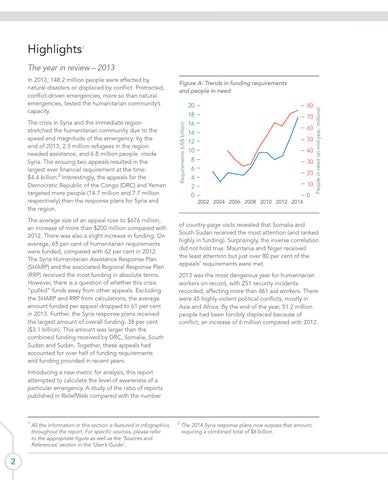
The average size of an appeal rose to $676 million, an increase of more than $200 million compared with 2012. There was also a slight increase in funding. On average, 65 per cent of humanitarian requirements were funded, compared with 62 per cent in 2012. The Syria Humanitarian Assistance Response Plan (SHARP) and the associated Regional Response Plan (RRP) received the most funding in absolute terms. However, there is a question of whether this crisis “pulled” funds away from other appeals. Excluding the SHARP and RRP from calculations, the average amount funded per appeal dropped to 61 per cent in 2013. Further, the Syria response plans received the largest amount of overall funding: 38 per cent ($3.1 billion). This amount was larger than the combined funding received by DRC, Somalia, South Sudan and Sudan. Together, these appeals had accounted for over half of funding requirements and funding provided in recent years.
20
80
18
70
16
60
14 12
50
10
40
8
30
6
20
4
10
2 0
2002 2004 2006 2008 2010 2012 2014
0
of country-page visits revealed that Somalia and South Sudan received the most attention (and ranked highly in funding). Surprisingly, the inverse correlation did not hold true: Mauritania and Niger received the least attention but just over 80 per cent of the appeals’ requirements were met. 2013 was the most dangerous year for humanitarian workers on record, with 251 security incidents recorded, affecting more than 461 aid workers. There were 45 highly violent political conflicts, mostly in Asia and Africa. By the end of the year, 51.2 million people had been forcibly displaced because of conflict, an increase of 6 million compared with 2012.
Introducing a new metric for analysis, this report attempted to calculate the level of awareness of a particular emergency. A study of the ratio of reports published in ReliefWeb compared with the number
1
2
ll the information in this section is featured in infographics A throughout the report. For specific sources, please refer to the appropriate figure as well as the ‘Sources and References’ section in the ‘User’s Guide’.
People in need (at mid-year, millions)
The crisis in Syria and the immediate region stretched the humanitarian community due to the speed and magnitude of the emergency: by the end of 2013, 2.5 million refugees in the region needed assistance, and 6.8 million people inside Syria. The ensuing two appeals resulted in the largest ever financial requirement at the time: $4.4 billion.2 Interestingly, the appeals for the Democratic Republic of the Congo (DRC) and Yemen targeted more people (14.7 million and 7.7 million respectively) than the response plans for Syria and the region.
Figure A: Trends in funding requirements and people in need
Requirements (US$ billion)
In 2013, 148.2 million people were affected by natural disasters or displaced by conflict. Protracted, conflict-driven emergencies, more so than natural emergencies, tested the humanitarian community’s capacity.
2
he 2014 Syria response plans now surpass that amount, T requiring a combined total of $6 billion.