Trends, challenges and opportunities
Opportunities
Humanitarian assistance – a multiplicity of systems Humanitarian assistance involves a multi-polarity of systems comprising Government, community, military, private sector, diaspora and the multilateral humanitarian system. To improve the effectiveness of humanitarian assistance, it is vital to develop a better understanding of these different actors or systems, including their motivation, capacity and added value, and to identify opportunities to increase cooperation, compatibility and synergies between them. The goal of such
Local NGOs
Affected people It is rarely acknowledged that affected people are often the first to meet their own needs. They have sophisticated coping mechanisms and resilience strategies following a disaster or in response to protracted crises. They rely on each other, sharing resources, creating collaborative labour forces and integrating into areas where they have been displaced.
Local NGOs and religious organizations, among others, act as early responders in many cases. They use more culturally relevant approaches to help support their communities. They also face fewer access restrictions and remain after international actors leave. One issue that curtails local NGOs’ capacity is a lack of access to funding. Many do not meet the funding criteria established by major donors. In 2013, 93 national NGOs and 22 local NGOs received international humanitarian funds, compared with 294 international NGOs.
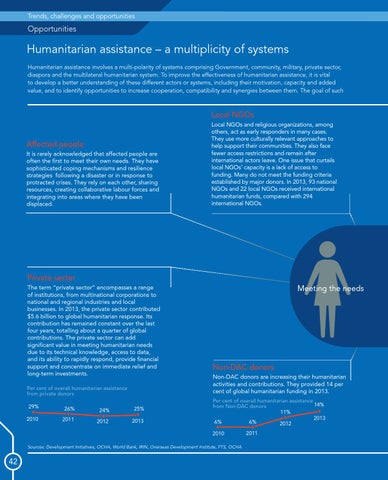
Private sector The term “private sector” encompasses a range of institutions, from multinational corporations to national and regional industries and local businesses. In 2013, the private sector contributed $5.6 billion to global humanitarian response. Its contribution has remained constant over the last four years, totalling about a quarter of global contributions. The private sector can add significant value in meeting humanitarian needs due to its technical knowledge, access to data, and its ability to rapidly respond, provide financial support and concentrate on immediate relief and long-term investments. Per cent of overall humanitarian assistance from private donors 29%
26%
24%
25%
2010
2011
2012
2013
Meeting the needs
Non-DAC donors Non-DAC donors are increasing their humanitarian activities and contributions. They provided 14 per cent of global humanitarian funding in 2013. Per cent of overall humanitarian assistance 14% from Non-DAC donors 11% 2013 6% 6% 2012 2010
Sources: Development Initiatives, OCHA, World Bank, IRIN, Overseas Development Institute, FTS, OCHA
42
2011