Opportunities Trends, challenges and opportunities
Opportunities
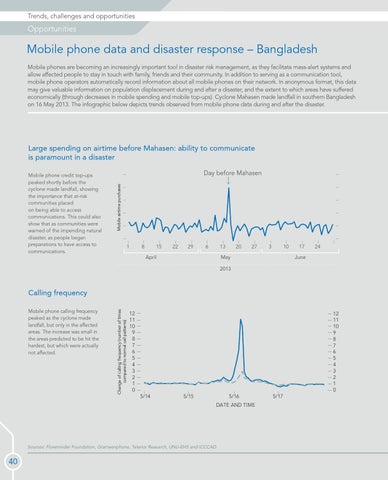
Mobile phone data and disaster response – Bangladesh Mobile phones are becoming an increasingly important tool in disaster risk management, as they facilitate mass-alert systems and allow affected people to stay in touch with family, friends and their community. In addition to serving as a communication tool, mobile phone operators automatically record information about all mobile phones on their network. In anonymous format, this data may give valuable information on population displacement during and after a disaster, and the extent to which areas have suffered economically (through decreases in mobile spending and mobile top-ups). Cyclone Mahasen made landfall in southern Bangladesh on 16 May 2013. The infographic below depicts trends observed from mobile phone data during and after the disaster.
Large spending on airtime before Mahasen: ability to communicate is paramount in a disaster Day before Mahasen Mobile airtime purchases
Mobile phone credit top-ups peaked shortly before the cyclone made landfall, showing the importance that at-risk communities placed on being able to access communications. This could also show that as communities were warned of the impending natural disaster, as people began preparations to have access to communications.
1
8
15
22
29
6
13
April
20
27
3
10
May
17
24
June
2013
Mobile phone calling frequency peaked as the cyclone made landfall, but only in the affected areas. The increase was small in the areas predicted to be hit the hardest, but which were actually not affected.
Change of calling frequency (number of times compared to normal call patterns)
Calling frequency 12 11 10 9 8 7 6 5 4 3 2 1 0
12 11 10 9 8 7 6 5 4 3 2 1 0 5/14
5/15
5/16 DATE AND TIME
Sources: Flowminder Foundation, Grameenphone, Telenor Research, UNU-EHS and ICCCAD
40
5/17