Trends, challenges and opportunities
Opportunities
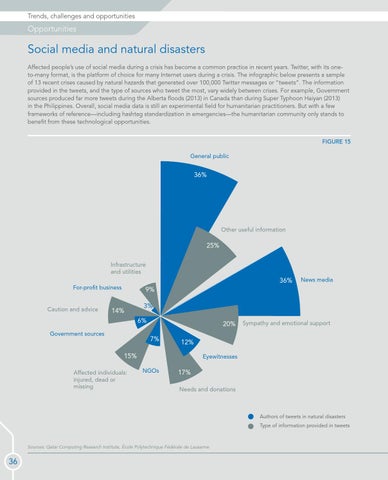
Social media and natural disasters Affected people’s use of social media during a crisis has become a common practice in recent years. Twitter, with its oneto-many format, is the platform of choice for many Internet users during a crisis. The infographic below presents a sample of 13 recent crises caused by natural hazards that generated over 100,000 Twitter messages or “tweets”. The information provided in the tweets, and the type of sources who tweet the most, vary widely between crises. For example, Government sources produced far more tweets during the Alberta floods (2013) in Canada than during Super Typhoon Haiyan (2013) in the Philippines. Overall, social media data is still an experimental field for humanitarian practitioners. But with a few frameworks of reference—including hashtag standardization in emergencies—the humanitarian community only stands to benefit from these technological opportunities. FIGURE 15 General General public public
36% 36%
Other Other useful useful information information
25% 25% Infrastructure Infrastructure and and utilities utilities
36% 36%
For-profit For-profit business business Caution Caution and and advice advice
News News media media
9% 9%
14% 14%
3% 3% 6% 6%
Government Government sources sources
20% Sympathy and and emotional emotional support support 20% Sympathy 7% 7%
12% 12%
15% 15% Affected Affected individuals: individuals: injured, injured, dead dead or or missing missing
Eyewitnesses Eyewitnesses NGOs NGOs
17% 17% Needs Needs and and donations donations
Authors Authors of of tweets tweets in in natural natural disasters disasters Type Type of of information information provided provided in in tweets tweets
Sources: Qatar Computing Research Institute, École Polytechnique Fédérale de Lausanne
36