The Statistical Annex is published on the UNODC website: http://www.unodc.org/unodc/en/ data-and-analysis/WDR-2014.html
WORLD DRUG REPORT 2014
The World Drug Report provides an annual overview of the major developments in drug markets for the various drug categories, ranging from production to trafficking, including development of new routes and modalities, as well as consumption. Chapter 1 of the World Drug Report 2014 provides a global overview of the latest developments with respect to opiates, cocaine, cannabis and amphetamines (including “ecstasy�) and the health impact of drug use. Chapter 2 zeroes in on the control of precursor chemicals used in the manufacture of illicit drugs.
WORLD DRUG REPORT
2014
Vienna International Centre, PO Box 500, 1400 Vienna, Austria Tel: +(43) (1) 26060-0, Fax: +(43) (1) 26060-5866, www.unodc.org
ISBN 978-92-1-148277-5
COVER_WDR 2014.indd 1
27/05/2014 12:30:18
UNITED NATIONS OFFICE ON DRUGS AND CRIME Vienna
World Drug Report 2014
UNITED NATIONS New York, 2014
Š United Nations, June 2014. All rights reserved worldwide. ISBN: 978-92-1-148277-5 eISBN: 978-92-1-056752-7 United Nations publication, Sales No. E.14.XI.7 This publication may be reproduced in whole or in part and in any form for educational or non-profit purposes without special permission from the copyright holder, provided acknowledgement of the source is made. The United Nations Office on Drugs and Crime (UNODC) would appreciate receiving a copy of any publication that uses this publication as a source. Suggested citation: United Nations Office on Drugs and Crime, World Drug Report 2014 (United Nations publication, Sales No. E.14.XI.7). No use of this publication may be made for resale or any other commercial purpose whatsoever without prior permission in writing from UNODC. Applications for such permission, with a statement of purpose and intent of the reproduction, should be addressed to UNODC, Research and Trend Analysis Branch. DISCLAIMER The content of this publication does not necessarily reflect the views or policies of UNODC or contributory organizations, nor does it imply any endorsement. The designations employed and the presentation of material in this publication do not imply the expression of any opinion whatsoever on the part of UNODC concerning the legal status of any country, territory or city or its authorities, or concerning the delimitation of its frontiers or boundaries. Comments on the report are welcome and can be sent to: Division for Policy Analysis and Public Affairs United Nations Office on Drugs and Crime P.O. Box 500 1400 Vienna Austria Tel.: (+43) 1 26060 0 Fax: (+43) 1 26060 5827 E-mail: wdr@unodc.org Website: www.unodc.org
iii
PREFACE
The report is being published at a key moment in the global debate on the world drug problem. A high-level review of the implementation of the Political Declaration and Plan of Action on International Cooperation towards an Integrated and Balanced Strategy to Counter the World Drug Problem was conducted in March 2014 in Vienna by the Commission on Narcotic Drugs, followed by a regular session of the Commission. These meetings provided contributions to a special session of the General Assembly on the world drug problem, which will be held in 2016. The high-level review was more than a stocktaking exercise; it provided a much-needed forum for an open, inclusive dialogue, involving not just Governments but also the scientific community, civil society and young people, on the most effective ways to counter the world drug problem. Efforts to date to implement the Political Declaration and Plan of Action have resulted in some considerable successes, including sustainable reductions in illicit drug cultivation through alternative development initiatives and welcome improvements in treatment delivery. There have also undeniably been serious setbacks, however, not least the surge in opium cultivation and production in Afghanistan, the violence associated with the illicit drug trade, and the growing instability of regions, including West and East Africa, that are already vulnerable to trafficking and to rising levels of local production and use of illicit drugs. It is clear from the discussions at the high-level review, and from the findings of the present report, that there are no simple answers to these problems. Nevertheless, the lessons we have learned are valuable and we have attained a shared understanding of a way forward. First and foremost, we have learned that sustainable success requires a balanced, cooperative, comprehensive and integrated approach, addressing both supply and demand. This was emphasized in the Joint Ministerial Statement resulting from the High Level Review, in which governments reaffirmed the international drug conventions as the health and human rights-centred cornerstone of the drug control system, and pledged to strengthen cooperation.
In addition, for the first time the report presents joint estimates by the United Nations Office on Drugs and Crime (UNODC), the World Health Organization, the Joint United Nations Programme on HIV/AIDS (UNAIDS) and the World Bank on the number of people who inject drugs and the number of people who inject drugs and are living with HIV. I welcome these cooperative efforts, which are very much in the spirit of “One United Nations� and can help countries to address the discrimination that continues to hinder access to HIV prevention, treatment and care services, particularly for people who use drugs and for those in prison. As the chair of the UNAIDS Committee of Cosponsoring Organizations this year, UNODC is committed to ensuring evidence-informed HIV interventions for all key populations. We have seen that countries that have adequately invested in harm reduction services have lowered remarkably HIV transmission among people who inject drugs. The World Drug Report 2014 also addresses another important area, namely the results achieved and the challenges the international community continues to face in controlling precursors. All drugs, whether plant-based or synthetic, require chemicals for their manufacture or processing. An international control system facilitating the legal trade of such chemicals while avoiding their diversion must be very robust, particularly as we continue to see rises in the manufacture and trafficking of synthetic drugs, which cannot be controlled through traditional supply reduction approaches such as crop eradication. Changes in the international manufacture and trade of chemicals present challenges. Evidence shows, however, that measures to control precursor chemicals have had a tangible impact in reducing their diversion for illicit manufacturing of drugs, and this must remain a key supply control strategy. The work of the International Narcotics Control Board and its cooperative mechanisms is central in this regard. The international drug conventions entrust the Board with assessing the implementation of measures to control precursors at the international level and supporting countries to strengthen efforts to prevent diversion.
A balanced approach relies on evidence-based responses, with a firm emphasis on public health, and includes measures focusing on prevention, treatment and social rehabilitation and integration.
More broadly, we must continue to enhance international cooperation, including with respect to transparent sharing of data and analysis, to help us better understand the drug problem and address the many challenges, including the related issues of violence and insecurity. This is particularly important as we move towards the special session of the General Assembly on the world drug problem in 2016. I hope the World Drug Report 2014 will serve as a tool in these efforts, providing evidence to support the international community in devising more effective policies and finding joint solutions.
There remain serious gaps in service provision, with only one in six problem drug users accessing drug dependence treatment services each year. The new set of data on access to services presented in the World Drug Report this year can support Member States in addressing this crucial area more effectively.
Yury Fedotov Executive Director United Nations Office on Drugs and Crime
WORLD DRUG REPORT 2014
The World Drug Report 2014 is aimed at helping the international community to address the toll that illicit drug production, trafficking and consumption continues to take on all our societies, by providing a global overview and analysis of developments, based on the best available data.
Acknowledgements The World Drug Report 2014 was prepared by the Research and Trend Analysis Branch, Division for Policy Analysis and Public Affairs, United Nations Office on Drugs and Crime, under the supervision of Jean-Luc Lemahieu, Director of the Division for Policy Analysis and Public Affairs, and Angela Me, Chief of the Research and Trend Analysis Branch. Core team Research and study preparation Philip Davis Kamran Niaz Thomas Pietschmann Janie Shelton Antoine Vella Graphic design and layout Suzanne Kunnen Kristina Kuttnig Data processing and mapping support Preethi Perera Umidjon Rahmonberdiev Ali Saadeddin Editing and coordination Jaya Mohan Review and comments Valuable comments and contributions were received from Conor Crean, Natascha Eichinger, Martin Raithelhuber and Justice Tettey (Laboratory and Scientific Section) and from several colleagues from the Division for Operations, the Division for Treaty Affairs and the secretariat of the International Narcotics Control Board. The Research and Trend Analysis Branch is also grateful for the valuable advice provided by the following experts: Michael A. Cala Jesus Maria GarcĂa Calleja Jonathan Caulkins Karl L. Dehne Peter Reuter Keith Sabin The report also benefited from the work and expertise of many other UNODC staff members in Vienna and around the world.
v
CONTENTS
PREFACE
iii
EXPLANATORY NOTES
vii
EXECUTIVE SUMMARY
ix
1. RECENT STATISTICS AND TREND ANALYSIS OF ILLICIT DRUG MARKETS A. Extent of drug use: global overview B. Health and social impact C. Regional trends in drug use D. Opiates: overview E. Cocaine: overview F. Cannabis: overview G. Amphetamine-type stimulants: overview H. New psychoactive substances
1 3 13 21 34 39 46 51
2. PRECURSOR CONTROL A. Introduction B. What are precursor chemicals? C. The potential vulnerability of the chemical industry to the diversion of precursor chemicals D. Response of the inter-national community E. Patterns and trends in production of, and trade and trafficking in precursor chemicals F. Key precursors used in the illicit manufacture of drugs G. Effect of precursor control on the supply of illicit drugs H. Reactions of clandestine operators facing stronger precursor controls I. Concluding remarks ANNEX I
Tables on drug cultivation, production and eradication and prevalence
55 55 56 61 64 69 80 87 93 i
ANNEX II GLOSSARY
xv xvii
WORLD DRUG REPORT 2014
Regional groupings
vii
EXPLANATORY NOTES
The boundaries and names shown and the designations used on maps do not imply official endorsement or acceptance by the United Nations. A dotted line represents approximately the line of control in Jammu and Kashmir agreed upon by India and Pakistan. The final status of Jammu and Kashmir has not yet been agreed upon by the parties. Disputed boundaries (China/India) are represented by cross hatch due to the difficulty of showing sufficient detail.
Since there is some scientific and legal ambiguity about the distinctions between “drug use”, “drug misuse” and “drug abuse”, the neutral terms “drug use” and “drug consumption” are used in this report.
The designations employed and the presentation of the material in this publication do not imply the expression of any opinion whatsoever on the part of the Secretariat of the United Nations concerning the legal status of any country, territory, city or area or of its authorities, or concerning the delimitation of its frontiers or boundaries.
References to dollars ($) are to United States dollars, unless otherwise stated.
Countries and areas are referred to by the names that were in official use at the time the relevant data were collected.
The data on population used in this report are from: United Nations, Department of Economic and Social Affairs, Population Division, World Population Prospects: The 2012 Revision.
When referring to drug use, all mentions of amphetaminetype stimulants exclude “ecstasy”. References to “tons” are to metric tons, unless otherwise stated.
The following abbreviations have been used in this Report:
ATS amphetamine-type stimulants BMK benzyl methyl ketone CICAD Inter-American Drug Abuse Control Commission (Organization of American States) EMCDDA European Monitoring Centre for Drugs and Drug Addiction Europol European Police Office
3,4-MDP-2-P 3,4-methylenedioxyphenyl-2propanone NSDUH National Survey on Drug Use and Health of the Substance Abuse and Mental Health Services Administration of the Department of Health and Human Services of the United States of America P-2-P 1-phenyl-2-propanone PEN Online Pre-Export Notification Online PICS Precursors Incident Communication
FAO Food and Agriculture Organization of the United Nations GDP gross domestic product
System PMK piperonyl methyl ketone
INCB International Narcotics Control Board
PWID people who inject drugs
ISIC International Standard Industrial Classification INCSR International Narcotics Control Strategy Report, of the United States State Department LSD lysergic acid diethylamide MDA 3,4-methylenedioxyamphetamine MDMA 3,4-methylenedioxymethamphetamine
UNAIDS Joint United Nations Programme on UN COMTRADE UNIDO UNODC WHO
HIV/AIDS United Nations Commodity Trade Statistics database United Nations Industrial Development Organization United Nations Office on Drugs and Crime World Health Organization
WORLD DRUG REPORT 2014
APAAN alpha-phenylacetoacetonitrile
ix
EXECUTIVE SUMMARY
On the basis of comprehensive information on supply, as well as the relatively limited new information on demand, it can be concluded that overall the global situation with regard to the prevalence of illicit drug use and problem drug use1 is generally stable, with the total global number of drug users increasingly commensurate with the growth of the world population. That said, each region exhibits its own peculiarities with respect to specific drugs. Polydrug use, which is generally understood as the use of two or more substances at the same time or sequentially, remains a major concern, both from a public health and a drug control perspective.
Drug use and its health and social consequences Drug use continues to exact a significant toll, with valuable human lives and productive years of many persons being lost. An estimated 183,000 (range: 95,000-226,000) drug-related deaths were reported in 2012. That figure corresponds to a mortality rate of 40.0 (range: 20.8-49.3) deaths per million among the population aged 15-64. While that estimate is lower than for 2011, the reduction can be ascribed to the lower number of deaths reported in a few countries in Asia. Globally, it is estimated that in 2012, between 162 million and 324 million people, corresponding to between 3.5 per cent and 7.0 per cent of the world population aged 15-64, had used an illicit drug — mainly a substance belonging to the cannabis, opioid, cocaine or amphetamine-type stimulants group — at least once in the previous year. The extent of problem drug use - by regular drug users and those with drug use disorders or dependence -
remains stable at between 16 million and 39 million people. However, there continues to be a gap in service provision, as in recent years, only one in six problem drug users globally have had access to or received drug dependence treatment services each year. Although the general public may perceive cannabis to be the least harmful illicit drug, there has been a noticeable increase in the number of persons seeking treatment for cannabis use disorders over the past decade, particularly in the Americas, Oceania and Europe. Nonetheless, opiates remained the most prevalent primary drug of abuse among those seeking treatment in Asia and in Europe, as did cocaine in the Americas. With regard to injecting drug use, the United Nations Office on Drugs and Crime (UNODC), the Joint United Nations Programme on HIV/AIDS (UNAIDS), the World Bank and the World Health Organization (WHO), drawing on the most recent data available, jointly estimate that the number of people who inject drugs is 12.7 million (range: 8.9 million-22.4 million). That corresponds to a prevalence of 0.27 per cent (range: 0.19-0.48 per cent) of the population aged 15-64.2 The problem is particularly stark in Eastern and South-Eastern Europe, where the rate of injecting drug use is 4.6 times higher than the global average. The sharing of used injecting equipment makes people who inject drugs particularly vulnerable to HIV and hepatitis C. It is estimated that an average of 13.1 per cent of the total number of people who inject drugs are living with HIV. UNODC, the World Bank, WHO and UNAIDS jointly arrived at a global estimate of the number of people who inject drugs living with HIV of 1.7 million persons (range: 0.9-4.8 million). That situation is particularly pronounced in two regions of the world: South-West Asia and Eastern/ South-Eastern Europe, where it is estimated that the prevalence of HIV among people who inject drugs is 28.8 and 23.0 per cent, respectively. More than half of the people who inject drugs are estimated to be living with hepatitis C. Addressing HIV among people who inject drugs, through the implementation of an evidence-based comprehensive package of nine interventions,3 as a component of what is 2
1
There is no standard definition of problem drug use. The definition may differ from country to countryand may include people who engage in the high-risk consumption of drugs, for example people who inject drugs, people who use drugs on a daily basis and/or people diagnosed with drug use disorders or as drug-dependent based on clinical criteria contained in the International Classification of Diseases (tenth revision) of the World Health Organization and the Diagnostic and Statistical Manual of Mental Disorders (fourth edition) of the American Psychiatric Association, or any similar criteria or definition that may be used.
3
These estimates reflect the most recent data available from different sources, including integrated biological and behavioural surveillance surveys, the improved coverage and quality of surveillance within countries and the increase in the number of countries reporting. Therefore, these estimates should be understood as an update of previous global estimates and not be used as a comparison for the purposes of trend analysis. WHO, UNODC, UNAIDS Technical Guide for Countries to Set Targets for Universal Access to HIV Prevention, Treatment and Care for Injecting Drug Users: 2012 Revision (Geneva, World Health Organization, 2012).
WORLD DRUG REPORT 2014
The World Drug Report provides an annual overview of the major developments in drug markets for the various drug categories, ranging from production to trafficking, including development of new routes and modalities, as well as consumption. Chapter 1 of the World Drug Report 2014 provides a global overview of the latest developments with respect to opiates, cocaine, cannabis and amphetamines (including “ecstasy”) and the health impact of drug use. Chapter 2 zeroes in on the control of precursor chemicals used in the manufacture of illicit drugs.
x
WORLD DRUG REPORT 2014
also known as “harm reduction services”, is a major component of the global response to stop the spread of HIV. Of them, the four most effective interventions for HIV prevention, treatment and care are needle and syringe programmes, opioid substitution therapy (or other evidencebased drug dependence treatment in the case of people who inject non-opioid drugs), HIV testing and counselling, and antiretroviral therapy. The coverage of the four most effective interventions is greatest in Western and Central Europe, where harm reduction interventions have been scaled up for more than a decade, leading to a decline in the number of newly diagnosed cases of HIV among people who inject drugs and of AIDS-related deaths attributed to unsafe injecting drug use. However, recent outbreaks of HIV among people who inject drugs in parts of Europe demonstrate how the HIV epidemic situation can change very rapidly in areas where services and interventions are scaled down. It is well documented that a very high percentage of people who inject drugs have a history of imprisonment. Also, both drug use and injecting drug use are highly prevalent among prison populations. The lack of access to and availability of health care, especially drug dependence treatment and HIV prevention, treatment and care services in prisons, is of major concern, since the prison population, at a minimum, should have access to services equivalent to those available to the general public. For instance, in Europe, the proportion of prisoners who had used an illicit substance during incarceration ranged from 4-56 per cent. In Europe, the financial crisis seems to have had an impact on drug use modalities, with related health and social consequences. While there are no comprehensive data available yet, two phenomena seem to have emerged in parts of Europe that have appeared in parallel to the financial crisis. First, there appears to be a shift in the pattern of drug use which sometimes results in a higher risk of harm; and secondly, there has been a reduction in coverage of harm reduction services, which, according to recently published research, has increased the likelihood of unsafe injecting behaviour, thus influencing the spread of infections such as HIV and hepatitis C.
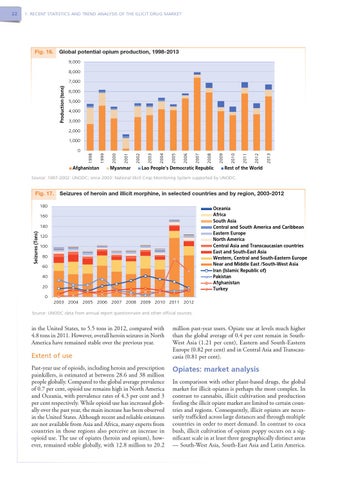
Drug profiles by category Opiates Opiates and opioids top the list of problem drugs that cause the most burden of disease and drug-related deaths worldwide. For the third consecutive year, Afghanistan, which has the world’s largest opium poppy cultivation, saw an increase in the area under cultivation (from 154,000 hectares in 2012 to 209,000 hectares in 2013). In addition, Myanmar witnessed expansion in the area of opium poppy cultivation, although less pronounced. In 2013, the estimated global production of heroin rebounded to the levels seen in 2008 and 2011.
The global area of illicit opium cultivation in 2013 stood at 296,720 hectares — the largest area since 1998, when estimates became available. There is evidence that Afghan heroin is increasingly reaching new markets, such as Oceania and South-East Asia, that had been traditionally supplied from South-East Asia. The long-established Balkan route seems to remain a corridor for the transit of Afghan heroin to the lucrative markets in Western and Central Europe, but its importance has declined due to various factors such as more effective law enforcement and a shrinking market in Western and Central Europe, as seen by the decline in opiate use and seizures in the subregion and the reduced level of supply compared with the peak levels of 2007. The so-called “southern route” is expanding, with heroin being smuggled through the area south of Afghanistan reaching Europe, via the Near and Middle East and Africa, as well as directly from Pakistan. An emerging phenomenon among opioid-dependent drug users in the United States of America is that synthetic opioids are being replaced with heroin, driven by the increased availability of heroin in parts of the United States, and lesser costs to regular users to maintain their dependency. Further, the reformulation of one of the main prescription pharmaceuticals abused, OxyContin, now makes it more difficult to snort or inject it. Following a sharp increase in 2011, global seizures of heroin and illicit morphine declined in 2012, while remaining higher than the levels of 2010 and prior years. The fluctuations were mainly driven by seizures in SouthWest Asia and Western and Central Europe. However, in 2012, there was an increase in heroin seizures in many other regions, mainly Eastern and South-Eastern Europe, South Asia and Oceania. Significantly, heroin seizures, and therefore presumably the flow of heroin, in key countries located along the “northern route” from Afghanistan to the Russian Federation, have gone down. At the same time, there is evidence of a significant number of small seizures of home made desomorphine, which is likely serving as a substitute for heroin. The emergence of potentially more harmful behaviour, including the abuse of opioids such as fentanyl, has been noted among opioid-dependent persons in Estonia, Finland and the United States. It has been observed that opioid users may alternate between pharmaceutical and/ or prescription opioids and heroin, depending on which substance is more available, accessible and cheaper in the market.
Cocaine While cocaine manufacture and trafficking have had a serious impact in the Western hemisphere, there are indications that overall global availability of cocaine has fallen. The estimated net area under coca bush cultivation as of 31 December 2012 was the lowest since the beginning of
Executive summary
In South America, cocaine consumption and trafficking have become more prominent, particularly in Brazil due to factors including its geographical location and a large urban population. In Western and Central Europe, the second largest market after the Americas, indicators of overall supply suggest a possible rebound in the availability of cocaine; retail purity has increased in some countries with sizable consumer markets. On the other hand, they do not show an increase in demand. There has even been a decline in cocaine use in some of the countries that have had higher levels of use. The market has expanded in Oceania in recent years, but the region has a different pattern of use compared with other consumer markets because it has a large body of users (a high prevalence) who use the substance with low frequency, perhaps due to the high price of cocaine.
Cannabis Cultivation and production of cannabis herb (“marijuana”) remains widespread, while production of cannabis resin (“hashish”) remains confined to a few countries in North Africa, the Middle East and South-West Asia. In Afghanistan, despite the fact that the area under cannabis cultivation has been decreasing, the potential cannabis resin production in 2012 was higher than in 2011 due to the greater yield per hectare. Global cannabis use seems to have decreased, essentially reflecting a decrease in cannabis use estimates reported by a number of countries in Western and Central Europe. However, in the United States, the lower perceived risk of cannabis use has led to an increase in its use. At the same time, more people using cannabis are seeking treatment each year.
2013
2012
2011
2010
2009
2008
2007
2006
2005
Cultivation of opium poppy Cultivation of coca bush Seizures of cocaine (base, paste, salts, "crack" and unspecified) Seizures of cannabis (marijuana and hashish) Seizures of heroin and illicit morphine Seizures of ATSª Source: Seizure data: annual report questionnaire supplemented by other official sources. Cultivation data: UNODC estimates based on national illicit crop monitoring systems supported by UNODC supplemented by other official data. a Including amphetamine, “ecstasy”-type substances, methamphetamine, non-specified ATS, other stimulants and prescription stimulants. For the categories of other stimulants and prescription stimulants, seizures reported by weight or volume only are included.
In Europe, the market has changed over the past decade, with cannabis herb produced locally or regionally now gaining ground over cannabis resin, largely sourced from Morocco, which previously was the dominant cannabis substance in Europe, as evidenced by seizure data. New regulatory frameworks in the States of Colorado and Washington in the United States and in Uruguay now make the recreational use of cannabis legal under some restrictions. The new laws also include provisions for the supply chain, including both licensed and personal cultivation. It is too early to understand the impact of these changes on recreational and problematic use of cannabis and in the broad range of areas that they may affect, including health, criminal justice, and public revenues and expenditures. It will take years of careful monitoring to understand the broader effects of those novel regulatory frameworks in order to inform future policy decisions. Based on existing research, it can be argued that with declining risk perception and increased availability, use and youth initiation may increase. Tax revenues from retail cannabis sales are expected to provide public revenue. However, expected revenue will need to be cautiously weighed against the costs of prevention and health care.
WORLD DRUG REPORT 2014
The most problematic use of cocaine is in the Americas. In North America, cocaine use has been declining since 2006, partly due to a sustained shortage. However, more recently, a slight increase in prevalence has been observed in the United States, as has an increase in maritime seizures.
2004
Cocaine use is still relatively concentrated in the Americas, Europe and Oceania, and practically all of the world’s cocaine is produced in three countries in South America. While there is no conclusive evidence with respect to the extent of cocaine use in Africa and Asia, expert opinion indicates that there may be pockets of emerging cocaine use in those two regions, related to the rise in trafficking through Africa and increased affluence in both continents.
2.8 2.6 2.4 2.2 2 1.8 1.6 1.4 1.2 1 0.8 0.6 0.4 0.2 0 2003
Global cocaine seizures increased to 671 tons in 2012, compared with the 634 tons seized in 2011. The main increase in the quantities of cocaine seized were in South America and Western and Central Europe.
Trend in main indicators of drug supply Trend in main indicators drug supply and and drug supplyofreduction, 2003drug supply reduction, 2003-2013 2013
Index (baseline 2003)
available estimates in 1990: 133,700 hectares, a decline of 14 per cent from the estimate for 2011.
xi
xii
WORLD DRUG REPORT 2014
Amphetamine-type stimulants While it is difficult to quantify the global manufacture of amphetamine-type stimulants, the number of dismantled laboratories manufacturing amphetamine-type stimulants, which were mostly manufacturing methamphetamine, continued to rise. Manufacture of methamphetamine in North America expanded once again, with a large increase in the number of methamphetamine laboratories reported dismantled in the United States and Mexico. Of the total of 144 tons of amphetamine-type stimulants seized globally, half were seized in North America and a quarter in East and South-East Asia. Large quantities of amphetamine seizures continue to be reported in the Middle East, in particular in Jordan, Saudi Arabia and the Syrian Arab Republic. Central and South-West Asia are emerging as new markets, with low levels of methamphetamine seizures and use being reported by two countries in those subregions. South-West Asia has also emerged as a significant production area for methamphetamine destined for East and South-East Asia. Production in West and Central Africa is also emerging. Seizures of “ecstasy” increased in 2012, with major quantities of “ecstasy” being seized in East and South-East Asia, followed by Europe (South-Eastern and Western and Central Europe), which together accounted for over 80 per cent of global seizures of “ecstasy”. The misuse of prescription stimulants or medications for attention-deficit hyperactivity disorder (ADHD) is not uncommon, although only a few countries report any prevalence of misuse among the general and youth population. Although misuse of prescription stimulants in other regions is not negligible, such abuse is reported mainly by countries in North and South America.
New psychoactive substances and web-based marketplaces While the Internet continues to be used as a means of drug trafficking and illicit trade in precursor chemicals, use of the so-called “dark net” has been growing. The “dark net” constitutes a virtual marketplace, which is inaccessible by web search, and where it is difficult for law enforcement authorities to identify website owners and users, as their identities remain hidden by means of sophisticated concealment methods. That makes the “dark net” a safe haven for buyers and sellers of illicit drugs, who trade principally in a digital currency (Bitcoin). While the overall proportion of drug transactions that take place in the “dark net” is unclear, the value of transactions, as well as the range of drugs available, appears to be growing. The dismantling of one prominent “dark net” site, the “Silk Road”, uncovered that the site had approximately $1.2 billion worth of total revenue from two to five years of operations. There is evidence of a niche market on the “dark net” for new psychoactive substancesas well as for
high-quality cannabis, heroin, methylenedioxymethamphetamine (MDMA) and cocaine. Finally, the proliferation of new psychoactive substances continues to pose a challenge, with the number of new psychoactive substances (348 such substances in December 2013, up from 251 in July 2012) clearly exceeding the number of psychoactive substances controlled at the international level (234 substances).
Drug-related crime Crime recorded by the authorities in relation to personal use and trafficking of drugs assessed separately has shown an increase over the period 2003-2012, in contrast to the general declining trend in property-related and violent crime. However, the proportion of drug offenders who were drug users with recorded offences for personal use has remained stable, given the increased number of users during that period. Worldwide, the large majority of drug use offences are associated with cannabis. Crime related to drug trafficking varies depending on the type of drug and the supply patterns involved in different regions. The majority of persons arrested for or suspected of drug offences are men; the involvement of women in drug offences varies according to drug type, reflecting the drugs of preference among women. The highest percentage of women arrestees or suspects can be observed in relations to crimes involving sedatives and tranquillizers (25 per cent).
Precursor control Most drugs, whether plant-based or synthetic, require chemicals to transform them into the final product. While chemicals are only one of the components required for the clandestine manufacture of plant-based drugs (heroin and cocaine), they constitute the essential components of illicitly manufactured synthetic drugs. Given the growing manufacture of synthetic drugs, the control of such chemicals, known as precursors, has emerged as a key supply control strategy because the traditional approaches, such as eradication of illicit crops and alternative development, cannot be applied to synthetic drugs. There are potential vulnerabilities in the structure of and trends in the production of and trade in chemicals that are used in the illicit manufacture of drugs. The international community has, over the years, strenghtened a control system aimed at enabling the legal trade of such chemicals while preventing their diversion into illicit manufacture. Some successes have been achieved in precursor control, but they have prompted a range of reactions from the traffickers and manufacturers of illicit drugs, which create new challenges for the international drug control system.
Executive summary
Vulnerabilities of the chemical industry to diversion of precursors
77 countries were engaged in the manufacture of precursor chemicals.
The chemical industry has seen strong growth rates and geographical shifts over the past few decades, notably the past two decades, when global production doubled and trade more than tripled. Also during that period, the bulk of production shifted to Asia, where the emerging chemical industry is now characterized by a sizeable cluster of small competing enterprises. In contrast to the past situation, when the chemical industry was dominated by large, vertically integrated conglomerates, these new developments have made the chemical industry potentially more vulnerable to the diversion of precursors.
A much larger number of countries were involved in trade in precursors. 122 countries reported exports of precursor chemicals over the period 2010-2012, while 150 countries reported imports. The largest exports of precursors were reported by countries in Asia, followed by Europe and the Americas. If only net exporting countries of precursor chemicals are considered, Asian countries account for 59 per cent of total net exports over the 2010-2012 period. Global exports in precursor chemicals rose at a rate similar to that of chemicals in general.
Response by the international community Precursor control emerged as one of the key pillars of international drug control in the United Nations Convention against Illicit Traffic in Narcotic Drugs and Psychotropic Substances of 1988. The Convention sets out specific measures for the manufacture and distribution of and international trade in a number of chemicals frequently used in the manufacture of drugs. These are listed under two categories: the more strictly controlled substances in Table I and the relatively less controlled substances in Table II. The 1988 Convention entrusts the International Narcotics Control Board with the implementation of precursor control at the international level. The system has been further enhanced by means of a number of resolutions adopted by the United Nations Commission on Narcotic Drugs, the Economic and Social Council and the General Assembly, as well as the Political Declaration adopted by the General Assembly at its twentieth special session, in 1998, and the Political Declaration and Plan of Action on International Cooperation towards an Integrated and Balanced Strategy to Counter the World Drug Problem, adopted by the General Assembly in 2009, including their related action plans. As of December 2013, 23 substances were under international control: 15 substances in Table I and 8 substances in Table II of the 1988 Convention. In March 2014, the Commission on Narcotic Drugs decided to schedule alpha-phenylacetoacetonitrile (APAAN) in Table I of the Convention.
Production and trade of precursor chemicals There is licit use and licit trade of precursors, and control includes the monitoring of the licit trade while preventing diversion. Through the analysis of information provided by countries to UNODC and international trade statistics, it can be concluded that over the period 2010-2012, some
The licit requirements for and applications of various precursors differ from country to country. The bulk (93 per cent) of the international trade in precursor chemicals, in terms of economic value, is of substances listed in Table II of the 1988 Convention. In 2012, the more strictly controlled substances in Table I accounted for only 7 per cent of international trade in precursor chemicals, or 0.04 per cent of overall international trade in chemicals, and their export growth has been far lower than for Table II substances. The most important Table I substances, in economic terms, are acetic anhydride, used in the manufacture of heroin, followed by potassium permanganate, used in the manufacture of cocaine, and pseudoephedrine, used in the manufacture of methamphetamine. The illicit trade in precursor chemicals cannot be quantified as easily as can the licit market, but information on seizures can provide some partial information on trends. Although annual seizures of precursor chemicals fluctuate greatly, the overall trend for Table I precursors seems to show an increase over the last two decades. By contrast, seizures of Table II substances, although fluctuating, have been following a stable trend overall. The regional distribution of seizures of precursors in Table I and Table II shows a concentration in the Americas, followed, depending on the time frame examined, by Europe or, in more recent years, Asia.
Impact of precursor control on drug supply Measures employed to control precursor chemicals have had a tangible impact on reducing the diversion of chemicals to the illicit manufacture of drugs, as could be observed through various methods of analysis: a) Increased volume of chemicals saved from diversion. The number of shipments stopped before being diverted increased sharply, and seizures of Table I precursors rose 12-fold from the period 1990-1992 to the period 2010-2012, the former period being the initial years of international precursor control. This may point to the effectiveness of precursor control, although it is not conclusive proof; b) High interception rates. Measuring seizures compared with the overall amount estimated to have been di-
WORLD DRUG REPORT 2014
Moreover, with more and more chemicals being traded across borders, a greater number of transit countries and the emergence of a number of chemical brokers and other intermediaries, the potential avenues for diversion of precursors to the clandestine manufacture of drugs have been increasing.
xiii
xiv
WORLD DRUG REPORT 2014
verted into illicit manufacture, show that about 15 per cent of diverted potassium permanganate (in the range of 10-28 per cent) and 15 per cent of diverted acetic anhydride (in the range of 7-22 per cent) have been intercepted over the period 2007-2012. Estimated diversions are equivalent to just 2 per cent of international trade in potassium permanganate and 0.2 per cent of international trade in acetic anhydride; c) Higher volumes of precursor seizures compared with the volume of seizures of the substances those precursors are used to manufacture. Seizures of precursors of “ecstasy”, expressed in terms of the amount of “ecstasy” they could be used to manufacture (end-product equivalent), were almost a fifth larger than “ecstasy” seizures over the period 2007-2012. Seizures of amphetamine and methamphetamine precursors calculated in terms of their end-product equivalents were more than twice as high as amphetamine and methamphetamine seizures over the same period;
New strategies by operators of drug laboratories Improved precursor controls at the global level have prompted clandestine operators of illegal laboratories to develop a number of counter-strategies. Those strategies include: •• the use of more sophisticated ways to obtain precursor chemicals •• the use of transit countries with weak control systems •• the emergence of organized criminal groups specialized in the supply of precursor chemicals •• the creation of front companies to conceal illegal imports •• the domestic diversion and subsequent smuggling of precursor chemicals to final destinations in order to bypass the international control system
d) Reduced availability of drugs due to precursor control. Three examples can be cited in which precursor control appears to have reduced the supply of precursors and led to a consequent reduction in the availability of the drug. The first is the shrinking of the market for lysergic acid diethylamide (LSD), which could be at least partly attributed to improved control of LSD precursors. The shrinking of that market is reflected in the 75 per cent decline in use of LSD among high school students in the United States over the period 1996-2013, which is highly correlated to the decreased availability of the substance. The second example is the decline in “ecstasy” use in many countries, associated with a lower purity of the substance, connected with the limited availability of that drug’s main precursor in the period 2007-2010. Thirdly, the improved control of precursors of methaqualone seems to have led to a decline in its availability and thus also its use over the past two decades;
•• the use of the Internet
e) Prices in the illicit market. While the price of acetic anhydride in the licit market fluctuated between $1 and $1.50 per litre in recent years, the price of illicit acetic anhydride in Afghanistan rose over the years, at times reaching peaks of some $430 per litre (2011), up from $8 in 2002. The price rises can be linked to improvements in precursor control. They also had an impact on the cost of heroin production. The proportion of acetic anhydride in total production costs of heroin in Afghanistan rose from 2 per cent in 2002 to 26 per cent in 2010 before falling to some 20 per cent in 2013.
Another counter-strategy is the manufacture of new psychoactive substances that can be manufactured with chemicals not under international control.
•• the misuse of pharmaceutical preparations (notably preparations containing ephedrine or pseudoephedrine) and, •• the emergence of non-scheduled precursor chemicals, including various pre-precursors that can be easily converted into the required precursors.
Thus, new pre-precursors for the manufacture of amphetamine-type stimulants have emerged in recent years, including APAAN, various esters of phenylacetic acid, 3,4-methylenedioxyphenyl-2-propanone, methyl glycidate and methylamine. Some of those substances, which are controlled only in a limited number of countries, have become major substitutes for the precursor chemicals used in the past and are now seized in greater quantities than are the internationally controlled precursors of amphetamine-type stimulants.
All of these strategies used by clandestine manufacturers create a new set of challenges for the international precursor control system. At the same time, they reflect the fact that precursor control does have an impact. There are already some instruments available at the international level to deal with the emerging problems — use of the “know-your customer” principle, the limited international special surveillance list, the Pre-Export Notifications (PEN) Online and the Precursors Incident Communication System (PICS) — but they are yet to be implemented in a number of countries. Their universal and effective implementation would be a step forward in meeting these challenges.
1
RECENT STATISTICS AND TREND ANALYSIS OF THE ILLICIT DRUG MARKET A. EXTENT OF DRUG USE: GLOBAL OVERVIEW
Fig. 2.
With respect to the different groups of substances, there has been an increase in opioid and cannabis use since 2009, whereas the use of opiates, cocaine and ATS (excluding “ecstasy”) has either remained stable or followed a decreasing trend. However, not all countries conduct national surveys on drug use, and most countries that do so conduct them only periodically, once every three to five years.
Index (baseline = 2009)
100 95
2009
2010
2011
2012
90 85 80
Cannabis Cocaine "Ecstasy"
Opiates Amphetamines Opioids
Source: Estimates based on the UNODC annual report questionnaire.
Therefore, rather than looking at the year-to-year change, it is more meaningful to take a longer-term perspective. Also, year-on-year changes in a country’s prevalence rate have only a slight impact on a region’s overall prevalence unless they occur in a country with a large population. For 2012 data, updated prevalence estimates are available for 33 countries, mostly countries of Western and Central Europe and North America, representing nearly 12 per
2012
2011
2011 2012 Annual prevalence among population age 152007 64 (percentage) 2012 2008 Annual prevalence among population age 15-64 (percentage) 2009 Annual prevalence among population age 1564 (percentage) 2010
2010 2011 2006
2009 2010 2012 2012
2008 2009 2011 2011
2006 2007 2009 2009 Annual prevalence among population age 152007 64 (percentage) 2008 2010 2010
Drug users (million)
2012 2012 2006 2008 2008
-
2011 2011 2012 2007 2007
15
2010 2010 2011 2006 2006
16
2009 2009 2010 2012
18
50
2008 2008 2009 2011
39
2007 2007 2008 2010
38
2006 2006 2007 2009
38
2009
149 100
2012 2006 2008
150
2008
155
210 200
2007
2006
172
203
Drug users (million)
211
272 250
105
324 8% 8% 315 324 324 8% 7.0% 324 315 315 300 6.7% 6.9% 315 300 7.0% 8% 7.0% 6.9% 6.9% 7.0% 300 300 324 6.7% 6.9% 300 7% 272 6.7% 6.2% 6.7% 315 300 300 7% 7% 7.0% 272 272 6.2% 6.2% 300 5.8% 5.7% 250 7% 272 6.7% 6.9%250 6.2% 242 240 5.8% 250 250 5.7% 5.7% 250 5.8% 5.8% 6% 6% 243 242 250 250 250 250 6.2% 226 6% 5.0% 5.2% 5.2% 242 240 2402115.7% 250 250 240 226 4.9% 5.2% 210 208 4.9% 5.8% 226 5.2% 4.8% 5.2% 5.7% 5.2% 226 5.2% 203 5.2% 5.0%5.0% 6% 242 5.0% 211 211 210 240211208 4.6% 4.9%4.9%4.9% 210 4.9% 208 210 203 203 200 4.9% 208 5% 5% 4.9% 4.8% 4.8% 5% 4.8% 226 203 4.6% 4.6% 5.0% 5.2% 5.2% 4.6% 4.9% 200 200 4.9% 4.8% 5% 4.6% 172 4% 4.0% 4% 4% 150 167 162 4.0% 172 172 155 4% 3.5% 3.4% 3.4% 3.6% 3.5% 150172150 153 4.0% 167 4.0% 149 162 167 167 153 3.6% 3.6% 162 155 155 162 153 3.5% 3.5% 3.5% 3.5% 3.6% 3.4% 3% 149 3.4% 155 3.5% 153 3% 3.5% 3% 4.0% 3.4% 149 3.4% 149 3.4% 3.4% 167 100 162 3.5% 3.4% 3.4% 3.6% 3.5% 3% 153 100 100 2% 2% 0.9% 2% 38 39 39 39 39 38 0.9% 0.9% 0.9% 0.9% 0.8% 50 38 2% 39 39 39 39 0.9% 0.9% 0.9% 38 0.9% 0.9% 0.8% 0.8% 390.9% 390.9% 0.9% 0.9% 0.9% 0.9% 0.9% 0.9% 39 38 39 38 39 39 39 39 0.9% 5038 50 38 0.9% 0.8% 1% 1% 1% 39 39 39 0.9% 0.9% 0.9% 0.9% 0.9%180.8%16 15 16 16 16 0.4% 0.4% 0.3% 0.3% 0.3% 0.3% 1% 16 1516 151616 1616 16 1616 16 0.4% 0.3% 0.3% 0.3% 0.3% 0.3% 0.3% 15 18 0.3% 0.3% 0.4% 0.3% 0.3% 0.3% 0.4% 160.4% 0.4% 0.4% 0.3% - 18 - 16 18 0% 0% 0% 16 16 16 0.4% 0.4% 0.3% 0.3% 0.3% 0.3% 0% 2010 2006
208
250
Drug users (million)
250
110
350
350 350
Drug users (million)
300
115
Global trends in drug use, 2006-2012
2011 2007
350
Trends in the prevalence of use of different drugs, 2009-2012
120
Globally, it is estimated that in 2012, some 243 million people (range: 162 million-324 million) corresponding to some 5.2 per cent (range: 3.5-7.0 per cent) of the world population aged 15-64 had used an illicit drug — mainly a substance belonging to the cannabis, opioid, cocaine or amphetamine-type stimulant (ATS) group — at least once in the previous year. Although the extent of illicit drug use among men and women varies from country to country and in terms of the substances used, generally, men are two to three times more likely than women to have used an illicit substance.1 While there are varying regional trends in the extent of illicit drug use, overall global prevalence of drug use is considered to be stable. Similarly, the extent of problem drug use, by regular drug users and those with drug use disorders or dependence, also remains stable, at about 27 million people (range: 16 million-39 million).
Fig. 1.
1
1
This is based on the prevalence rates of any drug use among males and females reported to the United Nations Office on Drugs and Crime (UNODC) by Member States through the annual report questionnaire.
WORLD DRUG REPORT 2014
No. of illicit drug users No of problem drug users No. of illicit of problem users Prevalence of problem drug use (percentage) No. of drug illicitusers drug users No ofNo problem drugdrug users Prevalence of illicit drug use (percentage) No. of illicit drug users No of problem drug users Prevalence of illicit drug use (percentage) Prevalence of problem drug use (percentage) Prevalence of illicit Prevalence of problem drug use (percentage) Prevalence of illicitNo drug use (percentage) Prevalence of problem drug use (percentage) No. of illicit drug users of problem drugdrug usersuse (percentage) Prevalence of illicit drug use (percentage) Prevalence of problem drug use (percentage) Source: Estimates based on the UNODC annual report questionnaire.
2
1. RECENT STATISTICS AND TREND ANALYSIS OF THE ILLICIT DRUG MARKET
Table 1.
Global estimates of users of different drugs, 2012 Number of users (millions of users)
Cannabis Opioids Opiates Cocaine ATS “Ecstasy”
Best estimate 177.63 33.04 16.37 17.24 34.40 18.75
Low 125.30 28.63 12.80 13.99 13.94 9.4
High 227.27 38.16 20.23 20.92 54.81 28.24
Prevalence (percentage) Best estimate 3.8 0.7 0.35 0.37 0.7 0.4
Low 2.7 0.6 0.28 0.30 0.3 0.2
High 4.9 0.8 0.43 0.45 1.2 0.6
Source: Estimates based on the UNODC annual report questionnaire.
Polydrug use Polydrug use is the use of two or more substances at the same time or sequentially;1 it is a common occurrence among both recreational and regular drug users2,3 in all regions. There are three distinct patterns of polydrug use: One pattern is different substances being taken together to have a cumulative or complementary effect.4,5 This pattern is commonly seen among cannabis and cocaine users, who may use the drug in combination with alcohol; other combinations are the use of heroin in combination with benzodiazepines,6 alcohol or other opioids (methadone, oxycodone, etc.) and the use of cocaine in combination with other stimulants. A second pattern is the use of a drug to offset the adverse effects of another drug, e.g., cocaine and heroin use (“speedball”), or cocaine use with other opioids,7 although in the latter case, there is also a complementary effect. 1
World Health Organization, Lexicon of Alcohol and Drug Terms (Geneva, 1994). 2 World Drug Report 2011 (United Nations publication, Sales No. E.11.X.10). 3 European Monitoring Centre for Drugs and Drug Addiction (EMCDDA), “Polydrug use: patterns and responses”, Selected issue 2009 (Lisbon, November 2009). 4 Ibid. 5 Annabel Boys, John Marsden and John Strand, “Understanding reasons for drug use amongst young people: a functional perspective”, Health Education Research, vol. 16, No. 4 (2001), pp. 457-469. 6 Markus Backmund and others, “Co-consumption of benzodiazepines in heroin users, methadone-substituted and codeine-substituted patients”, Journal of Addictive Diseases, vol. 24, No. 4 (2005).
cent of the global population aged 15-64. Therefore, the trends and global annual estimates of overall drug use and of different substances reflect only the changes in or revision of the estimates for those countries and regions.
Drug use and gender Nearly all drug use surveys indicate that men are more likely than women to use drugs such as opiates and cannabis. However the gender gap shrinks when data on the misuse of pharmaceuticals are considered. In five recently
A third pattern is observed when a drug is gradually replacing or being substituted by another drug due to changes in price or availability or because the drug is in fashion. Common examples are heroin being substituted by oxycodone, desomorphine or other opioids, as observed in various regions, or “ecstasy” being substituted by mephedrone or some other new psychoactive substance. Various studies have documented the extent of polydrug use. In a study conducted in 14 European countries in 2006, 60 per cent of cocaine users were polydrug users, of which 42 per cent used alcohol, 28 per cent used cannabis and 16 per cent used heroin.8 In another study, in the South-Eastern United States, 48.7 per cent of treatment admissions were for polydrug use, with alcohol, cocaine and cannabis being the most common substances.9 The main risks and consequences of polydrug use, for both recreational and high-risk drug users, continue to be the severe health consequences due to the increased toxicity, overdose and death. From a policy perspective, it is important to understand the patterns of polydrug use because such use invalidates the established profile and characterization of the user of a specific, single drug.
7
Francesco Leri, Julie Bruneau and Jane Stewart, “Understanding polydrug use: review of heroin and cocaine co-use”, Addiction, vol. 98, No. 1 (January 2003), pp. 7-22. 8 EMCDDA, Annual Report 2009: The State of the Drug Problem in Europe (Lisbon, November 2009), p. 42. 9 S. Kedia and others, “Mono versus polydrug abuse among publicly funded clients”, Substance Abuse Treatment, Prevention and Policy, vol. 2, 2:33 (8 November 2007).
surveyed countries (Australia, United States of America, Spain, Urban Afghanistan, and Pakistan), the illicit use of drugs is more common among men than women, but the non-medical use of pharmaceutical drugs is nearly equivalent, if not higher among women (see figure 3). Taking together the combined estimates of those five surveys, the illicit use of pharmaceuticals is notably different for the two sexes, as nearly half the women with past-year drug use had used pharmaceuticals, compared with only one third of men.
B. Health and social impact
16%
there are large regional disparities, with approximately 1 in 18 problem drug users receiving treatment in Africa (primarily for cannabis use), compared with one in five problem drug users receiving treatment in Western and Central Europe, one in four in Oceania, and one in three in North America.
14%
Drug-related deaths
12%
Drug-related death3 is the most extreme form of harm that can result from drug use. The United Nations Office on Drugs and Crime (UNODC) estimates that there were 183,000 (range: 95,000-226,000) drug-related deaths in 2012, corresponding to a mortality rate of 40.0 (range: 20.8-49.3) deaths per million persons aged 15-64.4
Estimated proportions of pharmaceutical and non-pharmaceutical illicit drug use in the past-year, by gender
20%
Past-year prevalence
18%
10% 8% 6% 4% 2% 0% Australia
USA
Pharmaceutical
Spain
Afghanistan Pakistan (urban)
Non-Pharmaceutical
Source: UNODC annual report questionnaire, Afghanistan National Urban Household Drug Use Survey, 2012, 2010 National Drug Strategy Household Survey Report (Australia), Drug use in Pakistan, 2012, Substance Abuse Mental Health Survey 2012, Encuesta Sobre Alcohol Y Drogas en Población General En España (EDADES) 2012. Note: Estimated proportions of non-medical use of pharmaceuticals are based on best available estimates and may not reflect all classes of pharmaceutical substances which are known to be abused.
B. HEALTH AND SOCIAL IMPACT Problematic drug use as reflected in the demand for treatment The need for treatment for drug use disorders and dependence reflects a problematic level of consumption. Therefore, analysing drug types that contribute to the demand for treatment can provide information on the drugs that have the highest negative impact on health in each region. Treatment for cannabis use is very evident in Africa, throughout the Americas and in Oceania. Although the general public may perceive cannabis to be the least harmful illicit drug, between 2003 and 2012 the proportion of total treatment admissions for cannabis increased in Western and Central Europe (from 19 per cent to 25 per cent), Eastern and South-Eastern Europe (from 8 per cent to 15 per cent), Latin America and the Caribbean (from 24 per cent to 40 per cent) and Oceania (from 30 per cent to 46 per cent). Opioids dominate the demand for treatment in Eastern and South-Eastern Europe and Asia. Cocaine is a major contributor to the demand for treatment in the Americas, in particular in Latin America and the Caribbean. ATS use is responsible for sizeable proportions of treatment demand in Asia and Oceania.
The current estimate of the total number of drug-related deaths is a downward revision from the value published in the World Drug Report 2013. However, this should not be interpreted as a decline in the global number of drugrelated deaths. That revision was predominantly the result of the updated estimates from only a few countries (Iran (Islamic Republic of ), Kazakhstan and Uzbekistan), which mostly affected the regional total for Asia and, consequently, the global number of drug-related deaths. Drug overdose is the primary contributor to the global number of drug-related deaths, and opioids (heroin and the non-medical use of prescription opioids) are the main drug type implicated in those deaths. Risk factors for overdose include the availability and purity of opioids; reduced tolerance due to a recent period of abstinence such as due to treatment, incarceration or self-imposed abstinence; lack of treatment for opioid dependence; and polydrug use, especially involving benzodiazepines and the use of alcohol.5 Deaths from opioid overdose are preventable not only by reducing opioid dependency or restricting supply but also by reversing the effects of opioids after an overdose has occurred. Naloxone, a pure opioid antagonist, is a medication recommended by the World Health Organization
3
4
Globally, it is estimated that approximately one in six problem drug users2 accesses treatment each year. However, 2
There is no standard definition of problem drug use. The definition differs from country to country and may include people who engage
5
in the high-risk consumption of drugs, for example, people who inject drugs, people who use drugs on a daily basis and/or people diagnosed with drug use disorders or as drug-dependent based on clinical criteria contained in the International Classification of Diseases (10th revision) of the World Health Organization and the Diagnostic and Statistical Manual of Mental Disorders (4th ed.) of the American Psychiatric Association, or any similar criteria or definition that may be used. The definition of drug-related deaths varies among Member States but includes all or some of the following: fatal drug overdoses, deaths due to HIV acquired through injecting drug use, suicide, and unintentional deaths and trauma, due to drug use. Because of the very limited reporting of data from countries in Africa, an alternative source is used: Louisa Degenhardt and others, “Illicit drug use”, in Comparative Quantification of Health Risks: Global and Regional Burden of Disease Attributable to Selected Major Risk Factors, vol. 1, M. Ezzati and others, eds. (Geneva, World Health Organization, 2004). Discussion paper UNODC/WHO 2013, “Opioid overdose: preventing and reducing opioid overdose mortality”, United Nations, June 2013.
WORLD DRUG REPORT 2014
Fig. 3.
3
1. RECENT STATISTICS AND TREND ANALYSIS OF THE ILLICIT DRUG MARKET
Fig. 4.
Changes in the primary drug of concern among people in treatment, by region, 2003-2012 100 Proportion of treatment demand (percentage)
4
90 80 70 60 50 40 30 20 10 0
2003 2012 2003 2012 2003 2012 2003 2012 2003 2012 2003 2012 2003 2012 North America
Africa Cannabis
Latin America & the Caribbean
Eastern& SouthEastern
America Opioids
Europe
Asia Cocaine
Western & Central
Oceania
Amphetamine-type stimulants
Other
Source: UNODC annual report questionnaire, national government reports.
Table 2.
Estimated number of drug-related deaths and mortality rates per million persons aged 15-64 years, 2012 Mortality rate per million aged 15-64
Number of drug-related deaths Region
Africa North America Latin America and the Caribbean Asia Western and Central Europe Eastern and South-Eastern Europe Oceania Global
Best estimate
Lower estimate
Upper estimate
Best estimate
Lower estimate
Upper estimate
36,800 44,600 4,900 78,600 7,500 8,700 1,900 183,100
17,500 44,600 4,000 11,400 7,500 8,700 1,600 95,500
56,200 44,600 7,300 99,600 7,500 8,700 1,900 225,900
61.9 142.1 15.1 27.7 23.2 37.9 77.5 40.0
29.4 142.1 12.6 4.0 23.2 37.9 65.3 20.8
94.3 142.1 22.7 35.0 23.2 37.9 78.5 49.3
% of population of countries where mortality data is available
.. 100 80 9 100 100 75
Source: UNODC annual report questionnaire; Inter-American Drug Abuse Control Commission; Louisa Degenhardt and others, “Illicit drug use”, in Comparative Quantification of Health Risks: Global and Regional Burden of Disease Attributable to Selected Major Risk Factors, vol. 1, chap. 13, M. Ezzati and others, eds. (Geneva, World Health Organization, 2004). Note: Data for Africa have been adjusted to reflect the 2012 population. The wide range in the estimates for Asia reflects the low level of reporting from countries in the region. The best estimate for Asia is placed towards the upper end of the reported range because a small number of highly populated countries reported a relatively high mortality rate, which produces a high regional average. Two dots (..) indicate insufficient data. Also see footnote 4.
(WHO) that can be administered to immediately reverse the effects of an opioid overdose. It is highly effective and safe and has no significant side effects and no potential for misuse.6 A number of countries have implemented communitybased programmes that make naloxone more readily available to appropriately trained opioid users, their peers and family members. In the United States, for example, there were 188 local opioid overdose prevention programmes distributing naloxone in 2010, and between 1996 and 2010, those programmes reported 10,171 opioid overdose reversals through use of naloxone.7 6 Ibid. 7 Centers for Disease Control and Prevention, “Community-based
Preventing non-fatal overdose cases
A major health consequence of high-risk drug use — especially among regular opioid users and people who inject drugs — that remains largely underreported is the occurrence of non-fatal overdose cases.8 Various studies conducted among opioid users and people who inject drugs have reported that the large majority of opioid users had survived an overdose episode in their lifetime (ranging between 30 and 83 per cent, as reported in different
8
opioid overdose prevention programs providing naloxone: United States, 2010”, Morbidity and Mortality Weekly Report, vol. 61, No. 6 (17 February 2012), pp. 101-105. Discussion paper UNODC/WHO 2013, “Opioid overdose: preventing and reducing opioid overdose mortality” (United Nations, June 2013).
B. Health and social impact
Most overdose cases occur when substances — opioids, for example — are mixed with other sedating substances, particularly alcohol and benzodiazepines (see the box on polydrug use). It may also occur when a person has had a short period of abstinence (e.g., after incarceration or having gone through a short-term episode of detoxification), resulting in lowered tolerance, and misjudges the dose.
Knowledge regarding the behaviour and health of people who use drugs, in particular among people who inject drugs, has expanded over the past decade. There has been a considerable effort over the past 10 years to conduct biological and behavioural surveillance studies specifically designed to measure hard-to-reach and hidden key populations (such as people who inject drugs) in order to estimate the size of those populations and the prevalence of infectious diseases, particularly HIV and hepatitis C, among them.
People who inject drugs, health implications and prevention and treatment services
While the number of integrated biological and behavioural surveys carried out to date is not precisely known, it has been estimated that over the past 10 years (from 2003 to 2013) between 125 and 200 behavioural surveillance surveys and integrated biological and behavioural surveys (which include serological tests for HIV and, in some cases, for hepatitis C and syphilis) have been carried out in over 50 countries.14
Unsafe injecting drug use can have very serious health implications due to the high risks of the transmission of blood-borne infections such as HIV, as well as hepatitis B and hepatitis C, contracted by sharing of contaminated injecting equipment. The Joint United Nations Programme on HIV/AIDS (UNAIDS) reports that the number of new cases of HIV among people who inject drugs (PWID) remains high, constituting up to 40 per cent of new infections in some countries and resulting in a major public health challenge.12 A recent study on the global burden of disease from drug dependence estimated that in 2010, 1,980,000 years of life were lost in conjunction with unsafe injecting drug use, through premature death as a consequence of HIV infection, and a further 494,000 years of life were lost worldwide due to hepatitis C infection.13
Current estimates are based on the information available on the prevalence of injecting drug use in 89 countries (compared with 83 countries in the World Drug Report 2013), representing 83 per cent of the global population aged 15-64, and the prevalence of HIV among people who inject drugs in 111 countries (compared with 106 countries in the World Drug Report 2013), representing 92 per cent of the estimated global number of people who inject drugs. This represents an improvement in data coverage compared with what was available previously at the time of the published estimates of the former Reference Group to the United Nations on HIV and Injecting Drug Use in 2008, for which the estimate of injecting drug use prevalence was based on data from 61 countries. The estimated prevalence of HIV among people who inject drugs was based on data from 84 countries.
9
B. Sergeev and others, “Prevalence and circumstances of opiate overdose among injection drug users in the Russian Federation”, as cited in P. Coffin, S. Sherman and M. Curtis, “Underestimated and overlooked: a global review of drug overdose and overdose prevention”, in Global State of Harm Reduction 2010: Key Issues for Broadening the Response, C. Cook, ed. (London, International Harm Reduction Association, 2010); K. E. Tobin and C. A. Latkin, “The relationship between depressive symptoms and nonfatal overdose among a sample of drug users in Baltimore, Maryland”, Journal of Urban Health, vol. 80, No. 2 (2003), pp. 220-229; P. O. Coffin and others, “Identifying injection drug users at risk of nonfatal overdose”, Academic Emergency Medicine, vol. 14, No. 7 (July 2007), pp. 616-623; S. Darke, J. Ross and W. Hall, “Overdose among heroin users in Sydney, Australia: I. Prevalence and correlates of non-fatal overdose”, Addiction, vol. 91, No. 3 (1996), pp. 405-411; B. Powis and others, “Self-reported overdose among injecting drug users in London: extent and nature of the problem”, Addiction, vol. 94, No. 4 (1999), pp. 471-478. 10 EMCDDA, Annual Report 2010 (Lisbon, 2010). 11 M. Warner-Smith, S. Darke and C. Day, “Morbidity associated with non-fatal heroin overdose”, Addiction, vol. 97, No. 8 (2002), pp. 963967. 12 UNAIDS, Global Report: UNAIDS Report on the Global AIDS Epidemic 2013 (Geneva, 2013). 13 L. Degenhardt and others, “Global burden of disease attributable to illicit drug use and dependence: findings from the Global Burden of Disease Study 2010”, The Lancet, vol. 382, No. 9904 (29 August 2013), pp. 1564-1574.
In calculating the 2012 estimates, UNODC, UNAIDS, WHO and the World Bank joined forces and reached out to a broad group of experts from academia,15 regional, international and civil society organizations to ensure that the scientific approach to the methodology was used and to access the greatest number of data sets available worldwide on the subject. A combination of methodological differences and factors related to data quality makes it a challenging task to reliably assess global and regional change and trends in the epidemic of injecting drug use and HIV among people who inject drugs.
People who inject drugs The joint UNODC/WHO/UNAIDS/World Bank global estimate for 2012 of the number of people who had recently injected drugs was 12.7 million (range: 8.9 million-22.4 14 E. de Buhr, “Assessment of integrated biological and behavioural surveys (IBBS) for key populations”, draft report dated 28 October 2013. 15 Including all former members of the Reference Group to the United Nations on HIV and Injecting Drug Use.
WORLD DRUG REPORT 2014
studies9). Additionally, it is estimated that in Europe, there are 20-25 non-fatal overdose cases to each drug-induced death.10 Non-fatal overdose can significantly contribute to morbidity, including cerebral hypoxia, pulmonary oedema, pneumonia and cardiac arrhythmia, which may result in prolonged hospitalization, brain damage and disabilities.11
5
6
1. RECENT STATISTICS AND TREND ANALYSIS OF THE ILLICIT DRUG MARKET
Table 3.
Estimated number and prevalence (percentage) of people who inject drugs among the general population aged 15-64 years, 2012 People who inject drugs
Region
Subregion
Africa America North America Latin America and the Caribbean Asia Central Asia and Transcaucasia East and South-East Asia South-West Asia Near and Middle East South Asia Europe Eastern and South-Eastern Europe Western and Central Europe Oceania Global
Low 300,000 2,470,000 1,770,000
Estimated Number Best 1,020,000 3,130,000 2,060,000
High 6,240,000 3,910,000 2,360,000
Prevalence Low 0.05 0.39 0.56
(percentage) Best High 0.17 1.05 0.49 0.61 0.66 0.75
700,000
1,070,000
1,540,000
0.22
0.33
0.48
3,480,000
4,650,000
6,190,000
0.12
0.16
0.22
360,000
410,000
470,000
0.67
0.76
0.87
2,450,000 390,000 30,000 250,000 2,530,000
3,260,000 650,000 70,000 250,000 3,760,000
4,420,000 920,000 130,000 260,000 5,850,000
0.16 0.22 0.03 0.03 0.46
0.21 0.37 0.08 0.03 0.68
0.28 0.51 0.13 0.03 1.06
1,800,000
2,900,000
4,750,000
0.78
1.26
2.07
740,000
870,000
1,100,000
0.23
0.27
0.34
120,000 8,910,000
130,000 12,690,000
160,000 22,350,000
0.49 0.19
0.53 0.27
0.66 0.48
Source: UNODC annual report questionnaire, progress reports of UNAIDS on the global AIDS response (various years), the former Reference Group to the United Nations on HIV and Injecting Drug Use, estimates based on UNODC data, and national government reports.
million), corresponding to a prevalence of 0.27 per cent (range: 0.19-0.48 per cent) of the population aged 15-64. There are, however, large regional variations in terms of data coverage and quality. The current estimate represents a slight downward revision in the global number of people who inject drugs from the estimate published in the World Drug Report 2013. However, this should not be interpreted as an actual decline in the number of people who inject drugs worldwide but rather as a revision of the estimate, following the first joint UNODC/WHO/UNAIDS/World Bank data and methodology review and independent expert consultations conducted at the end of 2013. This led to an updating of national estimates on people who inject drugs for 23 countries, including highly populated countries such as China and Indonesia. By far the highest prevalence of injecting drug use, with a rate 4.6 times the global average, is found in Eastern/ South-Eastern Europe, where 1.26 per cent of the population aged 15-64 are estimated to have recently injected drugs. Within that subregion, notably high rates of injecting drug use are observed for the Russian Federation (2.29 per cent), the Republic of Moldova (1.23 per cent), Belarus (1.11 per cent) and Ukraine (0.88-1.22 per cent). In terms of the actual numbers of people who inject drugs, three countries (Russian Federation, China and the United States) combined account for 46 per cent of the global total.
HIV among people who inject drugs UNAIDS reports that for the 49 countries for which data are available, the prevalence of HIV among people who inject drugs is at least 22 times higher than among the general population and, in 11 countries, is at least 50 times higher.16 The joint UNODC/WHO/UNAIDS/World Bank global estimate for 2012 of the number of people who inject drugs living with HIV is 1.7 million (range: 0.9 million-4.8 million), corresponding to an average prevalence of HIV among people who inject drugs of 13.1 per cent. There are great challenges in collecting data on people who inject drugs. They are often hard to reach and difficult to sample. Surveys among people who inject drugs might capture only people currently injecting drugs, and the global estimate of people who inject drugs living with HIV may not fully represent the number of people who have a lifetime history of injecting drug use and are living with HIV but who are not currently injecting drugs. The current estimate of the prevalence of HIV among people who inject drugs has been revised upwards from the estimate in the World Drug Report 2013. However, since the estimated total number of people who inject drugs has been revised downward, the estimated global number of people who inject drugs living with HIV
16 UNAIDS, Global Report: UNAIDS Report on the Global AIDS Epidemic 2012 (Geneva, 2012).
B. Health and social impact
Table 4.
7
Estimated number and prevalence (percentage) of HIV among people who inject drugs, 2012 HIV among people who inject drugs
Region
Subregion
Africa America North America Latin America and the Caribbean Asia Central Asia and Transcaucasia East and South-East Asia South-West Asia Near and Middle East South Asia Europe Eastern and South-Eastern Europe Western and Central Europe Oceania Global
Estimated number Low
Best
High
Prevalence Best estimate (percentage)
24,000 197,000 148,000
123,000 267,000 189,000
2,006,000 421,000 254,000
12.1 8.6 9.2
49,000
79,000
167,000
7.4
331,000
556,000
966,000
12.0
26,000
31,000
41,000
7.7
196,000 88,000 1,000 20,000 364,000
312,000 188,000 3,000 21,000 719,000
596,000 298,000 8,000 22,000 1,434,000
9.6 28.8 3.8 8.4 19.1
320,000
667,000
1,368,000
23.0
44,000
52,000
66,000
6.0
1,000 917,000
1,000 1,667,000
2,000 4,828,000
1.0 13.1
Source: UNODC annual report questionnaire; progress reports of UNAIDS on the global AIDS response (various years), the former Reference Group to the United Nations on HIV and Injecting Drug Use, estimates based on UNODC data, and national government reports.
Two regions stand out as having a very high prevalence of HIV among people who inject drugs. In South-West Asia, it is estimated that 28.8 per cent of people who inject drugs are living with HIV, predominantly reflecting the high prevalence of HIV among people who inject drugs in Pakistan. In Eastern/South-Eastern Europe, an estimated 23.0 per cent of people who inject drugs are thought to be living with HIV, primarily reflecting the high prevalence observed in both the Russian Federation (range: 18.4-30.7 per cent) and Ukraine (21.5 per cent). In terms of the actual number of people who inject drugs living with HIV, four countries combined (China, Pakistan, the Russian Federation and the United States) account for 62 per cent of the global total. An examination of the numbers of new cases of HIV diagnosed each year among people who inject drugs provides insight into changes in the epidemic over time and progress towards achieving the target set in the Political Declaration on HIV and AIDS adopted by the General Assembly in 2011 of reducing HIV transmission among people who
inject drugs by 50 per cent by 2015.17 Although the changes in the numbers of newly diagnosed cases may reflect improved surveillance, they also reflect changes in the transmission of HIV within that most-at-risk group. In several European countries18 with a high occurrence of newly diagnosed cases (incidence) of HIV among people who inject drugs, there was a noticeable peak in the number of new cases between 1999 and 2003, indicating that the epidemic in the region was greatest in those years and subsequently declined. That development is visible also in the sharp decline in the number of deaths from AIDS attributed to unsafe injecting drug use that occurred in later years in the western part of the WHO European region,19 with the number of deaths declining from 1,358 in 2006 to 179 in 201220. During that time period, the contribution of unsafe injecting drug use to total AIDSrelated deaths in that region declined from 43 per cent to 25 per cent. The decline in newly diagnosed HIV cases and AIDS-related deaths among people who inject drugs are consistent with the scaling-up of the provision of harm reduction services, a decline in the prevalence of injecting 17 Political Declaration on HIV and AIDS: Intensifying Our Efforts to Eliminate HIV and AIDS (General Assembly resolution 65/277, annex). 18 Countries of Western and Central Europe and Eastern and SouthEastern Europe. 19 For the list of countries of the European region as defined by WHO for the purposes of its work, see www.euro.who.int/en/countries. 20 European Centre for Disease Prevention and Control/WHO Regional Office for Europe. HIV/AIDS surveillance in Europe 2012.
WORLD DRUG REPORT 2014
remains essentially the same. Importantly, the new estimate reflects the results of the first joint UNODC/WHO/ UNAIDS/World Bank data and methodology review and independent expert consultations conducted at the end of 2013, which led to updated national estimates for 36 countries, including the three countries with large populations (China, the Russian Federation and the United States).
1. RECENT STATISTICS AND TREND ANALYSIS OF THE ILLICIT DRUG MARKET
Fig. 5.
Countries with a high occurrence of newly diagnosed cases (incidence) of HIV among people who inject drugs in Europe and Central Asia, 1993-2011
1,600 1,400 1,200 1,000 800 600 400 200
Latvia
Lithuania
2011
2009
2007
2005
2003
2001
1999
1997
Greece
Portugal
Eastern and South-Eastern Europe
60,000 50,000 40,000 30,000 20,000 10,000
Russian Federation
2011
2009
2007
2005
2003
2001
1999
1997
1995
0 1993
Ukraine
Central Asia
2,000 1,800 1,600 1,400
and a change in the behaviour of people who inject drugs, with less frequent injecting and safer injecting practices being observed in many Western European countries.21 There are some exceptions to the general downward trend in the number of new HIV cases among people who inject drugs in Europe, which demonstrate how the situation with regard to the HIV epidemic can change very rapidly. Greece (Athens) and Romania recently experienced significant increases in HIV cases among people who inject drugs. Those outbreaks were related to the increased frequency of injecting associated with a changing pattern of injecting, from heroin to cocaine in Greece and to amphetamines in Romania, and an increase in the sharing of needles and syringes.22,23 The European Monitoring Centre for Drugs and Drug Addiction (EMCDDA) notes a temporal association between those outbreaks and the low levels of harm reduction services in Greece (compared with international standards) and Romania.24 Eastern/South-Eastern Europe has very high prevalence rates and numbers of people who inject drugs and people who inject drugs and are also living with HIV, predominantly reflecting the situation in the Russian Federation and Ukraine. In those two countries, the number of people who inject drugs who are newly diagnosed with HIV each year continues to be higher than in other countries of the region. According to the Russian Federal Research and Methodological Centre for Prevention and Control of AIDS, the proportion of newly diagnosed cases of HIV attributed to injecting drug use was 58.7 per cent in 2009 and 57.0 per cent in 2013. In Ukraine, the number of newly diagnosed cases of HIV among people who inject drugs is levelling off at about 6,000-7,000 new cases annually. In Central Asia, a region with a high prevalence of injecting drug use, several countries with a high occurrence of newly diagnosed cases (incidence) of HIV among people who inject drugs have seen the incidence continue to rise over the past decade.25 Very high levels of risky injecting behaviour are reported in the region and, although some progress has been made in the scaling-up of HIV prevention, treatment and care services for people who inject drugs, many obstacles still remain.26
1,200 1,000 800 600 400 200
Azerbaijan Kyrgyzstan
Georgia Tajikistan
2011
2009
2007
2003
2001
1999
1997
1995
1993
0 2005
Number of new cases of HIV among people who inject drugs (PWID)
Estonia
1995
0 1993
Number of new cases of HIV among people who inject drugs (PWID)
Western and Central Europe
Number of new cases of HIV among people who inject drugs (PWID)
8
Kazakhstan Uzbekistan
Source: EMCDDA Statistical Bulletin 2013; European Centre for Disease Prevention and Control/World Health Organization, table INF-104; Federal Scientific and Methodological Center for Prevention and Control of AIDS, Russian Federation; Republican AIDS Center, Ministry of Health, Tajikistan.
21 L. Wiessing and others, “Trends in HIV and hepatitis C virus infections among injecting drug users in Europe, 2005 to 2010”, Eurosurveillance, vol. 16, No. 48 (2011). 22 EMCDDA, “HIV outbreak among injecting drug users in Greece” (Lisbon, November 2012). 23 EMCDDA, “HIV/AIDS among injecting drug users in Romania: report of a recent outbreak and initial response policies” (Lisbon, 2012). 24 EMCDDA and European Centre for Disease Prevention and Control, “Joint EMCDDA and ECDC rapid risk assessment. HIV in injecting drug users in the EU/EEA, following a reported increase of cases in Greece and Romania” (Lisbon, January 2012). 25 The initial peak in reported HIV incidence in Central Asia in the early 2000s is also in part related to the increase or initiation of HIV testing among people who inject drugs. 26 Claire Thorne and others, “Central Asia: hotspot in the worldwide HIV epidemic”, Lancet Infectious Diseases, vol. 10, No. 7 (July 2010),
B. Health and social impact
South-West Asia has the highest prevalence of HIV among people who inject drugs, with Pakistan contributing the most to that prevalence rate, as that country has a large number of people who inject drugs and a very high prevalence of HIV among people who inject drugs (37 per cent). In Pakistan, a recent cohort study27 conducted in three drop-in centres in Karachi followed 636 HIV-negative people who injected drugs over a period of two years (between 2009 and 2011). Even though all of those participating in the study were attending basic risk reduction programmes, the HIV incidence rate among them was 12.4 per 100 person-years. At the end of the 24-month study period, 24.9 per cent of the participants were HIVpositive. The authors reported that underfunding compromised the quality and quantity of outreach services and the full implementation of harm reduction programmes. The greatest risk factor for HIV infection was found to be the sharing of syringes, for which the risk of infection was 2.3 times higher than for those who did not share injecting equipment. The authors concluded that the absence of opioid substitution therapy and inadequate needle and syringe programme coverage undermined the success of the HIV harm reduction programmes studied. Other countries of South-West Asia might have similarly high levels of HIV incidence among people who inject drugs, but there is a lack of available data. Table 5.
9
Hepatitis among people who inject drugs Hepatitis B and C can lead to liver disease such as cirrhosis, liver cancer and death. Hepatitis C is highly prevalent among people who inject drugs and is transmitted through the sharing of contaminated injecting equipment even more easily than is HIV. The first year of injecting is the time of greatest risk for hepatitis C infection from sharing needles and syringes.28,29 The joint UNODC/WHO/ UNAIDS/World Bank global estimate for 2012 of the percentage of people who inject drugs who are living with hepatitis C is 52.0 per cent, corresponding to 6.6 million people aged 15-64. For 2012, the global estimate of the percentage of people who inject drugs living with hepatitis B is 6.7 per cent, corresponding to 850,000 people aged 15-64.
Coverage of services for the prevention and treatment of HIV among people who inject drugs Addressing HIV among people who inject drugs is a major component of the global response to the spread of HIV. A comprehensive package of nine evidence-based interventions, as a component of what are also known as “harm reduction” services, for the prevention, treatment and care of HIV among people who inject drugs, as outlined in the
Overview of the level of provision of harm reduction services Response at the global level Countries reporting low, medium or high coverage (percentage)
Percentage of people who inject drugs who were tested for HIV in the last 12 months and who know the results Percentage of all people who inject drugs who were reached by a needle and syringe programme over the last 12 months Number of needles-syringes distributed per person who injects drugs per year Percentage of opioid-dependent people who inject drugs on opioid substitution therapy Percentage of all HIV positive people who inject drugs receiving antiretroviral therapy at a specified date
Classification of coverage targets
Low
Medium
High
Number of countries reporting
31%
29%
40%
83
49%
25%
26%
85
62%
20%
18%
55
35%
32%
33%
79
20%
20 - 40%
40%
32%
31%
37%
74
25%
25 - 75%
75%
Global median value
36%a
74
Low
Medium
High
Less than
From - To
More than
40%
40 - 75%
75%
20%
20 - 60%
60%
100
100 - 200
200
Note: The table provides the classification and level of service provision for HIV testing and counselling, needle and syringe programmes, opioid substitution therapy and antiretroviral therapy among people who inject drugs and those among them living with HIV, according to the Technical Guide; the percentage of countries reporting low, medium or high coverage for those services; and the global average level of service provision. a Based predominantly on behavioural survey data.
pp. 479-488. 27 R. N. Samo and others, “High HIV incidence among persons who inject drugs in Pakistan: greater risk with needle sharing and injecting frequently among the homeless”, PLOS ONE (16 December 2013).
28 P. Vickerman, M. Hickman and A. Judd, “Modelling the impact on hepatitis C transmission of reducing syringe sharing: London case study”, International Journal of Epidemiology, vol. 36, No. 2 (2007), pp. 396-405. 29 A. J. Sutton and others, “Modelling the force of infection for hepatitis B, hepatitis C, and HIV in injecting drug users in England and Wales”, BMC Infectious Diseases (2006).
WORLD DRUG REPORT 2014
Source: UNODC annual report questionnaire, UNAIDS.
1. RECENT STATISTICS AND TREND ANALYSIS OF THE ILLICIT DRUG MARKET
Map 1.
Service coverage for people who inject drugs and those among them living with HIV, classified according to the Technical Guide
G G
G
G
G G G G G GG G G G G G GG G G G GG G G G G G
G
G
G
G G GG G G G G G G G G G G GG G G G G GG G G GGGG G G GG G
Opioid substitution therapy
G
high
Antiretroviral therapy
GG
G
G
G G
G G
G
G
G
Ç ÇÇ
G
Ç
low
G G
ÇÇ
medium
G
G
G G
G
high medium
G
G G G G
GG
G G
G
Ç
G
G
G G
G
Ç
G
G
Ç ÇÇ Ç Ç Ç
10
G G
G G
low no ART services Needle and syringe programmes
G
high
G
medium low Service exists, but coverage not known no NSP services
G
No data
Source: UNODC annual questionnaire, and the former Group to the United Nations on HIV and Injecting Drug Note: The boundaries and names shown and report the designations used on this map do not UNAIDS imply official endorsement or acceptance by theReference United Nations. Dashed lines represent undetermined boundaries. Dotted line represents approximately the Line of Control in Jammu and Kashmir agreed upon by India and Pakistan. The final status of Jammu and Kashmir has not yet been agreed upon by the parties. Use. The final boundary between the Republic of Sudan and the Republic of South Sudan has not yet been determined. Note: In reporting on the level of service coverage via the annual report questionnaire, Member States have the option of categorizing the level of service coverage as “not applicable”. That response has been interpreted as meaning that there is no service coverage. For some countries the level of service coverage for needle and syringe programmes is not known, but the service is known to exist in that country. However, the scale of provision of needle and syringe programmes in those cases can vary substantially. The boundaries shown on this map do not imply official endorsement or acceptance by the United Nations. Dashed lines represent undetermined boundaries. Dotted line represents approximately the Line of Control in Jammu and Kashmir agreed upon by India and Pakistan. The final status of Jammu and Kashmir has not yet been agreed upon by the parties. The final boundary between the Sudan and South Sudan has not yet been determined.
WHO, UNODC, UNAIDS Technical Guide30 (referred to hereafter as the Technical Guide) has been widely endorsed by high-level political bodies including the General Assembly, the Economic and Social Council, the Commission on Narcotic Drugs and the Programme Coordinating Board of UNAIDS. In addition, donor agencies, including the Global Fund to Fight AIDS, Tuberculosis and Malaria (GFATM) and the United States President’s Emergency Plan for AIDS Relief (PEPFAR) have committed to using that framework. In order of priority, the four most important interventions are needle and syringe programmes, opioid substitution therapy, HIV testing and counselling, and antiretroviral therapy.31 National estimates of the level of service coverage in the community (the extent to which people who inject drugs 30 WHO, UNODC, UNAIDS Technical Guide for Countries to Set Targets for Universal Access to HIV Prevention, Treatment and Care for Injecting Drug Users: 2012 Revision (Geneva, WHO, 2012). 31 Ibid.
actually receive the intervention) and the distribution of needles and syringes are presented using a classification of “low”, “medium” or “high” as defined according to the targets set in the Technical Guide. In most countries, the extent of services provided to people who inject drugs falls below the lower-level targets presented in the Technical Guide. However, global estimates mask important regional variations. The coverage of services is highest in Western and Central Europe, with 50-60 per cent of reporting countries indicating that a high proportion of people who inject drugs are accessing needle and syringe programmes, opioid substitution therapy, HIV testing and counselling and antiretroviral therapy services. In Eastern/South-Eastern Europe, despite the increase in service availability in some countries, access to needle and syringe programmes in particular remains low. In North America, none of the countries report a high level of access of people who inject drugs to any of the services, with needle and syringe programmes consistently reaching only a low proportion of people who inject drugs. In Latin America (no countries from the
B. Health and social impact
Fig. 6.
11
Levels of service provision for countries with the highest prevalence rates (among those reporting on service provision) of injecting drug use and HIV among people who inject drugs 100
Percentage of countries
90 80 70 60 50 40 30 20 10 0 Coverage of HIV testing and counselling No data
Coverage of needle and syringe programmes
No service coverage
Coverage of Needles & syringes Coverage of opioid substitution therapy antiretroviral therapy distributed per person who injects drugs per year Low coverage
Medium coverage
High coverage
Source: UNODC annual report questionnaire, UNAIDS. Note: In reporting on the level of service coverage via the annual report questionnaire, Member States have the option of categorizing the level of service coverage as “not applicable”. That response has been interpreted as meaning that there is no service coverage. 16 countries have been assessed for this figure.
In the 16 countries32 that have the highest prevalence of people who inject drugs and the highest prevalence of HIV 32 Belarus, Canada, Georgia, Indonesia, Kazakhstan, Latvia, Malaysia, Myanmar, Pakistan, Republic of Moldova, Russian Federation, Spain, Tajikistan, Thailand, Ukraine and United States. Other countries which have higher prevalence rates may not be included in this list due to lack of reporting of service provision data.
among people who inject drugs — which account for 45 per cent of the global number of people who inject drugs and 66 per cent of the global number of people who inject drugs living with HIV — a generally low level of service provision can be noted, particularly with regard to needle and syringe programmes and opioid substitution therapy.
Drug use among prisoners and implications for health It is estimated that worldwide, on any single day, there are more than 10.2 million people held in prisons (including pretrial detention), with the numbers growing in every continent.33 However, prison population rates differ considerably from region to region and between different parts of the same continent.34 Many of those held are incarcerated for offences related to the use, possession or supply of drugs. Drug use and injecting drug use are both highly prevalent among prison populations, often more so than among the general population. EMCDDA reports that the proportion of prisoners who had used an illicit substance during incarceration in individual countries in Europe (mostly Western and Central Europe) ranged from 4 to 56 per 33 Roy Walmsley, “World Prison Population List” 10th ed. (London, International Centre for Prison Studies). 34 The World Prison Population List (10th ed.) indicates that the median prison population rate per 100,000 for West African countries is 46; Southern African countries: 205; North American countries: United States: 716, Canada: 118; South American countries: 202; Caribbean countries: 376; South/Central Asian countries (mainly the Indian subcontinent): 62, East Asian countries: 160; Western European countries: 98; countries spanning Europe and Asia (e.g., Russian Federation and Turkey): 225; and Oceania: 151.
WORLD DRUG REPORT 2014
Caribbean reported information), the two overall most important interventions (needle and syringe programmes and opioid substitution therapy) are generally reaching only low numbers of people who inject drugs. It should be noted that in Latin American countries, the prevalence of use of opiates is very low and therefore, in reporting by countries, opioid substitution therapy would not be indicated as relevant. Also six of the seven Latin American countries reporting through the annual report questionnaire indicated that needle and syringe programmes were “not applicable”, reflecting that the practice of injecting drugs is at a low level. In Central Asia and Transcaucasia, a region with a high prevalence of injecting drug use, only two countries indicate a high level of HIV testing and counselling, and access to needle and syringe programmes, and overall low levels of access to opioid substitution therapy. In East and South-East Asia, a region with a large number of people who inject drugs and, among them, a significant number of people living with HIV, 50 per cent of the countries reporting indicate a high level of HIV testing and counselling among people who inject drugs. However, needle and syringe programmes are not reaching many people who inject drugs in many countries in the region. South-West Asia has the highest prevalence of HIV among people who inject drugs, but no country in the region reported a high level of coverage for any of the services.
12
1. RECENT STATISTICS AND TREND ANALYSIS OF THE ILLICIT DRUG MARKET
Global Burden of Disease Study 2010: Estimating the burden of disease from drug dependence Illicit drug use can have a profoundly negative effect on a person’s health. It can lead to premature death, such as in the case of overdose, but can also severely curtail the quality of life through disability (any short-term or long-term health loss), such as from liver disease, or infection with HIV and hepatitis B and C as a result of sharing contaminated needles and syringes.1 These effects can be quantified in an indicator called “disability-adjusted life year” (DALY), which encompasses both the years of potential life lost due to premature death (YLL) and the years of life lived with disability (YLD). A recent study published by Degenhardt and others (2013)2 produced global estimates of disability-adjusted life years for illicit drug dependence3, and drug use as a risk factor for other health outcomes (schizophrenia from cannabis use, hepatitis and HIV from injecting drug use, and drug dependence as a risk factor for suicide). The findings of that study reveal that in 2010, drug dependence on illicit drugs was responsible for 3.6 million years of life lost through premature death and 16.4 million years of life lived with disability globally. Combined, this is equal to 20 million years of disability-adjusted life years (representing 0.8 per cent of global all-cause disability-adjusted life years), an increase from 13.1 million years estimated for 1990. Opioid dependence contributed most to the burden of disease, being responsible for 55 per cent of years of life lost due to premature death and 44 per cent of years of life lost through disability. The increase in the global burden of disease from cannabis, amphetamine and cocaine dependence between 1990 and 2010 is essentially attributable to population growth, but this is not the case for opioid dependence. The burden of disease from opioid dependence increased by 74 per cent between 1990 and 2010, with 42 per cent of that increase attributable to an increase in the prevalence of opioid dependence. According to UNODC data, the prevalence of opioid use has been increasing globally over the past five years as a consequence of the increased misuse of prescription opioids, whereas the prevalence of opiate (heroin and opium) use has been stable at the global level and declining in some regions such as Europe. A total of 43,000 deaths were attributed to opioid dependence in 2010, which suggests that life expectancy was typically cut short by 46 years in each of those cases of death. The global burden of disease attributed to cannabis dependency is higher than that for cocaine. Although cocaine use is associated with greater harm, the far higher number of cannabis-dependent users results in the greater global burden of disease overall. Broadly speaking, males contribute two thirds of the number of years of life lost and years lived with disability for all drug types. Disabilityadjusted life years rose sharply between the ages of 15-24, reaching a peak in the relatively young 20-30 age group, consistently across all drug types. Illicit drug use was estimated to be the cause of 0.8 per cent of disability-adjusted life years worldwide in 2010 (ranking as the 19th leading risk factor). In comparison, tobacco smoking was the cause of an estimated 6.3 per cent of global disability-adjusted life years, and alcohol the cause of an estimated 3.9 per cent. However, for drug use, disability-adjusted life years reach a peak among users aged 20-30 years, and among that age group it contributes a higher proportion to the burden of disease. The burden of disease from acquiring HIV through injecting drug use was estimated to be 2.1 million years in 2010, of which 2.0 million were from years of life lost through premature death. The burden of disease from hepatitis C acquired through injecting drug use is also high and was estimated to be responsible for 494,000 years of life lost in 2010 through premature death. 1 WHO, Neuroscience of psychoactive substance use and dependence (Geneva, 2004). 2 L. Degenhardt and others, “Global burden of disease attributable to illicit drug use and dependence: findings from the Global Burden of Disease Study 2010”. 3 Defined as the presence of three or more indicators of dependence for at least a month within the previous year. These indicators consist of a strong desire to take the substance, impaired control over use, a withdrawal syndrome on ceasing or reducing use, tolerance to the effects of the drug, the need for larger doses to achieve the desired psychological effect, a disproportionate amount of time spent by the user obtaining, using and recovering from drug use, and persistence of drug taking despite the problems that occur.
cent, with 11 countries reporting levels of 20 per cent or higher. Further, countries reported proportions of prisoners who had injected drugs while incarcerated ranging from 0.7 to 31 per cent, with seven countries reporting rates of injecting drug use of 7 per cent or higher.35
Several studies document that a very high percentage (56-90 per cent) of people who inject drugs report a history of imprisonment since starting injecting.36 An overview of HIV in prisons in all regions identified rates of infection many times higher than among the general popu-
35 EMCDDA, Statistical Bulletin 2013. Tables DUP-3 and DUP-4.
36 WHO, UNODC and UNAIDS, Effectiveness of Interventions to Address HIV in Prisons, Evidence for Action Technical Papers (Geneva, WHO, 2007).
C. Regional trends in drug use
20 15 10
80
All drugs
Other drug use disorders
Opioid dependence
Cocaine dependence
Amphetamine dependence
Cannabis dependence Years (millions)
Median
50
Minimum
40 30 20
0
Years lived with disability, females Years lived with disability, males Years of life lost, females Years of life lost, males
1.0
Amphetamine dependence as risk factor for suicide
Cocaine dependence as risk factor for suicide
Opioid dependence as risk factor for suicide
Injecting drug use as risk factor for HIV
Injecting drug use as risk factor for hepatitis C
0.5
Cannabis use as risk factor for schizophrenia
Annual prevalence of any illicit drug use
Injecting drug use in prison
HIV infection among prisoners
Source: UNODC annual report questionnaire, EMCDDA and national government reports. Note: Data are available for only a limited number of countries, mostly from Western and Central Europe. The countries included in each category vary.
women’s prisons. Although there are fewer women in prison, both drug use and HIV infection are more prevalent among women in prison than among imprisoned men.39
1.5
0.0
Inter-quartile range
60
0
2.0
Maximum
70
10
5
2.5
Prevalence of drug use, injecting drug use and HIV infection among prisoners
Years lived with disability, females Years lived with disability, males Years of life lost, females Years of life lost, males
Source: L. Degenhardt and others, “Global burden of disease attributable to illicit drug use and dependence: findings from the Global Burden of Disease Study 2010”, The Lancet, vol. 382, No. 9904 (29 August 2013), pp. 1564-1574.
lation.37 A study that compiled information on HIV prevalence in prisons for 75 low-income and middle-income countries found rates greater than 10 per cent in 20 of those countries.38 The situation is of particular concern in 37 Ibid. 38 K. Dolan and others, “HIV in prison in low-income and middleincome countries, The Lancet Infectious Diseases, vol.7; No. 1 (2007), pp. 32-41.
Although the availability of data is limited, there is a high level of illicit substance use in prisons, in particular the regular use of opioids40. Injecting drugs is also a common practice. This is of concern because the prison environment is one in which there are limited prevention and treatment options for dealing with drug dependence and its associated health consequences. The lack of access to and availability of health care, especially drug dependence treatment and HIV prevention and care services, in prisons is of major concern, since the prison population, at a minimum, should have access to these services to an extent equivalent to those available to the community outside.
C. REGIONAL TRENDS IN DRUG USE Africa Reliable and comprehensive information on the drug situation in Africa is not available. The limited data available suggest, however, that cannabis use, notably in West and Central Africa (about 12.4 per cent) is probably higher than the global average (3.8 per cent). The prevalence of use of other substances — except for cocaine, which remains at the global average — is low overall in Africa. A recent survey conducted in Cabo Verde in 201241 found 39 UNODC/UNAIDS, “Women and HIV in prison settings”. 40 For details see annex on drug use in prisons. 41 National inquiry on the prevalence of psychoactive substance abuse
WORLD DRUG REPORT 2014
Years (millions)
25
Fig. 7.
Prevalence (percentage)
Estimated disability-adjusted life years, years of life lived with disability and years of potential life lost due to premature death for drug use disorders, and attributable to illicit drug use as a risk factor for other health outcomes, by gender, 2010
13
1. RECENT STATISTICS AND TREND ANALYSIS OF THE ILLICIT DRUG MARKET
High levels of use of other substances were also reported, with annual prevalence as follows: cannabis, 2.6 per cent; amphetamine, 1 per cent; methamphetamine, 1.6 per cent; “ecstasy”, 1.7 per cent; cocaine, 1.6 per cent; and crack, 2 per cent. The prevalence in the last year of people injecting drugs was reported as 1.9 per cent.43 In South Africa, expert perception is that there is some increase in the use of heroin and methamphetamine and some decrease in the use of crack cocaine (with use of other drugs being stable).44 Treatment facilities report that cannabis remains the most common illicit substance used, particularly among young people. Almost half of the admissions at specialist treatment centres were primarily related to cannabis use disorders. Polydrug use appears to be a common phenomenon among drug users in treatment.45
Americas With the exception of opiate use, use of all other groups of substances (cannabis, opioids, cocaine, ATS and “ecstasy”) remains at levels higher than the global average in the region. North America
In the United States, past-year illicit drug use by persons aged 12 years or older reached the highest level in the past
42 43 44 45
among the general population, conducted by the Ministry of Justice of Cabo Verde, published in April 2013, in collaboration with UNODC. UNODC, annual report questionnaire replies submitted by Nigeria for 2012. Federal Neuropsychiatric Hospital, Aro, Substance Abuse in Perspective in Nigeria 2009: National Survey on Alcohol and Drug Use in Nigeria 2012, Nigeria. UNODC, annual report questionnaire replies submitted by South Africa for 2012. Siphokazi Dada and others, “Alcohol and drug abuse trends”, update, June 2013 (Cape Town, South Africa, South African Community Epidemiology Network on Drug Use, 2013).
Prevalence of drug use in the United States, 2002-2012
18 16 14 12 10 8 6 4 2
Any illicit drug Cocaine "Ecstasy" Pain relievers Stimulants
2012
2011
2010
2009
2008
2007
2006
2005
2004
0 2003
In Nigeria, the expert perception is that there has been a large increase in the use of cannabis, with some increase in the use of ATS.42 According to the national survey on alcohol and drug use in Nigeria conducted in 2009, aside from alcohol, the non-medical use of tranquillizers had the highest annual prevalence (5.5 per cent) among the population aged 15-64 years. The misuse of prescription opioids was also reported to be high and more prevalent than the use of heroin (3.6 per cent annual prevalence of other opioids, and 2.2 per cent annual prevalence of heroin).
Fig. 8.
2002
that 7.6 per cent of the population had used an illicit substance at least once in their lifetime, 2.7 per cent had used an illicit substance in the past year and 1.6 per cent in the past 30 days. Cannabis was the most popular drug (2.4 per cent reporting use in the past year) followed by cocaine (0.2 per cent annual prevalence). The survey also reported common use of a “cocktail” containing crack cocaine and cannabis. ATS use, although at low levels (0.1 per cent lifetime prevalence), seems to be emerging.
Annual prevalence (percentage)
14
Cannabis Heroin Psychotherapeutics Tranquillizers
Source: Substance Abuse and Mental Health Services Administration, Results from the 2012 National Survey on Drug Use and Health: Summary of National Findings, NSDUH Series H-46, HHS Publication No. (SMA) 13-4795. Rockville, MD: Substance Abuse and Mental Health Services Administration, 2013.
10 years, increasing from 14.9 per cent in 2011 to 16.0 per cent in 2012. That overall increase in drug use, led mainly by the increase in cannabis use, is considered to be linked with lower risk perceptions of cannabis use, especially among young people.46 The use of cannabis rose from 11.5 per cent to 12.1 per cent and the non-medical use of psychotherapeutic drugs, particularly prescription opioids, rose from 5.7 per cent to 6.4 per cent after declining in 2011. In 2012, use of cocaine also increased slightly among the adult population but remained stable or declined among youth.47 In 2012, drug use was reported to be the highest among those in their late teens or twenties, while drug use among older adults, e.g., among those in their fifties, was also increasing, partly due to the ageing cohort of “baby boomers”, whose levels of drug use have been higher than those of previous cohorts.48 However, past-year use of any illicit substance declined from 19.0 per cent in 2011 to 17.9 per cent in 2012 among the youth population aged 12-17 years, reaching the lowest level in the previous 10 years. From 2011 to 2012, pastyear and past-month use of almost all drug types declined
46 United States, Department of Health and Human Services, Substance Abuse and Mental Health Services Administration, Center for Behavioral Health Statistics and Quality, The NSDUH Report: Trends in Adolescent Substance Use and Perception of Risk from Substance Use (Rockville, Maryland, 2013). 47 United States, Department of Health and Human Services, Substance Abuse and Mental Health Services Administration, Results from the 2012 National Survey on Drug Use and Health: Detailed Tables (Rockville, Maryland, 2013), table 7.2B. 48 Ibid., Summary of National Findings, NSDUH Series H-46, HHS Publication No. SMA 13-4795 (Rockville, Maryland, 2013).
C. Regional trends in drug use
In the United States, the increasing non-medical use of pain relievers (prescription opioids) is also reflected in the continuing increase in the percentage of treatment admissions for opiates other than heroin,50 which now surpass treatment admissions for cocaine and methamphetamine.51 The number of deaths resulting from prescription painkiller overdose also continues to rise, especially among women.52 However, increases in heroin-related overdose deaths in the United States have also been reported (see “The interplay between illicit and pharmaceutical opioid use”). In addition, medical emergencies related to the nonmedical use of pharmaceuticals increased 132 per cent over the period 2004-2011, with the number of medical emergencies involving opiates and/or opioids rising 183 per cent.53 In Canada, however, past-year use of cannabis in 2012 among the population aged 15 years or older remained unchanged from the previous year, while there was an increase in cannabis use among those aged 25 years or older: from 6.7 per cent in 2011 to 8.4 per cent in 2012. Past-year use of other illicit substances was estimated at about 1 per cent, and no changes were observed in the prevalence of those substances in the short term (20112012) or the long term (2004-2012).54 Latin America and the Caribbean
In South and Central America and the Caribbean, use of cocaine remains high, especially in South America, where cocaine use is currently at levels comparable to high-prevalence regions. With the exception of ATS, the use of other illicit substances remains low in the subregion. According to a recent survey conducted among university students in the four Andean countries, the annual prevalence of cannabis use ranged between 15.2 per cent in Colombia and 3.6 per cent in the Plurinational State of Bolivia. Cocaine use was high in Colombia (2.2 per cent) compared with 1.1 per cent in Ecuador, 0.5 per cent in 49 Ibid., Detailed Tables, tables 7.5B and 7.6B. 50 The category “opiates other than heroin” includes non-prescription methadone, buprenorphine, codeine, hydrocodone, hydromorphone, meperidine, morphine, opium, oxycodone, pentazocine, propoxyphene, tramadol and any other drug with morphine-like effects. 51 United States, Department of Health and Human Services, Substance Abuse and Mental Health Services Administration, Center for Behavioral Health Statistics and Quality, Treatment Episode Data Set (TEDS): 2001-2011. National Admissions to Substance Abuse Treatment Services, BHSIS Series S-65, HHS Publication No. SMA 13-4772 (Rockville, Maryland, 2013). 52 Centers for Disease Control and Prevention, “Prescription painkiller overdoses: a growing epidemic, especially among women”, 3 July 2013. 53 United States, Department of Health and Human Services, Substance Abuse and Mental Health Services Administration, Drug Abuse Warning Network, 2011: National Estimates of Drug-Related Emergency Department Visits, DAWN Series D-39, HHS Publication No. SMA 13-4760 (Rockville, Maryland, 2013). 54 Health Canada, Canadian Alcohol and Drug Use Monitoring Survey: summary of results for 2012; available from www.hc-sc.gc.ca.
Peru, and 0.3 per cent in the Plurinational State of Bolivia. ATS prevalence was reported at 0.9 per cent in Colombia, 0.7 per cent in Ecuador and 0.5 per cent in Peru. Comparing the trends between 2009 and 2012, among students in the four countries there has been an overall increase in cannabis use (from 4.8 per cent in 2009 to 7.9 per cent in 2012), a small increase in the use of ATS and stable trends with regard to cocaine use. A major finding of the survey was the high prevalence of use of lysergic acid diethylamide (LSD) among university students, which increased from 0.2 per cent in 2009 to 0.95 per cent in 2012.55 LSD use was reported as being particularly high among students in Colombia.56
Asia Reliable prevalence estimates are available for only a few countries in Asia. Those data suggest that consumption of illicit drugs is at levels similar to or below the global average. Tentative estimates suggest that cannabis is the most common illicit substance, with an annual prevalence of use of 1.9 per cent among those aged 15-64 years, followed by ATS (excluding “ecstasy”) at 0.7 per cent, “ecstasy” at 0.4 per cent, opiates at 0.35 per cent and cocaine at 0.05 per cent. As reported by experts, the use of methamphetamine continues to rise in most countries in East and SouthEast Asia, with accompanying seizures of methamphetamine in pill and crystalline forms reaching record levels in 2012. “Ecstasy” use seems to be staging a comeback, while use of new psychoactive substances is on the rise.57 In the absence of reliable survey data, national experts have indicated that in East and South-East Asia, the use of ATS has both increased and diversified. ATS have been ranked among the three drug types most used in countries in the subregion since 2009. Methamphetamine pills are predominantly used in countries such as Cambodia, the Lao People’s Democratic Republic, Myanmar, Thailand and Viet Nam, whereas crystalline methamphetamine is the primary drug of concern in Brunei Darussalam, Cambodia, Indonesia, Japan, the Philippines and the Republic of Korea.58 There has also been a resurgence in the “ecstasy” market, with increased use in 2012 being reported by experts in a number of countries following a decline for several years. 55 Comunidad Andina, II Estudio Epidemiológico Andino sobre Consumo de Drogas en la Población Universitaria, Informe Regional 2012 (Lima, 2013). 56 The Colombian forensic experts of the Attorney General’s Office analysed samples of substances sold as LSD, following a reported increase in its use and unusual health effects reported by users. The results from samples obtained in three major cities of Colombia revealed that substances sold as LSD did not contain such substance but rather the synthetic phenethylamines 25B-NBOMe and 25C-NBOMe (reported in UNODC, Global SMART Update 2013, vol. 10, September 2013). 57 UNODC, Global SMART Update 2013, Patterns and Trends of Amphetamine-Type Stimulants and Other Drugs: Challenges for Asia and the Pacific (Vienna, November 2013). 58 Ibid.
WORLD DRUG REPORT 2014
or remained stable among the 12-17 years age group.49
15
1. RECENT STATISTICS AND TREND ANALYSIS OF THE ILLICIT DRUG MARKET
“Ecstasy” seizures more than tripled in 2012 compared with the previous year. The new psychoactive substances market is also growing rapidly in the subregion. Ketamine use has been long-standing in the region. Its use is considered to be stabilizing, while kratom continues to be used as a traditional stimulant in Malaysia, Myanmar and Thailand. The use of synthetic cannabinoids has also been Trends in registered drug users and proportion of registered drug users by drug type in China, 2000 - 2012
120
2,500,000
100
2,000,000
80
1,500,000
60 1,000,000
40
500,000
20
2012
2011
2010
2009
2008
2007
2005
2004
2003
2002
0 2001
0
Registered drug users
Fig. 9.
Proportion of drug users by drug type (percentage)
16
Synthetic drugs Other opioids Other drugs Heroin Total drug users registered Registered heroin users Source:Information provided by China in the UNODC annual report questionnaire and the annual reports on drug control in China published by the Office of the National Narcotics Control Commission.
reported in China, Indonesia, Japan, the Republic of Korea and Singapore.59 Experts from China report a stable situation with regard to the consumption of cannabis, cocaine, and tranquillizers and sedatives. However, the number of registered drug users continued to increase. Opioid use remains high in China, with 1.272 million opioid users registered by the end of 2012, compared with 1.18 million in 2011.60 The proportion of heroin users among registered drug users (59 per cent of users) decreased in 2012, as the number of registered synthetic drug users increased more than heroin users, especially because, as reported by the experts, there has been a large increase in the use of methamphetamine.61 Moreover, recent estimates of people who inject drugs — primarily heroin — are lower than previous estimates. The estimated prevalence of people who inject drugs in China, at 0.19 per cent in 2012, is less than the estimate of 0.25 per cent for 2005.62 59 Ibid. 60 China, National Narcotics Control Commission, Annual Report on Drug Control in China 2013 (Beijing, 2013). 61 UNODC, annual report questionnaire replies submitted by China for 2012. 62 China National Centre for AIDS/STD Control and Prevention, 2012.
Compared with East and South-East Asia, South-West and Central Asia are marked by high prevalence of opiate use, with an accompanying high prevalence of people who inject drugs and who are living with HIV: 28.8 per cent in South-West Asia and 7.7 per cent in Central Asia. The prevalence of opiate use in Afghanistan, Iran (Islamic Republic of ) and Pakistan is among the highest globally (average of 1.5 per cent of the adult population in the three countries), whereas it is 0.8 per cent in Central Asia — twice the global average.
Europe In Europe, cannabis is by far the most commonly consumed illicit substance, with an estimated 24 million pastyear users (4.3 per cent of those aged 15-64), followed by cocaine with 3.7 million past-year users (0.7 per cent of those aged 15-64). The use of opioids and opiates is comparable to global average levels. ATS (excluding “ecstasy”) are consumed at a level little below the global average, but the use of “ecstasy” is higher, with an annual prevalence of 0.5 per cent compared with the global average of 0.4 per cent. Illicit drug consumption patterns are quite different between the two subregions in Europe. The use of cannabis and cocaine is much higher in Western and Central Europe, whereas the consumption of opioids and opiates is much higher in Eastern and South-Eastern Europe. Western and Central Europe
In Western and Central Europe, although cannabis use remains high (5.7 per cent annual prevalence), there is evidence of trends of decreasing use, especially in countries with long and established cannabis use.63 The recent household surveys in Poland and Italy show substantially lower prevalence of cannabis use than previously reported, which can also be ascribed to methodological differences in those two most recent surveys.64 There is also an increasing diversity in the types of cannabis products available, especially high-potency herbal cannabis and the synthetic cannabis-like products that are emerging in the subregion.65 Cocaine consumption in Western and Central Europe remains high, at 1 per cent of the adult population. However, countries with high levels of use, e.g., Denmark, Italy, Spain and the United Kingdom of Great Britain and Northern Ireland, report a declining trend in cocaine use as well as in treatment demand.66 The past-year use of opioids, mainly heroin, is estimated as 0.4 per cent of the population aged 15-64. However, in Western and Central Europe, other opioids such as buprenorphine, fentanyl and methadone are available in the illicit markets, with reports that heroin has been 63 EMCDDA, European Drug Report: Trends and Developments 2013. 64 Use of cannabis in Italy was reported as 14.6 per cent in 2009 and 4 per cent in 2011, while in Poland cannabis use was reported as 9.6 per cent in 2010 and 3.8 per cent in 2012. 65 EMCDDA, European Drug Report: Trends and Developments 2013. 66 Ibid.
C. Regional trends in drug use
a significant increase in the use of opium. Heroin use is reported as stable in Ukraine, and there is an increase in the use of ATS in the country.70
5
The Russian Federation has the highest prevalence of opiate use in the subregion. However, heroin use is reportedly being replaced by cheaper and more readily available prescription or over-the-counter preparations containing opioids.71 The use of ATS, synthetic opioids and synthetic cannabinoids is also perceived to be increasing, particularly among the youth population.72
0
Oceania
25 20 15
2012/13
2011/12
2010/11
2009/10
2008/09
2007/08
2006/07
2005/06
2004/05
10
“Ecstasy” Amphetamine Tranquillizers
Source: United Kingdom, Home Office, “Drug misuse: findings from the 2012/13 Crime Survey for England and Wales” (London, July 2013).
replaced with fentanyl and buprenorphine in some countries.67 Overall, most countries in the subregion report declining trends in the use of heroin. The number of heroin users entering treatment for the first time has also been declining, resulting in an ageing cohort of heroin users currently in treatment. Injecting heroin, a common practice, has also been declining. Coupled with other interventions, this is likely to have contributed to the decline in the number of new HIV infections among heroin users who inject drugs.68 Amphetamine and “ecstasy” remain the most commonly used synthetic stimulants in the subregion, with an annual prevalence of use of 0.6 per cent and 0.5 per cent of the adult population respectively. Injecting amphetamine continues to be seen as common among chronic drug-use populations. While amphetamine use has been stabilizing in parts of the subregion, there are concerns that it is being displaced by methamphetamine, given the increasing availability of methamphetamine in some markets.69 Eastern and South-Eastern Europe
The main concern in Eastern and South-Eastern Europe is the high level of consumption of opioids, notably opiates, with annual prevalence rates of 1.2 per cent and 0.8 per cent, respectively. “Ecstasy” use is also above global average levels, with an annual prevalence of 0.6 per cent. The subregion is also marked by having one of the highest prevalence rates of people who inject drugs, as well as a high prevalence of people who inject drugs living with HIV. In two countries with high rates of opiate consumption, Belarus and Ukraine, experts perceive a significant increase in the use of opiates, with Belarus also reporting 67 Ibid. 68 Ibid. 69 Ibid.
Drug use information in Oceania is limited to Australia and New Zealand. No new data are available for 2012. The region has high levels of use of most substances: cannabis, 10.8 per cent; synthetic opioids, 3.0 per cent; cocaine, 1.5 per cent; ATS, 2.1 per cent; and “ecstasy”, 2.9 per cent. In Australia, expert opinion points to an increase in the consumption of cannabis, cocaine, hallucinogens, and solvents and inhalants, but a decline in the use of “ecstasy”. There is a wide range of drug analogues and new psychoactive substances that are currently available in the Australian illicit drug market.73 In New Zealand, experts have reported that there has been an increase in the use of heroin, pharmaceutical opioids, prescription stimulants and synthetic cannabinoids. There has also been a diversification of new drugs available in a wide variety of forms: a range of synthetic drugs sold under the broad product name “ecstasy”, a large number of new synthetic cannabinoids and new analogues of existing controlled drugs and so-called “research chemicals”.74
Drug use and the financial crisis in Europe The global financial crisis had, and continues to have, significant effects on joblessness and income inequality, as well as physical and mental well-being.75,76,77,78 Although 70 UNODC, annual report questionnaire, replies submitted by Belarus and Ukraine for 2012. 71 UNODC, annual report questionnaire, replies submitted by the Russian Federation for 2012. 72 Ibid. 73 UNODC, annual report questionnaire, replies submitted by Australia for 2012. 74 UNODC, annual report questionnaire, replies submitted by New Zealand. 75 WHO, “Summary: Health, health systems and economic crisis in Europe, impact and policy implications” (Geneva, 2013). 76 Alexander Kentikelenis and others, “Health effects of financial crisis: omens of a Greek tragedy”, The Lancet, vol. 378, No. 9801 (October 2011), pp. 1457-1458. 77 Shu-Sen Chang and others, “Impact of the 2008 global economic crisis on suicide: time trend study in 54 countries”, BMJ, vol. 17, No. 347 (September 2013). 78 Margalida Gili and others, “The mental health risks of economic crisis in Spain: evidence from primary care centres, 2006 and 2010”, European Journal of Public Health, vol. 23, No. 1 (February 2013), pp. 103-108.
WORLD DRUG REPORT 2014
30
2003/04
Annual prevalence (percentage)
Fig. 10. Trends in drug use in England and Wales, 2003/04-2012/13
Cocaine Opiates Cannabis
17
18
1. RECENT STATISTICS AND TREND ANALYSIS OF THE ILLICIT DRUG MARKET
The “dark net”, bitcoins and the increasing sophistication of online drug sales The online marketplace for illicit drugs is becoming larger and more brazen, now capitalizing on technological advancements in private web transactions and virtual online currency to protect the identities of suppliers, consumers and website administrators. Buyers and sellers are connecting online via “dark net” sites1 and most often, traffic drugs directly through the postal service. UNODC global seizure data indicate that over the past decade, there was a 300 per cent increase in cannabis seizures obtained through the postal service between 2000 and 2011, the majority of which are coming from seizures reported from countries in Europe and the Americas.2 The “dark net” cannot be accessed through traditional web searches; it requires logging in through a web proxy, such as to a Tor3 network, which connects to another location in the network, ensuring that the Internet Protocol (IP) address is not visible on either side of the transaction. These websites do not function as stores per se but work in a manner similar to eBay,4 where users and buyers can connect and are provided a venue to manage transactions and track fraudulent sales. Transactions are mostly conducted using the online peer-to-peer currency “bitcoin”, which remains in escrow, until it is transferred to the seller once the product is satisfactorily delivered. At the time of this writing, 1 bitcoin was worth $625. Several websites such as “Black Market Reloaded”, “The Armory” and “The General Store”, like the now defunct “Silk Road” website, sell a wide variety of products using this method. Despite the efforts to keep the site administrators, users and sellers unknown, 2013 saw the successful dismantling of several of these large-scale online drug trafficking operations, most notorious among them being the “Silk Road”, which was seized by the Federal Bureau of Investigation of the United States, along with $28 million 1
2 3 4
The term “dark net” refers to a distribution network of users, obscured by encryption technology, and anonymized by hidden IP addresses. “Dark nets” are niches within the “deep web”, which includes network connected sites that are not searchable by major search engines. UNODC, individual drug seizure database. “TOR” is the acronym for “The Onion Router” and works by encrypting communications to relay Internet traffic through multiple proxies worldwide to mask users’ locations and hide servers. An online auction and shopping website in which people and businesses buy and sell a wide variety of goods and services worldwide.
European economies are recovering,79 reductions in health services related to austerity measures have been observed, with 15 out of 19 countries in Europe reporting cuts to drug-related budgets ranging between 2 and 44 per cent.80 79 European Commission, European Economic Forecast: Winter 2014 (Brussels, 2014). 80 Claudia Costa Storti and others, “Economic recession, drug use and public health”, International Journal of Drug Policy, vol. 22, No. 5
The “Silk Road” in numbersa
Estimated number of registrants: 200,000 Total revenue from 2.5 years of operation: 9.5 million bitcoins (approx. $1.2 billion) Top three items for sale: “weed”, “drugs”, “prescriptions” Origin of sales: 44 per cent shipped from the United States, 10 per cent from the United Kingdom a Nicolas Christin, “Traveling the “Silk Road”: a measurement analysis of a large anonymous online marketplace”, see footnote 6. United States of America FBI Indictment against the alleged administrator of the “Silk Road” website.
in bitcoins belonging to the administrator.5 While “Silk Road” sold approximately 24,400 drug products, websites such as “The Armory” have taken over broader elements of weapons and ammunitions trafficking after they were no longer available on the “Silk Road”.6 In a research paper on the user experience of the “Silk Road”, an interviewee, after detailing his favourite purchases (good-quality cannabis, 3,4-methylenedioxymethamphetamine (MDMA), and 2,5-dimethoxy-4-iodophenethylamine (2C-I)) stated that the “Silk Road” provided users with access to substances they otherwise would not have tried.7 While there are no reliable statistics on how many people are buying drugs on the Internet, the variety available and purchased on the “dark net” appears to be diverse and growing. Because purchases and sales through the “dark net” pose unique challenges for law enforcement and presents a niche market for high-quality drugs and new psychoactive substances, if the past trend continues, it has the potential to become a popular mode of trafficking in controlled substances in years to come. 5
6
7
United States, Federal Bureau of Investigation, “Manhattan U.S. Attorney announces seizure of additional $28 million worth of bitcoins belonging to Ross William Ulbricht, alleged owner and operator of “Silk Road” website”, press release, 2013. Nicolas Christin, “Traveling the “Silk Road”: a measurement analysis of a large anonymous online marketplace”, in Proceedings of the 22nd International Conference on the World Wide Web, International World Wide Web Conference Steering Committee (Geneva, 2013), pp. 213-224. M. C. Van Hout and T. Bingham, “‘Silk Road’, the virtual drug marketplace: a single case study of user experiences”, International Journal of Drug Policy, vol. 24, No. 5 (2013), pp. 385-391.
Data are not yet available to explore the comprehensive impact of the crisis on drug markets, but early information describes two phenomena that have developed in parallel to the crisis: first, the reduction of services provided as a result of decreased funding, and second, a shift from more expensive to cheaper drugs (see below), and increased risk of harm due to the use of substances that require more (September 2011), pp. 321-325.
C. Regional trends in drug use
frequent injections (see: HIV among people who inject drugs). While surveys on the number of problem drug users in many of the hardest hit countries are not yet available, experts expect the number of dependent users to remain stable.81 Shifting trends in patterns of drug use
19
Drug-related crime (drug law offences) According to available information, during the period 2003-2012, both the number of persons arrested/suspected for possession for personal use85 and the number of users of illicit drugs increased: the former group by 31 per cent and the latter by approximately one fifth. Relative to the total population, the rate of persons arrested for or suspected of offences related to possession for personal use increased by 18 per cent, while the point estimate prevalence of drug users (as a percentage of the population in the 15-64 age bracket) has remained fairly stable.
In some of the countries most affected by the financial crisis, demand for heroin declined, as users shifted to cheaper drugs. For example, between 2008 and 2009 in Milan, Italy, decreases in cocaine and heroin, which are more expensive, were observed, but increases in methamphetamine and cannabis, which are less expensive drugs, The increases in drug-related crime were also apparent in were noted.82 In Romania, among people who inject drugs, offences for drug trafficking,86 while other kinds of crime a shift was observed, with 97 per cent interviewed in 2009 declined. Although these indicators come with a large reporting heroin as the main drug of injection and in 2012, degree of uncertainty, they suggest that, over the period most respondents (49.4 per cent) reportedly injecting ATS 2003-2012, the annual global proportion of drug users (mostly synthetic cathinones) and only 38.1 per cent that was arrested for possession for personal use has flucinjecting heroin.83 In Greece, increased injection of a cheap tuated between 3 and 4 per cent. This suggests that the new stimulant-type drug called “sisa”, has been reported. increase in crime rates for possession for personal use was “Sisa” can be made in a kitchen from ephedrine, hydrodue to the increase in the total number of drug users. chloric acid, ethanol and car battery fluid.84 Widespread polydrug use also facilitated those shifts. Comparing the relative importance of the various drugs Comparison of growth in prevalence of illicit drug use and in rate per
Index (baseline) 2003
1.6 14
1.4
12
1.2
10
1.0
8
0.8 0.6
6
0.4
4
0.2
2
0.0
2003
2004
2005
2006
2007
2008
2009
2010
2011
2012
0
Users recorded for personal use offences (percentage)
capita of persons recorded for personal drug use offences, 2003-2012 Fig. 11. Comparison of growth in prevalence of illicit drug use and in per capita rate of persons recorded for personal drug use offences, 2003-2012
Prevalence of illicit drug use among the general population aged 15-64, best estimate (indexed relative to 2003, left axis) Prevalence of illicit drug use among the general population aged 15-64, range (indexed relative to best estimate in 2003, left axis) Percentage of users of illicit drugs recorded for personal use offences, best estimate (right axis) Percentage of users of illicit drugs recorded for personal use offences, range (right axis) Rate per capita of persons recorded for personal drug use offences (indexed relative to 2003, left axis, based on data for 45 countries) Global population (indexed relative to 2003, left axis)
81 Jonathan Caulkins, “The global recession’s effect on drug demand — diluted by inertia”, International Journal of Drug Policy, vol. 22, No. 5 (September 2011), pp. 374-375. 82 Zuccato E. and others, “Changes in illicit drug consumption patterns in 2009 detected by wastewater analysis”, Drug Alcohol Depend, vol. 118, Nos. 2 and 3 (November 2011), pp. 464-469. 83 Botescu Andrei and others, “HIV/AIDS among injecting drug users in Romania Report of a recent outbreak and initial response policies”, EMCDDA, 2012
84 EMCDDA and Greek RETOIX Focal Point, 2011 National Focal Report (2010 data) to the EMCDDA by the Retoix National Focal Point: Greece — New Development, Trends and In-Depth Information on Selected Issues (RETOIX, Athens 2011). 85 Drug possession for personal consumption refers to drug offences related to the use or the possession of drugs for personal consumption (see art. 3, para. 2, of the United Nations Convention against Illicit Traffic in Narcotic Drugs and Psychotropic Substances of 1988). 86 Drug trafficking refers to drug offences committed not in connection with the use or possession of drugs for personal consumption (see art. 3, para.1, of the 1988 Convention).
WORLD DRUG REPORT 2014
Source: UNODC estimates based on annual report questionnaire supplemented by other official sources.
1. RECENT STATISTICS AND TREND ANALYSIS OF THE ILLICIT DRUG MARKET
1.5 1.4 1.3 1.2 1.1 1.0 0.9 0.8 0.7 0.6 0.5
Fig. 14. Share of the four major drug classes in drug offender records, by region and globally, 2012
Drug possession (45 countries) Drug trafficking (47 countries) Robbery (63 countries) Rape (61 countries) Homicide (126 countries) Burglary (51 countries) Motor vehicle theft (67 countries)
Offender records ÂŞ in given region (percentage)
2012
2011
100 75 50 25 0
All drugs Cannabis Illicit opioids Cocaine Illicit ATS
Trafficking (25 countries)
Source: UNODC estimates based on United Nations Survey of Crime Trends and Operations of Criminal Justice Systems, UNODC Homicide Statistics, annual report questionnaire and European Monitoring Centre for Drugs and Drug Addiction.
Female offenders among persons recorded for drug-related offences, Fig. 13. Female offenders among persons by recorded drug classfor and type of offence, drug-related offences, by 2012 drug class and type of offence, 2012 25
Offender records ÂŞ in given region (percentage)
2010
2009
2008
2007
2006
2005
2004
Possession for personal use (27 countries)
2003
Index (baseline 2003)
Global trend in per capita crime rates for selected types of crime, 2003Fig. 12. Global trend 2012 in crime rates per population for selected types of crime, 2003-2012
100 75 50 25 0
All drugs Cannabis Illicit opioids Cocaine Illicit ATS
20 Source: UNODC estimates based on annual report questionnaire.
15 10 5 All drugs
Prescription opioids Amphetamine-type stimulants Substances not under international control Illicit opioids Sedatives and tranquillizers Hallucinogens
0 Cannabis Other and non-specified Cocaine
Females among offenders (percentage)
20
Personal use offences (48 countries) Trafficking offences (57 countries) Source: UNODC estimates based on annual report questionnaire.
in records of drug-related crime, cannabis is clearly the most prominent drug in cases of possession for personal use, followed by ATS (see figure 14). Asia and the Americas both exhibit features which distinguish them from the prevalent global trend. In the Americas, cocaine follows cannabis as the second most prominent drug with respect to possession related to personal use, and was almost at par with cannabis (in first place) with respect
a Since a given offender can be recorded in connection with different drugs, the percentage of records given does not necessarily coincide with the percentage of offenders. In addition, offenders recorded in connection with other substances are not included in the graph. Hence the total may not add up to 100 per cent. b Average of the five regions, weighted by the estimated number of offenders (for all drug types) in each region.
to trafficking. In other regions, opioids or ATS take second place for possession related to personal use. In Asia, illicit opioids offer some competition to cannabis as the most prominent drugs for possession related to personal use, and illicit ATS emerge as the most prominent for trafficking offences. In Europe, illicit ATS ranked last among these four drug classes in terms of trafficking offences, despite being in second place (after cannabis) in terms of personal drug use offences. An analysis of the gender make-up of persons recorded for drug-related offences indicates that the population apprehended for using controlled substances tends to be predominantly male, in keeping with the picture that emerges from drug use data. The same is true for trafficking. For all drug classes and with respect to both possession for personal use and trafficking offences (separately), less than
D. Opiates: overview
one quarter of offenders were female. However, that proportion of female offenders varied significantly for the various drug classes, with the category of sedatives and tranquillizers standing out as the one with relatively high proportions of females, for both possession for personal use and trafficking offences. This conforms with drug use data for women. The proportion of female offenders tended to be higher for trafficking offences than for possession related to personal use, but typically only marginally so, and still far below 50 per cent. Moreover, the relative importance (ranking) of each drug class, in terms of frequency of offending by females, was quite similar for trafficking and drug-use offences.
D. OPIATES: OVERVIEW
21
as 3,900 ha (range: 1,900-5,800 ha). However, the 2013 estimates are not comparable with the estimates of 2012 due to the varying methodology in the use of high-resolution satellite images and time of conducting the helicopter survey.88 Myanmar continued the trend of increasing cultivation that began after 2006.89 (See tables in annex I for details on opium poppy cultivation and production in the different countries and regions). The potential production of opium in 2013 is estimated at 6,883 tons, which is a return to the levels observed in 2011 and 2008. The opium production in Afghanistan accounts for 80 per cent of the global opium production (5,500 tons). The potential production of heroin (of unknown purity) has also increased to 560 tons, comparable to 2008 estimates of 600 tons (see figure 16).
Seizures
Cultivation and production The global area under illicit opium poppy cultivation in 2013 was 296,720 hectares (ha), the highest level since 1998 when estimates became available. An increase in cultivation was seen in both Afghanistan and Myanmar. The main increase was observed in Afghanistan, where the area of opium poppy cultivation increased 36 per cent, from 154,000 ha in 2012 to 209,000 ha in 2013. The main area of cultivation in Afghanistan was in nine provinces in the southern and western part of the country, while the major increase was observed in Helmand and Kandahar.87 In Myanmar, the increase in the area of cultivation was not as pronounced as in Afghanistan. In South-East Asia, the total area under cultivation in the Lao People’s Democratic Republic in 2013 was estimated
Globally, seizures of heroin and illicit morphine went down 19 per cent in 2012. The main declines in opiate seizures were reported in South-West Asia and Western and Central Europe, where seizures declined by 29 per cent and 19 per cent, respectively (from 117 tons in 2011 to 82 tons in 2012 in South-West Asia, and from 6 tons in 2011 to 4.85 tons in 2012 in Western and Central Europe). A substantial increase in heroin seizures, however, was reported in Eastern and South-Eastern Europe (15.98 tons in 2012 compared with 9.88 tons in 2011), mainly as a result of increased quantities reported seized in Turkey. Heroin seizures also increased substantially in Australia and New Zealand (1.09 tons in 2012 compared with 0.61 tons in 2011) and in South Asia (1.3 tons in 2012 compared with 0.723 tons reported in 2011). In North America, heroin seizures declined by 58 per cent in Mexico but increased
Fig. 15. Opium poppy cultivation and eradication in Afghanistan, 1997-2013
2005
2004
2003
2002
2001
1998
1997
0
Source: 1997-2002: UNODC; since 2003: National Illicit Crop Monitoring System supported by UNODC. 87 UNODC and Ministry of Counter Narcotics of Afghanistan, “Afghanistan opium survey 2013: summary findings”, November 2013.
88 UNODC, Southeast Asia Opium Survey 2013 (Bangkok, 2013). 89 Ibid.
WORLD DRUG REPORT 2014
7,348 2013
209,000
154,000 9,672 2012
3,810 2011
131,000
2,316 2010
123,000
5,351 2009
123,000
5,480 2008
19,047 2007
80,000
74,000
21,430
15,300
121 2000
5,103
400
25,000
1999
50,000
8,000
75,000
82,000
100,000
64,000
125,000
91,000
150,000
104,000
131,000
175,000
58,000
Hectares
200,000
157,000
165,000
Cultivation Eradication
2006
225,000
193,000
250,000
1. RECENT STATISTICS AND TREND ANALYSIS OF THE ILLICIT DRUG MARKET
Fig. 16. Global potential opium production, 1998-2013 9,000 8,000 Production (tons)
7,000 6,000 5,000 4,000 3,000 2,000 1,000
Afghanistan
Myanmar
Lao People's Democratic Republic
2013
2012
2011
2010
2009
2008
2007
2006
2005
2004
2003
2002
2001
2000
1999
1998
0
Rest of the World
Source: 1997-2002: UNODC; since 2003: National Illicit Crop Monitoring System supported by UNODC.
Fig. 17. Seizures of heroin and illicit morphine, in selected countries and by region, 2003-2012 180
Oceania Africa South Asia Central and South America and Caribbean Eastern Europe North America Central Asia and Transcaucasian countries East and South-East Asia Western, Central and South-Eastern Europe Near and Middle East /South-West Asia Iran (Islamic Republic of) Pakistan Afghanistan Turkey
160 140 Seizures (Tons)
22
120 100 80 60 40 20 0 2003 2004 2005 2006 2007 2008 2009 2010 2011 2012
Source: UNODC data from annual report questionnaire and other official sources.
in the United States, to 5.5 tons in 2012, compared with 4.8 tons in 2011. However, overall heroin seizures in North America have remained stable over the previous year.
Extent of use Past-year use of opioids, including heroin and prescription painkillers, is estimated at between 28.6 and 38 million people globally. Compared to the global average prevalence of 0.7 per cent, opioid use remains high in North America and Oceania, with prevalence rates of 4.3 per cent and 3 per cent respectively. While opioid use has increased globally over the past year, the main increase has been observed in the United States. Although recent and reliable estimates are not available from Asia and Africa, many experts from countries in those regions also perceive an increase in opioid use. The use of opiates (heroin and opium), however, remained stable globally, with 12.8 million to 20.2
million past-year users. Opiate use at levels much higher than the global average of 0.4 per cent remain in SouthWest Asia (1.21 per cent), Eastern and South-Eastern Europe (0.82 per cent) and in Central Asia and Transcaucasia (0.81 per cent).
Opiates: market analysis In comparison with other plant-based drugs, the global market for illicit opiates is perhaps the most complex. In contrast to cannabis, illicit cultivation and production feeding the illicit opiate market are limited to certain countries and regions. Consequently, illicit opiates are necessarily trafficked across large distances and through multiple countries in order to meet demand. In contrast to coca bush, illicit cultivation of opium poppy occurs on a significant scale in at least three geographically distinct areas — South-West Asia, South-East Asia and Latin America.
D. Opiates: overview
Long-term assessment In spite of the apparent complexity and the fluctuations in key supply indicators, a long-term perspective (taking 1991 as a starting point) reveals some elements of stability in the underlying fundamental indicators at a global level. As of the early 1990s, opium poppy was predominantly cultivated in South-East Asia; following a significant decline in that region, cultivation in Afghanistan increased significantly (reaching a record level in 2013), and cultivation returned to an increasing trend, as of 2007, in Myanmar. Global cultivation reached a low around 2005 and in 2013, returned for the first time to a level comparable to the high level of 1991 (even exceeding it by a small margin). However, owing to the typically higher yields in South-West Asia (disregarding transitory year-on-year fluctuations attributable to environmental factors), the overall trend over the period 1991-2013 was one of increasing production of opium poppy, even if the sharp increase in Afghanistan in 2013 is excluded. Over the same period, seizures of illicit opiates worldwide (aggregated by assuming a conversion factor of approximately 10 kg of opium per 1 kg of heroin) increased quite steadily. This increase has a significant impact on global supply of opiates. UNODC estimates indicate that the ratio (sometimes referred to as the “interception rate”) of seizures of opiates to illicitly produced opiates present in the illicit market (both expressed in opium equivalents) increased from 4-9 per cent in 1991 to 18-30 per cent90 in 2012. With respect to the demand side, the earliest UNODC estimates of global consumption date to the late 1990s. 90 These calculations are approximate and are derived by assuming that the weighted average purity of heroin seizures worldwide (among which seizures at upper levels of the supply chain, in terms of weight, are believed to be predominant) is no less than one third of the purity at the point of manufacture, and that a range of 7-10 kg of opium are needed for 1 kg of heroin at the point of manufacture. In addition, in order to account for the delay between the production of opium and seizures of derived opiates, some of which are made after processing into heroin and in locations far removed from the source, a two-year moving average of opium production is considered as a proxy for the amount of opiates present in the market.
Those estimates have always been produced on the basis of the latest available data, using a methodology that was being continually updated, and are therefore not strictly comparable. Nevertheless, they indicate a generally stable trend in terms of prevalence rate of annual use. However, since the global population has also been increasing, this means that there has been an increase in the number of users. That growth in demand appears to be weaker than the growth in supply. However, the growth trend in supply moves closer to the growth trend in demand once seizures are taken into account. Further, these estimations do not take into account any possible losses that may occur in times of excess production. If such losses did occur, it would suggest that the appropriately adjusted trend in supply would move even closer to the trend in demand. Even without that additional adjustment, and notwithstanding the large degree of fluctuation and uncertainty inherent in these estimates, the available supply of opiates (net of seizures) per opiate user appears to have increased only marginally, if at all, over the period 1998-2012. Numerically, it would appear that the impact of opiate seizures by law enforcement authorities worldwide, while becoming more discernable in the big picture, had the effect of bringing the apparently strong growth in supply more in line with the growth in demand, which increased more slowly than opium production. However, it is not a foregone conclusion that there is in fact a causal relationship; it could possibly be the outcome of supply adjusting to the circumstances in order to keep meeting demand. In other words, one possibility is that the available supply was contained as a consequence of seizures, but the opposite cannot be excluded: that production adjusted to correct for seizures so as to keep supply stable. Most importantly, this picture is an assessment of the end result, but it is difficult to ascertain, for the purposes of comparison, what would have happened had the efforts of the international community been different. Moreover, it is important to note that the estimates on drug use are based on limited data and therefore subject to a high degree of uncertainty.
Recent trends Although global supply and demand may be evening out globally in the long term, the illicit market for opiates is far from static, especially when shorter-term trends are taken into account. There is growing evidence of significant changes in the flows of heroin out of Afghanistan, of heroin from Afghanistan becoming more available in consumer markets other than the long-established European destinations, and of the interplay between the illicit and licit markets for opioids (including opiates). European markets and their relationship to Afghanistan
It appears that the flow of heroin along the long-established Balkan route, from Afghanistan to Western and Central Europe via Iran (Islamic Republic of ) and Turkey, has declined in recent years. Various factors may have contributed to the decline in seizures along this route, including
WORLD DRUG REPORT 2014
Moreover the historical delineations whereby the supply of illicit opiates in a given consumer market could be assumed to originate in one of those source regions — rather than from several — have blurred, with trafficking routes diversifying accordingly. Moreover, demand for illicit opiates is widespread and cannot be assumed to be concentrated in certain regions. These layers of production and consumption are intertwined. For instance, opium is consumed as is and further used to manufacture morphine, which is then used in the manufacture of heroin. Furthermore, opiates and other opioids, chemically and pharmacologically very similar, are also widely available and used as licit pharmaceutical products, resulting in an interplay that may involve diversion from licit to illicit markets at various stages of the supply chain.
23
1. RECENT STATISTICS AND TREND ANALYSIS OF THE ILLICIT DRUG MARKET
25
4
20
3
15
2
10
2013
2011
2009
2007
2005
2003
2001
1999
0 1997
0 1995
5 1993
1
Interception ratea Total opiate seizures in opium equivalents (indexed, left axis) Opium cultivation (indexed, left axis) Opium production (indexed, left axis) a The practical significance of the “interception rate” should be approached with caution, as this concept is ultimately an abstract ratio which, depending on the context, may not always be intuitive (see footnote 90).
Source: UNODC estimates based on annual report questionnaire and national illicit crop monitoring systems supported by UNODC, supplemented by other official data.
Fig. 19. Comparison of growth rates in supply of and demand for illicit opiates, 1998-2012 2.0 1.8 1.6 1.4 1.2 1.0 0.8 1998 1999 2000 2001 2002 2003 2004 2005 2006 2007 2008 2009 2010 2011 2012
0.6
Available supply of opiates, range (indexed) Opium production, 2 year moving average (indexed relative to line of best fit) Number of opiate users (UNODC estimates) (indexed relative to line of best fit) Opium production (line of best fit, baseline 1998) Available opium supply (line of best fit, baseline 1998) Number of opiate users (line of best fit, baseline 1998)
Source: UNODC estimates based on annual report questionnaire and national illicit crop monitoring systems supported by UNODC, supplemented by other official data.
1.2
1.8 1.6
1.0
1.4
0.8
1.2 1.0
0.6
0.8
0.4
0.6 0.4
0.2
0.2
0.0
0.0
Prevalence of past-year use (Percentage)
30
1998 1999 2000 2001 2002 2003 2004 2005 2006 2007 2008 2009 2010 2011 2012
5
Global prevalence of illicit opiate use Fig. and 20. supply Globalof prevalence of illicit opiate use illicit opiates per user, and supply of illicit opiates per user, 1998-2012 1998-2012
Index (baseline 1998)
35 Interception rate (percentage)
6
1991
Index (baseline 1991)
Evolution of main opiate supply and supply reduction indicators, 1991 2013 Fig. 18. Evolution of main opiate supply and supply reduction indicators, 1991-2013
Index (baseline 1998)
24
Available supply of opiates per past-year opiate user, range (indexed) Global population in the 15-64 age bracket (indexed, baseline 1998) Global prevalenceª of past-year use of illicit opiates (percentage, right axis)* Global prevalenceª of past-year use of illicit opiates (percentage, right axis)ᵇ Available supply of illicit opiates per past-year user, line of best fit (indexed, baseline 1998) Source: UNODC estimates based on annual report questionnaire, national illicit crop monitoring systems supported by UNODC and UNPD population data, supplemented by other official data. Note: Comparable data is not available for 1999, 2000 and 2007-2009.
the success of law enforcement authorities in key transit countries and a decline in demand in the destination market. Based on UNODC estimates, the number of past-year users of opiates in Western and Central Europe may have declined by almost one third between 2003 and 2012 (from 1.6 million to 1.13 million). This is also observed for example, in the data from Germany, where the number of people arrested for the first time for heroin use fell steadily between 2003 and 2012 — overall, by more than one half. Even so, in 2011 and 2012, there may have been a certain deficiency in the available supply of heroin (which may yet be corrected), as the purity-adjusted price of heroin underwent a distinct transition between 2010 and 2011, and maintained the increased level in 2012. Indeed, the decline in heroin flowing on the Balkan Route appears to have been too sudden to be accompanied by a corresponding drop in demand. The ensuing shortfall may have helped trigger the development of routes serving as alternatives to the Balkan route — whose emergence is suggested by other evidence — to supply Europe, possibly via the Near and Middle East and Africa, as well as directly from Pakistan, suggesting that the so called Southern Route is expanding.91 91 UNODC, The illicit drug trade through South-Eastern Europe, 2014.
D. Opiates: overview
In an analysis of 120 cases in the period June 2006-October 2012 in which heroin was seized from air passengers on itineraries involving Europe,92 Pakistan was the second most cited country of provenance, second only to Turkey and followed by Kenya. While the role of Turkey as a transit country appeared to be on the decline over that time period, the cases involving Kenya related almost exclusively to the year 2012. In addition to European countries, other countries from Africa, including East and West Africa, as well as the Near and Middle East, also appeared as countries of provenance in those itineraries.
2012 2012
2011 2011
2010 2010
2009 2009
2008 2008
2007 2007
2006 2006
2005 2005
2004 2004
2003 2003
30 30 25 25 20 20 15 15 10 10 5 5 0 0
Number of of countries Number countries
60 60 50 50 40 40 30 30 20 20 10 10 0 0
2002 2002
Heroin seizures in key locations Heroin in key locations alongseizures the Balkan route and along theof Balkan route prominence Turkey as aand transit Fig. 22. prominence Heroin in key ofheroin, Turkey as locations a transit along countryseizures for 2002-2012 the Balkan and prominence of country for route heroin, 2002-2012 Turkey as a transit country for heroin, 2002-2012 Heroin seizures (tons) Heroin seizures (tons)
In the replies to the annual report questionnaires for the reporting years 2002-2011, Africa was only sporadically indicated as a region of provenance for heroin reaching Europe; in contrast, in 2012, East Africa which had previously never been identified by a European country as an area of provenance, was among the more prominent such regions in terms of number of mentions, following the Near and Middle East/South-West Asia (including Afghanistan) and South-Eastern Europe (including Turkey). Among East-African countries, the United Republic of Tanzania, which throughout the period 2010-2012 registered annual levels of seizures significantly higher than in previous years, appears to be the most prominent as a country of provenance, although Ethiopia, Kenya and Uganda were also mentioned. Italy in particular appears to be affected by this flow to a significant extent.
25
Total heroin seizures in Iran (Islamic Republic Total heroin seizures in Iran (Islamic Republic of), South-Eastern Europe and Western and of), South-Eastern Europe Central Europe (left axis) and Western and Heroin seizures in South-Eastern Europe (left Central Europe (left axis) Heroin axis) seizures in South-Eastern Europe (left axis) Heroin seizures in Western and Central Europe Heroin seizures in Western and Central Europe (left axis) (left axis) Heroin seizures in Islamic Republic of Iran (left Heroin axis) seizures in Islamic Republic of Iran (left axis) Number of countries identifying Turkey as Number countries identifying country of provenance for heroinTurkey (right as axis) country of provenance for heroin (right axis)
Source: Seizure data: UNODC annual report questionnaire supplemented by other official data.
3.5 3.5 3 3 2.5 2.5 2 2 1.5 1.5 1 1 0.5 0.5 0 0
9,000 9,000 8,000 8,000 7,000 7,000 6,000 6,000 5,000 5,000 4,000 4,000 3,000 3,000 2,000 2,000 1,000 1,000 0 0
Opium production in in Afghanistan (tons) Opium production Afghanistan (tons)
2003 2004 2005 2006 2007 2008 2009 2010 2011 2012 2003 2004 2005 2006 2007 2008 2009 2010 2011 2012 Average opium production in Afghanistan in preceding two years (tons, right axis) Average opium production in Afghanistan in preceding two years (tons, right axis) Total heroin seizures in the Russian Federation and Central Asiaᵃ (indexed, left axis) Total heroin seizures in the Russian Federation and Central Asiaᵃ (indexed, left axis) Total heroin seizures in Iran (Islamic Republic of), Turkey and Western and Central Europeᵇ Total heroin (indexed, leftseizures axis) in Iran (Islamic Republic of), Turkey and Western and Central Europeᵇ Heroin seizures in Pakistan ͨ (indexed, left axis) (indexed, left axis) Heroin seizures in Pakistan ͨ (indexed, left axis)
Seizure data: UNODC annual report questionnaire supplemented by other official data. Production: National illicit crop monitoring system supported by UNODC. a Taken as representative of the northern route. b Taken as representative of the Balkan route. c Possibly representative of the southern route.
92 Data from the database on illicit drug seizures with relation to European airports, Germany Customs.
WORLD DRUG REPORT 2014
Indexed heroin seizures (baseline 2003) Indexed heroin seizures (baseline 2003)
Heroin seizure trends in key countries and regions along the Balkan Heroin trends in key countries and regions alongtrends the Balkan andseizure northern routes, compared with heroin seizure in and northern routes, compared with heroin seizure trends in northern routes, Fig. 21. Heroin seizurePakistan trends in key countries and regions along the 2003-2012 Balkan and and opium production in Afghanistan, Pakistan opium production in Afghanistan, 2003-2012 in Afghanistan, compared with heroin and seizure trends in Pakistan and opium production 2003-2012
1. RECENT STATISTICS AND TREND ANALYSIS OF THE ILLICIT DRUG MARKET
6,000
1,600 1,400
5,000
1,200 4,000
1,000 800
3,000
600
2,000
400 1,000
200 0
0 2003 2004 2005 2006 2007 2008 2009 2010 2011 2012 <13 14-17 18-20 21-24 25-29 30-39 40+ Year/ age in years
Male arrestees, by year (left axis) Arrestees in 2003, by age group (right axis)
Number of first-time arrestees for heroin use, 2003 and 2012 (by age)
Number of first-time arrestees for heroin use (2003-2012, breakdown by gender)
First-time arrestees for heroin in Germany, 2003-2012 Fig. 23. First-time arrestees for heroin use use in Germany, 2003-2012
Female arrestees, by year (left axis) Arrestees in 2012, by age group (right axis)
Source: Germany Bundeskriminalamt.
Data on individual heroin seizure cases93 from Pakistan up to the first quarter of 2012 also confirm a recently increasing frequency of use of airports in Europe (notably the United Kingdom), the Near and Middle East (notably, in 2012, Oman and Saudi Arabia) and Bangladesh (although that increasing mention of Bangladesh was offset by decreasing mention of other countries in South Asia) as a destination for heroin couriers leaving Pakistan by air. However, consignments trafficked via passenger aircraft are necessarily small, and it is not clear to what extent such trafficking can affect the flow of heroin; these emerging
patterns are likely most significant to the extent that they reflect a broader tendency to source heroin from a given region using maritime or land transportation. The number of heroin seizure cases involving sea transport reported by Pakistan was much more limited; however, since 2009 the only such cases with a known destination were predominantly of shipments being sent to West and Central Africa, with all others destined for Western and Central Europe. A distinct market for heroin, also supplied for several years by heroin from Afghanistan, is that of Eastern Europe,
1,200
35
1,000
30 25
800
20
600
15
400
10
200
5 0
0 2003ᵃ 2004ᵃ 2005
2006
2007
2008
2009
2010
2011
2012
Equivalent purity in Western and Central Europe (percentage)
Heroin retail prices in Western and Central Europe and the United States, 2003-2012 Fig. 24. Heroin retail prices in Western and Central Europe and the United States, 2003-2012
Price
26
Equivalent average purity (12 countries, right axis) Purity-adjusted retail price, weighted average, 12 countries in Western and Central Europe (United States dollars per pure gram) Purity-adjusted retail price, weighted average, 12 countries in Western and Central Europe (EUR per pure gram) Nominal price (unadjusted for purity), weighted average, 12 countries in Western and Central Europe (euros per gram) Purity-adjusted retailᵇ price in the United States (United States dollars per pure gram) Source: For European countries, UNODC annual report questionnaire, EMCDDA, European Police Office (Europol). For the United States, Office of National Drug Control Policy, United States. a For 2003 and 2004, comparable price data for the United States were unavailable. b Purchases recorded in the System to Retrieve Information from Drug Evidence (STRIDE) database of the United States Drug Enforcement Agency.
93 UNODC IDS database.
D. Opiates: overview
Number of cases
Fig. 25. Number of cases of heroin being seized passengers recorded Number of from cases air of heroin being seized in selected European from air passengers with airports selected with selected countries of2007-2012a provenance, countries of provenance, 2007-2012 16 14 12 10 8 6 4 2 0
Kenya 2007
2008
Pakistan 2009
2010
Turkey 2011
a 2012a
Source: Database on illicit drug seizures with relation to European airports IDEAS, German Customs. a Data for 2012 were incomplete.
27
interaction between the licit and illicit markets for opioids. In 2011 and 2012,94 in addition to seizures of heroin, the Russian Federation reported seizures of desomorphine — a substitute for heroin that can be derived relatively easily from pharmaceutical products — amounting to 100 kg in 2011 and 95 kg in 2012. Although these quantities are small in comparison with the quantities of seized heroin, in terms of number of cases, in 2012 there was approximately one desomorphine seizure for every three heroin seizures in the Russian Federation. (For comparison, in 2011, there had been approximately three desomorphine seizures for every four heroin seizures in that country.) The fact that the average quantity per seizure of desomorphine was low (8.2 g in 2012 and 3.5 g in 2011, compared with 65 g of heroin in 2012 and 55 g in 2011) confirms that desomorphine is typically home-made and not usually trafficked in large quantities. Other markets and new flows through Pakistan
where the levels of opiate use are significantly higher than Approximately one fifth of illicit opiate users worldwide the global average. The Russian Federation remains a major live in the subregion of the Near and Middle East/Southconsumer market for illicit opiates, with significant quan- West Asia, in spite of the fact that the region accounts for tities of heroin flowing northwards from Afghanistan via only 6 per cent of the global population aged 15-64 years. Central Asia. A marked increase in total heroin seizures in Although opiate use, particularly the use of opium, is not the Russian Federation and Central Asia together (repre- new in that region, it is plausible that the high levels of sentative of that northern route) was observed between production in Afghanistan may have brought about an 1998 and 2004. Since then, overall seizures declined, but increase in the use of opiates (and, by association, possibly it is plausible that the increased availability may have stim- other opioids) close to this major source of illicit opium. ulated a demand for opioids, which was met by alternative In Pakistan, the annual prevalence of regular opiate use is sources when the influx of heroin subsequently declined. estimated to have risen from 0.7 per cent in 2006 to 1.0 95 With reference Ranking of past-year of illicit opiates by subregion, basedto onthe period 21 March per cent in 2013. If that is the case, it would be yet another instance use of the prevalence and number of users, 2012 Fig. 26. Ranking of past-year use of illicit opiates by subregion, based on prevalence and number of users, 2012 Number of past-year users of illicit opiates (right to left)
5,000,000 4,000,000 3,000,000 2,000,000 1,000,000 South America Central America Eastern Africa Oceania East/South-East Asia North Africa Caribbean South Asia Southern Africa Western/Central Europe West and Central Africa North America Central Asia Eastern/South-Eastern Europe Near and Middle East/South West Asia
East/South-East Asia Near and Middle East/South West Asia South Asia Eastern/South-Eastern Europe North America Western/ Central Europe West and Central Africa Central Asia North Africa Southern Africa East Africa South America Caribbean Oceania Central America
Number of past-year users (midpoint) Opiate users as percentage of population aged 15-64, by subregion (midpoint) Opiate users as percentage of population aged 15-64 (global, midpoint)
Source: UNODC estimates based on annual report questionnaire and UNPD population data, supplemented by other official sources. 94 UNODC, annual report questionnaire, replies submitted by the Russian Federation for 2012. 95 UNODC and Pakistan, Ministry of Narcotics Control, “Drug use in Pakistan, 2013: technical summary report”.
WORLD DRUG REPORT 2014
0.0 0.5 1.0 1.5 Annual prevalence of use of illicit opiates (percentage, left to right)
28
1. RECENT STATISTICS AND TREND ANALYSIS OF THE ILLICIT DRUG MARKET
2011-19 March 2012,96 experts in the Islamic Republic of Iran, a country with relatively high rates of opium use, perceived an increase in both opium and heroin use.
total for China for that year. It is likely that these quantities originate in Myanmar, in line with the increasing trend in opium poppy cultivation in this country in recent years.
With respect to Afghanistan, a recent study97 conducted by the United States Government found high (in comparison with other countries) levels of use or exposure in the urban population of Afghanistan (overall and among both men and women), with 2.6 per cent of the urban test population (of all ages) testing positive for opioids (including pharmaceutical opioids). Users of opioids in the form of opium and heroin were predominantly men, while women predominantly used codeine. Even a relatively high proportion of children tested positive for opioid use (including heroin): the study indicates that some 1.3 per cent of urban children were exposed to an opioid present in their physical environment or had been given the drug by an adult.
More broadly, South-West Asia (or countries therein) has recently been mentioned as a source of heroin with increasing frequency by countries in South-East Asia, including Indonesia and Malaysia, both of which have registered increasing heroin seizures since 2006. Malaysia in particular has a significant market for heroin, with a relatively high level of heroin use (although declining according to expert perception101), and an increasing inflow of heroin, trafficked via sea and air cargo, facilitated by groups with ties to Pakistan (possibly in collusion with West African groups active mainly in Malaysia in the trafficking of methamphetamine and cocaine) and intended for both the local market and for onward trafficking.102
Although the annual prevalence of use of illicit opiates in East and South-East Asia is estimated to be significantly below the global average, this subregion accounts for approximately one fifth of all users globally, mainly by virtue of the large population of China. In the past, the heroin market in China was supplied mainly from SouthEast Asia; although Myanmar in particular continues to be a major source country for heroin reaching China, it appears that around 2006, a surplus of heroin from Afghanistan started to find its way to China, via Pakistan and other countries in South-East Asia.98 By 2007, the number of registered heroin users in China, which had declined in 2005, was on the increase, and heroin seizures in China followed a similar pattern, with a slight delay, which could be attributable to a time lag as law enforcement authorities adjusted their efforts to the changing flow. This evidence does not immediately translate into a conclusion that heroin use in China is on the rise, especially since some of these indicators could reflect drug supply and demand reduction efforts rather than supply itself; indeed, the latest UNODC estimates suggest that annual prevalence of opiate use in China (in 2012) is lower than previously thought (0.19 per cent of the general population aged 15-64, compared with 0.25 per cent in 2005). However, it seems clear that the share of heroin in the Chinese market originating in South-West Asia continues to increase, as has also been indicated by Chinese authorities,99 who detected 98 instances of heroin trafficking from South-West Asia in 2012 and 148 cases in 2013.100 Heroin seizures in the Chinese province of Yunnan (bordering Myanmar), continued to increase, reaching 5.4 tons in 2012, constituting 74 per cent of the 96 Solar Hijri calendar year 1390. 97 United States, Department of State, Afghanistan National Urban Drug Use Survey (ANUDUS) (December 2012). 98 World Drug Report 2011, pp. 73 and 74 and fig. 42. 99 China, National Narcotics Control Commission, 2013 Annual Report on Drug Control in China (Beijing, 2013). 100 Ibid., 2014 Annual Report on Drug Control in China (Beijing, 2014).
Nevertheless, the main source for heroin in Malaysia likely continues to be Myanmar.103 In addition to heroin, it appears that the use of morphine is, or at least was in 2010, widespread in Malaysia; moreover, in recent years, authorities have dismantled a number of clandestine laboratories processing heroin (seven in 2011), apparently producing a low purity end product.104,105 The fact that heroin seizures in Pakistan have increased markedly since 2009, independently of the trend in opium production in Afghanistan and in contrast to seizures in key countries along the Balkan and northern routes, suggests a major transformation in the flows out of Afghanistan, with Pakistan playing an important role. Given the extensive coastline of Pakistan on the Indian Ocean and that maritime channels generally provide the possibility of trafficking large quantities over long distances, it is likely that significant quantities of heroin are trafficked by sea out of Iran (Islamic Republic of ) and Pakistan. Seizures by the Pakistan Anti-Narcotics Force (one of several law enforcement agencies in Pakistan) at seaports reached almost 1.2 tons in 2013, more than double the annual amounts throughout the period 20102012.106 Reports of individual seizure cases also corrobo101 UNODC, Patterns and Trends of Amphetamine-Type Stimulants and Other Drugs: Challenges for Asia and the Pacific (November 2013). 102 Ibid. 103 Malaysia assessed the proportion of seized heroin originating in Myanmar at 80 per cent in 2010. For the reporting year 2011, Malaysia mentioned the Lao People’s Democratic Republic, Myanmar and Pakistan as the main countries of provenance. Over the period 2010-2012, Myanmar nationals accounted for the largest number of foreign nationals arrested for drug-related offences in Malaysia. See also UNODC, Patterns and Trends of Amphetamine-Type Stimulants, p. 92. 104 UNODC, Patterns and Trends of Amphetamine-Type Stimulants (November 2013). 105 Country report submitted by Malaysia to the Thirty-seventh Meeting of Heads of National Drug Law Enforcement Agencies, Asia and the Pacific. 106 Pakistan Anti-Narcotics Force “Heroin and precursors trafficking through southern route”, presentation made at the UNODC workshop on Afghan opiate trafficking through the southern route, held
D. Opiates: overview
29
50
2.5
40
2.0
30
1.5
20
1.0
10
0.5
0
Index
Proportion of consignmentsᵃ with planned destination in East and South East Asia (percentage)
Fig. 27. Indicators of heroin use and supply in China, compared with selected indicators of opiate supply in South-West Asia, 2002-2012
0.0 2002 2003 2004 2005 2006 2007 2008 2009 2010 2011 2012
Production of opium in Afghanistan, indexed (baseline 2002, right axis) Percentage of reported heroin consignments trafficked by air seized by Pakistanᵃ with planned destination in the rest of East and South-East Asia (by number, left axis) Percentage of reported heroin consignments trafficked by air seized by Pakistanᵃ with China (including Hong Kong) as planned destination (by number, left axis) Registered heroin users in China indexed (baseline 2007, right axis) Heroin seizures in China, indexed (baseline 2007, right axis) Heroin seizures in Pakistan, indexed (baseline 2002, right axis) Source: UNODC annual report questionnaire, National illicit crop monitoring system in Afghanistan supported by UNODC, UNODC IDS database, Office of the National Narcotics Control Commission of China (annual reports).
on 24 and 25 March 2014. 107 Presentations by the Drug Control Commission of the United Republic of Tanzania on heroin trafficking in the country and by the National Drug Law Enforcement Agency of Nigeria on “heroin trafficking: Nigeria’s experience”, made at the UNODC workshop on Afghan opiate trafficking, March 2014. 108 Combined Maritime Forces is a multinational naval partnership that operates in international waters, encompassing some of the world’s most important shipping lanes in the Indian Ocean and adjoining bodies of water. 109 Presentation by the Combined Maritime Forces on counter-narcotics operations in the Indian Ocean, made at the UNODC workshop on
India, with almost 18 per cent of the world’s population in the 15-64 age bracket, is exposed to illicit opiates originating in both South-East Asia and South-West Asia. According to Indian authorities (i.e. country report submitted by India to Thirty-seventh Meeting of Heads of National Drug Law Enforcement Agencies, Asia and the Pacific, and the reply submitted by India in response to the 2011 UNODC annual report questionnaire) heroin from South-West Asia reaches India across the India-Pakistan border and tends to be trafficked onward to destinations such as Europe, the United States and South-East Asia. These destinations are presumably more lucrative markets than India, given the relatively low price of heroin in India (reported to be the equivalent of $8.6-$13 per gram, as of 2011, compared with a range of $100-$400 per gram of heroin from South-West Asia in the United States and an average price, taken from 17 countries in Western and Central Europe and weighted by population, of $72, both in the same year). The share of heroin of South-West Asian origin as a proportion of total heroin seizures in India in 2011 was assessed at 45 per cent, while most of the remainder (54 per cent) originated in India itself (according to information submitted by India in the annual report questionnaire). Moreover, Indian authorities also indicate illicit cultivation of opium poppy in some pockets within India, suspected diversion of opium from licit cultivation and manufacture of “brown sugar” (also referred to as “low-quality heroin”)
Afghan opiate trafficking, March 2014.
WORLD DRUG REPORT 2014
rate those maritime patterns of heroin trafficking. Based on a limited number of officially reported seizures of heroin consignments known to have been trafficked by sea, the proportion of total weight seized in cases for which Pakistan was mentioned as a country of provenance (including seizures made by authorities of Pakistan) rose sharply to a record level in 2009 and since then, has remained higher than in any prior year. In terms of the number of seizures, the increase was more gradual, but the proportion also climbed to record levels in 2010 and 2011. Further information from national law enforcement agencies107 and international forces on specific, particularly significant seizures in the Indian Ocean, as well as in seaports and coastal regions in Africa, reinforces the evidence that heroin is being transferred for maritime conveyance on the southern coast of Iran (Islamic Republic of ) and Pakistan. Laboratory analysis of several large heroin seizures (at least five seizures in excess of 100 kg each) in 2012 and 2013 made by the Combined Maritime Forces108 in international waters have confirmed that Afghanistan is the country of origin for the heroin trafficked in those cases.109
i
ANNEX I TABLES Cannabis Cannabis cultivation, production and eradication, 2012 Cultivated (ha)
Eradicated (ha)
Harvestable (ha)
Production (tons) Indoor
Afghanistan
10,000
Outdoors
Indoors
50
Australia 6
0
308
Bosnia and Herzegovina Brazil
22
185
Bulgaria
8
8
3,500
800
52,000
5,000
Mexico
Philippines Poland
United States of America
240 121
2,807
3
616,133
5 42
216,902
1,377
291
7,706
4,114,911
458
1,318
3,796
101
4
3
21,202
119,059
783
129
12,166 47,000
760
38,000
21
1,224,738
4
58,156
Tajikistan Ukraine
322
2,700
9,058
New Zealand
154
965,320
Latvia
Morocco
Outdoors
7,538
18,526 0
Italy Lebanon
35,146
6,913
Chile Costa Rica
Indoors
33,000 17,668
6
Outdoors
Sites eradicated
1,400
Albania Azerbaijan
Plants eradicated
188 687
627
2,596
6,470
2,180,121 529
2,200,000 302,377
3,631,582
WORLD DRUG REPORT 2014
Country
0.2
..
0.2
0.05
4.0
0.6
1.7
0.3
4.0
16.5
0.9
Annual seizures per capita in 20112012 (milligrams)
50
..
-36
-40
32
112
111
-32
32
-21
-38
Change in seizures from biennium 2009-2010 to biennium 2011-2012 (percentage)
24.4
..
0.1
28.3
17.3
11
18
9.4
3.9
14.1
0.5
 Nominal (unadjusted) price (weighted average in US dollars per gram)
17.7
..
0.2
9.1
18
11.5
22.1
16.7
3.7
13.8
0.4
Purchasing power parity-adjusted retail price, 2011-2012, weighted average (international dollarsa per gram)
Notes: Two dots (..) indicate insufficient data. All averages are weighted by population. a An international dollar would buy in the region concerned a comparable amount of goods and services a United States Dollar would buy in the United States.
0.1
..
Near and Middle East/ South-West Asia
Oceania
2
17
Central Asia and Transcaucasia countries
South Asia
2
Western and Central Europe
1
2
South-Eastern Europe
East and South-East Asia
1
17
Central and South America and the Caribbean
Eastern Europe
67
8
Seizures in 2011-2012 (percentage of global total)
North America
Africa
Region
Cannabis herb supply indicators
9
..
-24
35
268
22
206
25
89
-8
14
Average change in price (percentage)
4
..
-37
29
205
16
164
1
73
-12
-7
Average change in inflation adjusted price (percentage)
Moderate, stable
..
Moderate
Low, moderate decline
Low
Moderate, increasing
Moderate, increasing
Low
High
High, stable
High, stable
Assessment of availability for consumers
ii ANNEX I
Tables on drug cultivation, production and eradication and prevalence
iii
Cocaine Global illicit cultivation of coca bush, 2002-2012 (Hectares) Bolivia (Plurinational State of) Colombia a
2002
2003
2004
2005
2006
2007
2008
2009
2010
2011
2012
21,600
23,600
27,700
25,400
27,500
28,900
30,500
30,900
31,000
27,200
25,300
102,000
86,000
80,000
86,000
78,000
99,000
81,000
73,000
62,000
64,000
48,000
62,500
60,400
Peru b Peru c
46,700
Total
44,200
50,300
48,200
51,400
53,700
56,100
59,900
61,200
64,400
170,300 153,800 158,000 159,600 156,900 181,600 167,600 163,800 154,200
155,600 (d)
133,700
Sources: For Bolivia (Plurinational State of), 2002: CICAD and United States Department of State, International Narcotics Control Strategy Report; since 2003: national illicit crop monitoring system supported by UNODC. For Colombia and Peru: national illicit crop monitoring system supported by UNODC. Note: An account of the different concepts for different areas and their effect on comparability was presented in the World Drug Report 2012 (pp. 41-42). In the continuing efforts to improve comparability of estimates between countries, the estimated net area under coca bush cultivation at the reference date of 31 December is presented for Peru in addition to the area under coca bush cultivation in Peru as seen on satellite imagery. The reference date of 31 December is also used for the estimated area under coca bush cultivation in Colombia. The estimates presented for the Plurinational State of Bolivia represent the area under coca bush cultivation as seen on satellite imagery. a Net area on 31 December. Estimates from 2009 were adjusted for small fields, while estimates for previous years did not require that adjustment. b Net area on 31 December. c Area as interpreted from satellite imagery. d The global coca cultivation figure was calculated using the area as interpreted on satellite imagery for Peru.
Potential production of sun-dried coca leaf, 2005-2012 (Tons)
Bolivia (Plurinational state of)
2005
2006
2007
2008
2009
2010
2011
2012
28,200
33,200
36,400
39,400
40,100
40,900
33,500
30,400
34,20038,300
37,30041,800
37,90042,300
38,60043,100
31,90035,400
28,90031,900
Range Peru Range
97,000
105,100
107,800
113,300
119,000
120,500
126,100
119,700
85,400108,600
91,000119,200
93,200122,000
97,600127,800
102,400134,200
103,000136,300
110,300142,100
103,300 - 136,100
Sources: For Bolivia (Plurinational State of): potential sun-dried coca leaf production available for cocaine manufacture is estimated by the national illicit crop monitoring system supported by UNODC. Source of estimates for leaf yield is UNODC for Yungas de la Paz, and United States Drug Enforcement Administration (DEA) for Chapare (DEA scientific studies). The estimated amount of coca leaf produced on 12,000 ha in the Yungas of La Paz, where coca cultivation is authorized under national law, was deducted (ranges: upper and lower bounds of the 95 per cent confidence interval of the estimated coca leaf yield). For Peru: potential sun-dried coca leaf production available for cocaine manufacture is estimated by the national illicit crop monitoring system supported by UNODC. A total of 9,000 tons of sun-dried coca leaf production was deducted, which, according to Government sources, is the amount used for traditional purposes (range: upper and lower bounds of the 95 per cent confidence interval of the estimated coca leaf yield.
WORLD DRUG REPORT 2014
Note: The estimates for 2011 and 2012 are not directly comparable ; for a discussion of the different concepts, see the World Drug Report 2012, pp 41-42.
iv
ANNEX I
Potential production of fresh coca leaf, 2005-2012 (Tons) Colombia
2005
2006
2007
2008
2009
2010
2011
2012
555,400
528,300
525,300
389,600
343,600
305,300 305,300-349,600
263,800
231,700 179,200-284,200
Range
Potential production of fresh coca leaf in oven-dried equivalent, 2005-2012 (Tons) 2005 Colombia
164,280
2006
2007
154,130
154,000
2008
2009
2010
116,900
103,100
91,600 91,600-104,880
Range
2011
2012
79,100
69,500
Sources: National Illicit Crop Monitoring System supported by UNODC. Notes: Owing to the introduction of an adjustment factor for small fields, estimates since 2010 are not directly comparable with those of previous years. The ranges reflect the uncertainty associated with the estimates. For Bolivia (Plurinational State of) and Peru, the ranges are based on confidence intervals, and the best estimate is the midpoint between the upper and lower bounds of the range. In the case of Colombia, the range is estimated on the basis of the area under coca cultivation in the two previous years. The methodology used to calculate uncertainty ranges for production estimates is still under development, and figures may be revised when more information becomes available.
Potential manufacture of 100% pure cocaine, 2005-2012 (Tons) 2005
2006
2007
2008
2009
2010
2011
2012
80
94
104
113
n.a.
n.a.
n.a.
n.a.
680
660
630
450
410
350
345
309
Bolivia (Plurinational state of) Colombia
350-400
Range
240-377
Peru
260
280
290
302
n.a.
n.a.
n.a.
n.a.
Total
1,020
1,034
1,024
865
*
*
*
*
Sources: For Bolivia (Plurinational State of): Government calculations based on coca leaf yield surveys by UNODC (Yungas of La Paz) and United States DEA scientific studies (Chapare). For Colombia: national illicit crop monitoring system supported by UNODC and DEA scientific studies. Due to the introduction of an adjustment factor for small fields, estimates since 2010 are not directly comparable with those of previous years. For Peru: Government calculations, based on a coca leaf to cocaine conversion ratio from DEA scientific studies. Notes: Owing to the ongoing review of conversion factors, no point estimate of the level of cocaine production could be provided since 2009. Because of uncertainty about the level of total potential cocaine manufacture and about the comparability of the estimates of the various countries, the figures were estimated as ranges (842-1,111 tons in 2009, 788-1,060 tons in 2010, 776-1,051 tons in 2011 and 714-973 tons in 2012). Detailed information on the ongoing revision of conversion ratios and cocaine laboratory efficiency is available in the World Drug Report 2010 (p. 249). Figures in italics are being reviewed. Information on estimation methodologies and definitions can be found in the section on methodology in the online version of this report.
Reported cumulative eradication of coca bush (ha), 2005-2012) 2005
2006
2007
2008
2009
2010
2011
Bolivia (Plurinational State of)
manual
6,073
5,070
6,269
5,484
6,341
8,200
10,460
Colombia
manual
31,980
43,051
66,805
95,634
60,544
43,690
33,727
spraying
138,775
172,026
153,134
133,496
104,771
101,939
103,302
2012
11,044 30,486 100,549
Peru
manual
7,605
9,153
10,188
11,102
10,091
12,239
10,290
14,235
Ecuador
manual
18
9
12
12
6
3
14
..
Venezuela (Bolivarian Republic of)
manual
40
0
0
0
0
..
..
..
Source: UNODC annual report questionnaire and database on estimates and long-term trend analysis (DELTA); Government of Bolivia (Plurinational State of), Colombia and Peru. Notes: Totals for Bolivia (Plurinational State of) since 2006 include voluntary and forced eradication. Totals for Peru include voluntary and forced eradication. Two dots (..) indicate that data are not available
0.11
South-Eastern Europe
0.26
46.4
137.4
5.6
1
0.3
244.4
959.6
2.9
Annual seizures per capita in 2011-2012 (milligrams)
57
17
-30
6
4
-8
-7
22
Change in seizures from biennium 2009-2010 to biennium 2011-2012 (percentage)
391
83
112
188
167
92
10
83
Nominal (unadjusted) retail price, weighted average (United States dollars per gram)
255
77
164
375
237
90
15
145
Purchasing power parity-adjusted retail price, 2011-2012, weighted average (international dollarsa per gram)
25
1
48
8
20
1
19
..
Average change in price (percentage)
19
-4
29
-11
10
-4
9
..
Average change in inflationadjusted price (percentage)
..
Medium
High, slight increase
Low, moderate decline
Low, moderate increase
Low
High, stable
High, moderate decline
Assessment of availability for consumers
WORLD DRUG REPORT 2014
Two dots (..) indicate insufficient data. aAn international dollar would buy in the region concerned a comparable amount of goods and services a United States Dollar would buy in the United States.
Notes: Seizure data are based on aggregates of seized cocaine salts, “crack� cocaine, cocaine base, coca paste and unspecified cocaine. Due to the paucity of data, price data and seizure data are not adjusted for purity. In order to preserve comparability between countries and over time, price data are based on records of cocaine salts only. All averages are weighted by population.
Oceania
10.26
0.03
Eastern Europe
Western and Central Europe
0.21
17.55
North America
Asia
71.10
0.47
Seizures in 2011-2012 (percentage of global total)
Central and South America and the Caribbean
Africa
Region
Cocaine supply indicators
Tables on drug cultivation, production and eradication and prevalence v
vi
ANNEX I
Opium/Heroin Net cultivation of opium poppy in selected countries, 1998-2013 (Hectares) 1999
2000
2001
2002
2003
2004
2005
2006
2007
2008
2009
2010
2011
2012
2013
90,583
82,171
7,606
74,100
80,000
131,000
104,000
165,000
193,000
157,000
123,000
123,000
131,000
154,000
209,000
Pakistan
284
260
213
622
2,500
1,500
2,438
1,545
1,701
1,909
1,779
1,721
362
382
382
Subtotal
90,867
82,431
7,819
74,722
82,500
132,500
106,438
166,545
194,701
158,909
124,779
124,721
131,362
154,382
209,382
22,543
19,052
17,255
14,000
12,000
6,600
1,800
2,500
1,500
1,600
1,900
3,000
4,100
6,800
3,900
89,500
108,700
105,000
81,400
62,200
44,200
32,800
21,500
27,700
28,500
31,700
38,100
43,600
51,000
57,800
702
890
820
750
128,642
123,075
96,150
74,200
50,800
34,600
24,000
29,200
30,100
33,600
41,100
47,700
57,800
61,700
6,500
6,500
4,300
4,153
4,026
3,950
1,950
1,023
715
394
356
341
338
313
c
3,600
1,900
4,400
2,700
4,800
3,500
3,300
5,000
6,900
15,000
19,500
14,000
12,000
Subtotal
10,100
8,400
8,700
6,853
8,826
7,450
5,250
6,023
7,615
15,394
19,856
14,341
12,338
12,338
12,338
2,050
2,479
2500
2500
3,074
5,190
5,212
4,432
4,184
8,600
7,700
10,500
16,100
11,900
13,300
216,204
221,952
142,094
180,225
168,600
195,940
151,500
201,000
235,700
213,003
185,935
190,662
207,500
236,420
296,720
SOUTH-WEST ASIA Afghanistan
SOUTH-EAST ASIA Lao People's Democratic Republic a a
Myanmar Thailand
b
Viet Nam
b
Subtotal
442 113,187
LATIN AMERICA Colombia Mexico
OTHER Other countries
TOTAL
d
Source: For Afghanistan: 1998-2002: UNODC; 2003-2012: National Illicit Crop Monitoring System supported by UNODC. For Pakistan: annual report questionnaire, Government of Pakistan, United States Department of State. For the Lao People’s Democratic Republic: 1998-1999: UNODC; 2000-2012: National Illicit Crop Monitoring System supported by UNODC. For Myanmar: 1998-2000: United States Department of State; 2001-2012: National Illicit Crop Monitoring System supported by UNODC. For Colombia: 1998-1999: various sources; From 2000: National Illicit Crop Monitoring System supported by UNODC. For 2008-2012, production was calculated based on regional yield figures and conversion ratios from the United States Department of State/DEA. For Mexico: estimates derived from United States Government surveys. Note: Figures in italics are preliminary and may be revised when updated information becomes available. Information on estimation methodologies and definitions can be found in the methodology section of the online version of the present report. a May include areas that were eradicated after the date of the area survey. b Owing to continuing low cultivation, figures for Viet Nam (as of 2000) and Thailand (as of 2003) were included in the category “Other countries”. c The Government of Mexico does not validate the estimates provided by the United States, as they are not part of its official figures and it does not have information on the methodology used to calculate them. The Government of Mexico is in the process of implementing a monitoring system in collaboration with UNODC to estimate illicit cultivation and production. d Eradication and plant seizure reports from different sources indicate that illicit opium poppy cultivation also exists in the following subregions: North Africa, Central Asia and Transcaucasia, Near and Middle East/South-West Asia, South Asia, East and South-East Asia, Eastern Europe, South-Eastern Europe, Central America and South America. Starting in 2008, a new methodology was introduced to estimate opium poppy cultivation and opium/ heroin production in those countries. The estimates are higher than the previous figures but have a similar order of magnitude. A detailed description of the estimation methodology is available in the online version of the present report.
Tables on drug cultivation, production and eradication and prevalence
vii
Global potential production of oven-dry opium in selected countries, 1998-2013 (Tons) 1999
2000
2001
2002
2003
2004
2005
2006
2007
2008
2009
2010
2011
2012
2013
185 3,400 3,600 4,200 4,100 5,300 7,400 5,900 4,000 3,600 5,800 3,700
5,500
SOUTH-WEST ASIA Afghanistan Pakistan Subtotal
4,565 3,276 9
8
4,574 3,284
5
5
52
40
36
39
43
48
44
43
9
9
190 3,405 3,652 4,240 4,136 5,339 7,443 5,948 4,044 3,643 5,809 3,709
5,500
SOUTH-EAST ASIA Lao People's Democratic Republic
124
134
112
120
43
14
20
9
10
11
18
25
41
23
Myanmar
895 1,087 1,097
828
810
370
312
315
460
410
330
580
610
690
870
893
Thailand a
8
Viet Nam a
2
Subtotal
167
6
6
9
1,029 1,260 1,237
949
930
413
326
335
469
420
341
598
635
731
8
LATIN AMERICA Colombia
88
88
80
52
50
49
24
13
14
10
9
8
8
Mexico b
43
21
91
58
101
73
71
108
150
325
425
300
250
Subtotal
131
109
171
110
151
122
95
121
164
335
434
308
258
258
258
30
38
32
56
50
75
63
16
15
139
134
181
281
208
232
OTHER Other countries c TOTAL
5,764 4,691 1,630 4,520 4,783 4,850 4,620 5,810 8,091 6,841 4,953 4,730 6,983 4,906 6,883
Source: For Afghanistan: 1998-2002: UNODC; 2003-2012: National Illicit Crop Monitoring System supported by UNODC. For Pakistan: annual report questionnaire, Government of Pakistan, United States Department of State. For the Lao People’s Democratic Republic: 1998-1999: UNODC; 2000-2012: National Illicit Crop Monitoring System supported by UNODC. For Myanmar: 1998-2000: United States Department of State; 2001-2012: National Illicit Crop Monitoring System supported by UNODC. For Colombia: 1998-1999: various sources; From 2000: National Illicit Crop Monitoring System supported by UNODC. For 2008-2012, production was calculated based on regional yield figures and conversion ratios from the United States Department of State/DEA. For Mexico: estimates derived from United States Government surveys. Note: Figures in italics are preliminary and may be revised when updated information becomes available. Information on estimation methodologies and definitions can be found in the methodology section of the online version of the present report. The opium production estimates for Afghanistan for 2006-2009 were revised after data quality checks revealed an overestimation of opium yield estimates in those years. a Owing to continuing low cultivation, figures for Viet Nam (as of 2000) and Thailand (as of 2003) were included in the category “Other countries”.
WORLD DRUG REPORT 2014
b The Government of Mexico does not validate the estimates provided by the United States, as they are not part of its official figures and it does not have information on the methodology used to calculate them. The Government of Mexico is in the process of implementing a monitoring system in collaboration with UNODC to estimate illicit cultivation and production. c Eradication and plant seizure reports from different sources indicate that illicit opium poppy cultivation also exists in the following subregions: North Africa, Central Asia and Transcaucasia, Near and Middle East/South-West Asia, South Asia, East and South-East Asia, Eastern Europe, South-Eastern Europe, Central America and South America. Starting in 2008, a new methodology was introduced to estimate opium poppy cultivation and opium/ heroin production in those countries. The estimates are higher than the previous figures but have a similar order of magnitude. A detailed description of the estimation methodology is available in the online version of the present report.
viii
ANNEX I
Global potential production of opium and manufacture of heroin of unknown purity, 2004-2013 (Tons) Total potential opium production
2004
2005
2006
2007
2008
2009
2010
2011
2012
2013
4,850
4,620
5,810
8,091
6,841
4,953
4,730
6,983
4,906
6,883
Potential opium not processed into heroin
1,197
1,169
1,786
3,078
2,360
1,680
1,728
3,400
1,850
2,600
Potential opium processed into heroin
3,653
3,451
4,024
5,012
4,481
3,273
3,002
3,583
3,056
4,283
Total potential heroin manufacture
529
472
553
686
600
427
383
476
385
560
Notes: Only for Afghanistan, the proportion of potential opium production which is not converted into heroin within the country could be estimated. For all other countries, for the purpose of this table, it is assumed that all opium potentially produced is converted into heroin. If the total potential opium production in Afghanistan in 2012 were converted into heroin, the total potential heroin production in Afghanistan would be 786 tons and global production would be total 923 tons. The estimates for 2006 - 2009 were revised due to the revision of opium production figures for Afghanistan. Figures in italics are preliminary and may be revised when updated information becomes available.
Reported opium poppy eradication in selected countries, 2003 to 2013 (Hectares) Afghanistan
2003
2004
2005
2006
2007
2008
2009
2010
2011
2012
2013
21,430
a
5,103
15,300
19,047
5,480
5,351
2,316
3,810
9,672
7,348
8
22
Bangladesh Colombia Egypt
3,266
3,866
2,121
1,929
375
381
546
711
299
34
65
45
50
98
121
89
222
1
489
720
449
536
1,345
918
1,490
Guatemala India Lao People’s Democratic Republic Lebanon Mexico Myanmar Nepal Pakistan Peru Thailand
494
167
12
247
8,000
624
2,420
3,052
5,746
4,134
3,556
2,575
1,518
779
575
651
579
662
4
67
27
20,034
15,926
21,609
16,890
11,046
13,095
638
2,820
3,907
3,970
3,598
4,820
4,087
19
4
21
35
4,185
5,200
391
354
614
0
105
68
57
98
92
88
28
23
32
21
767
122
110
153
220
285
201
278
8
1
Ukraine Venezuela (Bolivarian Republic of) Viet Nam
21
0
87
100
32
154
0
0
0
38
99
590
707
397
4
14,753 15,491
28
319
8,268
16,389 15,726 7,058 23,718 12,288
1,053
592
208
205
38
35
264
436
31
Sources: UNODC annual reports questionnaire, Government reports, reports of regional bodies, and the United States International Narcotics Control Strategy Report Notes: In this table, only eradication reported in terms of area is considered. Eradication reported in terms of number of plant seizures can be found in the annex on seizures of the electronic version of the World Drug Report located at https://www.unodc.org/wdr/ a Although eradication took place in 2004, it was not officially reported to UNODC.
2
12
49
Central Asia and Transcaucasian countries
East and South-East Asia
Near and Middle East/SouthWest Asia
1
Oceania
0.5
0.2
1.7
0.2
0.01
1.7
0.1
0.4
0.04
0.2
0.01
Annual seizures per capita in 2011-2012 (milligrams)
140
-18
-31
-28
-20
8
27
-43
-52
38
15
Change in seizures from biennium 2009-2010 to biennium 2011-2012 (percentage)
423.4
68.9
45.8
97.8
11.6
25.6
125.3
90
..
272
..
 Nominal (unadjusted) price (weighted average in US dollars per gram)
284.7
63.7
70
198.5
23.2
51.8
158.8
184
..
265.2
..
Purchasing power parity-adjusted retail price, 2011-2012, weighted average (international dollarsa per gram)
-20
-1
60
-15
94
243
39
23
..
-3
..
Average change in price (percentage)
WORLD DRUG REPORT 2014
Notes: All averages are weighted by population. Due to the paucity of data, price data and seizure data are not adjusted for purity. Two dots (..) indicate insufficient data. a An international dollar would buy in the region concerned a comparable amount of goods and services a United States Dollar would buy in the United States.
7
14
Western and Central Europe
South-Eastern Europe
3
1
Central and South America and the Caribbean
Eastern Europe
8
North America
1
1
Africa
South Asia
Seizures in 2011-2012 (percentage of global total)
Region
Heroin supply indicators
-24
-6
39
-29
73
169
27
2
..
-7
..
Average change in inflation adjusted price (percentage)
..
Moderate, slight increase
Moderate, decreasing
High, decreasing
Moderate
Moderate, decreasing
High, stable
High, stable
Moderate
..
Low, increasing
Assessment of availability for consumers
Tables on drug cultivation, production and eradication and prevalence ix
28,510
15,220
177,600
2,650
18,530
5,470
24,000
125,300
2,220
18,460
4,750
23,220
16,230
5,450
5,910
1,310
28,900
15,080
35,040
227,300
3,540
18,590
6,210
24,800
49,240
13,200
23,440
2,220
88,100
15,340
35,430
720
1,810
53,300
30,570
7,700
8,670
10,580
57,530
Upper
3.8
10.8
5.7
2.4
4.3
3.5
3.4
0.6
3.5
1.9
5.7
11.2
2.6
2.5
8.1
12.4
5.0
4.3
4.1
7.5
Best estimate
2.7
9.1
5.7
2.1
4.2
1.7
2.0
0.4
2.4
1.0
5.6
11.2
2.5
1.2
8.0
5.2
3.5
2.2
1.4
3.3
Lower
Prevalence (percentage)
4.9
14.5
5.7
2.7
4.5
5.2
4.8
1.5
4.1
3.1
5.7
11.3
2.7
6.6
8.4
13.3
9.1
6.6
7.1
9.7
Upper
33,000
740
1,210
2,800
4,010
2,890
5,190
3,370
470
11,920
830
13,460
40
100
14,440
1,020
340
320
250
1,930
Best estimate
28,600
560
1,140
2,790
3,930
2,170
3,880
2,530
460
9,040
800
13,320
40
60
14,210
440
230
130
90
900
Lower
Number (thousands)
Source: UNODC estimates based on annual report questionnaire data and other official sources.
Global estimate
Oceania
Western and Central Europe
Eastern and South-Eastern Europe
Europe
33,210
9,390
Near and Middle East/ South West Asia
South Asia
10,140
1,870
East and SouthEast Asia
Central Asia and Transcaucasia
54,610
South America
Asia
35,230
North America
320
690
680
Caribbean
Central America
660
51,090
51,820
Americas
2,950
4,230
Southern Africa
West and Central Africa
11,990
2,850
5,610
North Africa
2,070
19,860
Lower
6,210
44,560
Best estimate
Number (thousands)
East Africa
Africa
Region or subregion
Cannabis
Annual prevalence of the use of cannabis, opioids and opiates, by region
38,200
830
1,290
2,810
4,100
3,610
6,540
4,740
490
15,380
870
13,600
50
190
14,710
1,150
360
520
1,100
3,140
Upper
Opioids
0.7
3.0
0.4
1.2
0.7
0.3
1.9
0.2
0.9
0.4
0.3
4.3
0.2
0.4
2.3
0.4
0.4
0.2
0.2
0.3
Best estimate
0.6
2.3
0.4
1.2
0.7
0.2
1.4
0.2
0.9
0.3
0.3
4.2
0.1
0.2
2.2
0.2
0.3
0.1
0.1
0.2
Lower
Prevalence (percentage)
0.8
3.4
0.4
1.2
0.7
0.4
2.4
0.3
0.9
0.5
0.3
4.3
0.2
0.7
2.3
0.5
0.4
0.4
0.7
0.5
Upper
16,400
40
1,120
1,890
3,000
2,770
3,320
3,340
440
9,860
110
1,420
20
80
1,620
1,000
290
320
220
1,840
Best estimate
12,800
40
1,050
1,880
2,920
2,150
2,410
2,500
420
7,480
90
1,280
20
50
1,430
430
200
130
160
920
Lower
Number (thousands)
20,200
60
1,200
1,890
3,090
3,400
4,440
4,700
450
12,990
120
1,490
20
160
1,800
1,140
310
520
310
2,290
Upper 0.3
0.4
0.2
0.3
0.8
0.5
0.3
1.2
0.2
0.8
0.3
0.04
0.5
0.1
0.3
0.3
0.4
0.3
0.2
0.1
0.3
0.2
0.3
0.8
0.5
0.2
0.9
0.2
0.8
0.3
0.03
0.4
0.1
0.2
0.2
0.2
0.2
0.1
0.1
0.2
Lower
Prevalence (percentage)
Best estimate
Opiates
0.4
0.2
0.4
0.8
0.6
0.4
1.6
0.3
0.8
0.5
0.05
0.5
0.1
0.6
0.3
0.5
0.4
0.4
0.2
0.4
Upper
x ANNEX I
17,200
380
3,140
540
3,670
14,000
380
3,110
290
3,400
-
50
370
-
430
20,900
460
3,160
810
3,970
-
140
1,100
-
2,230
3,390
5,690
170
330
9,580
2,430
730
40
-
4,680
Upper
0.4
1.5
1.0
0.2
0.7
-
0.03
0.03
-
0.05
1.2
1.8
0.6
0.6
1.5
0.7
0.8
0.02
-
0.4
Best estimate
0.3
1.5
1.0
0.1
0.6
-
0.02
0.02
-
0.02
1.2
1.7
0.6
0.2
1.4
0.2
0.2
0.02
-
0.1
Lower
Prevalence (percentage)
0.4
1.9
1.0
0.4
0.7
-
0.05
0.07
-
0.08
1.3
1.8
0.6
1.2
1.5
1.1
0.9
0.03
-
0.8
Upper
34,400
510
1,950
850
2,800
-
440
8,980
-
19,520
1,410
4,410
340
210
6,370
-
610
740
-
5,200
Best estimate
13,900
WORLD DRUG REPORT 2014
410
1,920
470
2,400
-
370
3,440
-
4,530
1,170
3,710
340
20
5,250
-
300
260
-
1,360
Lower
Number (thousands)
54,800
530
1,980
1,230
3,220
-
820
20,400
-
34,520
1,640
5,100
340
520
7,600
-
830
1,220
-
8,950
Upper
0.7
2.1
0.6
0.4
0.5
-
0.2
0.6
-
0.7
0.5
1.4
1.3
0.8
1.0
-
0.7
0.6
-
0.9
0.3
1.7
0.6
0.2
0.4
-
0.1
0.2
-
0.2
0.4
1.2
1.3
0.1
0.8
-
0.4
0.2
-
0.2
Lower
Prevalence (percentage)
Best estimate
ATS (excluding "ecstasy")
Source: UNODC estimates based on annual report questionnaire data and other official sources.
Global estimate
Oceania
Western and Central Europe
Eastern and South-Eastern Europe
Europe
-
90
Near and Middle East/ South West Asia
South Asia
480
-
East and SouthEast Asia
Central Asia and Transcaucasia
1,330
5,460
5,580
3,340
North America
South America
Asia
60
160
180
160
Caribbean
Central America
3,300
8,970
540
160
9,260
1,600
West and Central Africa
Americas
640
Southern Africa
-
30
-
30
East Africa
North Africa
Lower
800
Best estimate
Number (thousands)
2,590
Africa
Region or subregion
Cocaine
Annual prevalence of the use of cocaine, amphetamines and “ecstasy�, by region
1.2
2.2
0.6
0.5
0.6
-
0.3
1.3
-
1.2
0.6
1.6
1.3
1.9
1.2
-
1.0
0.9
-
1.5
Upper
18,800
720
1,650
1,340
3,000
-
-
3,180
-
10,750
370
2,770
30
50
3,210
-
250
-
-
1,080
Best estimate
9,400
700
1,630
1,110
2,740
-
-
1,630
-
2,650
190
2,740
20
10
2,960
-
140
-
-
350
Lower
Number (thousands)
28,200
720
1,680
1,580
3,260
-
-
6,630
-
18,850
550
2,800
40
160
3,530
-
310
-
-
1,880
Upper
0.4
2.9
0.5
0.6
0.5
-
-
0.2
-
0.4
0.1
0.9
0.1
0.2
0.5
-
0.3
-
-
0.2
0.2
2.9
0.5
0.5
0.5
-
-
0.1
-
0.1
0.1
0.9
0.1
0.04
0.5
-
0.2
-
-
0.1
Lower
Prevalence (percentage)
Best estimate
"Ecstasy"
0.6
2.9
0.5
0.7
0.6
-
-
0.4
-
0.7
0.2
0.9
0.1
0.6
0.6
-
0.4
-
-
0.3
Upper
Tables on drug cultivation, production and eradication and prevalence xi
xii
ANNEX I
Prevalence of drug use among persons held in prisons Region
Subregion
Country
Year of estimate
America
North America
Canada
2011
Annual prevalence of any illicit drug use 56.72
South America
Argentina Ecuador
2009 2007
64.4 33.9
55,000 15,736
Armenia
2012
∙∙
∙∙
Kyrgyzstan Indonesia China, Macao SAR
2010 2010 2012
15 17.04 25.6
7,000 133,252 488
Malaysia
2011
39
12,214
Myanmar
2011
30
1,544
Near and Middle East /South-West Asia
Israel Lebanon
2012 2012
51.8 ∙∙
10,485 2,249
Eastern Europe
Belarus
2011
∙∙
1,200
Russian Federation
2012
14.8
701,517
Bulgaria
2011
21.6
9,000
Croatia Romania
2010 2011
17.3 2
∙∙ 29,284
Belgium
2010
∙∙
∙∙
Czech Republic
2012
37.7
20,000
Denmark France
2010 2003
8 ∙∙
3,969 61,604
Germany
2011
33
70,041
Hungary
2008
8.4
16,328
Italy Latvia
2012 2011
23.84 17.7
65,701 4,588
Lithuania
2012
14.61
9,734
Netherlands
2007
57
13,260
Asia
Central Asia and Transcaucasia
East and South-East Asia
Europe
Southeast Europe
Western and Central Europe
Number of persons held in prisons 14,141
Three main drugs Cannabis Cocaine salts Opiods Cannabis Cocaine Tranquilizers Cannabis Opioids Pharmaceutical opioids
Ketamine Cannabis Methamphetamine Heroin/morphine "Syabu" "Ganja" Amphetamines Cannabis Opiates Cannabis Cocaine Heroin Opium Cannabis Tranquillizers Cannabis Cocaine Opioids Heroin Cannabis Amphetamines Opioids Cannabis "Ecstasy" Amphetamine Cannabis Cocaine salts Cannabis "Ecstasy"-type substances Methamphetamine Cannabis Cocaine Opioids Cannabinoids Opioids Amphetamines Cannabis "Ecstasy" Amphetamines Amphetamine Cannabis Sedatives and tranquillizers ATS Opioids Cannabis Cocaine Heroin
Tables on drug cultivation, production and eradication and prevalence
xiii
Prevalence of drug use among persons held in prisons Year of estimate
Annual prevalence of any illicit drug use
Number of persons held in prisons
Three main drugs
Region
Subregion
Country
Europe
Western and Central Europe
Poland
2007
∙∙
84,156
Amphetamine Cannabis "Ecstasy"-type substances
Slovakia
2012
17.24
10,850
Heroin Cannabis Methamphetamine
Slovenia
2011
21.6
4,975
Spain
2011
∙∙
70,472
Sweden
2011
42
6,250
Australia
2012
70
29,383
New Zealand
2011
5.5
8,600
Oceania
Oceania
Cannabis Cocaine salts Heroin Cannabis Methamphetamine Pharmaceutical opioids ATS Cannabis Opioids
Source: UNODC annual report questionnaire. Note: Two dots (∙∙) indicate that data are not available.
Morbidity among persons held in prisons Subregion
America
North America
Year of estimate
Hepatitis B Prevalence Number
Hepatitis C Prevalence Number
HIV Infection Prevalence Number
Canadaa
2008
∙∙
∙∙
30.2
3,907
1.72
222
United States of Americab
2010
∙∙
∙∙
∙∙
∙∙
1.46
∙∙
Uruguay
2004
8.5
Kazakhstan
2012
∙∙
∙∙
∙∙
∙∙
2.2
Kyrgyzstan
2010
10
∙∙
10
∙∙
15
∙∙
Tajikistan
2011
∙∙
3,000
∙∙
3,000
China, Hong Kong SAR
2012
∙∙
∙∙
∙∙
∙∙
0.74
∙∙
Indonesia
2011
∙∙
∙∙
∙∙
∙∙
3.63
∙∙
Indonesia
2010
∙∙
∙∙
0.84
∙∙
∙∙
5,106
Malaysia
2011
0.18
66
1.23
445
3.04
1,102
Eastern Europe
Republic of Moldova
2011
Western and Central Europe
Belgium
2011
5.8
∙∙
22.4
∙∙
4.8
∙∙
Czech Republic
2009
16.2
∙∙
41.6
∙∙
2.4
∙∙
Finland
2010
∙∙
∙∙
84
1,600
2
40
France
2012
∙∙
∙∙
4.8
3,000
2
1,220
Germany
2011
∙∙
∙∙
14.3
∙∙
1.2
∙∙
Hungary
2012
1.25
35
7.01
194
0.13
3
Latvia
2012
∙∙
∙∙
∙∙
∙∙
6
450
Lithuania
2011
∙∙
∙∙
∙∙
∙∙
4.1
396
5.2
41
South America Asia Central Asia and Transcaucasia
East and South-East Asia
Europe
Country
Luxembourg
2007
Slovakia
2012
Source: UNODC annual report questionnaire unless otherwise stated. a Source: Public Health Agency of Canada b Source: United States Department of Justice Note: Two dots (∙∙) indicate that data are not available.
5.5 ∙∙
226
9 3.82
72 41
52.6 36.84
417 395
0.47
5
WORLD DRUG REPORT 2014
Region
xv
ANNEX II
Regional groupings This report uses a number of regional and subregional designations. These are not official designations. They are defined as follows: •• East Africa: Burundi, Comoros, Djibouti, Eritrea, Ethiopia, Kenya, Madagascar, Mauritius, Rwanda, Seychelles, Somalia, Uganda and United Republic of Tanzania. •• North Africa: Algeria, Egypt, Libya, Morocco, South Sudan, Sudan and Tunisia. •• Southern Africa: Angola, Botswana, Lesotho, Malawi, Mozambique, Namibia, South Africa, Swaziland, Zambia and Zimbabwe. •• West and Central Africa: Benin, Burkina Faso, Cameroon, Cabo Verde, Central African Republic, Chad, Congo, Côte d’Ivoire, Democratic Republic of the Congo, Equatorial Guinea, Gabon, Gambia, Ghana, Guinea, Guinea-Bissau, Liberia, Mali, Mauritania, Niger, Nigeria, Sao Tome and Principe, Senegal, Sierra Leone and Togo. •• Caribbean: Antigua and Barbuda, Bahamas, Barbados, Bermuda, Cuba, Dominica, Dominican Republic, Grenada, Haiti, Jamaica, Saint Kitts and Nevis, Saint Lucia, Saint Vincent and the Grenadines and Trinidad and Tobago. •• Central America: Belize, Costa Rica, El Salvador, Guatemala, Honduras, Nicaragua and Panama. •• North America: Canada, Mexico and United States of America. •• South America: Argentina, Bolivia (Plurinational State of ), Brazil, Chile, Colombia, Ecuador, Guyana, Paraguay, Peru, Suriname, Uruguay and Venezuela (Bolivarian Republic of ).
•• East and South-East Asia: Brunei Darussalam, Cambodia, China, Democratic People’s Republic of Korea, Indonesia, Japan, Lao People’s Democratic Republic, Malaysia, Mongolia, Myanmar, Philippines, Republic of Korea, Singapore, Thailand, Timor-Leste and Viet Nam. •• Near and Middle East/South-West Asia: Afghanistan, Bahrain, Iran (Islamic Republic of ), Iraq, Israel, Jordan, Kuwait, Lebanon, Oman, Pakistan, Qatar, Saudi Arabia, Syrian Arab Republic, United Arab Emirates and Yemen. The Near and Middle East refers to a subregion that includes Bahrain, Israel, Jordan, Kuwait, Lebanon, Oman, Qatar, Saudi Arabia, the Syrian Arab Republic, the United Arab Emirates and Yemen. •• South Asia: Bangladesh, Bhutan, India, Maldives, Nepal and Sri Lanka. •• Eastern Europe: Belarus, Republic of Moldova, Russian Federation and Ukraine. •• South-Eastern Europe: Albania, Bosnia and Herzegovina, Bulgaria, Croatia, Montenegro, Romania, Serbia, the former Yugoslav Republic of Macedonia and Turkey. •• Western and Central Europe: Andorra, Austria, Belgium, Cyprus, Czech Republic, Denmark, Estonia, Finland, France, Germany, Greece, Hungary, Iceland, Ireland, Italy, Latvia, Liechtenstein, Lithuania, Luxembourg, Malta, Monaco, Netherlands, Norway, Poland, Portugal, San Marino, Slovakia, Slovenia, Spain, Sweden, Switzerland and United Kingdom of Great Britain and Northern Ireland. •• Oceania: Australia, Fiji, Kiribati, Marshall Islands, Micronesia (Federated States of ), Nauru, New Zealand, Palau, Papua New Guinea, Samoa, Solomon Islands, Tonga, Tuvalu, Vanuatu and small island territories.
WORLD DRUG REPORT 2014
•• Central Asia and Transcaucasia: Armenia, Azerbaijan, Georgia, Kazakhstan, Kyrgyzstan, Tajikistan, Turkmenistan and Uzbekistan.
xvii
GLOSSARY
amphetamine-type stimulants — a group of substances composed of synthetic stimulants that were placed under international control in the Convention on Psychotropic Substances of 1971 and are from the group of substances called amphetamines, which includes amphetamine, methamphetamine, methcathinone and the “ecstasy”-group substances (3,4-methylenedioxymethamphetamine (MDMA) and its analogues) annual prevalence — the total number of people of a given age range who have used a given drug at least once in the past year divided by the number of people of the given age range coca paste (or coca base) — an extract of the leaves of the coca bush. Purification of coca paste yields cocaine (base and hydrochloride) crack cocaine — cocaine base obtained from cocaine hydrochloride through conversion processes to make it suitable for smoking
opioids — a generic term applied to alkaloids from opium poppy, their synthetic analogues and compounds synthesized in the body opiates — a subset of opioids comprising the various products derived from the opium poppy plant, including opium, morphine and heroin poppy straw — all parts (except the seeds) of the opium poppy, after mowing problem drug users — people who engage in the high-risk consumption of drugs, for example people who inject drugs, people who use drugs on a daily basis and/or people diagnosed with drug use disorders or as drug-dependent based on clinical criteria contained in the International Classification of Diseases (tenth revision) of the World Health Organization and the Diagnostic and Statistical Manual of Mental Disorders (fourth edition) of the American Psychiatric Association, or any similar criteria or definition that may be used
WORLD DRUG REPORT 2014
new psychoactive substances — substances of abuse, either in a pure form or a preparation, that are not controlled under the Single Convention on Narcotic Drugs of 1961 or the 1971 Convention, but which may pose a public health threat. In this context, the term “new” does not necessarily refer to new inventions but to substances that have become available in recent years
The Statistical Annex is published on the UNODC website: http://www.unodc.org/unodc/en/ data-and-analysis/WDR-2014.html
WORLD DRUG REPORT 2014
The World Drug Report provides an annual overview of the major developments in drug markets for the various drug categories, ranging from production to trafficking, including development of new routes and modalities, as well as consumption. Chapter 1 of the World Drug Report 2014 provides a global overview of the latest developments with respect to opiates, cocaine, cannabis and amphetamines (including “ecstasy�) and the health impact of drug use. Chapter 2 zeroes in on the control of precursor chemicals used in the manufacture of illicit drugs.
WORLD DRUG REPORT
2014
Vienna International Centre, PO Box 500, 1400 Vienna, Austria Tel: +(43) (1) 26060-0, Fax: +(43) (1) 26060-5866, www.unodc.org
ISBN 978-92-1-148277-5
COVER_WDR 2014.indd 1
27/05/2014 12:30:18