1. RECENT STATISTICS AND TREND ANALYSIS OF THE ILLICIT DRUG MARKET
“Ecstasy” seizures more than tripled in 2012 compared with the previous year. The new psychoactive substances market is also growing rapidly in the subregion. Ketamine use has been long-standing in the region. Its use is considered to be stabilizing, while kratom continues to be used as a traditional stimulant in Malaysia, Myanmar and Thailand. The use of synthetic cannabinoids has also been Trends in registered drug users and proportion of registered drug users by drug type in China, 2000 - 2012
120
2,500,000
100
2,000,000
80
1,500,000
60 1,000,000
40
500,000
20
2012
2011
2010
2009
2008
2007
2005
2004
2003
2002
0 2001
0
Registered drug users
Fig. 9.
Proportion of drug users by drug type (percentage)
16
Synthetic drugs Other opioids Other drugs Heroin Total drug users registered Registered heroin users Source:Information provided by China in the UNODC annual report questionnaire and the annual reports on drug control in China published by the Office of the National Narcotics Control Commission.
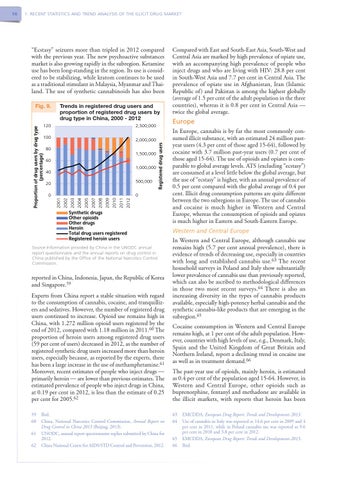
reported in China, Indonesia, Japan, the Republic of Korea and Singapore.59 Experts from China report a stable situation with regard to the consumption of cannabis, cocaine, and tranquillizers and sedatives. However, the number of registered drug users continued to increase. Opioid use remains high in China, with 1.272 million opioid users registered by the end of 2012, compared with 1.18 million in 2011.60 The proportion of heroin users among registered drug users (59 per cent of users) decreased in 2012, as the number of registered synthetic drug users increased more than heroin users, especially because, as reported by the experts, there has been a large increase in the use of methamphetamine.61 Moreover, recent estimates of people who inject drugs — primarily heroin — are lower than previous estimates. The estimated prevalence of people who inject drugs in China, at 0.19 per cent in 2012, is less than the estimate of 0.25 per cent for 2005.62 59 Ibid. 60 China, National Narcotics Control Commission, Annual Report on Drug Control in China 2013 (Beijing, 2013). 61 UNODC, annual report questionnaire replies submitted by China for 2012. 62 China National Centre for AIDS/STD Control and Prevention, 2012.
Compared with East and South-East Asia, South-West and Central Asia are marked by high prevalence of opiate use, with an accompanying high prevalence of people who inject drugs and who are living with HIV: 28.8 per cent in South-West Asia and 7.7 per cent in Central Asia. The prevalence of opiate use in Afghanistan, Iran (Islamic Republic of ) and Pakistan is among the highest globally (average of 1.5 per cent of the adult population in the three countries), whereas it is 0.8 per cent in Central Asia — twice the global average.
Europe In Europe, cannabis is by far the most commonly consumed illicit substance, with an estimated 24 million pastyear users (4.3 per cent of those aged 15-64), followed by cocaine with 3.7 million past-year users (0.7 per cent of those aged 15-64). The use of opioids and opiates is comparable to global average levels. ATS (excluding “ecstasy”) are consumed at a level little below the global average, but the use of “ecstasy” is higher, with an annual prevalence of 0.5 per cent compared with the global average of 0.4 per cent. Illicit drug consumption patterns are quite different between the two subregions in Europe. The use of cannabis and cocaine is much higher in Western and Central Europe, whereas the consumption of opioids and opiates is much higher in Eastern and South-Eastern Europe. Western and Central Europe
In Western and Central Europe, although cannabis use remains high (5.7 per cent annual prevalence), there is evidence of trends of decreasing use, especially in countries with long and established cannabis use.63 The recent household surveys in Poland and Italy show substantially lower prevalence of cannabis use than previously reported, which can also be ascribed to methodological differences in those two most recent surveys.64 There is also an increasing diversity in the types of cannabis products available, especially high-potency herbal cannabis and the synthetic cannabis-like products that are emerging in the subregion.65 Cocaine consumption in Western and Central Europe remains high, at 1 per cent of the adult population. However, countries with high levels of use, e.g., Denmark, Italy, Spain and the United Kingdom of Great Britain and Northern Ireland, report a declining trend in cocaine use as well as in treatment demand.66 The past-year use of opioids, mainly heroin, is estimated as 0.4 per cent of the population aged 15-64. However, in Western and Central Europe, other opioids such as buprenorphine, fentanyl and methadone are available in the illicit markets, with reports that heroin has been 63 EMCDDA, European Drug Report: Trends and Developments 2013. 64 Use of cannabis in Italy was reported as 14.6 per cent in 2009 and 4 per cent in 2011, while in Poland cannabis use was reported as 9.6 per cent in 2010 and 3.8 per cent in 2012. 65 EMCDDA, European Drug Report: Trends and Developments 2013. 66 Ibid.