1. RECENT STATISTICS AND TREND ANALYSIS OF THE ILLICIT DRUG MARKET
Map 1.
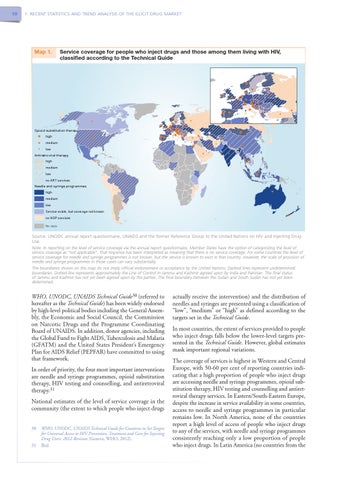
Service coverage for people who inject drugs and those among them living with HIV, classified according to the Technical Guide
G G
G
G
G G G G G GG G G G G G GG G G G GG G G G G G
G
G
G
G G GG G G G G G G G G G G GG G G G G GG G G GGGG G G GG G
Opioid substitution therapy
G
high
Antiretroviral therapy
GG
G
G
G G
G G
G
G
G
Ç ÇÇ
G
Ç
low
G G
ÇÇ
medium
G
G
G G
G
high medium
G
G G G G
GG
G G
G
Ç
G
G
G G
G
Ç
G
G
Ç ÇÇ Ç Ç Ç
10
G G
G G
low no ART services Needle and syringe programmes
G
high
G
medium low Service exists, but coverage not known no NSP services
G
No data
Source: UNODC annual questionnaire, and the former Group to the United Nations on HIV and Injecting Drug Note: The boundaries and names shown and report the designations used on this map do not UNAIDS imply official endorsement or acceptance by theReference United Nations. Dashed lines represent undetermined boundaries. Dotted line represents approximately the Line of Control in Jammu and Kashmir agreed upon by India and Pakistan. The final status of Jammu and Kashmir has not yet been agreed upon by the parties. Use. The final boundary between the Republic of Sudan and the Republic of South Sudan has not yet been determined. Note: In reporting on the level of service coverage via the annual report questionnaire, Member States have the option of categorizing the level of service coverage as “not applicable”. That response has been interpreted as meaning that there is no service coverage. For some countries the level of service coverage for needle and syringe programmes is not known, but the service is known to exist in that country. However, the scale of provision of needle and syringe programmes in those cases can vary substantially. The boundaries shown on this map do not imply official endorsement or acceptance by the United Nations. Dashed lines represent undetermined boundaries. Dotted line represents approximately the Line of Control in Jammu and Kashmir agreed upon by India and Pakistan. The final status of Jammu and Kashmir has not yet been agreed upon by the parties. The final boundary between the Sudan and South Sudan has not yet been determined.
WHO, UNODC, UNAIDS Technical Guide30 (referred to hereafter as the Technical Guide) has been widely endorsed by high-level political bodies including the General Assembly, the Economic and Social Council, the Commission on Narcotic Drugs and the Programme Coordinating Board of UNAIDS. In addition, donor agencies, including the Global Fund to Fight AIDS, Tuberculosis and Malaria (GFATM) and the United States President’s Emergency Plan for AIDS Relief (PEPFAR) have committed to using that framework. In order of priority, the four most important interventions are needle and syringe programmes, opioid substitution therapy, HIV testing and counselling, and antiretroviral therapy.31 National estimates of the level of service coverage in the community (the extent to which people who inject drugs 30 WHO, UNODC, UNAIDS Technical Guide for Countries to Set Targets for Universal Access to HIV Prevention, Treatment and Care for Injecting Drug Users: 2012 Revision (Geneva, WHO, 2012). 31 Ibid.
actually receive the intervention) and the distribution of needles and syringes are presented using a classification of “low”, “medium” or “high” as defined according to the targets set in the Technical Guide. In most countries, the extent of services provided to people who inject drugs falls below the lower-level targets presented in the Technical Guide. However, global estimates mask important regional variations. The coverage of services is highest in Western and Central Europe, with 50-60 per cent of reporting countries indicating that a high proportion of people who inject drugs are accessing needle and syringe programmes, opioid substitution therapy, HIV testing and counselling and antiretroviral therapy services. In Eastern/South-Eastern Europe, despite the increase in service availability in some countries, access to needle and syringe programmes in particular remains low. In North America, none of the countries report a high level of access of people who inject drugs to any of the services, with needle and syringe programmes consistently reaching only a low proportion of people who inject drugs. In Latin America (no countries from the