B. Health and social impact
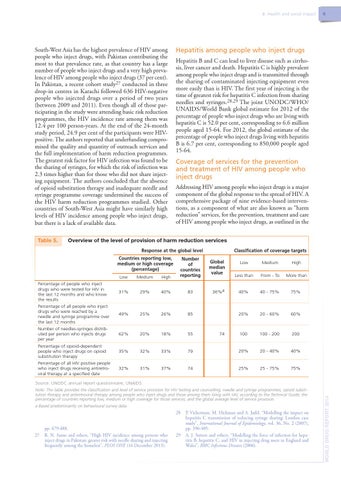
South-West Asia has the highest prevalence of HIV among people who inject drugs, with Pakistan contributing the most to that prevalence rate, as that country has a large number of people who inject drugs and a very high prevalence of HIV among people who inject drugs (37 per cent). In Pakistan, a recent cohort study27 conducted in three drop-in centres in Karachi followed 636 HIV-negative people who injected drugs over a period of two years (between 2009 and 2011). Even though all of those participating in the study were attending basic risk reduction programmes, the HIV incidence rate among them was 12.4 per 100 person-years. At the end of the 24-month study period, 24.9 per cent of the participants were HIVpositive. The authors reported that underfunding compromised the quality and quantity of outreach services and the full implementation of harm reduction programmes. The greatest risk factor for HIV infection was found to be the sharing of syringes, for which the risk of infection was 2.3 times higher than for those who did not share injecting equipment. The authors concluded that the absence of opioid substitution therapy and inadequate needle and syringe programme coverage undermined the success of the HIV harm reduction programmes studied. Other countries of South-West Asia might have similarly high levels of HIV incidence among people who inject drugs, but there is a lack of available data. Table 5.
9
Hepatitis among people who inject drugs Hepatitis B and C can lead to liver disease such as cirrhosis, liver cancer and death. Hepatitis C is highly prevalent among people who inject drugs and is transmitted through the sharing of contaminated injecting equipment even more easily than is HIV. The first year of injecting is the time of greatest risk for hepatitis C infection from sharing needles and syringes.28,29 The joint UNODC/WHO/ UNAIDS/World Bank global estimate for 2012 of the percentage of people who inject drugs who are living with hepatitis C is 52.0 per cent, corresponding to 6.6 million people aged 15-64. For 2012, the global estimate of the percentage of people who inject drugs living with hepatitis B is 6.7 per cent, corresponding to 850,000 people aged 15-64.
Coverage of services for the prevention and treatment of HIV among people who inject drugs Addressing HIV among people who inject drugs is a major component of the global response to the spread of HIV. A comprehensive package of nine evidence-based interventions, as a component of what are also known as “harm reduction” services, for the prevention, treatment and care of HIV among people who inject drugs, as outlined in the
Overview of the level of provision of harm reduction services Response at the global level Countries reporting low, medium or high coverage (percentage)
Percentage of people who inject drugs who were tested for HIV in the last 12 months and who know the results Percentage of all people who inject drugs who were reached by a needle and syringe programme over the last 12 months Number of needles-syringes distributed per person who injects drugs per year Percentage of opioid-dependent people who inject drugs on opioid substitution therapy Percentage of all HIV positive people who inject drugs receiving antiretroviral therapy at a specified date
Classification of coverage targets
Low
Medium
High
Number of countries reporting
31%
29%
40%
83
49%
25%
26%
85
62%
20%
18%
55
35%
32%
33%
79
20%
20 - 40%
40%
32%
31%
37%
74
25%
25 - 75%
75%
Global median value
36%a
74
Low
Medium
High
Less than
From - To
More than
40%
40 - 75%
75%
20%
20 - 60%
60%
100
100 - 200
200
Note: The table provides the classification and level of service provision for HIV testing and counselling, needle and syringe programmes, opioid substitution therapy and antiretroviral therapy among people who inject drugs and those among them living with HIV, according to the Technical Guide; the percentage of countries reporting low, medium or high coverage for those services; and the global average level of service provision. a Based predominantly on behavioural survey data.
pp. 479-488. 27 R. N. Samo and others, “High HIV incidence among persons who inject drugs in Pakistan: greater risk with needle sharing and injecting frequently among the homeless”, PLOS ONE (16 December 2013).
28 P. Vickerman, M. Hickman and A. Judd, “Modelling the impact on hepatitis C transmission of reducing syringe sharing: London case study”, International Journal of Epidemiology, vol. 36, No. 2 (2007), pp. 396-405. 29 A. J. Sutton and others, “Modelling the force of infection for hepatitis B, hepatitis C, and HIV in injecting drug users in England and Wales”, BMC Infectious Diseases (2006).
WORLD DRUG REPORT 2014
Source: UNODC annual report questionnaire, UNAIDS.