Executive summary
In South America, cocaine consumption and trafficking have become more prominent, particularly in Brazil due to factors including its geographical location and a large urban population. In Western and Central Europe, the second largest market after the Americas, indicators of overall supply suggest a possible rebound in the availability of cocaine; retail purity has increased in some countries with sizable consumer markets. On the other hand, they do not show an increase in demand. There has even been a decline in cocaine use in some of the countries that have had higher levels of use. The market has expanded in Oceania in recent years, but the region has a different pattern of use compared with other consumer markets because it has a large body of users (a high prevalence) who use the substance with low frequency, perhaps due to the high price of cocaine.
Cannabis Cultivation and production of cannabis herb (“marijuana”) remains widespread, while production of cannabis resin (“hashish”) remains confined to a few countries in North Africa, the Middle East and South-West Asia. In Afghanistan, despite the fact that the area under cannabis cultivation has been decreasing, the potential cannabis resin production in 2012 was higher than in 2011 due to the greater yield per hectare. Global cannabis use seems to have decreased, essentially reflecting a decrease in cannabis use estimates reported by a number of countries in Western and Central Europe. However, in the United States, the lower perceived risk of cannabis use has led to an increase in its use. At the same time, more people using cannabis are seeking treatment each year.
2013
2012
2011
2010
2009
2008
2007
2006
2005
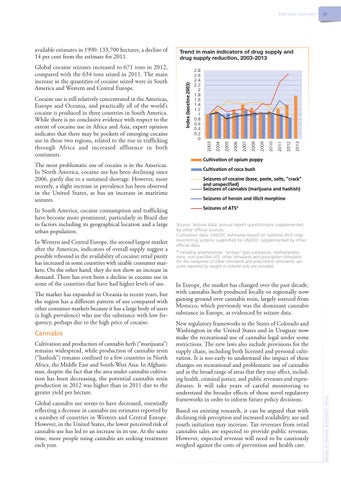
Cultivation of opium poppy Cultivation of coca bush Seizures of cocaine (base, paste, salts, "crack" and unspecified) Seizures of cannabis (marijuana and hashish) Seizures of heroin and illicit morphine Seizures of ATSª Source: Seizure data: annual report questionnaire supplemented by other official sources. Cultivation data: UNODC estimates based on national illicit crop monitoring systems supported by UNODC supplemented by other official data. a Including amphetamine, “ecstasy”-type substances, methamphetamine, non-specified ATS, other stimulants and prescription stimulants. For the categories of other stimulants and prescription stimulants, seizures reported by weight or volume only are included.
In Europe, the market has changed over the past decade, with cannabis herb produced locally or regionally now gaining ground over cannabis resin, largely sourced from Morocco, which previously was the dominant cannabis substance in Europe, as evidenced by seizure data. New regulatory frameworks in the States of Colorado and Washington in the United States and in Uruguay now make the recreational use of cannabis legal under some restrictions. The new laws also include provisions for the supply chain, including both licensed and personal cultivation. It is too early to understand the impact of these changes on recreational and problematic use of cannabis and in the broad range of areas that they may affect, including health, criminal justice, and public revenues and expenditures. It will take years of careful monitoring to understand the broader effects of those novel regulatory frameworks in order to inform future policy decisions. Based on existing research, it can be argued that with declining risk perception and increased availability, use and youth initiation may increase. Tax revenues from retail cannabis sales are expected to provide public revenue. However, expected revenue will need to be cautiously weighed against the costs of prevention and health care.
WORLD DRUG REPORT 2014
The most problematic use of cocaine is in the Americas. In North America, cocaine use has been declining since 2006, partly due to a sustained shortage. However, more recently, a slight increase in prevalence has been observed in the United States, as has an increase in maritime seizures.
2004
Cocaine use is still relatively concentrated in the Americas, Europe and Oceania, and practically all of the world’s cocaine is produced in three countries in South America. While there is no conclusive evidence with respect to the extent of cocaine use in Africa and Asia, expert opinion indicates that there may be pockets of emerging cocaine use in those two regions, related to the rise in trafficking through Africa and increased affluence in both continents.
2.8 2.6 2.4 2.2 2 1.8 1.6 1.4 1.2 1 0.8 0.6 0.4 0.2 0 2003
Global cocaine seizures increased to 671 tons in 2012, compared with the 634 tons seized in 2011. The main increase in the quantities of cocaine seized were in South America and Western and Central Europe.
Trend in main indicators of drug supply Trend in main indicators drug supply and and drug supplyofreduction, 2003drug supply reduction, 2003-2013 2013
Index (baseline 2003)
available estimates in 1990: 133,700 hectares, a decline of 14 per cent from the estimate for 2011.
xi