Empowering
women
through
public procurement
Š International Trade Centre 2014 The International Trade Centre (ITC) is the joint agency of the World Trade Organization and the United Nations. Street address: ITC 54-56, rue de Montbrillant 1202 Geneva, Switzerland Postal address: ITC Palais des Nations 1211 Geneva 10, Switzerland Telephone:
+41-22 730 0111
Fax:
+41-22 733 4439
E-mail:
itcreg@intracen.org
Internet:
http://www.intracen.org
Empowering women through public procurement
iv
ABSTRACT ID=43120 2014 F-06.08.02
EMP
International Trade Centre (ITC) Empowering Women through Public Procurement. Geneva: ITC, 2014. xviii, 65 pages. This guide provides governments, procuring entities and other stakeholders with a deeper understanding of the challenges faced by women-owned businesses to participate in public procurement markets offers tools to address these challenges and stimulate increased entrepreneurial activity by womenowned businesses; provides a brief overview of the public procurement objectives of public procurement systems; highlights common challenges faced by women-owned businesses in public procurement markets and discusses techniques to address them; reviews affirmative action policies and programmes to build the capacity of women-owned businesses and to encourage their participation in public procurement; discusses metrics, monitoring and evaluating progress towards policy objectives, as well as enforcing compliance with preferential procurement policies; includes bibliographical references (pp. 64-65).
Descriptors: Women Entrepreneurs, Public Procurement, Millennium Development Goals, Gender, Developing Countries.
English, French, Spanish (separate editions) ITC, Palais des Nations, 1211 Geneva 10, Switzerland (www.intracen.org)
The designations employed and the presentation of material in this publication do not imply the expression of any opinion whatsoever on the part of the International Trade Centre concerning the legal status of any country, territory, city or area or of its authorities, or concerning the delimitation of its frontiers or boundaries.
Digital image on the cover: Š shutterstock Š International Trade Centre 2014 All rights reserved. No part of this publication may be reproduced, stored in a retrieval system or transmitted in any form or by any means, electronic, electrostatic, magnetic tape, mechanical, photocopying or otherwise, without prior permission in writing from the International Trade Centre.
Doc. P254.E/DBIS/TS/14-VIII
ISBN 978-92-9137-419-9 United Nations Sales Number E.14.III.T.3
International Trade Centre, Palais des Nations, 1211 Geneva 10, Switzerland (http://www.intracen.org)
v
Foreword Government procurement offers a unique, fiscally responsible route to empower women, combat poverty and promote inclusive economic growth. Public procurement accounts for as much as 10–15% of gross domestic product (GDP) in developed countries and over 30% of GDP in developing countries. This translates into trillions of dollars of government spending annually. To date, however, women entrepreneurs have been largely excluded from this sizeable market due to lack of access to information on bids, understanding of procedures and ability to meet requirements. As both market regulators and participants, governments are in a unique position to change this and benefit from enlarging the pool of potential suppliers. Investing in women-owned businesses pays dividends in terms of creating jobs and development. Small and medium-sized enterprises (SMEs) are the engines for job growth in the world economy, accounting for nearly 80% of jobs worldwide. Increasing their competitiveness increases their likelihood of success, expansion and job creation. Women entrepreneurs tend to reinvest up to 90% of their earnings in their families and communities, which links inclusive economic growth directly to development. Inclusive economic growth has proven to be a prerequisite to achieving development goals. In his report, ‘A Life of Dignity for All’, the United Nations Secretary-General Banki Moon observed, ‘Inclusive economic growth with decent employment and decent wages has proven to be a prerequisite for achieving the Millennium Development Goals, particularly Goal 1, on eradicating extreme poverty and hunger.’ Data collected by the World Economic Forum’s Gender Gap Report confirms this observation, showing a positive correlation between women’s empowerment, GDP per capita, and human development. Gender equality and women’s empowerment are set to be a cornerstone of the Post2015 Development Agenda, increasing the relevance of pursuing options through procurement to deliver on development commitments. Recognizing these important linkages, the International Trade Centre (ITC) and its partners established the Global Platform for Action on Sourcing from Women Vendors in 2010. The Global Platform is a network of policymakers, international organizations, buyers, trade support institutions, women’s business associations and womenowned businesses. Network members share the objective of increasing the amount of corporate, government and institutional procurement secured by women vendors, in order to bring greater economic benefit to women and their communities. As part of the Global Platform, ITC drafted a guide to assist governments with public procurement reform, in order to sensitize them and other stakeholders to the issues women entrepreneurs face in those markets. In December 2013, ITC presented a draft outline of the guide to a group of public procurement experts, women entrepreneurs and representatives of women’s business associations who were attending the Africa Regional Workshop: Fostering the Participation of Women Vendors in Procurement Markets. During this meeting, participants provided valuable feedback to ITC on the draft outline and shared many of their experiences with us, all of which helped shape the final draft of this guide.
vi
This guide aims to assist governments and procuring entities conceptualize, develop and implement policies and programmes that will enable women entrepreneurs to participate more fully in public procurement markets. It begins by examining some very basic, but often overlooked questions: What is a women-owned business? How do we identify those businesses? The guide then examines the many barriers and challenges that prevent or discourage women entrepreneurs from entering the public procurement market and presents a range of best practices for overcoming them. In doing so, the guide calls attention to a very salient point: businesses owned by men and women are different. As a result, to be effective, governments must tailor their procurement reforms accordingly. Access to public procurement markets is only half the story. Women-owned businesses also require more targeted assistance to help them overcome a history of discrimination and marginalization and succeed in the marketplace. The guide discusses strategies such as margins of preference, reservations and capacity-building programmes used by governments around the world to stimulate participation by women entrepreneurs and other marginalized groups. This guide draws on a wide range of research, commentaries, treatises, and case studies in the field of public procurement including from Brazil, Chinese Taipei and the European Union, as well as from Africa, where consultations were held. This guide is part of ITC’s work to promote the participation of women entrepreneurs and producers in global value chains and to ensure they enjoy greater economic benefits from international trade. I hope the guide will encourage and assist governments to use public procurement to facilitate the economic empowerment of women entrepreneurs in their countries.
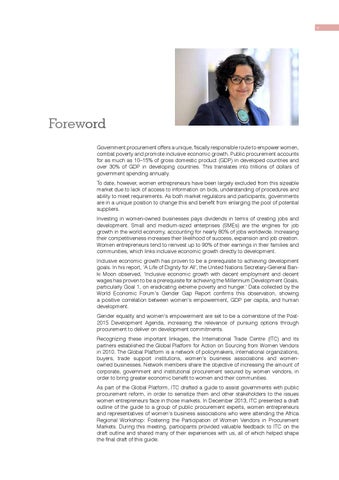
Arancha GonzĂĄlez Executive Director, International Trade Centre
vii
Acknowledgements Keric Chin, a private practice lawyer and legal consultant, is the author of this guide. He based it on his 20 years of cumulative experience as an acquisition professional in the United States Air Force and as a government contracts attorney in both the federal government and private practice. He has advised clients on all facets of government contracts formation, administration, and compliance issues, litigated contract disputes and bid protests, and managed government research and development projects. He recently completed a review of New Zealand’s public procurement system for Transparency International New Zealand. ITC is grateful to the government and private sector participants who provided helpful suggestions and shared many of their own experiences with public procurement. In particular, ITC would like to acknowledge participants of the Africa Regional Workshop held in Kampala, Uganda, in December 2013. In particular, ITC would like to thank Cornelia Sabiiti, Executive Director, Uganda Public Procurement and Disposal Authority; Florence Kata, Executive Director, Uganda Export Promotion Board; Sebastian Jerry Ackotia, Director of Public Policy and Strategy, Ghana Public Procurement Authority; Adeyemi Ayinde Tajudeen Suleiman, Executive Director, Nigeria Chamber of Commerce in Sierra Leone; Dr. Maggie Kigozi, former Executive Director, Uganda Investment Authority; and all those who participated in the public procurement break-out sessions. In addition, ITC would like to thank all those who made valuable contributions at the second Senior Executive Roundtable on Government Procurement – Sourcing from Women Vendors, and the APEC Workshop: Access to Markets – Including Women Entrepreneurs in Government Procurement Processes that took place at the Women Vendors Exhibition and Forum in Mexico in 2012; the panel on Leveraging Government Procurement to Source from Women Vendors at the ITC World Export Development Forum that took place in Indonesia in 2012; and the Inaugural Senior Executive Roundtable on Government Procurement – Sourcing from Women Vendors, held as a side event at the 8th WTO Ministerial Conference in Geneva in 2011. ITC is most grateful to the government of Samoa for piloting the rollout of this guide, including through the delivery of training modules at the National University of Samoa. This has been made possible through the unflagging support of the Hon. Fonotoe Nuafesili Pierre Lauofo, Deputy Prime Minister of Samoa and Ms. Belinda Filo-Tafunai, Ministry of Foreign Affairs and Trade, Samoa. ITC further thanks Irene Natividad, President, Global Summit of Women, for inviting ITC and the government of Samoa to deliver the keynote address at the Ministerial Roundtable at the Global Summit of Women in Paris in 2014. This has raised awareness and interest in this important area of work. Other experts who provided helpful feedback and assistance with the guide include Hong Siew Lim and Juan Hoyos of the International Trade Centre, and Anna Caroline Müller of the World Trade Organization. Meg Jones, ITC Senior Programme Officer, Women and Trade, supervised the writing of this guide, with Vanessa Erogbogbo, ITC Programme Officer Women and Trade. Natalie Domeisen was responsible for editorial management and promotion, Dianna Rienstra acted as editorial consultant, Kristina Golubic created the design and artwork, and Iva Stastny-Brosig conducted the layout. Digital printing was done by Serge Adeagbo and Franco Iacovino. The work would not be possible without the support of the governments of Australia, Norway and the United Kingdom of Great Britain and Northern Ireland.
viii
CONTENTS Foreword Acknowledgements Abbreviations Executive summary Promoting gender equality is ‘smart economics’ Public procurement – a powerful tool Defining and understanding the target community A checklist for action Stimulating entrepreneurial activity Capacity-building programmes Measuring progress towards policy objectives
v vii xii xiii xiii xiii xiv xiv xv xvii xvii
Chapter 1
Public procurement, a tool to shape societies Why government purchasing affects markets
1 2
Competition laws and social regulations shape markets
2
Purchasing is worth 10–40% of GDP
3
Public procurement for women – ‘smart economics’ Support women, boost national competitiveness
Policies must be gender sensitive About this guide
3 3 4 5
Chapter 2
Public procurement systems An overview of the process Acquisition planning Source selection
Contract administration
Policy objectives Principles guiding procurement systems Making trade-offs Stakeholders
7 8 9 9 10 10 11 13 14
Chapter 3
Laying the groundwork to support women-owned businesses Defining women-owned businesses Defining company size
15 16 17
ix
Determine the firms eligible for preferential treatment
Certification and registration programmes Certification options Addressing fraud South Africa tackles fronting The importance of recertification Registration systems – pros and cons Closing the information gap
17 18 18 18 19 20 20 22
Chapter 4
Leveraging public procurement through reform Increase access to information Work with women’s business organizations
Streamline the tender process Standardize and simplify
Prequalification can create barriers
24 25 26 26 26 27
A word of caution
Rationalize requirements Stumbling blocks for women entrepreneurs
Potential solutions Teaming arrangements
23
27 28 28
28
Specialized agencies
28
Limit contract size
29
Provide sufficient time for tenders
29
‘Best value’ or lowest price criteria? Best-value criteria raises concerns
Providing feedback builds capacity and capabilities Complaint mechanisms
Prompt payments are critical
30 30 31 32 32
Incentives for prompt payments
32
Subcontractors often pay the price
33
Chapter 5
Leveraging public procurement through targeted assistance Contract compliance Affirmative action plans Stimulating entrepreneurial activity Establish and monitor targets
35 35 37 37 37
x
Small business subcontracting plans
38
Preferences
38
Reservations or set-asides
41
Avoiding abuses
42
International agreements and guidelines
42
WTO’s agreement on public procurement
42
Room to accommodate preferences
45
Flexibility
45
Exceptions and derogations
46
World Bank guidelines
46
Building business capacity
47
Women’s business organizations: force multipliers
47
Technical assistance
48
Financial assistance
48
Mentor-protégé programmes
50
Establishing business champions
51
Building government capacity
51
Chapter 6
Monitor, evaluate and enforce policies Establish appropriate metrics Impacts Outcomes Outputs
54 55 55 55 56
Assessing progress Selecting meaningful indicators
53
The US Small Business Administration
Monitoring – data collection and analysis Evaluate results and make adjustments Enforce compliance if necessary
57 58 59 59 60
Conclusion
Towards greater commitment to women-owned businesses
61
References
63
xi
FIGURES Figure 1. The public procurement process
8
BOXES Box 1: Brazil – reconciling competing objectives
13
Box 2: Indonesia - A snapshot of women-owned businesses
21
Box 3: South Africa - Preferential procurement
39
Box 4: Kenya’s reservation scheme
41
Box 5: European Union - An overview of preferential procurement
44
Box 6: Ethiopia - A model for women-owned banking
49
Box 7: Business support for women entrepreneurs
50
Box 8: Ghana - Mainstreaming procurement training
51
TABLES Table 1. National legislation examples authorizing preferential procurement policies for women-owned businesses 40 Table 2. Safeguarding preferential contracts
42
Table 3. Impact indicator examples
56
Table 4. Outcome indicator examples
56
Table 5. Output indicator examples
57
xii
Abbreviations B-BBEE
Broad-Based Black Economic Empowerment (South Africa)
CEEC
Citizens Economic Empowerment Commission (Zambia)
COC
Certificate of Competency (United States)
FAR
Federal Acquisition Regulation (United States)
GDP
Gross domestic product
HDI
Historically Disadvantaged Individual (South Africa)
IFC
International Finance Corporation
ITC
International Trade Centre
MDGs
Millennium Development Goals
MSME
Micro, small and medium-sized enterprise
RBM
Results-based management
SBA
Small Business Administration (United States)
SME
Small and medium-sized enterprise
UNCITRAL
United Nations Commission on International Trade Law
UNDP
United Nations Development Programme
WTO
World Trade Organization
WTO GPA
World Trade Organization Agreement on Government Procurement
xiii
Executive summary Governments can use public procurement to leverage the potential of women-owned businesses for their economies. The sooner governments invest in reforms and targeted assistance to increase access to public procurement, the sooner the benefits will flow to women, their families, their communities and their nations.
T
his guide provides governments, procuring entities and other stakeholders with a deeper understanding of the challenges faced by women-owned businesses to participate in public procurement markets. It offers tools to address these challenges and stimulate increased entrepreneurial activity by women-owned businesses. Governments have long used public procurement as a tool to promote socioeconomic objectives. These objectives are sometimes referred to as ‘horizontal’ or ‘collateral’ because they are ancillary to the primary purpose of public procurement, which is to acquire goods and services for the government. Horizontal considerations in formulating public procurement policies are wide ranging, from promoting labour laws to encouraging local industrial development to supporting environmentally sustainable practices. To date, few governments have made a concerted effort to use public procurement as a tool to unleash the vast economic potential of women entrepreneurs.
Promoting gender equality is ‘smart economics’ The case for public procurement as a tool to promote participation by womenowned businesses is compelling from a developmental and economic perspective. A growing body of research shows that inclusive growth is critical to achieving many of the Millennium Development Goals (MDGs). At the time of publication, a stand-alone goal on gender equality and women’s empowerment was proposed for the Post-2015 Development Agenda, which succeeds the MDGs. Research shows that there is a positive correlation between gender equality and a country’s gross domestic product (GDP) per capita. When women are excluded from the marketplace, the economy suffers. Promoting gender equality is, in the words of former World Bank President Robert Zoellick, ‘smart economics’. The same applies to promoting participation by women-owned businesses in public procurement.
Public procurement – a powerful tool Public procurement is a powerful tool to achieve socioeconomic objectives because it operates at the intersection of the government’s regulatory and buying powers. Governments are market regulators and market participants. They regulate the public procurement process by establishing the legal and regulatory framework. Governments spend trillions of dollars annually purchasing the goods, works and services they require to fulfil their public functions.
xiv
The public procurement process involves three phases: acquisition planning and market research; source selection and contract award; and contract administration and close out. By carefully structuring the rules that govern each of these phases, governments seek to achieve various policy objectives. For most procurement systems, those objectives include value for money, integrity, equal treatment and efficiency. These objectives can and should include increased participation by women entrepreneurs in public procurement and in the economy more broadly.
Defining and understanding the target community An important first step to leveraging public procurement in support of women-owned businesses is to define what it means to be a women-owned business and the criteria for participation in preferential programmes. Lack of consistency, clarity and data in this area has frustrated past efforts to promote increased participation by women entrepreneurs. It continues to do so today. The definition of a women-owned business may vary from country to country. However, it is critical that definitions emphasize ownership and control by women to avoid tokenism and illicit practices such as fronting. These definitions and associated criteria are also key to understanding market capacity, establishing a baseline against which to measure progress, targeting technical, financial and other forms of assistance, and determining which businesses are eligible for preferential status. The definitions of and associated criteria for women-owned businesses are also critical to establishing effective certification and registration programmes. While often combined, certification and registration are distinct processes with different objectives. The objective of the certification process is to ensure that businesses meet the eligibility criteria established by the government, while the objective of the registration process is to provide a point of entry for companies wishing to do business with the government. When combined with an effective certification system, a comprehensive, accurate, and up-to-date contractor registration system can serve a number of important functions. This serves as the point of entry for companies wishing to do business with the government and provides invaluable data to government on market capacity and demographics. In some countries, registration systems are also used to prequalify contractors, obtain various certifications and develop approved vendor lists. Proof of registration and certification as a women-owned business alleviates the need for individual procuring entities to determine on a case-by-case basis whether a particular tenderer qualifies to bid and is entitled to preferential treatment.
A checklist for action Certifying and registering women-owned businesses have limited value unless governments also address the challenges that prevent these firms from accessing and fully participating in public procurement markets. Research has identified common challenges in both developing and developed economies. They include lack of information about tender opportunities, overly complex and burdensome tender procedures, unreasonable technical and financial qualification requirements, large contract sizes, insufficient time to assemble tenders, price competition, lack of feedback from procuring agencies, and failure by those agencies to promptly pay women-owned businesses.
xv
To overcome these challenges, governments should, at a minimum, adopt the following measures: Publish all procurement opportunities on a central electronic clearinghouse and disseminate the same information directly to women’s business organizations. Streamline and standardize tender documentation and prequalification procedures across procuring entities. Permit women-owned businesses to prequalify for groups of contracts or certain categories of goods, works and services. Ensure one procuring agency can use the results of prequalification procedures conducted by another. Tailor the technical, financial and other qualification and prequalification requirements to the size and complexity of the procurement opportunities. Avoid bundling multiple requirements into one large contract. Allow sufficient time for firms to prepare tenders. Encourage use of economically most advantageous or best value award criteria where appropriate. Caveat: The use of economically most advantageous award criteria may not be appropriate where the added discretion invites corruption or increases complexity. Provide meaningful feedback to unsuccessful bidders on the strengths and weaknesses of their tenders and areas for improvement. Implement and enforce rules regarding prompt payment of women-owned businesses at the prime and subcontract levels and hold procuring entities and government officials accountable for the same. Some of these challenges are not unique to women-owned businesses; they are challenges faced by other businesses, irrespective of ownership. Any reforms addressing these challenges may have collateral benefits for other businesses. International instruments in the area of government procurement, such as the World Trade Organization Agreement on Government Procurement and the 2011 UNCITRAL Model Law on Public Procurement, can be important sources of inspiration for countries wishing to address such challenges. However, it is important for governments to understand that the solutions to these challenges must be gender-specific. This is because businesses owned by women and those owned by men are not similarly situated. Seemingly gender-neutral rules, policies and programmes can have a disparate impact on women-owned businesses.
Stimulating entrepreneurial activity Removing barriers faced by women-owned businesses is a necessary step. However, their removal is unlikely to substantially increase participation by womenowned businesses in public procurements unless other steps are taken. To stimulate entrepreneurial activity, governments must develop affirmative policies, procedures, and programmes specifically for women-owned businesses.
Targeted assistance strategies Governments have long used ‘targeted assistance’ strategies to encourage or promote economic participation by historically disadvantaged individuals and other marginalized groups within society. Although few governments have done so to date, these same strategies can be used to promote increased economic participation by women-owned businesses. This guide presents some examples of targeted assistance strategies used by governments to encourage participation by women-owned and other disadvantaged
xvi
businesses in public procurement markets. The strategies that governments adopt must be gender-specific and reflect market realities, including the capacities and capabilities of women-owned businesses in the market. Governments cannot establish preferential procurement policies in a vacuum.
Establishing mandatory goals or targets Establishing mandatory goals or targets for procuring entities is an important example of a targeted assistance strategy. For example, in the United States, the statutory target for small businesses ‘owned and controlled’ by women is not less than 5% of the total value of all federal contracts. These targets are not quotas. They encourage procuring entities to increase the share of procurement dollars going to women-owned businesses through less controversial means, such as conducting market research, setting up outreach programmes, and building the capacity of those firms to do business with the government. To be effective, this strategy also requires monitoring, reporting and oversight mechanisms to ensure the procuring entities are making progress toward their goals.
Subcontracting plans The goal of small business subcontracting plans is to increase the number of womenowned businesses and other target groups participating as subcontractors on government contracts. This is a fruitful area for government intervention because it leverages both the buying power and innovation of government prime contractors. Firms awarded contracts over a certain dollar threshold must submit plans to procurement officials establishing targets for participation by women-owned businesses in their supply chains and their strategies for achieving those targets. This approach has the potential to dramatically increase the number of business opportunities for women entrepreneurs because it pushes preferential procurement policies down the supply chain. Subcontracts are often a small firm’s entrée into the broader public procurement market.
Preferences Preferences are perhaps the best known and most-widely used form of targeted assistance. Preferences can provide women-owned businesses with a competitive edge in public procurements, addressing to some extent the adverse effects of marginalization, and increasing their participation in the formal economy more generally. They often involve granting a price preference or margin of preference to firms that are eligible for preferential treatment. In these cases, the procuring entities artificially increase the bid prices of the non-preferred firms by a set number of percentage points while making no adjustments to the bid prices of the preferred firms. Award is then made to the firm with lowest evaluated (as opposed to proposed) price. Alternatively, the preference may take the form of additional points. This is the case in South Africa, where the government has developed a sophisticated preferential procurement system that awards points based on a firm’s certified Broad-Based Black Economic Empowerment status level. The legislative authority to pursue preferences and reservations for women entrepreneurs already exists in a number of countries.
Reservations Reservations, or set asides, are arguably the most controversial form of targeted assistance, but feature prominently in many countries. They involve setting aside one or more procurement opportunities for competition among a preferred category of firms, such as women-owned businesses. Firms that do not meet the eligibility criteria are
xvii
excluded. Kenya recently announced it would amend its public procurement regulations to reserve 30% of government contracts for women, youth and persons with disabilities. International trade agreements and rules may, to some extent, limit governments’ discretion in deploying preference schemes such as margins of preference or reservations. This is because preferences and reservations have often been used to discriminate against foreign firms, whereas one of the primary objectives of international trade agreements is to open up domestic procurement markets to foreign firms. In many cases, government can still pursue preferential procurement policies as long as those policies do not discriminate against foreign women-owned firms and are otherwise permitted by national legislation.
Capacity-building programmes Capacity-building programmes are an important component of a comprehensive preferential procurement system. The targeted assistance strategies discussed earlier are primarily intended to increase the demand for goods and services from womenowned businesses. For the system to be effective, the demand must be matched by supply. To address this, governments must establish programmes that build the capacity of women-owned businesses to compete successfully in public procurement markets and deliver the goods and services that the governments require to fulfil their public functions. Women’s business organizations and other trade support institutions can be valuable partners.
Measuring progress towards policy objectives As with any system, monitoring and evaluation are necessary to ensure compliance with preferential policies and programmes, to measure progress towards government or organizational objectives, and to make adjustments where necessary to improve the system. Although an in-depth discussion of monitoring and evaluation is beyond the scope of this guide, it does provide a brief overview of the results-based management approach used by the International Trade Centre and suggests ways in which that approach can be applied to a preferential procurement system for women-owned businesses.
xviii
Chapter 1
Public procurement, a tool to shape societies
Š shutterstock.com
Chapter 1 – Public procurement, a tool to shape societies
‘
The message is simple. Women who are safe, healthy, educated and fully empowered to realize their potential transform their families, their communities, their economies and their societies. We must create the conditions so they can do so.
’
High-Level Panel of Eminent Persons on the Post-2015 Development Agenda1
W
hile the main goal of public procurement is to buy goods and services that governments need, public procurement can also be used to promote socioeconomic objectives. These are often referred to as ‘horizontal’ or ‘collateral’ objectives because they are ancillary to the primary purpose of public procurement, which is to acquire goods and services for the government (Quinot, 2013). Socioeconomic objectives governments consider when formulating public procurement policies are wide ranging. Public procurement has been used to: Promote non-discrimination in employment, by requiring contractors to develop affirmative action programmes; Encourage industrial development, by favouring locally produced goods and domestic businesses; Support environmental sustainability, by requiring contractors to supply energyefficient products and goods made from recovered or bio-based materials. Unfortunately, few governments have used public procurement as a tool to unleash the vast economic potential of women entrepreneurs.2
Why government purchasing affects markets Public procurement is a powerful tool to promote socioeconomic objectives because it operates at the intersection of the government’s regulatory and buying powers (McCrudden, 2004).
Competition laws and social regulations shape markets Governments have the power to regulate market participants by encouraging markets through competition laws or by restraining markets through social regulation, such as health and safety laws.
2
Empowering women through public PROCUREMENT
Chapter 1 – Public procurement, a tool to shape societies
Purchasing is worth 10–40% of GDP Governments are also active, major participants in the market. Each year, governments spend trillions of dollars buying goods, services, and works (Anderson, Pelletier, OseiLah and Müller, 2011; Audet, 2002). Public procurement is estimated to comprise as much as 10–15% of the gross domestic product (GDP) in developed countries and 30–40% in developing countries (Kirton, 2013).
Public procurement for women – ‘smart economics’ Research shows that there is a positive correlation between gender equality and a country’s gross domestic product (GDP) per capita. When women are excluded from the marketplace, the economy suffers. Promoting gender equality is, in the words of former World Bank President Robert Zoellick, ‘smart economics’. The same applies to using public procurement policy to stimulate entrepreneurial activity by women-owned businesses
Support women, boost national competitiveness There is a positive correlation between gender equality and a country’s level of competitiveness, GDP per capita and its rank in the Human Development Index, according to the World Economic Forum. ‘While correlation does not prove causality, it is consistent with the theory and mounting evidence that empowering women means a more efficient use of a nation’s human capital endowment and that reducing gender inequality enhances productivity and economic growth’ (World Economic Forum Gender Gap Report 2013, p. 31). Output per worker jumps from 13–25% when barriers that prevent women from entering certain sectors or occupations are eliminated, according to the World Bank’s World Development Report 2012.
Empowering women through public PROCUREMENT
3
Chapter 1 – Public procurement, a tool to shape societies
The report also warns of the consequences of keeping barriers to women in place. ‘When women’s labour is underused or misallocated – because they face discrimination in markets or societal institutions that prevents them from completing their education, entering certain occupations, and earning the same incomes as men – economic losses are the result.’ Gender equality and empowering women are critical to achieving many of the Millennium Development Goals (MDGs), which include poverty reduction, universal primary education, reduced child mortality, improved maternal health and reduced spread of HIV/AIDS. Ban Ki-moon, Secretary-General of the United Nations, recently reaffirmed the linkages between inclusive policies and development. ‘Inclusive economic growth with decent employment and decent wages has proven to be a prerequisite for achieving the MDGs, particularly on Goal 1, on eradicating extreme poverty and hunger’ (UNGA, 2013). Inclusive growth is set to become one of the main pillars of the Post-2015 Development Agenda (United Nations, 2013).
Policies must be gender sensitive To harness the potential of women-owned businesses, procurement policies must be gender sensitive. Businesses owned by women and those owned by men are not the same (Kepler and Shane, 2002; National Women’s Business Council, 2009; World Bank, 2012). Women-owned businesses:
Tend to be smaller; Are often less experienced; Have less access to human, financial and social capital; Tend to be in less-profitable sectors, such as retail sales and services; Have owners who tend to have more family and care responsibilities.
Gender-neutral laws do not create a neutral playing field. Women entrepreneurs face unique challenges as a result of past and current discriminatory practices and attitudes. Because women-owned businesses are dissimilar, it is important to consider the disparate impact of seemingly gender-neutral rules, policies and programmes.
4
Empowering women through public PROCUREMENT
Chapter 1 – Public procurement, a tool to shape societies
About this guide This guide reflects extensive consultation with government representatives, trade support institutions and women entrepreneurs. It is designed to assist governments and procuring entities develop public procurement policies, practices, and programmes that will stimulate women-owned businesses. Well-designed preferential procurement policies can ‘serve the goals of supporting small and medium-sized enterprises (SMEs) and a fair distribution of government contracts to them whilst also promoting value for money in procurement’ (Linarelli, 2013, p. 450). Government ministries and agencies involved in public procurement may wish to develop and implement their own preferential procurement policies and programmes at the ministry and agency levels, even if those policies and programmes are not rolled out government-wide. This could serve as a model for government-wide initiatives. Coherent government-wide policies would, however, seem more likely to have a significant impact and increase transparency through multiplication of rules and practices. Chapter 1 introduces readers to public procurement and why it is relevant to womenowned businesses. Chapter 2 provides a brief overview of the public procurement process and objectives of public procurement systems. Public procurement involves: Acquisition planning; Source selection; Contract administration and close out. Governments regulate this process based on policy objectives. For most public procurement systems, these objectives include: Obtaining suitable goods, works and/or services in an economically efficient manner and on the best possible terms; Eliminating corrupt practices; Ensuring equal opportunity and equal treatment; Opening markets to international trade. Promoting socioeconomic, industrial and environmental policies, including those related to women-owned businesses, are important secondary objectives of public procurement systems. Chapter 3 addresses the beneficiaries. Defining the target population is the starting point in designing procurement policies that promote participation of women-owned businesses. This chapter discusses the importance of defining what it means to be a women-owned business. These definitions and associated criteria are key to understand market capacity, establish a baseline against which to measure progress, target technical and financial assistance, and determine which businesses are eligible for preferential status. Chapter 4 highlights common challenges faced by women-owned businesses in public procurement markets and discusses techniques to address them. Removing or reducing these barriers is a necessary first step to increase women’s access to public procurement markets. This can be through ensuring that international best practices in government procurement, such as those embodied in the WTO Agreement on Government Procurement (WTO GPA)3 and other international instruments such as the United Nations Commission on International Trade Law (UNCITRAL) Model Law on Public Procurement are followed. However, additional targeted measures are required to ensure the success of women-owned businesses in those markets.
Empowering women through public PROCUREMENT
5
Chapter 1 – Public procurement, a tool to shape societies
Chapter 5 discusses affirmative action policies and programmes to build the capacity of women-owned businesses and to encourage their participation in public procurement. Chapter 6 discusses metrics, monitoring and evaluating progress towards policy objectives, as well as enforcing compliance with preferential procurement policies.
ENDNOTES 1. United Nations (2013, p. 31). 2. To fully appreciate the economic potential of women entrepreneurs, consider the pivotal role they play in developing economies. For example, in the Southern Africa Development Community (SADC), women make up 70% of the intra-SADC trade and account for more than US$ 4 billion worth of cross-border trading. In Uganda, Rwanda and Lao People’s Democratic Republic, women make up 38%, 60% and 68%, respectively, of the registered small businesses (International Trade Centre, 2011). 3. On 6 April 2014, a revised version of the GPA entered into force. It provides for a modernized and streamlined text of the Agreement as well as enhanced market access. For further information, see http://www.wto.org/english/tratop_e/gproc_e/gp_gpa_e.htm.
6
Empowering women through public PROCUREMENT
Chapter 2
Public procurement systems
table of contents for chapter ���������������������������������������������������������������������������������������������������������������������� p table of contents for chapter ������������������������������������������������������������������������������������������������������������������������������������������������� p
table of contents for chapter ���������������������������������������������������������������������������������������������������������������������� p table of contents for chapter ���������������������������������������������������������������������������������������������������������������������� p table of contents for chapter ���������������������������������������������������������������������������������������������������������������������� p
© shutterstock.com
Chapter 2 – Public procurement systems
Preferential procurement policies to support women-owned businesses require participation from policymakers, procuring entities, women entrepreneurs, trade support institutions and women business organizations.
P
ublic procurement is ‘the process through which the state acquires goods, works, and services needed to fulfil its public functions’ (Quinot and Arrowsmith, 2013, p. 1).
An overview of the process The public procurement process encompasses three distinct but related phases, shown in figure 1. Figure 1. The public procurement process
Acquisition Planning • Requirements definition • Market research • Budgeting and funding • Procurement method & contract type selection • Specification development • Solicitation preparation
Source Selection Process • Notice of opportunity • Issuance of solicitation • Receipt of responses • Evaluation and source selection • Contract award
Contract Administration • Performance monitoring • Delivery and acceptance • Invoice and payment • Final accounting and close-up
Source: Author.
8
Empowering women through public PROCUREMENT
Chapter 2 – Public procurement systems
Acquisition planning The process begins with acquisition planning and market research. Acquisition planning includes ‘the efforts of all personnel responsible for an acquisition, coordinated and integrated through a comprehensive plan for fulfilling the agency need in a timely manner and at a reasonable cost’.1 It includes: Identifying and defining agency needs; Conducting market research to determine the most suitable strategy; Selecting the most appropriate procurement method, including international competitive bidding, national competitive bidding, restricted competition and requests for quotation; Developing work specifications; Drafting a source selection plan with evaluation criteria; Preparing the formal solicitation. Acquisition planning also involves budgeting, funding, logistics and allocating organizational responsibilities. The scope and depth of acquisition planning depends upon the value, complexity and scope of the acquisition. The planning to procure a few reams of office printing paper is simple, while procuring a power cogeneration plant is complex. The primary and secondary objectives of the procuring entity also shape the scope and depth of the acquisition planning phase.
Source selection In this phase, the procuring entity selects a contracting partner. Steps include: Publishing or advertising the procurement opportunity; Disseminating the solicitation or tender documents to interested parties; Evaluating responses to the solicitation; Selecting a contracting partner; Finalizing the terms and conditions of performance; Awarding the contract. Similar to the acquisition planning phase, the value, complexity and scope of the acquisition and the objectives of the procuring entity dictate the scope and depth of the source selection process.
Contract administration Contract administration ‘includes all relationships between the government and the contractor that arise out of contract performance. It encompasses all dealings between the parties from the time the contract is awarded until the work has been completed and accepted, payment has been made, and disputes have been resolved’ (Cibinic, Nash and Nagle, 2006, p. 1).
Empowering women through public PROCUREMENT
9
Chapter 2 – Public procurement systems
The ultimate goal is to ensure that the government receives goods or services for which it has contracted and the contractor receives payment. Contract administration activities vary by the nature, scope and type of contract. They include: Monitoring contract performance (technical, schedule and cost); Modifying the contract to accommodate changing needs or circumstances; Resolving disputes; Conducting a final accounting; Closing out the contract.
Policy objectives Public procurement takes place within a legal and regulatory framework with specific policy objectives. These objectives may be enshrined in national constitutions, national legislation, government and agency regulations or policy statements. These policy objectives help shape each phase of the procurement process. While policy objectives vary, common themes have been identified: Value for money. A major goal is to obtain suitable goods, works or services in an economically efficient manner and on the best possible terms. This does not necessarily mean obtaining goods, works or services at the lowest price. Integrity. Goods, works and services should be acquired without corruption and conflicts of interest. Corruption takes many forms and includes practices such as bribery, collusion, fraud and kickbacks. Conflicts of interest can be personal or organizational. The integrity of the public procurement system is an important policy objective in its own right. It also helps ensure value for money by eliminating the economic inefficiencies inherent in corrupt practices and conflicts of interest. Accountability. Interested parties, such as the general public or prospective contractors, require the means to verify whether the government is complying with the law and regulations, as well as fulfilling its responsibilities. Accountability and transparency also contributes to value for money and integrity of the system.
© shutterstock.com
10
Empowering women through public PROCUREMENT
Chapter 2 – Public procurement systems
Equal opportunity and treatment. Equal treatment of participants in the public procurement system contributes to objectives, such as integrity, and is an objective in its own right. The concept of equal treatment holds that no distinction is made between firms, except where such a distinction is justified under law or regulation. For example, a distinction based on nationality of a firm would be inappropriate unless permitted by law or regulation. Fair treatment. Fair treatment is similar to procedural due process, which is the right to notice and the opportunity to be heard before a decision is made that adversely affects a firm. For example, the government should notify a firm of its intention to suspend or debar it from doing business with the government, and provide its representatives with an opportunity to be heard on the matter. Opening markets to international trade. Regional and international agreements designed to open public procurement markets to foreign firms, goods and services are among the most important developments in public procurement over the last two decades (Arrowsmith et al., 2011). As a result, many public procurement systems include the principle of non-discrimination against foreign firms, goods and services. Promoting socioeconomic, industrial and environmental policies. Although no less important than the objectives identified above, these policy objectives are labelled as ‘collateral’, ‘secondary’ or ‘horizontal’ because they are considered external to the process of acquiring the goods and services. Examples include enforcement of fair labour standards (socioeconomic), promotion of national industrial competitiveness (industrial), and the use of bio-based and recovered materials (environmental). Efficiency. An important goal of all public procurement systems is to acquire goods and services efficiently by minimizing unnecessary delays, waste of resources or costs. Source: Arrowsmith, et al., 2011.
Principles guiding procurement systems Most procurement systems are guided by three principles: transparency, competition and equal treatment. Transparency includes publicity for contract opportunities; publicity for the rules governing each procedure; a principle of rule-based decision-making that limits discretion of procuring entities and officials; and mechanisms to verify whether the rules have been followed and enforced. Transparency is important to combat corruption, collusion and nepotism. Transparency also helps to achieve other policy objectives, such as fair treatment and accountability. But transparency can come with costs. For example, it can increase the cost of doing business and reduce efficiency. Competition is important to achieving value for money because it pressures prospective contractors to put forward their best offers to win contracts. Competition also drives innovation and is important to achieving other objectives, such as equal treatment and integrity. Like transparency, competition can come with costs. Equal treatment is both a principle and an objective of most procurement systems (Arrowsmith, et al., 2011). The expression of these general principles and objectives vary from country to country.
Empowering women through public PROCUREMENT
11
Chapter 2 – Public procurement systems
In the Philippines, for example, the policy is to ‘promote the ideals of good governance’. Under the Government Procurement Reform Act, the system is governed by transparency, competitiveness through equal opportunity, efficiency through simplified and streamlined procedures, accountability, and public monitoring to ensure strict compliance with laws and regulations. In Kenya, the 2005 Public Procurement and Disposal Act declares these objectives: maximize economy and efficiency, promote competition and ensure competitors are treated fairly, promote integrity and fairness, increase transparency and accountability, increase public confidence, and facilitate the promotion of local industry and economic development. In India, the 2005 General Financial Rules state, ‘Every authority delegated with the financial powers of procuring goods in the public interest shall have the responsibility and accountability to bring efficiency, economy, transparency in matters relating to public procurement, and for fair and equitable treatment of suppliers and promotion of competition in public procurement.’ © shutterstock.com
12
Empowering women through public PROCUREMENT
Chapter 2 – Public procurement systems
Making trade-offs Translating policy objectives into regulations and procedures may require trade-offs. Implementation of a policy objective or principle may conflict with the attainment of others. For example, governments can promote transparency by establishing elaborate appellate procedures for bidders who believe they were treated unfairly during source selection. Those same procedures make the system less efficient, by delaying acquisition of goods and services during the appeal process; they also might generate additional expenditures by procuring entities and disappointed bidders. The challenge for governments is to find the appropriate balance among competing objectives. South Africa had to make trade-offs when it first established a preferential procurement scheme to promote black empowerment and protect or advance historically disadvantaged individuals. Prior to 2011, procuring agencies had to specify how preference points would be awarded for each tender opportunity, and then adjudicate the number of preference points awarded to each bidder. Because of the judicial remedies available, preference points became a fertile ground for legal challenges, making the system inefficient. The 2011 Preferential Procurement Regulations eliminated the discretion given to procuring entities, by setting out the specific preference points based on its certified Broad-Based Black Economic Empowerment (B-BBEE) status level. Procuring agencies no longer needed to award preference points, streamlining the procurement process (Quinot, 2013).
Box 1: Brazil - reconciling competing objectives Š shutterstock.com
principal place of business of the bidders, or any other matter that is irrelevant to the subject matter of the contract. However, the principle of equality is not absolute. In 2006, the Public Procurement Act was amended to accommodate a competing objective – the promotion of micro and small enterprises. The Complementary Law No. 123 of 14 December 2006 authorized preferential treatment for these enterprises and provided for the reservation of bids exclusively for them (Article 48).
In Brazil, equality is the most important principle underlying the procurement process. The Federal Constitution, which establishes the general framework for public procurement, provides that all public entities must comply with the principles of lawfulness, impersonality, morality and efficiency. Public works, services, purchases and sales must be carried out by means of a public bid procedure that ensures equal conditions for all bidders. The law expressly forbids invitations to bid that contain provisions that frustrate the competitive process, including the imposition of any preferences or discrimination related to the place of birth or
More recently, Federal Law No. 12,349/10 introduced additional preference schemes. It established a preference margin for Brazilian products and services, as well as other restrictions related to the origin of goods and services used in information technology and communication systems that the federal executive branch deems to be strategic. The government argues these measures are necessary for national development and to promote cultural and socioeconomic development, the welfare of the people, and Brazilian technological autonomy. These objectives compete with the overarching objective of equality. Source: Practical Law (2013); Teixiera (n.d.).
Empowering women through public PROCUREMENT
13
Chapter 2 – Public procurement systems
Stakeholders Preferential procurement policies to support women-owned businesses require participation from policymakers, procuring entities, women entrepreneurs, trade support institutions and women business organizations. Policymakers establish the legal and regulatory framework. Public procurement is a powerful tool for change. To be effective, legislators and government officials must establish an appropriate legal and regulatory framework. This is a pre-requisite for a preferential procurement scheme for women entrepreneurs. Procuring entities must be sensitized through training to implement efficiently. Procuring entities develop and implement preferential procurement policies, procedures and programmes. Procuring officials must be sensitized to the unique barriers and challenges faced by women entrepreneurs. They require training to understand and comply with preferential procurement policies, procedures and programmes, and account for their implementation. Women entrepreneurs require training to take advantage of preferential access programmes. Women entrepreneurs require training because of the unique and complex nature of public procurement systems and the historic lack of participation by women-owned businesses. Trade support institutions can bridge training gaps, especially women’s business organizations. National trade promotion organizations, sectoral associations and especially women’s business associations can assist governments in reaching and sensitizing women entrepreneurs. Women tend to join women’s business organizations more frequently than other industry or trade groups. As a result, women’s business organizations have a better understanding of the issues facing women entrepreneurs, a deeper knowledge of market demographics, ready access to large constituencies and more convening power. Many offer programmes to provide networking opportunities, resources, education, training, mentoring and other support services essential to the success of women-owned businesses.
ENDNOTES 4. Title 48, Code of Federal Regulation (C.F.R.) § 7.101 (1995) (United States).
14
Empowering women through public PROCUREMENT
references
Š shutterstock.com
64
References Anderson, M. (2013). The Prompt Payment Code: It’s About Time. National Small Business Chamber. Retrieved from http://www.nsbc.org.za/emailers/newsletter-2013/articles/article-7-feb-2013-mike.html. Anderson, R.D., P. Pelletier, K. Osei-Lah & A.C. Müller (2011). Assessing the Value of Future Accessions to the WTO Agreement on Government Procurement (GPA): Some New Data Sources, Provisional Estimates, and an Evaluative Framework for Individual WTO Members Considering Accession. Staff Working Paper ERSD-2011-15. World Trade Organization. Retrieved from: http://www.wto.org/english/res_e/reser_e/ ersd201115_e.pdf. Arrowsmith, S., S. Treumer, J. Fejø, & L. Jiang (2011). Public Procurement Regulation: An Introduction. Retrieved from www.nottingham.ac.uk/pprg/documentsarchive/asialinkmaterials/ publicprocurementregulationintroduction.pdf. Audet, D. (2002). Government Procurement: A Synthesis Report. OECD Journal on Budgeting, Vol. 2, No. 3, ISSN 1608-7143. Paris: OECD. Beuter, R. (2011). European Public Procurement: Time for Reform? European Institute for Public Administration. Retrieved from http://www.eipa.eu/files/repository/eipascope/20110912110554_ EipascopeSpecialIssue_Art7.pdf. BOPA (2013). Botswana: Business Guidelines Receive Thumbs Up. Retrieved from http://allafrica.com/ stories/201308060144.html. BWASA (Businesswomen’s Association of South Africa) (2013). The Current Status of Policies, Practices, Measures and Barriers regarding Women-owned Businesses in Government Procurement. Retrieved from http://bwasa.co.za/files/docs/0/52932eba0fbd7_bwa_wobs_in_govt_procurement_report_2013.pdf. Cibinic, J., Jr., R.C. Nash, Jr. and J.F. Nagle (2006). Administration of Government Contracts (4th ed.). Riverwoods, IL: CCH. Cohen, M. (2013). Law to Stop Black Empowerment ‘Fronting’ Approved. Mail & Guardian. Retrieved from http://mg.co.za/article/2013-06-21-00-law-to-stop-black-empowermentfrontingapproved/. Commonwealth Secretariat (n.d.). Why Does Gender Matter for Public Procurement Policy? Retrieved from http://www.thecommonwealth.org. DG Enterprise And Industry (September 2007). Evaluation of SME Access to Public Procurement Markets in the EU (Final Report). European Commission. Retrieved from http://ec.europa.eu/enterprise/dg/files/ evaluation/pme_marches_publics_report_en.pdf Ellis, A., C. Manuel, C.M. Blackden (2004). Gender and Economic Growth in Uganda: Unleashing the Power of Women. Washington DC: World Bank. Ellmers, B. (2011). How to Spend It: Small Procurement for More Effective Aid. Eurodad. Retrieved from http:// www.eurodad.org/4639. FreshMinds Research (October 2008). Evaluating SME Experiences of Government Procurement. Retrieved from http://shared.freshminds.co.uk/marketing/SME_Procurement_Report.pdf. Gathira, W. (2013). What Should be Done to Support Women Enterprises to Participate in and Benefit from the Lucrative Public Procurement Market. Social Impact Institute. Retrieved from http://sii-africa.org. Government of Botswana (2011). Guidelines for Registration of Micro & Small Businesses Exempt from Licensing Requirements. Ministry of Trade and Industry. Government of Liberia (2011). Rationale, Policy, and Implementation Framework for MSME Development in Liberia: 2011-2016. Ministry of Commerce and Industry. Government of Taiwan (2012). White Paper on Small and Medium Enterprises in Taiwan, 2012. Ministry of Economic Affairs. Retrieved from: https://www.moea.gov.tw/Mns/english/news/News. aspx?kind=6&menu_id=176&news_id=2796. Hettne, J. (2013). Strategic Use of Public Procurement – Limits and Opportunities. European Policy Analysis. Issue 2013:7epa. Swedish Institute for European Policy Studies. Retrieved from www.sieps.se/sites/ default/files/2013_7epa.pdf. International Finance Corporation (IFC) (2014). IFC and Goldman Sachs 10,000 Women Launch $600 Million Global Facility for Female Entrepreneurs. Retrieved from http://ifcext.ifc.org/ifcext/pressroom/ IFCPressRoom.nsf/0/46E12EAD05D0619B85257C9200595A41. International Trade Centre (2011). ITC Gender Mainstreaming Policy. Geneva, Switzerland: International Trade Centre UNCTAD/WTO. Kepler, E. and S. Shane (2007). Are Male and Female Entrepreneurs Really Different? Washington DC: U.S. Small Business Administration. Kirton, R.M. (2013). Gender, Trade and Public Procurement Policy. Commonwealth Secretariat. Linarelli, J., I. Bartok, P. Holden, D. Letchmiah, J.A. Roussel, F. Trionfetti, K.P. Varma. (1998). SME And ExportLed Growth: Are There Roles For Public Procurement Programs, A Practical Guide for Assessing and Developing Public Procurement Programmes to Assist SMEs. Geneva, Switzerland: International Trade Centre. Retrieved from http://www.wto.org/english/tratop_e/gproc_e/wkshop_tanz_jan03/itcdemo3_e.pdf Manuel, K. (2012). Legal Protections For Contractors on Federal Prime Contracts. R41230. U.S. Congressional Research Service. Retrieved from https://www.fas.org/sgp/crs/misc/R41230.pdf. McCrudden, C. (2004). Using public procurement to achieve social outcomes, Natural Resources Forum 28, 257–267.
65
National Women’s Business Council (2013). Procurement Statistics Revealed Great Gains for Women-Owned Small Businesses. Retrieved from http://www.nwbc.gov/research/procurement-statistics-revealed-greatgains-women-owned-small-businesses. -------- (June 2009). Successful Practices for Establishing and Modifying Entrepreneurship Programs for Women: Resources for Entrepreneurship Centers & Non-Credit Programs. Retrieved from https://www. nwbc.gov/research/successful-practices-establishing-and-modifying-entrepreneurship-programswomen-resources. -------- (June 2006). Best Practices in Federal Procurement: A Study of the Successes and Barriers for WomenOwned Businesses. Retrieved from http://www.nwbc.gov/sites/default/files/osdbubestpracticesreportfin. pdf. Nielsen, R. (n.d.). EU Discrimination in Procurement. Copenhagen Business School. Retrieved from http:// arbetsratt.juridicum.su.se/Filer/PDF/klaw46/discrimination.procurement.pdf Novirianti, D. (2013). Gender and Government Procurement in Indonesia (Gender Vendor Survey)(Presentation slides). Millennium Challenge Account-Indonesia. Retrieved from http://smefinanceforum.org/post/ gender-and-government-procurement-in-indonesia-gender-vendor-survey. Orser, B. (March 2009). Procurement Strategies to Support Women-Owned Enterprises. Retrieved from http://www.weconnectcanada.org/uploads/File/ CanadaWorksMarch302009WEConnectCanadaProcurementStudy.pdf. Practical Law (2013). Public Procurement in Brazil: Overview. Retrieved from http://us.practicallaw.com/6-5214700?source=relatedcontent. Quinot, G. (2013). Promotion of Social Policy Through Public Procurement in Africa. In G. Quinot & S. Arrowsmith (eds.), Public Procurement Regulation in Africa (pp. 370-403). New York: Cambridge University Press. Quinot, G. and S. Arrowsmith (2013). Introduction. In G. Quinot & S. Arrowsmith (eds.), Public Procurement Regulation in Africa (pp. 1-21). New York: Cambridge University Press. Rampedi, P. (2012). Firm cleaned up millions using helper. The Star. Retrieved from http://www.iol.co.za/thestar/firm-cleaned-up-millions-using-helper-1.1302575?ot=inmsa.ArticlePrintPageLayout.ot. Reed, T.S., Luna, P.G., and Pike, W.C. (2005). Balancing Socioeconomic and Public Procurement Reform: Effective Metrics for Measuring Small Business Participation in Public Procurement. In K.V. Thai, et al. (eds.), Challenges in Public Procurement: an International Perspective (pp. 81-100). Florida, USA: PrAcademics Press. Southern Africa Gender Protocol Alliance (2012). Productive resources and employment, economic empowerment, in SADC Gender Protocol 2012 Barometer – Botswana (Chap. 4). Retrieved from http:// www.genderlinks.org.za/article/sadc-gender-protocol-2012-barometer---botswana-2012-11-29. Sun, B. (2012). Supporting Women Entrepreneurs – Phoenix Micro Startup (Presentation slide). Council of Labor Affairs, Executive Yuan. Taylor, J.D. and K. Roga (2009). Preferential Procurement: A Case Study of South Africa. Retrieved from http:// www.ippa.org/IPPC4/Proceedings/13ProcurementPreferences/Paper13-6.pdf. Teixiera, D.P.R. (n.d.). The Brazilian Experience of Using Public Procurement Policies to Promote the Development of Micro and Small Enterprises from the Legal Point of View. http://www.ippa.org/IPPC4/Pro ceedings/13ProcurementPreferences/Paper13-3.pdf. United Nations (2013). A New Global Partnership: Eradicate Poverty and Transform Economies Through Sustainable Development. New York: United Nations Publications. Retrieved from http://www. post2015hlp.org/wp-content/uploads/2013/05/UN-Report.pdf. UNDP (United Nations Development Programme) (2009). Handbook on Planning, Monitoring and Evaluating For Development Results. New York: UNDP. Retrieved from http://www.undp.org/eo/handbook. -------- (2002). RBM in UNDP: Selecting Indicators. New York: UNDP. Retrieved from http://web.undp.org/ evaluation/documents/methodology/rbm/indicators-Paperl.doc. UNGA (United Nations General Assembly) (2013). A life of dignity for all: accelerating progress towards the Millennium Development Goals and advancing the United Nations development agenda beyond 2015. Report of the Secretary General to the 68th Session of the UN General Assembly, A/68/202. UNGA. Retrieved from http://www.un.org/ga/search/view_doc.asp?symbol=A/68/202. United States Department of Justice (2013). Press Release, Security Contractors Plead Guilty in Virginia to Illegally Obtaining $31 Million from Contracts Intended for Disadvantaged Small Businesses. Retrieved from http://www.justice.gov/opa/pr/2013/March/13-crm-323.html. World Bank (2013). Ghana’s Comprehensive Approach to Public Procurement Reform. Washington DC: World Bank. Retrieved from http://www.worldbank.org/en/news/feature/2013/02/04/Ghana-8217-sComprehensive-Approach-to-Public-Procurement-Reform. --------- (2012). World Development Report 2012, Gender Equality and Development. Washington, DC: World Bank. --------- (2011a). Promoting Entrepreneurship in Botswana: Constraints to Micro Business Development. Report No. 59916-BW. Washington, DC: World Bank. Retrieved from http://siteresources.worldbank.org/ INTBOTSWANA/Resources/Promoting_Enterpeneurship_in_Botswana.pdf. -------- (2011b). Guidelines: Procurement of Goods, Works, and Non-Consulting Services Under IBRD Loans and IDA Credits & Grants. Washington DC: World Bank. Retrieved from http://siteresources.worldbank. org/INTPROCUREMENT/Resources/278019-1308067833011/Procurement_GLs_English_Final_Jan2011. pdf. World Economic Forum (2013). The Global Gender Gap Report 2013. Geneva: World Economic Forum. Retrieved from http://www.weforum.org/reports/global-gender-gap-report-2013.
FSC is an independent, non-governmental, not for profit organization established to promote the responsible management of the world´s forests. Printed by ITC Reprographic Service on FSC paper, which is environmentally-friendly paper (without chlorine) using vegetable-based inks. The printed matter is recyclable.
A free pdf is available on ITC’s website at: www.intracen.org/publications.