WORLD MIGRATION REPORT 2015 Migrants and Cities: New Partnerships to Manage Mobility
25 Table 1
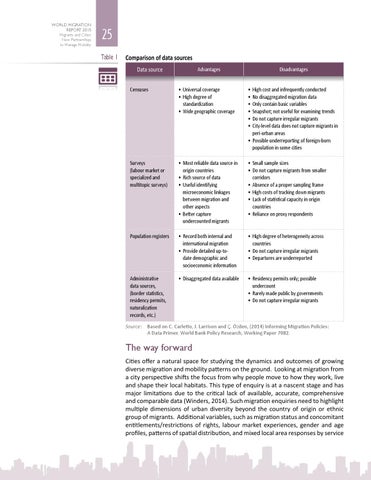
Comparison of data sources Data source
Advantages
Disadvantages
Censuses
• Universal coverage • High degree of standardization • Wide geographic coverage
• High cost and infrequently conducted • No disaggregated migration data • Only contain basic variables • Snapshot; not useful for examining trends • Do not capture irregular migrants • City-level data does not capture migrants in peri-urban areas • Possible underreporting of foreign-born population in some cities
Surveys (labour market or specialized and multitopic surveys)
• Most reliable data source in origin countries • Rich source of data • Useful identifying microeconomic linkages between migration and other aspects • Better capture undercounted migrants
• Small sample sizes • Do not capture migrants from smaller corridors • Absence of a proper sampling frame • High costs of tracking down migrants • Lack of statistical capacity in origin countries • Reliance on proxy respondents
Population registers
• Record both internal and international migration • Provide detailed up-todate demographic and socioeconomic information
• High degree of heterogeneity across countries • Do not capture irregular migrants • Departures are underreported
Administrative data sources, (border statistics, residency permits, naturalization records, etc.)
• Disaggregated data available
• Residency permits only; possible undercount • Rarely made public by governments • Do not capture irregular migrants
Source: Based on C. Carletto, J. Larrison and Ç. Özden, (2014) Informing Migration Policies: A Data Primer. World Bank Policy Research, Working Paper 7082.
The way forward Cities offer a natural space for studying the dynamics and outcomes of growing diverse migration and mobility patterns on the ground. Looking at migration from a city perspective shifts the focus from why people move to how they work, live and shape their local habitats. This type of enquiry is at a nascent stage and has major limitations due to the critical lack of available, accurate, comprehensive and comparable data (Winders, 2014). Such migration enquiries need to highlight multiple dimensions of urban diversity beyond the country of origin or ethnic group of migrants. Additional variables, such as migration status and concomitant entitlements/restrictions of rights, labour market experiences, gender and age profiles, patterns of spatial distribution, and mixed local area responses by service