WORLD HUMANITARIAN DATA AND TRENDS 2015
WORLD HUMANITARIAN DATA AND TRENDS 2015
Introduction World Humanitarian Data and Trends presents globaland country-level data-and-trend analysis about humanitarian crises and assistance. Its purpose is to consolidate this information and present it in an accessible way, providing policymakers, researchers and humanitarian practitioners with an evidence base to support humanitarian policy decisions and provide context for operational decisions. The information presented covers two main areas: humanitarian needs and assistance in 2014, and humanitarian trends, challenges and opportunities. This edition also features a new section on regional perspectives, which showcases region-specific trends identified by OCHA’s regional offices. The report intends to provide a comprehensive picture of the global humanitarian landscape, and to highlight major trends in the nature of humanitarian crises, their drivers, and the actors that participate in prevention, response and recovery. The 2015 edition builds on previous iterations of the report, providing an overview of 2014 as well as selected case studies that can be used for humanitarian advocacy. There are many gaps in the available information due to the complexity of humanitarian crises. Even the concepts of humanitarian needs and assistance are flexible. There are also inherent biases in the information. For example, assistance provided by communities and by local and national Governments is less likely to be reported. The outcomes and impact of assistance are difficult to measure and rarely reported. Funding data is more available than other types of information. There are also limitations on the availability and quality of data. Further information on limitations is provided in the ‘User’s Guide’. The data presented in this report is from a variety of source organizations with the mandate, resources and expertise to collect and compile relevant data, as well as OCHA-managed processes and tools, such as the inter-agency appeal process and the Financial Tracking Service (FTS). All the data presented in this report is publicly available through the source organizations and through the report’s own data set. Further information on data sources is provided in the ‘User’s Guide’. World Humanitarian Data and Trends is an initiative of the Policy Analysis and Innovation Section of
ii
OCHA’s Policy Development and Studies Branch (PDSB). This report is just one part of OCHA’s efforts to improve data and analysis on humanitarian situations worldwide and build a humanitarian data community. This edition was developed with internal and external partners, whose contributions are listed in the ‘Sources and References’ section. OCHA extends its sincere gratitude to all those partners for their time, expertise and contributions.
Interpreting the visuals and data The report uses many visual representations of humanitarian data and trends. There is also some limited narrative text and analysis, which provides basic orientation and helps to guide individual interpretation. However, there may be multiple ways to interpret the same information. The ‘User’s Guide’ contains more detailed methodological information and specific technical notes for each figure. Readers are encouraged to refer to the technical notes for more detailed descriptions of decisions and assumptions made in presenting the data. For the latest information on needs and funding requirements for current strategic response plans or inter-agency appeals, see fts.unocha.org.
Accessing the data All the data presented in this report can be downloaded through the Humanitarian Data Exchange (https://data.hdx.rwlabs.org/). The report can be explored through its interactive companion microsite www.unocha.org/humanity360.
Contents Highlights
2
The year in review – 2014 Humanitarian assistance in 2014 Overall funding, capacity and reporting
6
Humanitarian needs: inter-agency appeals, funding and visibility Inter-agency appeal analysis and public awareness
8
Humanitarian needs: sector funding Funding per sector, CERF contributions per sector
14
Conflict in 2014 Overall numbers of refugees, IDPs and asylum seekers; number of political conflicts
16
Natural disasters in 2014 Overall trends in natural disasters, number of affected people and cost of disasters
18
Global landscape Migration, global demographics, health, technology, gender-based violence and poverty 20 Issues of increasing concern Statelessness, forced labour and human trafficking
22
Regional perspectives Responding to natural disasters in the Asia-Pacific region 26 Initial response and key immediate needs 28 The impact of conflict on humanitarian action in the Middle East and North Africa Regional overview and country pages: Afghanistan, Iraq, Libya, oPt, Pakistan, Syria, Yemen 30 Regional refugee-hosting countries in focus Egypt, Lebanon, Jordan, Turkey
39
Trends, challenges and opportunities The cost of humanitarian assistance The evolution of the Central Emergency Response Fund The evolution of country-based pooled funds Funding trends: where does the money come from? The humanitarian-development nexus in protracted crises Measuring impact: the case of Darfur Long-term trends in natural disasters Long-term trends in conflict Vulnerability and cycles of internal displacement Disaster-related displacement and middle-income countries The impact of explosive weapons on civilian populations The use of improvised explosive devices The data deficit: the case of East Africa Online volunteer coordination: the Ebola emergency Innovative tools for data coordination and collection Social media and humanitarian disasters: Typhoon Ruby Perceptions about humanitarian action
42 44 46 48 52 54 58 60 62 64 66 68 70 72 74 76 78
User’s guide Limitations, technical notes by figure, sources and references
84
1
Highlights
1
The humanitarian community is doing more, for more people 2014 was a record year on many fronts. The humanitarian community2 targeted more people than ever before (76 million) and it received more funding than even before ($10.8 billion through interagency appeals, $24.5 billion overall). Development indicators (page 52) in the six crises with continuous inter-agency appeals for 10 years or more, such as infant mortality rate and access to improved water sources, have improved as humanitarian spending per person has increased. However, not all records reached in 2014 had such a positive note. Four inter-agency appeals surpassed the billion-dollar mark (Iraq, South Sudan, the Syria Regional Refugee Response Plan and the Syria Humanitarian Assistance Response Plan), and the majority of funding requested and provided went to these mega-crises. The global funding gap was the largest to date, both in absolute terms ($7 billion) and percentage terms (40 per cent). The amount of funding requested through inter-agency appeals was also a record ($18 billion). Within the context of UN peace operations, humanitarian action became the costliest UN activity ($10 billion), with funding levels surpassing the budget of peacekeeping operations ($8 billion) (page 42).
2
received high levels of funding. However, Somalia ranked high in attention but its funding levels dropped by two percentage points.
Conflict, the absence of political solutions and vulnerability continued to drive protracted crises Protracted, conflict-driven emergencies continued to test the humanitarian community’s capacity. In total, 59.5 million were displaced by conflict or violence, with an average 30,000 new displacements per day. Between 2011 and 2014, nearly 145,000 deaths and injuries were recorded from the use of explosive weapons; 78 per cent were civilians (page 66). The overall number of people affected by natural disasters or displaced by conflict increased to 200.5 million, more than 50 million compared with 2013. Global conflict trends were even more dramatic in the Middle East and North Africa region (page 30). This was the only region in the world to experience an increase in high-intensity conflicts, reaching a record 14 in 2014. Further, the number of IDPs in the region more than doubled in five years, from 6.7 million to 15.6 million between 2009 and 2014. In the absence of political solutions, the region’s crises are likely to continue affecting the livelihoods, safety and resilience of communities.
Last year’s report introduced a metric to understand the level of public attention for different crises by calculating the ratio of ReliefWeb reports to web page visits. Using that same metric, it was possible to observe potential cases of donor fatigue and discrepancies with the widely held notion that funding follows public attention (page 8). For example, South Sudan ranked highly in terms of public attention and
Better analysis and new technologies are creating incentives to be more efficient and effective
1 All the information in this section is featured in infographics throughout the report. For specific sources, please refer to the appropriate figure as well as the ‘User’s Guide’. The most recent year for which complete data is available is 2014. Therefore, this publication is not intended to provide information on the status of current emergencies. Its aim is to track some of the root causes of today’s crises and understand the provenance of humanitarian requirements.
2 Humanitarian assistance involves a plethora of actors, from affected people and communities to local and national Governments, civil society and international aid organizations. Organizations account for what they do in varying ways, and the efforts of many actors may not be reported. This publication acknowledges the important contribution of all humanitarian actors, and uses the term ‘humanitarian community’ to denote those actors that receive international humanitarian funding.
The humanitarian community continued to innovate and find new ways to work more efficiently and effectively. During the Ebola crisis, digital
Highlights
Inter-agency appeals: funding requested and people targeted Figure A: Inter-agency appeals: funding requested and people targeted 19.5bn
Amount requested through 2005 to 2015appeals inter-agency US$ billion
82.5m People targeted at mid-year million
3.8bn
2015
2014
2013
2012
2011
2010
2009
2008
2007
2006
2005
26m
humanitarians established a Skype group (page 74) to assist information sharing. The group also facilitated the participation of non-traditional responders. Separately, online volunteers compiled information on healthcare facilities (page 72). The information was then mapped out to provide a comprehensive picture of existing healthcare facilities and released to support responders. Open-source tools, such as KoBoToolbox facilitated assessments by providing a template for data collectors and the capacity to share results in real-time and perform quick analysis. The use of social media to support humanitarian response also evolved: following Typhoon Ruby (page 76) in the Philippines, over 12,000 tweets were categorized to gain information about humanitarian aid, requests for help and locations of damage.
National Governments further demonstrated their commitment to build their capacity to undertake disaster management capacity. In the Asia-Pacific region, the number of countries with a formal disaster management authority continuously increased since 2006 to reach a record 26. Further, all of the 10 countries that had the highest numbers of disasters and disaster-affected people (page 58) had a formal disaster management authority. Despite these advances, the humanitarian community continued to experience challenges in truly understanding humanitarian need: measuring impact continues to be a challenge, and the lack of sex and age-disaggregated data makes it difficult to understand the special requirements of women and children in humanitarian situations. Data is patchy: a study of 10 countries in Africa (page 70) showed that at the national level, data was available for a wide range of development indicators (e.g. education, access to drinking water, mobile phone use) but there was barely any information available on disaster risk reduction or gender dimensions. In May 2016, humanitarians, policy-makers and affected people will meet at the World Humanitarian Summit. This presents a unique opportunity to support a move towards a new humanitarian paradigm – an Agenda for Humanity – driven by analysis, based on a full understanding of needs and risks, promoting collective outcomes and shared accountability, and leveraging each other’s comparative advantages to truly meet the needs of affected people.
Humanitarians also made headway in building programming based on data analysis: a study of 31 Central Emergency Response Fund (CERF) grants for Haiti and the Asia-Pacific region show that nearly 85 per cent of funding was used to support response in the food, WASH, health, shelter and logistics sector (page 28). This type of insight and analysis will lead to better programming and pre-positioning of supplies.
3
“ This year the UN marks its seventieth anniversary. Sadly, there is little time for reflection or celebration. More pressing are the competing demands and challenges fuelled by an upsurge in conflict, disease and human suffering ‌ the international community must rise to the moment.â€? Ban Ki-moon, UN Secretary-General, 2015
THE YEAR IN REVIEW, 2014
The year in review – 2014
Humanitarian assistance in 2014 In 2014, overall needs and requirements increased, putting even more strain on responders. Notwithstanding current crises, 2014 was a record year on many fronts: funding requirements ($18 billion), overall contributions ($24.5 billion), people targeted (76 million) and a 40 per cent funding gap. The size of the humanitarian community continued to expand: the number of jobs advertised through ReliefWeb and the number of hiring organizations increased by over 3,000 each. There was, however, a slight decrease in the number of organizations participating in inter-agency appeals. On a positive note, the number of incidents affecting aid workers decreased, potentially due to investments in security management.
Affected people
141 million affected people by natural disasters
59.5 million people forcibly displaced by violence and conflict
76 million
people targeted by inter-agency appeals
Sources: Aid Worker Security Database, ALNAP, CRED EM-DAT, FTS, OCHA, ReliefWeb, UNHCR
6
Humanitarian assistance in 2014
It is still difficult to gauge the impact of international humanitarian assistance. Compounding this challenge, information about national capacities and funding outside of traditional channels is not regularly captured or reported. Assistance is often measured in terms of funding, but this is not an accurate proxy for humanitarian need. Over the last year, there has been increased support for programming based on common risk analysis and more evidence-based decision-making, with platforms such as the Humanitarian Data Exchange facilitating openness and data sharing.
FIGURE 1
Funding Capacity
26,309 jobs advertised
International humanitarian funding $24.5 billion
4,480 global number of operational aid agencies
4,094 organizations
hiring through ReliefWeb
Top three advertised job categories Number of jobs Program/Project management 9,345 Monitoring and Evaluation 4,435 Media/Communications 2,446
OECD-DAC Donors
190 aid worker security
$16.8 billion
incidents in 2014
(represents 10.8% of ODA)
329 aid workers affected by security incidents in 2014
Non-DAC Donors $1.9 billion
International
on ReliefWeb
Private Donors $5.8 billion
667 humanitarian organizations participating in inter-agency appeals
Requirements for consolidated appeals $18 billion Funding for consolidated appeals $10.8 billion Per cent covered 60% Unmet requirements $7.2 billion
7
The year in review – 2014
Humanitarian needs – inter-agency appeals, funding and visibility In 2014, appeal funding requirements increased by 38 per cent compared with 2013. There have been eight new appeals since 2013, bringing the total to 27 in 2014. There were three level-three emergencies: Central African Republic (CAR), the Philippines (Super Typhoon Haiyan) and Syria. A record number of inter-agency appeals surpassed the billion-dollar mark (Iraq, South Sudan, the Syria Regional Refugee Response Plan and the Syria Humanitarian Assistance Response Plan). The majority of funding requested and provided went to these mega-crises. Iraq, South Sudan and the Syria response plans accounted for approximately 55 per cent of funding required and requested. Globally, the average amount of funding received per person increased by $28 to $182. In 2014, only four per cent of projects were gender-specific, showing no increase from previous years.
Country Country details details
Funds Funds requested/received requested/received
Awareness Awareness
Afghanistan
Requested Requested $406m $406m Funded Funded $309m $309m 76% 76% of of requirement requirement met met Targeted people 5 million Targeted people 5 million Funding Funding per per person person $62 $62
18,439 18,439
1,878 1,878 1:10 1:10
Burkina Faso
Requested Requested $99m $99m Funded Funded $41m $41m 41% 41% of of requirement requirement met met Targeted Targeted people people 1.3 1.3 million million Funding Funding per per person person $31 $31
748 748
3,468 3,468 1:5 1:5
Cameroon
Requested Requested $126m $126m Funded Funded $73m $73m 58% 58% of of requirement requirement met met Targeted Targeted people people 66 million million Funding Funding per per person person $12 $12
964 964
6,857 6,857 1:8 1:8
Central African Republic Requested Requested $555m $555m Funded Funded $379m $379m 68% 68% of of requirement requirement met met Targeted people 1.8 million Targeted people 1.8 million Funding Funding per per person person $210 $210
3,329 3,329
1:20 1:20
Chad
Requested Requested $618m $618m Funded Funded $227m $227m 37% 37% of of requirement requirement met met Targeted Targeted people people 2.1 2.1 million million Funding Funding per per person person $108 $108
Sources: FTS, inter-agency appeal documents, ReliefWeb, UNHCR
8
65,590 65,590
1,225 1,225
7,086 7,086 1:6 1:6
Humanitarian needs – inter-agency appeals, funding and visibility
Last year’s report introduced a metric to understand the level of public attention for different crises by calculating the ratio of reports to web page visits. Using that same metric, it was possible to observe potential cases of donor fatigue and discrepancies with the widely held notion that funding follows public attention. As with last year, South Sudan ranked highly in attention and funding. However, this was not the case for Somalia. That country continued to rank highly in attention, but its funding level dropped by 2 percentage points. The attention level on Afghanistan dropped by 4 points, but its funding level increased by 2 percentage points. The overall trend shows that while public interest can sometimes be aligned with funding, there is no direct correlation between attention and inter-agency appeal funding. FIGURE 2
Country details
Funds requested/received
Awareness
Democratic Republic of the Congo Requested $832m Funded $393m
3,134
47% of requirement met Targeted people 4.8 million Funding per person $82
32,210 1:11
Djibouti Requested $74m Funded $21m
235
28% of requirement met Targeted people 0.25 million Funding per person $84
1,950 1:9
Gambia Requested $18m Funded $4m
1,624
283
24% of requirement met Targeted people 0.25 million Funding per person $18
1:6
Haiti Requested $157m Funded $90m 57% of requirement met Targeted people 0.4 million Funding per person $227
996
16,567 1:17
0:0 Up
Down Same New compared to 2013
Amount requested
Amount received
Reports published
Web page visits
Ratio of reports to visits
9
The year in review – 2014
Country details
Funds requested/received
Awareness
Iraq Requested $1,113m Funded $819m 74% of requirement met
3,419
50,642
Targeted people 1 million Funding per person $819
1:15
Mali Requested $481m Funded $239m 50% of requirement met Targeted people 1.6 million Funding per person $149
1,906
19,104 1:11
Mauritania Requested $91m Funded $38m 41% of requirement met Targeted people 0.5 million Funding per person $71
2,242
544 1:5
Myanmar Requested $192m Funded $129m 67% of requirement met Targeted people 0.42 million Funding per person $306
1,200
14,658 1:13
Niger Requested $305m Funded $173m 57% of requirement met Targeted people 3.5 million Funding per person $49
5,616
955 1:6
Nigeria Requested $93m Funded $18m 19% of requirement met Targeted people 8.4 million Funding per person $2 Sources: FTS, inter-agency appeal documents, ReliefWeb, UNHCR
10
11,774
1,916 1:7
Humanitarian needs – inter-agency appeals, funding and visibility
Country details
Funds requested/received
Awareness
occupied Palestinian territory Requested $931m Funded $502m
25,215
2,837
54% of requirement met Targeted people 1.9 million Funding per person $264
1:9
Philippines
(Typhoon Haiyan and Zamboaga) Requested $789m Funded $475m 60% of requirement met Targeted people 3.06 million Funding per person $155
23,772
2,717 1:9
Republic of Congo Requested $14m Funded $5m 36% of requirement met Targeted people 0.01 million Funding per person $522
366
1,378 1:4
Sahel Region Requested $50m Funded $23m 47% of requirement met Targeted people 11.8 million Funding per person $2
n/a
n/a*
Senegal Requested $64m Funded $21m 33% of requirement met Targeted people 1.1 million Funding per person $19
5,009
787 1:7
0:0 Up
Down Same New compared to 2013
Amount requested
Amount received
Reports published
Web page visits
Ratio of reports to visits
* The ratio of reports to visits cannot be calculated for regional or multi-national responses because web page visits could be duplicated.
11
The year in review – 2014
Country details
Funds requested/received
Awareness
Somalia Requested $933m Funded $458m 49% of requirement met
47,591
1,635
Targeted people 2 million Funding per person $229
1:30
South Sudan Requested $1,802m Funded $1,595m 89% of requirement met Targeted people 3.8 million Funding per person $420
111,842
4,504
1:25
South Sudan Regional Refugee Response Plan (RRRP) (Ethiopia, Kenya, Sudan and Uganda) Requested $658m Funded $356m 54% of requirement met Targeted people 0.72 million Funding per person $497
n/a
n/a
Sudan Requested $986m Funded $547m 55% of requirement met Targeted people 6.9 million Funding per person $79 Sources: FTS, inter-agency appeal documents, ReliefWeb, UNHCR
12
2,935
26,592 1:10
Humanitarian needs – inter-agency appeals, funding and visibility
Country details
Funds requested/received
Awareness
Syria Humanitarian Assistance Response Plan (SHARP) Requested $2,256m Funded $1,123m
5,455
78,432
50% of requirement met Targeted people 10.8 million Funding per person $104
1:15
Syria Regional Response Plan (RRP) Requested $3,741m Funded $2,333m 62% of requirement met Targeted people 6.6 million Funding per person $354
n/a
n/a
Yemen Requested $596m Funded $349m 59% of requirement met Targeted people 7.6 million Funding per person $46
1,128
14,998 1:14
0:0 Up
Down Same New compared to 2013
Amount requested
Amount received
Reports published
Web page visits
Ratio of reports to visits
13
The year in review – 2014
Humanitarian needs – sector funding 2014 saw a repeating pattern in terms of sector funding. Multisectoral programmes and the food-assistance sector continued to have the largest funding requests. Food assistance is generally the best-funded sector, but coordination and support services was the best-funded sector in 2014. It received a similar funding level in 2013 (77 per cent), so this change in pattern reflects decreasing funding levels for emergency food aid rather than increased support for coordination.
Agriculture
Coordination and support services
Economic recovery and infrastructure
Education
45%
75%
29%
35%
609
42
272 12%
15% 22
650
5,517
491 3%
699
1% 3,144
8% 753 353
52%
57%
47%
Mine action
Multi-sector
Protection/ human rights
Sources: CERF, inter-agency appeal documents, FTS
14
203 1%
518 179 4%
49% 24 3
1,267
14%
Safety and security (staff and operations)
Sector not specified
Humanitarian needs – sector funding
The Central Emergency Response Fund (CERF) comprised 4 per cent of the total funding available in 2014 ($412 million). This marked a slight decrease compared with 2013, when CERF contributed $482 million. Its largest contribution in absolute terms went to emergency food assistance ($109 million), and its largest contribution in percentage terms (49 per cent) went to one of the worst-funded sectors: safety and security of staff and operations. In 2014, only $6 million of CERF funding went towards projects addressing gender-based violence. FIGURE 3
Food
Health
66%
51%
4,426 2,909 4%
2,024
1,025 7%
60%
Per cent funded
4%
$10.8bn $18bn
1,798
12% 476
26%
12% 987 468
KEY
47%
CERF % of total funds Total funded (US$m)
Total requested (US$m)
Percentage funded
Shelter and NIFs
Water and sanitation
Comparison to 2013
Up
Down
No change
15
The year in review – 2014
Conflict in 2014 Forty-six extremely violent political conflicts took place in 2014, marking an increase of one compared to 2013. The total number of political conflicts increased by 10 to 424. The overall number of refugees and people forcibly displaced by violence or conflict increased by 8.3 million to reach a staggering 59.5 million people worldwide. The number of internally displaced persons (IDPs) increased by roughly 15 per cent to reach a new high of 38.2 million. There were
Number of people affected by conflict
Number of individuals forcibly displaced because of persecution, conflict, generalized violence or human rights violations.
38.2 million Internally Displaced Persons (IDPs)
59.5 million
Top five countries: total number of IDPs, 2014
Syria 3.88 million Top five countries: highest refugee-producers
19.5 million Refugees
1.8 million Asylum-seekers
Sources: Heidelberg Institute for International Conflict Research, Institute for Economics and Peace, IDMC, UNHCR
16
Afghanistan 2.59 million
Somalia 1.11 million Sudan 666,000 South Sudan 616,200
Conflict in 2014
approximately twice as many IDPs as refugees. Protracted crises in five countries—Democratic Republic of the Congo (DRC), Iraq, Nigeria, South Sudan and Syria—accounted for 60 per cent of new IDPs. In 2014, 51 per cent of refugees were under 18 years. The proportion of of refugee girls and women has gradually increased from 48 per cent in 2011 to 50 per cent in 2014.
FIGURE 4 Iraq 2.7 million Top five countries: number of new IDPs, 2014
South Sudan 1.3 million
60%
Syria 1.1 million Democratric Republic of Congo 1 million Nigeria 0.9 million
new displacements
Syria 7.6 million Colombia 6 million
56%
Iraq 3.3 million of the world’s IDPs
Democratic Republic of the Congo 2.7 million Pakistan 1.9 million
45% of the world’s refugees
Economic cost of conflict
Number of conflicts* Political conflicts
424
Violent crises
177
Highly violent crises
46
$14.3 trillion equivalent to 13.4% of global GDP
* For a description of conflict intensity, see technical note and Heidelberg Institute for International Conflict Research.
17
The year in review – 2014
Natural disasters in 2014 Roughly the same number of natural disasters occurred in 2014 as in 2013. However, the number of affected people increased from 97 million in 2013 to 141 million in 2014. This could be explained by an increase in the number of droughts. This was the only disaster category that registered an increase in 2014, and droughts accounted for 39 per cent of affected
Number of natural disasters
Number of countries affected
Number of affected people
Total damage
319
107
141 million
$110 billion
Top five costliest disasters
Top five countries by number of people affected China
US$ billions
7
Philippines
Cyclone Hudhud
10 million India
5
India
Drought
5.7 million Burkina Faso
Brazil
Japan
4 million Sri Lanka
58 million Same
5.1
5
3 million New − compared to 2013
5.9
Winter damage
Earthquake
Floods
China
India, Pakistan
Occurrence of disaster types Flood
Storm
184 95
Earthquake 25 Drought 20 2010 Sources: CRED EM-DAT, MunichRE
18
155
137
84
90
30
29
16
16
2011
2012
148 106 28
135 100 49 35
9 2013
2014
Natural disasters in 2014
people. In terms of mortality, floods and landslides accounted for 63 per cent of fatalities. Forty-eight per cent of disasters occurred in Asia. Over 85 per cent of people killed and 86 per cent of those affected were also in Asia. As in 2013, China, the Philippines and India remained the top three countries in terms of the number of people affected.
FIGURE 5
Number of people affected by natural disaster per region
Numbers of disasters per region
millions 0.2
2.9 9
7.7
Oceania 33.3
39
Europe Africa
52
144
Americas 97.9
Asia 75
Type of disasters per region ania Oce pe Euro Asia s erica Am rica Af
Drought
Earthquake
Flood
Storm
19
The year in review – 2014
Global landscape Conflicts and natural disasters have been seen as the main drivers of humanitarian need. They are often treated as discrete events, with little analysis of the underlying causes and warning signs. Today, the humanitarian landscape is changing more rapidly than ever. Global risks are recognized as increasingly central to humanitarian crises. They can make people more vulnerable and prevent them from building the resilience necessary to cope with shocks. The protracted and recurrent crises we see around the world today are a direct result of this vulnerability. In some cases, this
Food security
Gender-based violence
Pandemics
BASELINE: Of the world’s 570 million farms, 9 out of 10 are run by families. Family farms produce about 80 per cent of the world’s food. By 2014, approximately 805 million people were chronically undernourished, down more than 100 million over the last decade.
BASELINE: One in every three women has been beaten, coerced into sex or abused in some other way, frequently by someone she knows. Globally, up to 38 per cent of murders of women are committed by an intimate partner. Six-hundred million women globally are living in countries where domestic violence is still not considered a crime.
BASELINE: By the end of 2014, there were 12,861 confirmed cases of Ebola in Guinea, Liberia, and Sierra Leone. About 75 per cent of new human diseases are caused by microbes that originate in animals.
PROJECTION: In 2050, global food production will have to increase by 60 per cent from its 2005-2007 levels to meet increasing demand by the world’s projected population of 9.7 billion.
PROJECTION: One in five women worldwide will become a victim of rape or attempted rape in her lifetime. The majority of these victims will be young women.
PROJECTION: Pandemics such as Ebola, MERS, HIV/AIDS and SARS will continue to be spurred by population growth, increased global trade and travel, global warming and poverty. Methods for dealing with pandemics will need to change from reactive to proactive to manage the threat.
Climate change
Diaspora
Economy
BASELINE: No year since 1880 has been as warm as 2014. In 2014, 48 per cent of disasters occurred in Asia. In East Asia and the Pacific, the number of people exposed to floods and tropical cyclones has increased by 70 per cent since 1980.
BASELINE: Remittances constitute the second largest source of foreign capital (after foreign direct investment). In 2014, 245 million migrants sent half a trillion dollars to their countries of origin, supporting on average 4.5 people each and affecting over 1 billion people worldwide.
BASELINE: In 2014, global Gross Domestic Product (GDP) was $77.87 trillion, with an annual growth of 2.6 per cent. Inequality has reached unsurpassed levels: the richest 1 per cent of people own 48 per cent of global wealth. Of the remainder, 94.5 per cent is owned by the world’s richest 20 per cent, leaving 5.5 per cent of global wealth to be distributed among 80 per cent of the world’s population.
PROJECTION: Climate change may reduce raw water quality and pose risks to drinking water quality, even with conventional treatment. Climate change without adaptation will negatively affect crop production for local temperature increases of 2°C or more. Future annual losses due to disasters are estimated at $314 billion in built environments.
PROJECTION: Diaspora groups are as diverse as the communities they serve, and there is not enough data to understand the capacities and role of the diaspora. In the humanitarian context, diaspora could become a key aid partner.
PROJECTION: Increasing inequality will result in the 1 per cent having more wealth than 99 per cent of the global population in the next two years. Global GDP is expected to increase to 3.1 per cent in 2016.
Sources: CRED, DESA, FAO, Global Slavery Index 2014, ILO, IOM, ITU, Millennium Development Goals Progress Report, NRC, Oxfam, UNHCR, UNISDR, UNDP, UNESCO, UNODC, UN Women, USAID, WHO, World Bank
20
Gobal landscape
vulnerability is exacerbated by the absence of a political solutions to conflicts. The humanitarian community has placed renewed emphasis on better understanding the drivers of crises, to move towards an evidence-based model where the root causes of humanitarian need are better understood and, therefore, the humanitarian community can serve affected people in a more effective way.
FIGURE 6
Health
Urbanization
Population
BASELINE: Since 1990, the mortality rate for children under age 5 has declined by approximately 50 per cent. Maternal mortality has declined by 45 per cent. Pneumonia and diarrhoea account for 70 per cent of deaths in 15 countries, all of them in sub-Saharan Africa and Asia. Pneumonia kills 2,600 children a day.
BASELINE: In 2014, approximately 3.8 billion people lived in urban areas. Fifty-three per cent of the world’s urban population lived in Asia, followed by Europe (14 per cent) and Latin America and the Caribbean (13 per cent).
BASELINE: In 2014, the world's population was 7.2 billion people. Global population is increasing at a slower rate than 10 years ago, by 1.18 per cent annually, or 83 million people a year. PROJECTION: By 2050, the world's population will increase to 9.7 billion people. More than half of the global increase will be in nine countries: DRC, Ethiopia, India, Indonesia, Nigeria, Pakistan, Tanzania, Uganda and the USA.
PROJECTION: Unless early action is taken, preventable diseases will continue to be the main causes for the deaths of children under age 5.
PROJECTION: By 2050, 66 per cent of the world’s population could live in urban areas, adding 2.5 billion people to urban populations. China, India and Nigeria are expected to account for 37 per cent of the world’s urban population growth between 2014 and 2050.
Migration
Technology
Poverty
BASELINE: In 2014, over 22,000 migrants died en route to Europe. Of the 232 million global migrants, 72 million live in Europe. Youths aged between 15 and 24 account for approximately 12 per cent of international migrants.
BASELINE: In 2014, there were 6.9 billion mobile telephone subscriptions. For every Internet user in the developed world, there are two in the developing world. However, two thirds of the population living in developing countries remain offline. Seventy-seven per cent of Twitter accounts were for users outside the United States.
BASELINE: In 2014, an estimated 863 million people lived in slums, the majority in sub-Saharan Africa (approximately 200 million).
PROJECTION: Family migration is the main and largest channel of entry for migrants, and it has great impact on human and economic development. Greater attention to coherent policy is necessary to assess the potential of the family unit in international migration, as well as protection challenges.
PROJECTION: By the end of 2015, there will be 7 billion mobile telephone subscriptions, 5.5 billion of which will be from developing countries. There will be 3.2 billion Internet users, 2 billion of whom will be from developing countries.
PROJECTION: By 2030, approximately 3 billion people will need adequate housing. To meet this, 96,150 housing units need to be completed per day from now until 2030.
Increasing concern No change in concern Decreasing concern
21
The year in review – 2014
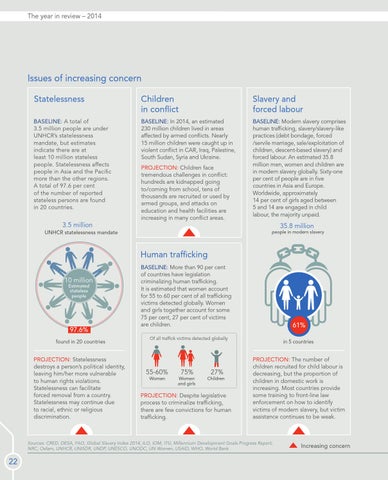
Issues of increasing concern Statelessness
Children in conflict
Slavery and forced labour
BASELINE: A total of 3.5 million people are under UNHCR’s statelessness mandate, but estimates indicate there are at least 10 million stateless people. Statelessness affects people in Asia and the Pacific more than the other regions. A total of 97.6 per cent of the number of reported stateless persons are found in 20 countries.
BASELINE: In 2014, an estimated 230 million children lived in areas affected by armed conflicts. Nearly 15 million children were caught up in violent conflict in CAR, Iraq, Palestine, South Sudan, Syria and Ukraine.
BASELINE: Modern slavery comprises human trafficking, slavery/slavery-like practices (debt bondage, forced /servile marriage, sale/exploitation of children, descent-based slavery) and forced labour. An estimated 35.8 million men, women and children are in modern slavery globally. Sixty-one per cent of people are in five countries in Asia and Europe. Worldwide, approximately 14 per cent of girls aged between 5 and 14 are engaged in child labour, the majority unpaid.
3.5 million
PROJECTION: Children face tremendous challenges in conflict: hundreds are kidnapped going to/coming from school, tens of thousands are recruited or used by armed groups, and attacks on education and health facilities are increasing in many conflict areas.
35.8 million
UNHCR statelessness mandate
people in modern slavery
Human trafficking 10 million Estimated stateless people
97.6% found in 20 countries
PROJECTION: Statelessness destroys a person’s political identity, leaving him/her more vulnerable to human rights violations. Statelessness can facilitate forced removal from a country. Statelessness may continue due to racial, ethnic or religious discrimination.
BASELINE: More than 90 per cent of countries have legislation criminalizing human trafficking. It is estimated that women account for 55 to 60 per cent of all trafficking victims detected globally. Women and girls together account for some 75 per cent, 27 per cent of victims are children.
61%
Of all traffick victims detected globally
55-60% Women
75%
Women and girls
27%
Children
PROJECTION: Despite legislative process to criminalize trafficking, there are few convictions for human trafficking.
in 5 countries
PROJECTION: The number of children recruited for child labour is decreasing, but the proportion of children in domestic work is increasing. Most countries provide some training to front-line law enforcement on how to identify victims of modern slavery, but victim assistance continues to be weak.
Sources: CRED, DESA, FAO, Global Slavery Index 2014, ILO, IOM, ITU, Millennium Development Goals Progress Report, NRC, Oxfam, UNHCR, UNISDR, UNDP, UNESCO, UNODC, UN Women, USAID, WHO, World Bank
22
Increasing concern
200.5 million people were affected by natural disasters or displaced by conflict and violence.
Conflict and violence displaced 30,000 people per day. Over 22,000
migrants died en route to Europe.
77 per cent of Twitter accounts were for users outside the United States. Within the context of UN peace operations, humanitarian action was the costliest activity, surpassing the peacekeeping budget by $2
billion.
The cost of global conflict was estimated at $14.3
trillion.
19.3 million people were displaced by natural disasters; 91 per cent of this displacement was due to weather-related events. Civilians comprised 78 per cent of the almost 145,000 deaths and injuries caused by explosive weapons between 2011 and 2014. Since 2006 85 per cent of CERF funding in Asia-Pacific has been used primarily to fund 5 sectors: food, WASH, health, shelter and logistics. Between 2009 and 2014, the number of IDPs in the Middle East and North Africa region
more than doubled from 6.7 million to 15.6 million.
Women accounted for 55
to 60 per cent of all human trafficking victims.
Only 4 per cent of projects in inter-agency appeals were gender-specific, showing no increase from previous years.
facts2014 2014 KeyKey facts
“ To reaffirm humanity, we must also counteract the politicization of aid. In today’s conflicts, life-saving assistance, like access to water or healthcare, is often used as a tool or a weapon ... All humanitarian action must seek not only to end suffering and meet immediate needs, but to keep people safe from harm and enable them to live with dignity.” Stephen O’Brien, Emergency Relief Coordinator and Under-Secretary-General for Humanitarian Affairs, 2015
USER’S GUIDE 83
User’s Guide
User’s Guide Limitations
Technical notes
This report is intended to provide a comprehensive overview of global humanitarian data and trends. However, there are many gaps and inconsistencies in the information available. There is no single, comprehensive source of humanitarian information and data. There are no widely used standards for measuring humanitarian needs or response, even less so for measuring the longterm effectiveness of assistance. And there are no agreed definitions of humanitarian needs or assistance.
Countries
Humanitarian emergencies and their drivers are extremely complex. By definition, crises are chaotic. They arise due to the interrelationships between multiple causes, which are not easily measured or understood. Political and practical difficulties can prevent the collection and sharing of information about humanitarian needs and assistance. Humanitarian assistance involves a plethora of actors, from affected people and communities to local and national Governments, civil society and international aid organizations. Organizations account for what they do in varying ways, and the efforts of many actors are not reported at all. Some humanitarian actors may not be willing or able to share the information they collect, which often leads to biases or gaps in the information available. There are also technical limitations that affect the availability, consistency, reliability and comparability of data. There is a lack of common standards for data and sharing protocols, and statistical systems in many countries are still weak. Statistical methods, coverage, practices and definitions differ widely. Comparison between countries and across time zones involves complex technical and conceptual problems that cannot be resolved easily or unequivocally. Data coverage may not be complete because of special circumstances affecting the collection and reporting of data, such as problems arising from conflicts. These factors are more prominent in countries that are experiencing or vulnerable to major humanitarian emergencies. Because of these limitations, the data presented in this report should only be interpreted to indicate major trends and characterize major differences between emergencies and countries. Readers should consult the original sources for detailed information on the limitations of the data.
84
The term “country” refers to any territory for which authorities or other organizations report separate statistics. It does not necessarily imply political independence.
Regions and country groupings Regional groupings are based on the World Bank’s classification of major world regions: East Asia and Pacific, Europe and Central Asia, Latin America and the Caribbean, Middle East and North Africa, South Asia, and sub-Saharan Africa. Income groups are based on the World Bank’s classification http://data.worldbank.org/about/country-classifications. Countries are divided according to annual GNI per capita, calculated using the World Bank Atlas method. In 2014, these income cut-offs are low income, US$1,045 or less; lower-middle income, $1,046–$4,125; upper-middle income, $4,126 - $12,736; and high income, $12,736 or more. Low-income and lower-middle-income countries are sometimes referred to as “developing countries”.
Humanitarian funding Humanitarian aid/humanitarian assistance – This includes the aid and actions designed to save lives, alleviate suffering, and maintain and protect human dignity during and following emergencies. The characteristics that separate this from other forms of assistance are 1) it is intended to be governed by the principles of humanity, neutrality, impartiality and independence; 2) it is intended to be short term in nature and provide for activities during and in the immediate aftermath of an emergency. In practice, these phases are difficult to define, especially in protracted emergencies or situations of chronic vulnerability. Humanitarian aid can also include risk reduction, preparedness activities and recovery. Humanitarian aid is given by Governments, individuals, NGOs, multilateral organizations, domestic organizations and private companies. Different actors have different definitions of “humanitarian”, and some may not differentiate humanitarian aid from other forms of assistance. For the purposes of this report, aid is considered to be humanitarian if it is reported as such by the actor that provides it.
Limitations and technical notes
Humanitarian aid contributions from Governments in this report include: 1. The humanitarian aid expenditures using data from the OECD DAC and FTS. The 29 OECD DAC members1 and some non-members report annually on Official Development Assistance (ODA) flows to OECD. Reports include bilateral humanitarian aid contributions plus ODA flows to multinational organizations. 2. Funding through inter-agency appeals reported by donors to FTS. Data is in current prices. Official Development Assistance – This comprises a grant or loan from an official source to a developing country (as defined by OECD) or multilateral agency (as defined by OECD) to promote economic development and welfare. It is reported by DAC members, along with several other Government donors and institutions, according to strict criteria. Humanitarian aid typically accounts for about 10 per cent of total ODA each year.
Humanitarian inter-agency appeals To raise money for humanitarian activities, humanitarian organizations often issue appeals or strategic response plans (post-2013). Appeals may contain information on the number of people affected by emergencies and their needs, the proposed activities to respond to those needs and the funding required. To respond to ongoing crises or after a major emergency, humanitarian organizations may participate in an inter-agency appeal process. This brings aid organizations together to jointly plan, coordinate, implement and monitor their emergency response. At the country level, the Humanitarian Coordinator leads the process, in collaboration with the Humanitarian Country Team. Types of inter-agency appeals include:
2. Flash appeals, which are used to structure a coordinated humanitarian response for the first three to six months of an emergency. Flash appeals are issued within one week of an emergency and are triggered by the Humanitarian Coordinator in consultation with all stakeholders. The appeal provides a concise overview of urgent life-saving needs and may include recovery projects that can be implemented within the appeal’s time frame. For the purposes of this report, the term “inter-agency appeals” is used to denote, interchangeably, consolidated appeals, strategic response plans, flash appeals and other appeals that follow similar principles and processes (such as joint Government-UN plans). See www.humanitarianresponse.info/programme-cycle/space.
Years, symbols and conventions • 2014 is the most recent year for which complete data was available at the time of publication. Where 2014 data is not available, the latest year is shown and this is noted. • A dash (-) means that data is not available or that aggregates cannot be calculated because of missing data in the years shown. • 0 or 0.0 means zero or small enough that the number would round to zero at the number of decimal places shown. • A billion is 1,000 million.
1. Strategic response plans (formerly known as consolidated appeals), which are used when several organizations appeal together for funds for the same crisis. Aid organizations use the strategic response process to plan, coordinate, fund, implement and monitor their activities. A strategic response plan can be issued for one year or more. Projects included can be planned for more than a year, but their budgets must be broken into 12-month periods.
1 Australia, Austria, Belgium, Canada, Czech Republic, Denmark, Finland, France, Germany, Greece, Iceland, Ireland, Italy, Japan, Korea, Luxembourg, the Netherlands, New Zealand, Norway, Poland, Portugal, Slovak Republic, Slovenia, Spain, Sweden, Switzerland, the United Kingdom, the United States and the European institutions
85
User’s Guide
Technical notes by figure The year in review 2014 Humanitarian assistance in 2014 Figure 1. The overall number of people targeted for assistance through inter-agency appeals is derived from the Global Humanitarian Overview: Status Report August 2014. This number is different from numbers reported in the Global Humanitarian Assistance Report 2015 and the Global Overview of Humanitarian Needs 2014, as there are variations in the data used for those analyses. The number of people forcibly displaced by violence and conflict reflects the findings contained in UNHCR’s annual Global Trends Report (2014) and IDMC’s Global Overview 2015: People internally displaced by conflict or violence and Global Estimates 2015: People internally displaced by disasters. The number of people affected by natural disasters is sourced from the Centre for Research on the Epidemiology of Disasters International Disaster Database (CRED EMDAT). Funding figures for international humanitarian assistance reflect the findings of the Global Humanitarian Assistance Report 2015.
Humanitarian needs – inter-agency appeals, funding and visibility Figure 2. The numbers for this figure are derived from crisis-specific midyear reviews or the Global Humanitarian Overview: Status Report August 2014 (whichever was most recent), with the exception of Afghanistan, Cameroon, DRC, Djibouti, Haiti, oPt, Sahel Region, Syria Humanitarian Response Plan and Yemen, where no midyear review was available. Figures for these countries were taken from the original planning documents. The figure for ‘People to receive help/people targeted’ for Cameroon was taken from the sectoral response plans contained in the Strategic Response Plan 2014-2016. Any discrepancies in figures are due to rounding up/down. Data for funding received was sourced from FTS. The amounts under the heading ‘Funding per targeted person’ were calculated using data from FTS (data captured 1 August 2015) divided by ‘people targeted’. Original planning for the Syria Regional Response Plan (RRP) predicted 4.1 million refugees by the end of 2014. An additional 2.7 million people in host communities would also benefit from the RRP. This report uses the actual number of refugees registered and assisted by UNHCR by the end of 2014, i.e., 3.9 million plus the 2.7 million people envisioned to receive help in host communities. The level of attention an appeal receives was derived using data from ReliefWeb, namely by calculating the ratio
86
between the number of reports published on a particular country to the number of web page visits for that country. This metric is merely an approximation of public interest, since it is based on a single source (ReliefWeb), albeit a prime information source for humanitarian practitioners.
Humanitarian needs – sector funding Figure 3. Sectors are reflective of the ‘Criteria for inclusion of reported humanitarian contributions into the Financial Tracking Service database, and for donor/appealing agency reporting to FTS’. Full descriptions of the sectors and activities are at http://fts.unocha.org/exception-docs/ AboutFTS/FTS_criteria_for_posting_contributions.pdf. For CERF funding, logistics, support services and telecoms have been folded into the overall Coordination and Support Services sector. For all funding, coordination support services - other, logistics and the UN Humanitarian Air Service have been folded into the overall Coordination and Support Services sector. Camp management has been folded into Shelter and NFI. The Health sector includes nutrition.
Conflict in 2014 Figure 4. The number of highly violent political conflicts is defined per the methodology used in the Conflict Barometer of the Heidelberg Institute for International Conflict Research. A political conflict is defined as “a positional difference, regarding values relevant to a society … between at least two assertive and directly involved actors” carried out through conflict measures beyond normal regulatory procedures. A highly violent political conflict (a “limited war” or “war”, for definition see www.hiik.de/en/) is determined through five proxies: (i) weapons, (ii) personnel, (iii) casualties, (iv) refugees, and (v) IDPs and destruction. For more detailed information, see www.hiik.de/en/. Of the 424 political conflicts in 2014, 223 involved the use of violence. This figure is subdivided into violent crises and highly violent conflicts. Highly violent conflicts include 25 limited wars and 21 wars. Unlike UNHCR, when calculating the top refugee-producing countries, this report takes into account the number of refugees being assisted by UNRWA. As such, there is a discrepancy between the figure presented in this report (56 per cent of refugees come from 5 countries, based on 19.5 million refugees worldwide) and that presented by UNHCR in its report Global Trends 2014: World at War (53 per cent of refugees come from 3 countries, based on 14.4 million refugees under UNHCR’s mandate).
Technical notes by figure
Natural disasters in 2014 Figure 5. The data in this figure is for disasters associated with natural hazards. The total number of natural disasters does not include biological disasters, such as epidemics or insect infestations. The total number of disasters differs from the CRED EM-DAT Annual Disaster Statistical Review 2014, as it was downloaded directly from the database to showcase the most up-to-date information for 2014. The rest of the overall natural hazard information is sourced from the Statistical Review. To allow for ease of comparison between the graphs that map the occurrence and reporting of natural disasters, natural hazards are classified according to the natural disaster groupings used in ReliefWeb. These are earthquakes (including tsunamis), floods (including flash floods) and storms (including extra-tropical cyclone/winter storms, severe local storms, snow avalanches, storm surges and tropical cyclones).
Global landscape Issues of increasing concern Figure 6. Each baseline and predictive statistic is drawn from one or various sources. Users are encouraged to refer to the reference list and corresponding reports for the full descriptors and further statistics. The baseline statistic for poverty is for 2010. That is the last year for which the World Bank released poverty estimates (figures released in 2013). UNHCR only has data for the number of Stateless people in 75 countries. This means data is not available for 50 per cent of the world’s States. Stateless people from oPt are not included in statistical reporting. The Institute on Statelessness and Inclusion estimates 15 million Stateless people worldwide (UNHCR’s ‘at least 10 million’, plus 1.5 million Stateless refugees, plus 3.5 million Stateless oPt refugees). The numbers under slavery and forced labour are derived from ILO’s database and the Global Slavery Index.
Regional perspectives Responding to natural disasters in the Asia-Pacific region Figure 7. Data for these figures was provided by OCHA’s Regional Office for Asia and the Pacific, in coordination with country offices.
Initial response and key immediate needs Figure 8. Data for these figures was provided by OCHA’s Regional Office for Asia and the Pacific, in coordination with country offices.
Middle East and North Africa: regional overview and country pages Regional refugee-hosting countries in focus Figures 9 and 10. Data for these figures was provided by OCHA’s Regional Office for the Middle East and North Africa, in coordination with country offices. Data was completed by research at headquarters. Specific data sources and notations are as follows: • People affected by conflict: these were calculated by adding the number of IDPs and refugees residing in a country. For the regional overview, ‘people affected by conflict’ include the sum of IDPs and refugees living in all countries under the purview of OCHA’s Regional Office for the Middle East and North Africa (Afghanistan, Algeria, Bahrain, Egypt, Iran, Iraq, Jordan, Kuwait, Lebanon, Libya, Morocco, Oman, oPt, Pakistan, Saudi Arabia, Syria, Qatar, Tunisia, Turkey, United Arab Emirates and Yemen). Refugee figures reflect the number of refugees residing in a particular country, regardless of origin. The refugee figure includes both refugees covered under UNHCR’s mandate and reported through UNHCR’s statistical database plus Palestinian refugees under UNRWA’s mandate. The latter is applicable to Jordan, Lebanon and Syria, who are hosts to Palestinian refugees as reported by UNRWA. IDP figures were provided by the Internal Displacement Monitoring Centre (IDMC). When IDMC’s IDP figures are not available, UNHCR’s figures are used. All numbers in detail are available for download through the report’s dataset, www.unocha.org/humanity360. • Funding: inter-agency appeal information from FTS was used to determine levels of financial humanitarian assistance. Data was retrieved on 1 August 2015. There may be some discrepancies as figures in FTS continue to be updated. While primarily focusing on inter-agency appeals, when data was available, the amount of funding requested and received for each country’s portion of a regional response plan (RRP) is included in the calculation. The following countries were included in RRPs: • 2010 RRP for Iraqi refugees: Jordan, Lebanon, Syria, Region (Egypt, Iran, Turkey and the Gulf States) • 2011 Libya RRP: Libya, Egypt, Tunisia, Niger • 2013 Syria RRP: Egypt, Iraq, Jordan, Lebanon, Turkey • 2014 Syria RRP: Egypt, Iraq, Jordan, Lebanon, Turkey. Funding received by country for the 2010 RRP for Iraqi refugees was not available. The 2011 Libya RRP showed the breakdown of funding per country. The total RRP is thus shown under Libya.
87
User’s Guide
In an effort to provide as comprehensive a picture of humanitarian funding in the region, funding figures also show appeal-like processes reported through FTS, such as joint Government-UN appeals. In the regional overview, funding figures were obtained from FTS and inter-agency appeal documents for countries/ territories experiencing a humanitarian situation. These are Afghanistan, Egypt, Iraq, Jordan, Lebanon, Libya, oPt, Pakistan, Syria, Turkey and Yemen. The number of security incidents and aid workers affected were retrieved from the Aid Worker Security Database for these countries. There may be a discrepancy between figures reported to the Aid Worker Security Database and other security figures, such as those collected by the UN Department of Safety and Security with only focus on UN staff. The funding gap represents the percentage difference between funding requested and funding received. • Partnerships: the number of organizations participating in the inter-agency appeal denotes those humanitarian organizations (UN Agency, NGO, or Red Cross / Red Crescent) using the inter-agency appeal process/SRP to request funding for a specific project. These projects are included in FTS. The numbers of organization participating in inter-agency appeals were retrieved from FTS, with the exception of oPt. The OCHA oPt Country Office provided the number of humanitarian organizations participating in the CAP/SRP and these may differ from FTS. The numbers of international NGOs and national NGOs were reported by country teams to denote humanitarian organizations working to provide life-saving assistance and protection. Not all of these organization may participate in the inter-agency appeal. Country-specific notations on data are as follows: • Jordan, Lebanon and Syria: the refugee figures include refugees under UNHCR’s mandate and Palestinian refugees under UNRWA’s mandate. • Lebanon: no IDP figures are shown for coherence with strategic response plans. • Pakistan: for 2012 to 2014, the amount of people targeted and reached in the Agriculture Cluster is included in the Food Security Cluster. • Jordan: the numbers of people targeted and reached reflect the number of Syrian refugees targeted and assisted in Jordan per sector. In addition, a further 650,000 Jordanians were targeted and assisted in 2014, and 500,000 Jordanians were targeted and assisted in
88
2013. 2015 figures are for the first quarter of 2015. Targets have been adjusted, given that the initial targets assumed 1 million refugees would be in the country by the end of 2013 and 800,000 by the end of 2014. Total refugee arrivals were fewer than expected. • Syria: the numbers of people targeted and reached for each sector are derived from the SHARP’s ‘Sector Achievements’ in 2013 and 2014. The number of national NGOs represents those that are authorised by the Syrian Government to partner with UN agencies. However, this does not mean that they all effectively work as partners with the UN, due to security-, access- and capacity-related reasons. • Turkey: 2015 data current as of 31 March 2015. • Yemen: 2014 protection figures include gender-based violence and child protection. • oPt: 2013 figures as of midyear review. In 2014, 1.9 million people were reached through the SRP, with an additional 1.2 million reached through food distribution during the Gaza conflict.
Trends, challenges and opportunities The cost of humanitarian assistance Figure 11. The total number of people affected includes a sum of the total number of people affected by conflict globally and the total number of people affected by natural disasters in the world each year. The total number of people affected by conflict comprises the total number of IDPs (figures from IDMC Global Estimates 2014), asylum seekers and refugees (figures from UNHCR’s ‘Statistical Online Population Database’). The total number of people affected by natural disasters is sourced from CRED using the same criteria outlined in the technical note for figure 5. The total number of people targeted for assistance through inter-agency appeals is derived from OCHA midyear reviews. The yearly peacekeeping budget was used as a measure for the cost of peacekeeping operations. Data on the peacekeeping budget comes from the UN Documents System, which comprises all types of official United Nations documentation, including resolutions of the General Assembly, Security Council, Economic and Social Council and the Trusteeship Council from 1946. The system is accessible at http://documents.un.org/. The total amount of funding requested and received through inter-agency appeals is derived from FTS, specifically for appeals that have lasted at least a year.
Technical notes by figure
These figures were adjusted for inflation (rates from the International Monetary Fund). The costs for security of UN Field Operations are derived from UN budget documentation (programme planning) approved by the Fifth Committee for a given biennium. The costs are graphed on the year in which the biennium ends; for example, for the 2004-2005 fiscal biennium, the costs of security for field operations are plotted on the x-axis point for 2005. Budget documents are available at http://www.un.org/en/ga/fifth/. Funding for development activities is larger than humanitarian assistance; for example, in 2103 funding for UN development system amounted to $16 billion (A/70/62). For the purposes of this figure, development funding is excluded from calculations to allow a direct comparison between peace operations and humanitarian assistance, especially as conflict is a key driver of the latter. For more information of development funding see Quadrennial Comprehensive Policy Review http://www.un.org/en/ecosoc/. The length of peace operations was sourced from Einsiedel, Sebastian, Examining major recent trends in violent conflict, United Nations University, 2014. http://cpr.unu.edu/ examining-major-recent-trends-inviolent-conflict.html.
The evolution of pooled funds
of appeals, e.g., consolidated appeal overviews, chapeau of humanitarian appeals and country-specific strategic response plans. If there were discrepancies in the figures provided in the global overview and in country-specific midyear reviews, preference was given to the countryspecific plans. Data on development indicators (infantmortality rate, literacy, cereal yield and access to improved water sources) is available from the World Bank’s statistical database. Data for oil and energy prices was retrieved from the World Bank’s Commodity Markets outlook. Data for food price index was retrieved from FAO.
Measuring impact: the case of Darfur Figure 16. For the AU/UN Hybrid Operation in Darfur (UNAMID): the number of uniformed personnel includes military troops, police and the maximum number of formed police units authorized under the relevant Security Council resolutions, namely 1769 (2007), 1828 (2008), 1881 (2009), 1935 (2010), 2003 (2011), 2063 (2012), 2113 (2013) and 2173 (2014). Data on UNAMID’s budget comes from the General Assembly’s Fifth Committee’s resolutions on financing UNAMID. Note that appropriations run from 1 July to 30 June.
Long-term trends in natural disasters, 2004-2014
Figure 13. The word clouds only take into consideration the top five countries and sectors by levels of funding received. For a full list of countries funded and amount of funding disbursed (per country and sector), please consult the data set associated with this report (available through the Humanitarian Data Exchange).
Figure 17. Data retrieved from CRED EM-DAT on 1 October 2015. The number of inter-agency appeals includes flash appeals and other types of appeals, whereby there was a natural disaster component. The number of people targeted may be approximate. It is estimated based on original appeal documents, which have changed over time.
Funding trends: where does the money come from?
Long-term trends in conflict
Figure 14. For the purposes of this figure, appeal calculations for 2014 include the Typhoon Haiyan Strategic Response Plan and Zamboanga Crisis Response Plan. Funding for the flash appeals for the Bohol earthquake and Typhoon Hagupit (Ruby) are included under ‘Contributions outside the appeal’. Appeal calculations for 2013 include the Mindanao Action Plan.
Figure 18. In a deviation from the World Bank’s geographic zones, this infographic uses the geographic zones defined in the Conflict Barometer of the Heidelberg Institute for International Conflict Research to reflect the research findings without compromising results. For a description of geographic zones and an explanation of conflict-intensity levels, please visit www.hiik.de/en/ konfliktbarometer/. Data is available for previous years, however, data is only showcased from 2006 to coincide with the inclusion of the ‘Distribution of all conflicts by region and intensity type’ charts in the reports. This is in order to avoid a mistake when classifying previous information.
The humanitarian-development nexus in protracted crises Figure 15. Funding per targeted person was calculated by dividing the appeal funding received per country from FTS by the number of targeted people. The number of targeted people was obtained from the midyear review of global humanitarian response overviews and previous versions
89
User’s Guide
Disaster-related displacement and middle-income countries Figure 20. Data on the number of disasters and overall people affected comes from CRED EM-DAT. Data on IDPs was provided by IDMC, based on its report Global Estimates 2015: People displaced by disasters. GDP per capita was retrieved from the World Bank’s ‘World Development Indicators Database’. The percentage of urban population was calculated by dividing estimates on the total number of urban dwellers by total population, based on data from the UN Statistics Division’s Demographic Statistics ‘Population by sex and urban/rural residence’. Data on urban population was not available for the Philippines and only for certain years for India. When comparing the number of people affected with the number of IDPs in India in 2012, there is a statistical anomaly in that it is the only year where the proportions are inverted (i.e., more people displaced than affected). This could be due to the different methodology employed in data collection by IDMC and CRED EM-DAT. Excluding this statistical anomaly, the trend remains that in general, there are more people affected than displaced per country per year.
The impact of explosive weapons on civilian populations The use of improvised explosive devices Figures 21 and 22. Explosive weapons include manufactured ordnance such as aircraft bombs, mortars and rockets, as well as improvised explosive devices (IEDs). These infographics are based on data recorded by Action on Armed Violence (AOAV) between 2011 and 2014. During this period, AOAV recorded the impact of explosive weapons around the world using English language media sources. No claims are made that this data reflects every casualty or incident of explosive violence, but it reflects general trends and contexts in which civilians have been most at risk. AOAV uses an incidentbased methodology adapted from the Robin Coupland and Nathan Taback model. Data on explosive violence incidents is gathered from English-language media reports on the following factors: date, time and location of the incident; the number and circumstances of people killed and injured; the weapon type; the reported user and target; the detonation method and whether displacement or damage to the location was reported. The narrow focus and methodology of AOAV’s explosive violence monitoring mean that its civilian death and injury figures may be lower than the overall figures published by other agencies, such as the Office of the High
90
Commissioner for Human Rights. Comprehensive details about AOAV’s methodology are at https://aoav.org.uk/ explosiveviolence/methodology/.
Innovative tools for data coordination and collection Figure 24. Digital responders have worked over the past year, often behind the scenes, to support the Ebola response in West Africa. Their efforts span data collection, map development, translations, emergency telecommunications and analysis, to name a few areas. A full storyboard highlighting the work of Digital Humanitarian Network-affiliated member organizations, while working towards disease elimination, is available here: http://digitalhumanitarians.com/DHNEbolaStoryboard/. OCHA hosts the OCHA KoBoToolbox server, https://kobo.humanitarianresponse.info. Software development and technical administration are managed by the KoBoToolbox project at the Harvard Humanitarian Initiative. Statistics on user accounts, number of deployed projects and data submissions are counted as of 14 August 2014 based on server database figures. Figures are as of 30 June 2015. The statistics do not include projects or data deleted by users and are thus slightly lower than the actual number.
Social media and humanitarian disasters: Typhoon Ruby Figure 26. Source maps for geo-location of damage can be found here: http://maps.micromappers.org/2014/hagupit/ tweets/ and http://maps.micromappers.org/2014/hagupit/ images.
Perceptions about humanitarian action Figure 27. Data is derived from the World Humanitarian Summit surveys conducted globally for diaspora, youth, and civil-military actors, and regionally for the WHS preparatory consultation for Eastern and Southern Africa; Europe and Others; Latin America and the Caribbean; Middle East and North Africa; South and Central Asia; and West and Central Africa.
Data sources and references
Data sources and references This report presents a compilation of data from various sources that are determined to be the most comprehensive and authoritative available. Much of the information is originally collected by Governments and compiled into global data sets by international organizations. Some information is collected directly by international organizations and research institutes, or gathered from other third-party sources. Below are brief descriptions of the source organizations and the data they make available. Readers are directed to those organizations for additional data and information. Active Learning Network for Accountability and Performance in Humanitarian Action (ALNAP). ALNAP conducts research on humanitarian practices and evaluation. www.alnap.org/ Action on Armed Violence (AOAV). AOAV carries out research, advocacy and field work in order to reduce the incidence and impact of global armed violence. AOAV works with communities affected by armed violence, removing the threat of weapons and supporting the recovery of victims and survivors. AOAV also carries out research and advocacy campaigns to strengthen international laws and standards on the availability and use of conventional weapons; to build recognition of the rights of victims and survivors of armed violence; and to research, understand and act on the root causes of armed violence. https://aoav.org.uk/ Centre for Research on the Epidemiology of Disasters International Disaster Database (CRED EM-DAT). The EM-DAT disaster database contains data on over 18,000 disasters from 1900. It is compiled from various sources, including United Nations agencies, NGOs, insurance companies, research institutes and press agencies. www.emdat.be/ Development Initiatives (DI). DI is an independent organization providing information and analysis that supports action on poverty. The Global Humanitarian Assistance programme at DI is a leading centre of research and analysis on international financing flows to situations of humanitarian crisis. www.devinit.org/ and Global Humanitarian Assistance Report 2015 www.globalhumanitarianassistance.org/ report/gha-report-2015. The Development Data Hub at DI is a data aggregator to provide a single source for financial resource-flow data alongside poverty, social and vulnerability indicators. http://devinit.org/#!/data Digital Humanitarian Network (DHN). DHN leverages digital networks in support of humanitarian response. This network-
of-networks aims to form a consortium of volunteer and technical communities and provide an interface between humanitarian organizations and these networks. Upon activation, DHN members can monitor real-time media and social media, geo-locate event and infrastructure data, create live crisis maps, undertake big-data analysis and tag/trace satellite imagery. http://digitalhumanitarians.com/ Feinstein International Center. This is a research and teaching centre based at Tufts University in the USA. The centre promoted the use of evidence and learning in operational and policy responses to protect and strengthen the lives, livelihoods and dignity of people affected by, or at risk of, humanitarian crises. http://fic.tufts.edu/ Against the grain: the cereal trade in Darfur (December 2014, http://fic.tufts.edu/assets/Cereal_trade_Darfur_V3_ online3.pdf) Financial Tracking Service - United Nations Office for the Coordination of Humanitarian Affairs (OCHA FTS). FTS is a global, real-time database that records all reported international humanitarian aid (including that for NGOs and the Red Cross/Red Crescent Movement), bilateral aid, inkind aid and private donations. FTS features a special focus on consolidated appeals and flash appeals. All FTS data is provided by donors or recipient organizations. OCHA manages FTS. fts.unocha.org Food and Agriculture Organization of the United Nations (FAO). FAO works to raise levels of nutrition, improve agricultural productivity, improve the lives of rural populations and contribute to the growth of the world economy. It collates and disseminates a wide range of food– and-agricultural statistics. www.fao.org/economic/ess/ and The State of Food Insecurity in the World 2014 www.fao.org/3/a-i4037e.pdf Global Slavery Index. The Global Slavery Index provides a country-by-country estimate of the number of people living in modern slavery today. It is a tool to help citizens, NGOs, businesses and public officials to understand the size of the problem, existing responses and contributing factors so they can build sound policies to end modern slavery. http://www.globalslaveryindex.org/ Harvard Humanitarian Initiative (HHI). HHI is a Harvard University-wide centre that provides expertise in public health, medicine, social science, management and other disciplines to promote evidence-based approaches to humanitarian assistance. hhi.harvard.edu/ Heidelberg Institute for International Conflict Research (HIIK). HIIK is an independent and interdisciplinary
91
User’s Guide
association located at the Department of Political Science at the University of Heidelberg, Germany. HIIK is a leading authority in researching and disseminating knowledge on the emergence, course and settlement of inter-State, intraState and sub-political conflicts. hiik.de/en/index.html and Conflict Barometer 2014 http://www.hiik.de/en/konfliktbarometer/
generalized violence, human rights violations and naturalhazard-induced disasters to provide policymakers across the humanitarian and development fields with independent information and analysis. www.internal-displacement.org/ and Global Estimates 2014: People displaced by disasters. www.internal-displacement.org/publications/2014/globalestimates-2014-people-displaced-by-disasters/
Humanitarian Data Exchange (HDX). HDX aims to make humanitarian data easy to find and use for analysis. Three elements—a repository, analytics and standards—will eventually combine into an integrated data platform. https://data.hdx.rwlabs.org/
International Labour Organization (ILO). ILO aims to promote rights at work, encourage decent employment opportunities, enhance social protection and strengthen dialogue on work-related issues. www.ilo.org/ and Global Employment Trends for Youth 2013 www.ilo.org/ global/research/global-reports/global-employment-trends/ youth/2013/WCMS_212423/ lang--en/index.htm
Humanitarian Outcomes – Aid Worker Security Database (AWSD). AWSD records major incidents of violence against aid workers, with incident reports from 1997 through to the present. aidworkersecurity.org/ Index for Risk Management (InforRM). InfoRM is a global, open-source risk assessment for humanitarian crises and disasters. It can support decisions about prevention, preparedness and response. InfoRM covers 191 countries and includes natural and human hazards. It combines about 50 different indicators that measure hazards, vulnerability and capacity. http://www.inform-index.org/ Institute for Economics and Peace (IEP). IEP is a think tank dedicated to developing metrics to analyse peace and quantify its economic value. It does this by developing global and national indices, calculating the economic cost of violence, analysing country-level risk and understanding positive peace. IEP produced the annual Global Peace Index, a statistical analysis of the state of peace in 162 countries, outlining trends in peace and conflict, the economic cost of violence, and an assessment of the attitudes, structures and institutions that sustain peaceful societies. http://economicsandpeace.org/ and Global Peace Index 2015. http://www.visionofhumanity.org/ Inter-agency appeal documents and strategic response plans – OCHA. The Humanitarian Planning Cycle brings aid organizations together to jointly plan, coordinate, implement and monitor their response to natural disasters and complex emergencies. The appeal process results in appeal documents, which contain information on the number of people affected by emergencies, their needs and the funding required to respond to those needs. OCHA facilitates the appeal process. www.humanitarianresponse.info Internal Displacement Monitoring Centre (IDMC). IDMC, part of the Norwegian Refugee Council, monitors and analyses internal displacement caused by conflict,
92
Intergovernmental Panel on Climate Change (IPCC). IPCC is the international body for assessing the science related to climate change. It was established to provide policymakers with regular assessments of the scientific basis of climate change, its impacts and future risks, and options for adaptation and mitigation. http://ipcc-wg2.gov/AR5/ International Organization for Migration (IOM). IOM helps to ensure the orderly and humane management of migration, to promote international cooperation on migration issues, to assist in the search for practical solutions to migration problems, and to provide humanitarian assistance to migrants in need, be they refugees, displaced people or other uprooted people. www.iom.int/cms/en/sites/iom/home.html and Fatal Journeys, Tracking Lives Lost during Migration. http://www.iom.int/files/live/sites/iom/files/pbn/docs/FatalJourneys-Tracking-Lives-Lost-during-Migration-2014.pdf International Peace Institute – Global Observatory. The Global Observatory provides timely analysis on peace and security issues by experts, journalists and policymakers. It includes a Catalogue of Indices, where more than 60 indices and indicators have been categorized into eight themes and visualized into an interactive map. http://theglobalobservatory.org/ and http://theglobalobservatory.org/2015/04/ catalogue-indices-maps/ International Telecommunications Union (ITU). ITU is the United Nations specialized agency for information and communication technologies (ICTs). ITU allocates global radio spectrum and satellite orbits, develops the technical standards that ensure networks and technologies interconnect, and strives to improve access to ICTs to underserved communities worldwide. www.itu.int
Data sources and references
KoBoToolbox. KoBoToolbox is an integrated set of tools for building forms and collecting interview responses. It was built by the Harvard Humanitarian Initiative for easy and reliable use in difficult field settings, such as humanitarian emergencies or post-conflict environments. It is hosted and supported by OCHA and can be used without limitations by any humanitarian organization. https://kobo.humanitarianresponse.info/ Millennium Development Goals Report – Department of Economic and Social Affairs, United Nations. This annual report presents the most comprehensive global assessment of progress to date, based on data provided by a large number of international organizations within and outside the United Nations system. The aggregate figures in the report provide an overview of regional progress under the eight goals, and they are a convenient way to track advances over time. http://www.un.org/millenniumgoals/reports.shtml Munich Re. Munich Re combines primary insurance and re-insurance, specializing in risk management. Its primary insurance operations are concentrated mainly in the ERGO Insurance Group, one of the major insurance groups in Germany and Europe. www.munichre.com/en/homepage/index.html Norwegian Refugee Council (NRC). NRC is an independent, humanitarian, non-profit NGO. It provides assistance, protection and durable solutions to refugees and internally displaced persons worldwide. http://www.nrc.no/ Organisation for Economic Co-operation and Development’s Development Assistance Committee (OECD DAC). OECD DAC is a forum for selected OECD Member States to discuss issues surrounding aid, development and poverty reduction. OECD DAC provides comprehensive data on the volume, origin and types of aid and other resource flows to over 180 aid recipients. www.oecd.org/dac/stats/idsonline Oxfam. Oxfam is an international confederation of 17 organizations working with partners and local communities in more than 90 countries that work to create lasting solutions against “the injustice of poverty”. To achieve its purpose, Oxfam uses a combination of sustainable development programmes, public education, campaigns, advocacy and humanitarian assistance. https://www.oxfam.org/ PreventionWeb. This is a participatory web platform for the disaster risk reduction (DRR) community. It facilitates an understanding of DRR and professionals’ work in this area by providing current news and views on the topic and tools for exchange and collaboration. http://www.preventionweb.net/english/
Qatar Computing Research Institute (QCRI). QCRI conducts innovative, multidisciplinary applied computing research that addresses national priorities by enhancing the quality of life for citizens, enabling broader scientific discoveries and making local businesses more competitive globally. http://www.qcri.com/ ReliefWeb. ReliefWeb provides reliable disaster and crisis updates and analysis to humanitarians so they can make informed decisions and plan effective assistance. http://labs.reliefweb.int/ Standby Taskforce Team (SBTF). The SBTF is a global network of volunteers who collaborate online in the immediate aftermath of a natural disaster. The network draws from the latest technologies available, such as crisis mapping, artificial intelligence disaster response and other open-source solutions, with an aim to streamline and scale social media monitoring, and provide verification, geolocation and analysis in support of crisis response. http://blog.standbytaskforce.com/ United Nations Central Emergency Response Fund (CERF). CERF is a humanitarian fund that was established by the United Nations General Assembly in 2006 to enable more timely and reliable humanitarian assistance to people affected by natural disasters and armed conflicts. www.unocha.org/cerf/ United Nations Children’s Fund (UNICEF). UNICEF provides long-term humanitarian and development assistance to children and mothers in developing countries. It tracks progress through data collection and analysis and updates global databases. www.unicef.org/statistics/ United Nations Department of Economic and Social Affairs (DESA). DESA promotes development and works on issues including poverty reduction, population, macroeconomic policy, development finance and sustainable development. It generates and compiles a wide range of data and information on development issues. http://unstats.un.org/ unsd/, World Urbanization Prospects, 2014 Revision www.un.org/en/development/desa/publications/2014revision-world-urbanization-prospects.html, International Migration Report 2013 www.un.org/en/development/desa/ population/publications/migration/migration-report-2013. shtml, The World Population Prospects: 2015 Revision https://www.un.org/development/desa/publications/ world-population-prospects-2015-revision.html, World Economic Situation and Prospects 2015 https://www.un.org/development/desa/publications/ wesp-2015-2.html#more-944)
93
User’s Guide
United Nations Development Programme (UNDP). UNDP supports countries to reach their development objectives and internationally agreed goals, including the Millennium Development Goals. It collects, analyses and disseminates human development data, including through the preparation of the Human Development Index and its components. http://hdr.undp.org/en/statistics/ and the Human Development Reports http://hdr.undp.org/en United Nations Education, Scientific and Cultural Organization (UNESCO). UNESCO strives to build networks among nations by mobilizing for education, building intercultural understanding through the protection of heritage and support for cultural diversity, pursuing scientific cooperation and protecting freedom of expression. http://en.unesco.org/ United Nations Office for the Coordination of Humanitarian Affairs (OCHA). OCHA is responsible for bringing together humanitarian actors to ensure a coherent response to emergencies. OCHA’s mission is to mobilize and coordinate effective and principled humanitarian action in partnership with national and international actors, advocate the rights of people in need, promote preparedness and prevention, and facilitate sustainable solutions. http://www.unocha.org/, http://www.unocha.org/about-us/publications, OCHA Regional Office for Middle East and North Africa http://www.unocha.org/romena and OCHA Regional Office for Asia and the Pacific http://www.unocha.org/roap United Nations Office for Disaster Risk Reduction (UNISDR). UNISDR is the focal point in the United Nations system to ensure coordination and synergies among DRR activities of the United Nations system and regional organizations and activities in socioeconomic and humanitarian fields (GA resolution 56/195). UNISDR also supports the implementation, follow-up and review of the Sendai Framework for Disaster Risk Reduction 2015-2030 (Sendai Framework). http://www.unisdr.org/ and Global Assessment Report on Disaster Risk Reduction http://www.preventionweb.net/english/hyogo/gar/ 2015/en/home/ United Nations High Commissioner for Refugees (UNHCR). UNHCR is mandated to lead and coordinate international action to protect refugees and resolve refugee problems worldwide. It provides data and statistics about people of concern to UNHCR, including refugees, asylum seekers, returned refugees, the internally displaced and stateless people. www.unhcr.org/statistics and The Global Report 2013 www.unhcr.org/pages/49c3646c278.html
94
United Nations Human Settlements Programme (UN-Habitat). UN-Habitat promotes socially and environmentally sustainable towns and cities. It collects, analyses and disseminates human-settlements statistics. www.unhabitat.org/stats/ United Nations Office on Drugs and Crime (UNODC). UNODC is mandated to assist Member States in their struggle against illicit drugs, crime and terrorism. UNODC works through field-based technical cooperation projects; research and analytical work to increase knowledge and understanding of drugs and crime issues; and normative work to assist States in the ratification and implementation of the relevant international treaties. www.unodc.org/ and www.unodc.org/unodc/en/data-and-analysis/statistics/ index.html United States Agency for International Development (USAID). USAID is the lead US Government agency that works to end extreme global poverty and enable resilient, democratic societies. USAID works in over 100 countries to promote shared economic prosperity, strengthen democracy, protect human rights, improve global health, advance food security, further education, help in conflict recovery and provide humanitarian assistance. www.usaid.gov UN-Water. UN-Water is the United Nations inter-agency coordination mechanism for all freshwater- and sanitationrelated matters. World Water Development Report 2014 www.unwater.org/publications/publications-detail/ en/c/218614/ UN Women. UN Women was established in 2010 as the United Nations entity for gender equality and the empowerment of women. UN Women aims to support intergovernmental bodies, such as the Commission on the Status of Women, in their formulation of policies, global standards and norms; help Member States to implement these standards and to forge effective partnerships with civil society; and lead and coordinate the UN’s work on gender equality. http://www.unwomen.org/ and Beijing Declaration and Platform for Action http://www.unwomen. org/~/media/headquarters/attachments/sections/csw/ pfa_e_final_web.pdf?v=1&d=20150303T234153 World Bank. The World Bank provides financial and technical assistance to developing countries. It provides access to a comprehensive set of data about all aspects of development. It also works to help developing countries improve the capacity, efficiency and effectiveness of national statistical systems.
Data sources and references
http://data.worldbank.org/, PovcalNet http://iresearch. worldbank.org/PovcalNet/index.htm and World Development Indicators http://data.worldbank.org/products/wdi World Food Programme (WFP). WFP is the United Nations frontline agency mandated to combat global hunger. It publishes data, including on the number of people it targets and reaches with food assistance, food-aid flows and food and commodity prices. www.wfp.org/content/wfp-achievements-2013
World Humanitarian Summit (WHS). The WHS is an initiative of the United Nations Secretary-General. It is the first global summit on humanitarian action of this size and scope, and it will be held in Istanbul on 23 and 24 May 2016. Its goal is to bring the global community together to commit to new ways of working together to save lives and reduce hardship around the globe. https://www.worldhumanitariansummit.org/
World Health Organization (WHO). WHO is the directing and coordinating authority for health within the United Nations system. It provides access to data and analyses for monitoring the global health situation, including through its Global Health Observatory. http://apps.who.int/gho/data/
95
OCHA Policy Publications OCHA Policy Studies • World Humanitarian Data and Trends (Annual) • Leaving no one behind: humanitarian effectiveness in the age of the Sustainable Development Goals • Saving Lives Today and Tomorrow: Managing the Risk of Humanitarian Crises • Humanitarianism in the Network Age including World Humanitarian Data and Trends 2012 • Coordination to Save Lives - History and Emerging Challenges • To Stay and Deliver: Good practice for humanitarians in complex security environments • OCHA Aide Memoire • Safety and Security for National Humanitarian Workers
OCHA Occasional Policy Series The objective of the series is to stimulate a debate and dialogue, or to generate feedback, views and advice. These publications area available online through http://www.unocha.org/about-us/publications. #1 Global Challenges and their Impact on International Humanitarian Action, January 2010 #2 Climate Change and Humanitarian Action: Key Emerging Trends and Challenges, August 2009 #3 Energy Security and Humanitarian Action: Key Emerging Trends and Challenges, September 2010 #4 Water Scarcity and Humanitarian Action: Key Emerging Trends and Challenges, September 2010 #5 OCHA Evaluations Synthesis Report 2010, February 2011 #6 OCHA and Slow-onset Emergencies, April 2011 #7 Cross-Border Operations: A Legal Perspective, forthcoming, 2015
unocha.org reliefweb.int
#8 Security Council Practice on the Protection of Civilians: Analysis of Key Normative Trends, 2014
data.hdx.rwlabs.org
#9 Humanitarian Innovation: The State of the Art, 2014
worldhumanitariansummit.org
#10 Help from Above: Unmanned Aerial vehicles in Humanitarian Response, 2014
fts.unocha.org
#11 Humanitarianism in the Age of Cyber Warfare: The Principled and Secure Use of Information in Humanitarian Emergencies, 2014
@fts.unocha & @ochapolicy
#12 Hashtag Standards for Emergencies, 2014 #13 Interoperability: humanitarian action in a shared space, July 2015
facebook.com/unocha
#14 Shrinking the supply chain: Hyperlocal manufacturing and 3D printing in humanitarian response, July 2015
instagram.com/un_ocha
#15 An end in sight: multi-year planning to meet and reduce humanitarian needs in protracted crises, July 2015
medium.com/@UNOCHA
#16 Crowdfunding for emergencies, August 2015
96
Join us
youtube.com/ochafilms
This publication was developed by the Policy Analysis and Innovation Section of OCHA’s Policy Development and Studies Branch. Managing Editor: Lilian Barajas Researchers: Brittany Card, Paulina Odame Design and layout: Broadley Design Photo credits: OCHA, UNHCR OCHA wishes to thank data-source organizations and acknowledge the contributions of staff and partners in preparing and reviewing this document. For more information, please contact: Policy Development and Studies Branch (PDSB) United Nations Office for the Coordination of Humanitarian Affairs (OCHA) E-mail: ochapolicy@un.org Š2016 United Nations ISBN: 978-92-1-132043-5 eISBN: 978-92-1-057675-8
ISBN 978-92-1-132043-5